ISIS forces advance despite U.S. Airstrikes

President Recep Tayyip Erdogan of Turkey said Tuesday that the Syrian border town of Kobani, under siege from Islamic State fighters, was about to fall to the militants despite United States-led airstrikes on the group.

Asserting that aerial attacks alone may not be enough to stop the fighters’ advance, Mr. Erdogan called for more support for insurgents in Syria who are battling the Islamic State, and reiterated Turkey’s earlier call for a no-fly zone and a buffer zone along the border. Yet he stopped short of committing Turkey to any ground operation, something he has long said would require an international agreement and a no-fly zone.

His comments highlighted a key sticking point between Turkey and Washington: President Obama wants Turkey to take stronger action against the Islamic State, while Mr. Erdogan wants the American effort to focus more on ousting Syria’s president, Bashar al-Assad. Turkey has long supported the armed opposition to Mr. Assad.

“There has to be cooperation with those who are fighting on the ground,” Mr. Erdogan said, addressing Syrian refugees at a camp in Gaziantep, a border province west of Kobani.

But to the Syrian and Turkish Kurds watching in increasing desperation from hilltops here on Tuesday, the ground force that needs immediate help is the Kurdish group fighting the Islamic State in the streets of Kobani, the People’s Protection Committees. They believe that given Turkey’s long history of tensions with its Kurdish population, Mr. Erdogan sees the group, known as the Y.P.G., as an enemy and an even greater threat than the Islamic State.

Such complications are part of the tangled mix of alliances and enmities that have challenged the American effort to battle the Islamic State without wading deeper into the Syrian conflict.

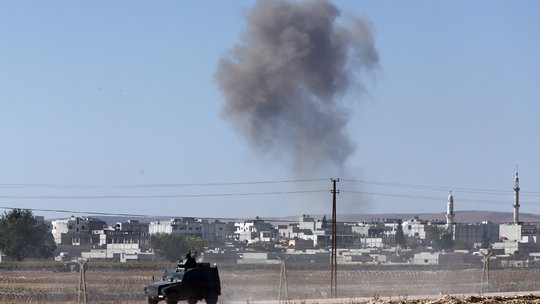
Not long after Mr. Erdogan spoke, an airstrike hit less than a mile to the southwest of Kobani, also known as Ain al-Arab, sending a black plume skyward. Residents said the target appeared to be an Islamic State tank that had been shelling the city for two days. Two more strikes followed in the same area in less than an hour.

Several other airstrikes hit Islamic State positions overnight and Tuesday morning on the southern and eastern outskirts of the town, said Barwar Mohammad Ali, a coordinator with the Kurdish Y.P.G. force who was reached by telephone inside Kobani.

“It is the first time that people have the impression that the airstrikes are effective,” Mr. Ali said, referring to Kurdish fighters on the front lines. “But they need more.”

He said street fighting had continued on Tuesday and that Y.P.G. fighters had killed numerous attackers and captured 20, including 10 foreigners.

The American military confirmed four new airstrikes on the Islamic State, also known as ISIS and ISIL: one strike south of Kobani that destroyed three armed vehicles and damaged another; another strike to the southeast that hit antiaircraft artillery, and two to the southwest that damaged a tank and “destroyed an ISIL unit.”

Source: BCNN

“Ebola is a Human Catastrophe…”, Scientist says

Professor Peter Piot, director of the London School of Hygiene and Tropical Medicine who named Ebola and was part of a team of scientists who discovered the virus in Kinshasa, formerly Zaire, in 1976, says the Ebola outbreak is no longer an epidemic but a “human catastrophe” he never thought “could get this bad.”

“It should be clear to all of us: This isn’t just an epidemic any more. This is a humanitarian catastrophe. We don’t just need care personnel, but also logistics experts, trucks, jeeps and foodstuffs. Such an epidemic can destabilize entire regions. I can only hope that we will be able to get it under control. I really never thought that it could get this bad,” said Piot when asked if the world had lost control of the Ebola epidemic in an interview with The Guardian.

“I have always been an optimist and I think that we now have no other choice than to try everything, really everything. It’s good that the United States and some other countries are finally beginning to help. But Germany or even Belgium, for example, must do a lot more,” he explained.

According to the Centers for Disease Control and Prevention the 2014 Ebola epidemic is the largest in history, affecting multiple countries in West Africa. Some 7,470 cases of Ebola have been reported in Guinea, Liberia and Sierra Leone, and 3,431 of them have died. Cases have also been reported in Nigeria and Senegal, and the United States confirmed its first case of the deadly disease in Dallas, Texas, a week ago.

Piot, who named Ebola after the Ebola River in the Democratic Republic of Congo, explained that the catastrophic outbreak of the virus was caused by what he calls a “perfect storm.”

“I think it is what people call a perfect storm: when every individual circumstance is a bit worse than normal and they then combine to create a disaster. And with this epidemic there were many factors that were disadvantageous from the very beginning. Some of the countries involved were just emerging from terrible civil wars, many of their doctors had fled and their healthcare systems had collapsed. In all of Liberia, for example, there were only 51 doctors in 2010, and many of them have since died of Ebola,” he said.

Piot explained that if Ebola hits large cities, it will be almost impossible to track and lead to an “unimaginable catastrophe.”

“In large cities, particularly in chaotic slums, it’s virtually impossible to find those who had contact with patients, no matter how great the effort. That is why I’m so worried about Nigeria as well. The country is home to mega-cities like Lagos and Port Harcourt, and if the Ebola virus lodges there and begins to spread, it would be an unimaginable catastrophe,” he emphasized.

Piot, however, expressed confidence that an Ebola outbreak in Europe or North America would be quickly brought under control when asked if he thought the outbreak was the beginning of a pandemic.

“There will certainly be Ebola patients from Africa who come to us in the hopes of receiving treatment. And they might even infect a few people here who may then die. But an outbreak in Europe or North America would quickly be brought under control,” he said.

“I am more worried about the many people from India who work in trade or industry in West Africa. It would only take one of them to become infected, travel to India to visit relatives during the virus’s incubation period, and then, once he becomes sick, go to a public hospital there. Doctors and nurses in India, too, often don’t wear protective gloves. They would immediately become infected and spread the virus,” Piot explained.

Source:Christian Post

Hong Kong: Former Bishop Admonishes Faithfuls

A former Catholic bishop of Hong Kong has warned of China’s growing influence and urged Christians to unite in the “fight” for democracy.

Cardinal Joseph Zen Ze-kiun, who at 82 is one of the oldest campaigners to have joined the Occupy Central movement for democracy in the recent mobile-phone torchlit protests in the streets, warned that China’s influence is increasing “day by day”. He said Christians must be prepared to battle for their beliefs if religious freedom in the former British territory is not to become a thing of the past.

The cardinal, who served as bishop between 2002 and 2009 and has been active in the pro-democracy movement for decades, said: “Beijing are taking more and more control of Hong Kong, and going back on the promises of the constitution.

“All of these efforts, all of this courage to take risks and be ready to pay the price is because we are fighting for something very important. If [the Hong Kong leader is chosen by Beijing]…then he will surely do anything that the central authority commands.”

The Cardinal added that “the Communist party have no interest other than their own power, and they made whole people into slaves.”

The protestors are angry at the Chinese government’s insistence on screening political candidates to ensure their allegiance to the CCP.

It was hoped that open elections would be held in 2017, but a motion ruling against this was passed in August. Many locals believe this to contradict Beijing’s promise to one day allow Hong Kong “universal suffrage”.

Cardinal Zen spent days addressing the crowds, many of them students, and spent nights sleeping on the streets in the hopes of making the voice of the people of Hong Kong heard.

“Beijing are taking more and more control of Hong Kong, and going back on the promises of the constitution,” he told Christian Today.

“All of these efforts, all of this courage to take risks and be ready to pay the price is because we are fighting for something very important. If [the Hong Kong leader is chosen by Beijing]…then he will surely do anything that the central authority commands.

“And [the CCP] are also corrupt, not only in the sense of bribery, but they also corrupt the culture, the way of life – people become materialistic, selfish, dishonest and ready to accept slavery,” he said.

“Everybody becomes desperate in their own field. This terrible culture is against what we have instilled here in Hong Kong in our education and in our schools. And in the long run, sooner or later – or very soon – we are going to become like in China, and that is terrible.”

Cardinal Zen, who was Shanghai born but moved to Hong Kong ahead of the CCP’s establishment in 1949, believes speaking out for democracy and freedom is a vital part of his Catholic faith, as well as his position in leadership.

“This is in the teaching of the church; the social teaching says that the participation of people is important,” he said.

“Because we care for human dignity, we are children of God and we can’t be made into slaves: that is the reason we must fight.”

This week the Occupy Central movement has appeared to be on the wane, with just a few hundred protestors – most of them students – remaining, and leaders said last night that they had agreed to hold talks with the government.

Cardinal Zen called on those still demonstrating to go home, but not to give up.

“At this moment, the students should retreat, because to retreat doesn’t mean to abandon the cause,” he explained.

Soure:Christian Today

US Court Ruling to make Gay Marriage possible in 30 States

Gay marriage will soon be possible in nearly two-thirds of America’s 50 states after a surprise decision by the Supreme Court not to intervene over key rulings of lower courts on the issue.

The decision means a further 11 states will now allow gay marriage, on top of the 19 where it is already permitted, taking the total number into a majority of states for the first time.

It came as nearly 200 Catholic bishops from around the world met in Rome to discuss, among other things, the Church’s hostility to gay relationships. Conservative advocates for the family criticised calls at the Extraordinary Synod on the Family in Rome for the Catholic Church to welcome homosexuals.

The Supreme Court decision affects five states in which appeals courts had struck down bans against gay marriage: Virginia, Indiana, Wisconsin, Oklahoma and Utah, as well as six other states overseen by the same appeal courts: North Carolina, South Carolina, West Virginia, Colorado, Kansas and Wyoming.

Evan Wolfson, president of Freedom to Marry, told USA Today: “The court’s letting stand these victories means that gay couples will soon share in the freedom to marry in 30 states, representing 60% of the American people. But we are one country, with one Constitution, and the court’s delay in affirming the freedom to marry nationwide prolongs the patchwork of state-to-state discrimination and the harms and indignity that the denial of marriage still inflicts on too many couples in too many places.”

Chad Griffin, president of the Human Rights Campaign, the gay rights group, said: “Any time same-sex couples are extended marriage equality is something to celebrate, and today is a joyous day for thousands of couples across America who will immediately feel the impact of today’s Supreme Court action.” But he added: “The complex and discriminatory patchwork of marriage laws that was prolonged today by the Supreme Court is unsustainable. The only acceptable solution is nationwide marriage equality.”

The New York Times said in an editorial: “On Monday morning, the first day of the Supreme Court’s new term, the most exhilarating news came not from anything the justices did, but from one thing they didn’t do. Without explanation and against expectations, the court declined to hear any of the seven petitions asking them to reject a constitutional right to same-sex marriage. By choosing not to review those cases, the justices made it possible for same-sex couples in a majority of states to marry.”

The Times continued: “It has been astonishing and moving to see the unprecedented speed with which the public and the judiciary have come around on the issue. A majority of Americans now support the right of same-sex couples to marry, compared with about a quarter in 1996. Among those under 30, support is at nearly 80 per cent.”

In Rome, however, Voice of the Family, an umbrella group of Catholic laity from major pro-life and pro-family organisations, showed that resistance to gay equality in marriage remains strong on the religious right.

Referring to a testimony given to the Synod where a married couple, Ron and Mavis Pirola, called on churches to welcome homosexual couples, Maria Madise, Voice of the Family’s coordinator, said: “The example given by the Pirolas – of ready acceptance of a son and his homosexual lover to a gathering where the grandchildren would welcome them into the family – gives a false lead to families and parishes. It is no example of love and mercy towards anyone.

“The unqualified welcome of homosexual couples into family and parish environments in fact damages everybody, by serving to normalise the disorder of homosexuality.

“It damages children by presenting homosexual relationships as models which may legitimately be chosen. It damages adults by making them complicit in tacit endorsements of the immoral and dangerous homosexual lifestyle. And it damages the homosexual couples themselves by failing to guide them with the truth in charity – that their relationship is gravely harmful for their moral and spiritual health.”

She urged the bishops meeting at the Vatican not to change the traditional doctrine on homosexuality.

“The Church is clear that a truly pastoral approach will appreciate the need for homosexual persons to avoid the near occasions of sin,” she said. “The Pirolas’ presentation will lead to considerable confusion on the part of Catholics dealing with such difficult situations”

At Tuesday’s daily Vatican press conference on the Synod, Cardinal Vincent Nichols, Archbishop of Westminster, said that the Synod responded to the Pirolas’ testimony “very warmly, with applause”.

John Smeaton, chief executive of the London-based Society for the Protection of Unborn Children, said: “Those Synod Fathers who, like Cardinal Nichols, welcomed the Pirolas’ disturbing testimony show that they are totally out of touch with the real problems faced by families. The homosexual agenda is forcing its way into schools, universities, workplaces and sports clubs. The last thing families and parishes need is for Church leaders to tell them to welcome homosexual couples.

Source:Christian Today

SuperBook – Bringing the Bible to the Children of the World

SuperBook, also known as Animated Parent and Child Theatre is an anime television series initially produced by Tatsunoko Productions in Japan in conjunction with the Christian Broadcasting Network in the United States and more recently solely produced by CBN for global distribution and broadcast.

Superbook teaches children timeless moral truths and life lessons through the captivating, Bible-based adventures of two time-traveling children and their robot friend.

The familiar and the futuristic interact with ancient people, places and events to create a sense of wonder, anticipation, empowerment, and personal breakthrough as the children witness God’s interaction with man. Superbook is always an exciting journey, full of discovery – with a transformational outcome.

Get SuperBook for your children OR the children you love

Help us reach the reach children with the Gospel

Characters

Chris Quantum
An awesome skateboarder, video gamer and lead guitarist in a garage band with his Valleyview Middle School buddies, Chris uncovers the secrets of Superbook through a mysterious portal to the past.

Joy Pepper
Next-door neighbor and classmate of Chris Quantum at Valleyview Middle School. She is outgoing and usually a bit more adventurous than Chris. She loves soccer, is athletic, and great at other sports as well.

Gizmo
Created by Chris’ dad, Professor Quantum, to protect the kids—but they end up protecting him. He loves upgrades to make himself more useful and would rather stay in the lab than time-travel with Superbook. A really cool feature of Gizmo is that he can change his appearance as needed.

  Help us reach the reach children with the Gospel

———————————————————————————————–

White House Sends Message to Oklahoma Beheading Suspect

A Department Of Homeland Security official read a greeting letter from the White House Saturday at the mosque where it is believed Alton Nolen worshiped before beheading a former co-worker last month.

David Myers, the director of the Department of Homeland Security’s Center for Faith-based & Neighborhood Partnerships, visited the Islamic Society of Greater Oklahoma City and, according to a DHR spokesman, read a letter imparting a generic presidential greeting for Eid al-Adha, a festival commemorating Ibrahim’s (Abraham) willingness to sacrifice his son to God.

The full greeting states “Michelle and I would like to extend our best wishes to Muslims in the United States and around the world who are celebrating Eid al-Adha, and to congratulate those performing the Hajj this year.

As our Muslim neighbors and friends gather for Eid celebrations, Muslim Americans are among the millions of pilgrims joining one of the world’s largest and most diverse gatherings. Hajj brings together Muslims from around the world — Sunni and Shiite — to share in reverent prayer, side by side. It serves as a reminder that no matter one’s tribe or sect, race or religion, gender or age, we are equals in humanity.

“On Eid, Muslims continue the tradition of donating to the poor and joining efforts with other faith communities in providing assistance to those suffering from hunger, sickness, oppression, and conflict. Their service is a powerful example of the shared roots of the world’s Abrahamic faiths and how our communities can come together in shared peace, with dignity and a sense of justice.

“On behalf of the American people, we extend our warmest greetings during this holiday. May the prayers of peace made by the Hajj pilgrims and those of all faiths around the world be heard and granted. Eid Mubarak.”

The presidential appointee’s gesture is a stark contrast to the threatening messages the mosque is receiving due to its connection to Nolen.

Nolen, believed to be a recent Muslim convert, allegedly beheaded Colleen Hufford, 54, and stabbed 43-year-old Traci Johnson at the Vaughan Foods Facility in Moore last month.

The Islamic Society of Greater Oklahoma City’s senior Imam, Imad Enchassi, told The Oklahoman that members remember seeing Nolen at the mosque’s prayer gatherings and recalled that he identified himself as a seeker who visited various places of faith, including churches and synagogues.

Nolen’s tattoos pay homage to that mixture of religions. Oklahoma Department of Corrections records show that Nolen has tattoos of the words “as-salaamu alaikum” meaning “peace be with you” in Arabic on his abdomen, “Jesus Christ” on his chest, “Judah” on his left arm and praying hands on his right arm.

Nolen, however, seemed to embrace Islam on Facebook where he reportedly referred to himself as “Jah’Keem Yisreal” and posted pictures of Osama Bin Laden and beheadings.

Though the style of Nolen’s attack mimics that of terrorist groups, law enforcement officials told CNN they believe the attack was motivated by workplace troubles.

Still threats of violence and denunciations of Islam have been pouring into the Islamic Society of Greater Oklahoma City.

Enchassi and the Islamic Society of Greater Oklahoma City denounced the attack in a note posted on the mosque’s website.

The note reads: “The Islamic Society of Greater Oklahoma City sends our heartfelt condolences and prayers to the victims and their families of (the Sept. 25) tragedy in Moore, Oklahoma. This unwarranted act does not represent Islam in any shape or form. We condemn and are 100 percent against the heartless and unnecessary act committed by the suspect. We stand for justice.”The mosque also hired security to watch over members during Myers’ visit.It is unclear whether Myers visited the mosque on at the president’s request or acted independently.

Source: Christian Post

Boko Haram behead Seven

Boko Haram militants killed seven people on Monday in the remote northeast of Nigeria, residents and an official said, with reports indicating the victims were beheaded in a revenge attack.

The overnight raid targeted the town of Ngamdu in troubled Borno state, the area hardest hit in the Islamists’ five-year uprising.

When locals woke they discovered “seven people had been brutally killed”, said resident Musa Abor.

The gunmen “slit their (victims) throats just the way people slaughter goats”, he added.

Abor and a Borno state official, who asked that his name be withheld, said the bodies had been decapitated, in the latest act of gruesome violence blamed on the Islamists who have killed more than 10,000 people since 2009.

In recent months, Boko Haram insurgents have targeted reprisal attacks at locals who have fought alongside the military as vigilantes.

An army officer in Borno, who also requested anonymity, said 15 Boko Haram fighters were killed in clashes in Ngamdu two weeks ago and the group had vowed revenge against the community.

Those killed on Monday could not immediately be identified as vigilantes and the defence ministry was not available to comment on the attack or the alleged beheadings.

The violence came as Nigerian Muslims marked the Eid al-Adha festival, a public holiday in the religiously divided country. Most Islamic holidays in recent years have been marred by Boko Haram violence.

The militants are thought to be in control of more than two dozen towns and villages in the northeast, but the military has vowed to retake all lost ground as part of a continuing offensive launched in May of last year.

The military had imposed a travel ban across Borno and neighbouring Yobe state to last through the Eid holiday to guard against insurgent attacks.

But the measure is almost impossible to enforce in the remote region, where analysts say the army does not have enough troops on the ground to patrol a vast area with a terrible road network and poor mobile phone coverage.

Source:Glide Global Tv

ISIS captures three Syrian Districts

Islamic State has today continued its advance into Kobane, the Syrian town near the Turkish border, after capturing three eastern districts yesterday.

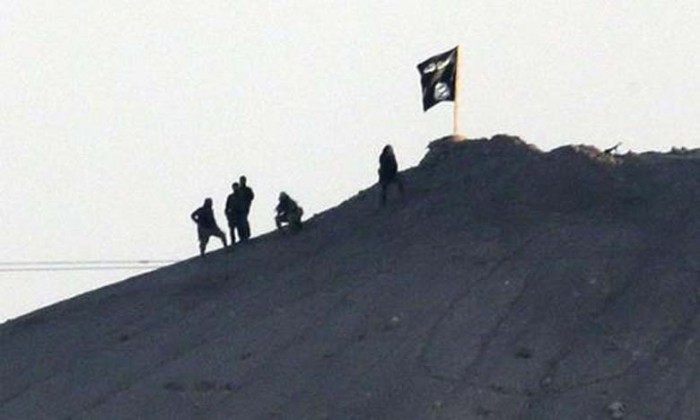
IS has been fighting for Kobane since mid-September, but yesterday two black IS banners were seen flying on the hills at the town’s eastern edge.

However, their progress has not gone unhindered. The Kurds, who took control of Kobane in 2012, have been among the most successful in staving off the advance of IS – both in Syria and northern Iraq.

But struggling to match the weapon capabilities of the Islamist militants, one Kurdish fighter resorted to desperate measures on Sunday when she blew herself up in order to kill IS fighters.

Deilar Kanj Khamis, whose military name was Arin Mirkan, killed at least 27 members of IS in her suicide mission.

The Kurdish forces, YPK, said in a statement that all their fighters would become suicide bombers if it meant they could stop IS. “If necessary, all our female and male fighters will become Arin. The attacks by [IS] against Kobane will not be allowed to achieve their goals,” the YPK statement said.

US-led air strikes have reportedly killed scores of IS fighters in the region in recent days. But today the Iranian government criticised the “passivity of the international community”.

As a border crossing with Turkey, Kobani is a strategic region, and this is not the first time that it has been fought over. IS and other Islamist militant groups in Syria have wanted to capture the town since August 2013.

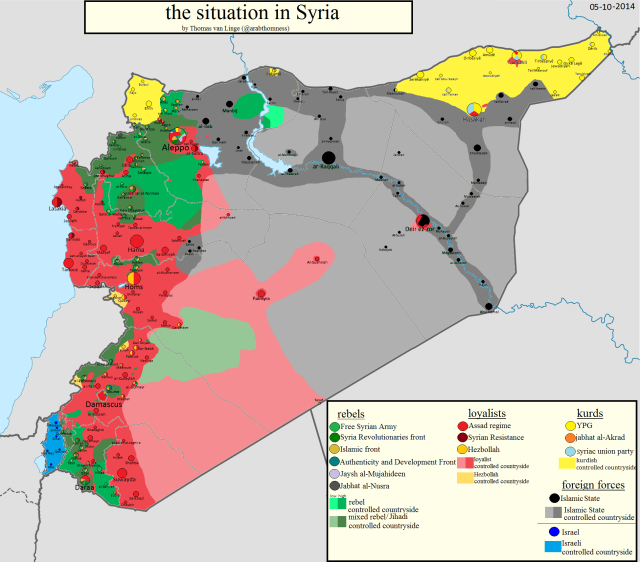
For IS, it has particular attraction, as it is the last remaining area of resistance in north-eastern Syria (marked by the yellow area in the map above).

Yesterday, the Turkish Prime Minister Ahmet Davutoglu told CNN: “We will do everything possible to help the people of Kobane because they are our brothers and sisters.”

But the Turks and Kurds are not the most natural allies. Not long ago they were fighting against each other. Now the Turks are being asked to offer asylum to many of the 160,000 Syrians who have fled the region.

Even so, Davutoglu said Turkey would be prepared to put boots on the ground in Syria, on the condition that “others do their own part”. The necessary conditions for this help include the support of the international community to defend the Turkish border after IS – meaning removing the threat posed by Assad.

In Iraq, Canon Andrew White, the vicar St George’s Baghdad, left for Jerusalem on October 5 and has decided not to return.

“I am not going back to Baghdad now so I will concentrate more of my effort on Gaza and Palestine that is what I feel G-d wants me to do,” he wrote on Facebook. “I love the Palestinians just as much as I do the Israelis and they so need our help.”

White added that he had been advised to leave by the Archbishop of Canterbury Justin Welby given his high profile and his support for Israel.

One Chaldean priest in Erbil summed up the position of Christians in the Middle East, saying in an interview with the National Post: “What we are living is the last chapter of an ancient story.”

Source:Christian Today

ISIS: How it makes its millions

On the southern edge of Turkey, rolling brown pastoral hills slope gently to the Syrian border, with small towns like this one dotting the horizon. The calm on this side of the border, however, belies the scene on the other side.

Just across the border in northern Syria, the Islamic extremist group known as ISIS is fighting a full-tilt battle in its effort to capture and control new territory, part of its push to create a sprawling Islamic caliphate, or separate Islamic state, modeled on the first caliphate that spread across the region in the centuries following the death of the Prophet Muhammad around 640 AD.

As ISIS fighters expand their control, it is in the border region, in villages like Besaslan, where the Islamic State group can make some of the money it needs to finance its wars. Oil-smuggling operations involving millions of barrels have recently been uncovered.

The oil comes from wells and refineries that ISIS has taken over inside northern Iraq and northern Syria, and until very recently it was easy to smuggle it into this quiet part of southern Turkey. One reason is that cheap, smuggled oil is a much-prized commodity in Turkey, where oil is so expensive that it almost doesn’t matter who is selling it, even if it’s your enemy.

In Hatay, Turkey, just a half hour’s drive away, gasoline costs roughly $7.50 per gallon.

Growing international alarm over ISIS expansion and the group’s increasingly visible atrocities — such as beheadings of Western journalists and aid workers, the videos of which are disseminated online — have brought renewed pressure on ISIS and its funding methods on the borders.

U.S.-led coalition forces just a week ago attacked and destroyed many ISIS oil facilities, precisely to cut off the group’s funding.

But the border smuggling is only one way that ISIS generates money.

The U.S. Treasury Department admits it does not have hard figures on the group’s wealth but believes ISIS reaps millions of dollars a month.

“And you have to remember their ‘burn’ rate — how much they spend — is huge, with salaries and weapons and everything,” a Treasury official said. “But on how much they have — there’s a very wide range of estimates out there. We think probably they make around $1 million per day.”

Matthew Levitt, director of the Stein Program on Counter terrorism and Intelligence at the Washington Institute for Near East Policy in Washington, D.C., calls ISIS “the best-financed group we’ve ever seen.”

Source: CNN News

Islamic State Destroys Church

DAMSASCUS (Worthy News)– Jihadists from the Islamic State have destroyed a Syrian church that memorialized the Armenian Genocide in which more than a million Armenian and Assyrian Christians died at the hands of Turkish Muslims.

According to Barnabas Aid, after seizing the Syrian city of Deir al-Zour, jihadists used explosives to destroy Holy Martyrs Church. News of the church’s destruction came as Armenia was celebrating the 23rd anniversary of its independence.

Constructed in 1990, the church compound contained a memorial and a museum that housed records that documented the genocide. Holy Martyrs is also a pilgrimage where Armenian Christians from Syria and other countries gather every April 24 to remember those who were murdered.

Deir al-Zour is called the Auschwitz of the Armenian Genocide because thousands of Armenian and Assyrian Christians were forcibly taken from their homes by Turkish soldiers and marched to Deir to their deaths.
Source: Worthy News