News Anchors Perform Elaborate Handshake During 2-Minute Commercial Break

[youtube]https://www.youtube.com/watch?v=S7ehlw_phys#t=46[/youtube]

WGN News anchors Robert Jordan and Jackie Bange have been together for many years. This whole thing started out really small and simple. And then along came the internet, and a video camera, and you tube, and here we are with the funniest dance routine since that scene in Big. It’s the original, What News Anchors Do During Commercial Breaks. This one has the nat sound, not cheesy music.

The news can often be a bummer, but watching these anchors have some fun behind-the-scenes really put a smile on my face.
Watch their hilarious commercial break below and tell us your thoughts in the comments!

D. Westry (The Master Speed Painter) wowed audience with an Iconic performance by completing an amazing speed painting in only 1minute and 22 seconds.

[youtube]http://www.youtube.com/watch?v=k8AkjWQ3P-M[/youtube]

D. Westry (The Master Speed Painter) wowed audience with an Iconic performance by completing an amazing speed painting in only 1 minute and 22 seconds

Missionaries Call for Intercessors to Draw a Blood Line Against Ebola

SIM, the global mission organization of which SIM USA is a part, is encouraging Christians around the world to set aside Monday through Oct. 5 and pray that God would stop the deadly Ebola virus in West Africa.

SIM encourages prayer specifically for the people of Liberia, Sierra Leone and Guinea, where the Ebola outbreak has been most severe. According to the World Health Organization, nearly 3,000 people already have died from Ebola, and more than 6,200 probable, confirmed and suspected cases of the disease have been reported. Experts say infections from the Ebola epidemic could soar to 1.4 million by mid-January.

“Our aim is that prayers will be raised continually throughout the entire week on behalf of those infected and affected by the Ebola virus,” said Joshua Bogunjoko, international director of SIM. “Though we are troubled by this outbreak, we do not despair. Though we grieve, we are not without hope. For two millennia, the church has prioritized the sick and marginalized. We are called to do no less today.”

The infection and death rates continue to rise in the region. SIM urges prayer specifically for health-care workers, grieving families, church and government leaders, and protection for those who come in contact with the deadly disease.

SIM USA had two of the three American missionary workers who contracted Ebola in Liberia and were evacuated to the U.S. for treatment.

SIM asks individuals and churches to particularly set aside Sunday, Oct. 5, as a day for focused prayer in stemming the tide of Ebola. The group asks Christians to pray individually, in groups and as church bodies for God to break the grip the deadly disease has upon the people of West Africa.

“We know that when Christians unite in prayer and call upon God, he acts,” Bogunjoko said. “We have witnessed countless examples of God answering the prayers of his people—from seemingly everyday requests to world-changing events. This is no different. We hope millions of Christians around the world will join us as we ask God to deliver us from this horrendous Ebola outbreak.”

The latest updates on SIM’s role in the Ebola epidemic in Liberia are available atsimusa.org.

Source : Chrisma News

What Does the Bible Really Say About Alcohol?

Relevance Magazine has a report – Here are your keys,” muttered the secretary when I arrived to pick up the keys to my office at Aberdeen University, where I would be studying for my doctorate in theology. “It looks like you’re in The Old Brewery.”

Intrigued by the name, I later found out that it reflected the building’s original function. Aberdeen was founded in the 15th century and used to train monks for ministry. In the brewery, monks brewed vast quantities of Scottish ale, which was served by the liter at mealtimes. And here I was, a post-fundamentalist Ph.D. student studying the Scriptures in a malted sanctuary where late medieval Bible college students once clapped mugs together in an act of worship.

Throughout Christian history, alcohol was rarely a taboo as it is in some circles today. John Calvin had a stipend of 250 gallons of wine per year written into his church contract. Martin Luther’s wife was a famed brewer of beer, which certainly won Martin’s heart. And the Guinness family created their renowned Irish Stout as an act of worship to Jesus. From Bordeaux to Berlin, wine and beer have always been part of church tradition. But what was once considered the nectar of heaven was later condemned as the devil’s libation.

A Smart Approach

Even though some Christians advocate for the total abstinence of alcohol as a moral mandate for all believers, the Bible never requires all believers to abstain from alcohol. It condemns drunkenness and being enslaved to wine (Ephesians 5:18; Titus 2:3), but it never says that tee-totaling is the better way to obey God. In fact, the Bible never says that abstaining from alcohol is the wisest way to avoid getting drunk. Think about it. Alcoholism has been rampant through every age, but the Bible never says that all believers should therefore refrain from drinking.

If Christians want to forbid all alcohol consumption to avoid drunkenness, then to be consistent, they should also avoid making a lot of money to guard against the crushing sin of materialism and the misuse of wealth.


If Christians want to forbid all alcohol consumption to avoid drunkenness, then to be consistent, they should also avoid making a lot of money to guard against the crushing sin of materialism and the misuse of wealth.

Alcohol as a Witness

I sometimes hear that when Christians drink, it ruins their testimony. But quite honestly, I’ve never understood this line of thinking. It’s one thing if you’ve struggled with alcoholism or are ministering in a Muslim country, but for the most part, most non-Christians I know are turned off by the arbitrary dos and don’ts created by modern Christians. I’m not convinced that if my unbelieving neighbor sees me slipping into a pub, I will lose much traction to my Gospel witness. In many cases, the Gospel will shine brighter when you break down wrong assumptions about Christianity by having a beer with your neighbor.

When we strip away all the man-made clutter that dims the Gospel, the full glory of Jesus shines much brighter. A good chunk of the dying world that’s rejected Christianity hasn’t said no to Jesus, but no to a pharisaical version of Him. Some people have been turned off by the Gospel because they’ve thought that becoming a Christ-follower meant giving up having a beer with your friends after work. If this is the “good news” we preach, then the true beauty of a crucified and risen King will become covered in the fog of a man-made, pharisaical “don’t drink” gospel. AA didn’t hang on a cross for your sins and abstaining from alcohol won’t give you resurrection life. Any Christianese, man-made, unbiblical footnotes to the gospel are actually a distraction and offense to the Gospel.

Lower Alcohol Content?

Now, some say that wine in the Bible was nothing more than grape juice and therefore neither Jesus nor the Biblical writers advocated drinking alcohol. Others say that wine was so diluted that it hardly contained any alcohol. But neither of these views can be substantiated by what the Scriptures actually say. If wine was really unfermented grape juice, then why did Paul warn the Ephesians: “Do not get drunk with grape juice, which is debauchery, but be filled by the Spirit?” This doesn’t make sense. It is true that wine back then probably had a lower ABV than today’s stuff. But whatever the alcohol content, people were quite able to get smashed by drinking too much of it (Proverbs 20:1; Isaiah 5:11). Still, the Bible never says not to drink it.

There’s another alcoholic beverage mentioned in the Bible called “strong drink. The Hebrew word for “strong drink,” shakar, refers to fermented barley, which is why some translations call it “beer.” Shakar had an ABV of around 6-12 percent, similar to a Belgium Trippel Ale or a Double IPA. Like all alcoholic beverages, the Bible prohibits abusing beer (Isaiah 5:11; 28:7; Proverbs 20:1; 31:4). But in moderation, drinking beer was encouraged (Proverbs 31:6). In fact, Deuteronomy 14:26 actually commands Israelites to use some of their tithe money to buy some beers and celebrate before the Lord. (Ever hear that verse being read as the ushers are passing the plates?) They were also commanded to offer up two liters of beer to God six days a week and even more on the Sabbath (see Numbers 28:7-10). This is why the absence of beer (and wine) was an outcome of God’s judgment on the nation.

Wine as a Blessing

But the Bible goes further than admitting that drinking is simply allowed. Throughout Scripture, the production and consumption of beer and wine are often connected to the covenant promises of God.

Under the old covenant, wine is a blessing (Deut 7:13; 11:14) and the absence of wine a curse (28:39, 51). When Israel looked to the future, God promises to flood them wine flowing from the mountaintops (Amos 9:14; Joel 3:18) and vats brimming with fresh wine (Joel 2:19, 24).

Jesus signals the beginning of such blessings by creating an over-abundance (150 gallons) of wine at Cana (John 2:1-10). And on the eve of his death, He sanctified a cup of wine as “the new covenant in my blood” (Luke 22:14-23). When Christ comes back, He’ll prepare “well-aged wine” (Isaiah 25:6)—the stuff I only notice on the top shelf but can never afford—and for theological reasons it will be served, as at Cana, in abundance.

There’s a growing tendency, however, among some younger evangelicals to celebrate their freedom without discipline.

Although a good beer and rich wine are blessings from God, they should be consumed with caution. There’s a growing tendency, however, among some younger evangelicals to celebrate their freedom without discipline. These young, restless, and slightly inebriated libertines are doing some great things for the Kingdom. They’re feeding the poor, living in community and planting authentic churches—or missional communities—all to the glory of God.

Yes, God cares about the poor; He also cares about your sobriety. Enjoying alcohol in moderation takes discipline, and many beer drinkers, I hate to say it, aren’t known for their discipline. A good glass of beer can be celebratory; it doesn’t belong in the hands of an undisciplined 16-year-old playing video games in his mom’s basement. Belgium ale is strong and complex. Savor it, sanctify it, and let it meditate on your palate. Give glory to God, not just to your thirst, when enjoying the blessings that flow from Eden. Drunkenness may not be at the top of God’s list of most heinous sins; neither should it be tossed aside as a relic of American fundamentalism.

Drinking alcohol without celebrating the Cross and Kingdom is theologically anemic. Abusing alcohol mocks the blood of Christ and scoffs at God’s holiness. But moderate, intentional, celebratory and reflective drinking of wine and beer, which contemplates the crucified and risen King and anticipates our future glory, is rooted in the grace that poured from Christ’s veins on Calvary.

Source : Relevance Magazine

Who’s Biggest? The 100 Most Significant Figures in History – CNN Reports

CNN Reports Jesus as Number One – Who’s bigger: Washington or Lincoln? Hitler or Napoleon? Charles Dickens or Jane Austen? That depends on how you look at it.

When we set out to rank the significance of historical figures, we decided to not approach the project the way historians might, through a principled assessment of their individual achievements. Instead, we evaluated each person by aggregating millions of traces of opinions into a computational data-centric analysis. We ranked historical figures just as Google ranks web pages, by integrating a diverse set of measurements about their reputation into a single consensus value.

Significance is related to fame but measures something different. Forgotten U.S. President Chester A. Arthur (who we rank as the 499th most significant person in history) is more historically significant than young pop singer Justin Bieber (currently ranked 8633), even though he may have a less devoted following and lower contemporary name recognition. Historically significant figures leave statistical evidence of their presence behind, if one knows where to look for it, and we used several data sources to fuel our ranking algorithms, including Wikipedia, scanned books and Google n-grams.

To fairly compare contemporary figures like Britney Spears against the ancient Greek philosopher Aristotle, we adjusted for the fact that today’s stars will fade from living memory over the next several generations. Intuitively it is clear that Britney Spears’ mindshare will decline substantially over the next 100 years, as people who grew up hearing her are replaced by new generations. But Aristotle’s reputation will be much more stable because this transition occurred long ago. The reputation he has now is presumably destined to endure. By analyzing traces left in millions of scanned books, we can measure just how fast this decay occurs, and correct for it.

We don’t expect you will agree with everyone chosen for the top 100, or exactly where they are placed. But we trust you will agree that most selections are reasonable: a quarter of them are philosophers or major religious figures, plus eight scientists/inventors, thirteen giants in literature and music, and three of the greatest artists of all time. We have validated our results by comparing them against several standards: published rankings by historians, public polls, even in predicting the prices of autographs, paintings, and baseball cards. Since we analyzed the English Wikipedia, we admittedly measured the interests and judgments of primarily the Western, English-speaking community. Our algorithms also don’t include many women at the very top: Queen Elizabeth I (1533-1603) [at number 13] is the top ranked woman in history according to our analysis. This is at least partially due to women being underrepresented in Wikipedia.

The 100 Most Significant Figures in History

1 Jesus

2 Napoleon

3 Muhammad

4 William Shakespeare

5 Abraham Lincoln

6 George Washington

7 Adolf Hitler

8 Aristotle

9 Alexander the Great

10 Thomas Jefferson

… Read More


Source : Time Magazine

Is Football Your Idol? 3 Ways to Know

You say – OF COURSE I don’t idolize football! I’m not even addicted to it, much less prone to making a god of it.

All I do is wear my Chargers jersey to work once a week, check my fantasy lineup first thing every morning (even on non-game days) and live or die with the on-field performance of huge men (and, in the case of college teams, boys) I don’t even know. I don’t even gamble on it! (Anymore…)

Cough.

So let’s be silly for a little bit today in order to get a little bit serious in the end. Here in the U.S., American football is the national pastime. Sometimes, we don’t even shy away from calling it a religion – the professional version is played on Sundays and holidays, it’s awarded a place of prominence in our schedules, and it helps us take our thoughts off our circumstantial troubles for a while.

And while none of these things are bad in and of themselves, as with most things, there’s a line.

I’m dating myself here, but my mother used to claim I had an unhealthy addiction to sports when I would rise early, run to the end of our gravel driveway in bare feet to get the newspaper, and splay the sports section out all over the living room floor to be sure I knew all the latest scoop. “I think this is too important to you,” she’d nag. “What? Why would you even say that, Mom?” “Well, for starters, you’re in your underwear. You could at least put a robe and slippers on when you bust out our front door at 6 a.m.”

So maybe she had a point. In my defense, it WAS Arizona, so it was rarely cold, and we DID live at a secluded end of an 8-house neighborhood…

Over at The Gospel Coalition, Kevin DeYoung has suggested Three Questions to Help Diagnose Possible Football Idolatry. I doubt I’ve ever had a full-blown case, but I’ll do my best to answer DeYoung’s questions accurately and sincerely.

“Is ministry and worship on the Lord’s Day compromised by my allegiance to football on Saturday and Sunday?”

Well, clearly not. Just this past weekend, my son’s baseball travel team had a Sunday tournament, so our familypurposed to attend our church’s Saturday evening service. But then, well, but then we were kinda tired, and Michigan State and Oregon were putting on such a good show that… okay, we stayed home. But most weeks, most weeks, I would like to pat myself on the back for making sure this family gets itself to early service on Sunday so we can get home in plenty of time to take in the full seven-ish hours of NFL RedZone!

“Are my emotions all out of whack?”

Okay, now this is really getting unfair. You’re asking me this a mere 35 hours after I stayed up until 1:30 a.m. (I’m almost always asleep by 10 p.m.) only to watch the San Diego Chargers blow ANOTHER double-digit, fourth-quarter lead. It’s the third straight year that’s happened in their opening game, for crying out loud! Why can’t they finish the job? Where is the killer instinct? Where can I register my complaint?! Aaarrrggghhh!

On the plus side, San Diego’s ineptitude did mean their top wide receiver Keenan Allen was held in check, meaning my opponent failed to generate enough points to beat my fantasy team. And I do have an illogical sense of accomplishment and a cool buzz going from that…

“Can my conversation go deeper than football?”

Well of course it can. Haven’t we already broached the Arizona climate, youth baseball, and underwear as topics this morning?

Seriously though, at least I score better on this question, but that may be because I was once privy to a discussion with a group of men from our Bible Fellowship class who expressed a sense of dread upon coming to class each week. They weren’t big football fans, and so didn’t know if they’d be able to join any pre-class discussions with any other guys.

So whenever I catch myself going too deep into football talk around a non-football audience… or letting my day be ruined or made overly glad because a team or a pretend team performed a certain way… or moving my devotional or worship time around in order to pay homage to football first, what I usually tell myself is:

Get a life!

And that’s the key, isn’t it? We all have a life to live, and that life is defined by what is at the center, what comes first. We all, everyone, even those who claim no belief in a divine being, have a god. Something that takes precedence. Something that gives life drive, purpose, meaning. But there is only one life we can “get” which is also the Source of Life.

In a 2013 article for Crosswalk.com, Chad Gibbs, author of God and Football, looks at this slice of life in his part of the country, the South:

So we’ve established that God and football are both pretty big down here, but which is bigger? Well, I’ve got a theory.

When you attend a church here, you will almost certainly hear people talking about football. Worshipers will gather before the service and discuss in reverent tones what went right and wrong the day before. The pastor will usually reference Saturday’s happenings by either praising a team’s win or mourning its loss, while oftentimes taking a playful dig at the misfortunes of a rival school. Churches sometimes encourage this blending of faith and fanaticism with “wear your team’s colors” day or by having viewing parties for big games — with half-time testimonies, naturally.

Conversely, God doesn’t get a lot of play in SEC stadiums, unless a player injures his neck or your team is lining up for a last second field goal. And sometimes God is called upon to do some damning — usually of referees or offensive coordinators — but that’s it. The SEC doesn’t really have to add God or anything else to their product to fill the seats. There is no “wear your denomination’s colors to the game” day.

Churches have to schedule around football.

And there’s the rub. As DeYoung concludes, “Go ahead and give football a little bit of your weekend. Just don’t give it your worship.” Time for me to “kick off” a renewed set of priorities.

Shawn McEvoy is Managing Editor for Crosswalk.com


Source : CrossWalk

Pakistani Pastor Accused of Blasphemy Shot and Killed by Police Officer

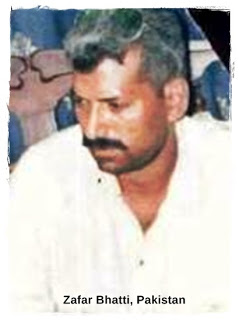
A Pakistani Christian pastor was shot and killed by a police officer while in jail in Pakistan for blasphemy charges. The officer also shot and wounded another man who had been accused of the same charge.
The pastor, Zafar Bhatti worked as a human rights activist for Christians; Bhatti had been charged with blasphemy in 2012 when he allegedly sent text messages that spoke against the Prophet Mohammed’s mother.
Briton Muhammad Asghar, who survived the shooting had been charged with blasphemy in 2010 and sentenced to death for writing letters that claimed he was a prophet. Asghar had been diagnosed with paranoid schizophrenia.
The men were held in the same prison cell; Bhatti had received death threats.
Xavier Williams speaking for human rights group Life for All said, “This is a barbaric act. There had been threats. The court should have instructed police to ensure Bhatti’s safety. Killing of a person who was falsely accused is mockery of the judicial system. The protectors of the innocent have become the predators.”

Topless Dancers paraded topless outside a Church during Worship Services in act of revenge

Denison Forum Reports – In the 14 years I’ve been writing the Cultural Commentary, I’ve never seen a story like this one: strippers and church members are picketing each other.
New Beginnings Ministries in Warsaw, Ohio has been campaigning against the Foxhole North gentleman’s club for nearly a decade, picketing on weekends and taking photos of guests’ license plates.  According to the pastor, “I take very seriously the responsibility as a pastor to see to it that the gospel of Christ is lifted up, that Christ himself is lifted up, and that evil is confronted.”
Now the club has fought back.  Recently some of its dancers paraded topless outside the church during worship services.  The club owner vows to return every Sunday until the church stops its protests.  Since it’s legal for both men and women to be topless in public in Ohio, the demonstrators were not arrested.
Picketing is one response to a strip club.  Here’s another.
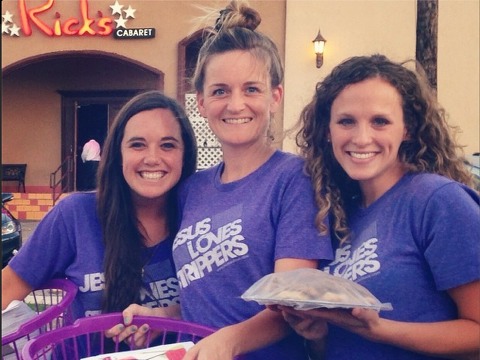
Jesus Said Love is a ministry focused on women in the commercial sex industry.  Its method is to GO, visiting strip clubs and bringing high quality gift bags to dancers and club employees; to LOVE, building intentional relationships with those at the clubs; and to CONNECT, helping people find meaningful community and spiritual resources.
According to Jesus Said Love, roughly 80 percent of exotic dancers are mothers.  Many are the victims of sex trafficking, victims of abuse, and/or need physical and emotional health care.  The ministry exists “to not only meet their spiritual needs, but to provide them with basic resources as well.  Doctors, lawyers, counselors and accountants all volunteer through Jesus Said Love to help these women establish a well-balanced life.”

[youtube]http://www.youtube.com/watch?v=4ZDmokOXY7I[/youtube]

There are times when Christians are called to take a public stand against sin, whatever the cost.  Jesus didn’t try to build relationships with moneychangers in the temple—he overturned their tables and drove them from his Father’s house (Matthew 21:12-17).  And there are times when working quietly and personally is the best way to deal with the human heart.  Jesus didn’t call Nicodemus out by day—he met with him privately at night (John 3:1-15).
In taking Christ to our fallen culture, how can you know what to do and when to do it?
First: be willing to obey whatever God asks you to do.  Sign the blank check before he fills in the amount.  If he requires a public stand, be willing to pay the price.  If he leads you more relationally, agree to follow his Spirit.
Second: whatever you do, speak the truth in love (Ephesians 4:15).  Be redemptive in your words and actions.  What matters is not whether you win a debate but whether you help someone find Jesus.  They will not believe God loves them until you do.
Third: measure success by obedience.  As Jesus Said Love puts it, “if we GO, LOVE and CONNECT, then we succeed.”
 For more from the Denison Forum on Truth and Culture, please visit www.denisonforum.org.

Do you want to live a life in whole-hearted pursuit of loving God and others?

Read today’s First15 at www.first15.org.

Bhutan Pastor Sentenced to Prison for Accepting Ministry Funds

A Bhutanese pastor has been sentenced to 11 months in prison for receiving donations for his ministry.
Serving in the landlocked country in South Asia located at the eastern end of the Himalayas, Pastor Tandin Yangwal allegedly received $11,864 in contributions from a foreign Christian organization.
“Wangyal was convicted under Article 71 of the Civil Society Organization Act of Bhutan, which outlaws raising funds for activities ‘in contravention of the laws of the country’ and without prior permission. The pastors were arrested in Khapdani village, Dorokha area in Samtse District, on March 5,” according to the Morning Star News.
Sources claim the Dorokha, Samtse District court ruled Yangwal used the funds for training and to share the Gospel, which is against the law in the Buddhist nation.
The Voice of the Martyrs reports that Christians once enjoyed a “measure of freedom beginning in 1965,” but established tighter restriction in 1990.
VOM’s website states:
“Bhutan’s constitution (2008) and other legislation officially protect religious freedom, but the country’s National Security Act (NSA) prohibits any ‘words either spoken or written, or by other means whatsoever, that promote or attempt to promote, on grounds of religion, race, language, caste, or community, or on any other ground whatsoever, feelings of enmity or hatred between different religious, racial, or language groups or castes and communities.’”
While Yangwal has ten days to refute the ruling, he reported to Morning Star News he has already filed an appeal to the Samtse District Court.

What Does Liberty Really Mean for Christians?

Both people on the right and people on the left “alike seem confused about what liberty and progress really mean and require,” writes Ethics and Public Policy scholar, Yuval Levin in the October First Things.
The confusion, he goes on, “begins from the straightforward premise that liberty consists of the individual’s freedom from coercion and constraint—in essence, the freedom to shape one’s life as one chooses.”
For those on the left, freedom happens through government.
The poor don’t enjoy the freedom the rich can afford. Thus the government takes some of the “excess” from the rich and gives it to the poor. This increases the menu of options the poor are now free to choose.
Women risk pregnancy when they have sex and babies limit freedom so the government sees to it that women can get the contraceptives, abortions, and childcare subsidies they need. This then guarantees that they are as free from the consequences of sex as men are.
Same-sex marriages, family defined any way you wish, no-fault divorce, legalized marijuana, low interest rates on consumer loans, political correctness, and the list goes on—the working assumption is, Levin writes, “Our society is more just to the degree that individuals are free from what are deemed artificial social constraints.” Then he adds, “It’s for this reason that some liberals see ‘political correctness’ as ministering to a greater freedom” and work for “expanded government for the sake of freedom.”
If that sounds like the mirror image of you worldview and politics, consider the view from the right where, Levin writes, this flawed thinking serves as the foundation of the conservative vision of liberty as well.
The difference is that instead of wanting a growing government that provides the means for maximum individual choice, conservatives want a shrinking government that will get out of the way of maximum individual choice.
That is, while the progressive wants to pass laws and increase the size of government to empower the choosing individual, conservatives want to repeal laws and decrease the size of government for precisely the same reason. Both share the same view of the human person and the same view of liberty. Thus both occupy themselves by tinkering with laws and politics believing that good social arrangements are the key to freedom and human flourishing.
But, Levin points out, both also presuppose individuals who are capable of using freedom well: “Thus the dangerous impoverishment of our political culture today: The idea of liberty that both progressives and conservatives generally articulate takes the person capable of freedom for granted without pausing to wonder where he might come from.”
“The older idea of liberty,” Levin continues, “requires not only that people be free to choose but also that they will be able to choose well…. And to become capable of it, we need more than that liberation of the individual from coercion. We need a certain moral formation.”
Proper moral formation makes us capable of liberty, says Levin. It requires that we submit to the structures in which we experience the interplay between freedom and responsibility.
The family is not valuable, he asserts, because of utilitarian considerations (married couples are statistically happier, children in intact families tend to do better at school, children of successful parents tend to be successful). Instead, “the family, more than any other human institution, forms us morally” by thrusting us into relationships about which we have no choice and demanding that we love, take responsibility, and submit to others.
Work forms us morally because it “buttresses dignity, inculcates responsibility, encourages energy and industry, and rewards reliability.”
Education from kindergarten through graduate school is too often viewed as nothing more than vocational training. By contrast, a complete and liberal education “forms our souls through exposure to beauty, to truth, and to the power of the sublime that we can only glimpse through the mediation of rare artistic genius.”
Finally religious institutions are vital to the project. They are “are not just counterbalances but foundations of the liberal order. They command us to a mixture of responsibility, sympathy, lawfulness, and righteousness that align our wants with our duties. They help form us to be free.”
Passing or repealing formal and informal laws in Congress, in our churches, or in our families is easy and the right balance can give the impression of freedom. The moral formation of souls is difficult. Levin calls it “the long way to liberty” and it is central to the Christian understanding of freedom.
Too many of us have forgotten this to the detriment of our families, churches, communities, and country. It’s time to consider Yuval Levin’s timely reminder about real freedom and to get busy forming souls on “the long way to liberty.”
Jim Tonkowich is a writer, commentator, and speaker focusing on the role of religion in our public life. His new book, The Liberty Threat: The Attack on Religious Freedom in America Today is available from St. Benedict Press and other online retailers.