In a message to President Obama, a former Muslim tells the truth about so-called “extremism.
[youtube]https://www.youtube.com/watch?v=5iZ6u-vqUxc[/youtube]
Source : Youtube.com/MightyDemocracy

In a message to President Obama, a former Muslim tells the truth about so-called “extremism.
[youtube]https://www.youtube.com/watch?v=5iZ6u-vqUxc[/youtube]
Source : Youtube.com/MightyDemocracy

CBN News report – Lebanese Christians are taking up arms to protect themselves from a potential threat by the Islamic State.
Lebanese believers have watched nervously as Christians in Syria and Iraq were forced to flee their homes and villages as ISIS takes more territory.
Now, the jihadist army poses a threat to Lebanon.
“We all know that if they come, they will slit our throats for no reason,” one resident said, an assault rifle by his side as he drove.
Last month, ISIS forces overran a border town, killing and kidnapping Lebanese soldiers and policemen. They have already publicly beheaded two captured soldiers.
Lebanese Christians believe they’ll have to defend themselves sooner or later. It is the first time they’ve done so since the end of the Lebanese civil war in 1990.
Source : CBN News

Just a few decades ago it was easier to tell the difference between a real Christian and a non-Christian, a saint and a sinner. There was not the kind of wiggle room we have today when we say of some professing Christian, “He’s a Christian, but he’s really messed up.” Or “He’s got a good heart, but he lives with his girlfriend.” Or nowadays, “She believes in Jesus, but she’s gay.”
Certainly when a person is truly converted, he does not become perfect or completely sanctified overnight, but at some early point in his Christian walk any genuine believer should be showing evidence and fruit of a true conversion. A grace that does not change us is not the grace of God.
Not only is the church vastly different than it was a few decades ago, but it is such a phantom of the original that it would be difficult for the early apostles to recognize it. Except in a few nations in the world where there is great persecution and other obscure places, it is becoming increasingly difficult to recognize the spirit and the message of today’s Christianity.
Back in the days of the early church, being in ministry leadership was the greatest sacrifice anyone could make and it reflected the message of the greatest sacrifice that was made—the cross. To be in ministry leadership today could be as easy as ordering an ordination certificate through the mail, taking a few Bible courses, polishing your sermon presentations, learning some leadership and church-growth principles, including how to win friends and influence people, and you’re in. I know this sounds a little sarcastic, but the point is made nonetheless.
In the early church’s purest form, the cross was the power of God and the center of Christianity, ruling the lives of the early believers. They had as their examples apostolic men who apprenticed under Jesus and who hazarded their lives for the sake of the gospel. There was no mistaking the pattern and the purpose of the lives of those first-day apostles. It is the reason they had power to make radical disciples who were distinct from the world. What they preached and what they practiced enabled them to transform the minds and hearts of so many. We have so little power to transform people’s lives today because we do not preach and live the cross.
The cross is not just about Jesus Christ dying for the sins of all mankind; it was a death to purchase mankind. We were bought by His precious Blood, remember (1 Cor. 6:20, 1 Pet. 1:18-19)? The cross is symbolic of our own death and separation from the world. Christians are people who are in the world but not of it. They do not partake of the carnal amusements and follies of the world that compromise their separation. They are not addicted to entertainment, obsessed with sports, caught up in worldly fashion, and indulging their lives in the flesh.
The Word of God likens the church to a chaste virgin who is presented to Christ (2 Cor. 11:2). Defilement of this separation is called spiritual adultery and fornication.
“Adulterers and adulteresses! Do you not know that friendship with the world is enmity with God? Whoever therefore wants to be a friend of the world makes himself an enemy of God” (James 4:4).
Who is your friend? And who is your enemy?
In the church of Thyatira, a false prophetess named Jezebel apparently was causing many in the church to defile themselves by spiritual fornication. The Lord severely rebuked the church for allowing this condition to continue.
“Nevertheless I have a few things against you, because you allow that woman Jezebel, who calls herself a prophetess, to teach and seduce My servants to commit sexual immorality and eat things sacrificed to idols” (Rev. 2:20-22).
History also offers us the possibility that this could have been physical fornication. Ancient types of labor unions called guilds controlled all commerce in Thyatira. The city was famous for the common practice of sealing business contracts by making an offering to a god in a temple, and then having sex with a temple prostitute to seal the deal. Either way, whether spiritual or carnal fornication, it was causing Christians to compromise their separation from the world.
Another factor that contributed to the defilement of early Christians occurred sometime toward the end of Paul’s life and years before John died. This was the time a philosophy called Gnosticism arose. It taught Christians that the body is inherently sinful and evil, but the spirit is born again and pure and holy. Therefore one could live how they pleased in this life, because in your spirit you were righteous and heaven-bound.
This gave professing Christians justification to live like the world while remaining a “Christian.” It also kept them from being martyred for their faith if they wanted out. This heresy greatly threatened to dilute the message and ministry of the cross.
Over time this belief system meant people could be “believers” in Jesus or fans of Jesus without actually being “disciples” of Jesus and answering the call to be separate from the world. We are seeing this today in various forms and philosophies and teachings.
John also addressed this demonic doctrine of Gnosticism that could lead to spiritual adultery and fornication and admonished Christians not to love the world.
“Do not love the world or the things in the world. If anyone loves the world, the love of the Father is not in him. For all that is in the world—the lust of the flesh, the lust of the eyes, and the pride of life—is not of the Father but is of the world” (1 John 2:15-17).
Lest any professing Christian take this lightly or throw this off as some legalistic form of doctrine, or a turning back to the law, let me remind you that Jesus called it the depths of Satan.
“Now to you I say, and to the rest in Thyatira, as many as do not have this doctrine, who have not known the depths of Satan, as they say, I will put on you no other burden. But hold fast what you have till I come” (Rev. 2:24-25).
One translation says that the false teachers of John’s day called this doctrine of Gnosticism, which permitted spiritual adultery and fornication—thus defiling the Christian’s separation from the world—as the deeper truths of Christianity. What some were calling “deeper truths” Jesus said were the depths of Satan. Things haven’t changed too much in this regard from what we are seeing in our modern day.
We must recover the spirit and the message of true Christianity. God is working to restore to the church its true character, power and authority. Without the preaching and practice of the life of the cross, we won’t get there.
Beware of a cross-less Christianity that breeds spiritual adultery and fornication.
Bert M. Farias, founder of Holy Fire Ministries, is the author of The Real Gospel and co-host of the New England Holy Ghost Forum. He is a missionary evangelist carrying a spirit of revival to the church and the nations. Follow him at Bert Farias on Facebook or @Bertfarias1 on Twitter.
Last week, a friend asked me what general advice I would give to young church leaders. I’m sure this list is not complete, but here’s a start.
1. Always be a learner. Degrees don’t signal an end to learning. The world keeps changing, and none of us knows everything. An unwillingness to learn is intellectual arrogance.
2. Learn the stories of your people. Everybody has a story, including that church member who frustrates you. Learn to ask about those stories. Listen well. Show genuine interest in the people God has placed in your care.
3. Love the grandparents in your church. Sure, maybe they don’t like change – but you probably won’t either when you reach their age. You need their life wisdom today.
4. Love the children in your church. From their early preschool years, children will choose their heroes. Be one of them.
5. Be patient. Follow Jesus’ lead as He made disciples – teach, listen, re-direct as needed, teach again . . . and trust the Father to change your congregation. Impatient church leadership is usually discouraged leadership.
6. Laugh. A lot. Today, the situation you face may seem unbearable. I assure you, though, that some of today’s events will be comical in the future. Learn to laugh today with godly joy.
7. Invest in at least three people. Lead your whole congregation, but pour yourself into at least three people – a non-believer you’re trying to reach, a new believer you’re equipping, and an older believer you’re encouraging.
8. As much as possible, don’t do ministry alone. Train somebody as you counsel, visit, and evangelize. Involving somebody else takes more time, but your congregation will be stronger in the long run.
9. Be willing to apologize. You are not always right. None of us is. You will make mistakes. You will hurt people, even unintentionally. Learn to say with integrity: “I’m sorry. Please forgive me.”
10. Don’t forget your spouse and children. Your spouse should not learn from others important information about church events. Your children should not wonder why you’re always away from home. Make your family part of your team.
11. Adore the church. The apostle Paul thanked God for the Corinthians and expressed his deep love for them (1 Cor. 1:4, 16:24) – all the while saying to them, “You’re an absolute mess.” That mess is still God’s church. Love them.
12. Don’t be afraid of numbers. You can evaluate numbers without idolizing them. If your church is seeing no one turn to Christ and few believers growing in their faith, those numbers ought to challenge and motivate you.
13. Be accountable to somebody. Seek an older leader to pour into your life – and don’t give up until you find that person. Give permission to ask about your Bible study, your prayer life, your godliness, and your evangelism.
14. Beware of “lostness apathy.” When your heart no longer breaks over non-believers, it’s time to repent. A lack of concern over the lost is sin.
15. Keep up with the news. You need to know what’s going on in the world. Your commitment to the Great Commission demands it.
16. Work hard. Frankly, we need no more lazy church leaders. Work every day as if you will answer to God for the way you care for the souls of people . . . because you will.
17. Seek financial guidance. Taxation on ministry salary can be confusing. Your contributions toward retirement income should begin now. Get some input from someone who knows this world.
18. Keep records. Years from now, you will wish you had records of the baptisms, weddings, and funerals you performed. I know, because my mentor told me to do the same – and I didn’t listen.
19. Plan now to end your ministry well. Nobody ends ministry well by accident. In fact, the decisions you make today will affect whether you end well in the decades to come. Don’t be stupid.
20. Thank God. I have NO idea why God allows me to be a leader in His church. He does, though, and I get to do something that affects eternity. So do you. Be grateful.
You can connect with Dr. Lawless on both Twitter and Facebook.

How are the biblical Babylonian captivity of the Jews, the beginning and end of World War II, the Great Depression, the Vietnam War, the Tower of Babel, Roe vs. Wade, the Industrial Revolution, the Great Recession and the 9/11 terrorist attacks tied to an ancient Jewish commandment? Jonathan Cahn, author of the runaway New York Times best-seller The Harbinger, takes readers behind the mystery of the Shemitah, which starts in a matter of days.
In the video below, Cahn tells Sid Roth about some of the fascinating connections he has found, outlined in more detail in his new best-seller, The Mystery of the Shemitah. Find out what the Shemitah signifies, how key events from world history tie into this ancient tradition, and what this Shemitah might mean for America, for the world and for you.
[youtube]http://www.youtube.com/watch?v=CmGDJ3kJqU0&list=UUczq0lf4nd5GHG-2Pjoz4Vw[/youtube]
Unless otherwise specified, the opinions expressed are solely the author’s and do not necessarily reflect the views of Christian Mail.
Source : Charisma News

While praying alone in the auditorium of Lakewood Church in Houston recently, I sensed God speak in my spirit. As I pondered just how and why God has used Joel Osteen to fill this massive auditorium with the masses week after week, I felt God respond to my query with a simple impression: “Joel Osteen is a friend to sinners.”
As the day progressed, the impact of that statement began to overwhelm me. I couldn’t think of another minister with significant public influence who could bear that title—not even a close second.
Of all the accusations Christ received, none were more controversial—especially from the religious crowd.
I began to reflect on the phenomenal ministry Joel and Victoria Osteen have had in our nation, beginning with their work as pastors. Since 1999, Joel has pastored Lakewood Church, the country’s largest church—in fact, the largest in our nation’s history. It’s a church where some 45,000 people attend weekly at one location. Lakewood Church buzzes nightly with discipleship classes facilitating its members and the nearly 50,000 people who receive a new believers book at the altar calls each year in the Lakewood services. Training and engaging the over 6,000 volunteers in Christ-centered ministries makes the 53-year-old Lakewood Church one of the healthiest churches in the country. The 90-minute weekend service includes 60 minutes of nonstop worship mixed with exhortation, prayer for the sick, a 90-second offering (with no announcements) and then Joel’s 27-minute message. Joel’s messages are skillfully and prayerfully laced with an average of a dozen or so Scripture references. (Joel has observed that multiple references to verses and books in the Bible to the high percentage of unbelievers in the television audience can be intimidating).
Joel addresses addictions, bad habits, dysfunction relationship issues, shame, ungodly self images and other “sins” people face. His solution is always the same: Trust in God’s free goodness. Expect His love and grace in every area of your life.
Sure, Joel touches 40 million people monthly through television and other media. His books have impacted over 30 million people and counting, including 5 New York Times best-sellers.
Yet his greatest attribute is his heart for the unbeliever. Joel is a friend to sinners.
Joel is not a televangelist. His dedication as a pastor is reflected in this interesting fact. In the past 14 years, Joel has missed an average of just two weekend services a year. Even though Joel speaks at 38 of those weekends services annually, you’ll still find him sitting on the front row (including Wednesday nights) when not speaking, faithfully serving his flock and being a humble example (including shaking hands with the guests and new converts for one hour between services).
Joel and Victoria and Lakewood Church are ambassadors of the gospel—the hope of Christ. Since 2004, Joel and Victoria have held over 130 live “Night of Hope” events around the country and overseas. These monthly events have brought over 1 million people to a public confession of their sins and Christ as Lord!
Each month, Joel’s family and the Lakewood team hit city after city with the message of hope. Joel’s 16-hour nonstop Friday begins with meetings with local pastors, media interviews, then time preparing for the event. Joel and Victoria exhort and preach the majority 3-hour event, which ends with 30 to 50 percent of the mostly unbelieving and unchurched attendees standing and confessing their sins and Christ as Savior. As the thousands leave the auditorium, Joel can be found shaking hands with those who’ve sponsored children for World Vision. On most occasions, Joel is one of the last to leave the building, rising early the next morning and heading back home to preach three services at Lakewood Church.
Joel has his critics. They post his “gotcha” clips from his hundreds of secular media interviews.
But what some call weakness is really Joel’s strength. Joel refuses with uncompromising conviction to use secular guest appearances to judge people. His kindness has kept the hearts and minds of millions receptive. Joel is a friend to sinners.
I’m not defending Joel; his fruit does that. I’m writing to those who are sincerely concerned that yet another popular “celebrity televangelist” would embarrass the Christian faith. Consider this, from someone who has been in full-time ministry for 40 years, who’s seen the ego-gone-wild, naive novices and those with tainted intentions: Joel is a sincere and now-seasoned voice to the generations and nations!
My wife, Jeannie, and I have traveled the world with Joel and his family for over 10 years, volunteering with this life-changing, God-fearing, soul-winning and graced-with-humility ministry. We’ve witnessed not one inappropriate word or deed. Joel’s behavior is consistently above reproach.
Though rarely mentioned, Joel and Victoria do not take a salary from the church or ministry. Expenses like air transportation, hotels, even food, are paid by them personally. In fact, Joel and Victoria are Lakewood Church’s largest contributors. Joel is a faithful husband, loving father and loyal friend to many—and has been for many years. No one is perfect, but for 14 years Joel has proven to be an honorable man giving honor to Christ.
Even sincere people have struggles understanding what it means to be a friend to sinners.
When Jesus was in the homes of the gluttonous and wine-bibbers, Jesus appeared comfortable, and so did the sinners. I’m sure the disciples felt betrayed, confused, angry and maybe a bit envious. Why was Jesus spending time with those people?
Like the disciples, we as Christians may feel betrayed—left out. And with a culture that has seemingly rejected our faith and oftentimes mocked and misrepresented it through the media, it’s easy to be disillusioned. Why would Joel and that grin of his be with “those” people? Why? Because Joel is a friend to sinners too.
Joel is an invited guest to our neighbor’s home, to the person we do business with, to our families and friends—all of whom watch and are positively influenced by his ministry. My goodness, even our president watches!
I believe history will record the past 14 years of Joel’s ministry and influence as one of the most effective pastor/evangelist of our time. And his compassionate passion for people indicates to me that his best efforts are yet to come!
Can I encourage us to begin to believe the best in and for each other? To especially pray and protect the gifts of Joel and Victoria? God has given them to represent and reach an increasingly number of unchurched, de-churched and unbelieving in our world. To be a friend of sinners should be a claim no one should be ashamed of!
Phil Munsey is the former senior pastor of Life Church in Irvine, Calif. He stepped down from that position to head the Champion’s Network, a national network of churches and leaders founded by Joel Osteen.
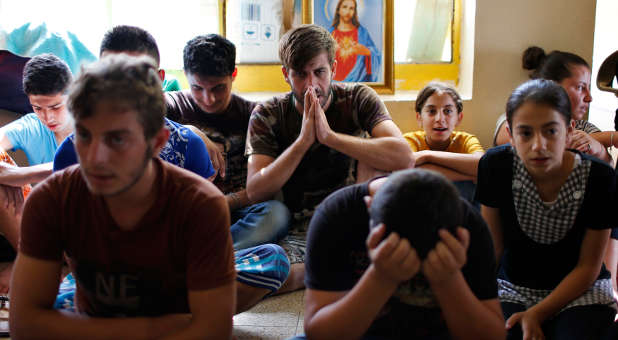
Where can God’s people go? What can God’s people do to help them?
“But the people who know their God will display strength and take action” (Dan. 11:32).
Arguably one of the most extreme and brutal terrorist groups in history, ISIS now controls a huge portion of Iraq. They have raped and sold women. They’ve kidnapped and murdered innocent children. The White House has publicly stated, “The situation is nearing a humanitarian catastrophe” and “a potential act of genocide.”
Christian Aid Mission is one of few organizations that works with local ministries in Iraq. These ministries are not fleeing because Iraq is their home and their calling is to their own people. They will remain and minister to the suffering throughout this crisis and beyond.”
A ministry leader in Erbil has reported, “Homes and churches were burned to the ground.”
More than 2 million internally displaced Iraqis and Syrian refugees, also fleeing ISIS, are currently packed into the Erbil region. Those exiled have filled every building in the city beyond capacity, leaving thousands to live and sleep on the streets. The president has said, “These innocent families are faced with a horrible choice: descend the mountain and be slaughtered, or stay and slowly die of thirst and hunger.”
With funding wired from Christian Aid Mission, the native ministries are able to buy supplies from local markets to distribute to the needy.
“Everything is available locally and could be purchased in a matter of hours and distributed within a few days,” reported one ministry leader. All funds sent to the indigenous ministries are strictly accounted for and overseen by proven ministry leaders.
This is a great opportunity for believers around the world to come alongside Iraqi Christians and show the love of God to those who are suffering.
Long after foreign aid agencies leave the region, these native workers will remain.
Christian workers in Iraq will personally present your gifts to the families and share a simple, clear message of the Gospel of Jesus Christ.
#HelpLocalIraq is an effort to bring attention to the indigenous ministries on the ground in Iraq who need our help. Please share this page with others and use #HelpLocalIraq.
Click here to download materials to help spread the word in your church.
* The needs are much greater than these numbers indicate.

[youtube]https://www.youtube.com/watch?v=SHJfGVmuYHg[/youtube]
Watch the footage as captured by security cameras of the moment before the guest-house collapsed at the Synagogue Church, Friday, last week where at least 41 people were confirmed dead.
Vanguard NGR gathered that this footage was edited for broadcast by Emmanuel TV and shown by Prophet T.B. Joshua to his congregation during service on Sunday 14th September, 2014.
READ MORE about the whole story of the Collapse
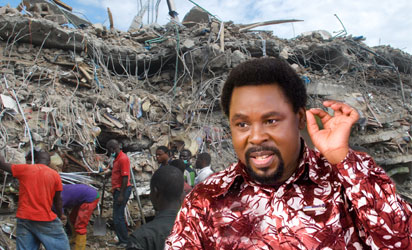
Premium Times Report – The Founder and General Overseer of The Synagogue Church of All Nations, Temitope Joshua, has linked the collapse of an uncompleted Guest House owned by his church to a “strange aircraft” which he said hovered around the building before its collapse.
Mr. Joshua said the plane hovered around the collapsed building for over 30 minutes.
The clergyman spoke just as emergency officials told this newspaper that 17 people died in the incident while 123 others were evacuated alive and rushed to hospital.
Briefing journalists, including a PREMIUM TIMES reporter, on the incident on Saturday, the pastor played a CCTV footage of a flying aircraft to back his claim.
In the footage, a plane was seen flying over the collapsed guest house at four different times on Friday morning — 11: 30 a.m, 11: 43 a.m, 11:45 a.m and 11: 54 a.m.
The building collapsed at 12:44 p.m Friday afternoon.
PREMIUM TIMES was unable to authenticate the footage, and it remains unclear whether there is indeed a relationship between the flying aircraft and the collapse of the building.
Click here to see the Video of the building collapsing
But in his speech, Mr. Joshua insisted the aircraft, which flew past almost an hour before the incident, was responsible for the collapse of the building.
The pastor said he was the target of the attack.
“Immediately I left the prayer room (which is a 10-minute drive form the church) for the church, I got a call that a jet was hovering over the prayer room but as I finished bathing and moved to the prayer room, I got another call that the jet has moved to the church and that was it,” Mr. Joshua said.
“Members cannot be the target, the easier way to stop this church is to get the head and from my explanation, you know the truth,” he added.
Mr. Joshua called on security agents to study the CCTV footage as they investigate the incident.
He promised to speak further on the incident during service on Sunday.
”Service will hold tomorrow and I will state my position tomorrow in service, you can watch it live on Emmanuel TV,” he said.
He also apologized to the press following the hostile treatment of journalists by members of his church.
“We are very sorry on their behalf,” he said. “Our members are not hostile. The Bible is our standard. Even the Bible today, without the press, it cannot be accessible to many. Our members have respect for the press. When we fight the press, we are fighting Emmanuel TV. They value you people.”
Meanwhile, rescue operations at the site of the collapsed hotel is still going on.
Authorities of the National Emergency Management Association, NEMA, said 17 people died in the incident while 123 others were rescued alive.
Speaking on the attitude of church members, NEMA spokesperson, Ibrahim Farinloye, said, “They are not too hostile neither are they receptive. We handled the equipment while they handled crowd control.”
As at 5:50 p.m. when our reporter left the scene, ambulances were still rushing rescued victims to the nearby Igando General Hospital.
The church members however remained hostile to journalists despite the apology by Mr. Joshua.
Nigeria’s National Emergency Management Agency (NEMA) said 42 people were killed in Friday’s incident, while 130 escaped or were pulled out alive from the rubble.
Source : Sahara Reporters | Vanguard NGR | Premium Times

CP Reports – ISS has released a video showing another beheading, that of a British aid worker, David Haines, the father of two who went to Syria to serve at a refugee camp. The terrorist group says the execution, which has evoked a strong global condemnation including from President Obama, is “a message to the allies of America.”
“The murder of David Haines is an act of pure evil. My heart goes out to his family who have shown extraordinary courage and fortitude,” British Prime Minister David Cameron tweeted early Sunday, the day after the video was released by the Islamic State, or ISS, Saturday night.
The gruesome video looks similar to the two previous videos showing the beheading of U.S. journalists James Foley and Steven Sotloff, and threatens to kill another British hostage.
“I would like to declare that I hold you David Cameron entirely responsible for my execution,” 44-year-old Haines can be heard saying in the video. “You entered voluntarily into a coalition with the United States against the Islamic State just as your predecessor Tony Blair did, following a trend against our British prime ministers who can’t find the courage to say ‘no’ to the Americans.”
The masked executioner then speaks with a British accent. “This British man has to pay the price for your promise, Cameron, to arm the Peshmerga [Kurdish] against the Islamic State. If you, Cameron, persist in fighting the Islamic State then you like your master Obama will have the blood of your people on your hands.”
In the last video showing the execution of U.S. journalist Sotloff, ISIS had threatened to kill Haines, who was working for a French international aid agency, ACTED, when he was abducted last March in Atmeh, Syria.
“We will do everything in our power to hunt down these murderers and ensure they face justice, however long it takes,” said Cameron, who was due to chair an emergency meeting Sunday.
President Obama also condemned the execution. “The United States strongly condemns the barbaric murder of U.K. citizen David Haines by the terrorist group ISIL,” he said in a statement late Saturday. “Our hearts go out to the family of Mr. Haines and to the people of the United Kingdom. The United States stands shoulder to shoulder tonight with our close friend and ally in grief and resolve.”
Source : Christian Post