Pastor apologises for bragging about punching a child

A pastor who bragged about punching a child and then “lead[ing] him to the Lord right there” has apologised for his actions.

“I do not condone abuse in any form,” a statement from Eric Dammann, pastor and senior elder at Bible Baptist Church in Hasbrouck Heights, New Jersey, reads.

“I chose a very poor example from my past and very poor wording to describe it and deeply regret using it. By viewing the clip it is certainly understandable how outraged people are. I acted out in one moment many years ago, it is not how I believe people especially a pastor should act.

“My actions were not reflective of Christ and the teachings of the bible. I was wrong, there are no excuses to be made. I was forgiven by Ben many years ago and can only ask the same from my church, community and the world.”

Dammann is seen recounting the story from his time as a youth pastor in a YouTube clip that now has over 2.3 million views.

In what appears to be a sermon, Damman describes the young man in question, Ben, as “a nice kid, just one of those kids…he was a real smart alec. He was a bright kid, which didn’t help things, right? [It] made him more dangerous.”

He then says he was leading a youth group when Ben began “trying to push my buttons, and he was just not taking the Lord serious. And I walked over to him…punched him in the chest as hard as I [could]. I crumpled the kid, I just crumpled him.

“And I leaned over and I said ‘Ben, when are you going to stop playing games with God?’ I led that man to the Lord right there,” Damman adds.

“There’s times when that might be needed.”

His comments have been met with universal outrage, and when contacted by the Daily Mail, Damman said his actions were “inexcusable”.

In the statement posted on the Bible Baptist Church website, he notes that the incident occured 13 years ago, and he now “deeply regret[s]” it.

Source: Christian Today

Pakistan must fight militants, says John Kerry

Pakistan must fight militant groups that threaten Afghan, Indian and US interests, US Secretary of State John Kerry said on Tuesday as he offered sympathy for the victims of last month’s massacre of children at a Pakistani school.

Nuclear-armed Pakistan has long been suspected by the West of playing a double game, fighting some militants while supporting those its generals have regarded as strategic assets to be used against rivals and neighbours, India and Afghanistan.

Visiting Pakistan after going to India over the weekend, Kerry said all militant groups should be targeted to bring security to the region.

“Terror groups like the Pakistani and Afghan Taliban, the Haqqani network, Lashkar-e-Taiba and other groups continue to pose a threat to Pakistan, to its neighbours and to the United States,” Kerry told a news conference in Islamabad, listing some of the most feared groups.

“And all of us have a responsibility to ensure that these groups do not gain a foothold but rather are pushed back into the recesses of (Pakistan’s) memory … Make no mistake. The task is a difficult one and it is not done.”

Most US-led forces in neighbouring Afghanistan officially completed their combat mission last month, prompting concern about the stability of the region where insurgents have been increasingly aggressive in past months.

Following last month’s attack on the school in which 134 children were killed, Pakistan has promised to stop differentiating between “good” and “bad” militants and to step up operations against their hideouts on the Afghan border.

Speaking at a news conference with Kerry, Pakistani foreign adviser Sartaj Aziz reassured his counterpart that “action will be taken without discrimination against all groups”.

But, although observers have noted some progress, most agree that Pakistan has yet to show it is seriously committed to go after all groups equally, including the powerful Haqqani network which attacks targets in Afghanistan from its bases in Pakistan.

“Obviously, the proof is going to be in the pudding,” Kerry said. “It will be seen over the next days, weeks, months, how extensive and how successful this effort is going to be.”

Aziz said, however, that the Haqqani group’s infrastructure had been “totally destroyed” as a result of the Pakistani army’s operation in a tribal region that has long been regarded as a safe haven for militants.

“Their ability to operate from here across to Afghanistan has virtually disappeared,” Aziz said.

FURTHER AID

The United States identified Pakistan as a key partner in its war against terror following the September 11, 2001, attacks and has spent billions of dollars on military aid to help the country fight insurgents.

But there is growing consternation in Washington about continuing with the same level of assistance unless Pakistan provided evidence it was using the funds effectively to eliminate militants holed up on its soil.

Kerry said however Washington would provide an additional $250 million in food, shelter and other assistance to help people displaced by conflict in tribal areas.

Aziz made a plea for the United States to keep giving Pakistan money to help rebuild the regions where the Pakistani military has been fighting militant groups.

“We expect our defence forces to remain engaged in counterterrorism operations for some time in the foreseeable future,” Aziz said. “Continuation of coalition support fund reimbursements are therefore a valuable support that must continue in the interests of both countries.”

Pakistan was deeply scarred by the December attack when gunmen killed the children at the military-run high school in the northwestern city of Peshawar in revenge for an army operation against Taliban hideouts.

Some analysts believe the national revulsion over brutal attack could convince hawks in the military to withdraw support for militants like the Haqqanis.

For its part, the government has reassured the West and its own sceptical public that it is doing everything to eliminate insurgent violence, reinstating the death penalty and expanding military operations in the tribal North Waziristan region.

Source: Christian Today

Mark Woods: Not marching for Horrofic killings in Nigeria doesn’t mean we don’t love or care for Nigeria

The killings in France were awful, awful. The demonstrators who turned out to express their love, support and solidarity – around 4 million of them – were doing a good thing. It was heartening, moving and hopeful.

You wouldn’t think so, though, by some of the reactions. The problem was that the Charlie Hebdo and Jewish supermarket killings in France, and the exhaustive coverage of motives and methods that followed, coincided with news of an even worse atrocity. This one was in Nigeria, and it was ghastly: Boko Haram conducted its worst ever massacre in the town of Baga in the northern Borno State. The figure of 2,000 dead is being used, but the bodies are said to be too many to count.

Around 2,000 in Baga; 17 in Paris. So which one should get world leaders marching arm in arm, solemn commitments to peace and justice, and 4 million people swearing eternal love and fraternité?

It’s the discrepancy between these figures that has got people fired up. Why, asks the Guardian, did the world ignore Boko Haram’s Baga attacks? Put in #bagatogether on Twitter, for instance, and there’s a deluge of criticism directed both at the media and at world leaders. The media are accused of ignoring Nigeria because it’s a long way away, it’s a developing country and anyway – the accusation runs – editors just think, “That sort of thing happens all the time in that sort of place.”

Well, you would have to be a pretty dreadful specimen of a human being, not just of a journalist, if you really thought like that. But that doesn’t mean that there’s no case to be answered. As an Amnesty blogger puts it: “Why aren’t global leaders linking arms in Abuja calling for an end to the merciless blood spill, abductions, rapes and other grotesque crimes committed by this terrorist group?”

Let’s be honest and admit that the media doesn’t always get it right. Yes: some stories are easier to report than others – and Boko Haram territory in Northern Nigeria is hard, with poor communications, and a dangerous beat to cover.

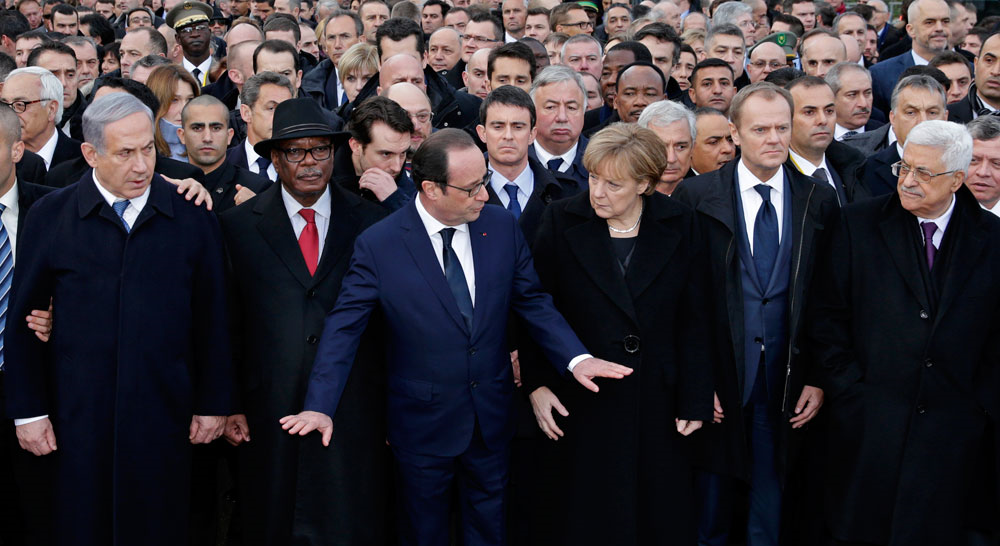
Let’s admit too that governments and the world leaders they represent are selective in the causes they support. It is hard to believe, for instance, that Israel’s Prime Minister Benjamin Netanyahu didn’t have an eye to both domestic and foreign politics when he turned up in France and assured Jews there that they would always be welcome back home: the Palestinian issue has become so toxic for Israel that highlighting Islamist atrocities plays very well for him.

More generally, the genuine moral engagement that many politicians feel in some of the great questions of our time will always – and rightly – be tempered by considerations of what is actually achievable. Windy rhetoric is pointless. Sooner or later, someone – usually a journalist – will ask, “So, what are you going to do?” Not one of the leaders gathered in Paris to mourn the killings would find it politically possible to send an effective army to fight Boko Haram, even if the Nigerians wanted them to.

But still: comparisons between the two – though they are undeniably plausible – are wrong, for three reasons. First, the outpouring of grief and its media coverage in Paris was real, and journalists had a duty to report it. It was at the heart of France’s circles of concern, while Nigeria – inevitably – is further out. There is nothing wrong with feeling more deeply for those who are closer to us. It is a natural, human instinct. For France to have said, “We will not march, because elsewhere in the world there are worse tragedies than ours,” would have denied them something precious – and because France is a near neighbour and Britain has a large French population, it was our story too.

Second, it doesn’t need a cynical dismissal of Boko Haram attacks as ‘normal for Nigeria’ to recognise that the Paris shootings were a profound and genuine shock to French and European society. This had not happened before. Its circumstances were peculiarly horrible. It was an attack on a cherished tenet of Western culture, free speech. It made people not only mourn, but think; and neither the mourning nor the thinking is over yet. “After the first death, there is no other”, wrote Dylan Thomas (A refusal to mourn the death of a child, by fire, in London). Under the scourge of Boko Haram, Nigeria’s first death was years ago. This is France’s first, at least of its kind; it should be allowed its mourning.

Third, why pick on Nigeria? What do the Twitter warriors think is happening in the Eastern Congo, or in North Korea, or in Syria or Iraq? The truth is that terrible things happen all over the world, all the time. Journalists report them as best they can and politicians try to deal with them as best they can. How are they supposed to judge which are more important? By body count, age of victims, geopolitical repercussions? Surely nothing so calculated – but somehow a judgment has to be made.

So does the unholy juxtaposition of the two events, in Paris and in Baga, simply have nothing to say to us? Of course not: but simplistic and confected outrage at the supposed callousness of press and politicians is neither fair nor helpful. We should have the honesty to admit that some things touch us more nearly than others: but out of that honesty, the Paris killings will have made us think more and pray harder for Nigeria. That’s a result.

Source: Christian Today

Record numbers of anti-Islamist Protesters march through Dresden

A record 25,000 anti-Islamist protesters marched through the east German city of Dresden on Monday, many holding banners with anti-immigrant slogans, and held a minute’s silence for the victims of last week’s attacks in France.

Chancellor Angela Merkel and other senior German politicians have called for people to stay away from rallies organised by PEGIDA, or Patriotic Europeans Against the Islamisation of the West – people who Merkel has said have “hatred in their hearts”.

On Tuesday she will take part in a vigil in Berlin organised by a Muslim group to remember the 17 people killed in Islamist attacks at the offices of satirical newspaper Charlie Hebdo and a kosher supermarket in Paris.

About 7,000 more protesters than last week turned out for the march, a police spokesman said.

Leader Lutz Bachmann set out PEGIDA’s demands for the government including drawing up a new immigration law, forcing immigrants to integrate and making sure that Islamists who leave Germany to fight are not allowed back into the country.

“We are getting more support each week,” co-founder Kathrin Oertel told Reuters.

“We are against all violence that is religiously motivated whether Muslim or Christian … People have been confronted by it now and are thinking about it more.”

Protesters, many dressed in black, waved the black, red and gold German flag. One carried a banner saying: “With our deepest sympathies for the families of the Paris terror victims.”

Mostly men over 50, many chanting of “Wir sind das Volk” or “We are the people”, they said they were more concerned about increasing immigration than the events in France.

Their banners read “Stop multiculturalism”, “I’m not a Nazi but everyone who enjoys our hospitality must integrate and respect our culture” and “Stop asylum fraud – every one is too many, go home!”

One carried a Christian cross illuminated with fairylights.

Eugen Peuke, 61, was at his second protest.

“It (multiculturalism) doesn’t work. Immigration is a problem. They steal. I just don’t want them here. The government isn’t listening,” he said.

Counter-demonstrators shouted “PEGIDA, you’re racist” and “Germany is ashamed of you”, and in Berlin and the western city of Duesseldorf the rallies were dwarfed by counter-protesters.

Germany has some of the world’s most liberal asylum rules, partly due to its Nazi past, and last year the number of asylum seekers, mainly from the Middle East, doubled to about 200,000 from 2013.

Source: Christian Today

Pope Francis calls for an investigation into Sri Lanka’s civil war

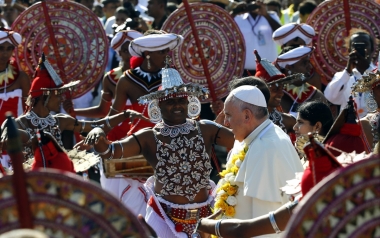
Pope Francis called on Sri Lanka to uncover the truth of what happened during its bloody civil war as part of a healing process between religious communities, as he arrived in Colombo a few days after the island’s wartime leaders were voted out.

Soon after landing in Buddhist-majority Sri Lanka, Francis appeared to make the case for a truth commission to investigate the 26-year civil war, an election pledge of the government voted into office on Thursday.

“The process of healing also needs to include the pursuit of truth, not for the sake of opening old wounds, but rather as a necessary means of promoting justice, healing and unity,” he said, wearing a long garland of yellow and white flowers.

Francis was speaking at Bandaranaike international airport, where he was met by President Maithripala Sirisena, troupes of dancers and a children’s choir. Sirisena said the visit was a blessing for his new government.

The pontiff departed past a long line of costumed elephants who reached their trunks towards his open-topped white jeep, which was briefly brought to a standstill by large crowds.

Francis is the first pope to visit Sri Lanka since the war ended in 2009. Fighting between the mainly Hindu Tamils and the and mostly Buddhist Sinhalese majority ended with a crushing defeat for the Tamils. A 2011 UN estimate put the death toll from the final army assault at up to 40,000 civilians.

The 78-year-old will spend two days in Sri Lanka before going to the Philippines as part of a trip aimed at shoring-up the Church’s presence in developing nations. The week-long tour is his second to Asia.

The Pope carried a message of inter-faith dialogue that chimed with an unusually harmonious atmosphere in Sri Lanka, which last week elected a government promising increased respect for long-suffering religious minorities.

“My government is promoting peace and friendship among our people after overcoming a cruel terrorist conflict. We have people who believe in religious tolerance and coexistence based on centuries old religious heritage,” Sirisena said.

About 70 per cent of Sri Lankans are Buddhists. Hindus make up about 13 per cent and Muslims 10 per cent. Catholics are about seven per cent, split between ethnic Sinhalese and Tamils.

HUMAN DIGNITY

Francis called for a more inclusive society in Sri Lanka, in comments that seemed directed at former president and wartime leader Mahinda Rajapaksa, who lost office after a resurgence in religious tensions.

“The great work of rebuilding must embrace improving infrastructures and meeting material needs, but also, and even more importantly, promoting human dignity, respect for human rights, and the full inclusion of each member of society,” he said, speaking under the hot morning sun.

Rajapaksa is feted as a hero for ending three decades of war. He also presided over a period of fast economic growth and infrastructure reconstruction.

However, he refused to allow a fully independent inquiry into alleged war crimes and presided over a period of growing repression of religious minorities as well as political opponents.

Rajapaksa’s rule coincided with isolated attacks led by hardline Buddhist monks against churches and other Christian centers.

Pope Francis had first-hand experience of devastating civil strife as a priest in his native Argentina during its “Dirty War”. A 50,000 page truth report after that war revealed shocking details of kidnappings, rapes and torture by the military junta.

He also carried a message with a wider resonance in the wake of Islamist militant violence in Nigeria and France last week.

“It is a continuing tragedy in our world that so many communities are at war with themselves,” he said. “The inability to reconcile differences and disagreements, whether old or new, has given rise to ethnic and religious tensions, frequently accompanied by outbreaks of violence.”

Source: Christian Today

5 Years After Quake, Christian set to fulfil Promise to Rebuild Haiti; Set to erect 30 New Schools for Over 25,000 Children despite setbacks

Five years after a 7.0 magnitude earthquake struck Haiti, Christian ministry Compassion International reveals it is on track to erect 30 new school buildings by this spring despite setbacks. The schools, built with the $31.2 million sponsors and donors from around the world gave the organization following the tragedy, will restore education and a pathway out of poverty for the more than 25,000 Compassion-assisted children who were affected by the disaster.

Compassion employed engineers from El Salvador and even created its own construction company in order to build 30 schools that can withstand future catastrophes by January. Compassion’s U.S. communications director, Tim Glenn, said some structural problems have extended its completion date to April. Still, the organization is proud of what it has been able to do.

On January 12, 2010, Haiti was rocked by a 7.0 magnitude earthquake that reduced several structures in its densely populated capital, Port-au-Prince, to rubble — including many church-run schools.

There is virtually no public school system in Haiti and many of the country’s children receive their education from private schools run by churches.

For the last 48 years, Compassion International has partnered with 270 local Haitian churches and their schools to implement holistic child development programs that provide students a pathway out of poverty through the love of Jesus Christ.

In the wake of the earthquake’s destruction, Compassion International’s management support director for Haiti, Matthew Moore, explained, “Many of our church partners had lost buildings. They had nowhere to go to church, they had nowhere to provide for the children.”

The ministry immediately jumped into action, reaching out to affected churches the day of the disaster.

Within the first nine months, Compassion delivered more than 600 tons of relief supplies such as food, clothing and temporary shelters to those displaced from their homes. Its mobile health clinics vaccinated nearly 15,000 children in the months following the disaster and distributed 4,000 hygiene kits. Compassion also provided post-traumatic counseling to children affected by the disaster.

In addition to providing for the immediate needs of the nearly 1.5 million displaced by the earthquake, Compassion also helped the families of its students rebuild their lives and their businesses with micro finance loans.

It biggest goal, however, was to rebuild destroyed schools. Without them, Moore stated, “We would have had to remove more than 25,000 children from our program.”

So Compassion invested in school construction, bringing in Salvadorian reconstruction engineer Hilda Bojorquez to teach workers how to build disaster-proof structures in accordance with international seismic building codes.

“The problem is that the Haitian engineers were not taught at school how to have an earthquake resistant plan so we dealt with challenge by hiring a group of technicians in El Salvador that made all of the blue prints,” Bojorquez said with help from a translator.

Glenn believes Compassion has made the most of its donations. “We provided immediate needs where it made the most sense,” Glenn told The Christian Post.

In 2011, nonprofit charity evaluator GiveWell estimated that over $5 billion in donations were pledged in 2010 to charities big and small to help the impoverished peninsula in 2010. Yet news reports of Haitians’ continued struggles have led to scrutiny on how many charitable organizations are actually distributing Haitian relief funds.

Days after the disaster, The New York Times reported pockets of displaced residents were still waiting for food and water. GiveWell noted in 2011 that despite the billions of dollars donated, “the situation remained dire.” In January 2014, Jake Johnson of the Center for Economic and Policy Research dinged USAID for under-delivering on the thousands of new homes and industries it promised to build.

Johnson also told NBC News this month that “if the expectation was to build back better and transform Haiti’s public sector, then yes, by any measure it’s been a failure.”

Problems such as fuel shortages, the country’s bad roads and one airport runway to receive supplies hampered many charitable groups from meeting their original goals.

Glenn told CP that Compassion used its existing infrastructure in Haiti and the neighboring Dominican Republic to overcome some of these difficulties.

The Christian ministry stockpiled supplies with some of its Dominican Republic partner churches and then trucked the supplies to its affected Haitian partners from there. Once the supplies reached Haiti, Compassion International allowed Haitian church leaders and volunteers to take the lead in dispensing food kits and additional relief.

Glenn explained, “We lift up the church to be the church in these communities.”

Compassion used its network again when it created its micro loan program for local small business creation. It only opened the program to the family members of Compassion-assisted children. The program distributed over 800 loans which spawned 452 local businesses.

Despite setbacks in the schools’ construction, Moore said, “We’ve accomplished virtually all the goals we set five years ago. The money that so many generous donors and sponsors gave the Haiti disaster response will be spent how we said it would be spent and we’ve impacted many of thousands of lives.”

He concluded, “I think all of our staff here, all the sponsors and those who love Compassion can be very proud of what we’ve accomplished.”

Source: Christian Post

North Korea; The most dangerous place to be a Christian

For the 13th time the annual World Watch List published each January by Open Doors, the organisation that campaigns for persecuted Christians, has North Korea at its head. It is once again judged to be the most dangerous country in the world to be a Christian.

Given the horrific images and stories we have become used to from Nigeria and the appalling events unfolding in Iraq and elsewhere in the Middle East, that’s quite a claim. However, to anyone involved in monitoring human rights, it is uncontroversial. North Korea is not just the worst place in the world to be a Christian, it is arguably the worst country in the world to live, full stop.

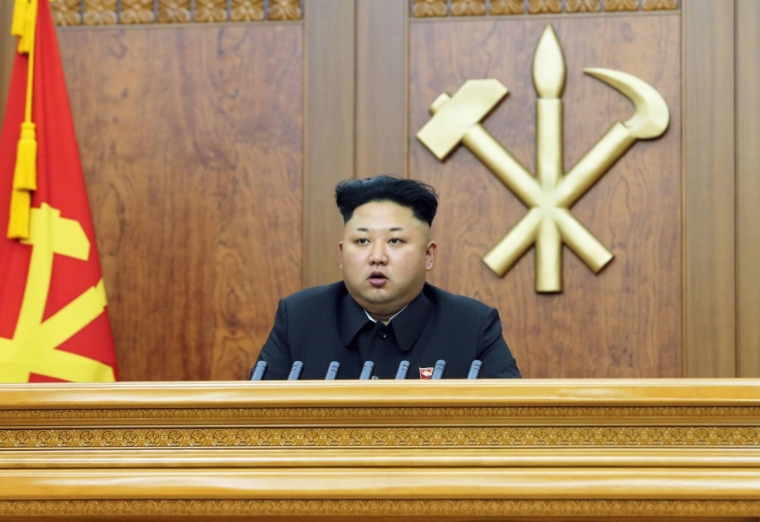
This is in spite of the fact that to the uninitiated, North Korea can seem like a bit of a joke. It hits the headlines for the most bizarre of reasons. Last year, for instance, male university students were ordered to get their hair cut in the style of the “Dear Leader”, Kim Jong Un. (It is a sort of extreme pudding-basin cut, unflattering on anyone.) There were, quite rightly, howls of derision – but rather less reflection on what the decree said about the leader’s personality cult and his ability to impose it on an entire nation.

More recently, North Korea has been accused of being behind the hacking of Sony Pictures emails in retaliation for The Interview, a spoof film about Kim Jong Un’s fictional assassination. We all enjoyed the candid emails about Angelina Jolie, but it demonstrates the country’s fearsome reach in cyber-warfare.

It is also a nuclear power with conventional forces which include an army that is the largest military organisation on earth. It has 9,495,000 active, reserve, and paramilitary personnel, representing 40 per cent of the entire population.

This wholesale militarisation of the country has been achieved through levels of state control and oppression which are unparalleled anywhere else. According to Amnesty International, “North Korea is in a category of its own when it comes to human rights violations. It is a totalitarian state where tens of thousands of people are enslaved and tortured. All forms of freedom of expression are repressed and anyone attempting to assert their rights is crushed. In North Korea, where failing to show sufficient reverence for the country’s leaders is a serious offence, no one is safe from arrest and imprisonment.”

The control exercised by the state has ensured the subjection of its people in the face of appalling hardships. A famine from 1994-98 killed hundreds of thousands of people: accurate data is impossible to come by and some estimates are as high as 3,500,000 out of a population of 22 million, though recent research suggests the range may be between 500,000 and 600,000.

A drought last year brought fresh suffering, with the United Nations estimating that around two-thirds of the population suffer chronic food shortages. Generations of North Koreans are growing up malnourished, stunted and prone to diseases for which a healthcare system which is non-existent outside the main cities is unable to provide remedies. Punitive sanctions imposed by most of the world out of justifiable outrage at the excesses of the regime have failed to moderate the behaviour of its leaders and arguably contributed to the suffering of ordinary North Koreans, while they are circumvented by China, which is terrified of the instability that might result from the collapse of its armed and dangerous neighbour.

TWISTED IDEOLOGY

But what lies behind the regime’s behaviour, and why does it target Christians?

Central to understanding the paranoia and secrecy of North Korea are the concepts of ‘Juche’, developed by the country’s founding father Kim Il Sung, and the related ‘Kimisungism’ named after him. Juche’s three key principles are political independence, economic self-sufficiency and self-reliance in defence. However, in practice these have morphed into an ideology of obsessive secrecy, ultra-nationalism and an extraordinary cult of personality focused on the country’s leader – Kim Il Sung and his successors. Such is the extent of this that a leader’s death, for instance, can be the focus of intense emotion – and anyone who doesn’t feel it or can’t fake it is in trouble.

In her book Nothing To Envy: Ordinary Lives in North Korea, Barbara Demick wrote, referring to Kim Il-sung’s death in 1994: “The histrionics of grief took on a competitive quality. Who could weep the loudest?”

She noted that one young student in Pyongyang felt nothing as all around him were wailing. However: “His entire future depended on his ability to cry. Not just his career and his membership in the Workers’ Party, his very survival was at stake. It was a matter of life and death.”

She wrote that he was saved by holding his eyelids open and his eyeballs exposed until they burned and began to tear up. Once they started, he began sobbing like everyone else.

Absolutely nothing can be allowed to challenge this cult – and certainly not Christianity, seen both as a foreign ideology and as a threat to the regime’s absolutism. Total social control has been achieved through the ‘Songbun’ system in which people are divided into three main classes: the loyal, the wavering and the hostile. These are further divided into 51 subclasses. Christians are part of the ‘hostile’ class, with Protestant Christians being ranked at 37 and Catholic Christians at 39 – a long way down the pecking order.

Open Doors estimates that there are around 300,000 Christians in the country, though hard evidence is difficult to come by because of the regime’s obsessive secrecy and total control of information – all newspapers are censored and only a tiny minority of trusted individuals have access to the internet. Believers meet largely in secret. The few churches allowed to operate are fronts put on for foreigners to able to demonstrate North Korea’s ‘freedoms’ – though bizarrely, in 1992, Billy Graham visited the country at the invitation of the ‘Eternal President’ Kim Il-Sung and was allowed to give a speech in Pyongyang. He made a second trip in 1994.

PRISON CAMPS

Evangelism is absolutely prohibited and carried out at the risk of death or imprisonment in one of the country’s fearsome labour camps. Last year it was reported in the South Korean press that 33 North Korean Christians faced execution after being charged with attempting to overthrow the regime – they had worked with South Korean Baptist missionary Kim Jung Wook and received money to set up 500 underground churches. While the story has been questioned, it is perfectly credible. And would-be Christian missionaries from outside the country such as Kenneth Bae and Jeffrey Fowle have found to their cost that North Korea does not tolerate religious interference.

Amnesty quotes one former inmate, Kim Young, who spent nine years in one of the prison camps. “It is a place that would make your hair stand on end,” she said. “From sunrise to sunset, you work. You get up at 3.30 to report for work at 4.30.” She also recollects pregnancy tests, forced abortions and deliberately induced miscarriages: “Pregnant women get sent to labour camps to carry loads up and down the hills which causes miscarriages.”

A former prison official says: “You would need to walk 12-14 miles to get to the field where you plough. You would be expected to walk the distance and then plough the field. You would have to stay awake until midnight as well. There are meetings going until midnight.”

Another woman Jihun Park, recalls: “Four women had to plough with an oxcart, two in front and two at the back, carrying a ton of soil in the cart. We couldn’t do this at a walking pace either, we had to run.”

According to a former military captain. “Starvation is the biggest problem. I saw piles of bodies who have died from starvation in public places.”

Torture, executions – including the execution of children, especially after they have tried to run away – and sexual abuse are common. A former prison guard says: “After a night of ‘servicing’ the officials, the women had to die because the secret could not get out. This happens at most of the political prison camps.

A peculiar refinement of the system is the “guilt by association” principle, in which several generations of a family in which one person has transgressed are executed or sent to labour camps as well – ensuring that every member of a family is made responsible for keeping the others in line. (Current president Kim Jong Un is reported to have ordered the execution both of his uncle and his uncle’s family in a purge last year.)

Around 100,000 people are thought to be held in these conditions.

CHRISTIAN WITNESS

Yet even so, the North Korean Church survives – even in the labour camps themselves. Open Doors tells the story of a woman called Chun, who was sent to one of North Korea’s horrific labour camps after she tried to escape to China as punishment for ‘defecting’ (refugees who do reach China are often sent back). “I was beaten and tortured so badly that I could barely stand up,” she says. However, in her dirty, overcrowded prison cell, she says: “There was one lady who was really kind to me. When I was in so much pain she invited me to lay my head in her lap. She stroked my hair.

“This lady came to faith when she was in China. She was put behind bars, just like me. It did not stop her from doing Christ’s work.” Some time later Chun herself became a believer. She says: “Despite all my suffering I love God with my whole heart. I am so grateful for Him.”

Like many of the world’s darkest places in the late 20th and 21st century, North Korea was a product of the rivalry between the USSR and the West. The mind of its founder Kim Il Sung was formed by the Marxism of his Soviet and Chinese mentors. However, the division of the Korean peninsula after the Korean War (1950-53) has allowed the North to calcify in a brutally oppressive oppression in which the minds, bodies and spirits of its citizens have been warped by a paranoid dictatorship which maintains its control through terror and indoctrination, uniting its people through fear of a common – imaginary – enemy.

Many of the old Cold War conflicts have been resolved. North Korea, where human suffering has nowhere been as great for so long, has not – and humanly speaking, there seems very little chance of change any time soon. UN Security Council resolutions, sanctions and even mass starvation have failed to shift the regime one iota.

It is always easier to pray for people when we know their stories and their faces. One of the problems faced by North Korean Christians is that they are usually anonymous. They have no internet; there are no pictures; there are no names. It is easier to concentrate on causes that are more media-friendly. But Jesus cared for the faceless and voiceless, too. In a world awash with information, the hidden horrors of North Korea need our prayers more than ever.

Source: Christian Today
Iraqi Christians who fled Islamic State says “none of us is angry with God”

An Iraqi Christian who has been on the run from Islamic State (IS) since June says that she and the hundreds of other refugees in Ankawa, Kurdistan, are not angry at God.

Speaking to Catholic charity Aid to the Church in Need, Suheila, an elderly Christian woman forced by IS to flee Mosul, said: “We’ve lost everything. The worst thing is that we don’t know when or whether we will be able to return to our homeland.

“But none of us is angry at God. Fortunately we are all still alive.”

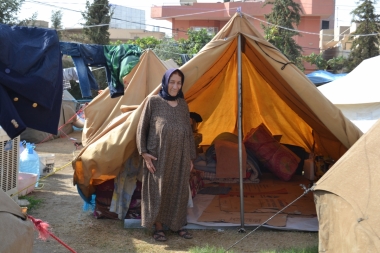
Last summer Suheila had to run for her life, along with tens of thousands of other Christians. She first sought shelter in Qaraqosh, but in August was forced to flee again when IS advanced. Now she lives in a sports club in Ankawa. “This is a really big improvement,” she says, “I am grateful for it. But in general, of course, this is no life.”

When Suheila and the other refugees arrived in Ankawa, a suburb of the Kurdish capital Erbil, four months ago, there was nowhere for them to go. Many of them had to sleep on the pavement and under bushes. The local church has been doing what it can to help them.

Father Daniel Alkhari, a young Chaldean priest who works in a refugee camp in Ankawa where more than 800 Christians are living, spoke to Aid to the Church in Need about their refugee crisis. “When the people arrived here they were totally traumatised,” he said. “It wasn’t easy for the people to cope with the fact that they suddenly had nothing and had to live in tents.

“The children in particular were suffering under the situation,” Father Daniel continued. “They saw their mothers crying and their fathers yelling. Then we began to structure the everyday routine to give the children something different to think about.”

The first school for Christian refugee children in Ankawa welcomed students to its classes in December, and seven other schools spread throughout Iraqi Kurdistan are due to open soon. This will enable more than 7,000 children to start going to school again.

Suheila’s words to a group of European visitors in Ankawa were, “Thank you, thank you, thank you. May God make things easy for you in your lives.”

Source: Christian Today


Catholic Archbishop accuses world of mourning last week’s french victims while ignoring the horrofic ongoing massacre of Nigerians by Boko Haram

The Roman Catholic Archbishop of Jos has accused the western world of focusing on mourning last week’s terror attack in France, while ignoring the ongoing massacre of Nigerians, including many Christians, at the hands of terror group Boko Haram. As many as 2,000 people are believed to have been killed and several churches were burned in one of the deadliest attacks last week in Baga.

“It is a monumental tragedy. It has saddened all of Nigeria. But we seem to be helpless. Because if we could stop Boko Haram, we would have done it right away. But they continue to attack, and kill and capture territories with such impunity,” Archbishop Ignatius Kaigama said, according to BBC News.

Over 40 world leaders joined with a million French citizens who marched in Paris on Sunday to honor the 17 people killed in terror attacks in the French capital last week. Twelve of the victims were cartoonists working for satirical newspaper Charlie Hebdo, who are believed to have been targeted by jihadist gunmen for illustrations of the prophet Muhammad that had angered some in the Islamic world.

Boko Haram continued its massacre of Christians and Muslims in Nigeria at the same time, however, and is believed to have killed close to 2,000 people in Baga and surrounding villages in Borno state.

The attack left countless bodies “strewn on the streets,” according to witnesses, and forced thousands to flee the region.

“I escaped with my family in the car after seeing how Boko Haram was killing people … I saw bodies in the street. Children and women, some were crying for help,” said witness Mohamed Bukar.

Further attacks were reported over the weekend, with three suicide bombers reportedly killing 23 people.

Kaigama called on the international community to show the same sort of spirit and resolve to Nigeria as it had shown for the victims in France.

“We need that spirit to be spread around,” the archbishop said. “Not just when it [an attack] happens in Europe, but when it happens in Nigeria, in Niger, in Cameroon.

“We [must] mobilise our international resources and face or confront the people who bring such sadness to many families.”

Boko Haram has made it its mission to establish an African caliphate in Nigeria, and in recent months has targeted the neighboring country of Cameroon as well.

Nigeria’s military has admitted it is struggling to deal with Boko Haram’s attacks, which have been becoming more violent since 2009, and asked for world leaders to help.

“The attack on the town by the bloodhounds and their activities since Jan. 3 should convince well-meaning people all over the world that Boko Haram is the evil all must collaborate to end, rather than vilifying those working to check them,” Nigeria’s defence spokesperson Chris Olukoladem said.

In the wake of Baga attack, the Christian Association of Nigerian Americans said that it is time for the United Nations to intervene and stop the massacre of people in the West African country.

“The numbers are adding up fast and it is becoming clearer and clearer that the Nigerian governments both federal and states are failing resoundingly in their responsibility to protect innocent lives and prevent this mass atrocities from going forward. These atrocities are increasingly becoming worse and worse as the times go by,” said Pastor Laolu Akande, CANAN executive director.

Source: Christian Today

British nurse with Ebola ‘is showing signs of improvement and no longer critically ill’

The British nurse being treated for Ebola in London is no longer in a critical condition, the hospital has confirmed.

In a statement released today, the Royal Free Hospital says it is “pleased to announce that Pauline Cafferkey is showing signs of improvement and is no longer critically ill. She remains in isolation as she receives specialist care for the Ebola virus.”

Cafferkey was diagnosed with Ebola on December 29 after returning to Britain from Sierra Leone, where she had been working for the charity Save the Children at a treatment centre outside the capital, Freetown.

Cafferkey is the first person to have been diagnosed with Ebola on British soil.

The Royal Free, Britain’s main centre for Ebola cases, successfully treated British aid worker William Pooley with the experimental drug ZMapp after he was flown back to Britain in August.

Ebola is transmitted through bodily fluids, and the hospital said it was treating Cafferkey inside a specially designed tent around her bed with controlled ventilation to reduce the risk of further infections.

In late December, when Cafferkey first arrived in hospital, the Archbishop of Canterbury Justin Welby showed his appreciation for those working to combat the virus, writing: “we owe them thanks and respect”, and asked for continued prayers.

The West African Ebola outbreak was first identified in Guinea’s remote southeast in early 2014. Guinea, Sierra Leone and Liberia have borne the brunt of the 20,000 infections and nearly 8,000 dead.

In December Sierra Leone’s government announced it was banning public celebrations over Christmas and New Year to try and prevent its spread.

Source: Christian Today