Pope Francis speaks on Charlie Hebdo attacks: “You can’t insult others faith”

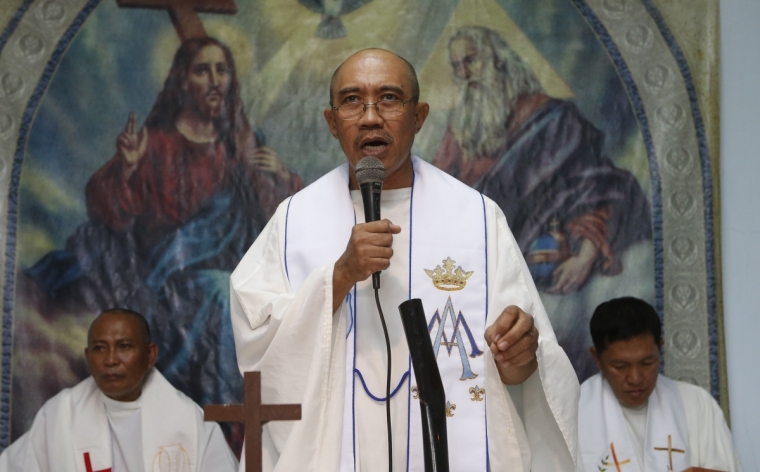
Pope Francis, speaking of last week’s deadly attacks by Islamist militants in Paris, has defended freedom of expression, but said it was wrong to provoke others by insulting their religion and that one could “expect” a reaction to such abuse.

“You can’t provoke, you can’t insult the faith of others, you can’t make fun of faith,” he told reporters on Thursday, aboard a plane taking him from Sri Lanka to the Philippines to start the second leg off his Asian tour.

Francis, who has condemned the Paris attacks, was asked about the relationship between freedom of religion and freedom of expression.

“I think both freedom of religion and freedom of expression are both fundamental human rights,” he said, adding that he was talking specifically about the Paris killings.

“Everyone has not only the freedom and the right but the obligation to say what he thinks for the common good … we have the right to have this freedom openly without offending,” he said.

To illustrate his point, he turned to an aide and said: “It is true that you must not react violently, but although we are good friends if [he] says a curse word against my mother, he can expect a punch, it’s normal.

“You can’t make a toy out of the religions of others,” he added. “These people provoke and then (something can happen). In freedom of expression there are limits.”

Seventeen people, including journalists and police, were killed in three days of violence that began with a shooting attack on the political weekly Charlie Hebdo, known for its satirical attacks on Islam and other religions.

Referring to past religious wars, such as the Crusades sanctioned by the Catholic Church against Islam, the Pope said:

“Let’s consider our own history. How many wars of religion have we had? Even we were sinners but you can’t kill in the name of God. That is an aberration.”

The Pope was also asked if he felt vulnerable to an assassination attempt or an attack by Islamic extremists.

Earlier this week, the Vatican denied Italian newspaper reports that US and Israeli intelligence officials had informed the Vatican that there could be an imminent attack by Islamist militants.

Francis said he was more worried about others – rather than himself – being hurt in an eventual attack and that he was confident about security measures in the Vatican and during his trips.

“I am in God’s hands,” he said, joking about having asked God to spare him a painful death.

“Am I afraid? You know that I have a defect, a nice of dose of being careless. If anything should happen to me, I have told the Lord, I ask you only to give me the grace that it doesn’t hurt because I am not courageous when confronted with pain. I am very timid,” he said.

Source: Christian Today
Religious Freedom Rally for sacked Atlanta Fire Chief outcome was an ” Outstandaing Success”

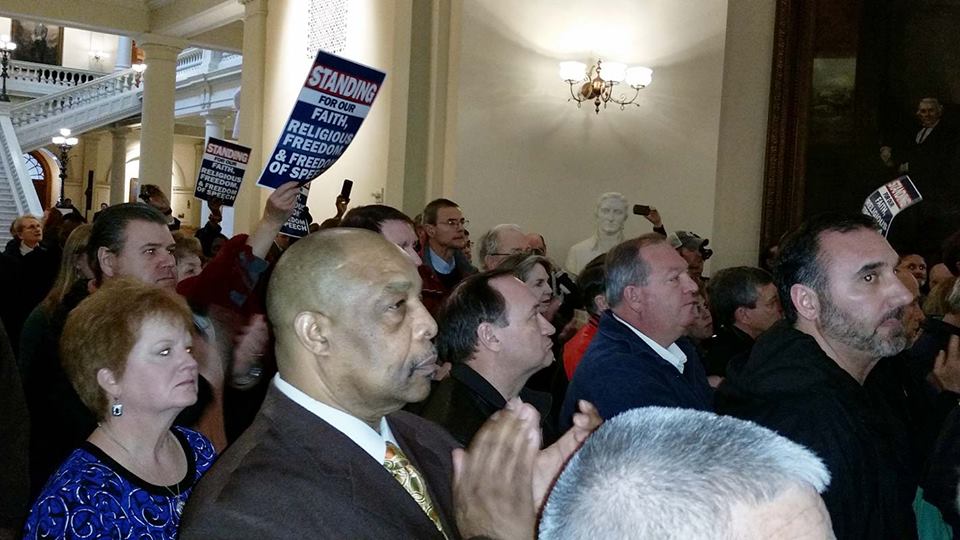
Faith leaders united for a public rally at the Georgia State Capitol on Tuesday in a show of support for ousted Atlanta Fire Chief Kelvin Cochran and according to one of the organizers, the event was a “tremendous success.”

Hundreds of religious freedom advocates gathered for the “Standing for our Faith Rally” in the Georgia State Capitol rotunda yesterday, one week to the day that Cochran was fired for espousing his Christian beliefs in a self-published book and distributing copies in the workplace.

“We thought the turnout was great,” Mike Griffin, a Public Affairs Rep. with the Georgia Baptist Convention told The Christian Post. “It was a tremendous success.”

Griffin, along with Pastor Garland Hunt of Prison Fellowship, organized yesterday’s rally in protest of Cochran’s dismissal. They, along with other conservative leaders including Cochran himself, say that Atlanta Mayor Kasim Reed’s decision to terminate the fire chief is symbolic of a growing threat on religious freedoms facing Christians and other people of faith.

“The idea that the government can force public servants to surrender their First Amendment rights is outrageous,” said Family Research Council President Tony Perkins who was also at the rally. “If a government will fire someone for their religious beliefs, no beliefs are safe from government regardless of how sacred those beliefs may be. Mayor Reed is sending a very clear message that Christians must check their faith at the door of public service.”

The event was attended by Atlanta pastors and other prominent leaders in the Christian community, including Ken Barun (Chief of Staff at the Billy Graham Evangelistic Association). It concluded with a walk to City Hall, where they hand-delivered a petition with 50,000 signatures to Reed’s office, followed by a prayer.

“The purpose of the rally was to give a show of support for chief Cochran and to draw attention to the importance of standing up for our First Amendment Rights,” Griffin said adding, “I think there is a growing concern among Christians of ‘I could be the next Kelvin Cochran.'”

In his 2013 book, Who Told You That You Are Naked?, Cochran calls homosexuality “sexual perversion” and “vulgar” and also likens it to “bestiality” among other things. He was suspended without pay late last year and forced to undergo sensitivity training when an AFRD member complained that he had shared the book with employees.

A city investigation determined Cochran had not discriminated against LGBT employees but he was fired anyway.

“I profoundly disagree with and am deeply disturbed by the sentiments expressed in the paperback regarding the LGBT community,” Reed wrote via Facebook at the time. “I will not tolerate discrimination of any kind within my administration.”

Yesterday, Reed responded to the outpouring of support at the rally for religious freedoms and said that although he too is “a man of faith,” he had no choice but to fire Cochran.

“The truth is that I am a man of deep faith myself, and we are a city of laws. Chief Cochran’s book, “Who Told You You Were Naked,” was published in violation of the city’s Standards of Conduct, which required prior approval from the Board of Ethics,” Reed wrote via Facbook on Tuesday.

In an exclusive interview with CP last week, Cochran said that he did in fact seek approval to write the book from the city’s ethics officer during a five-minute conversation. She allegedly cannot recall the conversation and he is currently exploring legal options to sue the city.

“I believe his actions, decisions, and lack of judgment undermined his ability to effectively manage a large, diverse workforce,” Reed continued. “Every single City of Atlanta employee deserves the certainty that he or she is a valued member of the team and that fairness and respect guide our employment decisions. His actions and his statements during the investigation and his suspension eroded my confidence in his ability to serve as a member of my senior leadership team.”

Since his termination, support for Cochran has grown rapidly, with fellow believers creating support pages online and directly contacting Reed to express their outrage. They want Reed to apologize to the married father of three and also reinstate him as fire chief.

“Here’s a man with impeccable integrity” said Griffin. “Chief Cochran is a man that – there’s almost no one that knows him that doesn’t speak well of him.”

Cochran, who regularly attends Elizabeth Baptist Church in Atlanta, said that he is grateful for the overwhelming support and called on Christians to unite to protect their religious freedoms.

“I would like to see a unified effort in the body of Christ. I think that our denominational boundaries, our racial boundaries, even our boundaires along political lines, democrats, republicans and independants has all weakened our voice on religious freedom,” he said of the Christian community. “Unless we come together and put all those boundaries and barriers aside for a unifed voice … we’re not going to actually have the strength politically like members of the LGBT community do.”

In 2009, Obama appointed Cochran as the fire administrator for the U.S. Fire Administration. He returned to his job as Atlanta’s fire chief the following year.

Source: Christian Post


Alex Malarkey says best-selling book is a lie

The best-selling story of a boy’s near-death experience is a fake, according to its co-author and subject.

The Boy Who Came Back From Heaven was written by Alex and his father Kevin Malarkey and published by Tyndale House in 2010. It purported to tell the story of six-year-old Alex’s experiences in heaven after a car accident in 2004, which included meeting and talking to Jesus.

Now, however, Alex – who was left quadraplegic by the accident – has written an open letter to booksellers including the Southern Baptist Convention’s Lifeway business recanting his story and taking aim at other accounts of “heaven tourism”, a genre that includes Heaven is for Real by Todd Burpo and My Journey to Heaven by Marvin Besteman.

Addressed to “Lifeway and Other Sellers, Buyers, and Marketers of Heaven Tourism, by the Boy Who Did Not Come Back From Heaven”, the letter says: “Please forgive the brevity, but because of my limitations I have to keep this short.

“I did not die. I did not go to Heaven.

“I said I went to heaven because I thought it would get me attention. When I made the claims that I did, I had never read the Bible. People have profited from lies, and continue to. They should read the Bible, which is enough. The Bible is the only source of truth. Anything written by man cannot be infallible.

“It is only through repentance of your sins and a belief in Jesus as the Son of God, who died for your sins (even though he committed none of his own) so that you can be forgiven may you learn of Heaven outside of what is written in the Bible … not by reading a work of man. I want the whole world to know that the Bible is sufficient. Those who market these materials must be called to repent and hold the Bible as enough.”

Alex’s mother Beth, who is divorced from his father and who is Alex’s caregiver, had previously disowned the book, writing on her blog: “It is both puzzling and painful to watch the book The Boy who Came Back from Heaven to not only continue to sell, but to continue, for the most part, to not be questioned.” She claimed that he had not benefited financially from it, concluding: “Alex did not write the book and it is not blessing him!”

The Southern Baptist Convention passed a resolution at its 2014 conference critical of ‘heaven tourism’ books, though they continue to be sold by Lifeway.

Tyndale House and Kevin Malarkey were approached to comment on this story.

Source: Christian Today

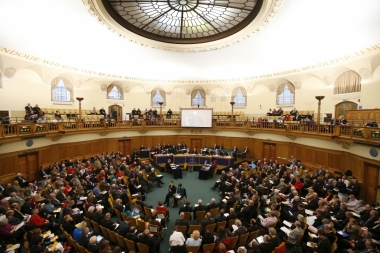
Church of England set to embark on sweeping changes, says Bishop Pete Broadbent

The Church of England will embark on sweeping changes aimed at getting rid of red tape and “hindrances to mission” if plans presented to next month’s General Synod are accepted.

The Church’s task group on ‘Simplification’, chaired by the Bishop of Willesden, Rt Rev Pete Broadbent, has produced a report into out-of-date and restrictive rules. In his introduction, Bishop Pete said that there is “a swathe of legislation – canons, measures and regulations – which are too complex, cumbersome to operate, and militate against change”.

“There has been a tendency over recent years, in framing our legislation, to over-prescribe, to defend against every possible eventuality, and to create a defensive bureaucracy that is in many instances no longer fit for purpose,” he continues, calling for a programme to “Identify the essential – what makes for good governance, proper legality and a clear process” and “Eliminate the rest.”

Among the targets of the report – one of four major pieces of work to go to the Synod – are restrictions on the deployment of clergy, for instance in short-term mission situations, and cumbersome procedures for closing churches and making good use of those which are no longer needed for regular worship. It also takes aim at “unusably generous compensation provisions for loss of office” where parish reorganisations – a process also needing reform – results in ministers being deemed surplus to requirements. At present, it says, “in some cases incumbents may remain in non-viable parishes until retirement, where this is seen as a more cost effective and less time consuming solution than agreeing a compensation package”.

Interviewed for the launch of the report, Bishop Pete said: “We are now in a situation where we need to do mission very urgently, where the re-evangelisation of England is our key task, and where there are a lot of things stopping that, and one of the things stopping it is the very complex and quite defensive bureaucracy that we have in terms of the legislation we operate under.”

Responses from dioceses, he said, had identified ” a lot of complexity which really doesn’t help people in terms of being able to be fleet-footed, and change things and enable things to happen in order for us to reach new ways of communicating the good news of Jesus Christ”.

If nothing changes about the way the Church operates, he said, “I do think we are near the Last Chance Saloon.

“There are parts of the country where the Church of England will probably not be surviving in 30 years time unless we do something to bring new people to church, to re-engage with our communities, to build on the really good stuff that’s already going on.

“No one is saying nothing’s happening. What we’re saying is a sea-change is needed whereby the Church needs to restructure itself in order to evangelise the country.”

Bishop Pete also called for the Synod to move quickly, saying: “I don’t want to get into a situation where we spend all our time debating whether the Church of England needs to change or not. I think it’s absolutely paramount for us to grasp this early and get on with it.”

Source: Christian Today

PEGIDA has spread to some European countries

A growing anti-Islamist group which started in Germany, has spread to a number of European countries, including Spain, Norway and Denmark.

Pegida, which stands for ‘Patriotic Europeans Against the Islamisation of the West’, is primarily concerned with immigration, though the attacks against satirical newspaper Charlie Hebdo in Paris last week seem to have stirred support for the movement in Spain and further afield.

Just a few hundred people gathered for the first march in Dresden in October, but since then the weekly demonstrations on Monday evenings have gathered momentum, most recently attracting up to 25,000 people.

But even higher numbers have attended counter-demonstrations across Germany, including Dresden, Berlin and Cologne. In Dusseldorf this week people reportedly shouted “Pegida you’re racist” as they marched, and the anti-Pegida protest in Leipzig on Monday attracted 35,000 people.

German Chancellor Angela Merkel has strongly condemned Pegida. In an address at the start of the year she said those who led the rallies “have prejudice, coldness, even hatred in their hearts”.

Despite the opposition, Pegida branches have now been set up in a number of European countries. A small Pegida march took place in Oslo, Norway this week and a demonstration is allegedly planned in Denmark on Monday. Other marches planned in Switzerland and Belgium in the coming weeks, according to Al Jazeera.

The Twitter account for the Spanish offshoot opened on the day after Paris attacks, posting pictures of the suspected terrorists. Since then it has gained almost 1,000 Twitter followers and nearly 3,000 Facebook likes.

According to the Pegida Spain Facebook page, the branch had planned to hold its first rally on Monday 12 January, but had to cancel after it was refused permission to demonstrate at the proposed site outside Madrid’s main mosque.

The group sent an email to AFP saying: “We are preparing a demonstration by Pegida Spain, where members of Pegida Germany will attend. We will publish the date on Twitter and announce it by email.”

Other social media accounts suggest there are Pegida-linked groups in the Netherlands and France among others, though these have fewer followers as yet.

On 7 January, the day of the Charlie Hebdo attacks, a ‘Pegida USA’ Twitter account was opened, and now has just over 200 followers. It describes its stance as “Freedom, tolerance, rule of law. Positions of @pegidaUSA may not fully overlap with PEGIDA but are in agreement with stand against totalitarian barbarism.”

In Pegida Germany’s19-point position paper the group claims to support asylum for refugees fleeing war, and religious freedom, including welcoming Muslims who are integrated in German society. But they say they are against Islamist fundamentalism and any hint of Sharia law in Germany, claiming they want to protect Germany’s Judaeo-Christian heritage.

Germany’s immigration figures are second only to the United States, though the eastern city of Dresden, where the protests began, has a relatively small immigrant community.

Source: Christian Today

Attacks on Indian Churches more frequent

Attacks on churches in India appear to be on the rise. Four churches in the the county’s capital have been targeted in the last seven weeks, according to The Times of India.

The most recent attack in New Delhi was on Our Lady of Graces Church. The perpetrator was caught on CCTV breaking glass and toppling a statue of Mary early yesterday morning.

Archbishop Anil JT Couto of New Delhi says that these attacks illustrate a disturbing pattern. Speaking to NDTV, Couto said, “A clear pattern of orchestrated attacks is emerging as more and more churches are targeted, vandalised and set on fire.”

The most serious incident of the four occurred last month, when St Sebastian’s Church in East Delhi was burnt down by attackers. Traces of kerosene were found inside the church premises and police confirm it was a case of intentional arson.

Speaking of the attacks, Archbishop Couto says, “This is very disturbing and we request the authorities to take adequate measures to bring to book the miscreants who are threatening to weaken the social fabric of this great nation.”

Christians in India are not strangers to persecution. This year, the country ranks higher than ever on Open Doors’ World Watch List – a list highlighting the 50 most difficult countries to be a Christian – reaching number 21.

India’s Christians feared a rise in persecution following the election of Narendra Modi and BJP last May. In the first 100 days of the new government’s rule there were over 600 attacks on Christian and Muslim groups, despite promises of greater protection for religious minorities.

Source: Christian Today

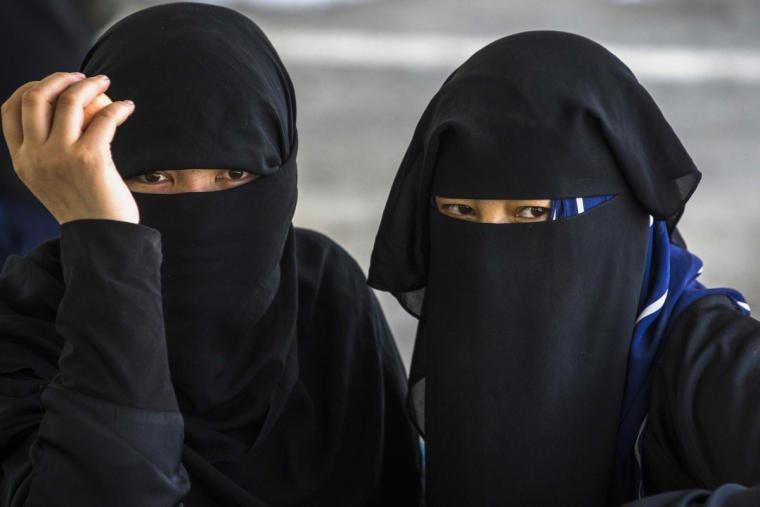
China bans burqa

Women have been banned from wearing the burqa in the capital of Xinjiang province, home to China’s largest Muslim community in an attempt to “curb growing extremism”.

State media announced the ban in Urumqi, a city of 3.1 million people, on Saturday.

“Burqas are not traditional dress for Uygur women,” the statement said. “The regulation is seen as an effort to curb growing extremism that forced Uygur women to abandon their colourful traditional dress and wear black burqas.”

Uyghurs are a predominantly Muslim, Turkic-speaking people, who account for 45.8 per cent of the population in the northwestern region of Xinjiang, according to the 2010 census.

There have been a number of clashes between the Uyghurs and Han Chinese migrants in recent years. The Chinese government has promised to crack down on extremism in Xinjiang, and has blamed extremist terror attacks elsewhere in China on Islamists from this region.

But human rights advocates have said that the government’s laws, which claim to tackle separatism and extremism, have infringed on the rights of the Uyghurs.

The announcement also made reference to the ban on the burqa in France and Belgium, both of which came into force in 2011.

The ban in Urumqi was approved by local government last month, but given the go ahead from regional authorities this weekend, according to CNN.

Source: Christian Today

Warner Bros removes Hillsong musc documentary from schedule

Hillsong’s Christian music documentary ‘Hillsong – Let Hope Rise’ has been pulled from the Warner Bros schedule, according to Variety.

The movie, which is directed by Michael John Warren, follows the journey of Hillsong United – the young Australian group that grew from a megachurch youth ministry to one of the world’s biggest worship bands.

‘Hillsong – Let Hope Rise’ had been scheduled to air on April 1, since last July, but sources report that it has been pulled from its slot.

Worship band Hillsong United has sold more than 16 million albums and plays sell-out concerts worldwide. Its songs include Oceans, From the Inside Out and One Way. The group is led by Joel Houston, son of Brian and Bobbie Houston who founded Hillsong Church in Australia in 1983. More than 100,000 people now attend Hillsong churches in 12 locations around the world.

Warner Bros and Alcon Entertainment, who holds the rights to the documentary, had no immediate comment about the change in schedule, says Variety.

Source: Christian Today


The Catholic priest who doesn’t obey the rule of celibacy

Every Sunday morning, dozens of Roman Catholics gather at a small chapel on an island in the central Philippines to listen to Father Jess Siva share his personal experiences as a priest, and as a parent.

Siva, 54, has been celebrating Mass in the town of Lambunao for the past 15 years, giving communion, performing last rites for the dying, hearing confessions and officiating at marriages.

But while his small flock admire him, Church leaders in the Philippines consider him persona non grata for failing to adhere to one of the most important tenets of the priesthood – abstaining from sex.

“This is a very serious problem within the Church,” Siva, who is the father of two boys from a relationship with a member of his congregation’s choir, told Reuters. “I hope Pope Francis will recognize us.”

Although celibacy is not expected to be directly raised during the Pope’s visit to the Philippines this week, some in the Church hope that the pontiff will in time listen to their pleas for change.

In the Philippines, which accounts for about half of Asia’s Roman Catholics, Siva is not alone. A handful of priests have been asked to leave the priesthood for fathering children.

On January 11 Siva baptized the five-month-old son, and fourth child, of fellow Catholic priest Hector Canto. Siva officiated at Canto’s marriage in 1997.

There are already high hopes the Argentine Pope will change the Church’s traditional approach to issues such as sexual morality by becoming more welcoming to gays and easing restrictions on divorced and remarried Catholics.

Last year, Francis said he believes priests should be celibate but that the rule, which dates back over 1,000 years, could be changed someday.

“Celibacy is not a dogma,” he said when asked by a reporter whether the Church might consider allowing priests to marry as they can in the Anglican, Protestant and Orthodox Churches.

“It is a rule of life that I appreciate very much and I think it is a gift for the Church but since it is not a dogma, the door is always open,” he said.

The Church teaches that a priest should dedicate himself totally to his vocation, essentially taking it as his spouse, in order to help fulfill its mission.

Some have cited celibacy as one reason for the decline in men entering the priesthood.

In Africa, Catholic priests have openly questioned the celibacy rule, saying it is incompatible with their culture. African Archbishop Emmanuel Milingo was famously excommunicated in 2006 for ordaining four married men as priests as part of his group “Married Priests Now”. Milingo himself married a Korean woman.

Africa and Asia have the fastest growing Catholic populations, and today they are home just over a quarter of the world’s more than 1.2 billion Catholics.

The rule of celibacy has also been questioned in the Pope’s own backyard. Last year, 26 women in love with priests in Italy wrote a letter urging him to make celibacy optional, describing the “devastating suffering” it causes.

“YOU ARE ON YOUR OWN”

Siva, who was ordained a priest in 1986 and started living with his partner 12 years later, is making little headway in persuading the Church’s local leadership that it is time to change.

The archdiocese of Jaro, which includes the town of Lambunao, frowns upon his actions, saying the priestly activities of Siva, Canto and another priest, Elmer Cajilig, are “illicit”.

“They are on their own,” Jaro Archbishop Angel Lagdameo told Reuters. “They have violated our rules on celibacy. We do not recognize them.”

But Filipino Catholic bishops have done nothing to stop the ministry of the three priests who have openly violated the Church discipline.

Monsignor Victorino Rivas of the neighboring Archdiocese of Bacolod said cases of priests with families are confidential and that there are no statistics on their numbers.

Siva told Reuters there were two more priests in Iloilo City who may join his self-styled ministry called “Compania de los Padres de Familia” (The Company of Priests with Families).

There are more than 3,000 priests in the Philippines, where about 80 percent of the 100 million population is Catholic.

Celibacy surfaced last year during a bitter battle over a contraceptive law, as supporters of the bill exposed priests who fathered children.

Priests who break the celibacy rule are usually put on sabbatical leave, suspended, transferred, made to undergo “formation”, and advised to leave the priesthood to marry and start a family.

On Sunday, before the Pope’s visit to Asia, Siva and the two other unchaste priests celebrated a mass to dramatize an appeal to him to show “mercy and compassion”, the theme of his pastoral visit to the country.

In many remote communities, residents accept priests who fathered children because of the shortage of clerics. “What’s more important is there is a priest in our village,” said Jeremy David, a member of the Lambunao chapel choir.

Source: Christian Today


Pope Fancis might tackle Philippines work problem

Almost 5,000 Filipinos left their homes every day between 2010 and 2013 to seek work overseas, government data shows, most hoping to provide an education for their children and to meet the most basic needs of their families.

That startling statistic helped make the Philippines one of the world’s largest labour suppliers, mainly to other countries in Asia and the Middle East.

However, the strain of decades of labour migration has come with a significant social cost in Asia’s largest Catholic community and likely will be addressed by Pope Francis during his first visit to the Philippines which starts later today (Thursday).

Francis will meet ordinary Filipinos on Friday, including a migrant worker’s family. About half of the country’s 100 million people have been affected by labour migration.

It is a timely meeting for Francis, who has made defence of vulnerable migrants and workers a central issue of his papacy. At an October synod on the family, he urged bishops to find solutions to the challenges faced daily by families.

“We acknowledge the economic benefits that it brings,” said George Campos, head of Couples for Christ, the largest Catholic family movement in the Philippines.

“But it would not compensate [for] the loss of the parent from the children and the stability of the relationship within the family,” he said.

Between 10 million and 12 million Filipinos live and work overseas. With the average Philippine family comprising five members, that means at least half the population could depend on a relative working overseas sending money home to feed, clothe and educate their families.

Their remittances, which proved resilient during global economic crises, continue setting yearly records and account for about 9 per cent of Philippine GDP.

However, the social costs of such large-scale labour migration include the alienation of parents from their children and the breakdown of families.

Infidelity and marriage annulment cases have risen over the years – there is no divorce in the Philippines – although there are no official figures.

“From experience, the number one problem of couples is infidelity,” said Father Resty Ogsimer, executive secretary of the Catholic Church-based migrant welfare group ECMI.

Cases of workers being duped into human trafficking and prostitution also appear to be on the rise. Ogsimer said Filipinos often fell victim to human trafficking after leaving through unofficial channels via southwestern Zamboanga province on the way to Malaysia and elsewhere.

That is borne out by the case of a 29-year old mother of two who left in June 2012 after a Filipino recruiter and family friend promised her work with a theatre group in Singapore.

The woman, who asked not to be identified, said she was sold as a prostitute in the Johor Bahru region of Malaysia.

She returned to the Philippines a month later, battered and bruised and with an injured knee after she escaped from a walled compound where she was held by her recruiters.

A few months after her return, she separated from her husband, who she said took their youngest child and never returned.

There are more unexpected problems, authorities say, with families becoming accustomed to spending money they would not normally have and workers getting into debt to maintain new-found lifestyles.

The Church acknowledges the problems and ECMI has sought to create ministries helping migrants’ families in Catholic dioceses around the Philippines over the past five years, Ogsimer said.

Cardinal Luis Antonio Tagle said the Church must help children and spouses left behind to keep their families intact.

“It is a pastoral concern,” Tagle said last week.

Source: Christian Today