Westboro Baptist targets Gay Christian Network in anti-gay protest

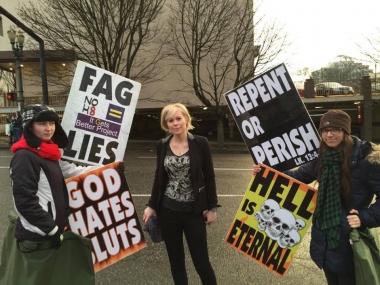
Westboro Baptist Church, which mounts aggressive protests in its campaigns against homosexuality, targeted the Gay Christian Network conference in Portland, Oregon yesterday.

Among the participants was author and worship leader Vicky Beeching, who said on Facebook: “I made sure I said hello to them, told them God loved them & so did I, and that the Gay Christian Network conference had nothing but love and grace to extend to them.”

Elswhere she wrote, “Was a pretty unpleasant environment to walk through, right before I spoke, but thankfully these loud angry people are not representative of most Christians.”

Other Christians from Portland formed a protective screen for the participants, numbering around 1,300 lesbian, gay, bisexual and transgender Christians.

OregonLive quoted Tony Kriz, an evangelical author, as saying: “I’m not comfortable with hate of any kind in my city. It has nothing to do with what you believe morally. Everybody needs to know they are loved.”

In her address to the conference Beeching said that “Christianity is less of a fixed, concrete faith and more about a relationship with a God who is alive and living” and “Our theology has become so systematised, so categorised, it can feel less like a living thing and more like … taxidermy.”

She also said, “I love Jesus as much as I ever have. And I’m gay. Deal with it.”

Source: Christian Today

Matthew Ashimolowo: The Lord showed me who will win Nigeria’s forthcoming election

Matthew Ashimolowo, the Nigerian-born senior pastor of London’s giant Kingsway International Christian Centre (KICC) has claimed to know the results of Nigeria’s forthcoming election.

Interviewed by Nigeria’s Sunday Sun newspaper, Ashimolowo warned of a “shaking of the world” in 2015. He said: “For Nigeria, the Lord showed me who will win the election. I will not men­tion his name, because I have to be politically neutral.”

He said that in spite of the deep divisions within the country, the country would remain united. “For us to have many nations that make up Nigeria, it was God that made it happen. And that prophetic mandate still remains on Nigeria. Anyone who incites people to di­vide this nation will lose his chance. Nigeria will remain one.”

He also claimed to know of a future leader who would transform the country, saying: “I see a man who will one day rise, but I don’t know when … He will turn the fortunes of Ni­geria round. Nigeria will look like one of these advancing nations like United Arab Emirates, India, and China. That is how Nigeria will be.”

Ashimolowo also warned of the power of the Boko Haram insurgency. “Boko Haram is a snake with many heads,” he said. “We are cutting one head, which is why the other head shows up. ”

He called for a “robust approach”, saying: “We need to deal with fifth columnists in the sys­tem who are empowering them.” Supporters within the country itself were “selling Nigeria to them, giving them petrol, money and ammunition”. He said: “Our prayer should be that our government will be bold enough to indict the fifth columnists, either inside the system or outside the system.”

Ashimolowo, 62, was born in northern Nigeria, came to England 31 years ago and started KICC 23 years ago. He was in Nigeria hosting the ninth annual event the church has run for widows in his home town of Odeomu in Osun State; around 4,000 will benefit from a distribution of clothing, food and financial assistance.

KICC also supports college students through providing scholarships and has received Nigerian government permission to found a university.

The claims to have worshippers from 46 nations and has acquired a 24-acre site in Chatham as its new headquarters. It has twice been investigated by the Charity Commission over financial irregularities.

Source: Christian Today

Boko Haram strapped explosives to 10-year-old girl, 16 killed, more than 20 injured

A bomb strapped to a girl aged around 10 years old exploded in a busy market place in the Nigerian city of Maiduguri on Saturday, killing at least 16 people and injuring more than 20, security sources said.

“The explosive devices were wrapped around her body and the girl looked no more than 10 years old,” a police source said.

Maiduguri, the capital of northern Borno state, lies in the heartland of an insurgency by Islamist militant group Boko Haram, and is often hit by bomb attacks.

A Nigerian security source said the bomb went off at 12:15 pm. The girl was killed and the bodies of at least 16 victims were counted in one hospital by mid-afternoon, civilian joint task force member Zakariya Mohammed told Reuters.

“Right now, there are 27 injured people in Borno Medical Hospital, while more were taken to other hospitals,” he said.

The northeastern states of Borno, Yobe and Adamawa are bearing the brunt of a five-year-old insurgency by Boko Haram, which wants to revive a mediaeval caliphate in Nigeria, Africa’s most populous country and its biggest energy producer.

Last year more than 10,000 people died in the violence, according to an estimate by the Council on Foreign Relations.

About 130 km (80 miles) away in the Yobe state capital Damaturu, the army subdued an Islamist militant attack on Friday evening, but not before militants had torched several buildings, a Reuters reporter in the city and witnesses said.

The Reuters witness saw a number of burnt buildings, including a police station and a mosque in the Abacha market, along with several shops.

Defence spokesman Major General Chris Olukolade said that five soldiers were wounded defending the city and the number of civilian casualties was still being determined.

Damaturu was last attacked in early December when air strikes called in to halt advancing militants.

Olukolade said the military would regroup before mounting an effort to retake the town of Baga in Borno state raided twice by Boko Haram in the last week. The insurgents also took over a nearby military base on the edge of Lake Chad.

He said 14 soldiers had been killed in the first attack at last weekend. On Friday, the government said it had launched ground action backed by airstrikes to reclaim the area.

On Saturday afternoon, a bomb exploded at the main police station in the town of Potiskum in Yobe state after a man was arrested and brought to the station with his car, the state police commissioner said.

“We took the suspect to the station and the car…exploded and killed one of my men and a driver. The suspect did not die…he is still in our custody,” Marcus Danladi told Reuters.

Residents who witnessed the scene said earlier two people had been arrested with the vehicle and blew themselves up once inside station.

The Boko Haram revolt is seen as the gravest security threat facing Nigeria, a country of 170 million people, and a serious challenge for President Goodluck Jonathan, who is seeking re-election in a national election set for February 14.

Source: Christian Today

Church faces discrimination in a town, case now in US Supreme Court

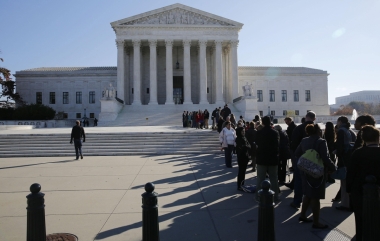
The US Supreme Court will today take up a new religious rights case when it considers whether a town in Arizona discriminated against a local church by forcing it to remove signs notifying the public of its worship services.

The nine justices are set to hear a one-hour argument in an appeal filed by the Good News Community Church, which objected to its treatment by town officials in Gilbert, Arizona. The church says its free speech rights, protected by the US Constitution’s First Amendment, were violated.

The conservative-leaning court’s last decision on a religious-themed issue came last June. The justices ruled 5-4 that owners of private companies can object on religious grounds to a provision of President Barack Obama’s signature healthcare law that requires employers to provide insurance covering birth control for women.

The Arizona case is not as contentious, with the town receiving little support and the Obama administration backing the church.

The church’s leader, Pastor Clyde Reed, says the town’s 2008 sign ordinance treated religious messages differently than other types of signs. The ordinance has different categories, based on content, that determine the size of the sign, where it can be placed, and how long it can be displayed.

The church’s signs were deemed to be event signs, which meant they received “far worse treatment” than other types, including those displaying political and ideological messages, its lawyers said.

The town’s lawyers asked the court not to hear the case, in part because a new, less restrictive ordinance was enacted in 2011.

The church is represented by the Alliance Defending Freedom, a conservative Christian group.

Solicitor General Donald Verrilli, the Obama administration’s top Supreme Court lawyer, said in court papers that the ordnance was clearly unconstitutional because it favors one type of speech over another.

The only supporters for the town are local government groups such as the National League of Cities that say in court papers the Gilbert ordnance was legal in part because the restriction imposed on the church was the same one that other churches and civic groups advertising public events were bound by.

The Supreme Court will review a February 2013 ruling in which the 9th US Circuit Court of Appeals rejected the church’s challenge.

A ruling is expected by the end of June.

The case is Reed v Gilbert, US Supreme Court, No. 13-502.

Source: Christian Today

Dozens of world leaders join hundreds of thousands in Paris solidarity march

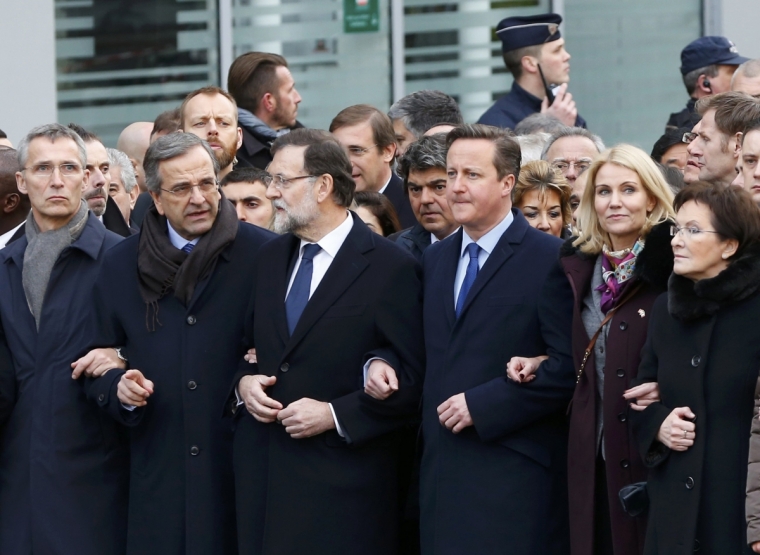
Dozens of world leaders including Muslim and Jewish statesmen linked arms leading hundreds of thousands of French citizens in an unprecedented march under high security to pay tribute to victims of Islamist militant attacks.

President Francois Hollande and leaders from Germany, Italy, Israel, Turkey, Britain and the Palestinian territories among others, moved off from the central Place de la Republique ahead of a sea of French and other flags. Giant letters attached to a statue in the square spelt out the word Pourquoi?” (Why?) and small groups sang the “La Marseillaise” national anthem.

Some 2,200 police and soldiers patrolled Paris streets to protect marchers from would-be attackers, with police snipers on rooftops and plain-clothes detectives mingling with the crowd. City sewers were searched ahead of the vigil and underground train stations around the march route are due to be closed down.

The silent march – which may prove the largest seen in modern times through Paris – reflected shock over the worst militant Islamist assault on a European city in nine years. For France, it raised questions of free speech, religion and security, and beyond French frontiers it exposed the vulnerability of states to urban attacks.

Two of the gunmen had declared allegiance to al Qaeda in Yemen and a third to the militant Islamic State.

“Paris is today the capital of the world. Our entire country will rise up and show its best side,” said Hollande in a statement.

Seventeen people, including journalists and police, were killed in three days of violence that began with a shooting attack on the weekly Charlie Hebdo known for its satirical attacks on Islam and other religions as well as politicians. It ended on Friday with a hostage-taking at a Jewish deli in which four hostages and the gunman were killed.

Overnight, an illuminated sign on the Arc de Triomphe read: “Paris est Charlie” (“Paris is Charlie”).

Several London landmarks including Tower Bridge were due to be lit up in the red white and blue colours of the French national flag in a show of support for the event in Paris. Fifty-seven people were killed in an Islamist militant attack on London’s transport system in 2005.

Hours before the march, a video emerged featuring a man resembling the gunman killed in the kosher deli. He pledged allegiance to the Islamic State insurgent group and urged French Muslims to follow his example.

DISSENTING VOICES

“We’re not going to let a little gang of hoodlums run our lives,” said Fanny Appelbaum, 75, who said she lost two sisters and a brother in the Nazi concentration camp at Auschwitz‎. “Today, we are all one.”

Zakaria Moumni, a 34-year-old Franco-Moroccan draped in the French flag, agreed: “I am here to show the terrorists they have not won – it is bringing people together of all religions.”

Among many children brought along to the march, Loris Peres, 12, said: “For me this is paying respect to your loved ones, it’s like family … We did a lesson about this at school.”

German Chancellor Angela Merkel, British Prime Minister David Cameron and Italy Prime Minister Matteo Renzi were among 44 foreign leaders marching with Hollande. U.N. Secretary-General Ban Ki-moon, Israel’s Benjamin Netanyahu – who earlier encouraged French Jews to emigrate to Israel – and Palestinian President Mahmoud Abbas were also present.

Immediately to Hollande’s left, walked Merkel and to his right Malian President Ibrahim Boubacar Keita. France has provided troops to help fight Islamist rebels there.

In a rare public display of emotion by two major-power leaders, cameras showed Hollande embracing Merkel, her eyes shut and forehead resting on his cheek, on the steps of the Elysee before they headed off to march.

After world leaders left the march, Hollande stayed to greet survivors of the Charlie Hebdo attack and their families.

While there has been widespread solidarity with the victims, there have been dissenting voices. French social media have carried comments from those uneasy with the “Je suis Charlie” slogan interpreted as freedom of expression at all cost. Others suggest there was hypocrisy in world leaders whose countries have repressive media laws attending the march.

The official estimate on attendance is due to be announced later. A 1995 protest against planned welfare cuts brought some 500,000-800,000 people onto the streets of the capital, while a 2002 rally against the far-right National Front’s then leader Jean-Marie Le Pen afer he got into the run-off of that year’s presidential election drew 400,000-600,000.

Twelve people were killed in Wednesday’s initial attack on Charlie Hebdo, a journal know for satirising religions and politicians. The attackers, two French-born brothers of Algerian origin, singled out the weekly for its publication of cartoons depicting and ridiculing the Prophet Mohammad.

All three gunmen were killed in what local commentators have called “France’s 9/11”, a reference to the September 2001 attacks on US targets by al Qaeda.

The head of France’s 550,000-strong Jewish community, Roger Cukierman, the largest in Europe, said Hollande had promised that Jewish schools and synagogues would have extra protection, by the army if necessary, after the killings.

France’s Agence Juive, which tracks Jewish emigration, estimates more than 5,000 Jews left France for Israel in 2014, up from 3,300 in 2013, itself a 73 percent increase on 2012.

Far-right National Front leader Marine Le Pen, whom analysts see receiving a boost in the polls due to the attacks, said her anti-immigrant party had been excluded from the Paris demonstration and would instead take part in regional marches.

In Germany, a rally against racism and xenophobia on Saturday drew tens of thousands of people in the eastern German city of Dresden, which has become the centre of anti-immigration protests organised by a new grassroots movement called PEGIDA.

A building of the newspaper Hamburger Morgenpost, which like many other publications has reprinted Charlie Hebdo cartoons, was the target of an arson attack and two suspects were arrested, police said on Sunday.

Turkish and French sources said a woman hunted by French police as a suspect in the attacks had left France several days before the killings and is believed to be in Syria.

French police had launched in an intensive search for Hayat Boumeddiene, the 26-year-old partner of one of the attackers, describing her as “armed and dangerous”.

Source: Christian Today
Pope Francis Asia visit

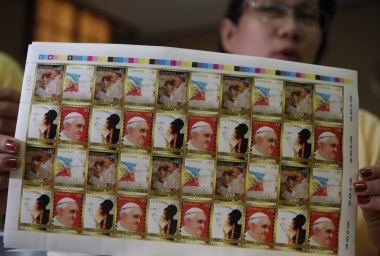
Pope Francis will return to Asia for the second time in less than six months, travelling to Sri Lanka and the Philippines this week to underscore his concern for inter-religious dialogue, poverty and the environment.

Security will be a main issue in both countries, particularly in the Philippines, Asia’s only majority Catholic country, where up to 6 million people are expected to attend an outdoor Mass on January 18.

Up to 40,000 police, troops and reservists will take part in what military chief General Gregorio Catapang has called the country’s biggest ever security operation.

“There will be soldiers rappelling up and down helicopters to rescue the Pope in case he will be pinned down by a sea of people. We may airlift or use naval boats to bring the Pope to safety if necessary,” he said.

When Pope John Paul II visited Manila in 1995, security perimeters were breached and he had to be taken by helicopter to a Mass site because his car could not get through a sea of some 5 million people.

One theme of the Jan 12-19 trip will be climate change. During his stay in the Philippines he will visit Tacloban, where Typhoon Haiyan killed 6,300 people in 2013.

Sri Lanka is among the Asian countries experts say will see sea level rises likely to displace people and adversely affect tourism and fisheries.

The Vatican says Francis, who is preparing an encyclical on the environment, will speak about the issue several times.

While Pope John Paul II made a number of trips to Asia – visiting both countries in 1995 – Francis’ immediate predecessor Benedict, who resigned in 2013, made none to a region the Vatican sees as a potential growth area.

“We have to recover the presence of a Pope in this preponderant area of humanity,” Vatican spokesman Father Federico Lombardi said. Only about three per cent of people in the region are Catholic.

“This continent in many ways represents a frontier for the Church,” said Father Antonio Spadaro, editor of the Italian Jesuit magazine Civilta Cattolica. “Inter-religious dialogue is tested every day and young Churches there are growing”.

SURPRISE ELECTION

The 78-year-old arrives on Tuesday morning in the Sri Lankan capital, Colombo, days after President Mahinda Rajapaksa lost his bid for a third term, ending a decade of rule that critics say had become authoritarian and marred by nepotism and corruption.

Lombardi said he hoped the surprise election result in the former British colony would not give rise to any “inconveniences that will affect the serenity and tranquillity of the trip”.

The main purpose of the three-day stop in Sri Lanka is to canonise Joseph Vaz, a Catholic priest credited with rebuilding the Church there in the 17th and 18th centuries after Dutch occupiers imposed Calvinism as the official religion.

The Indian Ocean island nation is about 70 per cent Buddhist, 13 per cent Hindu, 10 per cent Muslim and only about seven per cent Catholic. Francis will stress the need for worldwide inter-religious dialogue, and, speaking after the recent attacks in France, again condemn the concept of violence in God’s name.

He will also preach a message of reconciliation during a visit to Madhu, in the north, that was the centre of a 26-year civil war that ended with the defeat of ethnic Tamil rebels in 2009.

Vatican officials say that despite its minority status, the Church in Sri Lanka can help reconciliation because it includes members of both ethnic groups – Sinhalese and Tamil.

Francis arrives on Thursday in the Philippines, where more than 80 per cent of people are Catholic.

One main topic in the former Spanish colony will be the effect of immigration on the family. The search for jobs outside the country – mostly in domestic work – has put strains on many families.

Source: Christian Today

A cafe in the Lebanese city of Tripoli hit by suicide bomb attack

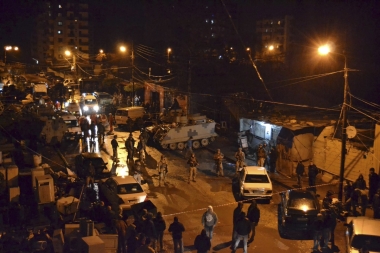
A suicide bomb attack on a cafe in the Lebanese city of Tripoli killed at least seven people on Saturday, the latest violence to hit a region repeatedly buffeted by conflict linked to the civil war in neighbouring Syria.

The Nusra Front, al Qaeda’s official affiliate in the Syrian civil war, said it carried out the double suicide attack in the predominantly Alawite district of Jabal Mohsen “in revenge for the Sunnis in Syria and Lebanon”. The statement appeared on a Twitter feed operated by the group’s media arm.

Lebanon’s National News Agency gave the names of two suicide attackers it said were from Tripoli, an overwhelmingly Sunni Muslim city whose long-standing sectarian tensions have been exacerbated by the Syrian civil war.

Lebanon’s Health Ministry said the attack killed seven people. Other officials put the death toll at nine. Three dozen people were wounded.

Prime Minister Tammam Salam said in a statement the attack was “a new attempt to spread the seeds of strife” in Tripoli and would not “weaken the determination of the state and its decision to confront terrorism and terrorists”.

The army said the attack was carried out by a lone suicide bomber, though its investigations were still under way. The National News Agency said the second bomber had blown himself up as people gathered in response to the first blast.

Lebanon’s security has been repeatedly jolted by the Syria crisis, which has also helped paralyse its government: the country has been without a head of state since May.

Tripoli, Lebanon’s second biggest city, has historically been a bastion for Sunni Islamist groups, making it a concern for Lebanese security agencies that have warned of plans by Islamic State and the Nusra Front to destabilise the country.

Militants linked to Islamic State and the Nusra Front mounted an attack on the Lebanese border town of Arsal last August. They are still holding around two dozen members of the security forces taken captive in that incursion.

CALLS FOR UNITY

The last major flare-up in Tripoli was in October, when at least 11 soldiers and 22 militants were killed in fighting between Sunni Islamists and the army.

The targeted cafe was on a street dividing Jabal Mohsen from the Sunni district of Bab al-Tabbaneh, which has often turned into a frontline for conflict between Sunni and Alawite communities over the years, particularly since Syria’s civil war erupted – pitting the government of President Bashar al-Assad, an Alawite, against an insurgency dominated by Sunni Islamists.

But its communal tensions were eased by a security plan brought into force last year.

Leaders from across Lebanon’s political divide called for unity. The powerful Shi’ite group Hezbollah, which is fighting alongside the government in Syria, responded to the attack by saying terrorist groups must be isolated.

It urged the people of Jabal Mohsen, whose Alawite sect is an offshoot of Shi’ite Islam, not to “be dragged towards reactions that would achieve the criminals’ vile aims”.

Former prime minister Saad al-Hariri, an influential Lebanese Sunni politician backed by Saudi Arabia, said the attack aimed to fuel discord in Tripoli.

Source: Christian Today

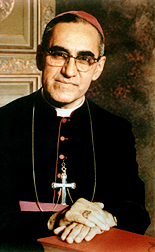
Oscar Romero recognised as a true martyr, says Vatican

Murdered Salvadoran Archbishop Oscar Romero has edged closer to sainthood after a panel of theologians voted unanimously to recognise him as a martyr.

According to the Catholic News Service, the Italian newspaper Avvenire reported yesterday that the panel advising the Vatican’s Congregation for Saints’ Causes declared that the archbishop had been killed “in hatred for the faith”.

Romero was killed on March 24, 1980, as he celebrated mass in a hospital in San Salvador. His death came the day after he had publicly called for soldiers to lay down their guns and end government repression. No one has been charged or convicted of his murder, though a death squad led by former Major Roberto D’Aubuisson is suspected of the killing.

Originally chosen as a conservative figure, he became increasingly horrified by the actions of the Salvadoran government during the country’s vicious civil war and spoke out against poverty, social injustice, assassinations and torture.

His sainthood cause was opened in 1993 but stalled over political questions: Pope Benedict XVI told reporters in 2007 that the archbishop was “certainly a great witness of the faith” who “merits beatification, I do not doubt.” But he said some groups had complicated the sainthood cause by trying to co-opt the archbishop as a political figure.

Romero’s cause will now go to the Congregation for Saints’ Causes, which advises the Pope on beatifications. Pope Francis has previously signalled his support for Romero’s cause.

Source: Christian Today

Franklin Graham defends Kelvin Cochran firing, saying it was ‘politically correct bullying’

Franklin Graham has sprung to the defence of former Atlanta fire chief Kelvin Cochran, sacked because he wrote a book stating traditional Christian beliefs about marriage and homosexuality.

In an opinion piece for Charisma News, the leading evangelical accused the city of “politically correct bullying”, saying: “The book on biblical morality simply restates God’s position put forth in His Word, the Bible.”

He paid warm tribute to Cochran, saying: “I personally know Chief Cochran. He served as chairman of my Crusade in Shreveport in 2005. He is a fearless man of great faith.”

The book was brought to the attention of Atlanta city council member Alex Wan, who is gay. Graham said: “Because Cochran expressed his biblical belief on sexual purity in general—not only on homosexuality—an openly gay city council member went on a rampage to discredit this upstanding servant of the community. Cochran didn’t discriminate against anyone, he didn’t persecute anyone for homosexuality or create a hostile work environment. Instead he was persecuted and denied his career because of his privately held religious beliefs. This is true discrimination.”

He concluded: “The LGBT community wants us to be afraid of expressing our Christian beliefs. They want us to cower in the face of their threats to the livelihoods of believers. But we shouldn’t back down!”

Cochran self-published the 162-page book last year entitled Who Told You That You Are Naked?, aimed at helping men overcome feelings of guilt over past sins. It defines ‘uncleanness’ as the “opposite of purity; including sodomy, homosexuality, lesbianism, pederasty, bestiality, and all other forms of sexual perversion”. It discusses homosexuality in half a page.

Cochran is a deacon, Sunday School teacher and Bible study leader at Atlanta’s Elizabeth Baptist Church.

Atlanta’s Mayor Kasim Reed said at a press conference about the sacking: “Despite my respect for Chief Cochran’s service, I believe his actions and decision-making undermine his ability to manage our fire department.

“Every single employee under the fire chief’s command deserves the certainty that he or she is a valued member of the team and that fairness and respect guide employment decisions. His actions around the book and his statements during this investigation have eroded my confidence in his ability to convey that message.”

Source: Christian Today

Andraé Crouch impacts on Gospel Music

I knew people had been praying for Andraé Crouch, and we reported as recently as Saturday that Andraé was doing better after he was admitted to the hospital for serious health complications. So it was a shock to learn that he died in Los Angeles on Jan. 8 at 4:30 PM PST.

I was a huge fan of Andraé Crouch’s music going back to my teenage years when he was just emerging on the music scene. In my early 20s, while a reporter with the Orlando Sentinel, I had the opportunity to interview him—which for me was a highlight.

He had come to Orlando to sing at a concert sponsored by the Rock House youth ministry, of which my wife and I were a part. After that interview, we were able to share a meal with him and his twin sister, Sandra. I found him to be humble—almost timid behind the scenes. From his music and his demeanor it was clear he really loved Jesus.

Some of his songs such as “To God Be the Glory” have almost become anthems they are so well known. I especially like “The Blood Will Never Lose Its Power.” I’ve been to many communion services where that was the song that was sung as we thought about the Lord’s body and blood.

His impact on Gospel music cannot overestimated. He was a crossover artist who made the black Gospel music sound part of Contemporary Christian music mainstream.

His songs have been recorded by everyone from Elvis Presley to Paul Simon, and he has worked as a producer and arranger with many of music’s top artists including Michael Jackson, Madonna, Quincy Jones, Diana Ross, Elton John and many others. Andraé can also be heard on Michael Jackson’s hit singles “Man in the Mirror,” “Keep the Faith,” “Will You Be There” and “Earth Song.”

I didn’t have a lot of interaction with him the last few years of his life, but we did cover some of the ups and downs of his life, including a cover story in 1998 which you can read by clicking here.

In the 1980s, the police stopped him in Los Angeles for an unspecified reason and found a vial on him. In an interview with todayschristianmusic.com, Crouch said he had never done drugs, but the story says he was detained for 10 hours before posting bail

Whether his account of the situation was true or not, I know that Andraé had been going through a difficult part of his life and that instance was a real wake-up call for him to get things right.

Andraé grew up in the Church of God in Christ, a well-respected Pentecostal denomination. He told a story on how as a child someone prayed for him to receive the gift of music, and he actually learned to play the piano without ever having taken lessons. His father, Bishop Benjamin Crouch, was highly respected in COGIC. When he died in 1993, Andraé became the pastor of his father’s church along with his twin sister, Sandra. The church in Los Angeles thrived under his leadership.

I have one of Andraé’s most recent albums, Mighty Wind, on my iPod, and I listen to it regularly. There is a certain song that he sings about coming home on track No. 10.

You may have some problems and life might be so confusing. But when you come home, God is gonna fix it for you.” The lyrics could have been taken as his own testimony about that difficult time.

Yet today as I listened to the song, I could imagine that Jesus must have been saying to Andraé:  “Come home. Please come home. The door is always open and the family is waiting. We’ve been waiting for you to come home.”

Andraé Crouch is home with the Savior he loved and served so well.

Source: Charisma News