people queue to buy Charlie Hebdo magazine

The latest issue of Charlie Hebdo magazine has gone on sale today, with bids on eBay now surpassing hundreds of pounds.

One listing for the special edition, the cover of which depicts the Prophet Muhammad holding a ‘Je suis Charlie’ sign under the banner “Tout est pardonné – All is forgiven – has reached a bid of over £1,500.

Five million copies are being printed to cope with the increased demand following last week’s shootings – far more than its usual circulation of 40,000. Newstands in France are selling copies for €3, and long queues have formed with those keen to get their hands on the magazine.

The edition is the first to be released since 12 people were killed when armed gunmen opened fire at the offices of the satirical magazine in Paris last Wednesday. It is believed that the attack was in response to controversial images published by the newspaper depicting the Prophet Muhammad, which is forbidden in Islam.

The shooting, and the deaths of five more people in related attacks, prompted rallying cries of “Je suis Charlie” and a call to protect freedom of speech. Hundreds of thousands of people joined world leaders in a march to pay tribute to the victims on Sunday.

As expected, however, the magazine’s latest edition has drawn some criticism for choosing to publish another potentially insulting cartoon.

David Cameron yesterday defended the decision, saying “When your freedom of expression is attacked in this way I don’t think it is surprising people want to stand up and fight for the freedom of expression they believe in.”

Speaking in an interview with Heart Radio, Cameron continued: “I think it’s right that we all hold that view even if [there are] people – and there will be many Muslims – who are offended by a depiction of the Prophet.”

Cameron added that offence is “not a justification for violence”, noting that “the overwhelming majority of Muslims completely understand and share that view.”

“I’m a Christian. I obviously don’t like seeing the religious things I hold dear mocked in an unpleasant way. But in a free country if people want to attack my religion and my beliefs you accept that because that’s part of living in a free country,” he said.

“It’s not for politicians to tell magazines or television stations or radio stations what they should publish or what they shouldn’t publish.

“It’s up for us to defend your right to publish what you believe is right within the confines of the law.”

The Muslim Council of Britain has issued guidelines as to how to respond to the newest cartoon. “Most Muslims will inevitably be hurt, offended and upset…But our reaction must be a reflection of the teachings of the gentle and merciful character of the Prophet (peace be upon him),” the Council has advised.

“Enduring patience, tolerance, gentleness and mercy as was the character of our beloved Prophet (peace and Blessings be upon him) is the best and immediate way to respond. With dignified nobility we must be restrained.”

Source: Christian Today


BOKO HARAM AGAIN

Boko Haram’s attack in Baga, Borno State, which killed hundreds, possibly thousands, on 3 January has once again drawn attention to the Islamist militant group that has been terrorising northern Nigeria for more than five years.

The group is responsible for the deaths of approximately 9,000 people in total, according to the Council on Foreign Relations‘ Nigeria Security Tracker, though estimates vary and this number does not include January’s attack. The Nigerian government has said there were 150 deaths in the Baga attack, but other reports suggest it was as many as 2,000. Amnesty International has said it could be the group’s deadliest attack to date.

Boko Haram’s international profile rose dramatically after the abduction of more than 250 schoolgirls from Chibok village, Borno state in April 2014, leading to the worldwide #BringBackOurGirls campaign. But these girls, most of whom are yet to be found, are just a fraction of the number of people Boko Haram has captured in the past couple of years. 40 young men were reportedly taken from Malari village in the northeast on 31 December 2014.

WHAT IS BOKO HARAM?

The name ‘Boko Haram’ roughly translates as “western education is sinful”, although its full name, which is rarely used (Jama’atu Ahlis-Sunnah Lidda’awati Wal Jihad) is Arabic for the “Sunni Community for the propagation of the Prophet’s Teachings and Jihad”.

Islamism, roughly defined, is a political form of Islam, though there are many different strands, including both militant and peaceful forms. It is often fused with a strongly anti-Western position, rejecting the perceived immorality of the West. While many Muslims would want to see some influence of Sharia in governance, Islamists seek to entirely replace secular governance with Sharia law.

Boko Haram claims to seek to establish an Islamic state, overthrowing western involvement in government and society, particularly education. The majority of those killed have been Muslims and young men, though its anti-western ideology also makes it strongly opposed to Christianity. And while religious ideology is one motivation, it is not the only one; there are sectarian divisions, inequality and corruption which create an environment for such groups to thrive.

WHO ARE THEY?

It has become more prominent since 2009, when the current leader Abubakbar Shekau came to power. Before then it operated as a less violent religious movement, which was less concerned with overthrowing the government.

Originally formed in 2002 under the Islamist cleric Mohammed Yusuf, then group was based at a headquarters in Madiguri, the capital of Borno State. It had approximately 10,000 followers in north-eastern Nigeria, as well as neighbouring Cameroon and Niger, many of whom were clerics and students.

Amid growing sectarian tensions, an uprising in July 2009 saw an outbreak of fighting between Boko Haram and Nigerian security forces. Yusuf was killed by the national forces, along with a number of members of the group, in what has been described by Human Rights Watch as an extra-judicial execution. His body was left on public display and shown on Nigerian state television in a display of strength over the group.

But it wasn’t long before it became clear that the threat had not passed, only become more violent. According to international affairs think tank Chatham House, the movement fragmented into smaller groups, and radical violent elements suppressed the more moderate, peaceful members of the original sect. One particularly notable splinter group emerged in 2011, known as Ansaru. It has since become a terrorist group in its own right, distinguishing itself from Boko Haram by attacking international targets, and may have formed connections to Al-Qaeda in the Islamic Maghreb.

The now more militant Boko Haram group is led by a man who claims to be Abubakbar Shekau, though there have been numerous rumours that he is dead.

Since Shekau came to power the group’s attacks have moved beyond Borno into neighbouring Yobe and Gombe states and occasional attacks in the south of the country. There have been numerous suicide bombings as well as attacks on churches – something that had not previously been done.

In August 2011, the group attacked the United Nations building in the Nigerian capital, Abuja, killing 23 people. In 2012, Boko Haram assisted another militant group who had abducted French hostages, although these attacks on foreign citizens do not appear to be core to the group’s purpose.

In January 2012 Shekau gave Christians in northern Nigeria an ultimatum to convert to Islam or to leave, in keeping with the group’s aims to establish an Islamic state.

It was listed as a terrorist organisation by the United States in 2013. In May the same year the Nigerian government declared a state of emergency in Borno state, which has since been extended to Yobe and Adamawa states.

According to Chatham House, the terror organisation had moved into a new phase in 2014, which demonstrated a growth in confidence. The think tank estimates that there are now between 6-8,000 members, up from 4,000 in 2009, with 15,000 Nigerian army soldiers based in Borno state trying to combat them.

But despite the presence of Nigerian forces, in August 2014 Shekau declared a caliphate in the region it controls in Yobe and Borno states, an area of about 20,000 square miles, according to the Telegraph. There are suggestions that Boko Haram has been influenced by Islamic State in Iraq and Syria, who declared a caliphate in that region in June 2014, driving hundreds of thousands from their homes in northern Iraq.

2015: ELECTIONS

There are fears that religious tensions will intensify in the run-up to the election in February and possible violence after the vote, the International Crisis Group reports. The two major parties are the ruling People’s Democratic Party (PDP), led by Christian President Goodluck Jonathan, and the All Progressives Congress (APC), whose key figures are all from the majority-Muslim north, although political parties have been warned not to politicise religious differences. Another concern is that the state of emergency in three north-eastern states could prevent people in that region from being able to vote, which would make the vote unrepresentative and possibly unconstitutional.

The President has faced significant criticism for his failure to suppress Boko Haram, and the Nigerian government is suspected of underestimating the numbers killed in attacks to downplay the threat. But January’s attack on Baga has thrown the militant group back into the international media spotlight, and Jonathan will face pressure at home and abroad to prevent it from further gaining in strength.

The current focus is on short-term security in order to allow the elections to happen as peacefully as possible, but the new president will need to look to long-term options, such as how to improve the military response in the northeast, as well as looking to structural changes that could foster peace and prevent interminable conflict.

Source: Christian Today

Pastor causes outrage he stops funeral for a gay woman

The pastor of a Colorado church caused outrage when he stopped a funeral for a lesbian woman after realising that a video tribute to her life showed her with her female partner Christina Higley.

Vanessa Collier, 33, died in a shooting incident which police say may have been suicide. She had two daughters, aged seven and 11. Her funeral service was held at the New Hope Ministries church in Lakewood, whose Pastor Ray Chavez – who was not officiating at the service – called a sudden halt to the proceedings after about 15 minutes.

The congregation of several hundred moved across the road to a funeral parlour and concluded the service there.

However, Pastor Chavez has been widely criticised for his actions and protesters gathered outside the church yesterday chanting slogans and carrying banners labelled “Dignity in Death”, “Bury the Dead” and “Love Trumps All”.

Higley wrote on Facebook: “Vanessa’s services were NOT refused because she is a ‘lesbian’. Her services were refused because we would not let New Hope Ministries ‘edit’ her life which was a slideshow of our family photos including our engagement and family photos of her and I with our two children! It never crossed my mind that it would be an issue considering we paid to use their facility ONLY. We brought in our own Pastor to facilitate. I would completely understand if we were asking to be married there and it be a conflict of interest.

“I’m not asking anyone to go against their own beliefs and religion. I only hoped we could find a house of God to celebrate my beautiful wife and her life (HER WHOLE LIFE) and lay her to rest in God’s arms … I lost my best friend, the love of my life and our children lost their mother!
“How would Ray Chavez explain to them why our family photos were inappropriate for her services to be conducted in that house of God?
“PLEASE I AM BEGGING ANYONE TO HELP EXPLAIN TO OUR CHILREN WHY OUR LIFE TOGETHER AS A FAMILY IS ANY LESS THAN ANYONE ELSES AND INAPPROPRIATE IN A HOUSE OF GOD???”

The family has not been reimbursed by the church for the cost of the booking.

The church has issued no statement on the incident and declined to comment when invited to do so by journalists.

Source: Christian Today

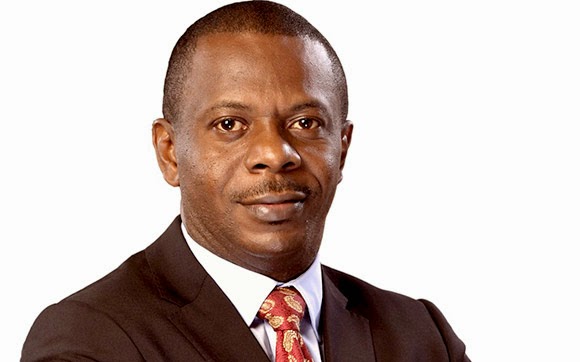
Pastor Poju Oyemade ready to get married in 2015

Finally the Senior Pastor of Covenant Christian Centre, Pastor Poju Oyemade, has announced that he is finally getting married.

He made this revelation in one of his services on Sunday recently and the congregation went wild with joy as it seems they have been waiting for this moment.

However the Senior Pastor is still keeping the name of the bride secret.  It is expected that this marriage might take place early this year

Source: Christian Media In Nigeria

YouVersion reveals Nigeria’s most popular Bible verse in 2014 – Philippians 4:8

Finally, brothers and sisters, whatever is true, whatever is noble, whatever is right, whatever is pure, whatever is lovely, whatever is admirable—if anything is excellent or praiseworthy—think about such things.

YouVersion, the popular Bible App, revealed that the passage above is the application’s verse of the year, being the most bookmarked, highlighted, and shared verse in Nigeria for the year 2014.

It also announced that the most popular verse in the world is Romans 12:2.
The app, which has been installed more than 162 million times since 2008, also identified the most popular verses in other countries such as United Kingdom, United States of America and many more.

Through the app, the Bible is available in more than 740 languages—350 of which were added this year—and in more than 1050 versions.

According to Bobby Gruenewald, founder of the Bible App,  “At the end of every year, we enjoy getting to see the impact the Bible App has had around the globe and discovering which verse our users engaged with the most”

“Year after year, the main trend we see is that a growing number of people across all generations and cultures desire to connect with the Bible digitally. Our hope is that, by adding new versions and languages,  he added
Click on the “Infographic” for more statistics
Download the Bible App at bible.com/app.

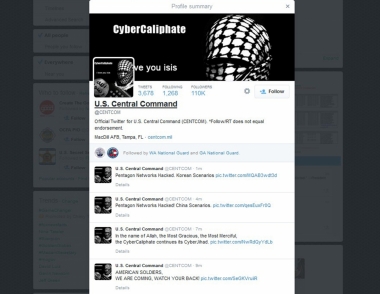
CyberCaliphate believed responsible for Pentagon Twitter hacking

The “CyberCaliphate” hacking group that attacked a Twitter account belonging to the Pentagon on Monday was founded by a Briton who was once jailed for hacking the personal address book of former British Prime Minister Tony Blair, according to government sources and private sector security experts.

US and European government sources said investigators strongly believe that Junaid Hussain, 20, was the leader of CyberCaliphate, though they do not know if he was personally involved in hacking the Twitter and YouTube accounts of the US Central Command, which oversees military operations in the Middle East.

Hussain could not be reached for comment.

In 2012, Hussain was jailed for six months for stealing Blair’s address book from an email account maintained by one of Blair’s advisors. Hussain pleaded guilty to putting details of the address book online and making hoax calls to a counter-terrorism hotline.

Hussain, who lived in Birmingham, England, moved to Syria sometime in the last two years, according to British media reports.

US and European investigators said they are investigating whether Monday’s attack on the US Central Command’s Twitter and YouTube accounts was launched from Syria, though they have not finished examining the technical evidence. The sources spoke on condition of anonymity.

Pentagon spokesman Army Colonel Steve Warren has called the cyberattack “inconvenient” but stressed that no sensitive or classified information was compromised by the hackers, who claimed to be sympathetic toward the Islamic State militant group being targeted in American bombing raids.

Investigators believe that Hussain was the main individual behind a Twitter account that operated under the pseudonym Abu Hussain al Britani, according to the sources. That account was linked to CyberCaliphate after the group last week claimed responsibility for hacking the Albuquerque Journal in New Mexico and WBOC, a Delaware television station. Neither the Albuquerque Journal nor WBOC responded to requests for comment.

The Abu Hussain al Britani account has been suspended as of Tuesday. One of the government sources said it was possible that other people besides Hussain used that account.

Alex Kassirer, an analyst with Flashpoint Global Partners, said Hussain led efforts by Islamic State to recruit “hackers for a CyberCaliphate.” Flashpoint Global Partners is a private company that monitors extremist Internet postings for government agencies and private clients.

Source: Christian Today

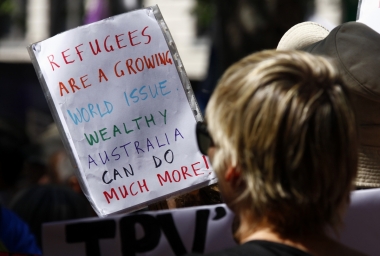
Asylum seekers sew their lips shut in Australian Detention Center

Hundreds of asylum seekers have gone on hunger strike at an Australian immigration detention centre in Papua New Guinea.

Some have sewn their lips shut to highlight fears for their security.

Australia uses offshore detention centers in Papua New Guinea and the tiny South Pacific island nation of Nauru to process would-be refugees trying to reach the country, often in unsafe boats after paying people-smugglers in Indonesia.

The detention center on Manus Island in Papua New Guinea was the scene of deadly riots in February 2014, in which one asylum seeker was killed and more than 70 injured after residents overran the camp, attacking detainees with makeshift weapons.

The protests began after detainees were told they would be moved into new accommodation, which they feared they make them more vulnerable to attack, said Ian Rintoul, executive director of the Refugee Action Coalition.

“Things have just come to a head. It’s impossible to exaggerate the real fears that people have for their safety and for their lives,” he told Reuters.

Manus Island is one of the poorest regions of Papua New Guinea, and residents have repeatedly expressed anger at the prospect of refugees being resettled in a community already lacking enough jobs.

Many of the detainees have been in the camps as long as 18 months and a technical problem has left them without running water for bathing.

A photograph provided to Reuters on Wednesday shows what appears to be a detainee with his lips stitched shut.

“Refugees inside the Manus Island detention camp are clearly suffering and have resorted to self-harm in an act of desperation,” opposition Greens Party Senator Sarah Hanson-Young said in a statement.

Prime Minister Tony Abbott’s tough line on people smuggling has been credited with grinding the trade to a virtual halt, but thousands remain in camps like Manus Island.

Under tough new laws instituted by former Prime Minister Kevin Rudd, none of the asylum seekers in Papua New Guinea will ever be eligible for resettlement in Australia, even if they are found to be genuine refugees.

But settling in Papua New Guinea would appear to be out of the question.

“There simply is no safe arrangement for resettlement in Papua New Guinea. It is a gaping whole at the end of the Australian government’s offshore processing arrangement and as long as that exists, there isn’t a remedy,” Rintoul said.

source: Christian Today

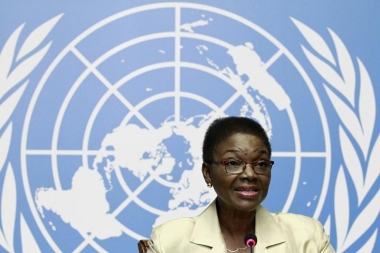
UN should intervene more in emergencies, says UN aid chief

UN aid chief Baroness Amos on Tuesday suggested more intervention in humanitarian emergencies as she said some states were aggressively asserting sovereignty rights to stop action being taken to protect civilians.

Amos cited Syria as an example after the United Nations Security Council had to adopt two resolutions to authorise the delivery of cross-border humanitarian aid in a bid to reach millions of people in need as a result of the country’s civil war.

“I don’t think that the Syrian government has ever forgiven me. They see me as personally responsible for pushing the Security Council to agree to those resolutions,” Amos told the Council of Foreign Relations in New York.

Amos, who will step down in March after more than four years, also said the conflict in Syria has been her low point. More than 12 million people in Syria need help, while another 3.2 million have fled the conflict that has killed some 200,000 people.

“Perhaps we could have pressured the Security Council earlier to get the resolutions that we did,” she said.

Amos said there was not enough accountability at the United Nations and that while the Security Council has recognised flagrant violations of international humanitarian law around the world, “there is no action after that”.

“As millions of people are forced to flee, as there is abuse on an unprecedented scale of girls and women in many countries … and action is not being taken in relation to this, I ask the question: should we not be more interventionist?” she said.

But Amos said she did not necessarily mean “boots on the ground” intervention.

“I’m asking the question about an architecture that we already have, a body of rules and law that we already have that we are not holding ourselves accountable to. I see this as a significant failure,” she said.

Source: Christian Today

Pope Francis gave Sri Lanka its first saint for half a million people

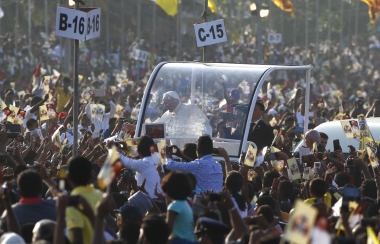
Pope Francis gave Sri Lanka its first saint at a waterfront Mass for more half a million people in Colombo on Wednesday, calling 17th century missionary Joseph Vaz a model of reconciliation after the country’s recent civil war.

The Pope, who on Tuesday was tired after starting his trip under a blazing sun, looked relaxed against a sparkling backdrop of rolling waves as he told the hushed crowd that Vaz was an example of religious tolerance relevant to Sri Lanka today.

“Saint Joseph shows us the importance of transcending religious divisions in the service of peace,” he said in his homily, delivered to a nation recovering from a long war between mainly Buddhist Sinhalese and Hindu Tamils.

Vaz, who was captured as a suspected spy after he crept into the tropical island in disguise, was born in 1651 in India’s Goa, then a Portuguese colony.

He traveled south at the age of 36, dressed as a beggar, to a country then divided into kingdoms and European colonies after hearing about the persecution of Catholics by the Dutch. He worked for years under the protection of a Buddhist king.

On Monday, Francis called on the Buddhist-majority country to uncover the truth about its bloody civil war that ended in 2009 with the army’s crushing defeat of Tamil rebels and the deaths of tens of thousands of civilians.

Francis’ visit, the first by a pope in 20 years, has added to the sense that a new chapter is opening on the island, which voted the wartime leadership out of power last week.

Francis, speaking slowly in English, said Christians should follow the example of Vaz to build peace, justice and reconciliation. Catholics make up about seven per cent of Sri Lanka’s 20 million population, while 10 times as many people follow Buddhism.

“We really need people like him to ensure peace and harmony in this country,” a woman who identified herself as Fathima, wearing traditional Muslim dress, said of the Pope.

About 10 percent of the population follow Islam. They faced rising attacks from Buddhist extremists under the government of former President Mahinda Rajapaka.

Earlier, Francis stepped out of his popemobile to greet people, placing his hands on children’s’ heads.

He was due to go by helicopter to a shrine in the north that was shelled in the war, then move on to the Philippines on Thursday as part of a week-long tour, his second trip to Asia, to shore up the Church’s presence in developing nations.

BENDING THE RULES

The canonization is an example of Francis’s no-nonsense approach to creating saints to meet the demands of the flock for new holy figures, particular in parts of the world where the Church is still growing.

He bent Church rules and dispensed with a regulation that normally requires a second miracle to be attributed to a candidate for sainthood. Vaz was beatified by Pope John Paul during a visit to Sri Lanka in 1995.

Vaz spent five years secretly preaching in the lush lowlands before making his way to the fortress-like Kingdom of Kandy in the hill district’s rainforests, where he was captured and accused of espionage for Portugal under the guise of religion.

He was detained for nearly a year until he convinced the powerful king that he was a priest, according to texts from the 17th century cited on a website run by Sri Lankan Catholics.

Vaz remained in Kandy until his death in 1711, by which time the Church says he had almost single-handedly re-established Catholicism in Sri Lanka.

Some nationalists highlight the violence of the Church’s early years and say it led to the destruction of many Buddhist temples.

Source: Christian Today

Half of British Population holds an antisemitic view

Nearly half of the British population holds an antisemitic view, according to a new poll published in a report today (Wednesday).

Britain is at “tipping point” on the issue of antisemitism, the report says.

The YouGov poll for the Campaign Against Antisemitism comes in the wake of shocking anti-Jewish outbursts in Paris after the Charlie Hebdo and other recent Islamist fundamentalist murders, which included a deadly attack on a Jewish supermarket.

Pollsters found that 45 per cent of Britons hold an antisemitic view.

And in a second survey carried out by the campaign itself, more than half of British Jewish people said they feared Jews have no future in Great Britain. A quarter of British Jews have considered leaving.

The YouGov survey, commissioned ahead of the 70th anniversary of the end of the Holocaust to be marked on Holocaust Memorial Day later this month, found that one in eight Britons believe Jewish people use the Holocaust as a means to get sympathy.

Between them, the two surveys found that one in four British people believe Jews chase money more than other British people, one in six people believe that Jews think they are better than other people and that Jews have too much power in the media.

More than half of all British Jews feel that antisemitism now echoes the 1930s and nearly as many fear their family is threatened by Islamist extremism. Nearly eight in ten said they had witnessed antisemitism disguised as a political comment about Israel.

There are nearly 270,000 Jewish people living in Britain, 0.4 per cent of the population. The community has thrived in Britain since Oliver Cromwell permitted their readmission to the country 360 years ago but the report shows that many people still harbour anti-Jewish opinions.

It says that although some antisemitic views may be unintentional, they are no less offensive for it. Many people in the UK have simply never met Jewish people, it says.

Last year saw the most antisemitic incidents since records began 30 years ago. In July 2014 alone, London suffered its worst ever month for hate crime, 95 per cent of which was against Jews.

The Annual Antisemitism Barometer is the largest study of its kind. While antisemitism in Britain is not at the levels seen most of Europe, the report says the poll results should be a wake-up call.

“Britain is at a tipping point: unless antisemitism is met with zero tolerance, it will continue to grow and British Jews may increasingly question their place in their own country,” it says.

Gideon Falter, chairman of the Campaign Against Antisemitism said: “Britain’s Jews must be shown that they are not alone. The government is clearly taking this seriously and in light of these figures we expect that the Police and Crown Prosecution Service will want to accelerate discussion of the five-point plan presented at our meeting with the Home Secretary last week.”

Jonathan Sacerdoti, also of the campaign, said: “Jewish people have contributed to almost every part of British life, yet rising antisemitism here and across Europe means that now more than ever Jews are afraid. Some are even reconsidering their future here. British values of tolerance and pluralism must be upheld, so that minority groups like Jews feel comfortable and protected.”

Source: Christian Today