Kurds Plead for Better Weaponry

Despite some recent setbacks, the Kurdish military, known as the Peshmerga, is still the best fighting force facing the terror group Islamic State, also known as ISIS…Report by CBN

After ISIS defeated the Peshmerga in a couple of battles, some wondered if the Kurdish military was up to the challenge.

There was a two-hour battle between ISIS and the Peshmerga Monday night. The jihadist army came with a large convoy and heavy artillery, but this time the Peshmerga prevailed.

Signs of the battle litter the town. A destroyed vehicle lobbed shells at the Peshmerga. Across the road, ISIS left behind a dead fighter.

The victory at Makhmur encouraged the Peshmerga, but they still face an enemy with a robust arsenal, much of it captured Iraqi equipment supplied by the U.S.

“Unfortunately, we have been outgunned by their access to resources because they are a rich terrorist organization,” one Peshmerga commander told CBN News. “We need heavy weaponry, armor, ammunition because they have access to massive amount of resources like bullet proof vehicles, heavy weaponry, [and] armor, which we unfortunately lack.”

Peshmerga commanders say because ISIS has heavy weapons, they can keep their distance. The Kurdish military says if they had the same kind of weapons it would be a different war.

One thing is clear. U.S. airstrikes have made a difference on the battlefield and in the diplomatic arena.

“Of course it’s good for us when a super power like the United States intervenes,” he continued. “The balance of power goes in our favor. But also it’s very important for us that it’s the first time recently that the U.S. has intervened and said ‘I’m going to protect my ally.'”

Peshmerga commanders told CBN News they need more help.

“The weapons that we have, ISIS has the same stuff, but even better ones. We need heavy weaponry, artillery and Humvees. These are all very important to us,” one commander said.

One senior Kurdish official said if the Peshmerga had been better armed, much of the current crisis and potential genocide might have been avoided. Commanders in the field say if they have the weapons, they’re more than up to the task.

“The Peshmerga are fighting for the sake of their land, their people and their rights, so they are encouraged. And they are ready to confront the enemy wherever they are,” he said.

Original Post by CBN

Fighters abandon Al-Qaeda affiliates to join Islamic State

U.S. spy agencies have begun to see groups of fighters abandoning al-Qaeda affiliates in Yemen and Africa to join the rival Islamist organization that has seized territory in Iraq and Syria and been targeted in American airstrikes, U.S. officials said…report by Washington Post

The movements are seen by U.S. ­counterterrorism analysts as a worrisome indication of the expanding appeal of a group known as the Islamic State that has overwhelmed military forces in the region and may now see itself in direct conflict with the United States.

“Small groups from a number of al-Qaeda affiliates have defected to ISIS,” as the group is also known, said a U.S. official with access to classified intelligence assessments. “And this problem will probably become more acute as ISIS continues to rack up victories.”

The influx has strengthened an organization already regarded as a menacing force in the Middle East, one that has toppled a series of Iraqi cities by launching assaults so quickly and in so many directions that security forces caught in the group’s path have so far been unable to respond with anything but retreat.

U.S. officials attribute the Islamic State’s rapid emergence to factors both psychological and tactical. Its core group of fighters honed their skills against the armies of Syrian President Bashar al-Assad and the United States when it occupied Iraq. The group has used raids and ransoms to stockpile weapons and cash. And its merciless reputation triggered rampant defections among Sunni members of Iraq’s security forces already disenchanted with the Shiite-led government in Baghdad.

Even before its assault on Kurdish territories in northern Iraq this month, analysts said the Islamic State had shown an almost impulsive character in its pursuit of territory and recruits, with little patience for the elaborate and often time-consuming terror plots favored by al-Qaeda.

Counterterrorism analysts at the CIA and other agencies have so far seen no indication that an entire al-Qaeda node or any of its senior leaders are prepared to switch sides. But officials said they have begun watching for signs of such a development.

The launching of U.S. airstrikes has raised new questions, including whether the bombings will hurt the Islamic State’s ability to draw recruits or elevate its status among jihadists. “Does that increase the spigot or close it?” said a senior U.S. counterterrorism official, who, like others, spoke on the condition of anonymity and noted that U.S. military operations in Afghanistan and elsewhere have crippled al-Qaeda but also served as rallying cries against the United States.

Longer-term, U.S. officials expressed concern that the Islamic State, which so far has been focused predominantly on its goal of reestablishing an Islamic caliphate, may now place greater emphasis on carrying out attacks against the United States and its allies.

President Obama was careful to depict the strikes as part of a humanitarian mission to protect endangered Iraqis, including members of a Christian sect, encircled with scant supplies on a northern Iraq mountaintop. Obama also referred to the presence of U.S. personnel in the region and stopped short of authorizing a broader assault against the Islamic State.

Still, the strikes triggered widespread calls for retaliation among militant groups online. A prominent figure on a well-known jihadist forum, Shumukh al-Islam, wrote Friday that the airstrikes should prompt fighters to unite against the United States.

“The mujahideen must strike and seek to execute proactive operations in their own home, America, to discipline America and its criminal soldiers,” the jihadist, Abu al-Ayna al-Khorasani, wrote, according to the SITE Intelligence Group, which monitors militant postings.

U.S. officials said the defections to the Islamic State have come primarily from al-Qaeda in the Arabian Peninsula, the Yemen-based group that has launched several bombing plots targeting the United States, and al-Qaeda in the Islamic Maghreb, which had seized territory in northern Mali before facing strikes carried out by France last year.

“It’s not to the point where it’s causing splintering within the affiliates,” said the senior U.S. counterterrorism official. But the defections have accelerated in recent months, officials said, and also involve fighters from groups in Libya and elsewhere that are not formally part of al-Qaeda.

U.S. officials estimate that the Islamic State has as many as 10,000 fighters, including 3,000 to 5,000 from countries beyond its base in Iraq and Syria. Its ranks have swelled with the emergence of the civil war in Syria — a country relatively easy to reach from both in the Middle East and Europe — as a larger magnet for jihadists than Afghanistan or Iraq were. The group has also attracted critical support from disenfranchised Sunni residents in Mosul and other Iraqi cities, civilians who have lost patience with the government of Iraqi President Nouri al-Maliki but may not embrace the hard-line agenda of the Islamic State.

The group has not been linked to any known plot against the United States, but Director of National Intelligence James R. Clapper Jr. testified in January that the group “does have aspirations for attacks on the homeland.”

U.S. officials have said about 100 Americans have either traveled to Syria or tried to. Among them was a former Florida resident, Moner Mohammad Abusalha, who returned undetected to the United States for several months this year before departing again for Syria and detonating a suicide bomb. Abusalha was not tied to the Islamic State, but officials believe that as many as a dozen Americans have linked up with the group.

The Islamic State traces its origin to al-Qaeda in Iraq but broke from the terrorist network this year after being criticized for its tactics — including the slaughter of civilians — and refusing instructions to cede the fight in Syria to a separate al-Qaeda ally known as al-Nusra.

Since then, the Islamic State has amassed arms, cash, fighters and territory at a breathtaking rate. In July, the group’s leader, Abu Bakr al-Baghdadi, took the pulpit at the largest mosque in Mosul, declaring himself the “caliph” of the Muslim world and urging followers to flock to his organization.

In doing so, Baghdadi fulfilled an ambition articulated by his predecessor, Abu Musab al-Zarqawi, who was killed by U.S. forces in Iraq in 2006. It also marked a significant departure from the al-Qaeda playbook.

Al-Qaeda’s commander in Yemen, Nasir al Wuhayshi, has written letters to subordinates cautioning against prematurely declaring Islamic rule even in small villages — in part out of fear that failing to hold territory or enforce Islamic law would lead the group to lose face with the local population.

Baghdadi’s lack of restraint appears to have expanded his appeal, according to U.S. officials who said the group’s expanding territory, aggressive reputation and roster of experienced fighters account for its momentum.

“They are demonstrating just how advantageous it is to a ­terrorist-insurgent group to be fighting in the field for years and years as they have been in Iraq and Syria,” said Daniel Benjamin, a professor at Dartmouth University who previously served as the top counterterrorism official at the State Department.

“Their skill at maneuver is really kind of extraordinary compared to groups you would compare them to,” including al-Qaeda’s affiliates in Yemen and Mali, Benjamin said. “They are not constrained by that fear of failure other al-Qaeda groups have shown,” he added, or the group’s tendency to “spend years preparing single attacks.”

Original Post by Washington Post
Samsung Galaxy Alpha with fresh metallic design

Samsung has unveiled its latest smartphone, the Galaxy Alpha, which is simultaneously a more grown-up and more pared-back version of the Galaxy S5. This is all thanks to the fact that Samsung has finally chosen to incorporate some real metal into its design.

From the images we’ve seen so far, it looks like the Alpha is going to be the aesthetic success story that other premium Samsung devices have failed to be. Samsung describes the metal rim as “setting a new standard” in terms of its phone design strategy, which we can only hope means that it’s a trend set to continue. The rear panel looks as though it will be made from the same soft-touch plastic as the Galaxy S5, but our first impressions are that the Alpha has a touch more sophistication than many of its predecessors.

And so to the specs, which are also pleasingly impressive. Lift the lid on the Alpha and you’ll find 2GB of RAM and a quad-core 2.5GHz processor (or Samsung’s famous Octa-core processor in some markets). When it comes to photography, the 12-megapixel camera will no doubt deliver some top shots — particularly given Samsung’s excellent real-time HDR mode — and can also shoot 4K video at 30 frames per second.

On the front of the Alpha is a 4.7-inch Super Amoled screen with a 1,280×720-pixel resolution screen, with a 2.1-megapixel camera nestled just above it. It’s a tad disappointing not to see a Full HD display and higher-resolution forward-facing snapper given that many cheaper phones now sport cameras with 5- or 8-megapixel cameras. Similarly, the 1,860mAh battery isn’t going to leave you with any spare juice come the end of the day. Internal memory is capped at 32GB, and if that doesn’t sound like it’ll be enough for you then you better look elsewhere as there’s no microSD card slot.

Samsung Galaxy Alpha with fresh metallic design
(Photo : wired.co.uk)

Nevertheless, the phone packs a decent lineup of components and combined with the newly introduced design strategy, the Alpha promises to be one of the standout devices of Samsung’s frankly vast range of portable products.

The Galaxy Alpha will be available at the beginning of September, just before the company announces yet more new devices — hopefully also with metal trims — at IFA in Berlin. The phone will be available in black, white, gold, silver and blue, and while we don’t yet have prices available, both EE and Carphone Warehouse have announced that they will be offering it.

Galaxy Alpha - Samsung Puts Pedal to Metal
(Photo: Technewsworld)

ISIS is ‘more powerful now than al Qaeda was on 9/11’ says Peter King

President Obama’s vow not to provide military support in Iraq beyond limited air strikes and humanitarian relief amounts to “a shameful abdication of American leadership,” Rep. Peter King, a New York Republican, said in an interview Sunday…by Washington Examiner

“We should take nothing off the table,” King said on NBC’s “Meet The Press” regarding the American response to the growing threat from the jihadist grou ,the Islamic State of Iraq and Syria(ISIS).

King was responding to an interview, also on “Meet The Press,” with Sen. Dick Durbin, of Illinois, the second-ranking Senate Democrat, who insisted “escalating it is not in the cards.”

“Neither the American people nor Congress are in the business of wanting to escalate this conflict beyond where it is today,” Durbin said.

But King argued that the incursion by ISIS into the Kurdistan region of Iraq, where the group threatens genocide against the Yazidi population, could ultimately threaten the national security of the U.S. if not addressed with necessary force.

“Every day that goes by, ISIS builds up this caliphate and it becomes a direct threat to the United States of America,” King said. “They are more powerful now than al Qaeda was on 9/11.”

King’s remarks came on the same day that Hillary Clinton, in an interview with the Atlantic magazine, called the Obama administration’s refusal to confront extremism in Syria, where ISIS originated, a “failure.”

“I know that the failure to help build up a credible fighting force of the people who were the originators of the protests against Assad—there were Islamists, there were secularists, there was everything in the middle—the failure to do that left a big vacuum, which the jihadists have now filled,” Clinton said.

King also termed the Obama administration’s foreign policy a “failure” — but instead honed in on President Obama’s decision to pull out of Iraq without protecting the Kurds and without ability to steer the direction of the country’s government, which has floundered under the leadership of Prime Minister Nouri al-Maliki.

“All [Obama] talks about is ending the war in Iraq. All he ended was American influence in Iraq,” King said. “And that’s the failure.”

Original Post by Washington Examiner

A KINGDOM BESIEGED – Christianity in Nigeria

Click here to Listen – A KINGDOM BESIEGED – Christianity in Nigeria

The drama ensued when two Christian delegates representing Christian Leaders, Bishop of Kafanchan Diocese of Catholic Church, Joseph Bagobiri and Pastor Emmanuel Bosun (Ogun State), raised the issue which they described as unfair treatment of Christians and Christianity in the country.

This angered their Muslim counterparts, who opposed their submissions.

They had both submitted that the constitution of Nigeria was skewed in favour of Islam and Muslims with a call on delegates to ensure that the imbalance was corrected.

Bagobiri opened the debate on religion. He gave a detailed analysis of how the Nigerian constitution did not have any mention of Christianity or the church, but Islam was repeatedly mentioned.

He also argued that the adoption of a particular religion by states must be done away with, adding that in a country like Nigeria, neutrality was needed.

He said since Islamic courts had been created, it was only normal to extend the hands of fellowship to Christianity in order to create a fair state.

He called for the establishment of Ecclesiastical Courts to handle Christian-related disputes, like Sharia courts.

Bagobiri said funding should also be provided for the Christian courts, just like Sharia courts so that Christians could have a sense of belonging in their own country.

In his contribution, Bosun argued that the conference must address religious imbalance in the country, adding that the conference needed to address religion squarely before it destroys Nigerians.

He said, “In the 1999 Constitution, Shariah was mentioned 73 times, Grand Khadi 54 times, Islam 28 times , Muslims 10 times and there is no single mention of Christ, Christian, Christianity or church. Some mischievous elements are taking these lapses in the constitution to come to the ungodly decision that probably that the state is an Islamic state.

“So, what are Christians doing here 100 of our churches were burnt down, Christians are being killed. In fact, it has reached the stage of genocide. I will cite one example – In one denomination in Plateau State, the Women’s Fellowship as at 2001 had 500 registered widows and by 2008, they had 900 registered widows. By February 2014, they had 25,000 registered widows.”

But a former Governor of Kebbi State, Adamu Aliero, citing Order 9 rule 7 raised a point of order.

He said, “A delegate must confine his contribution to the subject under discussion and will not introduce matters irrelevant thereto. The speaker on the floor is bringing issues that are not related to Mr. President’s speech. I therefore want the Chairman to call him to order. He is bringing diversionary issues that are very sentimental.”

But the Deputy Chairman of the conference, Prof. Bolaji Akinyemi, said Bosun could not be ruled out of order since others had been allowed to speak. He said he he would only plead that delegates should mind their contributions so as not to offend the sensibilities of other people.

Bosun therefore continued saying, “There is the need for us to abide by what Mr. President said on pages 14 and 15 for this conference to take a closer look at the Constitution and make recommendations that would facilitate redressing every imbalance therein so that all the citizens in Nigeria can live peacefully and live in harmony.

“If we set Nigeria on fire for whatever reason, none of us would be able to live here. We Christians do not hate Muslims. We are prepared to live together in harmony. I live in the South-West where Christians and Muslims live together and there is peace. We want to see that peace all over Nigeria- in the North, South, East and West.”

In his contributions, a delegate from the South-West, Pastor Tunde Bakare, told delegates not to deviate from the principles set by President Goodluck Jonathan as doing so would only make the conference a jamboree.

He said, “Two earlier distinguished delegates have described the President’s speech as a guiding principle to this conference. Another one said a marshal plan. Permit to go into the speech itself and bring three issues in three minutes. The President himself made clear his expected outcome of this conference that as stated in Pg. 19 “…my expectation is that the outcome of this conference will be a positive turning point for our country’s development. We must seize this opportunity to cement the cleavages and fault lines that separate us. We must relaunch our country.’ If my expectation are different from his (Jonathan’s) then we are in a jamboree. We must approach these issues with no suspicion and antagonism. Therefore we should be open-minded and work to achieve what is best for Nigeria.”

Point to Note : Each ministry in Nigeria stand on its own


Prayer Appeal: Before it is too Late!

I am sending out an appeal to all Christians to please, pray for President Jonathan. Please do not be angry.

Goodluck_Jonathan

Let us put our emotions aside and pray based on principle that God commands us to pray for “kings and for all that are in authority”.

We may not fully understand why the President takes decisions (or fails to take decisions) as he does, but, considering the barrage of incantations, enchantments, sorcery, invocations of evil and spells projected at him, it is a miracle that the man is still alive.

I heard from a reliable source today, that the people on the other side held a meeting a few days ago to plan how to get rid of him, using every means possible. A particular traditional ruler donated N50m, and others too made similar donations. Their current plan is to do massive rituals that will involve burying live animals in 17 different places all over the nation.

Only the church can break their spells. Unfortunately, many Christians are too upset with the President that he is not acting decisively. Permit me to ask, if you were the one facing this barrage of spells and enchantments, how would you have performed?

Please pray. We may not understand why, but God did not make a mistake in making Goodluck Jonathan president of Nigeria. Our duty is to sustain him with prayers in obedience to the Word of God.

If we fail in our responsibility to pray for him as God commands, then we cannot complain that he has failed in his responsibility of providing decisive leadership for the nation. Let us do our part in obedience to God.

Before it is too late, mobilize prayers for the President.

God bless you.

Your brother,

The Truth

Prayer Appeal from Kingdom News NG

‘We will raise the flag of Allah in the White House’, ISIL says to US

The first installment of a five-part documentary by Vice News on the Islamic State of Iraq and the Levant (ISIL) was released online Thursday, offering Westerners a rare glimpse into the inner workings of the terror group that now controls large swathes of Iraq and Syria…report by Washington Times

For three weeks, VICE News reporter Medyan Dairieh interviewed and recorded members of ISIL in the Syrian city of Raqqa, even capturing gruesome footage of an ISIL victory over the Syrian army’s 17th division. The terrorist group overran a position held by 50 soldiers belonging to the regime of Bashar al-Assad, decapitated them and put their heads on fence posts.

“I say to America the Islamic Caliphate has been established and we will not stop,” Abu Mosa, Islamic State Press officer told Vice News. “Don’t be cowards and attack us with drones. Instead send your soldiers, the ones we humiliated in Iraq. We will humiliate them everywhere, God willing, and we will raise the flag of Allah in the White House.”

The journalist said that ISIL’s reasoning for displaying the corpses of the Syrian regime was to send a message: “The city is firmly under ISIL control, under the command of Abu Bakr al-Baghdadi.”

Original Post by Washington Times

Disturbing Video message to the entire world by ISIS militants

Chilling message from IS militants warns the world of their bloody intent in a video celebrating taking control of key locations in Iraq…report by The Telegraph

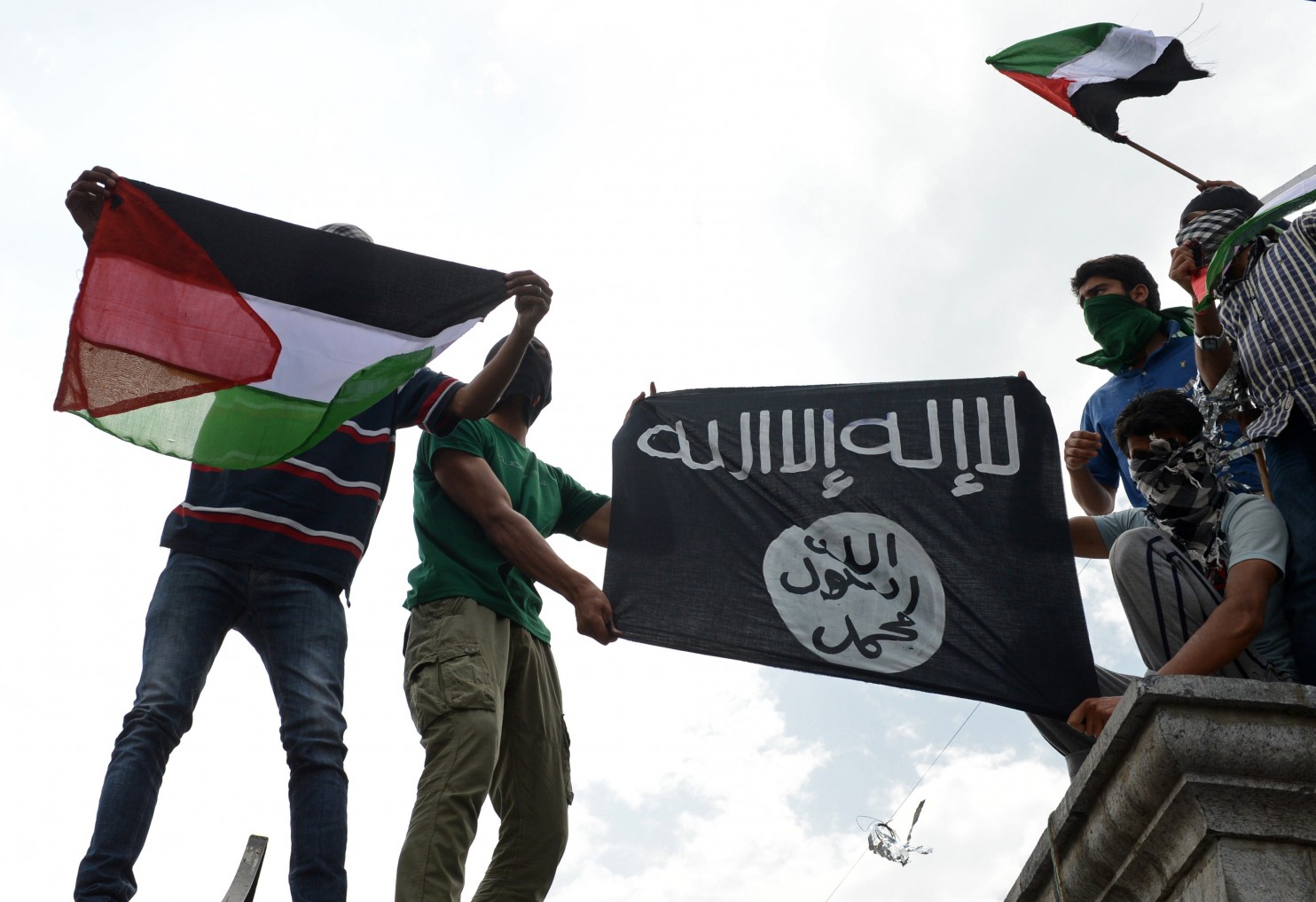
Video released by the Islamic State (IS) group has shown militants celebrating and raising the black IS flag over buildings and facilities in a number of key Iraqi locations under their control.

The militants took control of Mosul in June, and captured a string of towns and Iraq’s largest hydroelectric dam and reservoir in recent weeks.

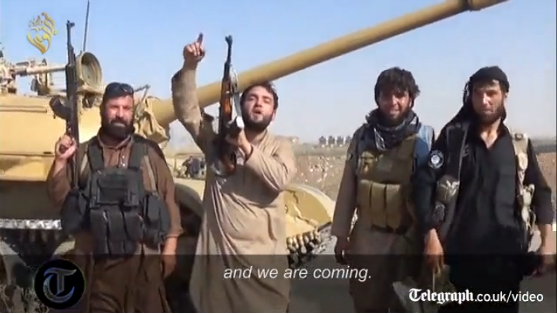
In the video, armed militants of the Islamic State group stand by a tank, holding weapons as one declares to the camera: “Our message to the entire world is that we are the soldiers of the Caliphate state and we are coming.”

Pushing southward from Mosul, they swept over Sunni-majority towns almost to Iraq’s capital of Baghdad, and now hold large parts of western Iraq as well as swaths of neighbouring Syria.

Iraqi government forces crumbled in the face of the assault but have since been able to prevent the militants from advancing into Shiite-majority areas.

In the north, the Kurds have been the main line of defence against the militants, but their fighters are stretched over a long front trying to fend them off.

The US has launched a number of military airstrikes in northern Iraq to hold off Islamic State forces advancing on Irbil, the capital of Iraq’s autonomous Kurdish region.

US President Barack Obama ordered the intervention after militants used artillery to shell Kurdish forces defending Erbil, which is home to a US consulate and about three dozen US military trainers.

The US also airdropped aid to thousands of members of the Yazidi religious minority who fled to a mountaintop after the militants took control of Sinjar, a city far from the Kurdish seats of power in Irbil and Suliminiya.

Original Post by The Telegraph

10-year-old would-be suicide bomber arrested in Nigeria

A 10-year-old girl strapped with a suicide bomber’s explosives belt has been taken into police custody alongside her 18-year-old sister in northern Nigeria, police said…report by the telegraph

Their arrest on Wednesday came shortly before another female suicide attacker blew herself up at a higher-education college in the nearby city of Kano, killing six people in the fourth such attack using women in a week.

Security sources suspect Boko Haram, Nigeria’s al-Qaeda-linked Islamist insurgents, has shifted its tactics to using women and girls indoctrinated by male relatives, or else forced to carry out attacks against their will.

The 10-year-old, Hadiza Musa, and her sister, Zainab Musa, 18, were being driven by a man in his 20s late in the evening in Funtua town, west of Kano, when they were stopped at a police roadblock and ordered out of their Honda hatchback.

“They were asked to alight but when they got down, officers saw that the youngest one was strapped with explosives, it was an IED on a vest she was wearing,” Mike Omeri, a Nigerian government spokesman, told The Telegraph.

“The girl did not offer resistance and she was stopped and her vest was demobilised. We have not yet forensically investigated it, but it was prepared and would have caused havoc.

“The older girl and the man tried to escape but they were cut off by ordinary citizens and arrested. We are questioning them.”

Using female suicide bombers appears to be a new tactic of Boko Haram in Kano, although they have used them on occasion for years further north in Nigeria.

Two female suicide bombers blew themselves up at a trade show and a petrol station in Kano on Monday, killing one other person and injuring at least six others.

On Sunday, a female suicide bomber killed herself but no one else while trying to target police officers.

“We wish to assure Nigerians that the government is putting all efforts and resources into countering the violent insurgency by Boko Haram,” he said.

“It is reprehensible that the terrorists are now using little girls that they have indoctrinated, or lured, or tricked and forced into being involved in something they have no reason in their mind to understand.”

In a separate incident on Tuesday, two suicide bombers killed 13 people in attacks on two mosques in the town of Potiskum, in Yobe state in the northeast. Boko Haram was again suspected.

The group, whose name translates roughly as “Western education is sin”, is holding more than 200 schoolgirls hostage that its forces kidnapped close to four months ago.

International efforts to locate and free them have been fruitless.

Original Post by The Telegraph

Boko Haram’s now uses Female suicide bombers to carry out terrorists operations

There were four suicide bombing attacks by young women in Kano, Nigeria, last week…report by Washington Post

Especially worrying is that the reported ages of the suicide bombers are getting younger and younger. A 10-year-old girl strapped with a suicide bomber’s explosives belt and her older sister were taken into police custody. The attacks raise concerns that Boko Haram has doubled its mobilization base.

These attacks and others led the city of Kano to ban public worship and celebrations of Eid, the holiday marking the end of Ramadan. Local police have issued warnings about women covered in hijab.

Who are the female suicide bombers in Kano?

Three narratives have emerged about who these young bombers were. A handful of reports originally suggested the women were among the Chibok girls kidnapped April 14 and other women and young girls abducted by Boko Haram over the past year. Another report instead alleges the young women are actually impoverished Kano beggars who have been outlawed by Kwankwaso. But a Nigeria-based security analyst says the suicide bombers are more likely to be the offspring of Boko Haram members.

The truth is we don’t know who these female bombers are, and we likely won’t anytime soon. In contrast to male suicide bombers, few female bombers leave “last will and testament” videos that could provide positive identification. What is clear is that regardless of whether the young women were girls abducted in Chibok or poor women picked up off the streets, Boko Haram has now embraced this tactical innovation quickly and with deadly results.

This is not a new phenomenon

Nigerian scholars have echoed what I have claimed in my own research on women and terrorism – that female suicide bombers are not a new phenomenon, even in Africa. As early as December 2009, Al Shabaab began to disguise themselves as women in order to effectively carry out suicide-bomber targeted assassinations. Al Shabaab began to pair a male and female operative to give the appearance of a couple on a date. This was particularly effective when the group would attack soft targets like hotels, restaurants or markets.

Women have been involved in terrorism since the 19th century, but religious groups previously eschewed the use of female bombers. The innovation in tactics by these groups introduces new challenges to those defending against terrorism. As scholar Nojeem Shobo of the University of Lagos has said, including women as perpetrators in terrorist attacks brings a “disturbing twist to the fight against insurgency.”

The nature of the organizations that employ female suicide bombers has changed.

Female suicide bombers were active in the 1980s in Lebanon and in the 1990s in Sri Lanka, Turkey and Chechnya. And by the turn of the century, female suicide bombers had spread to conflicts around the globe. What changed was the nature of the organization that employed them. Initially, leftist groups or secular organizations were more likely to employ a female in suicide attacks. Time and time again, they proved to be deadlier and more effective than men.

Bruce Hoffman illustrated how effective female bombers were in The Atlantic in June 2003:

“A person wearing a bomb is far more dangerous and far more difficult to defend against than a timed device left to explode in a marketplace. This human weapons system can effect last-minute changes based on the ease of approach, the paucity or density of people, and the security measures in evidence…In April of last year a female suicide bomber tried to enter the Mahane Yehuda open-air market—the fourth woman to make such an attempt in four months—but was deterred by a strong police presence. So she simply walked up to a bus stop packed with shoppers hurrying home before the Sabbath and detonated her explosives, killing six and wounding seventy-three.”

Most Islamist groups (besides the Chechens) were slow to adopt the strategy of female bombers either because they assumed they had more than enough men for the job or because the social limitations of women traveling without a chaperon (Mahram) required additional considerations and planning for female bombers. Some feminist scholars (e.g., Andrea Dworkin) assumed this reticence might also be a function of wanting to limit women’s roles in political violence lest this influence women’s power in a patriarchal society and politics as a whole.

The Islamic groups had an infinite ability for adaptation and doctrinal flexibility. Starting in 2004 with the release of a Web-based magazine called al Khansa’a, the evolution of religious ideology on female suicide bombers changed from advising women what to do while their men were on Jihad to telling women they, too, could be Jihadis and even be suicide bombers.

Why have Islamic groups recently taken so enthusiastically to including female suicide bombers?

I highlight four primary changes.

First, there has been an ideological shift. Debates emerged on-line and fatwas were issued stating that women’s obligation for Jihad is equal to that of men. This was largely led by Sheikh Yusuf al Qaradawi, an Egyptian cleric living in Qatar who has legitimized the use of women as suicide bombers.

Second, Al Qaeda’s structure changed. As the central core of Al Qaeda gave way to a host of regional affiliates, those affiliates were more inclined to involve women in front-line violent activities. While al Qaeda’s leaders swore that there were no women in the organization, Al Qaeda in Iraq, al Shabaab, Chechen militant groups in Chechnya and Dagestan, and groups in Pakistan and Uzbekistan and others began using female bombers as early as 2005. It’s only recently that female bombers have emerged among the Taliban in Pakistan and Afghanistan, relatively late adopters compared to the affiliated groups killing Western contractors or people in line for food aid.

Third, there were changes in targeting. Women are ideal operatives when attacking soft targets and blending in with civilians. As terrorist organizations have shifted from attacking military targets (hard targets) to civilian targets (soft targets), women have been especially useful. When an improvised explosive device is strapped around a woman’s midsection, it gives the impression that she is pregnant, throwing off security forces who don’t expect a woman — let alone one who is pregnant — to be carrying a bomb. As a result of the existing stereotypes we have of the inherent peacefulness of women, they are less likely to be searched at checkpoints and if the security services are too invasive (and reports of sexual violations at checkpoints is common in many of these conflicts), then invasive searching of women in traditional settings only helps the terrorist organizations recruit more men who are outraged that women are being abused. Mobilizing men to protect the honor of women is hardly a new tactic and was extremely effective in the 1960s and 1970s for the provisional IRA who used the strip-searching of Republican women in Belfast by the RUC to motivate men to join the movement.

Finally, including women offered a new mobilization strategy – not just of women, but also of men. Women serve a unique purpose in helping mobilize men into terrorist organizations. It is a powerful narrative when women (especially online) accuse men of being unmanly unless they step up and join the Jihad to protect their sisters in Islam. In addition to tapping 50 percent of the population, recruiting women is an effective strategy of goading men into participation. This also explains the effectiveness of women online as propagandists, fundraisers and recruiters for terrorist groups.

When are female suicide bombers used most often?

That said, my research suggests that terrorist groups tend to gravitate toward female operatives not when they are at their strongest but when they are at their weakest. Terrorist groups include women either because they are having a difficult time accessing hard targets — which are more valuable in the long term for their struggle — or because men are not signing up unless they are guilted into it. The fact that Boko Haram is using women may be an indication of their weakness more than their strength.

Original Post by Washington Post

Massacre in Predominantly Christian Gwoza, Nigeria Said to Leave 100 Dead

After weeks of sacking villages and destroying church buildings around Nigeria’s northeastern town of Gwoza, Islamic extremist group Boko Haram on Wednesday (Aug. 6) killed an estimated 100 people in the predominantly Christian town, sources said…report by Morning Star News

The shooting, fire-bombing and slashing of men, women and children in Gwoza, Borno state, as initially the military reportedly fled before an insurgent force backed by international terrorist groups, began at about 4 a.m., producing eyewitness assertions that Boko Haram, which seeks to impose sharia (Islamic law) throughout Nigeria, had taken control of the town of more than 276,000 people. Local residents reportedly said at least 100 people had been killed.

The full magnitude of the attack and the Nigerian military response was unknown as most sources have been forced to flee to Cameroon or Adamawa state, but on the initial day of the assault Pirda Tada, a Christian resident of Saha village, told Morning Star News that Boko Haram gunmen arrived in Toyota Hilux vehicles and motorcycles and attacked houses with Improvised Explosive Devices (IEDs) and fuel-bombs.

“I thank God for sparing my life, but three of my neighbors and members of our church were killed during the attack,” Tada said. “These Christians in our village had their throats slit with knives while their hands were tied behind their backs. Some houses were bombed as the Boko Haram gunmen were chanting, ‘God is great!’ in Arabic.”

Six Christians were killed at Saha village, and the insurgents destroyed houses and shops and burned the Church of Christ in Nations (COCIN) building in Pegi Barawa village, Tada said. Boko Haram rebels on July 19 had attacked Saha and Pegi Barawa village, near Gwoza; six Christians were reported to have been killed in Saha village.

Francis Mbala of Gwoza confirmed that Boko Haram attacked Saha and Pegi Barawa this week.

“The COCIN church and some houses and shops were burned down,” he told Morning Star News.

Since December, Boko Haram has also attacked in the Gwoza area the villages of Mainok, Barawa, Chinne, Arbakko, Attagara, Ngoshe, Klala, Kunde, Hembe, Gathahure, Klala, Himbe, Amuda, Agapalawa, Ashigashiya, and Chikedeh, Mbala said.

John Gula, a leader in the Christian community in Gwoza, told Morning Star News by phone that 42 Christians were killed at Attagara village; 24 in Agajara; four in Angurva; 20 in Agapalwa; one in Amuda; three in Alavawa; 13 in Chinene; three in Arboko; one in Ashigashiya; and one in Ngoshe.

It is estimated that more than 300,000 Christians have been displaced from the greater area, forcing many to flee to neighboring Cameroon.

In December Christian leaders had reported plans by Boko Haram to attack Christian communities in Gwoza. COCIN leaders and the denomination’s Gwoza District Church Council (DCC), in collaboration with the leadership of the Christian Association of Nigeria (CAN) in Gwoza, sent a petition to the Borno state government and security agencies reporting a threatening letter that Boko Haram had sent to Christian communities in Gwoza.

“You have been fleeing your homes, but we are still pursuing you, because the soldiers with you people cannot protect you,” the letter reads. “Your lives, farmlands and other property are also not safeguarded. Allah willing, we shall not fail to attack your communities and the listed churches in this letter.”

In December 2013, 15 Christians were killed, 274 houses were burned and 12 church buildings were destroyed by Boko Haram gunmen, the Christian leaders wrote in their letter. Yakubu Toeye, a Christian from Gwoza, told Morning Star News that the 12 church buildings destroyed in December were located in the Gwoza hills settlements of Kunde, Hembe, Gathahure, Himbe and Klala.

The Rev. Joel Y. Ndirmbita, secretary of the COCIN DCC, signed the petition calling attention to the plight of Christians in Gwoza area.

“We consider it an onerous task to bring to your notice an attempt and grand design to wipe us, Christians, from the face of the earth by some who claim to be members of the Boko Haram sect,” Ndirmbita and others wrote. “Boko Haram has perfected plans to launch an attack against us as contained in their threat letter of July 8, 2013, and addressed it to various churches in the Gwoza Local Council.They have now commenced by attacking us and uprooting crops on our farmlands and spraying them with chemicals.”

Original Post by Morning Star News