Many single men and women hoping to get married believe that when they get to meet and marry the person God has set aside for them, their lives will be complete and the gaps in their hearts will be filled.
My dear single friends, I know you’re hoping to have that love of a lifetime, thinking that it’s what will complete you, making you feel happy and content. While marriage does make us happy and content, it cannot complete our lives. Let me explain.
Historically wrong
History tells us that when men and women marry each other, they find happiness in each other but the problems don’t end there. We’ve heard and read stories of broken families, divorced couples, and estranged spouses. What happened to them? Didn’t they say “I do” at the altar? Didn’t they go through a romantic courtship period? Didn’t they promise “till death do us part”?
From history we see that a wife doesn’t complete a husband, and a husband doesn’t complete a wife. There’s only one person who can complete you and me, and that’s not your spouse or mine. It’s God.
Made complete
Friends, the truth is that when we try to look for a lifetime partner to complete us, we will end up incomplete just the same. All humans are imperfect, and there’s no perfect person – all have fallen short of the glory of God (Romans 3:23).
When we try to make up for our perceived inadequacies and imperfections by looking for someone perfect to complete us, we will find ourselves longing. We find ourselves latching on to the person we marry, thinking that he or she will be the one to satisfy every need, every longing, every hope unmet, and every dream unrealized.
And when we do that, we end up taking more than giving. We end up not loving the person we marry; we end up marrying them for what we can benefit.
Friends, that’s not right. We marry because we love. We marry because we want to give ourselves to the person we marry. We marry because we want to care for, nourish, and cherish the very person we believe God created to be our partner, companion, and friend for a lifetime.
Simply put, my dear friend, you do not seek a spouse who will complete you. You seek a spouse who will walk with you as you seek God, who alone completes both of you.
God Completes
Friends, I encourage you to find yourself in the Lord God. He alone completes us. He satisfies every longing and every need. He fulfills the greatest and deepest desires of our hearts as we delight in Him. And as we live for Him, we find ourselves happy and content with our lives, married or not.
God is our ultimate joy. God is the one who sustains our marriages. God is the one who makes us truly happy for more than just a lifetime. God completes us.
“I say to the Lord, “You are my Lord; I have no good apart from you.”” (Psalm 16:2)
Topic: The Implication Of The Blood Of Jesus [Wednesday October 18, 2017]
Scripture: And the blood shall be to you for a token upon the houses where ye are: and when I see the blood, I will pass over you, and the plague shall not be upon you to destroy you, when I smite the land of Egypt. Exodus 12:11-13
Thought For The Day: The potency of the Blood of Jesus is cure for every calamity in life.
The children of Israel were under captivity in Egypt for 430 years. Earlier on, God had promised them that He would bring them out of captivity to the Promised Land in Canaan. The servant of God, Moses was sent by God through the Burning Bush encounter to take them to the Promise Land, a land flowing with milk and honey, but Pharaoh, the king of Egypt refused to let the children of Israel go.
When Pharaoh refused to let them go, God instructed the Israelites to kill a lamb without blemish, sprinkle the blood on the lintel of their houses and have a Passover Feast. This, God said, should be done so that when the destroyer passes through the land of Egypt at midnight, he would pass over them and not destroy them.
Now, there is a relationship between Jesus Christ and the Passover. In the Old Testament, a lamb was killed for a household; but Jesus Christ who is the Lamb of God, was sacrificed not just for one household, but for the entire human race.
The Bible says in 1 Corinthians 5:7…For even Christ our passover is sacrificed for us. This implies that the sacrifice that Christ made on the Cross is as fresh today as it was over 2000 years ago. The potency of the Blood of Jesus is cure for every calamity in life. The Blood of Jesus speaks better things than the blood of Abel (Hebrews 12:24).
Beloved, Jesus Christ is the same yesterday, today, and forever (Hebrews 13:8). I counsel you to connect to the mystery of the Blood of Jesus Christ.
I prophecy to you today: by the Blood of Jesus, every enemy life against your life and destiny is coming under judgment right now, in Jesus’ Name.
Remember This: The potency of the Blood of Jesus is cure for every calamity in life. Assignments:
1. Take a study on the potency of the blood of Jesus Christ from God’s Word.
2. Apply the blood by faith by partaking on the communion table.
Prayer: O LORD, I ask that the power of the Blood of Jesus neutralize every deficiency in my life, in Jesus’ Name.
FOR FURTHER UNDERSTANDING, GET THIS MESSAGE: THE IMPLICATION OF THE PASSOVER.
Daily Reading: Jeremiah 31:27 to 32:44, 1 Timothy 3:1 to 16, Psalm 88:1 to 18, Proverbs 25:20 to 22.
Quote: The end results of walking by faith and in the Spirit leads to pleasing God. Culled from ALABASTER BOX by Dr Becky Enenche.
Today In History: 18/10/1962 – James Watson (US), Francis Crick (UK) and Maurice Wilkins (UK) won the Nobel Prize for Medicine for their work in determining the structure of DNA.
Amazing Fact: There are about 1 billion cars currently in use on earth.
Dunamis International Gospel Centre (DIGC), is a powerfully anointed church, headquartered at Abuja, Nigeria, with Dr Paul and Becky Enenche, as the Senior Pastors. It is a power-packed arena where God’s Presence, Principles and Power are at work for the salvation, healing and restoration of human destinies and dignities.
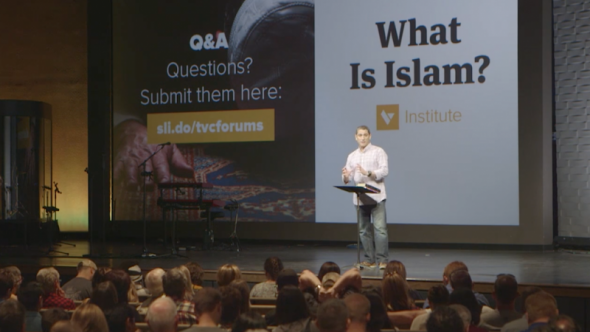
(Screenshot: The Village Church)Afshin Ziafat, lead pastor at Providence Church in Frisco, Texas, speaks on Islam at The Village Church Institute forum, October 2017.
An Iranian Christian pastor who was born in Houston is urging U.S. Christians to put aside their fear of Muslims and to be emboldened to love and share the truth of Christ with them.
Afshin Ziafat leads Providence Church in Frisco, Texas, and he recently spoke at a forum that The Village Church Institute hosts twice a year. His aim was to help Christians understand the basics of Islam and learn how to engage Muslims with the Gospel.
He made it clear during the forum that he’s not an Islamic scholar, but he grew up in an Islamic household and spent four years of his childhood in Iran, where his parents are from. After his conversion to Christianity during his senior year in high school in Houston, his father disowned him.
Ziafat, who travels to the Middle East to train Iranian pastors, laid out four basic beliefs that Muslims have about God, man, Jesus and salvation.
God
To Muslims, God is “holy transcendent” and “independent of creation,” he explained.
“The relationship with God I experienced personally in Islam is not like the personal relationship with Jesus that we have in Christianity,” he said.
The Muslim view of God is that God is a taskmaster and his followers are slaves. “Islam is about submission to Allah. He’s given us his rules and we’ve got to submit,” Ziafat said.
On the other hand, in Christianity, God is our father and we are his children, the Texas pastor noted.
Man
While Christians believe that man is born sinful, Muslims do not believe in an inherent sin nature. “Man sins but they believe you’re born sinless,” Ziafat explained.
“Christianity teaches us we were actually born in sin. That is a whole different starting point,” he noted.
“You’ve got to know that in the mind of a Muslim, there’s not this inherent need of a savior. That’s a foreign idea for them.”
Jesus
Muslims believe that Jesus was born of a virgin. They also believe he was sinless.
These are two of the greatest defenses of the deity of Christ, Ziafat noted, but Muslims do not believe Jesus was God. In Islam, Jesus was one of six major prophets, with Muhammad being the completer of the faith.
Regarding Jesus’ death, the Quran states that Jesus was not crucified but only appeared to them as so.
There have been many interpretations of what that means but in the end, “they don’t have a really good answer for the death and resurrection of Christ,” the Texas pastor said.
Salvation
There is no assurance of salvation in Islam. On Judgment Day, a person’s good deeds and bad deeds are weighed on a scale and if the good outweighs the bad, then that person can go to heaven.
Essentially, salvation in Islam is works-based while in Christianity, it is grace-based.
The Texas pastor noted that Muslims are given five pillars of faith to live by. These include: creed (belief in one god, Allah, and that Muhammad is his prophet), praying five times a day, fasting during Ramadan, giving 2 percent of one’s income to the poor, and making a one-time pilgrimage to Mecca (if they have the means to).
“If I did those five pillars of faith to the best of my ability then maybe I’d get to heaven,” he said of his Islamic upbringing. “I never had an assurance of my salvation.”
Grace is something that Muslims have a hard time wrapping their minds around, he noted. When he tried to share the Gospel with his father, his father responded, “Christianity makes no sense. You just say a prayer and Jesus brushes all the sin under the carpet.”
But that is not what Christianity teaches, Ziafat stressed. “In fact, I believe that’s what the scale system teaches — just do a little bit more good and all the bad gets swept under the carpet.
“When you put your faith in Christ, every one of your sins is accounted for and paid for on the cross by Jesus … Every sin is paid for.”
In the end, Ziafat believes that in Islam, the motive to live for God is fear, whereas in Christianity, the motive is love.
“What is lacking in Islam and most other religions is the unconditional love of God,” he stressed. “That is what transforms lives.”
So how can Christians share their faith with Muslims?
First, they can pray for their Muslim neighbors. That’s exactly what his high school friends did for a year before he converted to Christianity and he has heard many other testimonies of Muslims turning to Christ through the power of prayer.
Second, Christians ought to serve and love Muslims.
“I don’t have to tell you how much our culture is changing. The world is coming to us. This is a time for us to act,” Ziafat urged. “Has the church forgotten what we’re here for?”
“There are Muslims who are coming to our communities and they, just like me, feel like they’re on another planet and they want somebody to help them, … to help them get assimilated, teach them English, serve them,” he added. “They want to know that you care before they care about anything you know.”
Weighing in on the refugee crisis and the travel restrictions the Trump administration has been enforcing, Ziafat said that while he understands the angst amid terrorist attacks and the need for protective measures, ultimately, safety is not his priority.
“Safety is important but as a Christian, safety cannot be the overriding, the primary motive of my life. There’s something greater to me than saving my own life as a Christian,” he said. “I’ve got to think about opportunity too. Have we forgotten why we’re here?”
While many have asked whether Islam naturally leads to terrorism or whether it espouses violence, Ziafat emphasized that “Islam and terrorism is not synonymous.”
The concept of jihad, he explained, is “primarily a spiritual struggle in the life of Muslims to do good versus bad. That’s the way it’s presented first.”
While there are verses in the Quran that say to fight those who don’t believe in Allah, those verses are used by radicals for mainly political purposes, the pastor noted.
Ziafat, however, said he wouldn’t go as far as calling Islam a religion of peace. “I don’t think there’s peace in Islam, there’s not peace with God ever because there’s no forgiveness,” he stated.
Dispelling fears, he went on to note that most Muslims you will see across the street are nominal and that those who are devout will be “more fanatical about the five pillars.”
He encouraged Christians to build friendships with Muslims and to not be afraid of inviting them over. Also, Muslims do not expect others to know all their customs and culture.
“Muslims are the most hospitable, kind people you will ever meet,” he assured. “Sometimes, we’re so afraid of engaging their culture that we never end up doing it.”
“I have a limited amount of time on this earth and more than ever, Muslims are coming across the street and we have the greatest news ever,” he said.
“There is a unique opportunity to live out the Gospel. When they’re expecting you to treat them like an enemy and you love them, you are probably doing the most Christian thing you could possibly do.”
Topic: An Encounter with Stones — Wednesday October 18, 2017.
Read: Isaiah 53:1–6, Bible in a Year: Isaiah 53–55; 2 Thessalonians 1 He was pierced for our transgressions, he was crushed for our iniquities. Isaiah 53:5
After centuries of war and destruction, the modern city of Jerusalem is literally built on its own rubble. During a family visit, we walked the Via Dolorosa (the Way of Sorrow), the route tradition says Jesus followed on His way to the cross. The day was hot, so we paused for a rest and descended to the cool basement of the Convent of the Sisters of Zion. There I was intrigued by the sight of ancient pavement stones unearthed during recent construction—stones etched with games played by Roman soldiers during their idle moments. Those particular stones, even though likely from a period later than Jesus, caused me to ponder my spiritual life at the time. Like a bored soldier passing time in idle moments, I had become complacent and uncaring toward God and others. I was deeply moved by remembering that near the place I was standing, the Lord was beaten, mocked, insulted, and abused as He took all of my failure and rebellion on Himself.
“He was pierced for our transgressions, he was crushed for our iniquities; the punishment that brought us peace was on him, and by his wounds we are healed” (Isa. 53:5).
My encounter with the stones still speaks to me of Jesus’s loving grace that is greater than all my sin.
Prayer: Lord Jesus, through Your great sacrifice for us, we find forgiveness, healing, and hope. Thank You that we live today and forever in Your love.
Our sin is great—God’s grace is greater.
Insight:
In their context, few Old Testament prophecies of Jesus look like clear predictions. For the most part, it is only by reading backward that we can see how Jesus brought fullness of meaning to words that were mysterious in their own time. Yet when read in light of Jesus, these words can now be life-changing.
Isaiah’s prophecy of the Suffering Servant is an example of this. Many in Israel believed it was their own persecuted nation that was bearing the sins of the world. Only by looking back can people like us realize that “we” were the ones who unwittingly demanded the death of our own God and Savior (Zech. 12:10–14).
As hard as it is to admit, this is the kind of grief that is for our good and comfort. This is how we can read words that were once so mysterious and see how much our God loves us.
This message was written By David C. McCasland [Our Daily Bread Ministries.]
Join us on our podcast each weekday for an interesting story, well told, from Charisma News. Listen at charismapodcastnetwork.com.
Federal prosecutors on Tuesday said a Massachusetts man accused of plotting to attack police and behead a conservative blogger was a passionate supporter of the Islamic State militant group who recruited people including his own uncle into the scheme.
The prosecutors contend that David Wright, 28, along with his uncle and a friend had plotted to kill the blogger, a woman who organized a 2015 “Draw Mohammed” contest in Garland, Texas. They said the plan unraveled when the uncle, Usamaah Abdullah Rahim, lost patience and said he wanted to kill police officers instead.
“The defendant was a sophisticated recruiter, he manipulated people, including his own uncle, into believing that they needed to join ISIS and kill Americans,” said Assistant U.S. Attorney Stephanie Siegmann, using a common acronym to refer to Islamic State.
“The defendant was committed to ISIS and he knew exactly what he was doing,” Siegmann said in prosecutors’ closing statements at Wright’s trial in Boston federal court.
The three bought knives and planned to travel to New York to kill Pamela Geller, the organizer of the “Draw Mohammed” contest. That plan fell apart in June 2015 when Rahim told Wright he had lost patience and planned to attack police in Boston.
Law enforcement, who had been surveilling the group, overheard the conversation. When police approached Rahim to question him, he pulled a knife and was shot dead by officers.
Defense attorney Jessica Diane Hedges said that Rahim’s actions were a surprise to Wright. The defendant took the rare step of testifying in his own defense, saying he had never really intended to attack Geller. He described his actions as “role playing.”
Hedges noted that even law enforcement was surprised by Rahim’s attack.
“They weren’t planning on arresting Mr. Wright until Usamaah Rahim did something,” she said. “What the government has done in this case over and over is exploit the fear that ISIS inspires.”
If Wright is found guilty of the charge of conspiracy to commit acts of terrorism transcending national boundaries, he could face a life sentence.
Geller had organized the Texas event in May 2015 featuring cartoons of the Prophet Mohammed, images that many Muslims consider blasphemous. Two gunmen had attacked that event and were shot dead by police.
Geller contends her event was intended as a demonstration of the free-speech rights protected by the First Amendment of the U.S. Constitution.
Readers are Leaders! Subscribe now and get 3 magazines for the price of 1. Get Charisma, Ministry Today and SpiritLed Woman all for $24. YES – Sign me up!
3 Reasons Why you should read Life in the Spirit. 1) Get to know the Holy Spirit. 2) Learn to enter God’s presence 3) Hear God’s voice clearly! Click here to draw closer to God!
Seven people were killed and another 15 injured when suspected Islamic State militants targeted a bank and a church in Egypt.
Egyptian Christians, known as Copts, have been facing intensified persecution recently. According to The Christian Post, the ISIS militants attacked a bank and then the Church of Saint George in El-Arish, Egypt. They reportedly robbed the bank and then proceeded to fire on security forces who were guarding the unused church.
The militants then celebrated the attack by waving their black flags and marching through the streets.
“The militants fired shots randomly in the street as if they were celebrating with some of them raising their black flags (of ISIS) and they roamed the streets for about 20 minutes then disappeared,” said Alaa Lotfy, a shop owner in the area who was a witness to the attack.
This attack marks the second attack on Coptic Christians in hardly more than a week. Last week, Samaan Shehta, a Coptic Christian priest, was slain by a suspected ISIS militant. The attack was caught on video.
“This incident makes us once again ask so many questions. Why should a priest not be able to walk safely down a street, especially a suburban street in Cairo?” asked Bishop Anba Angaelos, the General Bishop of the Coptic Orthodox Church. “Why should he be chased by a man brandishing a deadly weapon and have no one run to his aid; in actual fact, everyone was running away.”
Just because you do good doesn’t mean you don’t need God. (TheHilaryClark/Pixabay)
Join us on the new C-Pop podcast where Taylor and Jessilyn discuss, debate and sometimes deride pop culture with a strong sense of humor and a focus on Christ. Listen at charismapodcastnetwork.com.
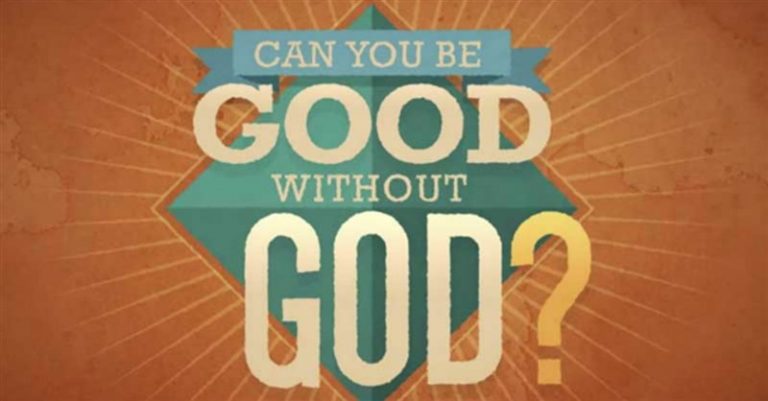
For the first time, a majority of Americans—56 percent—say it is possible to be a good person without a religious belief.
“God is not a prerequisite for good values and morality,” Greg Smith, Pew’s associate director of research, said in a post about the findings. ” … [T]he public’s increased rejection of the idea that belief in God is necessary for morality is due, in large part, to the spike in the share of Americans who are religious ‘nones.'”
Nones now account for about one-quarter—23 percent— of American adults, up from 16 percent in 2007. But their growth is not the whole story behind the numbers.
In the current poll, Protestants and Catholics were also polled, and 45 percent of them agree that God is not necessary for personal morality, up from 42 percent in 2011.
Even white evangelicals, who traditionally believe a relationship with God is crucial to morality, have budged. In 2011, one quarter of them (26 percent) said it was possible to be good without God, while now almost a third (32 percent) say so.
“To be sure, most white evangelicals still say belief in God is necessary for morality,” Smith writes. “But the share who say belief in God is a necessary underpinning of being moral has declined from 72 percent to 65 percent in just six years.”
The poll’s findings were published Monday (Oct. 16), four days before “Openly Secular Day” on Oct. 20, an event promoted by multiple organizations of atheists, humanists, agnostics and other secular individuals to highlight their lack of religious beliefs.
Readers are Leaders! Subscribe now and get 3 magazines for the price of 1. Get Charisma, Ministry Today and SpiritLed Woman all for $24. YES – Sign me up!
3 Reasons Why you should read Life in the Spirit. 1) Get to know the Holy Spirit. 2) Learn to enter God’s presence 3) Hear God’s voice clearly! Click here to draw closer to God!
(Photo: Reuters/Stefano Rellandini)Saint Peter’s Basilica is pictured at the Vatican March 7, 2013.
While many have seen a remarkable togetherness occurring among evangelical Protestants and Roman Catholics ahead of Protestantism’s 500th anniversary, important institutional and theological issues still separate us, according to two Wesleyan scholars. Such significant ground cannot be glossed over, they explain, and the debates that arise are worth having.
Both in a recent phone interview with The Christian Post and throughout the book’s 410 pages, the co-authors repeatedly stress that they consider Roman Catholics their fellow brothers and sisters in Christ and that their aim is not to widen the existing theological chasm. They maintain, however, that conversations where difficult questions are raised about these centuries-old, often painful divides are deeply needed.
Walls and Collins contend that it’s not the “Catholic” part that stands in the way of real unity, but the “Roman” part, as evidenced by the book’s title. Roman Catholics often criticize Protestants over “sola scriptura” (scripture alone), which they think is unworkable and has led to endless schisms. But the authors reply that Rome’s “sola Roma” approach comes with serious problems of its own and does not make them immune from division.
Expand | Collapse
(Photo: Courtesy of Ken Collins)Roman But Not Catholic: What Remains At Stake 500 Years After the Reformation
Other than the Roman Catholic distinctives about Jesus’ mother Mary and her role in the life of the Church, the office of the pope is perhaps the most profound source of division between Catholics and Protestants, a subject explored extensively in Chapter 11, “The Papacy: Shaking the Foundations.” Collins, who was raised Roman Catholic but became a Protestant in college and is now a professor of historical theology at Asbury Theological Seminary in Wilmore, Kentucky, believes this is an area where the Roman Church is committing the error of anachronism.
“[Rome] takes later historical products and reads them back into the first century where they don’t belong,” Collins told CP, regarding the office of the pope. Roman Catholics assert that Peter was the first pontiff to lead the Church. But the papacy is actually “an office based on a constellation of claims that developed over time,” Collins says, and it took centuries for it to come into place.
Several elements of the Roman church hierarchy were not even on the scene for there to have even been anything remotely close to a pope and the powers he exercises, Collins continued. The Asbury professor considers it “debatable” as to who the first actual pope was.
“It’s like saying, for example, that the United States of America, during the 13th century, didn’t have many people,” Collins explained. “Well, that’s a nonsense sort of statement because America didn’t exist in the 13th century.”
Expand | Collapse
(Photo: Courtesy of Ken Collins)Ken Collins, co-author of “Roman but Not Catholic: What Remains at Stake 500 Years After the Reformation.”
What is more, Walls interjected, is that the Roman Catholic Church maintains that the papacy is the unifying center of the Christian world today, when not only is that not the case for Protestant believers but also Eastern Orthodox Christians. The rumblings over Pope Francis and the recent controversy over “Amoris Laetitia” — a 2016 papal exhortation that addresses the Church’s stance on access to communion, divorce, sexual mores, and pastoral practice — demonstrate that such division exists even within the Roman Catholic faith, he added.
And aside from current disputes, the Roman Church may purport to be united but is for all practical purposes divided, Walls noted.
“Most [Roman Catholic] laity believe things that are quite out of sync with official Church teaching,” Walls said.
“Functionally, the Roman Catholic Church is the world’s largest pluralist Christian denomination comparable to many liberal Protestant denominations.”
Collins agreed to join Walls in co-writing Roman but Not Catholic to contribute his historical knowledge to the project. He told CP that he initially resisted the invitation from Walls but decided to take part when he considered how the Roman Church stands in negative judgement of his evangelical and Pentecostal peers in Latin America. Rome’s ill feelings toward them there and elsewhere are born out of an understanding of their ecclesiology, their doctrine of the Church — that they are the “one true Church.” At that point, being a co-author of the book became a “sacred calling for me,” he added.
Expand | Collapse
(Photo: Courtesy of Jerry Walls)Jerry Walls, author and professor of philosophy at Houston Baptist University.
Walls, who is a professor of philosophy at Houston Baptist University and was one of the originators of the Reforming Catholic Confession — a Protestant affirmation of the essentials of the Christian faith published on Sept. 12 — noted that, like the Confession, their book intends to recover and reclaim the word “Catholic,” a term Rome has appropriated for itself but in fact belongs to faithful Christians of every stripe.
“Certainly, our book is pointedly critical in one sense of the word but it’s ultimately one that aims for unity, and to attack and critique the barriers that divide Christians that should not divide Christians,” like the Lord’s Supper and who can be anointed with oil on the deathbed, Walls said.
“And ultimately we want to promote a vision of the Holy Catholic Church that is more expansive and larger than the Roman Church, the Eastern Orthodox Church, or the Protestant Church. It’s bigger than all of those.”
Christian unity is going to come about when Christ is at the center, Walls continued, when “all traditions recognize and respect each other fully as brothers in Christ, welcoming each other at the communion table, not because of your views of ecclesiology or sacramental theology but because of your commitment to Christ and your recognition that as followers of Christ he has called us to celebrate this together as a sign of unity.”
But until both Rome and Eastern Orthodoxy stop fighting over who is the “one true Church” and recognize that the Church of Jesus Christ is much bigger than any of them, Walls added, no real chance of unity is possible.
For Roman Catholics, ecclesiology seems to trump everything, Collins noted, even agreement on theological matters important to Protestant evangelicals like the doctrine of justification.
Collins emphasized: “It almost seems that in terms of Rome there is not only sacred Scripture, revelation that has been given to us by the Holy Spirit, but that the Holy Spirit has also given a particular polity and its that second move that this really does come from God.”
Unlike the official Roman Catholic governing body, the Magisterium, which Roman Catholics regard as supremely authoritative, Protestants do not believe that a specific, divinely-ordained Church structure carries the same weight and status as Scripture.
Expand | Collapse
German theologian Martin Luther
In Chapter 14, “Protestants in the Crosshairs,” Walls and Collins address in detail the phenomena of ardent Catholic apologists whose works have become popular, such as Protestant-turned-Catholic Devin Rose’s The Protestant’s Dilemma. Another book they mention, Surprised by Truth, boasts of selling over 250,000 copies on its cover and contains 11 testimonials of former Protestants who became Roman Catholic. The foreword for this book was penned by Calvinist-turned-Roman Catholic apologist Scott Hahn, who refers to the former Protestant writers describing their spiritual journey to Rome as “theological step-children who have finally come home.” Walls and Collins unpack how these popular Catholic apologetics also contain a considerable amount of imprecise and uncharitable language toward evangelicals and heavy, all-or-nothing, Rome-centric reasoning.
Protestants who read these works are likely exploring “conversion” to Rome already, they write, and they caution those who are exploring to avoid what they call “Roman fever,” a symptom of which is the tendency to compare the best of Roman Catholicism with the worst of Protestantism. Snarky lines like “We have Dante’s Divine Comedy, and you all have the Left Behind series,” are but one example of this, Walls recalled once hearing a Roman Catholic friend quip.
Despite all of this and other areas of conflict, Walls and Collins conclude Roman But Not Catholic by reiterating their affirmation of the genuine faith of Roman Catholic believers around the world, and prayerfully appeal to John 17:20–21, Jesus’ prayer that all those who would follow Him would be one, as He and the Father are one. They praise Pope Francis’ recent comments toward more inclusive practices in celebrating the sacrament of Holy Communion, even if his words were said in the midst of lingering doubt and ambiguity.
“Perhaps the pope will take further steps in this same direction, during the pivotal 2017 year, to allow us to celebrate the fundamental reality that we are all characterized by one Lord, one faith, one baptism. We surely hope so. The advance of world Christianity on occasion and its witness to the world would be epic,” the authors write.
Until such a time or some other breakthrough moment occurs, the disagreement will no doubt continue as it relates to how the disunity in this life will transition to unity in the next, they explain.
“Indeed, we are all getting closer to that glorious reality by God’s grace as we live out our Christian lives from decade to decade, walking in the obedience of faith, encouraged by hope and empowered by love.”
“God is not a prerequisite for good values and morality,” Greg Smith, Pew’s associate director of research, said in a post about the findings. ” … [T]he public’s increased rejection of the idea that belief in God is necessary for morality is due, in large part, to the spike in the share of Americans who are religious ‘nones.’”
Nones now account for about one-quarter — 23 percent — of American adults, up from 16 percent in 2007. But their growth is not the whole story behind the numbers.
In the current poll, Protestants and Catholics were also polled, and 45 percent of them agree that God is not necessary for personal morality, up from 42 percent in 2011.
Even white evangelicals, who traditionally believe a relationship with God is crucial to morality, have budged. In 2011, one quarter of them (26 percent) said it was possible to be good without God, while now almost a third (32 percent) say so.
“To be sure, most white evangelicals still say belief in God is necessary for morality,” Smith writes. “But the share who say belief in God is a necessary underpinning of being moral has declined from 72 percent to 65 percent in just six years.”
The poll’s findings were published Monday (Oct. 16), four days before “Openly Secular Day” on Oct. 20, an event promoted by multiple organizations of atheists, humanists, agnostics and other secular individuals to highlight their lack of religious beliefs.
“It’s getting to the point where even devoutly religious people know somebody who’s an atheist,” he said in an email.
“Just as we saw with the LGBTQ movement, it becomes a lot harder for religious people to demonize us when they know us, and knowing us poses a direct challenge to the absurd idea that people can’t be good without God.”
Two years ago, archaeologists began excavating under the section of the Western Wall known as Wilson’s Arch hoping to determine its age. It leads to the indoor men’s prayer section. (CBN News)
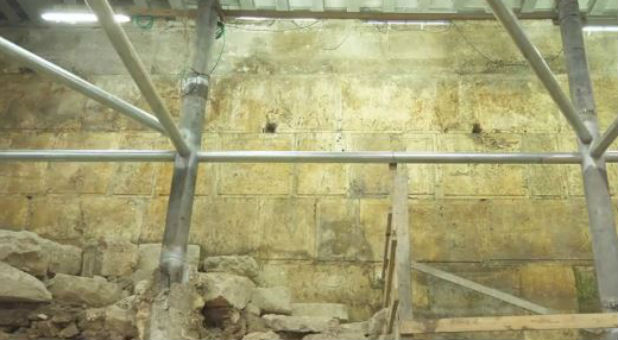
The Israel Antiquities Authority (IAA) unveiled a huge underground section of the Western Wall on Monday that had been hidden for nearly 2,000 years and while digging, they also discovered a Roman-era surprise.
Two years ago, archaeologists began excavating under the section of the Western Wall known as Wilson’s Arch hoping to determine its age. It leads to the indoor men’s prayer section.
“We drilled down these beams to support the floor,” IAA archaeologist Tehillah Lieberman told CBN News. “One of the main goals of the excavation was to not interrupt with the prayer activity going on.”
Wilson’s Arch is the only intact, visible structure remaining from the Temple Mount compound of the Second Temple period.
It was the last arch in a series that made up a giant bridge leading to the Temple Mount from the west and served as a passage for people to enter the Temple Mount and aqueduct.
It was no surprise that archaeologists exposed eight new courses or rows of massive stones of the Western Wall that had been buried beneath it for 1,700 years.
“We knew it was here, but to see it is very exciting,” said Lieberman.
“This is the Western Wall. This is the exact same thing that you see upstairs and outside. The preservation here is a lot better because it’s been covered—no rain, no sun. The preservation here of the stones is probably the best of the stones in the Western Wall that we know of today,” she said.
What they found under the street level there was a surprise.
“The most interesting thing that we found over here is a semi-circular building or theatre-like building,” said archaeologist Dr. Avi Salamon.
Salamon said it’s the first time in 50 years of excavating in Jerusalem that archaeologists found a public Roman building like this.
“Therefore the importance of the excavation is enormous,” Salamon told CBN News.
And it also confirmed historical writings that said there was a theatre near the Temple Mount. But oddly enough, archaeologists believe it was never used. Still it showed the change in character of the city.
“This shows us the change of the culture of the city from a Jewish city focusing on Temple Mount, Jerusalem changed into a Roman colony that has different needs, different uses—one of them is building entertainment, leisure buildings as this theater-like structure,” said Lieberman.
And there’s more.
“Underneath, where the floor originally was, we exposed the drainage channel that is built out of stone,” said Lieberman. “It’s parallel to the Western Wall, it’s parallel to the arches pier and it slopes towards the south.”
Lieberman says there’s another drainage channel that connects Robinson’s arch to the south to the City of David.
“It might even connect to that same drainage channel we know in Robinson’s Arch and to City of David and if that’s true you can probably walk from underneath the Western Wall plaza of today, the modern Western Wall plaza all the way to pool of Siloam,” she said.
Archaeologists hope to open the site to the public in a few years.
Readers are Leaders! Subscribe now and get 3 magazines for the price of 1. Get Charisma, Ministry Today and SpiritLed Woman all for $24. YES – Sign me up!
3 Reasons Why you should read Life in the Spirit. 1) Get to know the Holy Spirit. 2) Learn to enter God’s presence 3) Hear God’s voice clearly! Click here to draw closer to God!
We use cookies to ensure that we give you the best experience on our website. If you continue to use this site we will assume that you are happy with it.