

Islamic Radicals Chant ‘Allahu Akbar’ as They Hack to Death Atheist Student on Terror Hit List

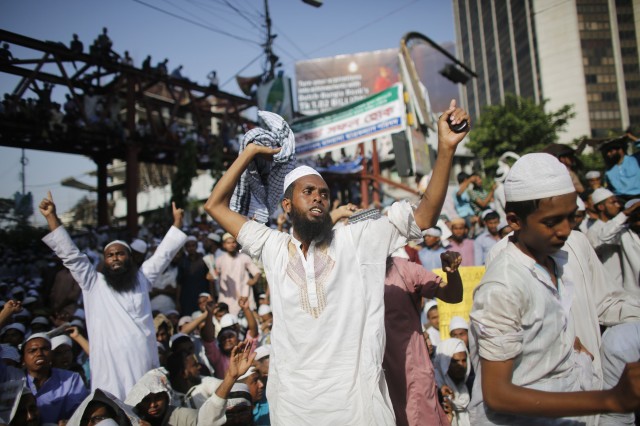
Islamic activists (Photo: REUTERS/Andrew Biraj)

Islamic activists shout slogans during a grand rally in Dhaka April 6, 2013.

Christian Post Report – Suspected Islamic radicals hacked a student to death on the streets of Dhaka and were reportedly heard chanting “Allahu Akbar” during the murder.

Dhaka Tribune reported that the student, 28-year-old Nazimuddin Samad, was a law student at Jagannath University, who campaigned for secular causes on Facebook and spoke out against radical Islam.

Police in Dhaka said Samad was walking home with a friend following classes Wednesday night near Bahadur Shah Park when they were attacked by three assailants. The killers apparently intercepted the two student on a motorcycle and attacked them with machetes, hacking Samad to death, and later shooting him to make sure he was dead.

“He was on his way back home from his evening classes when he was circled by a group of three to four people,” Senior Assistant Police Commissioner Nurul Amin of the Dhaka Police told CNN.

“First the attackers hacked Samad with machetes, then shot him.”

Locals told police that the killers were chanting “Allahu Akbar” while carrying out the murder.

It is not yet clear what happened with the friend accompanying the secular student.

Imran Sarker, who leads a blogging and online activist network in Bangladesh, shared that Samad regularly posted on Facebook expressing views opposed to radical Islam.

“He was very vocal on issues of religious fundamentalism, war crimes, minority issues, corruption and injustice against women,” Sarker told CNN.

Officials said the murder was a pre-planned attack, making it the sixth murder of a secular writer or publisher in Dhaka in 16 months.

In August it was revealed that at least 84 bloggers in Bangladesh who have spoken out against radical Islam are on a terror hit list. A number of the atheists have been killed by extremists wielding machetes.

Although Bangladesh remains an officially secular country, secular critics of the government often accuse authorities of not punishing radical attackers harshly enough, and not providing sufficient protection for those who do not follow the Islamic religion.

World leaders, including United Nations Secretary General Ban Ki-Moon, have denounced such attacks, noting that they impact on the exercise of freedom of expression in Bangladesh.

“He (Ban Ki-Moon) calls on the government of Bangladesh to bring those responsible for the murder of Neel and the other bloggers to justice in an expeditious manner and act to ensure that all Bangladeshis can enjoy freedom of expression and all other human rights without fear,” the U.N. said following the murder of another atheits blogger, Niloy Neel.

JnU Proctor Nur Mohammad meanwhile revealed that Samad’s family has been informed of his murder, as they await further details.

Police are asking locals who witnessed the murder to share more information about the assailants, which will help them identify the suspects.

Source : Christian Post

Wales Archbishop Apologizes to Gays for ‘Persecution, Prejudice,’ but Can’t Support Gay Marriage

Gay marriage (Photo: Reuters/Ian Hodgson)

Jenny Taylor adjusts a wedding cake figurine of a couple made up of two men at the gay wedding show at the Town Hall in Manchester, November 6, 2005.

Christian Post Report – The Archbishop of Wales said in an open letter to the LGBT community that while the Church can’t support same-sex marriage, he apologized for what he called the persecution and prejudice they have faced.

“We, as bishops of the Anglican Communion, mindful of the results of our consultation and the Statement of the Primates of the Anglican Communion, and of all our members, including those who are gay and lesbian, do not feel that we can support at this time a move to change the discipline of the Church in Wales with respect to the teaching on marriage, nor can we permit the celebration of public liturgies of blessing for same-sex unions,” Barry Morgan said in a statement released Wednesday.

His comments refer to the major Anglican Primates meeting in January, which upheld the traditional definition of marriage between one man and one woman, and decided to suspend The Episcopal Church in America from moving away from that tradition.

The Primates stated that the move to change Canon law and bless gay marriage is a “fundamental departure from the faith,” and said the Episcopal Church will be suspended for a period of three years. For its part, the EC has said it will not be backing away from its support for gay marriage despite the consequences.

In his address, Morgan added that it is time to condemn “homophobic prejudice and violence,” and support all human beings as equal.

“We recognize that you have often been persecuted and ostracized by the Church for your sexuality, that you have been mistreated by the Church, and forced into secrecy and dissimulation by the attitudes of prejudice which you have faced.

“We deplore such hostility, and welcome and affirm the words of the Primates that condemn homophobic prejudice and violence. We too commit ourselves to offering you the same loving service and pastoral care to which all humanity is entitled, and we commit ourselves to acting to provide a safe space within the Church and within our communities in which you can be honest and open, respected and affirmed.”

He noted that despite the Church’s decision not to condone gay marriage or civil partnerships, “we commit ourselves as bishops to work for a Church in which you can be fully affirmed as equal disciples of Jesus Christ or seekers after truth.”

Morgan also stated that the “pain and tensions” surrounding the debate about human sexuality in the Church will not go away, but insisted that Christians are called to live “in love and charity with one another,” and to follow the example of Jesus to respond with “grace and as much accommodation as possible” to all people.

Anglican Communion leader Archbishop Justin Welby has also in the past recognized that there are “schismatic differences” between Anglicans on the issue of how to minister to gay people, and although he has also backed the traditional definition of marriage, has said the Church must remain united, even in disagreement.

“A 21st-century Anglican family must have space for deep disagreement, and even mutual criticism, so long as we are faithful to the revelation of Jesus Christ, together,” Welby has said.

Source : Christian Post

What’s the Purpose of Jesus’ Miracles in the Bible?

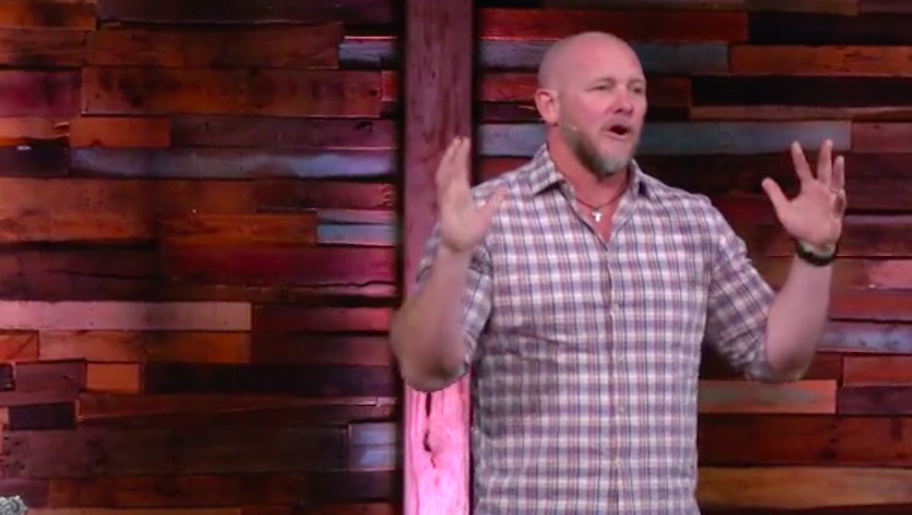
Pastor Joby Martin of The Church of Eleven22 speaking on miracles and signs. (Photo: Screenshot/The Church of Eleven22)
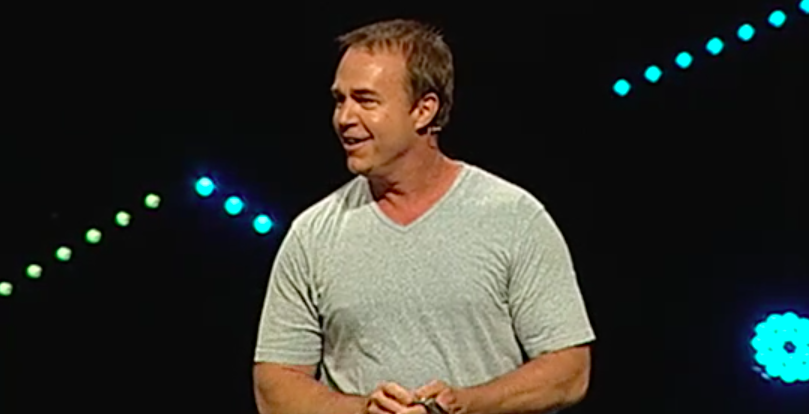
Pastor Joby Martin of The Church of Eleven22 speaking on miracles and signs.

Christian Post Report – Miracles are by definition something extraordinary. So when Jesus performs a miracle in the Bible, what’s his purpose for invoking his supernatural powers instead of taking the normal human route?

In John 2, Jesus famously turns water into wine at a local wedding, preached Pastor Joby Martin of The Church of Eleven22 in Florida, one of the fastest growing evangelical churhes in the country, in a sermon this past weekend as part of his Miracle series. Looking at the miracle outlined in John 2, says Martin, sheds light on our relationship with God, salvation, and the promise of eternal life.

“A miracle is when the unexplainable runs up against the undeniable,” Martin says.

The evangelical pastor says that the miracles and signs by Jesus are “not fables or parables, these are actual events. If the tomb is empty, then everything is possible.”

All of the miracles performed by Jesus point to the promise of redemption, Martin says, because “[the] only eternal miracle is the miracle of salvation.”

Martin suggests that Jesus miracle of turning water into wine is a “first of the signs” to reveal his glory and serves as a sign of Jesus’ future crucifixion, death and resurrection on the cross, and how that act guaranteed salvation for all people.

Jesus’ comment to Mary of “my hour has not yet come” foreshadows his future crucifixion experience and what it will do for mankind.

Through all of his miracles, Jesus wasn’t trying to show off his “raw power,” Martin explains, but rather he was “pointing to his redemptive purpose.”

Readers of this story need to look beyond the “sign” of the water and the wine. “A sign is not the thing, a sign points to something greater than itself,” Martin explains.

The Florida pastor tied John 2 to Revelation 19, which discusses the “marriage supper of the lamb.”

He questions if through this first miracle, Jesus was trying to “show a picture of what it looks like to be invited to the great wedding supper in heaven.”

If people allow Jesus to save them, thus transforming them from dirty water to wine, then they will be able to celebrate with him at a supper of the lamb in heaven, Martin says.

The pastor adds that all people are invited to this event and the ticket has already been paid: “There’s only one way into this party – through the life, death and resurrection of Jesus.”

Martin concludes that through his miracle, Jesus is communicating the bigger picture of his future death and resurrection, inviting all people to find salvation and join him in eternity.

“Lord I pray that there is not a man, woman or student in this place today who turns their back on that invitation [to salvation],” Martin prays.

Source : Christian Post

‘Jesus Was Persecuted, Christians Should Expect Nothing Less,’ Pastor Says 1 Year After Garissa Terror Attack

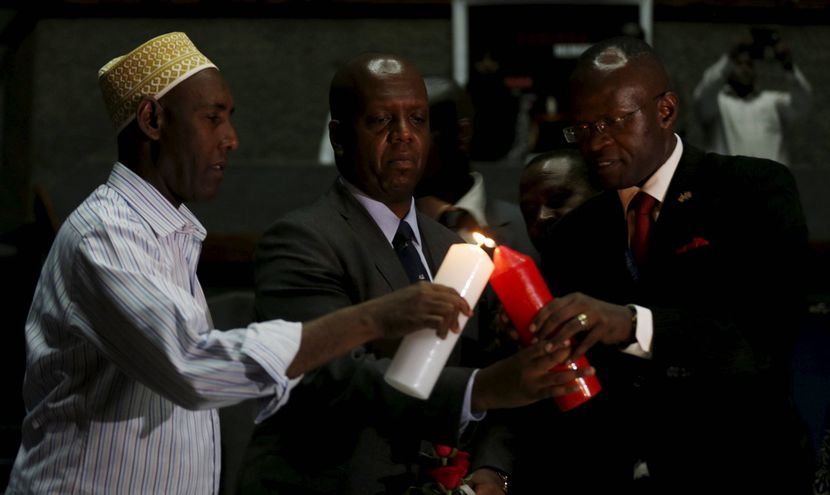
Kenya’s National Counter Terrorism Centre Director Martin Kimani (C) is assisted to light a candle during prayers to commemorate the first anniversary of the attack at the Garissa University College, in Kenya’s capital Nairobi, April 2, 2016.

Christian Post Report – Christians continue to reflect on what it means to be a follower of Jesus Christ one year after the horrific attack on Garissa University in Kenya where 148 students were slaughtered by Islamic radicals.

“God is always just and we should learn to appreciate his will, depend on him for strength, and thank Him for the gift of life because there is nothing that can compensate the lost lives of the students,” a Garissa-based pastor, identified as ‘Daniel,’ told persecution watchdog group the International Christian Concern in a report.

There have been several different commemorations for the victims of the massacre this past week, including candlelight vigils around the country, as well as a run on Saturday, BBC News reported.

The attack last year was carried out by al-Shabaab militants, who have been specifically targeting Christians, often separating them from Muslims before killing them in several kidnapping raids.

While based in Somalia, the terror group has launched several attacks on Kenya and elsewhere, responding to multinational military operations against it.

The terror group has suffered significant casualties in U.S. airstrike operations, and in March more than 150 of its fighters were killed during an American attack on Raso Camp, located 120 miles from the capital of Mogadishu.

Al-Shabaab continues organizing attacks, however, and in February took responsibility for the twin bombing at a busy restaurant in the Somali city of Baidoa, aimed at crippling the central government.

ICC shared in its report the stories of several Christians who were wounded and affected by the Garissa shooting, and noted that “the persecuted Church in Kenya teaches us what persevering faith looks like in the midst of hard trials.”

Pastor Daniel, who has been ministering to Christian students coping with the memories of the attack, reminded his followers that if “Jesus Himself represents the One most persecuted,” then Christians should expect nothing less.

Some of the Garissa residents who took part in the run organized for the victims told BBC that the city continues to be affected by what happened.

“As we try to mourn the innocent lives, it’s like it happened yesterday. The images of the dead bodies keep on playing in my mind. It was really a traumatising experience,” said Ali Awdoll, one of the organizers.

Awdoll added that the runners were taking part as “a gesture of the peace and humanity that we lost … there is no ‘we’ and ‘they’ in this whole thing — we are humanity and we all have one common enemy — the terrorists are our common enemy.”

Garissa Township MP Aden Duale emphasized that point, explaining that Kenyans need to stand united as one people.

“Together as a country, from the north to the south to the west to east, from the Muslims to Christians… together we must fight all forms of terror,” Duale said.

Garissa University College officially reopened back in January nine months following the attack.

Although some church leaders, including Roman Catholic Bishop Joseph Alessandro, praised the reopening of the college, he noted that it would be mainly Muslim students that will be returning, as most of the Christians have opted to move to other campuses in Kenya to continue their education.

Source : Christian Post

Evangelical Pastor on ‘Things I Wish Jesus Never Said’: Hard Teaching on Money

 (Photo: Screenshot/Mariners Church)

Doug Fields speaking at Mariners Church for the “Things I Wish Jesus Never Said” series.

Christian Post Report – Even if one is a committed Christian, there are things Jesus taught in the Bible that are hard to follow and one simply wishes Jesus never said them.

That’s why Mariners Church in Southern California is tackling these difficult teachings that people want to ignore head-on in its latest series, “Things I Wish Jesus Never Said,” this past weekend. Pastor Doug Fields, who is now executive director of HomeWord’s Center for Youth/Family at Azusa Pacific University but formerly served at Mariners Church and Saddelback Church, was the guest preacher to kick off the series about hard truths.

Fields examines Mark 10: 17-30, when a wealthy man asks Jesus what he can do to have eternal life. Jesus replies by telling him to sacrifice, a word Christians rarely like to hear, Fields says.

“‘One thing you lack,’ he said. ‘Go, sell everything you have and give to the poor, and you will have treasure in heaven. Then come, follow me,'” Mark 10:21 reads.

Using the metaphor of a classica Red Ryder wagon, Fields says that all Christians are towing around the important “items” in their life. An issue arises when Christians become more focused on the contents of their wagon compared to their walk with Jesus. It is then that they must sacrifice their metaphorical wagon, or the things that “prop you up in your life and serves as your identity,” and when they do, they can start living out their eternal life with Jesus.

So what makes up people’s identity – their precious earthly belongings or their relationship with Jesus?

In the book of Mark when Jesus tells the rich man to sacrifice his possessions, he is exposing what is in the young man’s wagon, and therefore “revealing the affection in his heart,” Fields explains. “The stuff in your wagon can get in the way of you following [God].”

“Get rid of the stuff that’s going to get in the way of you and [God] walking together,” Fields urges.

For the wealthy man in the story, “What was in his wagon was more important than Jesus […] he wasn’t pulling his wagon, his wagon was actually pulling him.”

Christians may then ask themselves, “If I sacrifice the items in my wagon, what’s in it for me?”

As stated in the verse, Jesus says that those who sacrifice will not only have eternal life after death, but they can start living this experience of eternal life right now.

It’s comparable to going to the Disneyland theme park, says the California pastor, but only staying at the entrance when you have the entire park to explore.

Fields concludes his message by encouraging listeners to look into their own wagon and determine what they need to sacrifice so they may better follow Jesus.

When people do this, “They begin to see the stuff they put in their wagon is not as important as they once thought it was” and they never want to go back.

Source : Christian Post

Justin Bieber Encourages Fans to Find Rest in God’s Presence

Justin Bieber (Photo: Reuters/Danny Moloshok)

Recording artist Justin Bieber poses with his Dance Song of The Year Award for “Where Are U Now” and Male Artist of the Year Award backstage at the 2016 iHeartRadio Music Awards in Inglewood, California, April 3, 2016.

Christian Post Report – With the release of his latest album “Purpose,” pop star Justin Bieber has been trying to turn his bad boy image around by talking more about his Christian faith.

In an Instagram post Tueday night, Bieber encouraged his fans with Psalm 46:10, which reads: “Be still, and know that I am God. I will be exalted among the nations, I will be exalted in the earth.”

“Remember there’s a God that loves you and is for you. Be still in his presence. He will give you true rest,” the “What Do You Mean” singer wrote.

remember there's a God that loves you and is for you. Be still in his presence he will give you true rest

A photo posted by Justin Bieber (@justinbieber) on

Earlier this year, Bieber encouraged his followers to start reading the Christian devotional Jesus Calling, which has sold more than 15 million copies worldwide.

During an interview with Complex magazine last year, the 21-year-old stated: “I just wanna honestly live like Jesus. Not be Jesus. … I don’t want that to come across weird. He created a pretty awesome template of how to love people and how to be gracious and kind.”

Bieber admitted in the same interview, however, that he has often rejected his faith and communion with other Christians.

“Christians leave such a bad taste in people’s mouths. I was like, ‘I’m not gonna go to church.’ I had these church friends and I was like, ‘You guys are cool, I like you guys, but I’m not going to church,'” he said.

Bieber rose to fame as a teen idol at 13, but by 2011 he was equally well known for his antics — smoking marijuana, vandalizing his neighbor’s property, using racial slurs and drag racing. But since that time he’s been work hard to transform his life.

Back in November, a Los Angeles Times reviewer described his experience at Bieber’s world tour as part pop concert, movie premiere, skateboarding demonstration and a church service.

“He talked about the importance of maintaining a positive spirit and surrounding himself with encouraging people. He credited his connection with God for helping him to get back on his feet after a string of widely publicised tabloid troubles. And when a fan in the audience — one of a dozen or so selected by the singer’s team for a question-and-answer session — asked if he had any advice on how to get through a romantic breakup, he demurred, flashing a bit of the humility that every religious leader knows is crucial in establishing a bond with one’s flock,” the Times reported.

Source : Christian Post

Discovery: Bones of ‘Last Missionary Martyr’ to Japan in 17th Century Found

Japanese flag (Photo: Reuters/Toru Hanai)

A Japanese flag flutters atop the Bank of Japan building in Tokyo May 22, 2015.

Christian Post Report – Japanese authorities have reportedly discovered the remains of a 17th century Italian Catholic priest, known as the “last missionary martyr” to Japan for his efforts to advance Christianity in one of the least Christian nations in the world.

“It is the first time we’ve found a near match of the bones of a foreign missionary,” said Waseda University professor Akio Tanigawa. “This is an extremely important discovery for the history of Christianity in Japan.”

Although the remains of Jesuit priest Giovanni Battista Sidotti were discovered back in April 2014 during excavation at the site of Krishitan Yashiki, they were not identified as belonging to the missionary until DNA matches were confirmed on Monday, the Japan Times reported.

As Vatican Radio explains, Sidotti was born in Sicily in 1668, and was inspired by stories of Christian martyrs to travel and work as a missionary in Japan during the Edo Period, when Christianity was outlawed as a Western influence.

Sidotti attempted to disguise himself as a samurai after he arrived in Japan in 1708, but was soon discovered and apprehended by Japanese officials at the time. He shared with the Japanese information about the geography and history of Europe, however, and even convinced them to begin deporting Catholic missionaries, instead of putting them to death.

“Yet Fr. Giovanni Sidotti attempted to convert his guards to Catholicism and was thrown in a pit where he died of starvation, passing into legend until 150 years ago when a book about his life was found,” the report explained.

Author Tomoko Furui, who has written about the life of Sidotti, said the discovery is very important.

“I want people in Japan and Italy to know about the meaning of Sidotti’s courage to come to Japan during that time,” Furui said.

Officials at Bunkyo Ward, an education and residential center, said now that officials are confident about the identification, plans can be made to transport the remains to Italy.

“If there is a request to have his remains returned to Italy, we would like to discuss how to deal with this,” a Bunkyo Ward official said.

Christianity remains a distinct minority in Japan, according to the CIA Factbook, making up only 1.5 percent of 126 million plus population, the majority of which practices Shintoism and Buddhism.

The Vatican has recognized the sacrifice of several Christian martyrs to Japan, including Takayama Ukon, a 16th century Christian samurai who was martyred for his faith in 1615.

Earlier this year Ukon became the first native Japanese martyr to be beatified by the Roman Catholic Church, with regional superior of the Pontifical Institute for Foreign Missions in Japan, Fr Mario Bianchin, calling it “fantastic news that brings great joy to the Church in Japan.”

Source : Christian Post

Billy Graham: God Cannot Save Those Who Turn Their Backs to Him

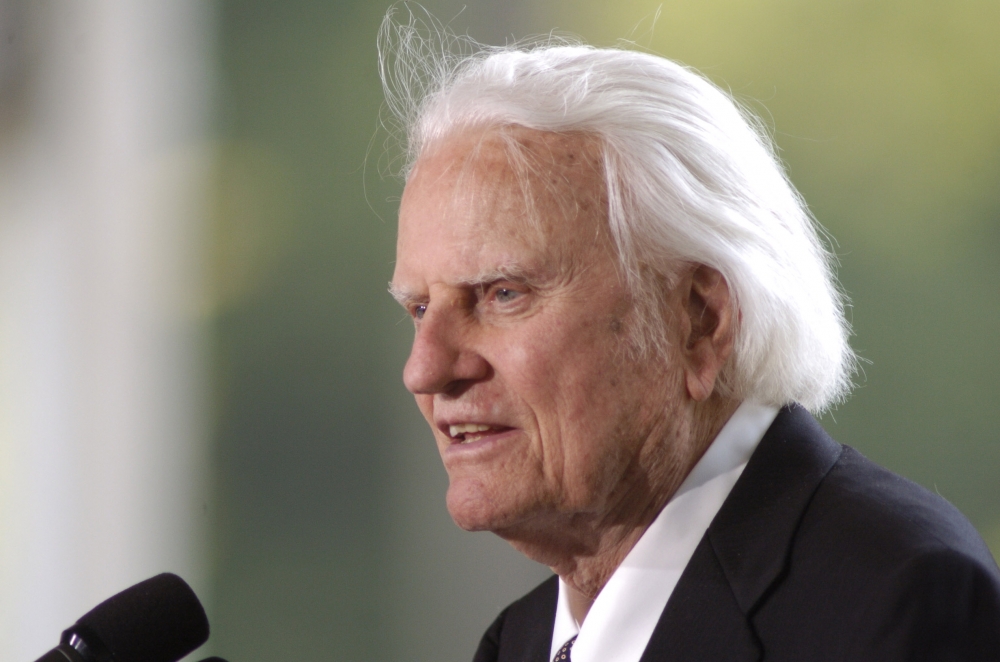
The Rev. Billy Graham (Photo: Reuters/Robert Padgett)

Evangelist Billy Graham speaks at the dedication of the Billy Graham Library in Charlotte, North Carolina, May 31, 2007.

Christian Post Report – God cannot save anyone who hardens their heart to His message, although He will always welcome those who return to Him, the Rev. Billy Graham said in a blog post this week.

In response to a question posted in the “My Answers” portion of the Billy Graham Evangelistic Association’s website, the 97-year-old evangelical leader said that although God will always welcome believers with open arms, no matter how far they’ve strayed, He cannot save those who have refused to listen to His message.

Graham points specifically to the story of Jesus’ crucifixion, when one of two criminals being crucified with Jesus repented of his sins and asked for forgiveness. The other criminal refused up until his death to have faith in God.

While the repentant criminal was granted eternal life, the other was not.

“God welcomes anyone — absolutely anyone — who sincerely turns to Him in repentance and faith, even at the last minute,” the evangelical leader writes.

However, “[…] God cannot save someone who refuses to be saved — and when a person repeatedly turns his or her back on Christ, their heart grows more and more hardened toward God.”

“As a result it becomes easier and easier for them to resist God’s call, and they are in danger of refusing to turn from their stubborn unbelief,” the pastor continues.

Ultimately, only God has the power to truly change the hearts of stubborn non-believers, Graham writes.

“Only God can change our hearts, and only God can break through the barriers your neighbor has built,” Graham writes, encouraging Christians to pray for nonbelievers so that “God will break through [their] barriers and draw [them] to Jesus.”

“Pray too that God will help you be an example to him of the hope and new life we have because of Christ,” Graham adds.

The Baptist minister has spoken on the topic of nonbelievers before, writing in an October 2015 post that Christians should show compassion and love towards their atheist friends and neighbors.

Graham writes that because God loves all of His children, so should we, and we should pray that non-believers find Christ.

“The most important thing you can do is pray for your [atheist] friend. Right now he has hardened his heart against God, and logic alone won’t change him (although you should be prepared to challenge his ideas if God gives you an opportunity). But God can change him, and you should pray that He will,” Graham writes.

He also encourages Christians to pray to God that they may “be an example to [atheists] of a life that has been changed by Jesus Christ.”

“Does [your atheist friend] see Christ’s love and joy and peace in you?” Graham questions. “Right now he wants to run his own life — but that is a dead-end road. Ask God to use you to show him there is another way— the way of Christ.”

Source : Christian Post

Megachurch Pastor: Why the Number 7 Is Important in the Bible

Pastor Chris Hahn of Southland Christian Church discusses the importance of rest in his "Plus Seven" series. (Photo: Screenshot/Southland Christian Church)

Pastor Chris Hahn of Southland Christian Church discusses the importance of rest in his “Plus Seven” series.

Christian Post Report – The number 7 appears throughout the Bible – 735 times to be exact and over 50 times just in the book of Revelation. But what significance does this number have and what should Christians take away from its use in the Bible?

Pastor Chris Hahn of the Kentucky megachurch Southland Christian Church, kicked off his new sermon series “Plus Seven” this past weekend, through which he will explain the meaning behind the number 7 in the Bible as it pertains to believers’ time, relationship and money.

On Sunday for part one of the series, Hahn preached about the significance of “Seven Days,” and explained he chose this sermon series topic because the number 7 “always represents completeness, wholeness, and perfection” in the Bible.

Hahn talked about the wholeness of time – a holy balance between work and rest in God – as prescribed by the Bible through a 7 day period as seen in Genesis 1-2, which records that God worked six days and rested on the seventh.

This “cycle of work and rest is whole […] it’s a perfect rhythm,” Hahn said. “My walk as a follower of Jesus is healthy when my rhythm of work and Sabbath is consistent.”

Although God has gifted Christians with the Sabbath, or day of rest, they often times don’t accept such a gift, instead overworking themselves.

Such behavior throws people off of their rhythm, Hahn explained, and ultimately causes us to be “an overworked [and] under-rested people.”

Keeping the Sabbath was an important practice explained in Genesis, and it was reiterated in the Ten Commandments, with the fourth one calling on Christians to remember the Sabbath day.

This mention shows the importance of rest, Hahn stressed, saying it made the “top ten list” along with the commandments against murder and adultery.

Along with keeping our balance of work and rest, the Sabbath serves as an important day for us to re-center our heart and mind on God.

Hahn explained that the day serves as a “block of time during the week to steer yourself toward God.”

“The point of Sabbath is not restriction, but rather refreshment,” the pastor said. “Good work and good rest lead to a good walk with God.”

This does not necessarily mean that Christians need to sit around all day doing nothing, but rather they can find activities that allow them to look inward and contemplate their relationship with God, such as gardening.

Not only does observing the Sabbath help you in your daily rhythm, relationships, and faith, it also prepares you for life beyond this life, Hahn said. “Sabbath rest – it just might be a glimpse of heaven.”

Ultimately, Hahn acknowledged that with the reality of daily life, taking a whole day to relax and focus on God can be a challenge and seem unrealistic.

Building a Sabbath into our busy schedules takes discipline and dedication, the pastor continued. To maintain this discipline, Hahn encouraged people to start slowly, gradually drawing themselves into this rhythm of work and rest.

The pastor concluded his sermon by calling on all members of the church to challenge themselves to carve out a block of time for themselves in the next seven days to rest and reconnect with God. When they do this, they will “begin to discover what it feels like to live in wholeness.”

Source : Christian Post

Moses’ Life Teaches Believers That Conflict Is Part of God’s Plan, Says Elevation Church Pastor

Elevation Church (Photo: Elevation Church)

Christian Post Report – Thousands worship at the Code Orange Revival, Jan. 17, 2012. The revival took place at Elevation Church in Charlotte, N.C., Jan.11-22.

Although Christians struggle with many different internal conflicts in their life, they must look to the story of Moses to find that often times “the conflict is the resolution,” Pastor Jonathan Josephs of Elevation Church in Charlotte, North Carolina, said during a sermon Sunday.

Josephs, who serves as a campus pastor at the church, which was listed as one of the largest evangelical churches in the United States by Outreach magazine back in 2013, spoke on the topic of reconciling internal conflicts during his message titled “Conflict Resolution.”

Every person struggles with their identity, Josephs says, because everyone plays different roles in their life: the role of a father, the role of a pastor, the role of an employee, the role of a husband, etc.

Josephs describes this struggle as the “third word,” or trying to put the perfect noun to define yourself after the phrase “I am.”

“I’ve got all these different third words and sometimes it’s hard for me to reconcile how they all fit together,” the pastor told the congregation.

What Christians fail to realize, he adds, is even though they may be constantly struggling to piece their internal conflicts together, these quarrels can actually work together to serve God’s plan.

Josephs points specifically to the story of Moses, who was born a Hebrew but was sent in a basket down the river to live as a prince in Egypt. Moses struggles with this internal conflict, and further complicates his life when he murders an Egyptian and hides him in the sand.

Moses then attempts to flee his past by hiding in the wilderness, where he encounters the burning bush. It is there that God tells Moses He will lead the Israelites out of Egypt, and Moses changes his perspective, realizing that all of his past experiences prepared him for this opportunity.

“I feel like God sent me here tonight to tell you that when you begin to embrace all the pieces that God has placed into your life — all the titles, all the third words, and you bring it before God, He’ll show you the purpose He has for you,” Josephs says. “The conflict you feel, God’s preparing all along to be the resolution, not only for you but for other people too.”

The pastor went on to say that he has now realized all of his previous experiences, which seemed to be conflicting, can actually work together to make him better in all of his roles. For example, as he grows as a husband, he’s becoming a better pastor.

“I am fearfully and wonderfully made. It wasn’t by mistake. It had to happen,” the pastor says.

Going back to the concept of “the third word,” Josephs says Christians should focus more on the “I am” rather than the noun, quoting Moses when he tells God: “I am here.”

Josephs concludes his sermon by calling on all Christians to come before God and tell Him “I am here,” so they may sooner see how their internal conflict is actually a part of God’s plan.

Source : Christian Post