

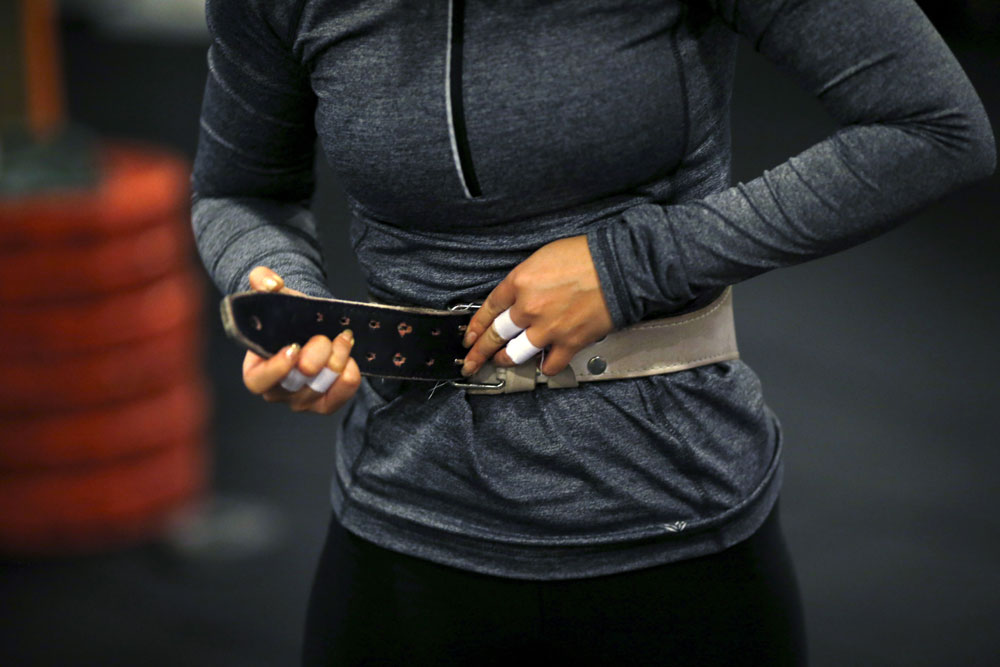
 (Photo: Reuters/Kim Hong-Ji)
Christian Post Report – Kim Jin-ah, 31, takes part in a crossfit class at a gym in Seoul, September 11, 2015. Looks no longer centre only on the face in beauty-obsessed South Korea, where more women are hitting the gym to improve muscle tone and physical health. As the ideal of beauty evolves in a country that is a trendsetter in cosmetics and the pursuit of plastic surgery, women’s fitness has become a growth business, say purveyors of health products, from diet supplements to dumb-bells.”Women used to starve in order to lose weight. Now they exercise,” said celebrity trainer Ray Yang, who leads a workout session during the Body Show, a weekly television event targeted at women that is now in its second season. Picture taken on September 11, 2015.
“If fat is not an insidious creeping enemy, I do not know what is.”
William Banting, Letter on Corpulence, Addressed to the Public (1869)
The similarities in diets from hundreds of years ago until now are striking. Very little has changed. Over the years the word “diet” has drastically morphed. Initially, the Greek word “diatia” meant a sensible, moderate and dutiful way of living and originally had no specific reference to food; later it came to be associated with foods that are customarily eaten. Though this definition is still used, “diet” is now indicative of an all-consuming practice and desire to lose weight – an $80 billion dollar industry that, according to the National Institute of Health, fails 98% of dieters. It summons images of fat-free rice cakes, diet sodas, restrictive meals, point systems, calorie counting and deprivation. But, how did the dieting craze of today first begin?

Dieting goes back at least as far as the 3rd century BC, according to Louise Foxcroft, author of Calories & Corsets: A History of Dieting Over 2000 Years. She says that followers of the ancient Greek physician Hippocrates recommended a diet of light and emollient foods, slow running, hard work, wrestling, sea-water enemas, walking about naked and vomiting after lunch. The Greeks believed that being fat was morally and physically detrimental, the result of luxury and corruption, so food and living should be plain with nothing to unduly stir the passions or arouse the appetites. This was the first documented diet or “diatia” (Foxcroft, 2011).
After the ancient Greeks, it is believed that it wasn’t until the year 1087 that dieting was mentioned again in literature. Apparently, that is when William the Conqueror had become too heavy to ride his horse, so he decided that he would stop eating solid foods and only partake in a “liquid diet” that consisted only of alcohol in an attempt to lose weight. If the tale is true, this is the first recorded instance in which an individual changed his or her food intake habits to lose weight. Although it was never documented whether or not the diet worked, William later died from a horse accident, which led historians to believe that the diet was somewhat successful if he was able to ride a horse again (Gruber, 2002)
Since William’s “liquid diet,” thousands of other diet theories have surfaced. For example, nearly 150 years ago, Englishman William Banting was advised by his doctor to begin journaling about his “diet” because he was not feeling healthy, and noticed he had put on weight. What Banting did was not far from the principal belief in today’s dieting world: cut sugars and starches from his meals and became the first to record the progress achieved by consuming a low-carbohydrate diet. He ate only protein (meat, poultry or fish) along with a combination of green vegetables and fruit. Banting lost 50 pounds in less than 12 months (Edwardes, 2003).
Remarkably, Banting’s diet is almost identical to a famous diet that many people use today. This protocol remains one of the foundations of our conventional diet belief system. And, it continues to follow the same pattern it did for Banting; average weight loss of around one pound per week.
Not long after the success of Banting’s diet, companies began marketing a variety of products to promote weight loss. It was not uncommon for these products to contain laxatives, purgatives, arsenic, strychnine, thyroid hormones, amphetamines, and other unsafe ingredients. Although proven dangerous, there is a surviving underground belief today that people can lose weight with these chemicals.
 (Photo: Reuters/Umit Bektas)
The daily meal intake of Turkish javelin thrower and Olympic hopeful Fatih Avan, 23, is pictured in Ankara May 29, 2012. Avan made the world’s second best throw of 2012 but the Olympic Games have a special place in his heart. “I may have become an elite athlete with my good performances but I can only be a great athlete if I can win an Olympic medal,” he says. Avan complements his rigorous training schedule with a nutritional programme which gives him a daily intake of 3500 kcal. His diet is mainly protein-based. “A good diet is essential for power. A correct and consistent diet proves its value in my training,” he says. Picture taken May 29, 2012.
In 1917, the weight-loss industry began to focus on calories when Dr. Lulu Hunt Peters published Diet and Health (Peters, 1918). The success of her book was attributed to the concept of counting calories. It sold more than two million copies and became the first bestselling American diet book. Dr. Peters urged readers to view the calorie as a measurement and rather than judge meals by portion size. It was recommended that the amount of calories in any given food were counted and totaled each day. She concluded that to lose weight it was important to stay under 1,200 calories a day.
Since Dr. Peters successful book, there have been hundreds of popular diets that use calorie counting as the principle method of losing weight. There is no doubt that counting calories has worked in the past. But, modern-day calories have changed because the nutrition contained in a calorie has diminished.
The calories that most of us consume are just not the same from a nutritional standpoint as those calories from decades and centuries before. Though it can be argued that a high-calorie diet will cause weight gain and a low-calorie diet will lead to weight-loss, the body’s health does not solely rely on this aspect of nutrition. If the body is constantly supplied with calories that have no nutritional value, the body will want to eat more, causing weight gain, obesity and disease.
Therefore, how does one fully nourish the body without overloading on calories? It is possible, and to understand the solution, it is necessary to explore the calorie and common beliefs surrounding it. In our next article we will talk about what a calorie is and why it is insufficient as a weight loss and dieting aid.
Source : Christian Post
 (Photo: REUTERS/Brendan McDermid)

 (Photo: REUTERS/Edgard Garrido)
 (Photo: Reuters/Maxim Shipenkov/Pool)




 (Photo: Screenshot/DesiringGod)
 (Photo: Reuters/Lucy Nicholson)
 (Photo: Reuters/Aziz Taher)
HBO Slams Manny Pacquiao for Gay People Comments, but Won’t Drop Fight
Christian Post Report – Manny Pacquiao and Tim Bradley Jr. pose for a photo during press conference at Madison Square Garden in New York, New York, to announce the upcoming boxing fight on April 9 in Las Vegas on April 9, 2016.
Even though HBO slammed Manny Pacquiao for what it says are “offensive and deplorable” comments about gay people, the cable network refuses to lose money by canceling the boxer’s fight against Timothy Bradley on April 9.
“We have an obligation to both fighters and, therefore, will proceed to produce and distribute that event,” HBO said in a statement this week, according to USA Today.
“However, we felt it important to leave no uncertainty about our position on Pacquiao’s recent comments toward the LGBTQ community. We consider them insensitive, offensive and deplorable,” it added. “HBO has been a proud home to many LGBTQ stories and couldn’t approach this event without clearly voicing our opinion.”
Pacquiao, an outspoken Christian and Filipino congressman, was criticized and dropped by sportswear giant Nike after telling Filipino station TV5 in an interview in February: “It’s common sense. Will you see any animals where male is to male and female is to female?
“The animals are better. They know how to distinguish male from female. If we approve [of] male on male, female on female, then man is worse than animals.”
The former eight-division world champion has said that he did not mean to cause offense to gay people, but has defended his stance as based on his beliefs on the Bible.
“What I am condemning is the act. I’m happier because I’m telling the truth. … It’s worse if we will hide the truth,” the boxer clarified.
“I’m happier that a lot of people were alarmed by the truth,” he added.
Pacquiao has said that he is not allowing the controversy to bother him, no matter what people are saying.
“I’m not bothered, that’s the world,” Pacquiao told local media. “I mean, Jesus lives in me so I’m always happy. Says the Bible, everyday has enough troubles of its own, so don’t be bothered about that.”
Pacquiao has also been backed by the Catholic Church in the Philippines, with Father Jerome Secillano, executive secretary of the Catholic bishops’ public affairs office, stating: “This is really in the Bible. There is this quote he (Pacquiao) uses from the Bible and we cannot change that.”
Secillano suggested, however, that the boxer could have chosen his words more wisely when making the comparison.
“The church … says that if this is your lifestyle, if this is your orientation, then we respect that, we cannot condemn them,” the priest said.
Source : Christian Post