ISIS Marks One Year of ‘Islamic Caliphate,’ Says Allah Will Award ’10 Times as Much’ to Jihadists Who Die During Ramadan

ISIS (Photo: Reuters/Stringer)

Christian Post Report – A militant Islamist fighter waving a flag, cheers as he takes part in a military parade along the streets of Syria’s northern Raqqa province, June 30, 2014.

Terror group ISIS has marked one year since the establishment of its self-proclaimed Islamic Caliphate in the territory of Iraq and Syria. The militants marked the occasion by calling for more jihadist attacks during the Islamic holy month of Ramadan, claiming that allah will reward jihadists who die with “10 times as much” during the period.

“ISIS’ Ramadan message specifically preaches that jihad is 10 times more obligatory during Ramadan and that those who die in jihad will be rewarded by allah 10 times as much as during the rest of the year,” said Ryan Mauro, national security analyst and adjunct professor of Homeland Security for the Clarion Project, according to Fox News.

“There will be ISIS supporters who have waited to strike until now in order to get the maximum award and those who were considering an attack and will now feel more pressure to actually do it.”

June 29, 2014, marked the official formation of the Islamic State, as the group is also known, when it also named its leader “Caliph Ibrahim,” Abu Bakr al-Baghdadi.

The U.S. and a broad team of international allies have been hitting ISIS targets across Iraq and Syria with airstrikes, and have armed and trained local forces on the ground fighting the militants. The terror group has continued attacking and capturing new cities throughout the year, however, and has been expanding its attacks in a host of other countries.

ISIS has beheaded scores of Christians in separate attacks, with some execution videos filmed in Libya, where the jihadists have been establishing a presence.

Most recently, dozens of foreigners were killed in three separate terror attacks in France, Tunisia and Kuwait on Friday, following an ISIS call for escalating attacks against Christians, Shiites and Sunni Muslims during the holy month of Ramadan.

The Syrian Observatory for Human Rights has estimated that ISIS now controls over 50 percent of Syria, and said that the jihadists have executed at least 3,027 civilians, rebels, members of regime forces and allied militiamen.

Among the many abuses, several reports have also exposed the establishment of training camps for children, where young boys are given military training and indoctrinated into jihadist ideology.

SOHR called for the U.N. Security Council and all countries and parties fighting for justice to establish specialist courts and sentence the “the massacres and the blatant violations of human rights” committed by ISIS and all aggressors in the region.

The U.S.’s strategy against ISIS has come under scrutiny, however. Last week, Sen. John McCain, R-Ariz., and Tony Perkins, president of the Family Research Council, warned in a joint statement that President Barack Obama and his European allies are failing to stop the massacre of Christians and other minorities throughout the Middle East and North Africa.

“They are committing brutal atrocities against Christian communities in Syria and Iraq, persecuting religious minorities and destroying entire towns and local economies,” McCain and Perkins said in an op-ed for Fox News, speaking of ISIS.

“Christians are fleeing their homes in increasing numbers, creating an exploding refugee crisis that will have grave ramifications on the stability and security of the entire region.”

Source : Christian Post

ISIS Threatens Mass Slaughter of Christians in Israel Before End of Ramadan

ISIS in Syria (Photo: Reuters)

Christian Post Report – Militant Islamist fighters parade on military vehicles along the streets of northern Raqqa province, Syria, June 30, 2014. Militant Islamist fighters held a parade in Syria’s northern Raqqa province to celebrate their declaration of an Islamic “caliphate” after the group captured territory in neighbouring Iraq, a monitoring service said. The Islamic State, an al-Qaida offshoot previously known as Islamic State in Iraq and the Levant.

Islamic militants claiming to be representatives of terror group ISIS in Jerusalem have threatened to “cleanse” Israel of all Christians and “non-believers” unless they leave the country. The extremists are accusing Christians of encouraging Muslims to abandon their religion.

“Those who work with the Zionists also encourage Muslims to leave their religion and become more secular and open, and they spread evil,” Arabic-language leaflets warns, according to The Jerusalem Post. “They take these Muslims away from us. … We know where they are, but we need help to find them all — all those Christian collaborators.”

The message continues: “ISIS soldiers will work to kill these people so this country is clean of them and … will clean this country and the Muslim Quarter from these Christians during this holy Ramadan.”

And further warns: “Because the Christians violated the Pact of Omar [made when Muslims conquered Jerusalem], we will do this. So we tell our Christians and the nonbelievers: Go away now or you will be killed when the Id [al Fitr festival ending Ramadan] is near. And you will be slaughtered like the sheep. One month is enough for them to go away.”

  • Egyptian Coptic Christian
    (Photo: Reuters/Ammar Awad)
    Egyptian Coptic Christian worshippers carry crosses during a procession along the Via Dolorosa on Good Friday during Holy Week in Jerusalem’s Old City April 10, 2015. Christian worshippers on Friday retraced the route Jesus took along Via Dolorosa to his crucifixion in the Church of the Holy Sepulchre. Holy Week is celebrated in many Christian traditions during the week before Easter.

Breaking News Israel claimed that ISIS does not have an operational presence in Israel, but has a number of Islamist supporters, some of which have joined its self-proclaimed Islamic Caliphate in Iraq and Syria.

There have also been reports of ISIS’ flag being flown atop the Temple Mount, a historic holy site for Jews, Christians and Muslims.

Rabbi Yehuda Glick, a Tempe Mount activist, described the situation as “very worrying.”

“The situation in general among Muslim leadership where, for some reason, celebrations like Ramadan are immediately interpreted as a celebrations of violence and terror is something that is very sad, mostly on the Muslim side,” Glick said.

“Of course, in terms of the State of Israel, we think the government of Israel should implement order on the Temple Mount. The Temple Mount should not be a place for demonstrating, and definitely not ISIS. I do hope that the authorities and police make sure it doesn’t happen again.”

There has been an increase of ISIS attacks outside Iraq and Syria during the Islamic holy month of Ramadan, following the directive of ISIS spokesman Abu Muhammad al-Adnani, who said that it should become “a time of calamity for the infidels … Shiites and apostate Muslims.”

Dozens were killed on Friday in three separate attacks in France, Tunisia and Kuwait, for which ISIS has claimed responsibility.

Hostility against Christians in Israel has been on the rise recently, with The Church of the Multiplication of the Loaves and Fishes at Tabgha, located on the shores of the Sea of Galilee where Jesus is believed to have fed the 5,000, burned in an arson attack earlier in June. Anti-Christian graffiti written in Hebrew and found at the site read: “May the false gods be eliminated.”

Source : Christian Post

When Heaven and Earth Become One

Christian Post Report – “And I saw the holy city, the new Jerusalem, coming down from God out of heaven like a bride beautifully dressed for her husband. I heard a loud shout from the throne, saying, ‘Look, God’s home is now among His people! He will live with them, and they will be His people. God Himself will be with them.'”
— Revelation 21:2-3

  • Greg Laurie
    (Photo: rever Hoehne for Harvest Ministries)
    Greg Laurie, senior pastor of Harvest Christian Fellowship in Riverside, California and Harvest Orange County in Irvine, California, shares the Gospel with a sold-out crowd of 19,000 for Harvest America at the American Airlines Center and Victory Park in Dallas, Texas, Oct. 5, 2014.

One day, Cathe was driving with our youngest son, Jonathan, who was then age 3. She was talking about the Rapture and how we would be caught up to heaven. The more she talked, the quieter Jonathan got. Finally, he blurted out, “Mom, I don’t want to go to heaven! I don’t want to leave this beautiful world that God made!” It’s hard for a 3-year-old to wrap his mind around heaven.

Sometimes Christians say, “When I die I will be with the Lord forever in heaven!” While it is true that when a believer dies they go to heaven, it is not true that we stay there forever. Because one day, heaven is going to come to earth.

My friend Randy Alcorn, in his book Heaven writes, “We won’t go to Heaven and leave Earth behind. Rather, God will bring Heaven and Earth together into the same dimension, with no wall of separation, no armed angels to guard Heaven’s perfection from sinful mankind.”

God is not going to abandon His creation; He’s going to restore it! Have you ever seen a perfectly restored classic car? (Guys especially see this as a thing of beauty.) Well, God is into restoration too—restoration of lives, bodies, and even our planet!

God’s perfect plan is to “bring all things in heaven and on earth together under one head, even Christ” (Ephesians 1:10 NIV).

Jesus will make earth into heaven and heaven into earth. Just as the wall that separates God and mankind is torn down in Jesus, so too the wall that separates heaven and earth will forever be demolished.

Copyright © 2015 by Harvest Ministries. All rights reserved.

Unless otherwise indicated, Scripture taken from the New King James Version. Copyright © 1982 by Thomas Nelson, Inc. Used by permission. All rights reserved. Bible text from the New King James Version is not to be reproduced in copies or otherwise by any means except as permitted in writing by Thomas Nelson, Inc., Attn: Bible Rights and Permissions, P.O. Box 141000, Nashville, TN 37214-1000

Used with Permission

Source : Christian Post

No More Christian Events in Jerusalem Without Rabbi’s Approval After Orthodox Jews Accuse Christians of ‘Forced Conversions’

Jerusalem Pais Arena, Empowered21 (Photo: The Christian Post/Leonardo Blair)

Christian Post Report – The Jerusalem Pais Arena, a multi-purpose sports arena with a seating capacity of 11,000 in Jerusalem, Israel is the venue for the Empowered21 Global Congress which will run May 20–25, 2015.

The Jerusalem Municipality will now have to consult with the city’s Rabbis before allowing Christians to host events in the city after the haredi, a group of ultra-orthodox Jews, accused Christians of forcing conversions at a conference held there last month.

The respected orthodox Jewish officials issued complaints to the municipality and the management of the city’s multi-purpose sports arena where the conference was held and called the event which hosted thousands of Christians from around the world a “major show of forced conversion,” according to YNetNews.com.

Haredi media charged that the event was aimed at convincing Jews to join Christianity with the help of missionaries who came to Israel for that purpose. The city’s rabbis demanded that the Municipality cancel the event, but they were unsuccessful due to legal issues.

Following the protests, haredi representatives came to an agreement with the city’s mayor Nir Barkat that Jerusalem’s rabbis and legal advisors will be consulted before permits are issued for future events.

“It has been decided that in future events, in case concerns are raised about illegal missionary activity, Jerusalem’s chief rabbis and the Municipality’s legal advisors will be consulted,” said Jerusalem Municipality in a statement.

While the report did not specify which Christian conference triggered the complaints, the Empowered21 Global Congress which featured thousands of spirit-filled believers was held in the Jerusalem Pais Arena, in Jerusalem, Israel last month.

Well known Christian leaders including Teen Mania Ministries president and founder Ron Luce, and Jentezen Franklin, senior pastor of Free Chapel church were present at the event which took place from May 20-25.

Oral Roberts University President, William M. Wilson, who also serves as president and co-chair of Empowered21, said the gathering would mark a landmark moment for the ministry’s movement.

“This is a pivotal moment in history for the global Spirit-empowered movement,” said Wilson in a statement. “The impartation service, which will pass the mantel of the global Spirit-empowered movement on to the next generation, is of particular significance. Our prayer is that this service will be a catalyst, igniting the hearts and minds of young people from around the globe with the fire of God’s love and power.”

Contact: [email protected]; follow me on Twitter @vinfunaro

Source : Christian Post

Former Tullian Tchividjian-Led Coral Ridge Presbyterian Gets Approval to Build Over 500 Apartments on Church-Owned Property

megachurch (Photo: Coral Ridge Presbyterian Church)

Christian Post Report – In this file photo, thousands attend a Sunday worship service at Coral Ridge Presbyterian Church in Fort Lauderdale, Fla.

A county government in Florida has approved a land use permit submitted by the megachurch Coral Ridge Presbyterian Church, which was formerly led by Billy Graham’s grandson Tullian Tchividjian, to build over 500 apartments on its property.

Broward County Commission voted unanimously on Tuesday to approve Item No. 64 on their agenda, which was submitted by Coral Ridge.

Kristin Carter, spokesperson for Broward County, told The Christian Post on Thursday that “the property owner requested approval to build 425 garden apartments and 175 mid-rise units on the northern 23 acres of the parcel, which is a total of just under 52 acres.”

Earlier this week local media reported that Coral Ridge Presbyterian was planning to develop a portion of land they owned in Lauderdale Lakes.

Coral Ridge’s Lauderdale Lakes property is presently vacant, the South Florida Business Journal reported on Monday. “Leigh Robinson Kerr & Associate is the planning firm on the application. It’s not clear who the church intends to sell the land to for development.”

News of the commission’s vote comes as Coral Ridge Presbyterian recovers from a sex scandal surrounding its former senior pastor, Tullian Tchividjian.

A grandson of the Rev. Billy Graham, Tchividjian admitted to having an extramarital affair after discovering that his wife had cheated on him.

“Last week I was approached by our church leaders and they asked me about my own affair. I admitted to it and it was decided that the best course of action would be for me to resign,” said Tchividjian in a statement.

Source : Christian Post

Episcopal Church Mulling 2 Israeli Divestment Proposals at General Convention to Boycott US Companies That Do Business With Israel

  • Katharine Jefferts Schori
    (Photo: The Episcopal Church via The Christian Post)
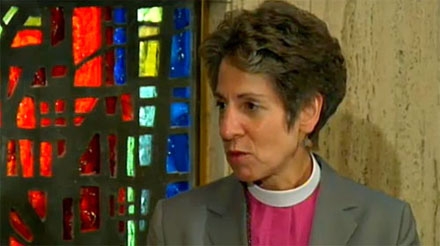
    Presiding Bishop Katharine Jefferts Schori of The Episcopal Church speaks in a live webcast conversation, July 21, 2010.

Christian Post Report – A mainline protestant denomination will consider adopting a resolution supporting divestment from companies that do business with Israel.

The Episcopal Church will consider several resolutions regarding the Israeli-Palestinian Conflict at its 78th General Convention that’s being held in Salt Lake City and began on Thursday.

Resolution D016, introduced by the Very Rev. Walter Brownridge of the Diocese of Hawaii, calls on the Church to compile a list of corporations profiting from the so-called “Israeli occupation of the Palestinian territories” and divest from said companies.

The resolution reads in part: “… upon receiving the position of said companies to these shareholder resolutions, Executive Council, by its June meeting of 2017 [will] develop a process of divestment from those companies who have refused to disinvest.”

  • Israel, Flag
    (Photo: Reuters)
    An Israeli flag flies high in Tel Aviv, December 28, 2010.

It continues: “That this General Convention directs the Executive Council to establish a work group to identify a list of products made or businesses present in West Bank settlements (including East Jerusalem) and publishing them within one year of adjournment of this Convention so that Church entities, including congregations and individual members can seek to boycott those products and/or businesses which are ‘illegal under international law’ …”

Resolution C003, also coming from the Diocese of Hawaii, calls on the denomination to adopt “a policy of selective divestment or a No Buy policy of any holdings in Caterpillar, Hewlett Packard and Motorola Solutions until such time that the conflict is resolved through a just outcome for Palestinians and all Israelis or that these companies take action to disinvest from their involvement in the [so-called] ‘occupation.'”

“That all Episcopalians be urged to pray and work for peace in the Holy Land, so that the Jewish and Palestinian people may come together in a spirit of reconciliation,” continued Resolution C003.

“That a copy of this resolution be sent to these companies along with a conveying letter and that the Church’s money managers be instructed to implement this policy and that this resolution also be sent to other church investors, including the Church Pension Fund, which are urged to follow this policy.”

Debates over divesting from Israel or companies that do business with Israel have periodically erupted in mainline Protestant churches.

Proposals for some level of divestment against companies that do business with the Israeli military have had mixed results in denominations like the United Methodist Church and Presbyterian Church (USA).

Back in March of 2012, Episcopal Church Presiding Katharine Jefferts Schori spoke out against divestment campaigns against Israel.

At the Middle East Peacemakers luncheon in Los Angeles that year, Bishop Jefferts Schori told the approximately 200 attendees that it was better to “invest in legitimate development in Palestine’s West Bank and in Gaza” than boycott or divest from Israel.

“The Episcopal Church does not endorse divestment or boycott,” stated Jefferts Schori, adding that such efforts “will only end in punishing Palestinians economically.”

While supporters of divestment have oft compared Israel to Apartheid South Africa, Episcopal News Service noted Wednesday that a 2005 Episcopal Church report disagrees.

“In the case of South Africa, the entire system of apartheid was illegitimate, and no actions short of dismantling it could be countenanced by the world community. The goal was the end of that South African regime,” read the report in part.

“The case of Israel is different. Church policies clearly support Israel’s right to exist, and no companies should be involved, however inadvertently, in any way with organizations engaged in violence against Israelis. Companies can and should operate in Israel proper.”

The aforementioned resolutions on divestment will be considered along with others by the General Convention attendees over the next week.

Source : Christian Post

Delaware Pastor Writes Hymn for Charleston Victims ‘They Met to Read the Bible;’ Song Goes Global

Carolyn Gillette (Photo: Courtesy of CarolynsHymns.com)

Christian Post Report – Hymn writer and Delaware church co-pastor Carolyn Gillette.

A Delaware pastor’s spiritual hymn written to remember the nine Christians killed in the shooting at Emanuel AME Church in Charleston, South Carolina, last week is now touching the lives of countless believers, as many churches around the world have started to include it in their worship services.

The hymn’s writer, Carolyn Winfrey Gillette who co-pastors Limestone Presbyterian Church in Pike Creek, Delaware, with her husband, Bruce, has written spiritual songs about other tragic events such as the 2010 earthquake in Haiti and 9/11.

Her latest hymn, “They Met to Read the Bible” that addresses the shooting in Charleston has gone viral on Facebook and has been written about by various secular media outlets, including The New Yorker.

“We’re amazed at the response the song has gotten,” said Bruce Gillette to The Christian Post. “It’s on an Australian worship planning website. I received emails from all over Canada. Churches from Brooklyn to San Francisco to Louisiana to North Dakota. Baptists, Evangelicals, Methodists, Presbyterian, Roman Catholic, Episcopalian, you name it, it seems to be attracting folks across the theological denominational spectrum.”

Carolyn wrote the song shortly after the news of the shooting hit and released it for free.

“It surprised us that The New Yorker, a secular magazine, wrote about it,” Carolyn told CP. “It is a prayer and I hope people see it that way and sing it that way. It’s a prayer for us to grieve with the victims and their families and it’s also a prayer for us to look at how out society needs to change and be more how God wants us to be.”

She also stressed the importance of the song’s lyrics.

“It’s not about me, it’s a prayer. And prayers are meant to be prayed and sung to God. It’s not about the writer of the words. It’s about the words and the message. That’s the most important thing,” said Carolyn.

Churches around the world included the hymn in their Sunday worship services the week after the shootings, according to Bruce, who’s happy to see God unifying believers through his wife’s song.

“In the book of Romans, we’re called to rejoice with those who rejoice and suffer with those who suffer. These are our brothers and sisters in Christ in Charleston and it’s nice to see the Christian Church [uniting].”

Bruce said his wife writes “biblically grounded” hymns and has penned spiritual songs inspired by the Apostle’s Creed, the Ten Commandments and the biblical images of God the Father. Her 9/11 hymn made national news in 2001, according to Gillette, who said songs she writes inspired by current events usually attract the most attention.

Her 9/11 hymn was sung during a special on the BBC in Britain for remembering victims killed in New York City in the Twin Towers.

Carolyn wrote “They Met to Read the Bible” on the Friday following the Charleston shooting. Shortly after releasing the song, Bruce emailed it to churches that have used her songs in the past and within a half an hour a pastor in Charleston said he wanted to share it with other clergy. Gillette said the song has received at least 15,000 hits on his personal Facebook page alone.

People just hearing the song this week are planning to include it in their worship services next Sunday, according to Bruce. Others plan on using it on July 5, the day after Independence Day, as a prayer for the U.S.

Carolyn’s hymns can viewed on her website www.carolynshymns.com.

“They Met to Read the Bible” addresses the tragic event in Charleston, South Carolina, where nine people were shot and killed by a lone gunman on June 17 at Emanuel AME Church during a Bible study. The church’s late pastor and State Senator Clementa C. Pinckney was one of the victims gunned down by 21-year-old Dylann Roof.

“They Met to Read the Bible”

ST. CHRISTOPHER 7.6.8.6.8.6.8.6 (“Beneath the Cross of Jesus”)

They met to read the Bible,
they gathered for a prayer,
They worshiped God and shared with friends
and welcomed strangers there.
They went to church to speak of love,
To celebrate God’s grace.
O Lord, we tremble when we hear
What happened in that place.

O God of love and justice,
we thank you for the nine.
They served in their communities
and made the world more kind.
They preached and sang and coached and taught,
And cared for children, too.
They blessed your church and blessed your world
With gifts they used for you.

We grieve a wounded culture
Where fear and terror thrive,
Where some hate others for their race
And guns are glorified.
We grieve for sons and daughters lost,
For grandmas who are gone.
O God, we cry with broken hearts:
This can’t continue on!

God, may we keep on sowing
The seeds of justice here,
Till guns are silent, people sing,
And hope replaces fear.
May seeds of understanding grow
And flourish all our days.
May justice, love and mercy be
The banner that we raise.

Contact: [email protected]; follow me on Twitter @vinfunaro

Source : Christian Post

At least 27 Killed in Mass Shooting at Tunisia Hotel, Separate Bombing in Kuwait; British PM Cameron ‘Appalled’ at Rising Terror Attacks

Tunisia (Photo: Reuters/Amine Ben Aziza)

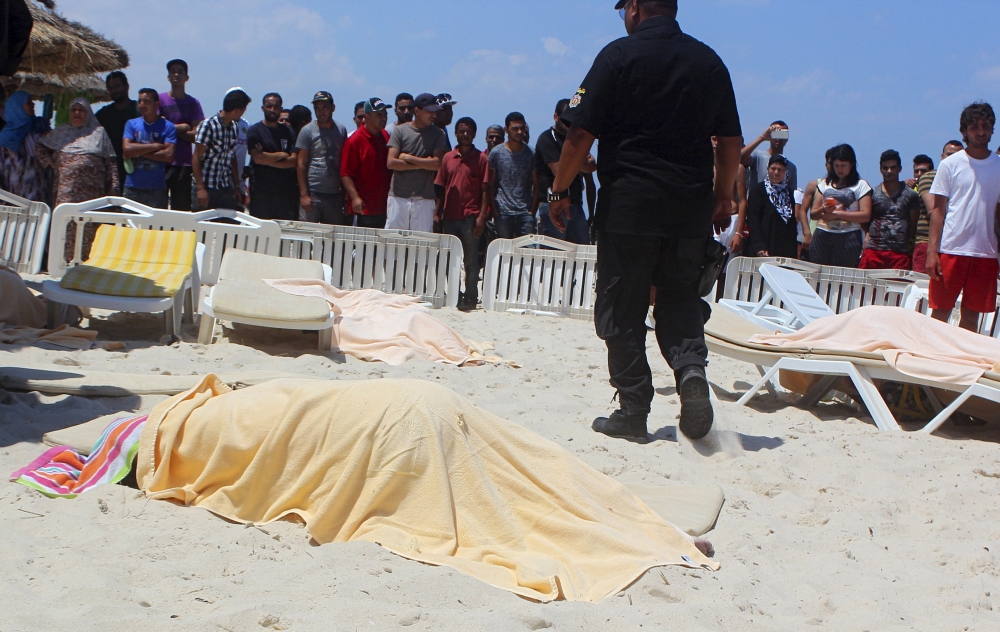
Christian Post Report – The body of a tourist shot dead by a gunman lies near a beachside hotel in Sousse, Tunisia, June 26, 2015. At least 27 people, including foreign tourists, were killed when at least one gunman opened fire on the Tunisian beachside hotel in the popular resort of Sousse on Friday, an interior ministry spokesman said. Police were still clearing the area around the Imperial Marhaba hotel and the body of one gunman lay at the scene with a Kalashnikov assault rifle after he was shot in an exchange of gunfire, a security source at the scene said.

At least 27 people have been killed in a mass shooting at a Tunisian beachside hotel in the popular resort of Sousse on Friday, just hours following news that a man was decapitated by suspected Islamic terrorists in France, and news of a separate bombing in Kuwait. British Prime Minister David Cameron has condemned the “atrocities,” warning that terror attacks across the world are on the rise.

“This is a threat that faces all of us. These events have taken place in Tunisia and in France but they can take place anywhere. We all face this threat,” Cameron added, according to The Guardian.

Reuters reported that foreign tourists are among the 27 people killed at the Imperial Marhaba hotel, when at least one gunman opened fire with a Kalashnikov assault rifle. The shooter was apparently killed in an exchange of gunfire with police, who are searching the area for other suspects.

Six other people have reportedly been wounded.

“One attacker opened fire with a Kalashnikov on tourists and Tunisians on the beach of the hotel,” said a hotel worker at the site. “It was just one attacker. He was a young guy dressed in shorts like he was a tourist himself.”

While no group has yet claimed responsibility for the attack, a number of North African tourist sites have been attacked by Islamic jihadists in recent years.

Tunisia also suffered another terror attack back in March, when 24 people were killed at the Bardo museum.

The shooting comes only hours after a terror attack was reported in eastern France, when police found a decapitated body at a gas station in Grenoble.

Reports said that the suspected attacker set off small explosive devices after driving into the factory, injuring several people. Police also said they found a flag with Arabic writing on the scene.

Yet another terror attack was reported on Friday in Kuwait, when a bomb blast shook a mosque inside the country’s capital. State media has said that several worshipers have been killed and injured, though no number has been provided as of yet. CNN noted that terror group ISIS has claimed responsibility for what it said was a suicide bombing at the Shiite mosque.

Yaqoub Al-Sanea, the nation’s Justice and Islamic Affairs minister, called the attack “a terrorist and criminal act that threatens our security and targets our national unity,” Kuwait News Agency reported.

It is yet unclear whether the three terror attacks on Friday are connected, but they have all occurred days after ISIS spokesman Abu Muhammad al-Adnani called on jihadists to escalate attacks against Christians, Shiites and Sunni Muslims during the holy month of Ramadan, as Reuters noted.

Al-Adnani said that Ramadan should become “a time of calamity for the infidels … Shiites and apostate Muslims.”

Source : Christian Post

Church of Nigeria, Anglican Communion

About Us

Early Beginnings

The Church of Nigeria has experienced eventful years of her history as an autonomous Province in the Anglican Communion worldwide.

The story can be traced to 1906 when a conference of Bishops in Communion with the Anglican Church held in Lagos. The Rt. Rev. E.H. Elwin, then Bishop of Sierra Leone, presided at the meeting. The Rt. Rev. Herbert Tugwell (Bishop of Western Equatorial Africa) was there with four of his Assistant Bishops: Charles Phillips, Isaac Oluwole, James Johnson and N. Temple Hamlyn. It was there that the need for a Province of West Africa was first highlighted.

A second conference for the purpose came up again in Lagos in 1935. But it was the conference of 30th October – 3rd November 1944, also in Lagos, that made a clear headway on this matter, leading first to the inauguration of the Church of the Province of West Africa in Freetown, Sierra Leone. This was done on the 17th of April, 1951 by the then Archbishop of Canterbury, The Most Revd. Geoffrey Fisher. The Bishop of Lagos, The Rt. Revd. L.G. Vining was elected first Archbishop of the new Province compromise these five Dioceses: Sierra Leone (1852), Accra (1909), Lagos (1919), On the Niger (1920) and Gambia (1935).

Between 1951 and 1977, the two Dioceses in Nigeria (Lagos and on the Niger) gave birth to fourteen new ones: Niger Delta, Ibadan, and Ondo/Benin (all created in 1952); Northern Nigeria (1954); Owerri (1959); Benin (1962); Ekiti (1966); Enugu (Ilesha (1974); Egba/Egbado and Ijebu (1976); Asaba (1977).

These sixteen dioceses in Nigeria soon began to sense a growing need for contextualization of their Christian witness. The opportunity eventually came at an Episcopal Synod at Ado-Ekiti on the 31st of January, 1974. There they resolved to set in motion the process of becoming an autonomous Province within the Anglican Communion. This was closely followed by the Standing Committee of the Church of Province of West Africa, which gave it their blessing and referred it to the Synod, which held on the Campus of the University of Lagos on the 14th of August 1975 and passed the resolution that the machinery for the actualization of this desire be set in motion.

Known then as the Association of Anglican Dioceses in Nigeria (AADN), a Constitution Drafting Committee was set up under the Chairmanship of Sir Louis Mbanefo (of blessed memory). The Anglican Consultative Council meeting in Trinidad (23rd March – 2nd April 1976) considered the draft to be “in order”and adopted it as “Resolution 34 on the proposed Province of Nigeria.”

Finally, a meeting of the Standing Committee of the Province of West Africa held in Benin City on the 13th of August 1977, the resolution was adopted for the Church of the Province of Nigeria to be inaugurated in the month of February 1979.

With the election of The Rt. Revd. Timothy Omotayo Olufosoye, DD, the Bishop of Ibadan to take the lead, he was presented at the Cathedral Church of Christ, Marina as the Archbishop, Primate and Metropolitan of the Province, which was designated as “The Church of Nigeria, Anglican Communion”. The Church of Nigeria was inaugurated on St. Matthias Day, 24th February, 1979.

Evangelism

There have been very significant milestones in the undaunted advance of the Church of Nigeria especially during the tenures of the man who has been rightly called the Visionary Primate. The Most Revd. Joseph Abiodun Adetiloye, DD (1988-1999). He it was who opened up the unreached areas to the gospel as part of our response to the Decade of Evangelism proclaimed at Lambeth in 1988. a significant achievement of his tenure is the creation of ten (10) Missionary Dioceses in 1990, a feat that was virtually repeated from 1996 onwards. It was during his tenure that the idea of internal Provinces gained ground with the first creation of three internal Provinces covering the three broad geographical regions of Nigeria. These earned the Church of Nigeria the reputation of being the fastest growing Province in the Anglican Communion.

A paradigm shift was launched in March 2000, when The Most Revd. Peter J. Akinola, DD,CON (2000-date) was presented as the third Primate of the Church of Nigeria, Anglican Communion. On the assumption of the primacy of the Church, Archbishop Akinola did not hide his granite determination to take the Gospel of Christ to the nook and crannies of Nigeria; and with the cooperation of his brother bishops the number of dioceses has risen astronomically. From 76 in year 2000, we now have 121 as at May 2007! He has focused his attention on consolidation of previous efforts to keep the banner of the gospel flying higher over the land, and the Church of Nigeria standing tall and taking its rightful place in the Anglican Communion.

One of the greatest challenges before the Church today is to embark on aggressive evangelism and discipleship that will build the Church into a strong witness for this and future generations. The Church of Nigeria is now actively reaching out to the UK and the USA through the ministry of our Chaplains in those parts. Our members who visit those nations or have settled there are the major focus of our ministry, while looking out for all others who are willing to respond to the gospel. We must pray that the Lord will raise more labourers for His work. Some of these are already in the seminaries undergoing training in our institutions and we look forward to a generation of faithful workers in the Lord’s vineyard. Much attention is being given to our theological institutions through the Church of Nigeria Endowment Fund which is aimed at making the Church self-reliant financially to carry on the work of mission.

The Church of Nigeria has over the years become established as the champion of mission efforts and has maintained its reputation as the fastest growing province in the Anglican Communion. That reputation has carried with it important and challenging responsibilities not only to model biblical ethics but to condemn every compromise or departure from the position held out by the Scripture. The Church was founded through the missionary effort of the CMS (Church Mission Society) and is being expanded in like manner. The mission arm is the Church of Nigeria Missionary Society (CNMS), which holds out the gospel flag to different parts of the country.

10 Ecclesiastical provinces, one indivisible church

Considering the sheer vastness of the Church of Nigeria (Anglican Communion), it was split into three Provinces on 20th September 1997 for effective management.

Province One, consisting of the Dioceses in the West, was headed by Archbishop Adetiloye who remained Primate of All Nigeria; Province Two consisting of the Eastern Dioceses had the Rt. Revd. Ben. Nwankiti of Owerri (now late), and after his retirement in 1998 J. A. Onyemelukwe, Bishop on the Niger, as Archbishop, while Province Three consisting of the Northern Dioceses had the Bishop of Abuja, the Rt. Revd. Dr. Peter J. Akinola as Archbishop.

In pursuance of pragmatic evangelism and for ease of administration, a 10-Province structure for the Church of Nigeria (Anglican Communion) was proclaimed at the Cathedral Church of Christ, Marina Lagos, on January 19, 2003. The provinces are: Lagos, Ibadan, Ondo, Bendel, The Niger, Niger Delta, Owerri, Abuja, Kaduna and Jos. Presented at the event were new Arcbishops Agbaje, Abe, Akinfenwa, Okoro, Nglass, Idowu and Mani. These Archbishops constitute the Primate’s Council which meets from time to time.

Forging ahead vigorously

There can be no organisation as large and complex as present day Church of Nigeria (Anglican Communion) without problems. But problems do not worry the incumbent Primate, who, since he was presented on 25 March 2000, has made several efforts in pursuit of peace.

Archbishop Akinola has, together with the entire leadership of the Church, evolved a Vision for the Church of Nigeria, which by the grace of God and the co-operation of all will take us to our “Eldorado” in a record time.

The Vision is clear. In summary, it is to the effect that the Church of Nigeria (Anglican Communion) shall be bible-based, spiritually dynamic, united, disciplined; self-supporting, committed to pragmatic evangelism, social welfare and a church that epitomizes the genuine love of Christ.

This vision statement has opened up fresh vistas of ministry which hitherto had been non-existent – all in a bid to become more relevant to the needs of our members and nation.

The machinery for achieving the set goals and establish a CARING CHURCH has been at work. The initial goal of being bible-based has led to the championing of adherence to scripture worldwide. The goal of being self-supporting is being actively pursued through the Endowment Fund and the social work is going on in the often ignored in the land and villages nation-wide.

The Primate

primatewriteup
The Primate of Nigeria

The Most Revd. Nicholas Dikeriehi Orogodo Okoh

THE BIOGRAPHY OF THE PRIMATE OF ALL NIGERIA
The Most Revd. Nicholas Dikeriehi Orogodo Okoh was born on 10th November, 1952 at Owa-Alero, Ika North East Local Government Area, Delta State to Mr. Stephen Chinakwe and Mrs. Nwagho Okoh. Without intending to be modest, his parents were poor peasant farmers, who carried out mere subsistence farming.

He attended St. Michael’s (Anglican) School, Owa-Alero from 1958-1964 where he obtained his First School Leaving Certificate. He had a four-year stint in business under one of his uncles. He later established his own business, only to abandon it and joined the Nigerian Army in 1969, while still a confirmation candidate. He was to be confirmed 6years later by Bishop Idowu at St. Stephen’s Cathedral Ondo while at VCLC, Akure. The terrible experience and uncertainty of life in the war-front made the young Nicholas to surrender to God. In 1970, at the end of hostilities, under the wrong influence of fellow soldiers, he backslided, until early 1971, when under a circumstantial experience he broke down completely and offered himself to the LORD. Within three months, he read the whole bible from Genesis to Revelation. His life was transformed. Thereafter he became a freelance Evangelist, gathering and leading many young people in his group. He continued his education and passed his O/L G.C.E. in 1974 and A/L G.C.E. in 1976, by which time he was already at Vining Christian Leadership Centre, where he trained as Catechist from 1975-1976. He was admitted to Immanuel College of Theology, Ibadan for his Pastoral Studies (1976-1979). There he obtained a Diploma in Religious Studies, and Diploma in Theology.
After his Ordination in July, 1979 he was appointed 3 Armoured Division Garrison Chaplain, Jos. Later that same year, he left for the University of Ibadan (1979-1982), where he obtained his B.A. (Hons). He returned to the same University (1984-1985) for the M.A. Degree.

He got married to Miss Nkasiobi Amaechi on October 4, 1986. The marriage is blessed with 5 children.

The Most Revd. Nicholas Okoh had the following appointments in the Nigerian Army:
Garrison Chaplain, 3 Armoured Division, N.A, Jos in 1979
Vicar – St. Luke’s Military Church, Yaba Lagos – 1982-1984
Vicar – All Saints (A.H.Q) Church, Abalti Barracks and A.H.Q Garrison Chaplain (PROT) from 1984-1989.
Assistant Director, 2 Mechanized Division Chap. (PROT) and Vicar, All Souls Military Church, Ibadan from 1990-1991.
Vicar – St. Augustine’s Military Church (PROT), Mokola, Ibadan and 2 Division Garrison Chaplain from 1992 – 1993
Deputy Director Chaplain, 3 Armoured Division and Vicar – All Saints Military Church, Rukuba, Jos from 1993-1997
Deputy Director, 1 Mechanized Division Chaplain (PROT) and Vicar – St. Luke’s Military Church, Kaduna from 1997-1999.
Assistant Director Chaplain (PROT) AHQ Group of Churches, Lagos from 1999-2001.
Colonel Co-ordinate, HQ DCSP – Lagos.
Vicar – All Saints (HQ) Church, Abalti Barracks, Western Avenue, Surulere, Lagos.

Archbishop Nicholas Okoh was commissioned a Lieutenant on November 1, 1982.
He was promoted Captain on November 1, 1986. Again he rose to the Rank of Major on November 1, 1991 and on November 1, 1996, he was promoted Lieutenant Colonel in the Nigerian Army, a position he held before the House of Bishops elected him Bishop of Asaba in March, 2001.

With his election, Archbishop Nicholas Okoh became the second Bishop of the Diocese of Asaba. He was elected Archbishop, Bendel Ecclesiastical Province by the Episcopal Synod on 22nd July, 2005.

SUMMARY OF CHURCH PREFERMENTS
Ordained Deacon – July, 1979
Priest – July, 1980
Canon – 1987
Archdeacon – April, 1991
Consecrated Bishop – May, 2001
Elected Archbishop – July, 2005
Elected Primate of All Nigeria – September, 2009
Presented as Primate of All Nigeria – March, 2010

————–

Source : Church of Nigeria, Anglican Communion

———————————————————

Advertisement


The Diocese of Lagos, Church of Nigeria. Anglican Communion

CHURCH HISTORY

Growth and Expansion

One of the most remarkable products of the evangelical movements of the 18th Century was the rise and establishment of many missionary societies such as that of the Baptist (1792), “The joint efforts” (1795) and Church Missionary Society – C.M.S (1799). Closely related to those earliest breakthroughs was the birth of the British and Foreign Bible Society (1804) and the C M S inspired founding of the West African Mission in the same year. There was also the Niger Expedition of 1841 which was a direct response by both the Church Missionary Society and Wesleyan Missionary Society to the clarion call by freed slaves in Freetown, Sierra Leone for the spread of the good news of salvation, the true gospel of liberation, among, their people .

That indeed was, the propelling force behind the historic exploratory visits by Henry Townsend of the CMS and Birch Freeman of the Wesleyan Missionary Society to Badagry in 1842 culminating the never to-be-forgotten joint service of Eucharist and thanksgiving and of unity, conducted under the famous” Agia” tree; on Christmas Day, 25th December 1842 by the two church missionaries.

The great labour of the early missionaries such as Henry Townsend, Charles Andrew Golmer and Samuel Ajayi Crowther specifically paved the way for the creation of the Yoruba Mission. The efforts were soon rewarded as Golmer was made Deacon in 1841 and priested the same year. Samuel Ajayi Crowther was himself consecrated Bishop in London on St. Peter’s Day (June 29th) 1864 and his great works and service will remain indelible on the printed pages of world history.

He had founded the All-African Mission in 1847, and headed it successfully until his death in 1891. But following Crowther’s death, the CMS Home office/Secretariat in London had, contrary to the global expectations of church watchers, chosen J .S. Hill as successor, leaving in the cold many of the very capable Africans who were most suitable for the job, with nearly all already gone half-way through the journey to full-‘fledged’ episcopate by serving as Assistant Bishops. Among them were Archdeacons James Johnson, Henry Johnson, Dandeson Crowther (son of late Ajayi Crowther), James Quaker, Isaac Oluwole and Charles Phillips. The Rt. Rev. J.S. Hill assumed leadership and tactfully invited Isaac Oluwole, Adolphus Howells and Charles Phillips to be his Assistant Bishops.

In 1894, Herbert Tugwell was consecrated Bishop of West Equatorial Africa and he was able to talk James Johnson into accepting what he had always rejected as “Half-bishop”. Meanwhile the spate of aggressive evangelical works in the area had further necessitated a further sub-division into two of what used to be known as the “Diocese of Western Equatorial Africa.

On 10th October 1919, the Nigerian country, West and North of the Niger were cut-off from the Diocese of Equatorial West Africa to form THE DIOCESE OF LAGOS. Through the initiative of Bishop Herbert Tugwell, F. Melville Jones, an energetic European Missionary Educationist and Principal of St. Andrew’s College, Oyo was consecrated as the first Bishop

The remaining part – East of the country, was carved out and named DIOCESE ON THE NIGER. Its formal inauguration took place on 5th March 1920 with the Rt. Rev. Bertram Lasbery as her first Bishop. Bishop Lasbery did not however, assume duty as Bishop of the Diocese on the Niger until the year 1922.

Back to Lagos, The Rt. Rev. F. Melville Jones served as Bishop for twenty-one years (1919-1940) before bowing out on retirement in 1940, The Rt. Rev. Leslie Gordon Vining (who was then Assistant Bishop of the Diocese on the Niger) became the second Bishop of Lagos. On 17th April 1951 at the inauguration of the Province of West Africa, Leslie Vining was elected and presented as the first Archbishop of the new Province. Under him, Lagos Diocese was divided into four Dioceses (Niger Delta, Ibadan, Kaduna and Ondo inaugurated in 1952). Vining died at sea on March 1955 and was succeeded by The Rt. Rev. Adelakun Howells. Then following in succession, the episcopacy of Seth Irunsewe Kale from 1963 to 1974; Festus Oluwole Segun from January 1975 to 1985 and the visionary Bishop Most Revd. Dr. Joseph Abiodun Adetiloye from 1985 to 1999.

From 2000 to date the Diocese of Lagos has flourished under the able leadership of His Grace, Most Rev. Dr. Ephraim Adebola Ademowo, a calculated, amiable and sagacious Bishop of note.

With seven (7) Bishops between 1919 and 2008, and its phenomenal expansion by leaps and bounds within the same period, the Diocese of Lagos has indeed come of age. Having given birth to numerous other Dioceses and having produced several Bishops who are holding their own in different parts of the Church of Nigeria, Lagos Diocese can look back today with a deep sense of fulfillment and gratitude to the Almighty God.

PAST BISHOPS

  • Rt. Revd. F.M. Melville Jones (1919 â 1940)
    The Rt. Rev. F. Melville Jones was the pioneer Bishop of Lagos; or what in Rotarian parlance the Americans would prefer to style “The charter Bishop of Lagos.”

    Bishop Leslie Gordon Vining (1940 â 1955)
    Most Rev. Leslie Gordon Vining would be remembered as perhaps the foremost expansionist before Abiodun Adetiloye, in the African History for it was Archbishop Vining who began the indigenization policy of the church Ministry in line with Henry Benn’s spirit of self-rule, self-propagation and self-sufficiency.

    Rt. Revd. Adelakun Howells (1955 â 1963)

    The Rt. Rev. Adelakun W. Howells ” was born in the Vicarage of St. John’s Church Aroloya, Lagos. The great Howells was highly privileged with his track of educational records which began with the rare opportunity of attending a private Nursery and Primary School in Central Lagos before proceeding to CMS Grammar School and King’s College both in Lagos; Fourah Bay College Sierra Leone where he later graduated in 1927 with a BA (Durham) degree in Arts and Theology. Between 1928 and 1933. Howells II added his Master of Arts (M.A.) and Bachelor of Divinity (BD) degrees, while he was still serving as Tutor at the Theological Seminary of the Diocese on the Niger. His father was the Rt. Reverend Adolphus Howells, one time Assistant Bishop of Lagos.

    Rt. Revd. Seth Irunsewe Kale (1963 â 1974)
    The Rt. Rev. 5eth Irunsewe Kale was of a humble parentage, but developed himself to become a towering intellectual giant, an apt teacher of sound pedagogical “Skills and a true cure of souls”.

    Rt. Revd. Festus Oluwole Segun (1975 â 1985)
    The Rt. Rev. F. O. 5egun was a great cleric. He was a fearless preacher, a great musician, an accomplished Administrator, eminent scholar and theologian.

    Most Revd. Dr. J. Abiodun Adetiloye (1985 â 1999)
    Abiodun Adetiloye is an enigma of some sort; a multi-dimensional personality a man of fame and great worth. Born in the town of Odo-Owa in the Ijero area of Ekitiland, Nigeria on Christmas Day, 25th December 1929, his father died when he was only 3 years old and the hope of seeing him through life was badly shaken and threatened. But in what looked like a providential twist of fate he towered well above his peers and contemporaries and became a reference point for God¬guided success and fulfillment. He had been acknowledged as being a rare beneficiary of God’s unique blessings, picking his life’s roses sometimes as if without effort yet with greater success stories to tell always. After the basic primary and secondary education in Ekiti, Joseph Adetiloye was admitted to Melville Hall; and on completion of the programme, he was made a Deacon and priested the same year. A graduate of King’s College, University of London in the U.K. Adetiloye began his career, teaching in schools and colleges but nursing an inner keenness for pastoral work. He was at one time Vice Principal of the Immanuel College of Theology in Ibadan and it was from there, he got appointed as Provost of the St. James’ the Great Cathedral, Oke-Bola Ibadan; under the Episcopal leadership of the Rt. Rev. S. O. Odutola.

    —————–