
Mormon Church supports LGBT legal protections

Christian Post report-

The Church of Jesus Christ of Latter-day Saints, commonly known as the Mormon Church, announced Tuesday it would back legal efforts to protect LGBT people from discrimination along with religious freedom protections. This middle ground approach is consistent with the teachings of Jesus Christ, church leaders said.

Russell Moore, president of the Southern Baptist Convention’s Ethics and Religious Liberty Commission, called the effort “well-intentioned but naive.”

LDS leaders acknowledged that the LGBT community has faced discrimination and violence against them. LGBT people should be protected from discrimination in housing, employment and other places where discrimination exists, they said, but religious freedom must also be protected in such laws.

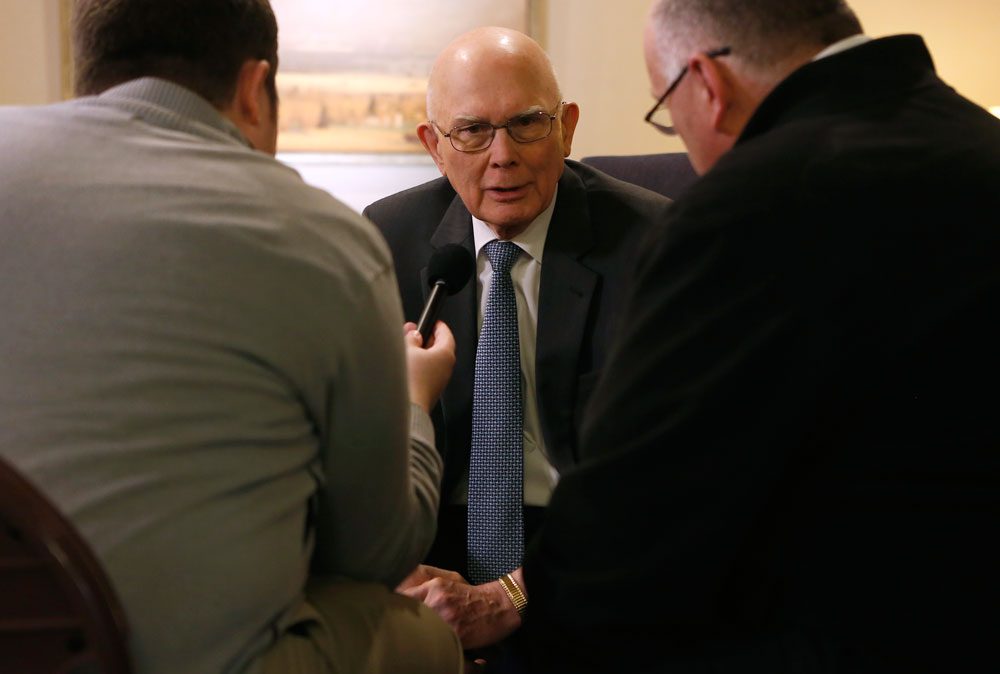
At the press conference, Dallin Oaks, an elder in the LDS’s Quorum of the Twelve Apostles, mentioned several recent examples of religious freedom not being respected, including when California universities forced Christian groups off campus, the CEO of Mozilla was forced to resign, and the mayor of Houston tried to subpoena the sermons of pastors.

“When religious people are publicly intimidated, retaliated against, forced from employment or made to suffer personal loss because they have raised their voice in the public square, donated to a cause or participated in an election, our democracy is the loser,” Oaks said. “Such tactics are every bit as wrong as denying access to employment, housing or public services because of race or gender.”

The LDS position is consistent with four principles that are based upon the teachings of Jesus Christ, Oaks asserted: everyone has the right to live according to the dictates of their conscience as long as they do not interfere with the health or safety of others; freedom of conscience includes the right to choose one’s faith, or no faith; laws should balance protecting freedom with respecting the fact the people have different values; and, persecution and retaliation of any kind are rejected.

The position is consistent with previous statements, the LDS leaders noted, such as their support for a Salt Lake City non-discrimination ordinance in 2009 and a 2010 statement condemning bullying of gay youth.

“I think the Latter-day Saints are well-intentioned but naive on where the reality stands today,” said Moore, who added that he has met with LDS leaders often to talk about those issues.

“I do not think, in most instances, sexual orientation ought to matter in housing or employment,” Moore continued, “but of course the proposals to address these concerns inevitably lead to targeted assaults on religious liberty.”

Moore also noted that gay rights organizations have responded with “hostility” toward the LDS effort to find a middle ground.

“Nonetheless,” Moore added, “I look forward to working with Mormons and others on protecting religious liberty for everyone in the years ahead.”

He also reiterated that Southern Baptists believe that all LGBT people “are created in the image of God and ought to be respected,” that “any sexual expression outside of marriage between one man and one woman is morally wrong,” and “that freedom of conscience for those of us who dissent from the Sexual Revolution ought to be maintained.”

Source: Christian Post

Tim Hughes set to leave Holy Trinity Brompton

Christian Today report- Tim Hughes is set to lead a church in Birmingham, leaving London’s Holy Trinity Brompton (HTB) where he has worked for almost a decade.

In an interview with Premier Radio, Hughes revealed that he will oversee St Luke’s Church in Birmingham city centre, and will move with his family around Easter.

He will remain connected to HTB, however – a small team will go with him to Birmingham, and he will continue to lead Worship Central.

“My wife and I have felt excited and called for a while now…to lead a church where we could build a community, see people being discipled, leaders being mobilised and released; and to really try and invest in a city to see God’s Kingdom come,” he told Premier’s Justin Brierley.

“Some really exciting opportunities have come up,” he added, noting that he grew up in Birmingham, where his father led St John’s Church, Harborne – “It’s kind of like going home.”

Hughes will also oversee the beginning of a second church, planted in a warehouse bought by the Diocese of Birmingham.

“The idea is that we’re going to start services with a real vision to engage young people, students, families – to see a congregation grow that will really resource, bless, and hopefully light up the city of Birmingham.”

Under the leadership of Nicky Gumbel, Hughes added, HTB has been “incredibly releasing, incredibly encouraging, and [has] massively blessed and invested into what we’re doing and what we’re planning to do in Birmingham.”

“This feels like a natural extension of what I’ve always been doing,” he said. “My heart is worship; to see people encounter God, to see people experience and spend time in the presence of God, and I think with what we’ve been doing with Worship Central which is very much going to continue, has been trying to encourage local churches and resource them in the area of worship.

“But actually, it’s the senior church leaders who are in many ways the gatekeepers to so much of what happens in local churches… and I think leading a church becomes more of an opportunity for me to raise up worship leaders, to create a community, a culture where we can be centred around the presence of God, where we can take risks, where I can encourage musicians, songwriters, artists to grow in their gifts, and I hope that then perhaps becomes a resource for other churches in that area.”

Source: Christian Today

YWAM license reinstated

Christian Today report- Youth With A Mission in England and Wales has had the threat of losing hundreds of volunteer workers lifted after an about-turn by the UK Visa and Immigration service (UKVI).

Following an inspection by UKVI officers reviewing the charity’s status as a visa sponsor, YWAM was notified in December by another body, the Sponsor Compliance Unit (SCU), that its licence would be suspended for 20 working days and would be revoked if outstanding issues were not addressed.

It faced the prospect of having to send back to their home countries up to 350 missionaries and their families, potentially crippling its work in deprived communities and among marginalised people.

Now it has been told that UKVI, part of the Home Office, has decided to reinstate the licence.

A YWAM statement said: “We are extremely grateful for this positive outcome, but admit that we have had to learn several hard lessons about our internal processes and our approach to record keeping. We are already implementing important changes to these areas and will work with diligence to live up to the high expectation of the UKV&I.”

In its statement, YWAM expressed concerns about the process that had led to the suspension and said that it had been offered a meeting with UKVI to discuss its experiences. It stressed that it had “always respected and supported the UKV&I in its legitimate search for unscrupulous and fraudulent organisations who attempt to flout or skirt the UK’s generous visa laws”.

YWAM is to meet with other Christian organisations under the auspices of the Global Connections network to recount their experiences. It said: “In doing so we hope to reassure and, if necessary, make any repairs to the relationship between our Government and the wealth of Christian organisations operating in the UK.”

The statement said: “The consequences for YWAM, should our licence have been revoked, would have been profound. Several hundred volunteer missionaries would have been told that they are no longer entitled to remain in the UK and would either had to leave or find an alternative sponsor. In stark terms, almost half of YWAM’s missionaries (approximately 300 people plus spouses and children) would have had to make alternative future plans. It would have affected YWAM’s activities, in-house training, social outreach and external ministries.

“We thank God that this situation has been so satisfactorily resolved and wish to offer our heartfelt thanks to all who have given support to us during this trying time. We have felt supported and encouraged and remain wholly committed to our pledge ‘to know God and make Him known’.”

Source: Christian Today

Download of the day: WinDirStat

Techradar report- Freeing up hard drive space can be difficult it you’re not sure where your largest files are located, but WinDirStat makes that task quick and easy, all for free.

Why you need it

We all know the problem – the longer you use a computer, the more your hard drives fill up and reach capacity. This is especially problematic if you use solid state drives (SSDs), which usually come with less storage capacity than traditional hard disk drives (HDDs).

That’s why using a program like WinDirStat is important. It scans the drive(s) of your choice and shows you which files and folders are taking up the most space in a clear, concise manner. It runs quickly, too, so you can take action to free up disk space without having to wait around for the program to finish scanning your drives.

WinDirStat’s interface is divided into two sections. The top half displays a browsable tree list of all the folders on your drive, with the largest at the top. That lets you quickly discover which folders are hogging up all the precious space on your drives.

Below that is a graphical representation of your drive. Each file is represented by a coloured rectangle, with larger rectangles representing larger files and folders. So whichever view you prefer, there’s always a simple way to get to the bottom of your hard disk space issues with WinDirStat.

Key features

  • Works on: PC
  • Versions: Free
  • User friendly interface: WinDirStat is so easy to use thanks to its clear interface and graphical representations of your drives
  • Understand your drive: Knowing which files and folders are gobbling up space on your hard drive allows you to move or delete them, freeing up valuable storage space.

Source: Techradar

How Marcus Borg challenged orthodoxy

Christian Today report- Liberal theologian Marcus J Borg, who died last week at the age of 72, polarised opinions. The New Testament scholar was both praised for his independent thinking and attempts to make the gospel credible, as he saw it, to the modern age, and vilified for his radical departures from Christian orthodoxy.

He was one of a group of scholars known as the Jesus Seminar, which was very active in the 1980s and 90s and sought to foster a critical approach to Christian origins as they were recounted in the four canonical Gospels and other early material (they rejected the notion that there was anything particularly authoritative about the Bible).

Among other projects, they approached the Gospels with a high degree of scepticism arguing that whereas the pioneers of historical criticism had to argue that something shouldn’t be regarded as factually true, so much more was known today about the shaky foundations of the biblical witness that the onus was on scholars to show that it should. So in The Five Gospels: The Search for the Authentic Words of Jesus (1993) for instance, they evaluated the authenticity of 500 Gospel statements and events by voting with coloured beads in a points-based system.

A red bead meant the voter believed Jesus did say what he is quoted as saying (three points); pink meant he probably said something like it (two points); grey meant it was Jesus-like (one point) and black meant it was a later addition (zero points). Very few sayings or events passed the test.

Borg, like the other Jesus Seminar participants, rejected the miraculous. Jesus, he believed, was a social prophet and reformer, a wisdom teacher and mystic of the same type as Gandhi and Martin Luther King.

An example of his approach is in a piece he wrote for his blog during Advent last year, in which lamented that “Advent and Christmas have virtually been swallowed up by the miraculous”, such as the stories of the visits of angels and the wise men being guided by a star. “To be candid, I do not think that any of this happened,” he wrote. “Of course, there is some historical memory in the stories. Jesus was born. He really lived. He was Jewish. His parents’ names were Mary and Joseph. They lived in Nazareth, a very small peasant village, perhaps as small as a few hundred. But I do not think that there was an annunciation by an angel to Mary, or a virginal conception, or a special star, or wisemen from the East visiting the infant Jesus, or angels filling the night with glory as they sang to shepherds.”

However, he denied being a “debunker” of the stories and said there was a “third way” between regarding them as fact or fable: “Rather, they are early Christian testimony, written roughly a hundred years after Jesus’s birth. They testify to the significance that Jesus had come to have in their lives and experience and thought. The stories are parabolic, metaphorical narratives that can be true without being factual.” Advent and Christmas, he said, “are about the biblical hope and way, the path, to a new kind of world. They are about our rebirth and the world’s rebirth.”

Unlike some other ‘progressive Christians’, he was respected both for his personal spirituality and for his willingness to engage courteously with orthodox believers. The former Bishop of Durham, academic N T Wright, took part in public debates with him and paid tribute to him saying that despite their disagreements, he and Borg shared “a deep and rich mutual affection and friendship”.

Theologian Brian D McLaren wrote: “Hardly the hard-bitten ‘liberal theologian’ out to eviscerate Christianity of any actual faith, he impressed me as a fellow Christian seeking an honest, thoughtful, and vital faith, ready to dialogue respectfully with people who see things differently.”

Borg also wrote on his blog that he sought to be “an evangelist to those in the Christian middle – people who are still in churches but who are troubled by some and perhaps many of conventional Christian beliefs that were taken for granted not so long ago”.

Borg wrote or co-wrote 21 books, one of the most popular of which was Meeting Jesus Again for the First Time. In his last, the memoir Convictions: How I Learned What Matters Most (2014), he wrote: “Imagine that Christianity is about loving God. Imagine that it’s not about the self and its concerns, about ‘what’s in it for me,’ whether that be a blessed afterlife or prosperity in this life.”

It would be ungracious to deny that he brought wisdom and penetration both to biblical scholarship and to the wider theological conversation. However, his work is open to criticism, too. Scholars have generally not found the approach of the Jesus Seminar convincing in its sweeping rejection of the possibility of knowing much about Jesus. The “progressive Christian” approach of Borg and his ilk, in its belief that whatever is of value in Christianity can be retained while it is detached from any historical roots, is surely misguided.

While Borg’s own commitment to the life of the Church and the Christian community is undoubtable – he became an Episcopalian and was a faithful churchgoer – it is hard to see his nuanced and subtle reading of the Bible attracting many to the cause. There is much of value in his work, but perhaps his greatest contribution to theology was in strengthening and refining the faith of orthodox believers who had to answer his objections.

Source: Christian Today

China: Christian faith increases despite Government’s opposition

Breaking Christian News- “By 2030, China’s total Christian population, including Catholics, is predicted to exceed 246 million, placing it above Mexico, Brazil and the United States as the largest Christian congregation in the world.” -Reuters

(China)—While Christianity continues to weaken in many parts of the world, China’s Christian churches are experiencing significant growth despite government restrictions.

“Some Sundays we are full. We also have 1,600 volunteers,” said Zhou Lianmei, the pastor’s wife of the Chongyi Church, one of the biggest mega-churches in the country. The convention-building sized church holds up to 5,000 worshipers and there are several services available every Sunday.

“I come because I found a love here that isn’t dependent on a person. It is like a river that doesn’t go away,” stated a young businesswoman from Hangzhou, the city where Chongyi Church is located.

The city of Wenzhou, often referred to as “China’s Jerusalem,” is home to over 1 million Protestants out of a population of 9 million. Experts believe that by 2030, China will hold the most Christians on the planet based on current growth rates.

“Chinese Christians know the Bible better than some Southern Baptists. That’s not a small thing,” Philip Wickeri, a Christian leader in Hong Kong, told the Business Insider.

For many years, Christianity was seen as a religion for elderly peasant women. However, that view has significantly changed: many of the newly baptized Chinese Christians are young, well-educated and earn a comfortable living.

Last year, half a million Christians were baptized in the country, according to China’s chief of religious affairs. Texas-based Baylor University and Peking University conducted a joint study that estimated 70 million Christians over 16 years of age reside in China.

Some Christians are even incorporating Biblical principles into their businesses. One company in China asks members to pledge a “Ten Commandments” of good behavior that includes “no bribing, no taking mistresses, no avoiding taxes, and no mistreating employees.”

Although China’s Christian population is growing, the government continues to tighten its hold on the faith. Over the past year, the country’s Communist police have bulldozed church buildings, demolished crosses, and destroyed religious artifacts.

One church offered to pay a series of fines in the belief that the attacks were about money. “We were fooled at first,” says one local pastor. “Then we discovered they didn’t care about fines. They went after our crosses and gave the impression they enjoyed it.” The aim was to humiliate and shame, he believes.

Source: Breaking Christian News

Faith Leaders urge Cameron to keep refugee promise

Christian Today report- A year on from the UK government’s promise of a resettlement scheme for Syrian refugees, just 90 have been offered asylum.

Some of Britain’s top faith leaders are now urging David Cameron to do more to protect the most vulnerable, particularly in the face of a hash Syrian winter.

“Many refugees have experienced persecution, torture or sexual violence, sometimes because of their religion or ethnicity, or have disabilities or other urgent medical needs which make them particularly vulnerable. Some will not survive the winter,” a letter signed by multiple religious leaders reads.

“We are proud of the way in which the UK has led the world in its humanitarian aid contribution to the Syria crisis. However, our help cannot end with aid. We urge you to show the same leadership on resettlement so that more of Syria’s most vulnerable refugees can find sanctuary here in the UK.

“We welcomed the announcement, a year ago, of the Syrian Vulnerable Persons Relocation (VPR) scheme but we are disappointed that only 90 refugees have so far been offered a safe haven here in the UK via this route,” the letter continues.

“One year on, we urge you to take this opportunity to commit to offering resettlement places to thousands, not hundreds, of refugees from Syria.

“In the face of a desperate and growing need, we believe that Great Britain has a moral responsibility to continue our noble tradition as a compassionate and welcoming safe haven for those in need of protection. As Prime Minister, you have the power to offer hope to people whose suffering is almost unimaginable to us. We ask you to do this today.”

Signatures of the letter include the Archbishop of Wales Barry Morgan, Head of the Jewish Reform Movement Rabbi Laura Janner-Klausner and Assistant Secretary General of the Muslim Council of Britain Shaykh Ibrahim Mogra.

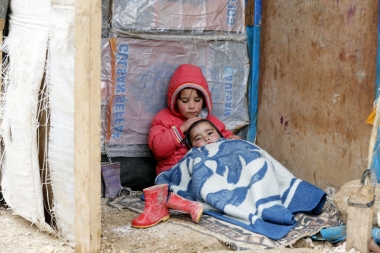
An estimated ten million people have been displaced by the ongoing conflict in Syria, four million of whom have fled the country since the outbreak of civil war almost four years ago. Over 1.25 million of these are children, and aid organisations working in the region have repeatedly expressed concern about both the immediate and long-term effects that the ongoing crisis will have on them. They are often described as a “lost generation”.

Amnesty International is now calling on countries to increase their resettlement commitments to five per cent of Syria’s refugees by the end of 2015, and a further five per cent next year. The UK has so far pledged to offer asylum to only a few hundred Syrians over the next three years.

“The UK government’s relief efforts in the region are to be commended but it is clear that so much more needs to be done to protect people fleeing the Syrian conflict, including those at risk of persecution due to their religion or ethnicity,” said Kate Allen, Amnesty International UK director.

“A year on from agreeing to resettle hundreds of refugees, the UK should take this opportunity to up their game and resettle thousands of Syria’s most vulnerable. The UK has done this in response to other conflicts, what is stopping this government from doing the same?”

Refugee Council Chief Executive Maurice Wren has accused Cameron of failing those in need. “We promised them safety. We promised them hope. We promised them a future. If David Cameron fails to significantly increase the scale of Britain’s resettlement scheme he will have broken that promise,” Wren said.

Edie Freedman, Executive Director of The Jewish Council for Racial Equality added: “We in the Jewish community know only too well the perils of being refugees and the indifference which too often meets their desperate plight to find sanctuary.

Syrians now make up the largest refugee group in the world. We appreciate that this is not a job for Britain alone, but we must do our fair share.”

The faith leaders join many others in calling on Cameron to do more. On Monday, a group of celebrities including Emma Thompson, Michael Palin and Sting signed a letter in which they said “every settlement place countries like Britain provide is a lifeline”.

“Resettling ‘several hundred people’ just isn’t good enough for a global leader. This issue isn’t about migration statistics or party politics, it’s about people. It’s about the values that we in Britain hold dear; compassion and humanity,” the letter contined.

“Your choice is simple, yet historic. You are in a position to offer some of the most vulnerable people in the world safety in Britain. You can offer hope. You can offer a future.”

Source: Christian Today

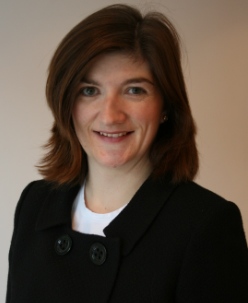
Nicky Morgan says she won’t stop defending the motion to instil British values

Christian Today report- Education Secretary Nicky Morgan yesterday said she will “vigorously defend” the drive to instil British values in UK schools, despite controversy over “intrusive” Ofsted questioning.

“I’m afraid I have no sympathy for those who say that British values need not apply to them, that this should purely be a special test for schools in predominantly Muslim communities or our inner cities,” Morgan said in a speech to think tank Politeia

“A commitment to British values means that we also hold to account those schools where girls are made to sit at the back of the class, where homophobia goes unchecked, where young people aren’t being made aware of the many facets of British culture.”

Morgan said that though children in some parts of the country may not know anyone of an ethnic minority, it’s important that they learn about diversity while they are young. “Surely a key part of our responsibility to those young people in enabling them to succeed in modern Britain is ensuring they understand and respect the differences that make our country unique,” she said.

“So I’m unapologetic in saying that no school should be exempt from promoting fundamental British values, just as no school should be exempt from promoting rigorous academic standards.”

Morgan’s comments come in the wake of faith schools coming under fire for supposedly failing to foster a tolerant environment.

The January 2015 Ofsted report for Grindon Hall, a Christian school in Sunderland, says that the curriculum “does not adequately prepare pupils for life in modern Britain.”

“Pupils show a lack of respect and tolerance towards those who belong to different faiths, cultures or communities…Discrimination through racist or homophobic language persists,” the report adds.

However, principal Chris Gray attributed Grindon Hall’s downgrading to “inadequate” to inappropriate questioning by Ofsted inspectors.

“The tenor of the inspection was negative and hostile at every stage, as if the data collected had to fit a pre-determined outcome,” Gray wrote in a formal letter of complaint.

He said that a ten-year-old girl was asked if she knew what lesbians “did”, while other children were asked “intrusive and deeply personal” questions.

“I have also heard reports of primary school children being asked if they knew of any boys or girls who thought they were in the ‘wrong body,'” Gray said. “Pupils were embarrassed and surprised to be asked questions about sexuality.”

He later accused the inspection team of having an “aggressive attitude”.

The government’s drive to promote British values has been criticised by some for being too narrow in its definitions.

Chief education officer for the Church of England, Nigel Genders, said last year that the Church “wholeheartedly support[s] the idea of schools being required to promote the values of tolerance and respect for those coming at things from a different perspective.

“However, ‘British Values’ cannot be allowed to become a test or an assessment of whether somebody in a community is ‘safe’ or ‘loyal’,” he said.

Source: Christian Today

More millennial teenagers are changing their views on abortion

Christian Today report- The landscape of the battle between pro-abortion and pro-life activists is showing some change as trends reveal that millennial teenagers are leaning more towards a pro-life stance rather than favouring the practice of abortion.

Robert P George, law professor at Princeton University, said at the Students for Life America’s 28th annual conference on Friday that the pro-life movement had appeared to have a bleak future in the past decades.

However, the professor said the dedication of pro-life leaders to the cause as well as the availability of new technologies have helped in educating the youth on “the reality of the beautiful human life of the child in the womb.”

According to the Washington Times, delegates to the conference exceeded previous figures. About 2,000 people attended the conference on Friday alone and the demand was so huge that the SFLA had to schedule a second day of the conference on Sunday in San Francisco in order to accommodate the numbers.

The professor said on Friday that there is a turning of the tide in favour of the pro-life movement, and he honoured the youth as being responsible for this new development.

“I see the future, and you are it,” Professor George told the attendees.

SFLA President Kristan Hawkins urged youth to speak out and let their thoughts be known on the issue. “When you speak, people listen,” Ms Hawkins said.

The Students for Life America is a pro-life umbrella organisation that encompasses more than 800 pro-life student groups scattered in various universities and high schools in the entire United States. It holds an annual conference whose purpose is to educate the youth, as well as bring them close to individuals who can help them pursue their own pro-life campaigns.

The SFLA also purports to introduce attendees through the annual conference to national leaders “who all know just how vital this pro-life generation is to abolishing abortion in our lifetime.”

Source: Christian Today

Most Americans agree they know nothing about Sikhs

Christian Today report- Almost two thirds of Americans admit they know nothing about Sikhs, a new survey has found, despite the fact that Sikhism is the fifth largest religion in the world.

A survey commissioned by the National Sikh Campaign (NSC) showed that 31 per cent of non-Asian Americans have never seen or interacted with someone who is Sikh, and only 11 per cent have a close friend or acquaintance who is Sikh.

When shown a photograph of a man in a turban, just 11 per cent of respondents identified him as Sikh – 20 per cent thought he was Muslim.

The survey also appeared to reveal reservations about traditional Sikh dress – 17 per cent of those surveyed thought they had much in common with a Sikh woman wearing a turban, in comparison with the 30 per cent who said the same of a Sikh woman with long hair and no turban.

A number of those polled admitted to feeling a little “wary,” “nervous,” or “cautious” of men in turbans.

The NSC report, entitled ‘Sikhism in the United States: What Americans know and need to know’, supports research conducted in 2014, which found that more than half of Sikh children are bullied at school, a statistic which increases to two-thirds among those who wear turbans.

According to the NSC, there has been a “dramatic increase in hate-based violence against Sikhs” since 9/11. This includes the Wisconsin Sikh temple shooting in 2012, which was biggest act of violence against a faith community in the US since the 1963 church bombings in Alabama.

“Sikhs experience daily encounters with discrimination and hate incidents that go unreported and therefore unrecognized,” the report said.

The report suggests that Sikhism is largely misunderstood in the US, although there are around half a million Sikhs living in the US. In response, the NSC is urging Americans to educate themselves about the faith, in the hope of seeing perceptions change.

“We want to make sure that we pave a way for a conducive environment for our future generations so they don’t have to take off their turban to hide or to feel sorry for their identity,” NSC co-founder Rajwant Singh said on Monday.

Another co-founder, Gurwin Singh Ahuja, added: “We hold incredibly progressive values. Sikhs believe that men and women are equal, that all faiths should have the right to practice, and we have to do a better job of communicating those things.”

“Ultimately,” he continued, “we want to give young Sikhs a future where tying their turban in the morning is not a cause for concern.”

Source: Christian Today