Messianic Leaders Call for Hour of Prayer Today against Coronavirus

Messianic Leaders Call for Hour of Prayer Today against Coronavirus


Israeli Messianic leaders have called all believers in Israel to pray today from 1 pm—2 pm ET against the coronavirus outbreak.

“We believe that during this pandemic, God is calling on mankind to call out to Him,” said the leaders, according to CBN News. “Our prayers are like incense that rises before God and beckons Him to intervene in what is going on around us.”

Messianic believers are encouraged to meditate on two passages during this time of prayer: Numbers 16:46-50, where Aaron offers incense and makes atonement to stop a deadly plague, and Revelation 8:4, which shows that the prayers of saints reach God.

“The plague had already started among the people, but Aaron offered the incense and made atonement for them,” Numbers 16:46-50 reads. “He stood between the living and the dead, and the plague stopped. But 14,700 people died from the plague, in addition to those who had died because of Korah. Then Aaron returned to Moses at the entrance to the tent of meeting, for the plague had stopped.”

Revelation 8:4 reads, “and the smoke of the incense, with the prayers of the saints, rose before God from the hand of the angel.”

Leaders also outlined five specific prayer requests:

1. Pray for God to seek and know our hearts

“Like each and every private or public time of prayer, we are to ask God to search us and know our hearts – to test us and see if there be any sin in us…

… Read More

Click here to read the rest of the story from our content source/partners – Christian Headlines.

قالب وردپرس

PODCAST: The Scripture & the Sense Podcast #448: Amos 5:1 with Daniel Whyte III

This is Daniel Whyte III president of Gospel Light Society International with The Scripture & the Sense Podcast #448, where I read the Word of God and give the sense of it based on an authoritative commentary source such as the Bible Knowledge Commentary or Matthew Henry Commentary. This podcast is based upon Nehemiah 8:8 where it says Ezra and the Levites “read in the book in the law of God distinctly, and gave the sense, and caused them to understand the reading.” The aim of this podcast is that through the simple reading of the Word of God and the giving of the sense of it, the church would be revived and the world would be awakened.

Today we are reading Amos 5:1.

1 Hear ye this word which I take up against you, even a lamentation, O house of Israel.

________

That was Amos 5:1. Now here is the sense of it.

The Matthew Henry Commentary reads:

The convincing, awakening word must be heard and heeded, as well as words of comfort and peace; for whether we hear or forbear, the word of God shall take effect. The Lord still proclaims mercy to men, but they often expect deliverance from such self-invented forms as make their condemnation sure. While they refuse to come to Christ and to seek mercy in and by him, that they may live, the fire of Divine wrath breaks forth upon them. Men may make an idol of the world, but will find it cannot protect.

The Bible Knowledge Commentary reads:

Amos’ third and fourth messages are structured and juxtaposed to highlight one overall truth: the nation would be judged by its mighty sovereign God, but individuals could yet repent and live. Together these two messages present one overall truth: the mighty sovereign God would judge the nation as a whole for its legal injustice and religious hypocrisy, but He offered life to individuals within the nation who would yet repent and seek Him. Amos summoned the people to hear his lament over their death. A “lament” was ordinarily a poem of grief sung at the funeral of a relative, friend, or leader. Prophets, however, also used this poetic form to mourn the death of a city, people, or nation. Though Israel was at the height of prosperity under Jeroboam II, her judgment was so certain that Amos lamented her fall as though it had already happened. To his listeners, hearing this lament would be as jarring as reading one’s own obituary in the newspaper.

____________

Thank you for listening to the Scripture & The Sense Podcast. Remember to read the Word of God each and every day and pray without ceasing to God for wisdom to understand it and apply it to your life. Most importantly, believe on the Lord Jesus Christ and thou shalt be saved. Please stay tuned for a complete presentation of the Gospel of the Lord Jesus Christ so that you can get your soul saved from Hell to that wonderful place called Heaven when you die. May God bless you and keep you is my prayer.

All Content & Images are provided by the acknowledged source

PODCAST: Whyte House Daily Devotional Bible Reading #113: Numbers 27, Psalm 121, and Romans 11 with Daniel Whyte III

This is Daniel Whyte III, president of Gospel Light Society International with the Whyte House Daily Devotional Bible Reading Episode #113. Where I read three chapters of the Holy Bible in the King James Version a day with my family as a part of our family devotions, to encourage you to read the Holy Bible in a year’s time. Today we are reading Numbers 27, Psalm 121 and Romans 11.

John Wycliffe said, “All Christian life is to be measured by Scripture; by every word thereof.”

Joyce Meyer said, “It is not about reading the Word. It is about obeying the Word.”

Numbers 27
1 Then came the daughters of Ze-loph’-e-had, the son of He’-pher, the son of Gil’-ead, the son of Ma’-chir, the son of Ma-nas’-seh, of the families of Ma-nas’-seh the son of Jo’-seph: and these are the names of his daughters; Mah’-lah, No’-ah, and Hog’-lah, and Mil’-cah, and Tir’-zah.

2 And they stood before Mo’-ses, and before El-e-a’-zar the priest, and before the princes and all the congregation, by the door of the tabernacle of the congregation, saying,

3 Our father died in the wilderness, and he was not in the company of them that gathered themselves together against the Lord in the company of Ko’-rah; but died in his own sin, and had no sons.

4 Why should the name of our father be done away from among his family, because he hath no son? Give unto us therefore a possession among the brethren of our father.

5 And Mo’-ses brought their cause before the Lord.

6 And the Lord spake unto Mo’-ses, saying,

7 The daughters of Ze-loph’-e-had speak right: thou shalt surely give them a possession of an inheritance among their father’s brethren; and thou shalt cause the inheritance of their father to pass unto them.

8 And thou shalt speak unto the children of Is’-ra-el, saying, If a man die, and have no son, then ye shall cause his inheritance to pass unto his daughter.

9 And if he have no daughter, then ye shall give his inheritance unto his brethren.

10 And if he have no brethren, then ye shall give his inheritance unto his father’s brethren.

11 And if his father have no brethren, then ye shall give his inheritance unto his kinsman that is next to him of his family, and he shall possess it: and it shall be unto the children of Is’-ra-el a statute of judgment, as the Lord commanded Mo’-ses.

12 And the Lord said unto Mo’-ses, Get thee up into this mount Ab’-a-rim, and see the land which I have given unto the children of Is’-ra-el.

13 And when thou hast seen it, thou also shalt be gathered unto thy people, as Aa’-ron thy brother was gathered.

14 For ye rebelled against my commandment in the desert of Zin, in the strife of the congregation, to sanctify me at the water before their eyes: that is the water of Mer’-i-bah in Ka’-desh in the wilderness of Zin.

15 And Mo’-ses spake unto the Lord, saying,

16 Let the Lord, the God of the spirits of all flesh, set a man over the congregation,

17 Which may go out before them, and which may go in before them, and which may lead them out, and which may bring them in; that the congregation of the Lord be not as sheep which have no shepherd.

18 And the Lord said unto Mo’-ses, Take thee Josh’-u-a the son of Nun, a man in whom is the spirit, and lay thine hand upon him;

19 And set him before El-e-a’-zar the priest, and before all the congregation; and give him a charge in their sight.

20 And thou shalt put some of thine honour upon him, that all the congregation of the children of Is’-ra-el may be obedient.

21 And he shall stand before El-e-a’-zar the priest, who shall ask counsel for him after the judgment of U’-rim before the Lord: at his word shall they go out, and at his word they shall come in, both he, and all the children of Is’-ra-el with him, even all the congregation.

22 And Mo’-ses did as the Lord commanded him: and he took Josh’-u-a, and set him before El-e-a’-zar the priest, and before all the congregation:

23 And he laid his hands upon him, and gave him a charge, as the Lord commanded by the hand of Mo’-ses.

Psalm 121
A Song of degrees.
1 I will lift up mine eyes unto the hills, from whence cometh my help.

2 My help cometh from the Lord, which made heaven and earth.

3 He will not suffer thy foot to be moved: he that keepeth thee will not slumber.

4 Behold, he that keepeth Is’-ra-el shall neither slumber nor sleep.

5 The Lord is thy keeper: the Lord is thy shade upon thy right hand.

6 The sun shall not smite thee by day, nor the moon by night.

7 The Lord shall preserve thee from all evil: he shall preserve thy soul.

8 The Lord shall preserve thy going out and thy coming in from this time forth, and even for evermore.

Romans 11
1 I say then, Hath God cast away his people? God forbid. For I also am an Israelite, of the seed of A’-bra-ham, of the tribe of Ben’-ja-min.

2 God hath not cast away his people which he foreknew. Wot ye not what the scripture saith of E-li’-as? how he maketh intercession to God against Is’-ra-el saying,

3 Lord, they have killed thy prophets, and digged down thine altars; and I am left alone, and they seek my life.

4 But what saith the answer of God unto him? I have reserved to myself seven thousand men, who have not bowed the knee to the image of Ba’-al.

5 Even so then at this present time also there is a remnant according to the election of grace.

6 And if by grace, then is it no more of works: otherwise grace is no more grace. But if it be of works, then it is no more grace: otherwise work is no more work.

7 What then? Is’-ra-el hath not obtained that which he seeketh for; but the election hath obtained it, and the rest were blinded.

8 (According as it is written, God hath given them the spirit of slumber, eyes that they should not see, and ears that they should not hear;) unto this day.

9 And Da’-vid saith, Let their table be made a snare, and a trap, and a stumblingblock, and a recompence unto them:

10 Let their eyes be darkened, that they may not see, and bow down their back alway.

11 I say then, Have they stumbled that they should fall? God forbid: but rather through their fall salvation is come unto the Gen’-tiles, for to provoke them to jealousy.

12 Now if the fall of them be the riches of the world, and the diminishing of them the riches of the Gen’-tiles; how much more their fulness?

13 For I speak to you Gen’-tiles, inasmuch as I am the apostle of the Gen’-tiles, I magnify mine office:

14 If by any means I may provoke to emulation them which are my flesh, and might save some of them.

15 For if the casting away of them be the reconciling of the world, what shall the receiving of them be, but life from the dead?

16 For if the firstfruit be holy, the lump is also holy: and if the root be holy, so are the branches.

17 And if some of the branches be broken off, and thou, being a wild olive tree, wert grafted in among them, and with them partakest of the root and fatness of the olive tree;

18 Boast not against the branches. But if thou boast, thou bearest not the root, but the root thee.

19 Thou wilt say then, The branches were broken off, that I might be grafted in.

20 Well; because of unbelief they were broken off, and thou standest by faith. Be not highminded, but fear:

21 For if God spared not the natural branches, take heed lest he also spare not thee.

22 Behold therefore the goodness and severity of God: on them which fell, severity; but toward thee, goodness, if thou continue in his goodness: otherwise thou also shalt be cut off.

23 And they also, if they abide not still in unbelief, shall be grafted in: for God is able to graft them in again.

24 For if thou wert cut out of the olive tree which is wild by nature, and wert grafted contrary to nature into a good olive tree: how much more shall these, which be the natural branches, be grafted into their own olive tree?

25 For I would not, brethren, that ye should be ignorant of this mystery, lest ye should be wise in your own conceits; that blindness in part is happened to Is’-ra-el, until the fulness of the Gen’-tiles be come in.

26 And so all Is’-ra-el shall be saved: as it is written, There shall come out of Si’-on the Deliverer, and shall turn away ungodliness from Ja’-cob:

27 For this is my covenant unto them, when I shall take away their sins.

28 As concerning the gospel, they are enemies for your sakes: but as touching the election, they are beloved for the father’s sakes.

29 For the gifts and calling of God are without repentance.

30 For as ye in times past have not believed God, yet have now obtained mercy through their unbelief:

31 Even so have these also now not believed, that through your mercy they also may obtain mercy.

32 For God hath concluded them all in unbelief, that he might have mercy upon all.

33 O the depth of the riches both of the wisdom and knowledge of God! how unsearchable are his judgments, and his ways past finding out!

34 For who hath known the mind of the Lord? or who hath been his counsellor?

35 Or who hath first given to him, and it shall be recompensed unto him again?

36 For of him, and through him, and to him, are all things: to whom be glory for ever. A’-men.

________

PRAY
________

When I was a teenager I wanted to get wisdom and knowledge, so I set out the read the big family Bible that many families had in those days. But I couldn’t get past Genesis 2 before I got bored with reading the Bible. I found out later in life that you have to believe on Christ and get saved before you can understand the Bible. So here is how I became a Christian and how you can too:

First, accept the fact that you are a sinner, and that you have broken God’s law. The Bible says in Romans 3:23: “For all have sinned and come short of the glory of God.”

Second, accept the fact that there is a penalty for sin. The Bible states in Romans 6:23: “For the wages of sin is death…”

Third, accept the fact that you are on the road to hell. Jesus Christ said in Matthew 18:8: “Wherefore if thy hand or thy foot offend thee, cut them off, and cast them from thee: it is better for thee to enter into life halt or maimed, rather than having two hands or two feet to be cast into everlasting fire.” Also, the Bible states in Revelation 21:8: “But the fearful, and unbelieving, and the abominable, and murderers, and whoremongers and sorcerers, and idolaters, and all liars, shall have their part in the lake which burneth with fire and brimstone: which is the second death.”

Now that is bad news, but here’s the good news. Jesus Christ said in John 3:16: “For God so loved the world, that he gave his only begotten Son, that whosoever believeth in him should not perish, but have everlasting life.” Just believe in your heart that Jesus Christ died for your sins, was buried, and rose from the dead by the power of God for you so that you can live eternally with Him. Pray and ask Him to come into your heart today, and He will.

Romans 10:9 & 13 says, “That if thou shalt confess with thy mouth the Lord Jesus, and shalt believe in thine heart that God hath raised him from the dead, thou shalt be saved… For whosoever shall call upon the name of the Lord shall be saved.”

If you believe that Jesus Christ died on the Cross for your sins, was buried, and rose from the dead, and you want to trust Him for your Salvation today, please pray with me this simple prayer: Holy Father God, I realize that I am a sinner and that I have done some bad things in my life. I am sorry for my sins, and today I choose to turn from my sins. For Jesus Christ sake, please forgive me of my sins. I believe with all of my heart that Jesus Christ died for me, was buried, and rose again. I trust Jesus Christ as my Savior and I choose to follow Him as Lord from this day forward. Lord Jesus, please come into my heart and save my soul and change my life today. Amen.

If you believed in your heart that Jesus Christ died on the Cross, was buried, and rose again, allow me to say, congratulations on doing the most important thing in life and that is accepting Jesus Christ as your Lord and Saviour! For more information to help you grow in your newfound faith in Christ, go to Gospel Light Society.com and read “What To Do After You Enter Through the Door”. Jesus Christ said in John 10:9, “I am the door: by me if any man enter in, he shall be saved, and shall go in and out, and find pasture.”

If you accepted Jesus Christ as your Savior today, please email me at [email protected] and let us know. There is some free material that we want to send you. If you have a prayer request, please e-mail that to us as well, and we will pray for you until you tell us to stop.

God loves you. We love you. And may God bless you.

All Content & Images are provided by the acknowledged source

Americans are not doing what we need to do: Why we must practice ‘physical distancing’ now

Americans are not changing our behavior as we absolutely must to defeat this enemy.

A new Harris Poll survey reports that 89 percent of Americans are still going to coffee shops. Half of respondents have not altered their hygiene behavior with house guests (e.g., asking friends and family to wash their hands immediately upon entering); 58 percent have not changed how often they are inviting people over.

You may have seen footage of beaches and bars filled with people socializing as if the situation were normal. One college student on spring break at Miami beach told reporters, “This virus ain’t that serious.”

This student is absolutely wrong. 

Coronavirus is killing thousands of people around the world. German Chancellor Angela Merkel is describing this as the gravest crisis we have faced since World War II. As I have written, more Americans could die from coronavirus than died in that horrific war.

The fact that you don’t feel ill does not mean that you are not ill. 

Many people with coronavirus will never have symptoms of the disease or will confuse their symptoms with seasonal allergies or the flu. However, they are still contagious. They can still infect others, including those who are most at risk.

And since more than half of all Americans have at least one of the symptoms that puts them at risk, to put the situation bluntly: we can literally be infecting people who will die as a result.

How can we get more of us to do what everyone must do?

The urgency of ‘physical distancing’

A psychologist suggests that we reframe the answer as “physical distancing,” as opposed to “social distancing.” This is a great idea, for two reasons.

First, “physical distancing” describes the actual need of the day. Staying at least six feet away from others is mandatory. 

Second, “social distancing” (apart from its meaning in the context of the pandemic) can contribute to loneliness, anxiety,…

… Read More


Click Read More to read the rest of the story from our content source/partners – Denison Forum.

قالب وردپرس

‘Have Yourself a Merry Little Quarantine:’ Americans Hang Christmas Lights as Symbol of Hope during Coronavirus Pandemic

‘Have Yourself a Merry Little Quarantine:’ Americans Hang Christmas Lights as Symbol of Hope during Coronavirus Pandemic


Earlier this week, Lane Grindle, a play-by-play broadcaster for the Milwaukee Brewers, tweeted an interesting idea: “What if we all put our Christmas lights back up? Then we could get in the car and drive around and look at them. That seems like a fair social distancing activity.”

And it’s catching on, according to Fox News. People from around the world have rehung their lights to show hope during a dark time. One little boy from Cumberland, Rhode Island, had similar idea, according to CNN.

“Hey, dad, can we turn the Christmas lights on? I want something to look at.” The Griffin family put up their lights and tweeted a picture. Around the country, people responded with pictures of their own lights strung up on a tree outside.

“Times are dark and there’s light to be spread,” Holly Griffin, mom to the little boy, said. “Now more than ever is a time to be looking outside yourself. I think taking our mental health seriously is really important and just hearing bad news all the time can really make that multiply.”

Griffin hopes the lights will bring cheer to those discouraged or for first responders, grocery store workers, and pharmacists who cannot socially distance.

Don Lewis strung lights over his balcony and tweeted a picture of it. “We are joining the trend to put up our Christmas lights now. Pretending this year is…

… Read More

Click here to read the rest of the story from our content source/partners – Christian Headlines.

قالب وردپرس

United Methodist Leaders Begin Planning New Conservative Denomination as Expected Split Draws Closer

A group of United Methodist leaders, including eight bishops, has issued a statement sharing its vision for a global traditionalist denomination focused on evangelism and the “primacy of Scripture.” Among the group’s essential doctrinal beliefs is defining Christian marriage as between a man and a woman.

Two of the bishops who signed the statement told UM News they would depart The United Methodist Church for such a new denomination. One other said he is considering it.

The Protocol of Reconciliation & Grace Through Separation, endorsed by a range of advocacy groups and some General Conference delegations, is due to be considered at the 2020 General Conference.

It calls for allowing traditionalist churches and conferences to leave with their properties to form another denomination, while also getting $25 million in United Methodist funds.

“Although no one yet knows what The United Methodist Church will look like following the 2020 General Conference, it is clear that our denomination is no longer unified in its beliefs,” the more than two dozen traditionalist leaders said in a press release accompanying their March 12 statement. “Therefore, some sort of separation is probable. As such, we felt it necessary to begin conversations about what the new traditional expression of Methodism might look like.”

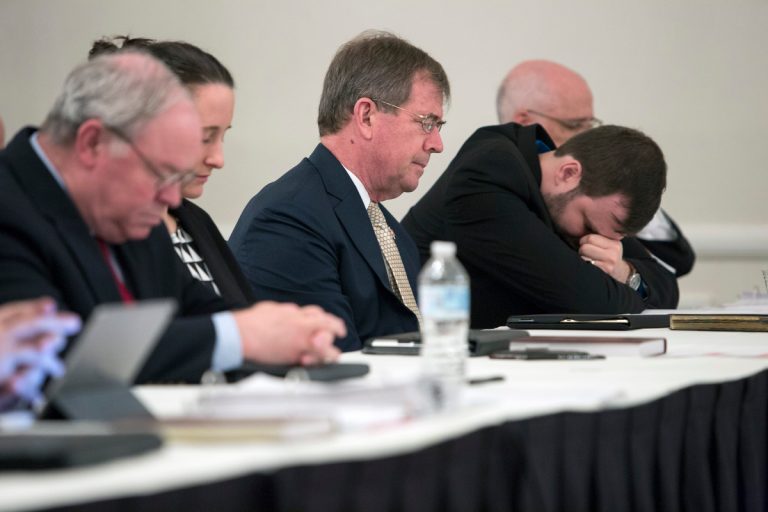
Texas Conference Bishop Scott Jones joined the Rev. Keith Boyette, president of the Wesleyan Covenant Association, and Patricia Miller, executive director of the United Methodist Confessing Movement, in convening a recent meeting in Atlanta that led to the statement.

Jones said he’s a part of other conversations about The United Methodist Church’s future and added that his signature on the document the group released did not guarantee he would be joining the new denomination, should the protocol pass.

“I have not made any commitments because I don’t know what my options are,” Jones said. “I helped convene this meeting because I have heard from many traditionalists that they were looking for a diverse, traditional option, and thought that a broader, wider conversation would be important.”

He added: “I am interested in serving faithfully in a vibrant Methodist church going forward. Exactly what shape that will take after General Conference is yet to be determined. We need good options that people can consider. This is certainly one of the options.”

Eurasia Area Bishop Eduard Khegay signed the statement and said by email that he plans to join the new denomination if the protocol passes.

“I am forever grateful to God and our UMC sisters and brothers around the world and hope to continue our friendships. But now I want to spend my time on expanding our mission and making disciples rather than figuring out how our denomination can please everyone,” Khegay said.

Upper New York Area Bishop Mark J. Webb also signed the statement and told UM News that if the protocol passes he intends “to follow God’s call upon my life and be a part of the formation of a global traditional expression of Methodism.”

He added, “My prayer is that in this season of uncertainty and discernment we will engage deeply in prayer and respectful conversation with one another to hear God’s call and honor one another’s response to that call.”

Bishop Mike Lowry, who leads the Central Texas Conference, is scheduled to retire this year but added that he is considering joining the new denomination if the protocol passes.

“As things stand, I think that’s a real possibility,” said Lowry, who also plans to be bishop-in-residence at United Theological Seminary in Dayton, Ohio.

“I’d want to pray about it and think about it. I participated in it, so I’m inclined to think I would. But I also know the protocol could get amended in ways that would change my answer.”

He said he does not see his job to either lead the Central Texas Conference out of the denomination or lead it to stay.

“I am not going to start a campaign for it to stay or leave,” he said. “I’ll leave that to the prayerful discernment of the people of the Central Texas Conference.”

Bishop James E. Swanson Sr., another signer, plans to retire this year and does not expect to depart The United Methodist Church.

“Now if the protocol passes in its current form then the Mississippi Annual Conference will make its own decision in keeping with the legislation consistent with the protocol,” he told UM News.

Other episcopal leaders who signed the statement include Nigeria Area Bishop John Wesley Yohanna; Baguio (Philippines) Area Bishop Pedro M. Torio Jr. and retired Bishop Young Jin Cho.

Under the protocol, an annual conference could leave The United Methodist Church with a majority vote of at least 57 percent.

Khegay predicted the Eurasia Area would vote to depart.

Jones said, “I will preside over the Texas Annual Conference and help it reach its own decision. I am committed to fairness of process and helping the conference make its own decision.”

Ian Urriola is a lay General Conference delegate from Upper New York. He said that if Webb and some clergy leaders want to leave, he’ll give them his blessing. But he hopes the conference will remain in The United Methodist Church.

Source: United Methodist News

All Content & Images are provided by the acknowledged source

A Christian Response to Racism in the Year of Coronavirus

Dr. Allen Yeh is Associate Professor of Intercultural Studies & Missiology at Biola University, Cook School of Intercultural Studies.

In the past couple of days, it feels like the coronavirus crisis has escalated to an unprecedented level. In reality, statistics of the spread have not changed that drastically. However, the response has generated some swift and drastic measures such as the NBA and NCAA sports being suspended, conferences being canceled, Disneyland and cruise ships closing, and universities shutting their campuses and moving all classes online for the rest of the semester.

This just happened with my university, and now all of us professors have a steep learning curve to transition to an entirely new platform mid-semester (many of us have never taught online before).

What is often lost in the midst of all this, however, is not just the left-brain, scientific, practical ways to handle the pandemic; it is the emotional intelligence side of all of this.

To continue with the university example, it is very easy for professors to get immersed in the logistics of how to suddenly learn to deliver online classes. But in the meanwhile, we may forget that our students are worried about things like losing their on-campus job, which leads to their inability to pay off their tuition, which means they might not graduate.

Being a good professor means that we not only become good deliverers of online content, but good shepherds of our students’ well-being. Ironically, teaching an online class actually requires us to be more pastoral than teaching in-person.

What is driving much of these drastic responses is emotions and fear.

Fear and emotions can be good things, as they are designed to protect us from things that may harm us (in fact, I do think that using the “sledgehammer to kill the fly” approach may actually be warranted right now to “flatten the curve” of the spread of the coronavirus—but that’s a whole other conversation).

But fear and emotions can also be drivers for unhelpful behaviors, such as panic and self-destruction. So, sometimes we need to actively fight against the way we’re biologically wired, because what is ‘natural’ is sometimes actually tainted by our sin nature.

One unfortunate side-effect of this global pandemic is racism. Rather than something like this bringing the world together to unite against a common enemy, it is easy to make some people the scapegoat; in this case, people of Asian descent.

True, the coronavirus originated in Wuhan, China, but the virus is not a discriminator of persons. Anyone could have it and anyone can transmit it. There have been documented cases (even captured on video and photos) of people spraying Febreeze on Asians in a New York subway to “disinfect” them; people posting memes (this even happened at my university) on social media of people making disgusted faces at Asians when they sneeze or cough; people avoiding Asian-owned businesses or restaurants; Dutch students wearing Chinese clothes and conical hats and pulling up the corners of their eyes, posing for a Instagram photo with a sign that read “Corona Time”; and the hashtag #kungflu trending; among many others.

“But for many people, having someone specific to blame, or an action specific to do, helps them make sense of this world or give them a sense of control, even if the fear is unwarranted or irrational. Take the hoarding of toilet paper, for example: while it does nothing to actually address the situation at hand (hand sanitizer or face masks make much more sense), it does hurt others.” Some of the positive pushback has been, for example, manufacture of buttons that say: “Wash your hands and don’t be racist.”

But more needs to be done. And we, as Christians, need to not only avoid discrimination, but we need to stem the tide of the racism, as much as cancellation of mass events is helping to quell the physical spread of the virus.

So what can Christians do?

First, there are two mantras that we can live by: you are the best advocate of a group if you are not part of it; and conversely, you are the best critic of a group if you are part of it.

Regarding the first principle, Jesus even said in Matthew 5:46-47, “If you love those who love you, what reward will you get? Are not even the tax collectors doing that? And if you greet only your own people, what are you doing more than others? Do not even pagans do that?”

We as Christians must demonstrate the radical love of Jesus, one that even exceeds that of non-Christians. If you can support groups that you do not have vested interest in, that will cause the secular world to sit up and take notice. “America first” or “my own race first” is not living out the Parable of the Good Samaritan, where Jesus defined our neighbor as the one who is most hated. In times of fear, take this as an opportunity to defend and support those who are most targeted and marginalized.

Source: Christianity Today

All Content & Images are provided by the acknowledged source

What Christians Can Learn About Racial Solidarity From ‘Burden’

Kutter Callaway is associate professor of theology and culture at Fuller Theological Seminary and co-director of Reel Spirituality. His most recent book is The Aesthetics of Atheism: Theology and Imagination in Contemporary Culture.

A few years ago, Fuller Seminary hosted a public screening of the Sundance award-winner The Birth of a Nation. Afterward, a handful of faculty and students gathered for dinner to reflect on the film and engage in a conversation about racial dynamics in our country, city, and seminary.

As we went around the table and shared our various experiences with race and racism, I voiced what I thought at the time was a fairly “woke” perspective regarding my growing awareness of racial inequalities. I admitted that I would never be able to know the true depths of the black experience in America. I confessed that, on a conceptual level, I was able to recognize the daily struggle of my sisters and brothers of color, but I would never be able to know it on a visceral level.

My friend and colleague, Joy J. Moore, an associate professor of biblical preaching at Luther Seminary, was clearly frustrated with my comments and pressed me to consider the deeper implications of what I was saying. For example, she asked if, since I, as a male, could never fully know what it meant to encounter the world as a woman, but then witnessed a woman being assaulted, would I hesitate to intervene because I couldn’t understand? She pressed further: Would I be incapable of knowing that it was wrong for a woman to be treated unjustly and be able to respond accordingly?

Through her analogy, Moore not only reframed my understanding of a movie but fundamentally altered the way I see the world. I experienced a similar kind of paradigm shift when I first watched the newly released film Burden, which debuted at the 2018 Sundance Film Festival. I wasn’t alone. The film won an Audience Award that year, along with a number of lengthy standing ovations for its depiction of love prevailing over the most insidious kinds of hate.

Inspired by the real-life story of Mike Burden (played by Garrett Hedlund), the narrative begins in 1996 with Mike and his fellow KKK members opening a Klan museum and neo-Nazi merchandise store in Laurens, South Carolina.

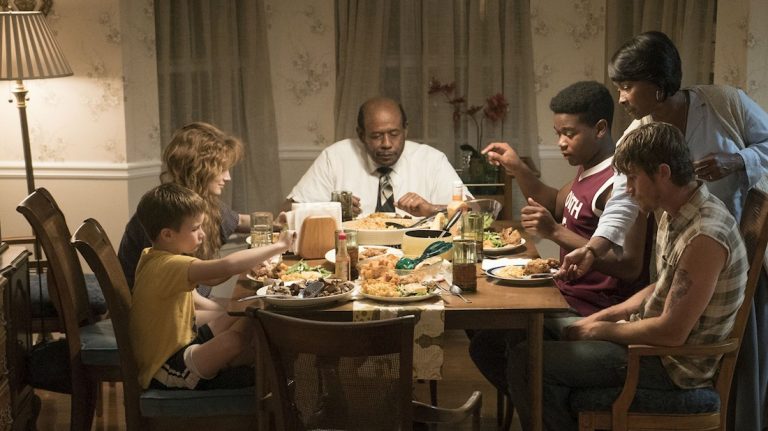
Judy, a young, white, single mother who wagers on loving Mike in spite of his racist ties, eventually gives him an ultimatum: Choose between her or the white nationalist family who adopted him as an orphan. In response to his girlfriend’s prompting, Mike chooses to leave the Klan. Shortly thereafter, the Rev. David Kennedy (Forest Whitaker)—who had been organizing and leading peaceful protests of the KKK museum—discovers that the Klan has driven Mike, Judy, and her young son to homelessness and hunger. In what can only be described as a radical and daring act of love, Kennedy is filled with compassion for their plight and invites them all to live in his home.

By telling the story of a hate-filled white nationalist and the African American reverend who chose to love him, Burden bears witness to the gospel writ large. It’s the kind of good news that traffics not in power or privilege, but in something that looks a whole lot like weakness and vulnerability. Indeed, some might even call Kennedy’s actions toward Mike Burden utter “foolishness” (1 Cor. 1:25). After all, what husband, father, or pastor in his right mind would allow a member of the KKK with a history of violently assaulting people of color to live in his home, eat with his family, and sleep in his son’s bed?

Yet, in more ways than one, Kennedy is simply doing what Jesus told his disciples to do:

Love your enemies, do good to those who hate you, bless those who curse you, pray for those who mistreat you. If someone slaps you on one cheek, turn to them the other also. If someone takes your coat, do not withhold your shirt from them. Give to everyone who asks you, and if anyone takes what belongs to you, do not demand it back. Do to others as you would have them do to you. (Luke 6:27–35)

It’s all fairly straightforward and simple. But that doesn’t make it any easier. In real life, Kennedy’s decision to provide food and shelter for a KKK member was not condoned by everyone within the African American community in Laurens, and the relational fallout the reverend experienced by caring for Mike Burden continues to this day.

Likewise, in the film, Kennedy struggles to convince members of his own family that what he is doing is right or even necessary, much less something that Jesus would ask of him. Frustrated and bewildered by the sudden appearance of a Klan member in her home, Janice Kennedy (Crystal Fox) offers a brutally honest assessment of her husband’s actions: “I share your faith in God, but I don’t share your faith in man.”

It is hard to have faith in humanity when there is so much evidence suggesting that we shouldn’t. For instance, after a recent Reel Spirituality screening of Burden, Andrew Heckler, the film’s director, shared a particular anecdote that was as sobering as it was unsettling. According to Heckler, during the movie’s filming in 2016, numerous strangers would daily appear on the set of Burden to check out the neo-Nazi merchandise store that had been created as part of the film’s set. These interested shoppers weren’t curious to learn more about the inner workings of film production. They came because they thought it was a functioning retail store and were hoping to purchase KKK memorabilia.

Stories like these reinforce the fact that the primary reason Burden is a challenging movie is because it is about current events. It isn’t a film about slavery in the 18th and 19th centuries, or the civil rights movements of the mid-20th century—rather, the film takes place in 1996. As both Burden and the story upon which it is based make painfully clear, it’s one thing to accept that America has a racist past. It’s quite another to acknowledge our racist present.

Before it is anything else, Burden is a film about the here and now. As such, it lays bare the dark heart of contemporary racism in America and asks us not to look away, even when our first instinct may be to flinch.

Source: Christianity Today

All Content & Images are provided by the acknowledged source

Legal Confusion in Sri Lanka Fans Flame of Buddhist Nationalist Hostilities, Sources Say

Legal Confusion in Sri Lanka Fans Flame of Buddhist Nationalist Hostilities, Sources Say


HYDERABAD, India, March 18, 2020 (Morning Star News) – Buddhist nationalists in Sri Lanka are disrupting Christian worship based on mistaken notions that churches need prior permission for services, sources said.

There is no law requiring registration of worship places in Sri Lanka, but in 2017 the country’s Supreme Court upheld a 2008 circular demanding all newly constructed places of worship obtain prior approval. That circular, issued by the Ministry of Buddha Sasana and Religion Affairs, exempts “traditional religions” but does not define them, leaving local authorities to discriminate against non-Buddhist faiths and block their right to worship, U.N. Special Rapporteur on Freedom of Religion or Belief Ahmed Shaheed wrote in a Feb. 28 report.

“Evangelical Christian churches in particular continue to report pressure and harassment by local authorities to close down places of worship because they were not registered,” Shaheed reported. “Their prayer meetings and worship activities are also routinely denied permission to take place. Moreover, intimidation and attacks against clergy and church members, desecration of evangelical churches and interference with religious activities are also perpetrated by local villagers and Buddhist monks.”

Sri Lanka’s religion ministry subsequently ruled that the circular on registration and construction of religious…

… Read More

Click here to read the rest of the story from our content source/partners – Christian Headlines.

قالب وردپرس

China Spins Corornavirus, Blames US and Seeks to Use It as Economic Weapon

After badly bungling and then covering up its handling of the coronavirus outbreak, China is now in full spin control mode, blaming the United States and trying to take advantage of this global epidemic.  

At his press briefing Wednesday, President Trump again called coronavirus “the Chinese virus,” in response to the latest moves by China. “I would like to begin by announcing some important developments in our war against the Chinese virus,” Trump said.

And while he is being criticized for it, China knew about the existence of coronavirus as early as last November, but the communist regime stopped Chinese labs from testing for it and even threatened health care workers like the late Dr. Li Wenliang, who tried to warn the outside world, and later died from the virus.

By January, China’s Center for Disease Control and Prevention declared on state television that the risk of transmission was low, and the government was arresting citizens who were trying to sound the alarm. Then with the coronavirus outbreak in full swing, Chinese officials allowed a lunar new year banquet to go ahead in Wuhan province – the epicenter of the pandemic – with tens of thousands of people sharing food dishes; then let millions travel out of Wuhan and China, spreading the disease across the world. 

There was no quarantine in Wuhan until a week before February.  

“The Chinese are directly responsible for all we are confronting right now,” says Frank Gaffney, executive chairman of the Center for Security Policy, “for having both precipitating this, for having taken actions that have made this worse, and now for lying about the fact that it was anybody other than them that was responsible.”

Beijing is now trying to rewrite the narrative of how coronavirus started. A Chinese foreign ministry spokesman suggested in a tweet last week that visiting American soldiers brought the coronavirus to China. 

And a new report by the open source intelligence organization Horizon Advisory says China intends to profit from the chaos it has sown into the world economy. Nate Picarsic of Horizon Advisory says a post-virus economic strategy by Chinese leaders is already underway. 

“It’s clear that there are thinkers in China who see this as an opportunity,” Picarsic says. “Having gone through this crisis already, they’re thinking about where there are opportunities to get an unfair advantage, vis-à-vis global competitors.” 

With western economies still in free fall, the Horizon report says Chinese leaders see a chance to replace the US as the top economic power and control the world economy. 

And in the blame game, China has doubled down. 

It’s now kicking out American journalists. And a Chinese tycoon who called Chinese President Xi a “clown” for making the coronavirus a pandemic through his ineptitude, has disappeared. 


Source CBN

All Content & Images are provided by the acknowledged source