


Kristen Waggoner on Weighing a Floral Designer’s Dignity and Freedom Against State Coercion

Kristen Waggoner is senior vice president of U.S. legal division for Alliance Defending Freedom. She argued Masterpiece Cakeshop at the U.S. Supreme Court and Arlene’s Flowers at the Washington Supreme Court. Follow Kristen on Twitter @KWaggonerADF or follow ADF @AllianceDefends.

America is a byword for freedom: freedom of speech, religion, assembly, the press. And because of those freedoms, we have traditionally enjoyed one of the world’s most diverse and tolerant societies. People of different views, faiths and persuasions are friends and neighbors who live together in peace. This is thanks in large part to the First Amendment, the genius of which is respect for each person’s human dignity.

Power over things like expression and religious views is limited to persuasion, and that forces all of us to think critically, defend our ideas and consider others’ perspectives — even those we think are terribly wrong.

But American culture has been shifting. Changing hearts and minds can be difficult. Activists are turning to brute force instead. So it should come as no surprise that the First Amendment cases on the Supreme Court’s docket of late boil down to whether the government can force its views on citizens.

High court cases that have made headlines recently have concerned forcing devout employers to provide drugs capable of ending human life (Hobby Lobby, Little Sisters of the Poor, March for Life), shutting out parents if they work through foster agencies that recognize marriage is between one man and one woman (Fulton), or punishing a cake artist who declines to create certain custom messages or participate in sacred events that violate his religious beliefs (Masterpiece Cakeshop). In each of these, the same question arises: Must the state treat differing beliefs, consciences and views respectfully and with equal dignity?

If our freedoms and pluralistic society are to survive, there can be only one answer: We must stop treating those with whom we disagree like enemies and allow every voice to be heard.

America is a nation where everyone should be free to speak their minds and honor their deepest convictions without fear of government punishment or retribution. Otherwise, we are no better than countless nations whose dissidents have fled to our shores for these very freedoms.

We have forgotten this lesson before. As the Nazis were about to overrun France, a case involving two Jehovah’s Witness schoolchildren reached the Supreme Court. Lillian and William Gobitas (misspelled Gobitis in official documents) refused to salute the American flag or recite the Pledge of Allegiance. They took a strict view of the Ten Commandments and refused to take an oath to anything but God.

Their neighbors did not understand and ejected them from the public schools. The Supreme Court ruled 8-1 against the children, and afterward, Jehovah’s Witnesses faced intense backlash from coast to coast: Their halls were looted and burned, whole families were run out of town. Law enforcement for the most part did nothing, thinking that the Supreme Court had declared them traitors.

Today’s cases look different, but the dangers they invite are the same. Consider Arlene’s Flowers v. Washington, which awaits a decision as to whether it will be heard by the Supreme Court.

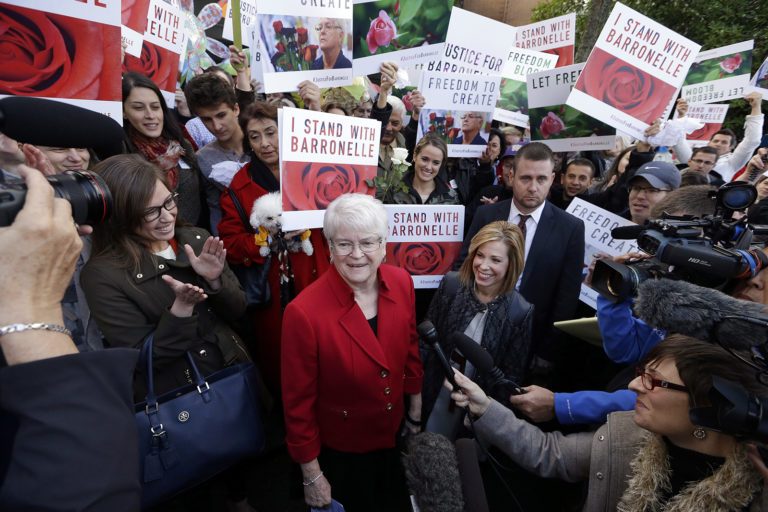
Barronelle Stutzman is a floral design artist who loves and serves everyone at her small shop in Richland, Washington. For nearly 10 years, she developed a lasting friendship with Robert Ingersoll and created dozens of innovative floral arrangements celebrating major events in his life, including Valentine’s Day and anniversary gifts for his partner, Curt Freed.

But when the couple decided to marry, Barronelle was faced with a difficult choice: betray her religious convictions or disappoint a friend. Barronelle took her friend Robert aside, told him how much she loved him and explained that she could not create custom arrangements for, or participate in, the ceremony. She referred him to three floral design studios nearby.

Barronelle’s compassionate response is exactly what our society needs right now. But government officials are often more interested in shaming those with whom they disagree than respecting their freedom.

Washington state’s attorney general filed a one-of-a-kind lawsuit, bringing a consumer protection complaint instead of leaving the matter to the Washington Human Rights Commission and waiting for someone to file a complaint, as is usually done. The attorney general has also threatened not only Barronelle’s business, but, in a highly unusual move, has joined the ACLU in suing her personally as well.

The AG admits that Barronelle creates expression for a living but argues that the state can force her to create certain messages or even require poets to write odes consistent with the government’s marriage views. Barronelle has spent nearly seven years in litigation and as the object of public derision and death threats, all because she couldn’t speak a message or participate in a wedding ceremony her faith disbelieves.

Unless the Supreme Court steps in, people of good faith, like Barronelle, will lose not just their livelihoods and personal assets but will become pariahs, just like the Jehovah’s Witnesses who came before.

The court has not shied from righting such wrongs in the past. In Barnette, it eventually overruled its own decision against the Gobitas children, declaring that “no official, high or petty, can prescribe what shall be orthodox in politics, nationalism, religion, or other matters of opinion or force citizens to confess by word or act their faith therein.”

Freedom demands such limits. The Supreme Court should affirm that Barronelle’s religious view of marriage is honorable and that the government cannot punish her for her beliefs.

The alternative is that government bureaucrats will continue their relentless attacks on beliefs held as much by Muslims and Jews as by Christians. Freedoms are not a liberal or conservative issue. The government that supports your beliefs today may take the opposite position tomorrow based on public pressure or an election. If we want freedom of speech and religion for ourselves, we must extend those freedoms to all people, even those with whom we disagree. A win for Barronelle is a victory for all of us.

Merely enforcing the First Amendment’s free speech and free exercise guarantees does not “weaponize” them or pose a threat to civil society, as one recent commentator claimed. Quite the opposite: Protecting these freedoms is what has allowed our country to grow and flourish. The sooner the courts act to stop government officials from bullying those with whom they disagree, the sooner we can bring an end to cancel culture and the discord, mistrust and division it sows. If we want to see our diverse society survive, it is time to stop drawing lines between us.

Source: Religion News Service

All Content & Images are provided by the acknowledged source

Thomas Reese on Spirituality in a Time of Quarantine

The Rev. Thomas J. Reese, a Jesuit priest, is a Senior Analyst at RNS. Previously he was a columnist at the National Catholic Reporter (2015-17) and an associate editor (1978-85) and editor in chief (1998-2005) at America magazine.

Churches around the world have had to cancel Sunday services because of the coronavirus. In the Vatican, services for Holy Week, the most sacred time of the liturgical year, will exclude the faithful.

The cancelling of church and sporting events has convinced most Americans that something significant is happening; after all, there is nothing more sacred to Americans than religion and sports.

The decision to cancel church gatherings was not easy, but it was correct. Religious leaders who don’t follow the advice of public health officials are being reckless and immoral by putting their congregants and others at risk.

We know that COVID-19 is usually passed through human contact (handshakes and touching), through droplets in the air (sneezes and coughs) or contact with infected surfaces (doors, pews, hymnals). This is not the time to get scrupulous about Sunday obligations or to worry about Sunday collections.

What would Jesus do? Jesus would tell you to stay home for your own good and the good of your neighbor.

But is that it? As Christians, we know that spirituality is not just about avoiding evil. It is also about doing good. Every crisis is an opportunity to do good. Here are some suggestions about what individuals, families, neighbors and parishes can do during this quarantine.

We may not have church services and the Eucharist, but we still have the Scriptures. Catholics can find the daily Scripture readings at USCCB.org in both written and audio form. They are also available through podcasts and apps on your smartphone or Amazon Echo.

Quarantine provides us with an opportunity to spend time with the Scriptures both as individuals and as a family. There are at least two ways of praying the Scriptures.

First there is meditation, in which you ask, what is the Scripture passage telling me? What does it tell me about God? What does it tell me about how to live my life? The second is contemplation, in which you use your imagination to put yourself into the story. Become a participant.

Ultimately, either method should lead to prayer, which is talking with God.

As Catholics of my age learned from the Baltimore Catechism, the different ways of praying can be summarized through the acronym “ACTS.” Prayer can be Adoration (God, you are awesome), Contrition (sorry, God), Thanksgiving (thank you, God) and Supplication (please, God). Many people get stuck in prayers of contrition and supplication and forget about thanksgiving and adoration.

This illustration provided by the federal Centers for
Disease Control and Prevention in January 2020 shows
the 2019 novel coronavirus (2019-nCoV). Image
courtesy of CDC

Reflection and prayer on the Scriptures can be done not only individually, but also as a family or in a virtual community. Parishes should establish virtual communities through Facebook or other social media where the community can share their reflections on the Scriptures.

But Christians are known not only for their piety but for their charity. How can you perform charity in a time of social distancing?

Parishes should use email contact lists to find those who need help shopping or with other tasks because they are elderly or otherwise at risk of infection. Parishes can become centers for networking.

But Christians do not just take care of their own; they are also called to look out for their neighbors. Every apartment building and neighborhood is a decentralized warehouse. In kindergarten we were taught the importance of sharing. Can we do that now? Rather than hoarding as individuals, can we as a community look out for one another?

Can we pitch in to sanitize our work environment and public spaces? For example, if you have a supply of Clorox, use some of it (one-part Clorox to 10-parts water) to disinfect the public surfaces in your workplace or apartment building (doorknobs, elevator buttons, handrails, etc.).

I am doing that in my house where I live with 16 Jesuits — mostly elderly at-risk men. I fear that if anyone in my house gets the virus, we will all get it. That is a risk of community life, as it is a risk of family life.

Even more at risk are those in homeless shelters or on the streets.

I host a “Friday night movie” at our community, and last Friday it was the 2011 movie “Contagion.” The virus in the movie was more deadly than COVID-19, but it did have a happy ending.

What bothered me most about the movie was how it predicted many of the things happening today. Nine years later, our country is still not prepared to deal with COVID-19. Scientists and experts have been predicting a pandemic for years, but the public and government officials prefer to ignore the science just as we are also ignoring the science of climate change.

It is easy for crackpots and charlatans to denigrate experts and scientists, but we listen to such fools to our peril. It is time to put the common good over our personal good; it is time to respect science not partisan spin masters; it is time to be our better selves.

[Update: Father Reese has learned that a member of his community has tested positive for COVID-19. Tom, who has no symptoms, is in self-imposed quarantine and will provide more information in his next column.]

Source: Religion News Service

All Content & Images are provided by the acknowledged source
Musical artists find new venue to sing: their living rooms

The spreading coronavirus canceled several touring performances from A-list musical artists, but those acts have found a new venue to sing: their living rooms.

John Legend, Bono, Coldplay’s Chris Martin, Pink, John Mayer, Keith Urban and more have held virtual concerts from their homes as the world continues to practice social distancing to slow the spread of the virus.

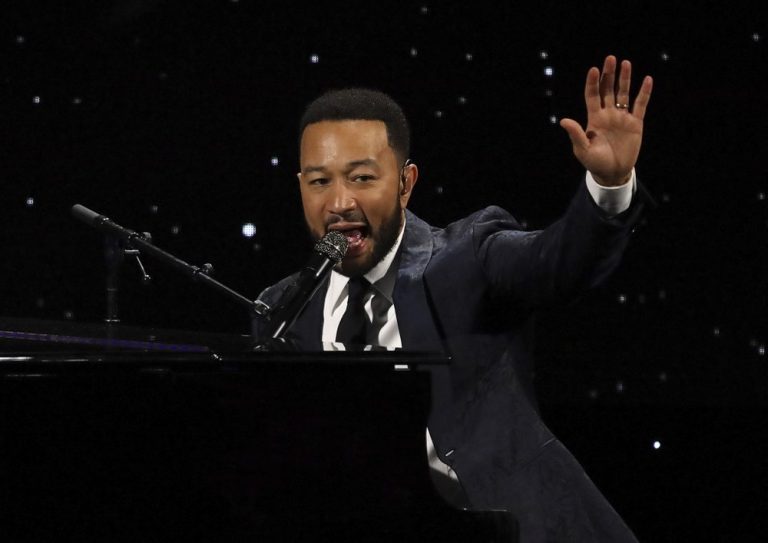
“I mean, we don’t normally do concerts live from our house in a robe,” Legend told The Associated Press late Tuesday, hours after performing a nearly hour-long concert which streamed on Facebook and Instagram Live. “This is a cool way to connect with people and make them feel some kind of love and intimacy and connection, even though they have to be stuck at home.”

“So many people are dealing with a lot of stress right now, trauma, anxiety, all those things. And they don’t know what to do. And a lot of musicians and artists and entertainers are unable to go out and do the thing that we do best, which is perform live at venues with lots of people,” he added. “So we’re trying to find ways to stay in touch with people and give them some love.”

The piano-playing superstar took requests from fans as he crooned from his living room like he does at one of his typical live concerts. Legend’s performance was in support of the World Health Organization’s newly-launched online concert series “Together at Home,” created in efforts to fight the coronavirus, which causes only mild or moderate symptoms such as fever and cough for most people but can be severe in some cases, especially older adults and people with existing health problems. People with mild illness recover in about two weeks, while those with more severe illness may need six weeks to recover.


Others have found creative ways to communicate with their fans, some homebound because of school closings and others working from home.

Miley Cyrus launched a daily Instagram live talk show called “Bright Minded: Live with Miley” (2:30 p.m. Eastern) to offer viewers some positivity and comfort. Tuesday’s show featured singer-actress Demi Lovato and Wednesday’s program will include Amy Schumer and her husband, Chris Fischer, as well as Lauren Speed and Cameron Hamilton from the popular Netflix reality series, “Love Is Blind.”

Rolling Stone magazine, which closed its offices like many companies to prevent the virus from spreading, will launch the new IGTV performance series “In My Room” on Wednesday at 3 p.m. Eastern. It will feature Brian Wilson of the Beach Boys performing “In My Room” as well as other classic songs; episodes will be released every Monday, Wednesday and Friday.

Brandon Flowers of The Killers tweeted a video of him washing his hands while singing the band’s signature hit, “Mr. Brightside,” while Lin-Manuel Miranda tweeted a live video of him performing an unreleased “Hamilton” song. And a tweet from Netflix editorial manager Jasmyn Lawson on Monday led to a virtual watch party for Beyoncé’s epic “HOMECOMING” documentary, to take place Wednesday.

“We’ve never been in this type of space before, and it’s really incredible to see artists coming together to figure out ways that they can bring joy and comfort and happiness to their fans given this crazy time that we’re living in at the moment,” said Kevin O’Donnell, Twitter’s head of music partnerships. “I think the creativity is just going to even ramp up even more.”

Former One Direction singer Niall Horan, Death Cab for Cutie’s Ben Gibbard, Rob Thomas, JoJo, Christine and the Queens, Yungblud, David Foster and Katharine McPhee have also joined the music community by livestreaming directly to fans. Neil Young is even planning to jump on board.

Former “Glee” actor and singer Chord Overstreet launched a live performance series on YouTube appropriately called “Quarantine Sessions” this week, while OneRepublic isn’t only performing, they’re offering cooking lessons on social media. And some acts are even performing from venues: Grammy-nominated rock band Code Orange livestreamed their performance to an empty Roxian Theatre in Pittsburgh via Twitch this weekend.

Other acts stuck indoors are finding ways to promote new albums or make up for canceled and postponed shows.

The canceled Luck Reunion festival, annually held in Willie Nelson’s backyard, will now go Thursday (7 p.m. Eastern) as a free broadcast featuring call-in sets filmed live by artists themselves from their own homes. Performers include Lukas Nelson, Jewel, Nathaniel Rateliff, Margo Price and more.

Latin superstars Juanes and Alejandro Sanz, whose concerts were postponed because of the virus, joined forces for a special streaming jam session in Miami this weekend, while Broadway stars are putting on twice-a-day concerts called “Stars in the House.” And alternative rock-pop band Grouplove and singer-songwriter Caitlyn Smith, who both released albums Friday and had tour plans in support of the albums scraped, are livestreaming performances.

The rock trio X Ambassadors have been bouncing around the world as several of their concert dates were canceled due to the virus. First was China. Then Milan. And while setting up in Poland for a performance, they were told to shut down. They made it home to Los Angeles on Thursday as President Donald Trump announced a travel ban.

Sam Nelson Harris of the band said the experience was traumatic, stressful and chaotic. And as he settles in, he’s hoping to give his fans a cool experience from home.

“I’m pretty conservative when it comes to my use of Instagram and I haven’t posted a single TikTok video, but I got all this time now to really figure out how to interact with it in a way that’s genuine for me. And because I really do want to reach out to our fans and to people who have not been able to come see us because of cancellations that we had to make during the pandemic,” said Harris, who has posted live performances from home on Instagram this week.

X Ambassadors have hit the Top 20 of the pop charts with “Unsteady,” “Renegades” and “Sucker for Pain” and the group — which includes drummer Adam Levin and Harris’ brother, keyboardist Casey Harris — have produced multiple songs on Lizzo’s Grammy-winning album “Cuz I Love You.”

“I have enough here at my house that I could do something on my own from scratch,” Harris said of making music from his home. “And what I’m actively doing right now is reaching out to other producers and songwriters and trying to get people to be sending stuff back and forth. I know a lot of musicians who are out of work right now, and who will be out of work for a while, so I want to try and get people involved with making music together, even though we can’t actually be there together in person.”

Legend, who has been working on new music, may still release the songs this spring while folks are homebound.

“I have a bunch of new music that’s already almost done. We just have to mix it, which won’t require a lot of group contact. So, I think we can get a lot of that out to people sooner rather than later,” he said.

“We have to decide as a music community if we’re going to let the fact that we can’t go out and physically promote it stop us from putting it out. And I tend to think we should put stuff out.”

Legend is also in the middle of figuring out if his U.S. tour, which is expected to launch in August, will still go on.

The Emmy, Grammy, Oscar and Tony winner compared current times to a film when aliens attack and “the whole earth comes together.”

“This is one of those things that all of us are facing as a global community. And it doesn’t discriminate based on what nation we live in or what race we are. And we have to come together as a community and do what we need to do to help each other get through it,” he said.

______

All Content & Images are provided by the acknowledged source
Congregations Improvise Ways to Fight COVID-19’s Isolation

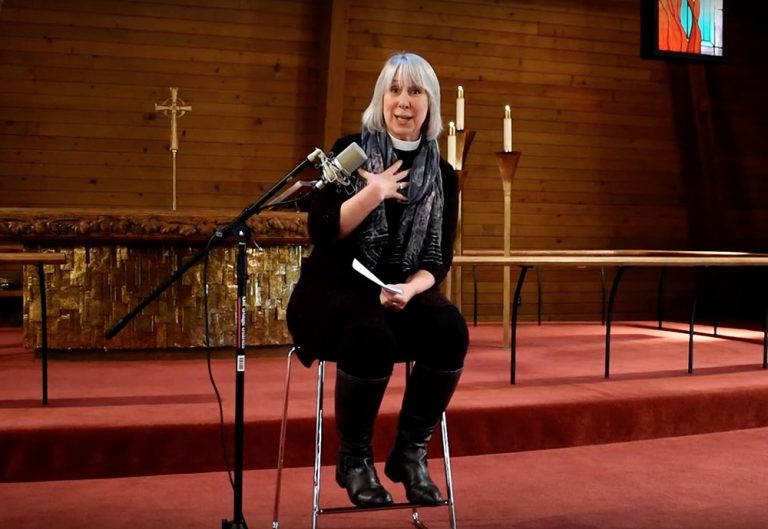
PULLMAN, Wash. (RNS) — On a normal Sunday, most of the 100 people filling the pews of the Rev. Lori Cornell’s congregation fit the Centers for Disease Control and Prevention’s description of those at high risk for COVID-19.

So like the majority of churches in the greater Seattle area, Calvary Lutheran Church of Federal Way has suspended its worship services and is turning to technology not only for its weekly celebration of the Eucharist, but for all the pastoral and social contact an aging congregation depends on church for.

But with social distancing and electronic connections come challenges. Cornell is worried older members of her church may become lonesome.

“They have the potential to feel more isolated than ever, so we’re trying to be really mindful of that,” Cornell said. “My concern is for people whose lives very much count on the church and who find themselves often dependent on other people to get them places they need to go, like Bible study, church and other events.”

Her church’s leadership is using Facebook as a way to stay connected, with plans to post homespun sacred music created by church musicians, and leading video chats throughout the week.

For those not technically savvy, the phone has become an important tool, Cornell said.

The Rev. Mike Denton, conference minister of the Pacific Northwest Conference of the United Church of Christ, said the phone tree is being rekindled in his region’s UCC churches too.

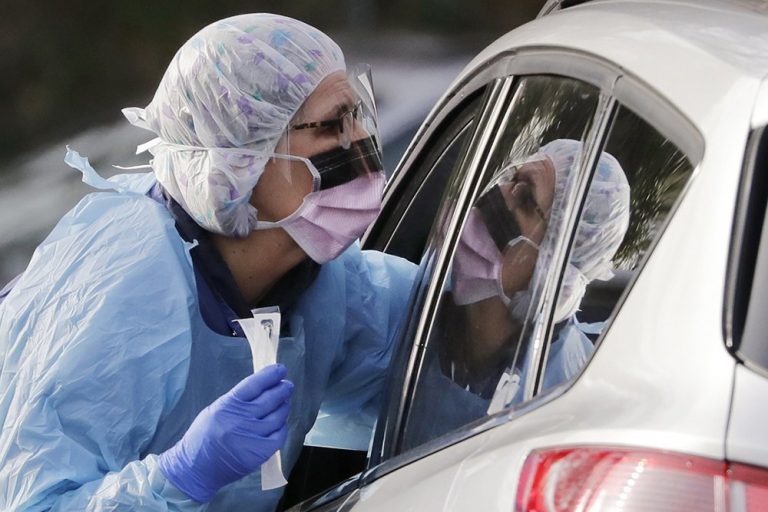
Laurie Kuypers, a registered nurse, reaches into a car to take a nasopharyngeal swab from a patient at a drive-through COVID-19 coronavirus testing station for University of Washington Medicine patients, on March 17, 2020, in Seattle. The appointment-only drive-through clinic began a day earlier.  (AP Photo/Elaine Thompson)

Because some elderly churchgoers have trouble hearing over the phone, handwritten letters are also being sent to those who are homebound.

“We want to be able to keep folks safe and we don’t want to be a carrier,” Denton said. “So it’s something we’re running into. We don’t know how to move beyond it yet.”

At Kavana, an independent Jewish cooperative in Seattle, Rabbi Rachel Nussbaum said her congregation is tech-savvy, to judge from last week’s Purim services. Celebrating over the video app Zoom, Nussbaum was joined by some 70 households, in costume on their sofas. “That was more, maybe, than we would have had in person,” she said.

Additionally, she said every member of the congregation is in touch with congregational leadership via email for personal check-ins.

“We’re starting with older members and people we suspect are isolated,” Nussbaum said.

Rabbi Rachel Nussbaum. Courtesy photo

She added that Kavana is continuing to explore other ways to foster closeness, including care package drop-offs, phone calls and letter-writing.

As students are forced to stay home from school, she said, this may be an area where they can volunteer.

Bishop Greg Rickel of the Episcopal Diocese of Olympia said priests are asked to use their own judgment when ministering to the sick or elderly.

“I have a retired priest in isolation right now fighting pretty hard for their health and I’m speaking to them by phone every day,” Rickel said. “So we’re having to do some of this remotely.”

But finding ways to be in community during this time is key, he said.

“Desmond Tutu said the idea of a solitary Christian is an oxymoron. Christianity is communal by its nature,” Rickel said. “For these days what I’m trying to impart to our people is that being communal is to isolate; to keep self away is the communal thing to do.”

At First Church Seattle, the congregational care team is working with vulnerable church members to find the best way to connect digitally. The Rev. Jeremy Smith said the care team is planning to create a hotline so homebound members who aren’t as tech-savvy can call in and listen to services.

The congregation has also been broken into small groups, which are meeting regularly via preferred medium — email, video chat or phone call.

“I have a 70-year-old in a group with a pair of 30-year-olds,” Smith said. “The founder of the United Methodist Church, John Wesley, put people into these types of small groups to check in with each other every week and pray for each other, and guide them toward Christian living, and I think in this digital age with this sort of hands-off — literally — way of living, I think it’s helping people connect with each other and can help sustain even those who are homebound.”

Smith said the church is still trying to figure out how to best care, physically and spiritually, for all members, but especially those who live in a care facility or in Seattle hospitals, which aren’t allowing visitors.

“This is not how things will be going forward. This is a season we’re going through, and when we emerge on other side, we’ll be ecstatic to see each other and high-five each other again, but until then have to find ways to sustain each other and to keep care for each other,” Smith said.

Source: Religion News Service

All Content & Images are provided by the acknowledged source
United Methodist Church Postpones General Conference Amid Coronavirus

The United Methodist Church has postponed its 2020 General Conference — where delegates were expected to take up legislation to split the denomination — over concerns about the spread of COVID-19, what’s commonly referred to as the coronavirus.

The quadrennial meeting of the denomination’s decision-making body was set to gather 862 delegates and other United Methodists from all over the world May 5-15 in Minneapolis.

Officials at the Minneapolis Convention Center informed the Executive Committee of the Commission on the General Conference that it was restricting all events at the venue through May 10.

That led to the announcement Wednesday (March 18) that the General Conference will be postponed.

Church leaders were already planning to meet Saturday (March 21) via teleconference to discuss plans for the General Conference.

It’s unclear how soon the denomination will be able to announce new dates for the meeting.

“This news is not unexpected based on the current guidance from health officials and we expect to move forward with new plans as quickly as possible,” Kim Simpson, chair of the Commission on the General Conference, said in a written statement.

Only the full Commission on General Conference is able to set a new date or alternate plan, according to the statement.

Delegates attend the first day of deliberations at the special session of the United Methodist Church General Conference in St. Louis on Feb. 24, 2019. RNS photo by Kit Doyle

The postponement follows recommendations from bishops and from the federal Centers for Disease Control and Prevention.

On Friday, United Methodist bishops had asked the Commission on General Conference to postpone the meeting.

“We write out of a deep love for our global church and as a tangible way of giving spiritual and temporal oversight in our role as shepherds and we are guided by the core value of helping delegates to do their best work,” wrote the Executive Committee of the Council of Bishops in a letter signed by the Council of Bishops’ current president, the Rev. Kenneth H. Carter, and incoming president, Cynthia Fierro Harvey.

The bishops’ letter noted the “grave risk” of spreading the virus amid international travel and such a large gathering of people.

It also pointed out that international travel restrictions to the U.S. would make it difficult for delegates from Central Conference outside the U.S. to enter the country.

“We note the damage such a General Conference would do to the trust level if matters of great and lasting importance are voted upon. We are guided here by the core value of justice,” it said.

The CDC has also recommended organizers cancel or postpone all large group meetings for at least eight weeks.

Events of any size only should continue following the guidelines previously issued by the CDC for protecting vulnerable populations, practicing good “hand hygiene” and social distancing, it said.

“This recommendation is made in an attempt to reduce introduction of the virus into new communities and to slow the spread of infection in communities already affected by the virus,” according to the CDC.

Delegates to the General Conference were expected to take up a proposal to split the denomination called “A Protocol of Reconciliation and Grace Through Separation.” The proposal, negotiated by 16 United Methodist bishops and advocacy group leaders from across theological divides, would create a new conservative “traditionalist” Methodist denomination that would receive $25 million over the next four years.

The protocol was announced in January, and three regional United Methodist annual conferences approved measures to send the protocol to the General Conference for a vote.

Bishops then asked the denomination’s top court to decide whether the proposed legislation implementing the protocol is constitutional.

Calls to split one of the largest denominations in the United States have grown since last year’s special session of the United Methodist General Conference approved the so-called Traditional Plan strengthening the church’s bans on the ordination and marriage of LGBTQ United Methodists.

Source: Religion News Service

All Content & Images are provided by the acknowledged source
Coronavirus Pandemic May Disrupt Major Religious Holidays Such as Easter and Passover

For many faith groups, spring is one of the most important times of the year.

Early spring coincides with at least three major religious holidays — Easter, Passover and, this year, the beginning of Ramadan.

All three — or at least public events surrounding them — could be disrupted by the outbreak of the COVID-19 virus. Over the weekend, the federal Centers for Disease Control and Prevention asked Americans to cancel or reschedule any meeting of more than 50 people. President Donald Trump asked Americans on Monday (March 16) to further limit gatherings, to no more than 10 people.

Data from the National Congregations Study shows that would include 60 percent of houses of worship — and 90 percent of all people who attend worship services.

The Rev. Laura Everett. Courtesy photo

We asked religious leaders for their thoughts on what happens if these central holidays are canceled.

Here’s what they told us:

Easter cannot be canceled. We may not gather in the same way, but Easter will not cease. The Resurrection continues. I think churches are wisely considering how to best keep people safe, and that may include not gathering in person on Easter Sunday.

On Passover, we ask the question: “Why is this night different from all other nights?” This year the answer is self-evident. We will celebrate on that night amidst a world devastated — physically and psychologically — by a pandemic.

Does Passover have a message for these trying times? Yes. In addition to the Ten Plagues and the miracles of the splitting of the Sea, what saved the Jewish people in Egypt was their unity. They did not despair when Pharaoh refused to Moses’s initial pleas. They did not despair when their enslavement grew more onerous. They listened to God and to one another. They never lose hope.

Neither can we.

The writer Alice Walker said hard times require some serious dancing. While we should not dance too closely right now, may our spirits and souls of hope sustain us.

Easter is an important marker in church life in which we remember and celebrate Jesus Christ’s resurrection. It would, of course, be incredibly disappointing not to celebrate that as we are accustomed to, but we are also reminded during this season how Jesus served us and how we are to serve others.

The Rev. Walter Kim speaks during his inauguration as the new president of the National Association of Evangelicals at the Capital Turnaround venue in Washington on March 4, 2020. RNS photo by Adelle M. Banks

The church can rise and shine in these times. The church can be creative in the ways we’re in contact with one another. We can offer worship on virtual platforms. We can help older people in various ways. There are lots of ways the church can engage in mission, not unlike what happens after a hurricane or tornado or some other unexpected and unprecedented occurrence in a community. It calls for generosity in new ways and connections in new ways. Suspending worship for two weeks is not suspending ministry. In fact, it’s inviting ministry in new and proactive ways and creative ways.

Given CDC recommendations, Easter — Resurrection Sunday — may preclude churches from being able to gather corporately.

However, it provides an opportunity to remind believers that the true church was never about buildings and sanctuaries. The true church remains unified by the Resurrection message of victory, triumph and hope over death, hell and the grave.

Omar Suleiman. Courtesy photo

That message remains unchanged and is needed today now more than ever. May this crisis challenge the Church to explore new and innovative ways to exalt Christ over Corona by any means necessary!

I’m planning to do my weekly sermon virtually (which had over 200k views this week between Facebook and Instagram), a daily series summarizing one chapter of the Quran every day in Ramadan (30 chapters in 30 days), and several other fireside chats.

The key is comfort and enabling people to recognize the unique opportunities for good in these times of isolation and desperation.

I think it’s important for us to realize that yeah, we need to take wise precautions and we’ve got to keep people safe and think prudently. But we also know that historically, biblically, in a time of crisis, the body of Christ runs toward tragedy, not from it. We don’t retreat back in fear; we go forward in faith. This is a unique opportunity for us to be able to demonstrate the love and generosity of Christ.

I would encourage you to check out what’s happening in your community.  Maybe just walk down the street and see those who are particularly vulnerable. There are opportunities for us to serve.

J.D. Greear prays in a recent video that he made with his son outside a grocery store in North Carolina. Video screengrab via The Summit Church

I will admit that we are in the very beginning of brainstorming about how to celebrate Easter when we are unable to physically gather together. And yet, it feels like we have an opportunity to really focus on what Easter is all about — life coming out of death; God’s best work being done in the dark when no one knows it is happening. We will certainly miss all of the celebration, the trumpets, the energy in the sanctuary, etc. But regardless if we are together in person or not, Easter happens.

No matter what, Easter always rises. And so we will celebrate God’s ability to make a way out of no way and hold on to that promise with our fingernails. We are Easter people and a pandemic does not change that truth.

This past Sunday, March 15, a few of my staff and some of our musicians gathered in our Manhattan sanctuary to broadcast worship, live, at 11:15 a.m. We won’t gather again for at least 8 weeks, as we seek to follow CDC guidelines regarding COVID-19 social distancing.

I can tell you God is in the suffering, in the healing, in the praying, in the living, and in the dying. God is in the worry, as in the whirlwind and whisper. … God is also in the incarcerated man, making hand sanitizer for $.86 an hour and in the woman hoarding sanitizer in her garage. God is in a cage on the border, and in the cruel person pouring water out so folks can’t drink it. God is in the governor shutting it down and in POTUS pretending it’s going to be OK. (That one is super hard for me to write.) There is some little bit of the Divine in each of us, hungry, thirsty for clean water, living on the streets or in a Penthouse. If we could feel the horrible power of that — each one a little like God — we’d also feel the truth of the Ubuntu philosophy: I am who I am because we are who we are. Your survival and mine are linked. When you are standing right in front of me (or behind me in line in the grocery store, or on a Zoom conference call) God is right there. In you and in me. We are inextricably connected in a web of humanity, is the way Dr. King described it. We can survive this virus, as a people, as a species, with that in mind.

As people of faith, we certainly grieve the loss of routine in our lives and in our churches, but the church calendar is an expression of our faith in a spiritual reality. It is not the spiritual reality itself. Easter represents our belief that there is a truth that illness, fear, pandemic, economic distress and even death cannot touch. That truth is God’s incredible love for us.

Once a year, we come together on Easter Sunday to celebrate that reality in all its fullness with trumpets, flowers, baskets, brunches, and words of great joy. This year, we most likely won’t be able to celebrate that love with those symbolic expressions on the designated day, but our faith in God’s love abides.

We will be relying on it in the days ahead and trusting that there will be a day when we can join together as a community in person again. The first thing we will celebrate is the power of God’s love, the power of love over pandemic and death.

That day, whenever it comes, will be Easter Sunday!

Adelle M. Banks, Yonat Shimron, Emily McFarlan Miller and Bob Smietana contributed to this report.

Source: Religion News Service

All Content & Images are provided by the acknowledged source
Samaritan’s Purse Donates Entire Field Hospital to Italy as Religious Groups Weigh Response to Coronavirus

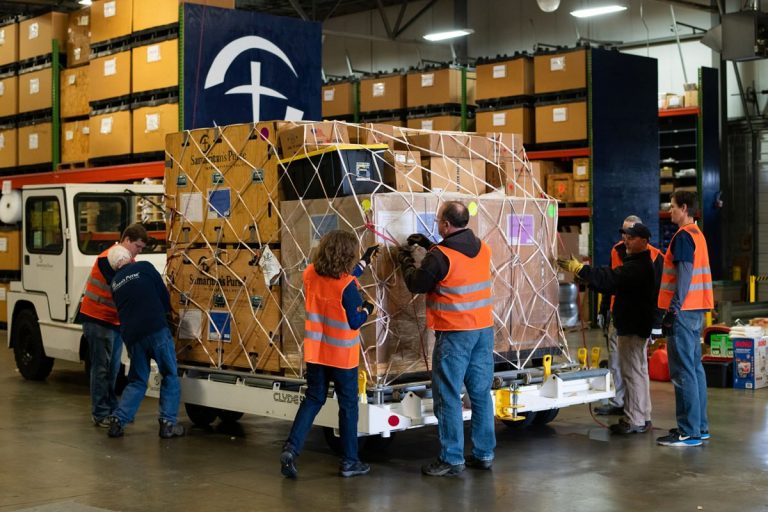
A DC-8 aircraft carrying an emergency field hospital and a team of 32 technicians and medical personnel took off from Greensboro, North Carolina, on Tuesday (March 17) for Cremona, Italy, to set up a triage operation outside a hospital there.

The massive shipment is a donation from Samaritan’s Purse, the evangelical humanitarian relief organization headed by Franklin Graham, who is also CEO of the Billy Graham Evangelistic Association. When assembled, the modular, tentlike field hospital will help Italian medical staff, whose local medical infrastructure has been overwhelmed with a coronavirus outbreak that has killed more than 2,500 people.

The donation represents one of the largest faith-based responses to the COVID-19 outbreak. In America, many U.S.-based religious groups are working on a smaller scale to provide resources to congregations wanting to help vulnerable people cope with quarantine or social distancing.

“Their hospital (in Cremona) is still functional, but it’s overrun and overwhelmed,” said Kaitlyn Lahm, a spokesperson for Samaritan’s Purse. “So we’re setting up our emergency field hospital adjacent to an existing hospital so we can provide surge capacity.”

It will take a team about three days to set up the 68-bed hospital, hook into the water system and electrical grid and assemble the medical equipment, said Melanie Wubs, medical response coordinator for Samaritan’s Purse. Once completed, it will have a laboratory and a respiratory care unit with beds outfitted with ventilators.

In all, Samaritan’s Purse expects to have a staff of 60 technicians, doctors, nurses and pharmacists.

On March 17, 2020, Samaritan’s Purse airlifted a 68-bed emergency field hospital and 32 disaster response specialists, including respiratory therapists, doctors and nurses, to aid those affected by the coronavirus in northern Italy. Photo courtesy of Samaritan’s Purse

But the main purpose of the field hospital is to serve as an overflow center for people needing emergency care in Italy’s hardest-hit Lombardy region. Italy is second only to China in the number of coronavirus infections. The country of 60 million people is under a tight lockdown, with shops and churches shuttered and restrictions on gatherings.

This is not the first time Samaritan’s Purse has assembled an emergency field hospital. The organization, known for its “shoebox ministry” that sends Christmastime packages filled with personal care items and small toys to needy children all over the world, is equally well known for its disaster relief efforts.

Its first field hospital was deployed in 2016 in response to the earthquake in Ecuador. It also set up an emergency field hospital about 12 miles from Mosul, Iraq, during the 2016-17 battle for the city. Last year, it installed a field hospital in the Bahamas in response to Hurricane Dorian.

Lahm said Samaritan’s Purse was working closely with the Italian government and its public health ministry. “We are talking to the key players on the ground to make sure this is something they need and want,” she said.

Other religious groups are also galvanizing to provide help.

More than 20 tons of medical equipment are loaded onto the Samaritan’s Purse DC-8 cargo plane to be sent to northern Italy on March 17, 2020, in Greensboro, North Carolina. Equipment included a specialized respiratory care unit developed specifically in response to COVID-19, and 32 disaster response specialists, including respiratory therapists, doctors and nurses. Photo courtesy of Samaritan’s Purse

As most religious congregations in the U.S. have curtailed services or canceled them altogether, some congregations and denominations are beginning to think not only about safeguarding their own, but reaching out to help others.

Among the initial forays, nonprofit soup kitchens, such as Miriam’s Kitchen in Washington, D.C., have retooled to provide carry-out containers rather than a dining room to prevent the spread of the disease. Hillel International launched [email protected] to provide Jewish college students an opportunity for online meetups.

Southern Baptist disaster relief groups such North Carolina’s Baptists on Mission have provided resources to churches wanting to respond to the coronavirus but unsure how to go about doing it without endangering the health of church members and volunteers.

“This is a unique opportunity for us to be able to demonstrate the love and generosity of Christ,” said J.D. Greear, president of the Southern Baptist Convention and a pastor of a North Carolina megachurch, in a video message. “I would encourage you to check out what’s happening in your community.”

Baptists on Mission is collecting names of churches that have kitchens and can cook for others as well as churches that can make deliveries of canned goods to shut-ins.

“The best response is going to be helping facilitate neighbor helping neighbor,” said Richard Brunson, director of North Carolina Baptists on Mission. “It’s knowing who the people are in your community who are isolated and at higher risk, not hurting them but encouraging them and providing in a way that doesn’t risk them being infected.”

Source: Religion News Service

All Content & Images are provided by the acknowledged source
Los Angeles Parishioners Worship in Mostly Empty Pews

LOS ANGELES (RNS) — Catholics seeking standard Sunday services were met with something new this past weekend.

At the Cathedral of Our Lady of the Angels, the mother church of LA’s Archdiocese, church bells tolled over deserted streets and an empty plaza on Sunday (March 15).

In lieu of the typical door greeter, visitors were met with health advisory signs and a stack of flyers titled, “Prayer in the Time of the Coronavirus.”

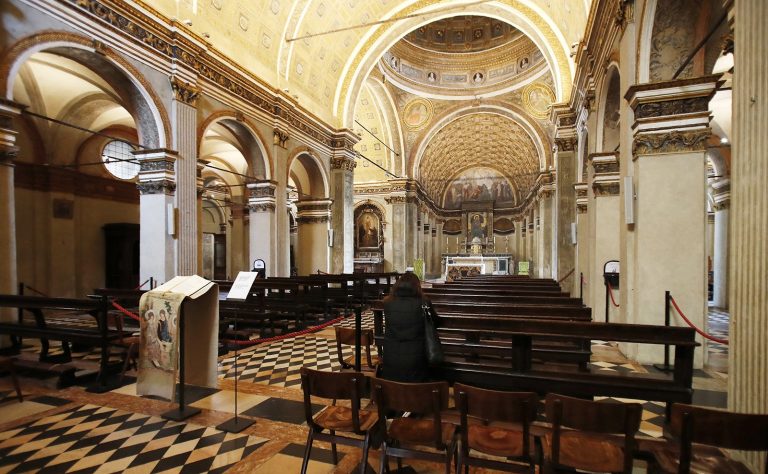
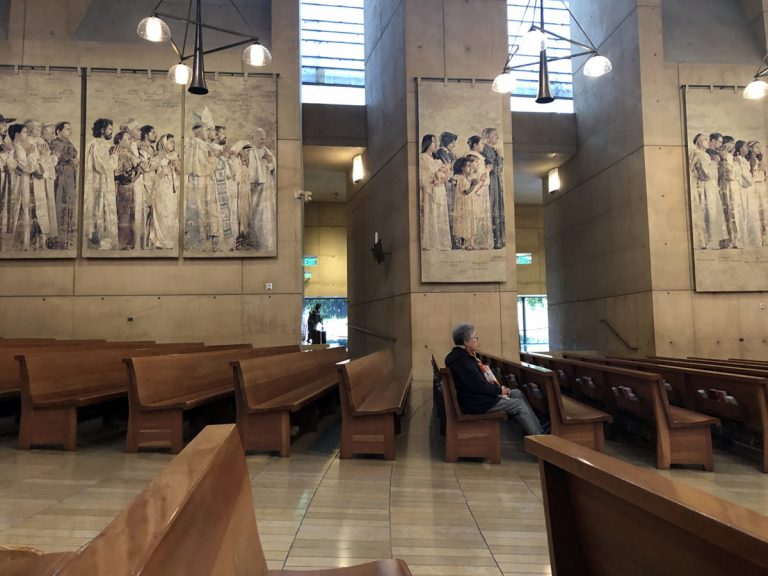
Inside the sanctuary, fewer than 100 people gathered in a space that can fit 3,000. Before the Mass began, an usher walked the aisles and whispered that the offertory bowl would not be passed around in an effort to avoid the spread of germs. In its place, a lonely basket sat in the center of the aisle for people who wished to drop their gifts.

After Mass began, the church’s pastor, the Rev. David Gallardo, wasted little time before addressing the unease.

“Health is on everyone’s minds during this pandemic,” he said, his voice echoing through the mostly empty church. “Health is important, but as Christians, we cannot forget that we are truly children of God destined for eternal life. This is why Jesus reminds us over and over again in the Gospels: Do not be afraid.”

The typically bustling plaza at the Cathedral of Our Lady of the Angels sat empty ahead of Sunday morning Mass, March 15, 2020, in Los Angeles. Photo by Hayley Smith

But people are afraid.

News reports of the deadly virus have occupied the media for days on end. The WHO’s latest numbers declared 118,000 diagnoses across 114 countries and 4,291 dead. In Italy, home of the Vatican, the disease has spread so quickly that there is a national quarantine, and Catholics seeking reassurance from the Pope have instead found announcements of closures and cancellations.

Like most people across the world, the parishioners at Our Lady of Angels were looking for answers at a time when few answers exist.

“I never lived through 9/11 or polio or any of those things,” said 17-year-old David Boneta after the 8 a.m. Mass. “Those aren’t things that ever even occurred to me. Coronavirus is the only real thing, and it’s scary.”

Across town at Our Mother of Good Counsel in Los Feliz, the atmosphere before the 10 a.m. Mass was similarly unsettled. Ushers collected offerings while wearing face masks, and parishioners pumped hand sanitizer into their palms from dispensers in the aisles.

Like Gallardo, the Rev. Mark Menegatti began his service by addressing the concerns of the crowd.

“Archbishop José Gomez has granted dispensation to all Catholics in the Archdiocese from the obligation of attending Mass this week, next week, or the week of March 28 and 29,” he said, referencing a letter published by Gomez on Friday.

“Anyone who is ill, or who knows someone who is ill, should stay home,” Menegatti said.

Only roughly one hundred people attended Mass at the 3,000-capacity Cathedral of Our Lady of the Angels in downtown Los Angeles, Sunday, March 15, 2020. Photo by Hayley Smith

Almost all churches in Los Angeles are following Gomez’s orders, which include eliminating the communal chalice and avoiding any direct bodily contact. When Menegatti’s Mass reached the moment of communion, parishioners lined up and cupped their hands to catch the hosts instead of taking them on their tongues.

“It feels apocalyptic,” said parishioner Sal Lopez after the service at Good Counsel. “It was so empty in there.”

His friend, Tomás Olmos, said he hasn’t felt this way in years.

“Every generation has their apocalyptic challenge,” Olmos said. “The atomic bomb, the AIDS scare, the swine flu, the Cuban missile crisis — there has always been some catastrophic thing threatening each generation. The best thing we can do at this time is pray and keep the faith.”

The Bible is rich with passages about sickness and compassion, including directives to “heal the sick” (Matthew 10:8) and provide for those who are suffering. “Is anyone among you sick?” reads James 5:14. “Let him call for the elders of the church, and let them pray over him.”

Still, the highly contagious nature of the virus has left many people grappling with questions of obligation and faith. How does one help the sick when it might mean endangering the lives of others?

Lopez said he thinks that instead of isolating people, the virus could help bring people together.

“Spiritually, it’s kind of nice for all of us to take this moment to pause,” he said.

His wife, Urbanie, agreed.

“If you go down by the (Silver Lake) reservoir, you’ll see a lot of families together,” she said. “The whole tribe. Students are coming home from college, and people are gathering and spending time with their families because there’s nowhere else to go.”

Parishioners at Our Mother of Good Counsel cupped their hands to catch the hosts without making physical contact, Sunday, March 15, 2020, in Los Angeles. Photo by Hayley Smith

At Our Lady of Angels, Gallardo also searched for deeper meaning. He read a passage from the Gospel of John in which Jesus asks for water from a stranger.

He used the story to remind parishioners of both their humanity and their glory.

“The real human needs that we have — thirst, food, shelter, education, a job, leisure — all of these things are important,” he said, “and we feel them when we don’t have them. The problem comes when we let these worldly concerns overwhelm and blind us to the deeper thirst, to the need for God.”

Flyers with the “Prayer in the Time of the
Coronavirus” were handed out at the
Cathedral of Our Lady of the Angels in Los
Angeles. Photo by Hayley Smith

Gallardo then led the room in a recitation of “Prayer in the Time of the Coronavirus,” which was written by Archbishop Gomez.

“In this time of trial and testing, teach all of us in the church to love one another and to be patient and kind,” the prayer said. But the room felt quiet, even as one hundred voices spoke.

After the service, people shuffled out quickly and quietly. Most didn’t linger or stop to chat, but one couple moved slowly and appeared shell-shocked.

“That was so empty,” said Frank Masterson. “There are usually many, many more people in there.”

His wife, Caren, said it’s a frightening and confusing time. She’s struggling with the question of what can be done for the sick and how far people of faith should go to help them. One of her friends relies on an oxygen tank, and just yesterday he told them he thinks he has the virus.

“We weren’t sure what the right thing to do was,” she said.

The couple debated about whether to offer to drive their friend to the hospital, which could mean putting themselves or others at risk of getting sick. Ultimately, they decided against it.

“I think the best thing we can do for him is pray,” she said.

Source: Religion News Service

All Content & Images are provided by the acknowledged source
How Coronavirus Plague Could Affect Millions of Persecuted Christians Around the World

Save the Persecuted Christians (STPC), which advocates on behalf of hundreds of millions of Christians facing heavy persecution worldwide, is addressing the coronavirus (COVID-19) pandemic.

“Situations such as these create an opportunity for persecutors to exploit the crisis at hand and operate with a greater sense of impunity, which is why it is imperative for each of us to also continue our prayers for those who are at risk of anti-Christian violence,” said Dede Laugesen, executive director of Save the Persecuted Christians.

“[Sunday’s] National Day of Prayer gave each of us an opportunity to come together in the midst of the seeming chaos and believe our God is greater than any outbreak. Although it is often easy to get swept up in the mass frenzy, we encourage you to remember that through prayer and faith we, as followers of Christ, can overcome every obstacle.

“There is no difficulty too great for God to overcome if His people cry out to Him and believe in His almighty power and ability. In Isaiah 43, God tells us that we are never alone and that He will always get us to the other side of any barrier. ‘When thou passest through the waters, I will be with thee; and through the rivers, they shall not overflow thee: when thou walkest through the fire, thou shalt not be burned; neither shall the flame kindle upon thee’ (Isa. 43:2, KJV).

SOURCE: Charisma News

All Content & Images are provided by the acknowledged source
PODCAST: The Power of the Throne of Grace in Prayer, Part 5 (Praying Through the Bible #397 with Daniel Whyte III)

TEXT: Hebrews 4:14-16

14 Seeing then that we have a great high priest, that is passed into the heavens, Jesus the Son of God, let us hold fast our profession.

15 For we have not an high priest which cannot be touched with the feeling of our infirmities; but was in all points tempted like as we are, yet without sin.

16 Let us therefore come boldly unto the throne of grace, that we may obtain mercy, and find grace to help in time of need.

——–

Robert Kendall said, “Prayer can no more be divorced from worship than life can be divorced from breathing.”

In its early days, Dallas Theological Seminary was in critical need of $10,000 to keep the work going. During a prayer meeting, renowned Bible teacher Harry Ironside, a lecturer at the school, prayed, “Lord, you own the cattle on a thousand hills. Please sell some of those cattle to help us meet this need.” Shortly after the prayer meeting, a check for $10,000 arrived at the school, sent days earlier by a friend who had no idea of the urgent need or of Ironside’s prayer. The man simply said the money came from the sale of some of his cattle!

In our last message in this series we looked at how we can approach the throne of grace boldly and with humble confidence because our high priest is none other than the son of God Jesus Christ. Because Jesus is the only priest who knows God directly, and is our only gateway to knowing God, we can have confidence in addressing our prayers to God in the name of Christ Jesus.

Second, we can approach the throne of grace boldly because we have a high priest who knows us. Hebrews 4:15 reads, “For we have not an high priest which cannot be touched with the feeling of our infirmities; but was in all points tempted like as we are, yet without sin.” While also being God, Jesus lived as a man while he was here on earth. While he was here he experienced all the struggles that are natural to the human experience – hunger, thirst, weariness, and the temptation to sin against God. Jesus, being God, of course could not have committed a sin, but he understands the struggle that we go through in our lives. John MacArthur said, “He knows the gamut of temptation yet He can stand apart in absolute pure moral evaluation and be a fair judge. All our temptations Christ felt, and He didn’t feel them with our blunted perception but He felt them with His infinite sensitivity. Mark this thought, sinlessness alone can estimate sin, did you get that? It is sinlessness alone that can estimate sin. And so Jesus Christ didn’t sin. He couldn’t sin, He had no capacity to sin. But that doesn’t minimize His temptations they were all the more terrible because He would not fall, He could not fall, He endured them to the extreme. And He’s a good one to stand back and evaluate us because being sinless He has a sensitivity to sin, and He can see it for what it is where we always cannot. I like what it says in Hebrews 12:8 it says, “For consider him that endured such contradiction of sinners against himself, lest ye be wearied and faint in your minds. Ye have not yet resisted unto blood, striving against sin.” You want to talk to somebody who knows what sin is about you talk to Jesus Christ, you don’t even know what that’s about in the fullest sense you haven’t been able resist to the point of blood. Jesus Christ knows sin, and He knows your weakness and He understands it. You say, well what does this have to do with me? This just simply means that after you’ve come to Jesus Christ you have one that you can go to who completely understands in every way, in every capacity. In fact the Apostle paul put it this way in First Corinthians 10 he said in verse 18, and this of course is a classic statement, “But there hath no temptation taken you but such as is common to man; but God is faithful, who will not tempt you above that you are able, but will, with the temptation, make a way of escape, that you may be able to bear it.” Jesus Christ knows the path. Someone has well said, In a trackless wood the one who goes first blazes the way or breaks twigs so others may follow. When Jesus passed through this world He gathered up so many thorns in His own feet that by this we may know the way for us to take.” When someone is charged with a crime, if they do not have the means to hire a defense lawyer, they are assigned one by the government. These defense attorneys usually do not know their client, and do not care about the outcome of the case on a personal level. They are just doing the job they have been assigned. But Jesus knows and cares about us personally. He understands our struggle with sin. So we can approach God’s throne of grace boldly because we know that our defense attorney, if you will, knows us on a personal level and is ready to defend us before God.

– – – – – – – – – – – – – – – – –

Now, if you are with us today, and you do not know the Lord Jesus Christ as your Saviour, your first prayer needs to be what we call the Sinner’s Prayer. First, please understand that you are a sinner, just as I am, and that you have broken God’s laws. The Bible says in Romans 3:23: “For all have sinned and come short of the glory of God.”

Second, accept the fact that there is a penalty for sin. The Bible states in Romans 6:23: “For the wages of sin is death…”

Third, accept the fact that you are on the road to hell. Jesus Christ said in Matthew 10:28: “And fear not them which kill the body, but are not able to kill the soul: but rather fear him which is able to destroy both soul and body in hell.” Also, the Bible states in Revelation 21:8: “But the fearful, and unbelieving, and the abominable, and murderers, and whoremongers and sorcerers, and idolaters, and all liars, shall have their part in the lake which burneth with fire and brimstone: which is the second death.”

Now this is bad news, but here’s the good news. Jesus Christ said in John 3:16: “For God so loved the world, that he gave his only begotten Son, that whosoever believeth in him should not perish, but have everlasting life.”

Just believe in your heart that Jesus Christ died for your sins, was buried, and rose from the dead by the power of God for you so that you can live eternally with Him. Pray and ask Him to come into your heart today, and He will.

Romans 10:9 & 13 says, “That if thou shalt confess with thy mouth the Lord Jesus, and shalt believe in thine heart that God hath raised him from the dead, thou shalt be saved… For whosoever shall call upon the name of the Lord shall be saved.”

If you believe that Jesus Christ died on the Cross for your sins, was buried, and rose from the dead, and you want to trust Him for your Salvation today, please pray with me this simple prayer: Holy Father God, I realize that I am a sinner and that I have done some bad things in my life. For Jesus Christ sake, please forgive me of my sins. I now believe with all of my heart that Jesus Christ died for me, was buried, and rose again. Lord Jesus, please come into my heart and save my soul and change my life today. Amen.

If you just trusted Jesus Christ as your Saviour, and you prayed that prayer and meant it from your heart, I declare to you that based upon the Word of God, you are now saved from Hell and you are on your way to Heaven. Welcome to the family of God! Congratulations on trusting Jesus Christ as your Lord and Saviour. You have done the most important thing in life. For more information to help you grow in your newfound faith in Christ, go to Gospel Light Society.com and read “What To Do After You Enter Through the Door”. Jesus Christ said in John 10:9, “I am the door, by me if any man enter in, he shall be saved, and shall go in and out, and find pasture.”

God loves you. We love you. And may God bless you.

Daniel Whyte III has spoken in meetings across the United States and in over twenty-five foreign countries. He is the author of over forty books including the Essence Magazine, Dallas Morning News, and Amazon.com national bestseller, Letters to Young Black Men. He is also the president of Gospel Light Society International, a worldwide evangelistic ministry that reaches thousands with the Gospel each week, as well as president of Torch Ministries International, a Christian literature ministry.

He is heard by thousands each week on his radio broadcasts/podcasts, which include: The Prayer Motivator Devotional, The Prayer Motivator Minute, as well as Gospel Light Minute X, the Gospel Light Minute, the Sunday Evening Evangelistic Message, the Prophet Daniel’s Report, the Second Coming Watch Update and the Soul-Winning Motivator, among others.

He holds a Bachelor’s Degree in Theology from Bethany Divinity College, a Bachelor’s degree in Religion from Texas Wesleyan University, a Master’s degree in Religion, a Master of Divinity degree, and a Master of Theology degree from Liberty University’s Rawlings School of Divinity (formerly Liberty Baptist Theological Seminary). He is currently a candidate for the Doctor of Ministry degree.

He has been married to the former Meriqua Althea Dixon, of Christiana, Jamaica since 1987. God has blessed their union with seven children.

All Content & Images are provided by the acknowledged source
