Preliminary Results Show Netanyahu Wins Prime Ministerial Election

Preliminary Results Show Netanyahu Wins Prime Ministerial Election


Prime Minister Benjamin Netanyahu earned more votes than challenger Benny Gantz in Israel’s prime ministerial election.

“It’s a win against all odds because we stood up against powerful forces. They already eulogized us. Our enemies said, ‘The Netanyahu era is over.’ But we turned the plate on its head,” Netanyahu said before a crowd of supporters, adding that it is “the biggest win of my life.”

Netanyahu now needs 61 seats in Israel’s Knesset to form a majority government. Netanyahu is on track to earn at least 59, according to CBN News. Gantz may only earn 32 seats.

Political experts predicted that Netanyahu and Gantz would be neck in neck in the race, many even believed Israel would have to undergo a fourth election for the Prime Minister position.

According to CBN News, despite initially appearing to have received fewer votes, Gantz wait until every vote is counted before conceding.

“We created something called Blue and White. We merged our documents and principles to one place and I am telling you that we won’t compromise on our principles and our way,” Gantz said Monday night.

As Christian Headlines previously reported, Monday’s election was an unprecedented third election for prime minister in a year. In the past two elections, the winner has been unable to form a majority government.

CBN News reports that Israel was forced into a third election after the winning…

… Read More

Click here to read the rest of the story from our content source/partners – Christian Headlines.

قالب وردپرس

62 Cents a Year Could Fund Historic Number of New Missionaries

If every Southern Baptist increased giving to international missions by the price of a single cup of coffee over the next five years, the International Mission Board would see historic growth in the number of missionaries it could fund.

That’s the cost of the first of five strategic action statements of Vision 2025, which was approved by the Executive Committee in February and will be brought for messenger approval at the 2020 SBC Annual Meeting. The vision begins where Southern Baptists started 175 years ago, with a common purpose to send more missionaries to the nations.

Strategic Action #1 says, “Increase the total number of full-time, fully funded missionaries by a net gain of 500, giving the SBC 4,200 full-time, fully funded missionaries through the IMB.” The action item comes directly from the IMB’s overseas leadership. IMB President Paul Chitwood announced the goal at their Jan. 29-30 trustee meeting in Riverside, Calif.

“We live in the most populous century in the history of humanity where 155,252 lost people die every day,” Chitwood said. “By growing our mission force by 500, and many of those 500 being devoted to training churches overseas to send their own missionaries, we believe Southern Baptists will see an exponential impact from their Great Commission faithfulness.”

IMB leaders didn’t choose the number 500 randomly. Last March the IMB’s affinity group leaders gathered to develop plans to accelerate the spread of the Gospel worldwide. During that week, Chitwood asked the leaders: “What is the minimum number of new field missionary personnel needed to have maximum impact in accelerating the spread of the Gospel?”

The question came at a critical time for one of the largest missions organizations in the world. In 2008, the IMB had a record number of 5,624 overseas missionaries, according to that year’s SBC Annual. As of January 2020, just 12 years later, that number had dropped to 3,673, a loss of nearly 2,000 appointed missionaries. While the number of missionaries had plummeted in a little more than a decade, lostness has climbed.

“The question was asked in the context that we did not have unlimited financial resources,” said Charles Clark, the IMB’s vice president for mobilization. “Each of the affinity leadership teams met to pray and consider the question, and the comprehensive sum they arrived at was 500 new personnel. While 500 additional field missionaries is a minimum number, it does represent the need to increase CP [Cooperative Program] and Lottie Moon [Christmas Offering] giving by Southern Baptists of some $50-plus million over the next five years.”

Mobilizing 500 additional missionaries in a five-year period would mark one of the biggest periods of growth in personnel in the board’s 175-year history and would begin the effort to return Southern Baptists to earlier levels of missionary advancement.

Source: Baptist Press

All Content & Images are provided by the acknowledged source

'Uncharted Territory': COVID-19 Infections Worldwide Now Stands at 90,000 with 3,100 Deaths

The leader of the World Health Organization now says we’re in “uncharted territory” with the COVID-19 epidemic.

Worldwide, more than 90,000 people have been infected, and 3,100 have died from the coronavirus.  At least 70 countries have been affected, like Italy where COVID-19 cases have spiked, leading Delta Airlines and American Airlines to suspend all flights to Milan.

Here in the US, another state, Georgia, has now confirmed its first two cases of the virus. Health officials have confirmed more than 100 cases of the virus in 14 states.

GET YOUR FREE FACTSHEET Coronavirus: What You Need to Know

As the disease continues to spread in the US, the epicenter is a Washington state community that’s bracing for more infections, while taking action to stop the spread.  Just outside Seattle, Wash., the death toll has risen to nine, research suggesting the virus could have been spreading in the community for weeks. 

Dr. Jeff Duchin, health officer for Seattle and King County, said, “The risk for all of us of becoming infected will be increasing.”  

Four of the victims were all living in the same Washington state nursing facility. It’s now the center of the outbreak.

Colleen Mallory, whose 89-year-old mother lives at the nursing home, is afraid. “If she gets sick she’s going to be gone,” she said.

On the other side of the country, school officials shut down a Rhode Island high school, and 38 people are under quarantine. Officials made the decisions after a student and faculty member tested positive for the virus following a school trip to Italy.

In New York state, officials launched their own testing procedures after announcing the first case in Manhattan.

Gov. Andrew Cuomo (D-NY) said, “There is no doubt that there will be more cases where we find people who test positive. This is New York. We’re a gateway to the world.”  

Vice President Mike Pence, who is in charge of the government’s response to the coronavirus, says the US is prepared. 

“Despite today’s sad news, let’s be clear, the risk to the American people of the coronavirus remains low,” he said.

Pence also said a possible vaccine could be making its way to clinical trials within the next 6 weeks.

President Donald Trump says he’s urging drug companies to speed up the process of creating a COVID-19 vaccine.

Meanwhile, prayer leaders have issued a call to prayer against the coronavirus. The Reformation Prayer Network and the intercessory group Generals International declared Tuesday as a day of prayer and fasting.

Prayer points include praying Psalm 91 over families and nations, praying against fear and praying for wisdom for leaders.

Source CBN

All Content & Images are provided by the acknowledged source

The Good News and Bad News About Generation Z’s Religious Trends

By now, we’ve all heard about the rise of the “nones.” Every year there seems to be another round of survey data indicating that the religiously unaffiliated in the US have jumped another percentage point or two.

But some recent findings about Generation Z may challenge that narrative, suggesting that the share of the nones may be leveling off.

The oldest members of Gen Z were born in 1995, which means that they joined survey populations when they turned 18, starting in 2013.

It would be fair to assume that their level of religious unaffiliation should exceed that of the millennials before them, the same way millennials left religion in larger numbers than Generation X. But that assumption is not borne out by the data.

Although all age groups have increasingly stepped away from religion over the past decade, every generation except Gen Z showed significantly higher rates of disaffiliation than the ones before.

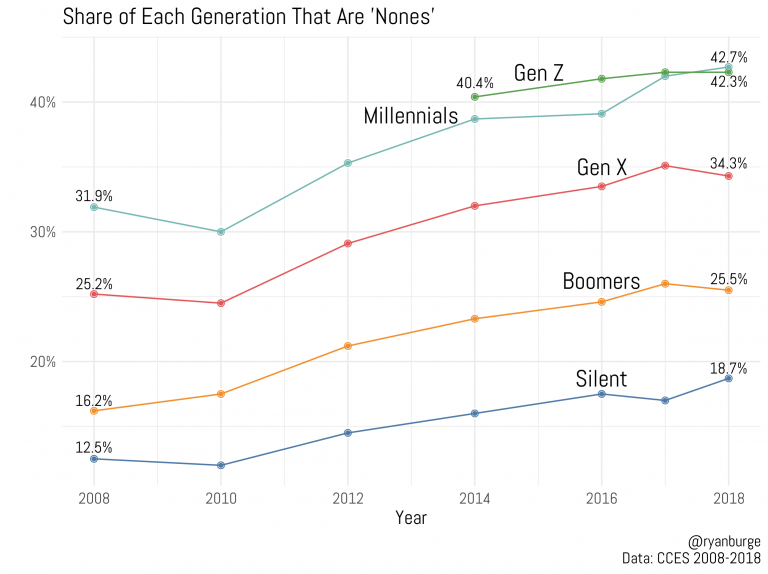
In 2008, boomers had 4 percent more nones than the Silent Generation, while Generation X was 9 percent higher than boomers. Millennials topped the charts at nearly a third of the population falling into the nones category.

That separation has persisted over the past decade. The rate of nones among the Silent Generation—the oldest subset—has increased by half, from 12.5 percent to 18.7 percent. By 2018, a quarter of boomers and a third of Gen Xers were unaffiliated. But the jump among millennials was truly unprecedented, climbing more than 10 percentage points in just 10 years to 42.7 percent.

Generation Z, during half the studied time, has appeared to chart a much different course. The rate of disaffiliation among Gen Z was just one percentage point higher than millennials in 2014. It moved up less than 2 percentage points in four years, meaning that the percentage of nones among Gen Z ended up no different than millennials: both around 42.5 percent.

Because Generation Z is still fairly young in these samples, it is possible many are still influenced by the religion of their parents. As a result, their disaffiliation may rise as they move into their late 20s and early 30s. Another possibility is that the nones have reached a natural ceiling at around 40 percent. However, that theory cannot be thoroughly tested until we have another decade of data.

All Content & Images are provided by the acknowledged source

Book Review: ‘The Bible and the Ballot: Using Scripture in Political Decisions’ by Tremper Longman III

Review by Jonathan Leeman. Leeman is the editorial director for 9Marks and an elder at Cheverly Baptist Church in Bladensburg, Maryland. He is the author of How the Nations Rage: Rethinking Faith and Politics in a Divided Age (Thomas Nelson). The views expressed in this commentary are solely those of the author(s) and do not necessarily represent those of BCNN1.

When it comes to determining how the Bible addresses political issues, its many related verses can feel like a massive sack of Legos. One person opens the sack and builds a car, another a brontosaurus, another an old Western town. With enough skill, you can build whatever you want.

Want to make the Bible say welfare policies are bad? Find a proverb on laziness leading to poverty (Prov. 10:4). Want to say the opposite? Find another calling people to “defend the rights of the poor and needy” (Prov. 31:8–9).

The point is not that Proverbs contradicts itself. All these passages say something true. But we lack clear rules for knowing how any one of them should guide today’s public policy. Further, we too often witness people and parties exploiting the Bible for their purposes.

Longtime Westmont College professor Tremper Longman III brings his Old Testament expertise to bear in The Bible and the Ballot: Using Scripture in Political Decisions. The book offers counsel on how to read Scripture politically, followed by what Longman believes the Bible teaches on ten public policy issues of our day: nationalism, religious liberty, war, abortion, criminal justice and capital punishment, immigration, same-sex marriage, the environment, poverty, and racism.

Most of what Longman offers about how to read the Bible politically is sensible. He argues that the Bible does not provide us with specific public policies, only general principles we should take seriously. I agree entirely.

Longman offers good, solid principles of interpretation. They include paying attention to a book’s genre and original context and taking account of continuities and discontinuities between the Testaments, especially the way in which a Christian reading of the Old Testament recognizes Christ’s fulfillment of all things.

Yet Longman’s approach is insufficient because it lacks institutional awareness. Let me explain. Suppose I place a list of evening “to dos” for my wife on my desk at work, but my assistant thinks it’s for him. Why am I returning a new pair of oven mitts to Bed Bath & Beyond? he wonders. The confusion arises because my wife and I inhabit one institutional structure, my assistant and I another, and interpreting such a to-do list means minding those structures.

Longman rightly observes that the rules binding Old Testament Israel cannot transfer directly to the New Covenant church. Yet we also need to ask which to-do lists the Bible gives to the governments of the nations. What is their purpose? What authority do they receive? The Old Testament prophets indict the nations for injustice. In Israel’s case, however, the indictment is for injustice plus idolatry. That’s significant because, in covenantal terms, the United States and Kenya stand closer to ancient Egypt and Rome than to ancient Israel and the church. By the same token, we must distinguish between church authority and individual Christians, who can work in government.

In short, reading the Bible politically requires institutional awareness, not just a few principles of interpretation. When we encounter Proverbs’ instructions regarding the poor, for instance, we need to read them through that institutional filter, just as my assistant needs to interpret the “to do” list through the filter of “Is this for me or for your wife?”

Without institutional and covenantal sensitivity, we pick up our Bibles and default to what feels right in our time and place. For instance, Longman feels politically burdened by Israel’s civil laws concerning foreigners. Why not by its moral laws concerning adultery or honoring one’s parents? Perhaps because it’s literally unimaginable today that the government might draw from Israel’s laws on sexuality.

Longman denies that his own previously held political views influenced his reading of Scripture. Indeed, he observes that Scripture changed his views on some matters as he studied for this book. Which is well and good. But with few exceptions, his views fall left of center (by 21st-century American standards) on nearly every issue. He’s reluctant about war. He would accommodate undocumented immigrants. He fears climate change. He pushes hard on caring for the poor. He calls for race reparations. He questions the justice of capital punishment due to racial disparities. He says the church shouldn’t impose its sexual ethic when it comes to same-sex marriage. And he seeks a “third way” on abortion, arguing that “there may be wisdom in making abortion rare and safe,” with the implication that it’s also legal, as Bill Clinton’s infamous triplet had it.

It concerns me when any Christian’s political positions match, point by point, a well-defined constellation on America’s left–right spectrum. You see the first two or three stars, and you know where the rest will flash. Perhaps this is my own idealism, but I’d like to think that working from Scripture would yield some unexpected combinations, like someone who is staunchly pro-life and pro-reparations, or pro-traditional marriage and pro-environment.

Source: Christianity Today

All Content & Images are provided by the acknowledged source

Karl Vaters on His New Book ‘100 Days to a Healthier Church’

Karl Vaters is pastor of Cornerstone Christian Fellowship in Fountain Valley, California. The views expressed in this commentary are solely those of the author(s) and do not necessarily represent those of BCNN1.

Today is the day!

You can now buy a copy of my newest book, 100 Days To A Healthier Church!

Here’s an excerpt.

Turning a church from unhealthy to healthy is a daunting task.

It starts by working smarter, not harder.

Here’s an example.

In the 1990s, I led a small group of church members on a missions trip to Bucharest, Romania. The country was just a few years removed from one of the most oppressive, violent and evil regimes in modern history.

One afternoon we were taking a short break in our hotel. While we were talking, a hotel employee was painting a wardrobe in the hallway—one of those portable closets they use in Europe, like the one in C.S. Lewis’s classic book. But there was something about the way he was doing it that was strange.

The employee would brush on a few strokes of paint, disappear into the hotel room for thirty seconds or so, reappear to brush on a few more strokes, then disappear again. This kept repeating. Why?

Then it hit me.

Although the wardrobe was in the hallway, the can of paint was in the middle of the hotel room, so the painter was walking into and across the room for every single dip of paint! But why would he do that? Probably because that’s where everything was placed when he arrived. This painter was nearing retirement age, and he had been raised under an extraordinarily repressive regime in which you kept your head down and did the job you were given, no questions asked. Conformity was rewarded, and innovation was frowned upon.

This painter was taking three or four times longer to paint the wardrobe because he had been socially, mentally, and emotionally programmed by a corrupt system not to think for himself. It didn’t occur to him to perform one simple step that would have made his job exponentially easier, faster and better: move the can.

What is true of that painter is also true for far too many pastors and other church leaders. Many of us are pastoring under systems that were in place long before us, and it hasn’t occurred to us that we can move the paint can.

Like the tired painter in that hotel hallway, it’s tempting to leave things where they are right now and keep going through the motions. Turning an entire church around is like getting the entire room ready—far too big a task to even contemplate at the moment.

Source: Christianity Today

All Content & Images are provided by the acknowledged source

Jenny Yang on the Twin Temptations of Political Engagement

Jenny Yang is the vice president of advocacy and policy at World Relief. The views expressed in this commentary are solely those of the author(s) and do not necessarily represent those of BCNN1.

At the height of the immigration debate in 2016, I accompanied a group of pastors in Washington, DC, to meet with their members of Congress. One pastor of a prominent, large evangelical church, remarked afterward how he wanted to go back to his hotel and take a shower because he felt so “dirty” talking to politicians.

The disdain we feel for our elected officials and political systems is often rooted in a belief that politics are defined by insincerity and dishonesty. Subsequently, many Christians chose to be apolitical. They don’t contact their elected officials, vote, or even discuss issues that show up nonstop on their social media feeds, such as climate change, gun violence, and immigration.

Contrary to those who avoid politics are evangelical Christians for whom politics is the only salvation for a Christian society under threat. Their conviction is marked by a hyperpartisanship, a blind allegiance that neglects the values Christians historically hold. We give a blank check to our “tribe,” and that ends up harming the very people God calls us to love and serve. As Richard Land recently wrote, “to equate God with any human institution, particularly one as flawed and as intensely human as either political party, is a form of blasphemy.”

Evangelical political engagement should be marked by neither political disengagement nor hyperpartisanship. If we are biblically political, we can work for systems and structures that create human flourishing throughout our entire society. But overt partisanship attaches us to centers of empire power and perpetuates injustice.

So how can we engage faithfully in politics?

Our political engagement should be rooted in the belief that everyone is created in the image of God. Our pro-life ethic should be for the entirety of life, from womb to tomb. We should support policies and hold our elected officials accountable to protect life and promote full human flourishing. Any language used by our elected officials to vilify others should not be the language of the church. No matter our politics, demonizing those of a different political persuasion is not consistent with the humility, decency, and propriety that marks us as followers of Jesus.

Among the greatest challenges in churches is consistently applying the whole biblical truth in every area of our lives. A consistent pro-life ethic should mean we hold our elected officials accountable to creating policies based on biblical values we espouse and not remain silent when those elected officials, or parties, espouse policies that would harm human life, promote family separation, or diminish religious liberties. If your preferred political candidate is strongly against abortion, then you should also press that elected official to support that baby’s life after birth by ensuring that he or she has access to nutritious food and a quality education.

Scripture calls us to demonstrate preference for those who are downtrodden, marginalized, and oppressed, both through God’s commandments (Deut. 10:18; Ps. 146:9; Zech. 7:10; Mal. 3:5) and Jesus’s example (John 4:4–26; Luke 8:43–48; Mark 2:1–12). We therefore advocate for those with disabilities, immigrants, those experiencing homelessness and mental illness, and those in the foster care system, among others. The way that we speak and act, along with our political engagement, must show care and concern for those who are often least able to defend themselves. A recent Barna study found that 43 percent of 18-to-35-year-olds said caring for the poor and vulnerable is a defining mark of a Christian, along with combating corruption, extreme poverty, and racism.

Source: Christianity Today

All Content & Images are provided by the acknowledged source

Keith Gordon on Evangelism Formation: Created to Be Creative for Christ

Keith Gordon is a pastor and associate director of the Church Evangelism Institute. The views expressed in this commentary are solely those of the author(s) and do not necessarily represent those of BCNN1.

If I was to testify about the four spiritual aliens (called my family) whom I live with on a daily basis, I could tell you that there is never a dull moment in our lives. I live in a house where boredom will never want to visit, where monotony could not find a room, and where the ordinary wouldn’t leave his luggage.

Our home is busy with creative people. As I often wondered where all of our children’s uniqueness derived, I had to realize that from generation to generation in both my family and wife’s family, there was and still remains some creative minds that has made their mark on society.

I believe that all children of God who are followers of Christ, should understand what they have inherited from their God and Father. At the moment of our salvation, our daddy in heaven has spiritually deposited in us his image and DNA in order to do a great missional work in our time that reflects who HE is through us.

We should be encouraged to know that our God has gifted each of us, through the extraordinary redemptive work of Jesus Christ, with the power of the Holy Spirit, to use his creative abilities to share our faith with others for his glory praise and honor.

So as Christ-followers who already have the creative power of God dwelling inside of us, it would be ideal to answer the questions for ourselves: How does God want us to access the creative ideas that he wants us to have to evangelize in different ways with others who are far away from Christ? Let’s consider these questions.

First, when will God hear from you first?

In other words, are you prayerfully discerning where God is creatively leading in seeking the lost? Luke 11:9-10, 13 says,

“And I tell you, ask, and it will be given to you; seek, and you will find; knock, and it will be opened to you. For everyone who asks receives, and the one who seeks finds, and to the one who knocks it will be opened. If you then, who are evil, know how to give good gifts to your children, how much more will the heavenly Father give the Holy Spirit to those who ask him!”

Since all of creation comes from the Creator, it only makes sense that we seek him for our creativity. Our time in devotion with God should always be spent in prayer for the lost who don’t know Christ as Lord and Savior.

God is the only One who creatively knows how to give us directions to reach the lost for his glory. In our prayers for reaching the lost, we should be asking God for his guidance in….

If you’ve noticed, throughout all the prayer emphasis about sharing faith with someone, the focus has always been completely about God. Whenever our prayers are God-focused, it helps us to discern creatively and become in tune with God for his glory.

Second, what has God put in your heart?

In other words, are you passionately desiring big, God-sized dreams in order to creatively reach the lost? Psalm 51:10 says, “Create in me a clean heart, O God, and renew a right spirit within me.” What’s been a unique, longing, aspiring and life-stretching goal that you keep thinking about for God? What is that “Shadow Mission” that hovers over you, that you believe that God has stirred up in you, that you just can’t shake? Dr. John Fuder, professor of Moody Theological Seminary, once said that “Whatever Break God’s Heart, Should Lead Our Hearts.”

Third, where are you already heading for God?

In other words, what are you doing as your normal and necessary function now for God’s glory? Matthew 28:19 says, “Go therefore and make disciples of all nations, baptizing them in the name of the Father and of the Son and of the Holy Spirit.”

As we go through the life that God has given us, let’s make disciples. I believe that God wants us to make creative what is already a natural part of our life. Here are several ways we are already serving or can be serving God in our lives.

Source: Christianity Today

All Content & Images are provided by the acknowledged source

White Evangelical Women Less Likely to Vote for Trump

White Evangelical Women Less Likely to Vote for Trump


According to a report released by the Public Religion Research Institute, white evangelical women’s support for Trump has started to decline.

White evangelicals in general still hold the strongest support base for Trump; however, 69% of evangelical men said that they favored the president while only 59% of women agreed, according to Relevant Magazine.

For Mormons, the number of women supporting the president dropped to 45% while 64% of men do. The number drops even lower for Jewish, Buddhist, Muslim, Hindu, Unitarian Universality and other religions with roughly only 30% of women holding favorable views of the commander in chief.

According to an article released by the Huffington Post, the gender gap has long existed amongst Democrats and Republicans. More women are likely to consider themselves Democrats than men. This was made especially apparent in the 2016 election when 52% of men voted for Trump and 41% of women voted for Hilary Clinton, as reported by Rutgers. This was the largest gender gap of 11 points since 1996.

But Trump’s aggressive language over the years has put white evangelical women in a difficult spot. Though many men resonate with the president’s abrasive behavior, according to Karen Swallow Prior, a professor of English at Liberty University, it has struck a nauseating tone for women who have suffered at the hands of an abusive leader.

“Women—who are most often the victims…

… Read More

Click here to read the rest of the story from our content source/partners – Christian Headlines.

قالب وردپرس

PODCAST: The Scripture & the Sense Podcast #431: Amos 3:6 (with Daniel Whyte III)

This is Daniel Whyte III president of Gospel Light Society International with The Scripture & the Sense Podcast #431, where I read the Word of God and give the sense of it based on an authoritative commentary source such as the Bible Knowledge Commentary or Matthew Henry Commentary. This podcast is based upon Nehemiah 8:8 where it says Ezra and the Levites “read in the book in the law of God distinctly, and gave the sense, and caused them to understand the reading.” The aim of this podcast is that through the simple reading of the Word of God and the giving of the sense of it, the church would be revived and the world would be awakened.

Today we are reading Amos 3:6.

6 Shall a trumpet be blown in the city, and the people not be afraid? shall there be evil in a city, and the Lord hath not done it?

________

That was Amos 3:6. Now here is the sense of it.

The Bible Knowledge Commentary reads:

Sixth, people do not tremble unless a war trumpet has been sounded in a city; but such an alarm always produces fear and apprehension. Nor does disaster finally come to a city unless the Lord has determined to cause it. But once His decision is made, the outcome is unavoidable. The “disaster” could be a plague, meager harvest, or hostile attack, designed by God to lead the people to repent, acknowledge His sovereignty in their lives, and trust Him for deliverance. The seven examples of related events began innocuously, but become increasingly foreboding. The first example had no element of force or disaster about it. The next two, however, concerned the overpowering of one animal by another, and the two after that pictured man as the vanquisher of animal prey. In the final two examples, people themselves were overwhelmed, first by other human instruments, then by God Himself. This ominous progression, to the point where God Himself is seen as the initiator of human calamity, brought Amos to a climactic statement.

____________

Thank you for listening to the Scripture & The Sense Podcast. Remember to read the Word of God each and every day and pray without ceasing to God for wisdom to understand it and apply it to your life. Most importantly, believe on the Lord Jesus Christ and thou shalt be saved. Please stay tuned for a complete presentation of the Gospel of the Lord Jesus Christ so that you can get your soul saved from Hell to that wonderful place called Heaven when you die. May God bless you and keep you is my prayer.

All Content & Images are provided by the acknowledged source