Members of the Church of Scientology are coming down hard on Leah Remini and her Emmy-winning series “Scientology and the Aftermath” on A&E. They launched a campaign to convince the documentary program’s advertisers to stop supporting the show.
REUTERS/Fred Prouser
Leah Remini’s “Scientology & Aftermath” is now in its second season on A&E.
Letters and emails from the group called the Scientologists Taking Action Against Discrimination (STAND) were sent to ad buyers of “Scientology and the Aftermath” in the last few months. According to The Wall Street Journal, Anheuser-Busch, Fiat Chrysler Automobiles, and Geico were among the advertisers that received the letters that cited Remini’s show as a hate campaign against Scientology.
“Its first season alone generated more than 400 incidents of harassment, threats of violence and vandalism against our churches and members,” the letter read. “The threat level has again risen, precisely coincident with A&E’s promotion and airing of the second season of this show, now spawning even more threats—bombings, murder and acts of physical violence.”
Remini remains unperturbed despite the show potentially losing income from STAND’s move. She also shot back at trolls on Twitter who attack her show with biases, especially after the airing of the most recent episode about how Scientology leaders abuse children.
The troll claimed Remini’s subjects were drugged before they spoke in front of the cameras. The TV star, however, turned the tables on the troll who had no basis for his claims.
Meanwhile, A&E has yet to renew “Scientology and the Aftermath” for season 3. Remini, however, has already mapped out some ideas about what’s coming up next season. It might include a change in the show’s title because she might pursue a different subject matter: Jehovah’s Witnesses.
“I’m open to doing a season 3 in a different way,” she told Entertainment Weekly. “We’ve been getting an overwhelming amount of emails and people contacting us through [social media] about other cults that are similar [to Scientology], so I’m looking into that.”
Leah Remini’s “Scientology and the Aftermath” airs every Tuesday nights at 10:00 EST on A&E.
My simply answer is that Halloween is a holiday for a religion to which I do not adhere. (Pixabay/StockSnap)
The Halloween debate in many Christian circles can get heated as if it were politics. This article is not meant to cast judgement on people who choose to celebrate Halloween. There are a lot of people I know and love who celebrate it. This article is merely sharing my family’s story and the reason we gave it up. If you don’t agree with me, that’s fine. It’s between you and God.
My husband and I both grew up celebrating Halloween. I would say we both had the stereotypical upbringing of carving pumpkins and trick-or-treating. My family would throw Halloween parties, and I remember getting a plastic Smurfette costume and wearing it proudly. Early on for me, Halloween was something that seemed innocent.
Somewhere along the way, it changed, though. I’m not exactly sure when that happened. Was it the time I dressed up as a witch, and my mother thought I looked so convincing that she wouldn’t let me go out of the house without a cross around my neck? Or was it the time that my aunt and I went into a “Haunted House” put on by the local theater company? I was so terrified that I begged my aunt to let me hide in the building in some random closet.
By the time I was in high school, I worked at a Halloween store, where I dressed up nightly and choreographed their runway show every year. At that point, I know something inside of me had started to wake up to the fact Halloween isn’t all fun and games. I remember working in that store and playing Carmen songs as this horrid pre-recorded witch would cackle a song. This is also about the time I began learning about the supernatural.
What I kept coming back to as I grew older was that there really is a devil; he is out to steal, kill and destroy. But God is bigger. Jesus came so that we might have life and have it more abundantly. Once I began learning about and seeing exorcisms (demons leaving people) as well as praying for people to get free from demonic activity, it was no longer fun and games to me. It was a very real battle.
Then my husband and I had children, and our oldest was old enough that we had to make a decision. The more I thought about this whole Halloween debate, and learned what its origins really are, the more I couldn’t deny it wasn’t a holiday just meant for fun and games. Rather, it has a very dark side. How could I parent children and encourage them to live their lives on fire for Jesus 364 days a year but tell them it was OK one day a year to act out some practices that are deeply saturated in witchcraft? Could I let the traditions I was raised with overpower a growing check in my spirit when it came to Halloween?
That’s about when a friend of mine sent me several videos. I started doing my own research regarding the origins of Halloween. It’s still celebrated today as a holy day in many demonic circles. Historically, the day is filled with things I do not believe people who are trying to move forward in their relationship with God need to be celebrating.
My simply answer is that Halloween is a holiday for a religion to which I do not adhere.
I’ve heard many arguments from people who want to justify celebrating it. Again, this is the choice my family and I have made. What others want to do is in between them and God. One of the most common arguments is that “Halloween is all fun and games. We dress our children in non-evil costumes.” However, did you know by declaring, “Trick or treat,” you’re basically saying, “Either give me candy or I’m going to put a curse on you?” Again, these are not things I want to encourage my children to say. My husband and I just couldn’t encourage celebrating this holiday in our family.
I’ve also heard the argument that All Hollow’s Eve is Catholic in its origins, so Halloween is based on that, and thus it must be OK. Actually, the Catholic Church took the pagan traditions of Halloween and tried to make it work within the church, so I don’t follow that line of reasoning either. Many people want to argue that “some Christmas and Easter traditions are also steeped in some pagan ones, so how can I say no to Halloween and not to the others?” My answer to this is simple. At Christmas I don’t worship a tree; I celebrate Jesus’ birthday. At Easter, I do not worship a bunny; I celebrate the resurrection.
Another common argument is that somehow “I’m making my children miss out on something by not celebrating Halloween.” Neither of my kids has ever wanted to celebrate the holiday. In fact, both knew at an early age that the creepy decorations and costumes in stores leading up to Halloween were distasteful. I didn’t have to tell them that. I can remember one of my kids being quite loud at some witch display. I tried to walk quickly past it because I was a little embarrassed at how loud my kids were.
If they want candy, I have no problem buying it for them, and I have no problem with them dressing up and being silly. We’ve been a part of various alternative harvest festivals over the years. I’ve also heard the classic argument, “Well I turned out OK,” to which my response is “Great! I’m glad you did, but why would that make me want to celebrate something like this?” Just because I walked on hot coals (not literally) doesn’t mean I think my children should. Why would I encourage my kids to play with fire?
Lastly, I’ve heard the argument “What if my kids grow up and choose to celebrate it?” Well, I hope they don’t. They know how my husband and I feel, but that doesn’t mean I would disown them. What they will choose to do with their future families is between them, their future spouses and God.
To all of these arguments, I want to say this, “When do we teach our children that we are different than the world, and that’s OK? Why do we have to do something just because everyone else is doing it? Why can’t we just take a step back and see what kind of fruit something is manifesting in our lives?”
I realize that by posting this article, I’ll probably offend some people. That is not my desire. I just wanted to share why we gave up Halloween. I wanted to educate some who may not realize the dark side of this day.
Anna M. Aquino is a published author, guest minister and prophetic voice. Her books: Cursing the Church or Helping It? Exposing the spirit of Balaam, Confessions of a Ninja Mom, An Ember In Time and A Marriage In Time are available wherever books are sold. Please feel free to check out her website at annamaquino.com
Readers are Leaders! Subscribe now and get 3 magazines for the price of 1. Get Charisma, Ministry Today and SpiritLed Woman all for $24. YES – Sign me up!
3 Reasons Why you should read Life in the Spirit. 1) Get to know the Holy Spirit. 2) Learn to enter God’s presence 3) Hear God’s voice clearly! Click here to draw closer to God!
Topic: I Know Your Works III [Wednesday 18, October 2017]
Memorise: “Now the Spirit speaketh expressly, that in the latter times some shall depart from the faith, giving heed to seducing spirits, and doctrines of devils;” – 1 Timothy 4:1
Read: Revelation 2:12-17
12 And to the angel of the church in Pergamos write; These things saith he which hath the sharp sword with two edges; 13 I know thy works, and where thou dwellest, even where Satan’s seat is: and thou holdest fast my name, and hast not denied my faith, even in those days wherein Antipas was my faithful martyr, who was slain among you, where Satan dwelleth.
14 But I have a few things against thee, because thou hast there them that hold the doctrine of Balaam, who taught Balac to cast a stumblingblock before the children of Israel, to eat things sacrificed unto idols, and to commit fornication.
15 So hast thou also them that hold the doctrine of the Nicolaitanes, which thing I hate.
16 Repent; or else I will come unto thee quickly, and will fight against them with the sword of my mouth.
17 He that hath an ear, let him hear what the Spirit saith unto the churches; To him that overcometh will I give to eat of the hidden manna, and will give him a white stone, and in the stone a new name written, which no man knoweth saving he that receiveth it.
Bible In One Year: Mark 10-11. Hymn: Sing Hymn 4 – Take My Life And Let It Be MESSAGE:
In our Bible reading, Jesus Christ commended the Church in Pergamos, reassuring them that nothing about them was hidden from Him. The interesting thing about this Church is that in spite of the nearness the Church to the seat of Satan, they still held on to the Name of Jesus Christ, they never denied their faith even in the face of terrible persecution. However, Jesus Christ had a serious allegation against them. They tolerated in their midst those who were holding on to and practicing false doctrines. This is a food for thought for Christians of the 21st century. In this end-time, we compromise a lot in the name of civilization and fundamental human rights.
Will Jesus not hate such a compromise in the name of fairness when it becomes a stumbling block to the saints? The saints are leaving their first love because of the doctrine of Balaam. This compromise spoiled the good works of the Church in Pergamos. Beloved, do not be deceived by your longevity in Church. God knows your works and He will reward you accordingly.
Prayer Point: Father, help me to disassociate myself from pollution.
Open Heavens Daily Devotional for Teen’s guide was written by Pastor E.A. Adeboye, the General Overseer of the Redeemed Christian Church of God, one of the largest evangelical church in the world and also the President of Christ the Redeemer’s Ministries.
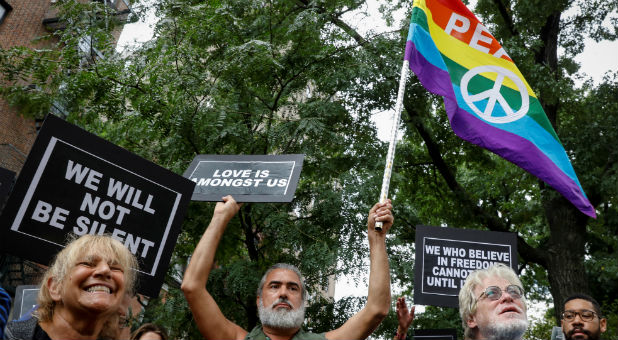
People gather outside the Stonewall Monument in New York City. (REUTERS/Brendan McDermid)
I recently spoke at a community college in Southern California, demonstrating that faith and science are not at odds. In posts leading up to the event, I was labeled a “hate pastor” as LGBT activists protested the event. Sadly, due to escalating campus protests across America, a number of sheriff deputies were on stand-by.
My wife and I were perplexed—when did a message of love become a message of hate? We love the LGBT community, and I wasn’t talking about this issue that evening. When my wife approached them, she was attacked verbally—from profanity to sexual innuendos.
Ironically, those who promote tolerance are often intolerant of those who disagree.
This experience, as well as an upcoming appearance on Fox News.com with Lauren Green to debate a pastor who supports homosexuality, prompted me to define the misunderstandings.
1. Tolerance “tolerates” differences; love embraces regardless of differences. In 2016, I received a call from a concerned sister whose brother was suicidal. The following day, I had the privilege of visiting him, a male prostitute, in North Hollywood. I spent two hours sharing God’s love, my prodigal story and hope in Christ. I left him feeling hopeful and encouraged.
A month later, I received a call that he had died in his sleep, possibly from complications of pneumonia. Just prior to his death, he told his family that he was reading my book, Desperate for More of God. Tolerance would not have motivated me to drive three hours round-trip, but love did. The message from his memorial is here. Judge for yourself—love or hate.
2. Challenging those with whom we disagree is often a characteristic of love, not hate. Parents confront, challenge and admonish daily. They don’t hate their children. Doctors and therapists challenge lifestyles that are high risk to help their patients. The reason it’s being labeled hate speech is to silence the messenger. In short, they don’t want to hear.
3. The Creator made His plan obvious. Jesus said that since the beginning of creation, God created them male and female in order that they would be joined together and become one flesh—to be fruitful and to multiply. He adds, “What therefore God has joined together, let not man put asunder” (Mark 10:9). Males and females were created purposely and are complementary by design.
4. The exceptions prove there is a rule. The question arises, “But not all married couples can have children; thus is procreation unnecessary? True, but this fact does not support homosexuality. Some are unable to conceive, and some have no desire for marriage or sex—exceptions do not void the rule. 1 Corinthians 7:2 is very clear that each man should have his own wife and each woman her own husband.
5. There is no scriptural support for homosexuality. Some argue, “The Bible is not an ethical textbook—culture changes and so does truth.” Not so. Not one moral law that God gave is obsolete, from adultery to fornication to homosexuality. Things that were harmful then are harmful now. They are never painted in a positive light. They caused deep pain then as they do now. Some have even suggested that Naomi and Ruth and Jonathan and David had same-sex relationships. This gives the phrase “grasping for the wind” new meaning. This is exegesis in its purest form—reading things into the text that are not there.
Some parents change their view when they find their son or daughter in an LGBT lifestyle; confused, they “accept” the lifestyle, but feelings are not a gauge for truth. Instead, offer hope and remind them that we all struggle with something. If a child sins in the area of anger, infidelity or addiction, we don’t change the Scriptures to fit their behavior; we offer hope in the midst of the struggle. Why should homosexuality or transgenderism be any different? No matter how many laws are passed in favor of gay marriage, it will not change God’s mind. Times change; truth does not.
6. The Bible is crystal-clear on the issue of sexual sin. As a famous teacher once said of the Bible, “If the plain sense makes good sense seek no other sense lest it result in nonsense.” I cringe every time I hear misguided statements in an attempt to support homosexuality, such as misinterpreting “abandoning natural relations” in Romans 1:26-28. Or that the sin of Sodom and Gomorrah was only neglecting the poor. Or that Corinthians is outdated and Leviticus is talking about rape. Indeed, neglecting the poor is/was a sin, but it was not the only sin. In addition to rampant homosexuality, they were drunkards, gluttons, covetous, profane and wicked. The context of Sodom and Gomorrah’s destruction was much more than neglecting the poor: “they were haughty and committed abominations.” (See Ezekiel 16 and Jude 1:5-8.) Additionally, early church fathers, as well as creeds and confessions and Reformers, all echoed the same truth.
7. God can advise against eating shellfish as well as homosexuality. Although the dietary laws of the Old Testament do not apply today, they are still beneficial. For example, we now know why things like pork and shellfish were forbidden—they are unhealthy. God’s wisdom is sound and purposeful in guiding relationships as well. Leviticus 20:13 states, “If a man lies with a male as he lies with a woman, both of them have committed an abomination …” Romans 1:24-26 says that homosexuality dishonors the body—an exchange of the truth for a lie takes place and they worship the creature rather than the Creator: “For this reason God gave them up to vile passions. For even their women exchanged the natural use for what is against nature (Rom. 1:26).
To suggest that these verses are invalid today because God also said to avoid shellfish or because it was the culture back then, is erroneous. I can tell my son not to place his feet on the table, and in the same sentence tell him not to play in the street—both “do not’s” are true even though the consequences differ.
8. The mocking tones of most pastors who support homosexuality speak volumes. A movement that truly is of God is undergirded with humility; words are seasoned with grace. But the opposite is often true with pastors who distort truth. One well-known pastor chided fundamentalists, “They are not fun and they are mental.” How foolish—the term fundamentals comes from essays constructed around 1905 covering the “fundamentals” of the faith. He is actually mocking the foundation of the faith.
Another leader made a shocking statement, “Our greatest spiritual problem has not been sin, it’s been shame.” Confused? So was I. Shame comes from sin. Many of these Christian leaders who support gay marriage only speak to their cheerleaders—they mock anyone who does not agree. I think of Jeremiah 23 often—they are teachers who alter God’s Word, avoid the difficult truths and encourage sin. Granted, arrogance and anger happen on the other side as well, but we don’t accept that behavior from either camp.
9. “I was born this way,” is not an excuse. Although new biological and psychological evidence suggests that the idea of being born gay lacks scientific support, let’s assume that a person can be born gay. We were all born with a bent to lie, cheat, lust, indulge and deceive. In fact, pornography has been coined “every man’s battle.” But that doesn’t make it right; it makes us sinful and in desperate need of a Savior. The hearts of men can change, and they change daily through a relationship with Christ.
10. The struggle for gay rights is not a civil rights issue. Race and color are not choices. Homosexuality is not a civil rights issue. It cannot be linked with the abolishment of slavery either. Some say, “The Bible encouraged slavery. Therefore, homosexuality is obviously OK now.” The Bible doesn’t say that slavery is “right”—it merely references a time when people had slaves and what those conditions were. [Dr. Michael Brown did an exceptional job of breaking down the civil rights issue here.]
In closing, there will be a time when we stand before God to give an account. Some may say, “Lord, I anchored my life in Christ. I believed Your Word and based my life on it as best that I could.” Others will say, “Lord, you gave me a new perspective … a new truth. Although Scripture once said that homosexuality is sin, I don’t think that applies now.” Whose shoes would you rather be in?
“When we become so tolerant that we lead people into mental fog and spiritual darkness, we are not acting like Christians—we are acting like cowards” (A.W. Tozer). We are so worried about offending others, but have we stopped to consider that we may be offending God?
*A sermon on these 10 points will be posted at WCFAV.org after Oct. 22, 2017.
Shane Idleman is the founder and lead pastor of Westside Christian Fellowship in Leona Valley, California, just North of Los Angeles. He recently released his seventh book, Desperate for More of God atshaneidleman.com. Shane’s sermons, articles, books, and radio program can all be found atwcfav.org. Follow him on Facebook at:facebook.com/confusedchurch.
Readers are Leaders! Subscribe now and get 3 magazines for the price of 1. Get Charisma, Ministry Today and SpiritLed Woman all for $24. YES – Sign me up!
3 Reasons Why you should read Life in the Spirit. 1) Get to know the Holy Spirit. 2) Learn to enter God’s presence 3) Hear God’s voice clearly! Click here to draw closer to God!
Topic: Unpleasant Chain Reaction — Wednesday October 18, 2017.
Text: Lamentation 4:13-22
Key Verse:“Rejoice and be glad, O daughter of Edom, that dwellest in the land of Uz; the cup also shall pass through unto thee: thou shalt be drunken, and shalt make thyself naked”(Lamentation 4:21).
Jesus was so much loved and adored by some inhabitants of Jerusalem in His triumphal entry that they were moved to cut down palm fronds, and lay them alongside their garments, on the ground as a token of their affection for Him. They had seen Him perform numerous miracles and deliverances. And so, they would have persisted in singing hosanna, as Jesus approached the temple. But the tide changed as a result of the fierce opposition of the chief priests and scribes, who persuaded them to betray Jesus before Pilate, and influenced the people to place a curse on themselves and their posterity. It was not as if the people were innocent either. In fact, it was to please them that the priests and prophets (who knew better) acted the way they did.
They not only shed the blood of their innocent children, whom they sacrificed to Moloch, but also the blood of the righteous men that were among them. They so polluted themselves with innocent blood that they made themselves odious to all observers, including the Gentiles who in turn cast aspersions and make mockery of them when they are visited with divine retribution. However, they were mistaken: God had not cast Israel off forever. If anything, He taunted the heathen in Lamentation 4:21. And so, for those who revel in the problems of others, alongside those that are instrumental to the calamities, sudden destruction looms.
Moreover, those who ridicule God’s people (the Church) will sooner or later be made a spectacle themselves. We ought not to gloat over the misery of others. Instead, we must recognize our mandate, as intercessors, to pray for the restoration of a straying brother or sister. Thought for the day: Deride not the fallen; learn from his fate. Bible Reading in one Year: 2 Kings 14-15
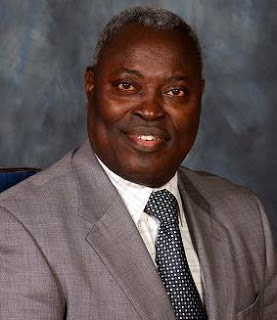
DCLM Daily Manna was written by Pastor William Folorunso Kumuyi; is the founder and General Superintendent of the Deeper Life Bible Church situated at KM 42 on the busy Lagos-Ibadan Expressway, Nigeria.
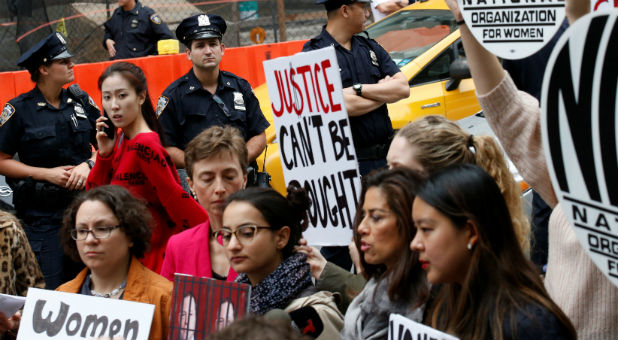
Women call for a criminal justice investigation into the Harvey Weinstein allegations. (REUTERS/Brendan McDermid)
A sad, revealing movement has risen out of the scandal surrounding Hollywood media mogul Harvey Weinstein. If you’ve been online the past two days, you’ve likely seen #MeToo across your social media feeds. The hashtag marks women who’ve been the victims of sexual assault or harassment at some time in their lives.
Among the #MeToo voices are prominent Christian leaders including Beth Moore, Alveda King and Karen Swallow Prior, as Charisma News previously reported. I applaud these women for speaking up. Their courage sends the message, “We are the church and we’ve been there too.”
The church is comprised of sinners and operates in a sin-sick world, therefore it is not immune to sexism and misogyny. We know the Christian journey isn’t a cookie-cutter path after we surrender our lives to Jesus Christ. We easily admit this when it comes to financial hardships, broken relationships and persecution for the faith. So why does it still feel taboo for Christians to admit they’ve been sexually victimized too?
I’ve written a lot about cafeteria-style Christianity, where some believers like to pick and choose which topics are relevant, as if the gospel is a buffet line. Note this is not just a temptation for progressive Christians. All of us are guilty of this at times. And for some reason, talk of rape, incest, and even emotional and physical abuse still cause us a measure of awkward discomfort.
It’s not that our small-group leaders, Bible teachers and pastors are implicitly denying or dismissing victims. I strongly believe most wish to compassionately and thoughtfully disciple victims through recovery. They just don’t know how.
With better training in godly counsel and understanding of trauma and defensive safeguards common to survivors of this abuse, local churches can be a place of shelter for victims’ recovery. Then congregants can say to victims outside of our sanctuary walls, “We’ve been through this too. Let’s process your pain together. And let me introduce you to our Savior’s transformative healing and grace.”
We shouldn’t wait until something like the #MeToo movement happens in mainstream culture to start talking about sexual assault and harassment. Instead of being reactionary, local churches can implement practical and prayerful ways to minister to victimized women and men inside and outside our sanctuary walls. It should be a part of our missional strategy.
Before we minister to the heart, Christians must first aim to care for a person’s basic needs, right? If you’re hungry, we feed you. If you’re naked, we clothe you. If you are sick or in prison, we visit you. How about if you’ve been violated and rejected, we counsel you? If you’re powerless, we protect you. If you’ve lost your voice, we advocate for you, and if you’re hurting, we support you.
Finally, the church should take the #MeToo movement seriously, lest we tarnish our public witness for Jesus Christ.
A young woman very close to me was raped at 15 years old by a young man she considered her good friend. During her attack, she cried out to God for help. Having grown up in a Pentecostal church her whole life she couldn’t understand why the Holy Spirit did not intervene and for what purpose she had to endure such a traumatic assault. She grew angry with God and frustrated with her church members’ failure to answer her questions and minister to her wounds.
Every day I pray for this young woman’s return to the church. Her story serves as a reminder our love for sisters, friends and neighbors should compel us to remember it takes work to be triumphant, and the church’s witness is a shining light in the darkest places. As Matthew 5:14 tells us, “You are the light of the world. A city that is set on a hill cannot be hidden.”
They eyes of a fallen world are watching us. They must see the church serves to protect victims, not create more.
Chelsen A. Vicariis the evangelical action director at the Institute on Religion & Democracy.
Readers are Leaders! Subscribe now and get 3 magazines for the price of 1. Get Charisma, Ministry Today and SpiritLed Woman all for $24. YES – Sign me up!
3 Reasons Why you should read Life in the Spirit. 1) Get to know the Holy Spirit. 2) Learn to enter God’s presence 3) Hear God’s voice clearly! Click here to draw closer to God!
Topic: Turn Back To God – Wednesday October 18, 2017.
Luke 22:32“But I have prayed for thee, that thy faith fail not: and when thou art converted, strengthen thy brethren.”
Text: Luke 22:32
The concept of “conversion” is mentioned in the Holy Scriptures at least 14 times. The basic meaning of the term is a turning or returning to God. This implies a turning away from sin and a turning to God. Repentance and putting faith in God are corresponding synonyms to conversion. The theological basis for conversion lies in the truth of the “atonement.”
Although man lapses into sin, the truth of the atonement remains. When men turn to God in repentance and faith, the effects of the atonement – reconciliation and forgiveness – avail.
The apostle Paul expresses the act of conversion in this way: “Turning to God from idols to serve the living and true God” (1 Th. 1:9). Also, “to open their eyes (the Gentiles), and to turn them from darkness to light, and from the power of Satan unto God, that they may receive forgiveness of sins, and inheritance among them which are sanctified by faith that is in me” (Jesus) (Acts 26:18).
Jesus instructed Peter to get back into ministry after he repented of his denial. If Jesus had not given Peter this command, many people might have doubted that Peter should be in a position of leadership. Indeed, Peter himself must have doubted whether or not he was fit. After Jesus’ resurrection, the Lord again admonished Peter three times to serve Him by ministering to His sheep.
In the context of Luke 22, Peter’s faith was shaken and he denied the Lord but did not reject Him. Jesus’ admonition to Peter was that when he turned back again to Him (converted), he was to strengthen the brethren.
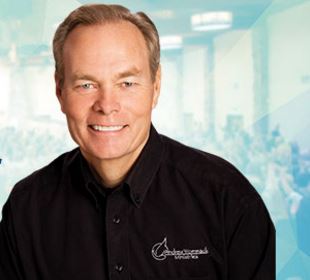
This message was written by The Association of Related Ministries International (ARMI) is an extension of Andrew Wommack Ministries (AWM). ARMI is a unique partnership committed to providing resources to help like-minded ministers succeed in a spirit of excellence and to draw from the experience and expertise of both the AWM and Charis Bible College staff. (www.awmi.net).
Topic: Blessed Are Peacemakers [Wednesday October 18, 2017]
I will both lay me down in peace, and sleep: for thou, Lord, only makest me dwell in safety. — Psalm 4:8
In a materialistic world which has tried to sever diplomatic relations with God, we have nowhere to retreat except within ourselves. We are like turtles in a traffic jam—the best we can do is to pull our heads into our shells and shut our eyes. But that’s a good way to get the life crushed out of us, as any dead turtle can attest. Man’s conflict with man has been but an expression on the human level of his conflict with God. Until man finds an armistice with God, he cannot know peace with his fellowman. If we are to be peacemakers, we first must make our peace with God.
Prayer for the day: In Jesus’ name, I have found peace with You, Father. My soul praises Your holy name.
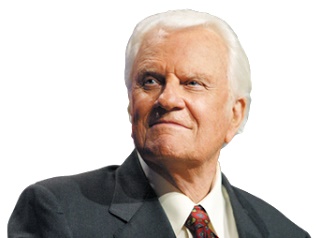
Written by Billy Graham, Founder of Billy Graham Evangelistic Association(BGEA). BGEA exists to proclaim the Gospel of Jesus Christ by every effective means and to equip the church and others to do the same.
Topic: From Tradition to Truth [Wednesday October 18, 2017]
Bless the Lord, O my soul, and forget not all his benefits: who forgiveth all thine iniquities; who healeth all thy diseases; who redeemeth thy life from destruction; who crowneth thee with lovingkindness and tender mercies; who satisfieth thy mouth with good things; so that thy youth is renewed like the eagle’s. – Psalm 103:2-5
Is there actually a divine purpose behind the bad things that happen in your life? Could it be that the sicknesses and calamities you experience are somehow a part of God’s plan for you? Before you can ever begin to experience the healing, delivering power of God, you’ve got to know the answer to those questions. You have to settle them once and for all. If you even suspect that God is the source of your misfortunes, you won’t be able to believe Him for deliverance from them. Your faith will be crippled because you’ll think that by escaping those things, you’ll be opposing His will.
In order to receive all the benefits God desires to give you, you must be absolutely sure that He is a good God. You must be certain that His will for you is health, not sickness; prosperity, not poverty; happiness, not sorrow—100 percent of the time! Psalms 103 alone is enough to prove that’s true. But if it’s not enough to convince you, there are many others too. One of the best known verses is Psalms 136:1 that says, “O give thanks unto the Lord; for he is good: for his mercy endureth for ever.”
If religious traditions have robbed you of the goodness of God, if they’ve taught you He brings trouble into your life so He can teach you something, start today washing those traditions away with the truth. Get out your Bible and let God Himself tell you through His own Word that He is the God who heals you (Exodus 15:26). Dig in to the Scriptures and discover for yourself that He is a God of mercy (Psalms 86:5), lovingkindness (Jeremiah 9:24), and compassion (Psalms 145:8).
Put your doubts to rest and open your heart to receive the truth about your heavenly Father. It’s the only thing that can truly set you free.
Scripture Reading: Psalm 89:1-28
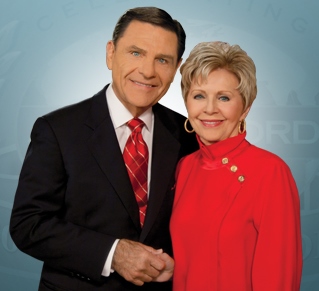
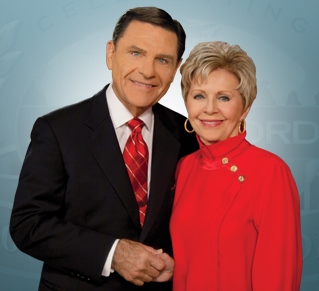
This message was written by Kenneth and Gloria Copeland, the leader of the Kenneth Copeland Ministries (www.KCM.org) that specializes in teaching principles of bible faith – prayer, healing, salvation and other biblical topics.
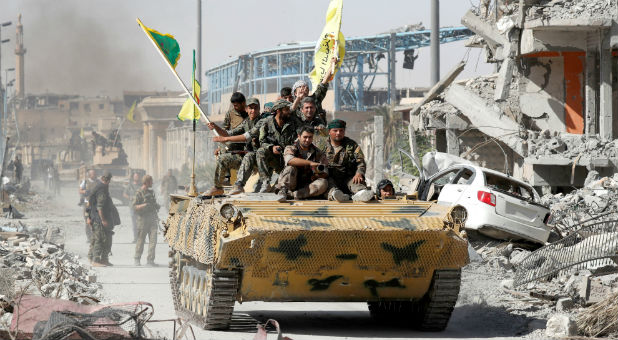
Syrian Democratic Forces (SDF) fighters ride atop of military vehicle as they celebrate victory in Raqqa, Syria. (REUTERS/Erik De Castro)
Join us on our podcast each weekday for an interesting story, well told, from Charisma News. Listen at charismapodcastnetwork.com.
U.S.-backed militias in Syria have declared victory over Islamic State in its capital Raqqa, a milestone in the fight to roll back the theocratic “caliphate” declared in 2014..
Here are facts about Raqqa:
The City
Raqqa sits on the Euphrates river around 90 km (56 miles) from the Turkish border in north central Syria.
Sunni militant group Islamic State overran Raqqa in January 2014, seizing control from rebel factions opposed to the rule of Syrian President Bashar al-Assad.
The United States has said Islamic State planned and sent teams from Raqqa to carry out attacks on cities including Paris, Brussels and Istanbul.
The Anti-IS Offensive
The Syrian Democratic Forces (SDF), an alliance of mostly Kurdish and Arab militias, began to advance towards Raqqa city in November 2016. After encircling the city, they launched the offensive to take it, facing tough resistance.
The United States-led coalition supported the SDF with air strikes and special forces on the ground.
Its People
The battle for Raqqa has taken a severe toll on civilians.
The United Nations said in March the city contained around 200,000 people, just under its pre-war population.
Since late last year, fighting around and in Raqqa has displaced tens of thousands of people. Many have fled the city to camps in surrounding territory now under the control of the SDF and its strongest component, the Kurdish YPG militia.
Civilians who were trapped inside the Islamic State enclave in the city endured miserable conditions for months, lacking water, power, food and healthcare. As the SDF captured parts ofRaqqa they were mostly been cleared of residents.
Air strikes, fighting and Islamic State snipers and mines have killed many hundreds of people.
The coalition says it is careful to avoid civilian casualties in its bombing runs in Syria and Iraq. But the U.N. human rights office and rights group Amnesty International have raised concerns about reports of high civilian deaths.
Islamic State imposed its very strict interpretation of Islamic law on Raqqa’s residents. The fighters have carried out public executions, lashings and violent punishments for infringements of their rule.
After the Fighting
The Raqqa campaign has stirred tension between the United States and NATO-ally Turkey. Potential Kurdish influence in the future of the mainly Arab city is sensitive both for some activists from Raqqa and for Turkey.
The YPG has become the main U.S. partner in the fight against Islamic State in northern Syria. Ankara views it as a Syrian extension of the Kurdistan Workers Party (PKK), which has waged a three-decade insurgency within Turkey, and fears growing Kurdish power along its border.
The SDF’s political allies have set up a Raqqa Civil Council of people from the city, which the SDF has said it will hand control to after Islamic State’s defeat. This echoes the pattern in other towns and cities that the SDF captured.
The U.S.-led coalition has helped train a new police force for the city.
Islamic State has made enemies of all sides in the more than six-year Syrian conflict, with separate offensives now trying to clear it from its last foothold in the towns along the Euphrates river in eastern Syria near the Iraqi border.
Besides the U.S.-backed SDF, the Syrian army, with Russian jets and Iran-backed militias, is also waging its own campaign against Islamic State in eastern Syria.
Heritage
A modern-day provincial transport hub and market town, Raqqa was built by the Abbasid Islamic Caliphate in the eighth century, serving as its capital at one point.
It has been inhabited since antiquity and contains important archeological and architectural sites. The United Nations has said they have been extensively looted during the war and religious buildings have been damaged.
Islamic State militants released a video of them bombing a large part of the Uwais al-Qarani shrine complex in March 2014.
Readers are Leaders! Subscribe now and get 3 magazines for the price of 1. Get Charisma, Ministry Today and SpiritLed Woman all for $24. YES – Sign me up!
3 Reasons Why you should read Life in the Spirit. 1) Get to know the Holy Spirit. 2) Learn to enter God’s presence 3) Hear God’s voice clearly! Click here to draw closer to God!
We use cookies to ensure that we give you the best experience on our website. If you continue to use this site we will assume that you are happy with it.