
Jim Denison on A Holy Tuesday Invitation to a Fath That Will Change Your Eternity

The brightest supermoon of the year: A Holy Tuesday invitation to risk-taking faith that changes eternity

Many of us are praying for British Prime Minister Boris Johnson to recover from COVID-19 after he was moved to intensive care yesterday. As of this morning, he is not yet on a ventilator but is receiving oxygen support.

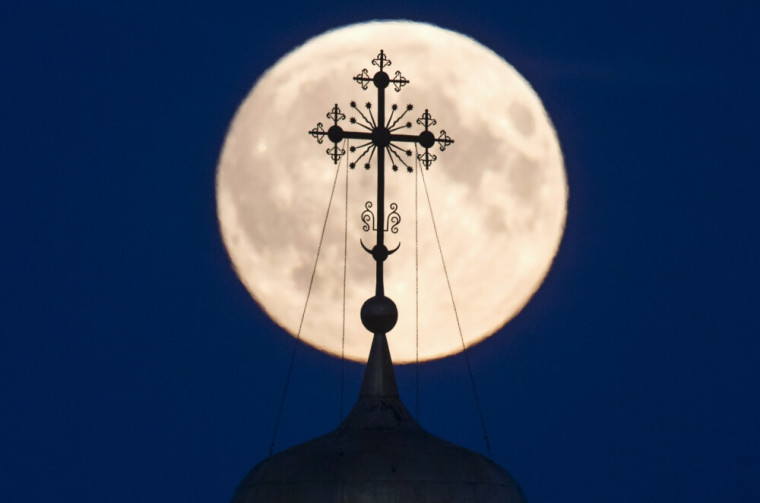
Meanwhile, the “biggest, brightest supermoon of 2020” is rising tonight. April’s full moon is a supermoon, meaning that it is full while also in perigee (its closest approach to us). During a supermoon, the moon is about 14% larger and 30% brighter than a normal full moon.

The April full moon is called the “pink moon” because it coincides with the blooming of the moss pink wildflower. The best time to view it will be tonight after the sun goes down.

A trick question and a transforming answer 

On Holy Tuesday, Jesus returns to the now-cleansed temple to teach the people. His enemies cannot find a way to arrest him due to His popularity, so they try to lure Him into committing blasphemy and defaming Himself before the crowds.

Among their attempts is this question asked by a lawyer: “Teacher, which is the greatest commandment in the Law?” (Matthew 22:36). If Jesus names one of their 613 laws, they will accuse Him of rejecting the others.

Our Lord replies: “You shall love the Lord your God with all your heart and with all your soul and with all your mind. This is the great and first commandment. And a second is like it: You shall love your neighbor as yourself. On these two commandments depend all the Law and the Prophets” (vv. 37–40).

SOURCE: Christian Post, Jim Denison

All Content & Images are provided by the acknowledged source

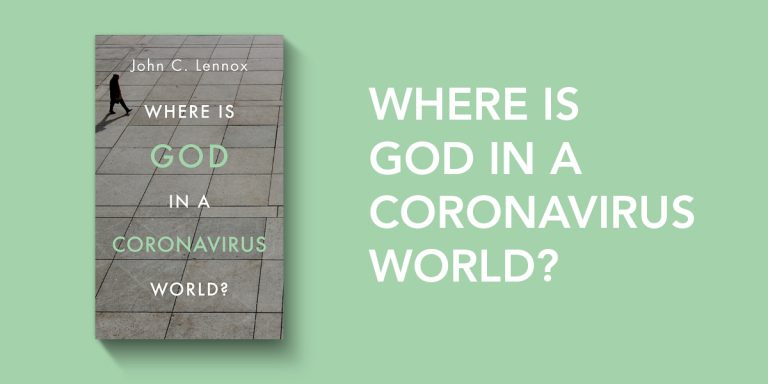
Mathematician John Lennox Believes Coronavirus Pandemic is a ‘Huge Loudspeaker’ Forcing Humanity to ‘Look to the God We Might Have Ignored for Years’

Acclaimed mathematician and philosopher of science John Lennox believes the coronavirus has forced an opportunity for humanity to wrestle with life’s deepest questions, to find God amid heartbreak.

In a video interview with Kharis Productions CEO Iain Morris, Lennox elaborated on themes he explores in his new short book, Where is God in a Coronavirus World?

When the disease first began to spread, Lennox knew the number of cases would grow exponentially, he said, noting his knowledge of statistics.

“I thought this is going to be utterly unique and devastating. And I thought, ‘Look, I’m locked down. I need to think about how to speak into this situation,” he explained.

It took Lennox approximately one week to write the book, spending eight to 12 hours per day on it.

In one of the chapters, he addresses a common objection to the Christian faith, namely, “How can there be a loving God who presides over human suffering?” relating it specifically to the coronavirus.

The atheist solution to this quandary is this is essentially “we’ve got what we’ve got so we have to put up with it,” he surmised, but that falls short.

“Atheism actually removes the very concept of good and evil. So there’s no point in calling this kind of thing natural evil, this disaster, if there is no such thing as evil,” the Christian apologist said.

Furthermore, he asserted, atheism removes any possible hope.

Yet the Gospel provides hope because it speaks about a God well-acquainted with suffering; at the heart of the Christian faith is God on a cross.

SOURCE: Christian Post, Brandon Showalter

All Content & Images are provided by the acknowledged source
Brian Stiller on How Early Christians Handled Their ‘Coronavirus’

Today, most of us sit confined in our homes, unsure of how widespread the COVID-19 virus is in our community, our country, or the world. I frequently open the app counting the global statistics and try to understand what life is like in places where the virus is creating unimaginable havoc.

Some have sarcastically dismissed the virus as being a political foil. Now such silliness is sobered by reality. Others try to spiritualize this pandemic, as if it is God’s punishment for our erring ways.

Today’s “New Normal”

We aren’t the first Christians to face a global pandemic. In fact, now is a good time to learn how we might deal with this world-being-shut-down crisis. Those in the early church faced two life-threatening epidemics within its first 200 years. The first was in 165 A.D., in which up to one-third of Roman citizens died, and the second was in 251 A.D.

My point in noting these early Christians is for one basic reason: that we will choose hope over confusion, humility over arrogance, empathy over self-interest, faith over fear. So that in recognizing our frail humanity, we will welcome the pervading presence and life of the Spirit to assert God’s will over our own distractions, providing us with a different way in which we view and make sense of what for too many is an existential reality.

Instead, let us see today and tomorrow through the prism of God’s grace and love.

Learning from the Early Christians

In these second and third-century catastrophes, Christians, who were then just a very small minority, exerted extraordinary impact on their societies. Facing headwinds of human devastation, they wasted no time, nor spared personal effort, to care for those struck down by those deadly pathogens.

Sociologist Rodney Stark in The Rise of Christianity[i] notes that in the midst of human calamity, the Christian community survived and thrived. He suggests three reasons for this.

First, Christians laid themselves down, even to death, and comforted those who were dying, bringing solace to those afflicted by the deadly contagions.

In so doing, Christians won approval from those who had seen them as a cult or a heresy. With their extraordinary acts of kindness, Christians were then viewed as a caring community and their faith taken more seriously.

The first of these massive epidemics was smallpox (it is surmised) during the reign of Marcus Aurelius in 165 to 180. A hundred years later another destructive epidemic hit (it may have been measles), resulting in a massive loss of life.

However, the extraordinary response from Christians contributed to an unprecedented growth of the church. While pagan religions and various forms of Greek philosophy provided a means of solicitating and appealing to various gods, Christians “offered a much more satisfactory account of why these terrible times had fallen upon their societies. And they projected a hopeful and even enthusiastic portrait of the future.”

Second, Christians bolstered by their faith seemed to endure hardships better than others.

So, when:

…disasters struck, the Christians were better able to cope, and this resulted in “substantially higher rates of survival” (Stark). This meant that in the aftermath of each epidemic, Christians made up a larger percentage of the population, even without new converts.

Third, Stark reasons that in such a widespread epidemic, “large numbers of people, especially pagans, would have lost the bonds that once might have restrained them from becoming Christians.

Additionally, the amazing survival rate of Christians offered evidence that this disreputable group called Christians should be looked at again. In any case, the number of conversions was substantial. Even in those early days, Cyprian, bishop of Carthage (North Africa), in writing about the 251AD epidemic noted, “…this mortality…has especially accomplished this for Christians and servants of God, that we have begun gladly to seek martyrdom while we are learning not to fear death.”

While the world is constrained by fear, we take on a different posture. We observe facts and listen to scientists, those who are gifted to us by God to make us wise. We then take their analysis and see it through the eyes of our eternal and caring God, always framed by hope. He is our platform from which we observe and respond.

Source: Christianity Today

All Content & Images are provided by the acknowledged source
Rock Church in California Helping Fight Coronavirus by Assembling 300,000 N95 Masks

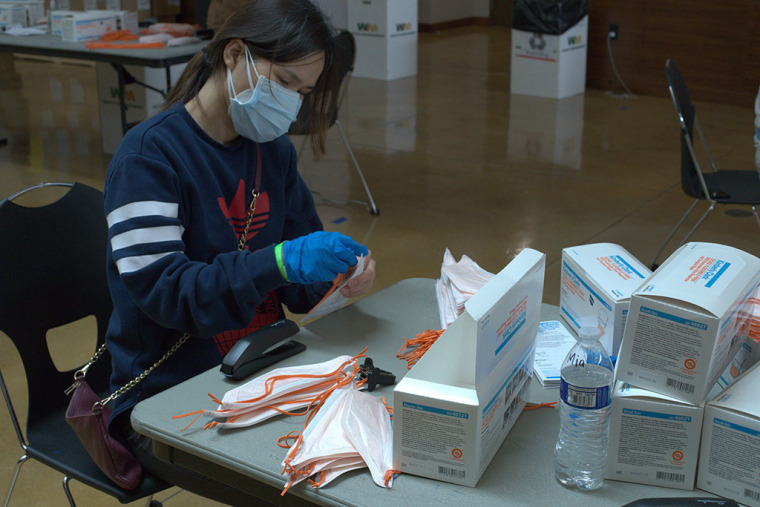
As the number of the new coronavirus cases continues to rise, volunteers from California’s Rock Church are helping replace the elastic bands on 300,000 N95 masks stored at the County of San Diego’s Medical Operations Center that are beyond the manufacturer’s recommended date.

San Diego’s Medical Operations Center had these masks stored in its warehouse but they could not be given to healthcare workers because they are beyond their manufacturer’s date and need new elastic bands to secure them, the church said in a statement, explaining that the Centers for Disease Control and Prevention has approved their use during this pandemic when they are not physically damaged.

“The respirator is still fully functional and meets CDC requirements for usage,” and once the elastic is replaced and tested, the masks will be used by doctors, nurses, other healthcare workers and patients across the county.

The replacement elastic is being provided by the Medical Operations Center, the church said.

The volunteer effort, in partnership with San Diego County’s Office of Emergency Services, could save the county $1 million, according to The San Diego Union Tribune.

The volunteers, all of whom are older than 18 and started replacing the elastic bands last Wednesday, have gone through a health screening and are practicing social distancing.

Rock Church pastor Miles McPherson said that volunteers will work for two to three weeks at its locations in Point Loma, City Heights, El Cajon and San Marcos. “It’s really just a matter of coming alongside, giving the most practical help we can give. This is an honor to help nurses and doctors,” he said.

SOURCE: Christian Post, Anugrah Kumar

All Content & Images are provided by the acknowledged source
China Bans Churches from Streaming Services, Even during Pandemic

China Bans Churches from Streaming Services, Even during Pandemic


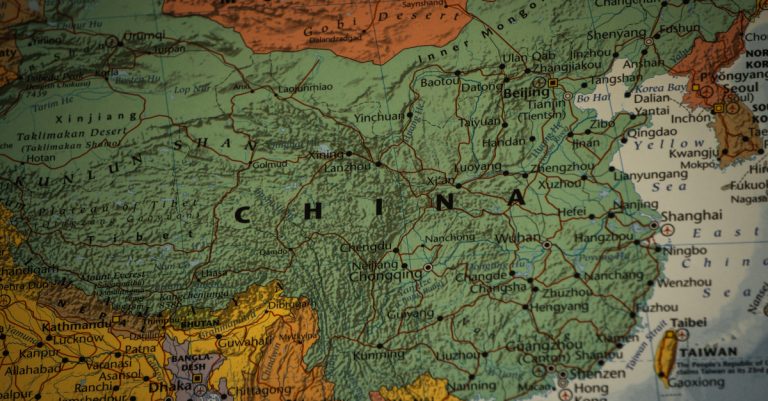
Churches around the world are staying in contact online during the COVID-19 pandemic, but such an action remains illegal in China.

The watchdog Bitter Winter reported April 5 that very few organizations, and “only those that hold state-issued licenses,” can stream religious services online in China.

“We can’t get together because of the pandemic,” an underground house church pastor in the province of Jiangxi told Bitter Winter.

The pastor tried to stream a sermon Feb. 9 through an app, but was stopped.

“Our first and only online gathering was blocked by the government soon after it started,” the preacher said.

That same day, another house church pastor, in the province of Shandong, also tried to stream online services.

“The meeting was stopped less than 20 minutes after the start,” Bitter Winter reported.

A 2018 Chinese law bans streaming services.

“No organizations or individuals will be allowed to live-stream or broadcast religious activities, including praying, burning incense, ordinations, scripture chanting, holding Mass, worshipping or receiving baptism online in the form of text, photo, audio or video,” the law says.

On Feb. 23, the government-approved Two Chinese Christian Councils of Shandong Province issued a notice “demanding all churches in the province to stop live-streaming their services immediately,” Bitter Winter reported.

On Feb. 28, the United Front…

… Read More

Click here to read the rest of the story from our content source/partners – Christian Headlines.

قالب وردپرس

Mexico’s Persecuted Protestants Lack Simple Coronavirus Defense

While many people around the world are reaching for soap, water, and antibacterial hand gel to prevent the transmission of the new coronavirus, Angelina does not have that luxury.

Her family and a neighboring family had their access to water and sewage services cut off by local authorities in January 2019. Fifteen months later, they still have no access.

All in an attempt to force them to renounce their Protestant faith.

As of April 2, Mexico had reported more than 1,500 cases of COVID-19, with 50 confirmed deaths. Just three days prior, the government announced a national health emergency, suspending non-essential activities, banning gatherings of over 50 people, and encouraging the population to “stay at home for as much time as possible.”

Angelina, 50, with her three adult children, lives in the central state of Hidalgo, which reports 26 confirmed cases, 3 deaths, and a further 65 suspected cases. With this number all but certain to climb in the coming days, her family and others like them lack access to one of the first lines of defense against this invisible threat.

One of the most common violations of religious freedom in Mexico is the cutting of access to basic services, including water and electricity. On January 14, 2019, authorities cut water and sewage services to two Protestant families in the primarily subsistence farming village of La Mesa Limantitla in the Hidalgo municipality of Huejutla, after Angelina and the others asked to be excused from obligatory financial contributions and community work linked to the celebration of Roman Catholic festivals and activities. Today, they are no longer recognized as members of the community and must walk half a mile to access water.

In addition to depriving religious minorities of access to basic services, even education, women within these groups can be singled out for particularly harsh treatment.

In the case of La Mesa Limantitla, Angelina was simultaneously stripped of her position as the community representative for Bienstar, a government well-being program. She was systematically ostracized and left without support after the local authorities threatened to cut other community members’ access to basic services if they visited her during her recovery from a hysterectomy in July 2019. Angelina told CSW, a UK-based religious freedom advocacy group, that as a result, no one visited her or offered support following the operation.

Angelina’s daughter-in-law, who was living with her as her caregiver after the surgery, was forced to return to her own home in the community because she was pregnant and could not continue without access to water and sewage services, leaving her mother isolated and alone.

Lack of access to clean water can lead to serious health issues such as malnutrition, diarrhea, and gastrointestinal disorders, creating a burden for those who are targeted as well as for those who care for the sick. The coronavirus pandemic is a real concern for many, but is of particular concern to those without basic sanitation.

Source: Christianity Today

All Content & Images are provided by the acknowledged source
Rachel Jones on When I Was a Health Risk to Society

Rachel Pieh Jones works and writes in East Africa. She is the author of Stronger than Death: How Annalena Tonelli Defied Terror and Tuberculosis in the Horn of Africa and writes the “Stories from the Horn” newsletter.

When I was radioactive, I carried a card in my wallet to explain why I set off alarms at the airport with my body. The card read, “Rachel Jones has undergone nuclear medical treatment.”

I keep the card in my wallet, even though I no longer need to show it at airports. I love the card and I hate it. I love it because it says I had nuclear treatment, which simply sounds awesome. I hate it because that awesome-sounding treatment didn’t give me the ability to fly or glow in the dark. I love it because not everyone gets to step through an airport scanner and explain to the TSA staff why their body is lighting up the screen and that makes me feel special. But I hate it because it means I have cancer, which also makes me feel special, but not in a good way.

I have thyroid cancer. I had a total thyroidectomy followed by radioactive iodine treatment, which meant the pill a nurse delivered inside a lead container and only touched with gloved hands and a pair of tongs, I put into my bare palm and then into my mouth and swallowed. There was nothing epic or momentous about the moment of swallowing the little pill, other than the Imagine Dragons song Radioactive, which echoed on endless repeat in my mind.

I took the pill, walked out of the hospital, drove home, retreated to the basement, and isolated myself for three days from all humans and animals, hoping that the cancer would die.

I was now a danger to society. As my body leaked radioactivity, I could damage someone else’s body simply by proximity. No touch, no shared space, no common utensils or toilets. Everything I touched needed to be scrubbed down, the space in which I breathed needed to be ventilated. No one could come within eight feet of me.

The COVID-19 response has evolved from disrupting vacations and air travel to shutting down schools and prompting “shelter at home” decrees. People are isolating at home the way I self-isolated in my parents’ basement. Being radioactive didn’t give me a fever, and wearing a mask wouldn’t have made a difference for me, but I needed to avoid human contact. It was my body, not just my breath, that was dangerous.

The fact of my body as danger made me think not about the people wearing the masks but the people they are protecting themselves from. The sick. The contagious. Coronavirus. Radioactivity. Me.

In the New Testament, Jesus touched lepers (Matt. 8:1–4). He embodied culturally subversive compassion and fearlessness around contagious disease. People could judge and shun him for touching the untouchables. They might not want to share a communal plate at mealtime with him. They might decide he was foolish or reckless.

But Jesus didn’t care what others thought. He challenged them to choose to love, even at risk to themselves. I’m not saying we need to forget about social distancing. Jesus had miraculous powers both to heal and to protect himself from contagion that none of us have. Still, it is worth noting this counter-cultural behavior.

I used to think about the joy and awe the lepers must have felt as healing power swelled through them. But what I rarely thought about is what it must have felt like for the sick to know that their bodies, their own selves were dangerous. That the simple act of being in the presence of someone they loved put that person at risk.

My own sense of shame was real, though cancer and treatment were not my fault, just as contracting COVID-19 is not the patient’s fault no matter their nationality or ethnicity, no matter what country they are in or came from or traveled through.

Fault or no, the fear that I would harm someone I loved was real. The waves of guilt pounded me: because of me, my family couldn’t do laundry in the basement, they needed to avoid part of the house, and the medical bills for this treatment piled up while I watched Netflix alone.

Source: Christianity Today

All Content & Images are provided by the acknowledged source
Engaged Christian Couples Face Unique Moral Challenges With the Coronavirus

Sophia Lee thought she’d be heading to the altar next month. She had the dress, the rings, and two plane tickets for a honeymoon in Eastern Europe. Instead, she and her fiancé, David Hermann, are in a holding pattern. The couple is sheltering in place in Los Angeles, preparing to watch their April 25 wedding date come and go. Like fellow engaged couples the world over, their wedding plans have gone the way of the polite handshake—that is to say, up in smoke.

Back in mid-March when the Centers for Disease Control and Prevention first recommended people avoid gatherings of 10 or more, Lee and Hermann, both Christians, made the tough call to cancel their large wedding ceremony. Lee, a senior reporter for World magazine, had already known for a few weeks that her extended family from South Korea would probably be unable to make the trip. So she and Herrmann made the gut-wrenching decision to plan for a smaller wedding with just their local pastor.

They figured they’d have a small ceremony, forgo their planned trip to eastern Europe, and opt for an Airbnb in Sequoia National Park, where they could honeymoon on a smaller scale and quietly grieve their best laid plans. But even that option now seems unlikely.

Situations like theirs are unfolding all over. Couples who had planned weddings even into the summer are grappling with a world totally unlike the one they knew when the engagement ring first sparkled in the light. Travel restrictions mean out-of-town guests are off the list. Large venues are closed. Some couples are postponing their wedding, while others are moving forward with small ceremonies. Some are even heading to the courthouse, if the courts are still open.

Whether to postpone or cancel a wedding is an especially tough decision for Christians, who are committed to living apart and being celibate until after the wedding.

Alex and Alexa McMahan had been planning a March 22 wedding in Winter Park, Florida. As more and more guests canceled and news of the virus devoured feeds, Alex and Alexa chose to transform their 120-guest event into a small outdoor ceremony in front of just 30 close family members and friends. The rest were invited to watch a livestream of the ceremony on YouTube.

Alexa said that was crucial, especially for her grandparents, whom she and Alex had originally invited to be their “flower girl” and ring-bearer. Alexa suspects they might have risked traveling to the ceremony had the livestream not been available.

The McMahans never considered postponing. “We had decided no matter what happens, we’re definitely going to get married this weekend,” Alexa said.

She and Alex met in 2018 on match.com and have lived apart for the duration of their relationship, Alex in Ohio and Alexa in Florida. They agreed not to live together before the wedding, which factored into their decision to forge ahead despite the pandemic. “I had left my job, and my lease was ending in May,” Alexa said. “And I’m in the process of applying to graduate school in Ohio. It was kind of like, we want to get in the same place and get settled.”

As couples like the McMahans scramble to make difficult decisions, their pastors are problem solving on the fly, too. Ashley Wooldridge is senior pastor at Christ’s Church of the Valley, a ten-campus church with 35,000 regular attendees in the Phoenix area. He said he’s counseling couples not to cancel their weddings.

“We’re just trying to come back and center couples on the vow they’re making before God, and that they can still do that in a smaller ceremony,” he said. “We’re doing a lot of backyard weddings right now.”

Wooldridge said he understands the emotional weight of making drastic changes to what have been, in some cases, lifelong wedding dreams. Still, he believes the crisis could be a blessing. “What an opportunity during this time to say, ‘Let’s go back to what the absolute most important thing about a wedding is, and that’s the covenant you’re making.’”

Source: Christianity Today

All Content & Images are provided by the acknowledged source
Max Lucado on Surviving April

This isn’t the April we wanted.

We wanted spring training. We wanted to go to church on Easter Sunday. We wanted a weekend trip to see the spring flowers. We wanted the Masters golf tournament. I love the Masters. I don’t just like it, I love it! I keep pictures of Amen Corner on my computer screen. I love April.

But this April? This isn’t the April we wanted.

But this is the April we’ve been handed: daily reports of disease and death. An economy that’s in freefall. Dwindling supplies. Another 30 days of distance and isolation. And, most of all, a month of fear. We fear for our family. We fear for the health of our health workers. We fear this microscopic, COVID-19 culprit that stalks our streets like a thief.

So we need to brace ourselves. Adjust our expectations. April as we wanted will not happen. God willing, it will reappear in 2021. But the 2020 version? It’s time for a deep breath, a steady resolve and a few decisions. I’m thinking of three essential, emotional tools.

Gratitude. Collect your blessings. Catalog God’s kindnesses. Assemble your reasons for gratitude and recite them. “Always be joyful,” the Apostle Paul wrote in his letter to the Thessalonians. “Pray continually, and give thanks whatever happens. That is what God wants for you in Christ Jesus.”

Look at the totality of those terms. Always be joyful. Pray continually. Give thanks whatever happens.

Gratitude is always an option. Matthew Henry made it his. When the 18th-century British minister and scholar was accosted by thieves and robbed of his purse, he wrote in his diary, “Let me be thankful, first because I was never robbed before; second, because, although they took my purse they did not take my life, third, because although they took my all, it was not much; and, fourth, because it was I who was robbed, not I who robbed.”

Quarry some gratitude. And, be kind to others. Be the family member who offers to wash the dishes. Be the colleague who reaches out to check on the team. Be the neighbor who mows the grass of the elderly couple.

You’ll be better because of it. Research bears this out. Studies have shown that giving to help others triggers dopamine. (New fundraising slogan, perhaps?) When volunteers wearing a functional MRI scanner were told they would be giving money to charity, the areas of their brains associated with pleasure — like food and sex — lit up like Christmas trees.

Seeking joy? Do good for someone else. It really is better to give than receive.

It’s time for gratitude. It’s time to serve others and it’s time for determination. Good, old-fashioned grit, a resolve that says, “I’m not giving in to fear. I’m not caving in to despair. With God as my helper, I’m going to weather this storm.”

Source: Religion News Service

All Content & Images are provided by the acknowledged source
‘This Is a Result of a Fallen World,’ Franklin Graham Says of the Coronavirus Pandemic

‘This Is a Result of a Fallen World,’ Franklin Graham Says of the Coronavirus Pandemic


Franklin Graham says the coronavirus pandemic is happening because of sin in a “fallen world” that has “turned its back on God.”

Graham, an evangelical leader and president of the organization Samaritan’s Purse, said in an interview with Fox News’ Jeannie Pirro that the pandemic is a “result” of the “fallen world.”

“This pandemic, this is a result of a fallen world, a world that has turned its back on God,” Graham said in the interview. “So I would encourage people to pray and let’s ask God for help.”

Pirro also asked Graham what he says to people asking the question of why God would allow the coronavirus outbreak to happen?

“I don’t think that God planned for this to happen,” he responded. “It’s because of the sin that’s in the world. Man has turned his back against God. We have sinned against Him. We need to ask for God’s forgiveness.”

Graham also talked about the emergency field hospital that Samaritan’s Purse had set up in New York City’s Central Park.

New York City is one of the hardest-hit cities with the coronavirus. As of Monday, there are more than 67,550 confirmed cases of the virus and some 3,000 related deaths.

As Christian Headlines previously reported, Samaritan’s Purse opened the 68-bed respiratory care unit on April 1. The unit is staffed with some 70 doctors, nurses and other medical workers. There are also…

… Read More

Click here to read the rest of the story from our content source/partners – Christian Headlines.

قالب وردپرس