Christians in China Set Good Example of How to Deal with Coronavirus Plague

The COVID-19 crisis may be over in China, but local believers are sharing with Christians in countries still going through it. For MNN coverage on the coronavirus click here. For the Prayercast video, click here.

Christians in China now pray for us, according to Kurt Rovensteine of Bibles for China. While the COVID-19 virus originated in China, the country has long seen the outbreak declining. Last week, China actually started reporting no new domestic cases. The cases they do see are imported.

Bibles for China works with the local Chinese church to provide free Bibles for Christians in country. Many of their partners have reached out as things in the country get back to normal. Rovenstine says Christians in China are praying for fellow believers in other countries hit hard by the virus.

What are Christians in China sharing with their brothers and sisters? Practical things, Rovensteine says. “Just be careful. [Be] cautious of travel and those kinds of things. But it’s always about the attitude of prayer and trusting God. And I think . . . their level of faith that God’s got this thing under control, even when it seems like we don’t [is very encouraging].”

SOURCE: Mission Network News, Kevin Zeller

All Content & Images are provided by the acknowledged source

How to Close the Inequality Wealth Gap According to 5 Black Women in Finance

The United States has long been seen as a land of economic opportunity. And the numbers suggest that’s true. Nowhere in the world is home to more millionaires than America, with more than 18 million people boasting a seven-figure net worth as of October 2019. But while that figure reflects America’s considerable wealth, other statistics paint a less positive financial picture.

For example, in 2018, families whose household wealth fell between the 50th and 90th percentiles accounted for just 1% of America’s total wealth. But wealth—the value of a person’s total assets minus the value of their total liabilities—isn’t just divided by class but by race and gender as well. In 2016, black families, on average, had a net worth of 10 cents to the dollar of the typical white family, while women owned 32 cents on the dollar when compared to men. The intersection of those two gaps sees black women bearing the brunt of wealth inequality. That wealth inequality is made worse by a pay gap in which Black women earn 61 cents for each dollar their white male counterparts do.

These statistics are disheartening, but there are many black women actively working to improve them. These women are working at some of the top investment banks in the world, generating and offering capital to women-owned businesses, leading financial literacy initiatives for minority communities, and breaking ground in the finance industry with their innovative businesses. I spoke with five of these women about what drives them and their advice for minorities and women pursuing financial freedom.

Chelsea Crowder, Vice President, JP Morgan Private Bank  

As a Black woman, in my work and life, I think about access to capital and wealth accumulation for black people and women. There is no simple solution to closing the racial wealth gap. It persists in this country and is a remnant of slavery, Jim Crow, and institutionalized racism. Despite making up 13% of the US population, Black people constitute less than 3% of the wealth in this country.

What we do have is culture. We are the purveyors of American culture when you think about what we eat, how we dress, the music we listen to, the sports we dominate, and even how we style our hair. We have to make sure that in the chain of value creation, we are owning and continuing the support and patronize institutions in our communities. The ideas and the value are there. Now, we just have to make sure that we are the ones capturing it.

I think that one of the most important skills is the ability to self-advocate. Raise your hand. Ask why. The idea that you can keep your head down, do great work, and that the work will speak for itself suggests that we live in a world where every opportunity is given equally. We’ve got to assert ourselves for opportunities and know the worth of our work and our ideas.

Finding the right mentor is essential. I call my mom my chief strategy officer. I have had to make tough decisions with respect to my career and to have someone to bounce ideas off of is so important. As important as it is to have a mentor, it’s also crucial to have a sponsor, someone who is in a position to advocate for you to get the opportunity.

note: At the time of this interview Crowder was an employee of Goldman Sachs and has since moved to JP Morgan Private Bank.

Tadia James, Venture Capitalist, Gingerbread Capital 

I was watching the news with my dad, and there was a story that came up about women making 70% of what men make. That was about 20 years ago, and it’s funny how much those statistics haven’t changed much. This was a pivotal moment for me because I learned at an early age that my experience as a woman in business would likely be very different from my male counterparts. I began to understand that my different perspective and life experiences as a woman were a unique advantage and part of my superpower. It’s important for both women and people of color to have a strong sense of self worth in business and know their value as not to settle for anything less than what they deserve.

Gingerbread Capital was created with the intention of investing in female founders leading high growth businesses. We are vocal advocates for this community because we believe in the power of diversity to achieve optimal outcomes. Research has shown repeatedly that investing in teams with at least one female founder tends to produce larger returns so we focus on investing in talented founders with big vision and the ability to execute. Investing in underrepresented founders is undoubtedly a key component of closing the wealth gap for current and future generations.

Business environments across all sectors can be tough to navigate for underrepresented communities largely because leadership is often not reflective of these communities. However, regardless of what your workplace environment looks like, the single biggest factor to building wealth lies within you. Double down on investing in your mindset and things that nourish you so that you are equipped to show up as the best version of yourself in all environments. It doesn’t matter how much you save or how much you invest if you fundamentally don’t believe that you are capable of building wealth. The reality is that inequality exists in many places – we know the stats. But how you respond is completely within your control. Some people will be discouraged and consume themselves with fear and what people think of them while others will push forward in spite of and remain focused on their goals. It was once said that “The person that believes they can and the person that believes they can’t are both right.” People are much more powerful in shaping their outcomes than they may think. Believe in you. Mindset is key.

Iyanna Vaughn, founder, Lovely Financials 

Wealth, to me, means that there are no limits to the possibilities in your life. Through the women that I serve every day and through my podcast, I generate these conversations where I talk candidly about how you can start wealth building habits today. There’s such a misconception that wealth is an endpoint, but wealth really begins with the small actions you take today so that your future self can reap the benefits. Discipline is, hands down, the most underrated skill a woman of colour needs to succeed financially. Every day, small actions compound dramatically.

It took me going through difficult life lessons to handle my finances better. I did a complete career change to a financial strategist for this very reason. I serve from a lens that completely empathizes with those who grew up without any financial education or guidance. I’ve created my lane in the business finance world with a mission to facilitate what wealth looks like in the lives of women of color. The first step is to change the language from ‘being bad with money’ to saying, ‘this is a challenge I’m working through and I’m worthy of overcoming.’

Source: Forbes

All Content & Images are provided by the acknowledged source

Florida Pastor Arrested for Holding In-Person Church Service during Coronavirus Pandemic

Florida Pastor Arrested for Holding In-Person Church Service during Coronavirus Pandemic


Florida pastor Rodney Howard-Browne was arrested Monday on charges of unlawful assembly, one day after his church held services in violation of a new county order prohibiting gatherings larger than 10 people.

Howard-Browne, pastor of the River at Tampa Bay Church, was released after posting a $500 bond. Hillsborough County issued a stay-at-home order last week, saying in its order COVID-19 is causing “widespread infection and loss of life” and is not slowing in Florida.

“Our goal here is not to stop anyone from worshipping, but the safety and well-being of our community must always come first,” Hillsborough Sheriff Chad Chronister said at a press conference, according to the Tampa Bay Times. 

State attorney Andrew Warren quoted Scripture in defending the county’s action.

“I’d remind the good pastor of Mark 12:31, which said there’s no more important commandment than to love thy neighbor as thyself,” Warren said. “Loving your neighbors is protecting them, not jeopardizing their health by exposing them to this deadly virus.”

Liberty Counsel is representing Howard-Browne and says the county’s order targets religious groups and has multiple exemptions. 

All total, the order includes 42 exceptions for those who are not required to stay at home. At the end of the list of 42 exceptions, the order says “businesses which are not described” in the…

… Read More

Click here to read the rest of the story from our content source/partners – Christian Headlines.

قالب وردپرس

China Enforces New Sinicization Rules on Christian Churches

Under the cover of COVID-19, a global pandemic that led to a lockdown of over 500-million people, the government of China began enforcing a number of administrative measures applied to religious groups.

They went into effect on February 1, 2020 and followed earlier rules put into place in 2018. While global attention focused elsewhere, it appears sinicization efforts began in earnest.

According to the Voice of the Martyrs USA, here are some of the requirements churches are being forced to follow:
1. Pastors must submit every sermon to authorities before preaching
2. The Communist anthem must be sung at the beginning of every worship service
3. A picture of President Xi- Jinping must be hung on the walls
4. Facial recognition cameras facing the audience must be installed in the church

The story isn’t new, says Todd Nettleton, spokesman for VOM-USA, but “Local officials have started to come into churches now and say, ‘wait a minute, you don’t have a picture of President Xi in your in your sanctuary. What are you waiting for to put that up?’ So the pressure has just ratcheted up and up.”

In the past, this kind of pressure often involved the unregistered church or the house church networks. However, enforcement is now coming down on the registered churches. It’s a concerted effort to make Christianity more Chinese, explains Nettleton. “The problem with that is that the Chinese version of Christianity that the Communist Party is putting forward is a version of Christianity that doesn’t conflict with the party teaching. It doesn’t conflict with the idea that President Xi is should be really revered and almost worshipped.”

However, for true Bible-believing Christians in China, they say, “‘we can’t compromise on this. Jesus Christ is the head of the Church. President Xi is not the head of the Church. We must follow the Bible; we must follow the dictates of our conscience and the dictates of the Scripture.’  That’s really where this conflict is coming.”

SOURCE: Mission Network News, R.B. Klama

All Content & Images are provided by the acknowledged source

‘Get Back in the Word’ during Pandemic, My Pillow CEO Urges Americans at White House

‘Get Back in the Word’ during Pandemic, My Pillow CEO Urges Americans at White House


Speaking in the White House Rose Garden, the CEO of My Pillow urged a national television audience on Monday to use the time at home during the COVID-19 pandemic to grow closer to God and family.  

Mike Lindell, the founder of My Pillow, was one of five CEOs to speak during the Coronavirus Task Force’s Monday press conference about how their companies are fighting the pandemic. 

My Pillow is a Minnesota-based pillow manufacturing company.

“We’ve dedicated 75 percent of [our] manufacturing to produce cotton facemasks,” Lindell said of masks that will go to doctors and nurses. “In three days, I was up to 10,000 a day. By Friday, I want to be up to 50,000 a day. I’m proud to manufacture our products in the United States, and I’m even more proud to be able to serve our nation in this great time of need.”

Lindell, a Christian, then pivoted to issues of faith and culture. 

“God gave us grace on Nov. 8, 2016, to change the course we were on,” Lindell said, referencing the date of President Trump’s election. “God had been taken out of our schools and lives.  A nation had turned its back on God.  

“… I encourage you: Use this time at home to … get back in the Word, read our Bibles, and spend time with our families,” he said. “With our great president, vice president, and this administration and all the great people in this country praying…

… Read More

Click here to read the rest of the story from our content source/partners – Christian Headlines.

قالب وردپرس

Royal no more: Harry and Meghan and good news on the pandemic

File photo from Nov. 27, 2017, when the Duke and Duchess of Sussex announced their engagement.

Prince Harry and his wife Meghan are officially making the transition today from senior members of Britain’s royal family. However, the Associated Press reports that their future is “unclear. International celebrities, charity patrons, global influencers?”

In their final post from their now-mothballed SussexRoyal Instagram account, the couple said, “As we can all feel, the world at this moment seems extraordinarily fragile. . . . What’s most important right now is the health and well-being of everyone across the globe and finding solutions for the many issues that have presented themselves as a result of this pandemic.” 

How artificial intelligence is fighting coronavirus 

Such “solutions” are being developed with escalating frequency today. 

For instance, the Food and Drug Administration (FDA) is expediting its review of diagnostic tests to combat COVID-19. The US Department of Health and Human Services (HHS) is likewise accelerating clinical trials for coronavirus vaccines. 

The FDA has approved an Israeli drug for use on COVID-19 patients, hoping it will help prevent Acute Respiratory Distress Syndrome, a condition that is responsible for about 50 percent of coronavirus fatalities. The FDA is also partnering with other agencies to accelerate 3D printing innovations in response to the pandemic. They will be working to create face shields, ventilator adapters, and medical prototypes. 

In addition, HHS has accepted thirty million doses of hydroxychloroquine sulfate and one million doses of chloroquine phosphate for possible use in treating patients hospitalized with COVID-19 or for use in clinical trials. Johnson & Johnson is ramping up production on its $1 billion coronavirus vaccine for market early next year. 

Ford is partnering with GE Healthcare to produce fifty thousand ventilators by July. Artificial…

… Read More

—

Click Read More to read the rest of the story from our content source/partners – Denison Forum.

قالب وردپرس

Dolly Parton Says Coronavirus is a Lesson From God; Tells Fans to ‘Keep the Faith’ Amid Pandemic

Renowned country music star and actress Dolly Parton offered some encouraging words in the midst of the COVID-19 pandemic.

In a tweet last Friday afternoon entitled “Keep the Faith,” Dolly offered her take on the virus as a lesson from God, Faithwire reports.

“It’s the light, I believe, that’s gonna dissolve the situation,” she said. “I think God’s in this, I really do. I think he’s trying to hold us up to the light so we can see ourselves and see each other through the eyes of love. And I hope we learn that lesson.”

“I think that when this passes, we’re gonna all be better people,” the beloved 74-year-old singer added optimistically.

Despite the negativity in the world today, she maintains “a positive attitude about it.”

“So just keep the faith”, she concluded. “Don’t be too scared. It’s gonna be alright. God loves us.”

Keep the faith ❤️ pic.twitter.com/xrmbQZbRcb

— Dolly Parton (@DollyParton) March 27, 2020

In an article by Fox News, Parton’s encouraging video elicited a positive response from her fans, who praised the “Jolene” crooner for lifting up their spirits.

One fan called Parton a “national treasure.”

Source: Christian Headlines

All Content & Images are provided by the acknowledged source

NYC Mayor Threatens to Close Churches ‘Permanently’ for Meeting During Coronavirus

New York City Mayor Bill de Blasio sparked a controversy over the weekend when he warned churches could be closed “permanently” if they meet during the COVID-19 pandemic.

The mayor, during his Friday press conference on the coronavirus response, said the “vast majority” of religious communities have “stopped their traditional worship service” in the face of the pandemic.

“We’ve had extraordinary support from the leaders of major Christian denominations,” de Blasio said. “We’ve had extraordinary across-the-board rabbinical support from all the different elements of the Jewish community. And the same is true of other faiths, as well.”

But a “small number” of religious communities – “specific churches, specific synagogues” – are “unfortunately not paying attention to this guidance,” he said.

The state of New York is under a shelter-in-place order.

The New York Police Department and Fire Department, de Blasio said, will enforce the order.

“Everyone has been instructed that if they see worship services … going on, they will go to the officials of that congregation,” de Blasio said. “They will inform them they need to stop the services and disperse. If that does not happen, they will take additional action, up to the point of fines and potentially closing the building permanently.”

The mayor emphasized that he hopes penalties will not be necessary.

“It’s the last thing I would like to do, because I understand how important people’s faiths are to them,” he said. “And we need our faiths in this time of crisis but we do not need gatherings that will endanger people. No faith tradition endorses anything that endangers the members of that faith.”

Nationwide, churches of every denomination have stopped meeting in-person. Many have said they were driven to do so out of a “love of neighbor.”

De Blasio’s threat of permanent closure received pushback on social media even from those who believe congregations should follow the government’s orders to stop the spread.

Source: Christian Headlines

All Content & Images are provided by the acknowledged source

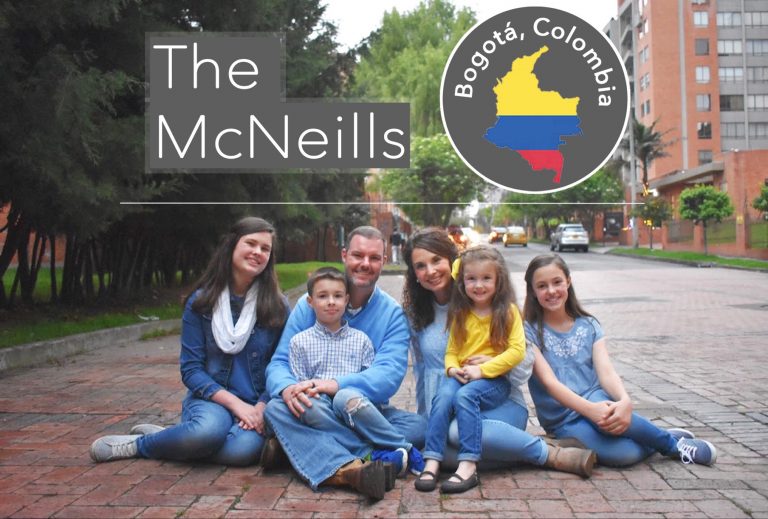
Missionary Family Spreads Hope in Colombia

BOGOTÁ, Colombia (BP) — Sarah McNeill sensed a city-wide quarantine coming. Her preparatory grocery run included school supplies, since her kids would transition to learning at home. She put printer paper and poster board in her cart and, with an idea blooming, added yellow, blue and red tissue paper.

The McNeills live on the 11th floor of a 13-story residential building. Like many in Bogotá, Colombia, their neighbors are fearful of COVID-19.

As Sarah conversed with one concerned neighbor, she was able to show the difference knowing Christ Jesus personally makes in times of crisis.

“There were tears in her eyes. It was like she didn’t think I understood,” Sarah explains. “We do understand, and we are trying to take precautions, but we also just have hope, and we trust that God is in all those details.”

With neighbors in fear, Sarah resolved to spread hope.

Source: Baptist Press

All Content & Images are provided by the acknowledged source

Johnny Pereira on From Crisis to Catalyst: How to Innovate Well by Asking Three Key Questions

The church is closed.

The words I never thought I’d have to say outside of an act of God. Well, we’re in the middle of one and I’ve had to tell my people that the way we’ve been doing church for the past 15 years has to change.

Unsurprisingly, this has led to a lot of confusion, concern, and even anger. What do you mean church is closed? Don’t you have faith?! Yes. But the church is greater than filling our buildings, and as many have said, the greatest way we can serve out neighbor is to close.

In the intervening days I’ve seen a lot of language around the church in crisis. How is the church going to endure through this crisis? How will this crisis change the church?

Instead, at Salem Chapel, we’ve been trying to change the way we look at this season. As the church works to understand and engage the gravity of the suffering and loss around the globe, I’d argue that we are best served by seeing this season as a catalyst. By catalyst, I simply mean change; the process by which some event substantively and irrevocably changes reality.

That’s us.

This experience has and is going to change us. We are going to be different on the other side, and so the church needs to think critically about how to respond proactively and productively. We need to keep our eyes fixed on the gospel mission, even as the world around us turns inward and self-protection.

In this spirit, I want to offer three catalyst question we are asking at Salem Chapel and how we have answered those questions in this new environment. This is not comprehensive by any stretch. Many people in our churches are taking the lead in projects I will only hear about afterward but are having significant kingdom impact today. But these are a few of our initiatives that I’d encourage you and your organization to consider as you think through these questions.

Catalyst Question #1: How are we gathering together for church service?

This is the most significant question most churches are grappling with this week. Some will be hosting online services for the first time in their history, others have streamed live services but never really given thought to tailoring their messages and delivery to an online audience.

At Salem, we are part of this move to online church and in thinking through this catalyst question we had four critical responses:

Developing a new platform
One thing this pandemic has taught us is how we can take for granted our buildings and services as platforms to proclaim the gospel and minister to people. No longer able to gather, we’re left trying to figure out how to cobble together new platforms online. But the immediate question is what to use? Facebook? Zoom? Skype? Carrier Pigeons? The choices are overwhelming and pastors don’t want to make a mistake out of the gate and alienate their people against the transition.

In response, we’ve turned to churchonlineplatform.com. It’s a free online program that allows viewers to comment, ask for prayer, and indicate they desire to trust Christ as their Savior. You can establish hosts that are able to monitor this engagement and reach out to people during the service while others focus on the content.

Adapting a new method
While technology has changed some aspects of church, the bulk of our ministries have largely remained unchanged in generations. Welcome, Worship, Message, Worship, Farwell—all within a span of roughly 75 minutes. Small groups and various other ministries each take days or nights throughout the week to round out the majority of how we engage. Now we have to rethink this method in terms of time,

So, while many of the elements of our online gatherings are similar to the traditional methods, we are adapting wherever possible to take advantage of the online medium. We are scaling down production to emphasize the intimacy of worship, focusing familiar songs that will remind our people that God’s church has and will endure.

We are emphasizing interactive scripture reading, having people post in chat verses that have meant a lot to them with the video leader reading out a few as time allows. We set out intentional guided prayer times and invite leaders to pray over the church from their homes. Finally, we have shortened the preaching to 20 minutes, recognizing that attention spans for digital content are shorter.

In all, we’ve shortened the meetings to no longer than 45 minutes while offering more meetings throughout the week for people to take breaks and check in. While I anticipate some might scoff at this, we want to emphasize adaptation with the aim of seeing greater overall impact in and for the people God throughout the week.

Modeling a new setting
While our people are regularly accustomed to high quality production in our Sunday morning services and various weekly ministries, we have decided to intentionally scale down these efforts. Our thought process has been to reflect the context in which many of our people are engaging us: their living rooms. Through mimicking the environments of our average people, we want to model to them this experience of “doing” church in quarantine. Small, intimate, and networked.

While for some churches continuing in regular production quality is the right move, we have found our people are responding to this move and engaging enthusiastically in worship, prayer, and time in the Word.

Moreover, by modeling it to them, we have shown that they can take the initiative in reaching out their friends and family to likewise prayer and read scripture on their own time. In doing so, we’ve been able to encourage people to invite those who aren’t Christian and the de-churched to join not only our primary gatherings but their own.

In essence, we have strived to create a service that is replicable across our community.

Embracing a spirit of new
A critical piece for leaders and laity alike to remember in this time is to have grace as you find what works best for you and your church. Not all churches are the same and we shouldn’t expect to nail everything on the first try. If something doesn’t work make, learn what you can and try something new.

In this spirit, be ready to mix up the platforms, methods, and settings as you try to find new ways to keep your people connected. Only a few days in and we are already talking about the “rut of redundancy,” throwing the same thing at our people and pushing our people to fatigue.

This is critical: beware of over-saturation! We don’t know how long it will be before we can gather in person again so we do not want to push too much content out at once and overload the church to where it becomes ‘white noise.’

Instead, try elevating others in your church as a change in voice. Use testimonies of God at work among your people, invite experts in different fields to share how they live out their faith, and give platforms for medical works to share insights into how to prepare and to pray. In each, remember that your people are being bombarded with information so don’t be afraid to intentionally encourage a break.

It was in one our meetings thinking about shaking up the regular online gathering that we discussed the idea of a “drive-in” format for Easter. We are now putting plans into place for people to drive to the church parking lot and for us to conduct the service on our roof. While plans might change as we listen to medical experts, it marked an important step in embracing the spirit of new and thinking creatively.

Source: Christianity Today

All Content & Images are provided by the acknowledged source