Japanese government ‘ready to respond to urgent cases’ with experimental drug Avigan, as British Ebola patient arrives back in UK from Sierra Leone…report by The Telegraph
Tokyo stands ready to offer an experimental drug developed by a Japanese company to help stem the global tide of the deadly Ebola virus, the top government spokesman said on Monday.
Japan’s Fujifilm Corporation has offered to provide supplies of Avigan, which also goes by the name Favipiravir, although the company points out that it is only approved as a treatment for influenza.
“We understand that several foreign researchers have published thesis saying that the drug reduced the Ebola virus in animal tests, using mice,” Nana Itagaki, a spokeswoman for Fujifilm, told The Telegraph.
“We now have sufficient supplies of Favipiravir for more than 20,000 people and we have a system for continuous production … We will prepare for the quick supply of Favipiravir when the WHO requests us to do so.”
The Japanese government backed the move. “Our country is prepared to provide the yet-to-be approved drug in cooperation with the manufacturer if the WHO requests,” said chief cabinet secretary Yoshihide Suga.
The World Health Organization (WHO) has been discussing the use of unapproved drugs as a way of getting a handle on an outbreak in Africa that has already cost more than 1,400 lives, with thousands more people infected.
There is currently no available cure or vaccine for Ebola, and the WHO has declared the latest outbreak a global public health emergency.
Several drugs are under development.
The use of an experimental drug called ZMapp on two Americans and a Spanish priest infected with the virus while working in Africa has opened up an intense ethical debate.
The drug, which is in very short supply, has reportedly shown promising results in the two Americans, although the priest died.
US company Mapp Bioparmaceutical which makes the drug said this month it had sent all its available supplies to west Africa.
The WHO earlier said a panel of medical experts had determined it is “ethical” to provide experimental treatments.
Mr Suga said on Monday: “Even before the WHO reaches a conclusion, we are ready to respond to individual requests [from medical workers] under certain conditions if it is an urgent case.”
Avigan is currently in clinical tests in the United States.
Its developer Fujifilm Holdings said it had received inquiries from abroad but declined to say how many and from which countries.
The company, which has diversified into health care fields, has “no problem” over the amount of stockpiles, according to spokesman Takao Aoki.
Two deaths in remote region of Democratic Republic of Congo confirmed as Ebola but “unrelated” to west Afica epidemic…report by The Telegraph
The Democratic Republic of Congo confirmed its two first cases of Ebola this year, but claimed they were unrelated to the epidemic raging in four countries of West Africa.
Congolese health minister Felix Kabange Numbi said that two of eight samples taken from victims of a mystery fever had tested positive for Ebola.
“The results are positive. The Ebola virus is confirmed in DRC,” Mr Kabange told AFP.
Speaking later on public television, he said the confirmation marked the seventh outbreak of Ebola in DR Congo, where the virus was first identified in 1976 near the Ebola River.
But he said the two new cases had “no link to [the epidemic] raging in West Africa” and were different strains from one another.
Authorities immediately imposed a quarantine around the affected area in Equateur province near Jera, more than 750 miles northeast of the Congolese capital Kinshasa.
Medical aid group Medecins Sans Frontieres said it was sending a crew to help handle patients in the area.
The UN’s World Health Organization (WHO) meanwhile announced that one of its health experts, an epidemiologist, had been infected while working in Sierra Leone.
The WHO gave no details of its infected expert, but said the person was “receiving the best care possible” and that it was considering a medical evacuation.
Also on Sunday, Britain’s first Ebola patient, a male nurse who contracted the disease in Sierra Leone, was admitted to a London hospital.
He arrived yesterday at Britain’s only specialist Ebola isolation unit at the Royal Free Hospital in London.
The patient, who is not “seriously unwell” according to the Department of Health, was evacuated in a specially equipped C17 Royal Air Force military plane before being taken by military ambulance across London flanked by a police escort.
The sobering news of Ebola’s spread came as UN officials pledged to step up efforts against the lethal tropical virus, which has infected more than 2,600 and killed 1,427, according to WHO figures released Friday.
Sierra Leone, where 392 Ebola deaths have been recorded, is one of four West African states struggling to control the spread of the aggressively contagious virus, which can spread through bodily fluids including saliva and blood.
Liberia has been particularly hard hit since the outbreak began in March, with 624 deaths, compared with 406 for Guinea and five for Nigeria, according to a WHO count on Friday.
On Saturday the UN Secretary-General Ban Ki-moon’s special representative for Liberia, Karin Landgren, pledged the world body would take a “strong role” in coordinating the response to the emergency.
But the WHO has warned that it could take “several months” to bring the epidemic under control, and estimates its count of the infected and dead is likely far too low, due in part to community resistance to outside medical staff and a lack of access to infected areas.
The epidemic, which first erupted in the forests in the south of Guinea, is also taking its toll on the economies of some of the world’s poorest countries.
“It is a total catastrophe. We are losing lots of money,” Alhaji Bamogo, who sells clothes in the market in the Liberian capital Monrovia, told AFP recently.
“All those who are coming to the market come only to buy food or products for the disinfection of Ebola,” he said.
Several international airlines have halted flights to the region in a move that Moody’s ratings agency warns “will exact an economic toll”.
Steel giant ArcelorMittal said contractors at its iron ore works in Liberia had suspended operations and were pulling out staff.
And in quarantined areas in Sierra Leone and Liberia, cash crops like cocoa and coffee are being left to rot as farmers fear to stray from home.
On Sunday, Benin postponed a meeting of African health ministers scheduled for early September.
Meanwhile the Ivory Coast has closed its borders with Guinea and Liberia, just days after Senegal did the same with Guinea.
And South Africa has banned entry for non-citizens arriving from Sierra Leone, Guinea and Liberia.
The measures taken against Ebola-afflicted countries, especially by neighbours, have caused friction in the region.
Ibrahim Ben Kargbo, the chairman of Sierra Leone’s presidential task force on Ebola, said he was “surprised” by the lack of solidarity among African countries.
It “gives the impression that we are pariah states,” Kargo said on state television.
Radical Hindu nationalists run rampant across India, damaging churches at an alarming rate…by Worthy News
But one church has recently risen from its ashes.
Back in February, Hyderabad’s Hindus had set fire to the thatched roof of Bethel Gospel Church; the church and everything inside was set ablaze.
“We are living in fear,” Pastor Christopher told International Christian Concern. “There have been continuous threats from the Hindu radicals. We Christians are treated as second-class citizens in this country.”
But with donations from ICC’s Community Rebuild Fund, the congregation of Bethel Gospel repaired the roof and walls damaged in the arson attack; ICC also helped replace carpets, the church PA system and the musical instruments that were also lost in the fire.
“ICC has come and rescued us,” Christopher said. “They also took an interest in visiting the church that was burnt to ashes. We are very encouraged knowing that ICC helped undo the damage caused by the Hindu radicals.”
Bethel Gospel Church again meets for Sunday worship and midweek services; the repairs have again made the church a more comfortable refuge for Christians who must daily endure persecution at the hands of Hindus.
A town in the north east of Nigeria is under an ‘Islamic caliphate’, according to Boko Haram’s leader which the Nigerian military denies…report by worthynews
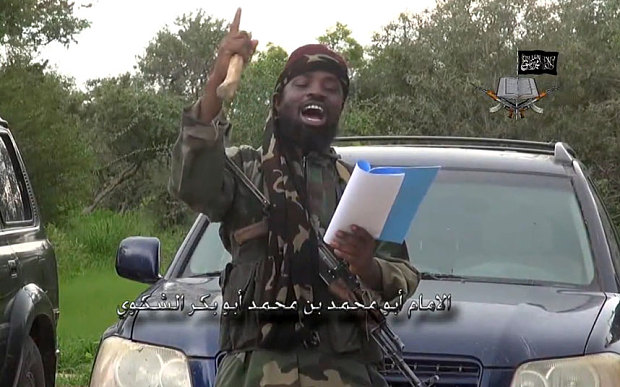
Boko Haram’s leader said a town in the north east of Nigeria seized by the insurgents earlier this month has been placed under an Islamic caliphate, in a video obtained by AFP on Sunday.
“Thanks be to Allah who gave victory to our brethren in (the town of) Gwoza and made it part of the Islamic caliphate,” Abubakar Shekau said in the 52-minute video.
The military however rejected the claim, saying in a statement the “sovereignty and territorial integrity of the Nigerian state is still intact”.
In a July video, Shekau voiced support for the leader of the Islamic State and the Levant (Isil) militants Abu Bakr al-Baghdadi, who in late June declared himself “the caliph” and “leader of Muslims everywhere”.
But there was no indication from Shekau in the latest video that he was associating himself with Baghdadi, whose Sunni Muslim fighters have taken over parts of Iraq and Syria.
As such, it was not clear if Shekau was declaring himself to be a part of Baghdadi’s call or if he was referring to a separate Nigerian caliphate.
In the 19th century, a Sokoto caliphate was proclaimed across most of modern-day northern Nigeria and was considered separate from other Islamic kingdoms, such as the Ottoman Empire.
Shekau – who has been designated a global terrorist by the United States – is shown in the video wearing military fatigues, with a Kalashnikov rifle strapped to his body.
He alternates between Arabic and the Hausa language that is dominant in the region.
He is pictured standing in front of three SUVs and flanked by four fighters, who are masked and armed. It is not clear when or where the video was filmed.
There was no indication that Shekau was actually in Gwoza for the filming and his whereabouts remain unknown but another unidentified fighter who speaks later in the video vowed that Boko Haram would keep control of the area.
“By the grace of Allah we will not leave the town. We have come to stay,” said the militant wearing a green shirt and a white cap.
The United Nations humanitarian office (OCHA) earlier this month confirmed reports that Gwoza was under rebel control.
Boko Haram is also believed to be in control of other areas near Gwoza in southern Borno, as well as large swathes of territory in northern Borno and at least one town in neighbouring Yobe state.
Mapping the precise areas which have fallen into Islamist hands is nearly impossible.
There are few humanitarian workers on the ground in the northeast, travel is dangerous and the region, which has been under a state of emergency since May of last year, has poor mobile phone coverage.
Experts have described Boko Haram’s gains in recent weeks as unprecedented, saying the group was closer than ever to achieving its goal of carving out a strict Islamic state across northern Nigeria.
But many analysts believe the military still has the capacity to reverse the insurgents’ advance.
A major offensive launched when emergency rule was declared in May last year appeared to put the militants on the defensive.
Critics say top brass failed to sustain the pressure and allowed the Islamists to retake some of the areas they had abandoned.
A lack of adequate weapons for troops sent to fight the well-armed rebels has hampered the counter-insurgency and some soldiers this week refused to deploy to Gwoza without better gear in an apparent mutiny.
Reacting to Shekau’s video, defence spokesman Chris Olukolade assured that the military would secure Gwoza.
“Any group of terrorists laying claim to any portion of the country will not be allowed to get away with that expression of delusion and crime,” he said. “Operations to secure that area from the activities of the bandits (are) still ongoing,” he added.
After Shekau’s 25-minute speech, the video shows militant fighters on pick-up trucks firing rocket-propelled grenades and other heavily armed insurgents firing weapons as they walk calmly along the road.
The footage appears to show them taking over a military base, stealing weapons and hundreds of rounds of ammunition as well as fuel cans.
In one frame, a fighter stands on top of a tank, waving the Islamists’ black flag.
The end of the video apparently depicts scenes of grisly executions, similar to those released by Isil in recent weeks. Boko Haram have used similar tactics before, however.
In one scene, about 20 men in civilian clothing are shown with their hands tied behind their backs and lying by the roadside before they are shot at close range.
A second shows two men, whom Shekau said disguised themselves as women to escape the town, beaten to death with shovels. Two others similarly dressed are shot beside what appears to be a trench full of bodies.
America’s military and intelligence officers are pledging an even greater commitment to striking down the radical Islamic terrorist group ISIS…report by CBN News
This follows an international effort to track down those who killed American journalist James Foley and new threats to kill Steven Sotloff, the second American journalist being held hostage.
“We’re pursuing a long-term strategy against ISIL (ISIS) because ISIL clearly poses a long-term threat,” Secretary of Defense Chuck Hagel said.
“We’ll work with our law enforcement, our intelligence and our military, partners, to try to bring justice to the Foley family and bring the full force of the United States to bear on these savages,” FBI Direct James Comey said
The White House also released and defended details of an unsuccessful mission to rescue several Americans in Syria last month.
ISIS had demanded $130 million ransom for Foley, but the United States refused to consider it.
Meanwhile, the terrorist army has not only been trying to fill Americans with fear by killing Foley, they’ve also been doing it from inside U.S. borders.
In the last few weeks a photo tweet from an ISIS supporter in front of the White House was posted and a pro-ISIS banner surfaced at the Ferguson riots in Missouri.
But the danger may be more than just about a public relations war.
Texas Gov. Rick Perry is just one of many who fear ISIS terrorists could have already entered the United States through the porous southern border.
“There is, I think, great concern, that the border between the United States and Mexico is unsecured and we don’t know who is using that,” Perry said.
“What I will share with you is that we’ve seen historic high levels of individuals from countries with terrorist ties over the course of the last four months,” he continued. “Individuals from ISIS and other terrorist states could be, and I think it is a very real possibility, that they may have already used that.”
The San Francisco Bay Area’s strongest earthquake in 25 years struck the heart of California’s wine country early Sunday, igniting gas-fed fires, damaging some of the region’s famed wineries and historic buildings, and sending dozens of people to hospitals…report by AP
The magnitude-6.0 quake, centered near the city of Napa, an oasis of Victorian-era buildings nestled in the vineyard-studded hills of northern California, ruptured water mains and gas lines, hampering firefighters’ efforts to extinguish the blazes that broke out after the temblor struck at 3:20 a.m.
Dazed residents who had run out of their homes in the dark and were too fearful of aftershocks to go back to bed wandered through Napa’s historic downtown, where boulder-sized chunks of rubble and broken glass littered the streets. Dozens of homes and buildings across the Napa Valley were left unsafe to occupy, including an old county courthouse, where a 10-foot wide hole opened a view of the offices inside.
College student Eduardo Rivera said the home he shares with six relatives shook so violently that he kept getting knocked back into his bed as he tried to flee.
“When I woke up, my mom was screaming, and the sound from the earthquake was greater than my mom’s screams,” the 20-year-old Rivera said.
Gov. Jerry Brown declared a state of emergency for southern Napa County, directing state agencies to respond with equipment and personnel. President Barack Obama was briefed on the earthquake, the White House said, and federal officials were in touch with state and local emergency responders.
The temblor struck about six miles south of Napa and lasted 10 to 20 seconds, according to the United States Geological Survey. It was the largest to shake the San Francisco Bay Area since the magnitude-6.9 Loma Prieta quake struck in 1989, collapsing part of the Bay Bridge roadway and killing more than 60 people, most when an Oakland freeway collapsed.
Queen of the Valley Medical Center in Napa, where an outdoor triage tent was set up to handle the influx, reported treating 172 people in the emergency room, although hospital officials could not say how many of them were there for bruises and cuts suffered in the quake and how many for more routine injuries and illnesses.
Twelve people were admitted for broken bones, heart attacks and other problems directly related to the earthquake, including an adult who remained in critical condition on Sunday night and a 13-year-old boy.
The teen was hit by flying debris from a collapsed fireplace and had to be airlifted to the children’s hospital at the University of California Davis hospital for a neurological evaluation. He condition was listed as serious, hospital spokeswoman Phyllis Brown said.
Napa Fire Department Operations Chief John Callanan said the city had exhausted its own resources trying to extinguish at least six fires after 60 water mains ruptured, as well as transporting injured residents, searching homes and collapsed carports for anyone trapped and responding to 100 reports of leaking gas.
Two of the fires happened at mobile home parks, including the one where four homes were destroyed and two others damaged, Callanan said. A ruptured water main there delayed efforts to fight the blaze until pumper trucks could be brought in, he said.
Nola Rawlins, 83, was one of the Napa Valley Mobile Home Park residents left homeless by the fire. No one was injured in the blaze, but Rawlins said she lost all her jewelry, papers and other belongings.
“There were some explosions, and it was burning. Everybody was out in the street,” she said. “I couldn’t get back in the house because they told everybody to go down to the clubhouse, so I didn’t get anything out of the house.”
U.S. Rep. Mike Thompson, who represents Napa, said federal and state officials had conducted an aerial survey of the area, but they wouldn’t have a cost estimate for the damage until they can get on the ground and into buildings. He said that while Napa suffered the worst of it, there also was significant damage about 17 miles south on Mare Island in Vallejo, a former naval shipyard where a museum and historic homes were declared uninhabitable.
(Photo: AP/Ben Margot)
“It’s bad any way you calculate it. But it could have been a heck of a lot worse,” Thompson said.
While inspecting the shattered glass at her husband’s storefront office in downtown Napa, Chris Malloy described calling for her two children in the dark as the quake rumbled under the family’s home, tossing heavy pieces of furniture for several feet.
“It was shaking, and I was crawling on my hands and knees in the dark, looking for them,” the 45-year-old woman said, wearing flip flops on feet left bloodied from crawling through broken glass.
Sunday’s quake was felt widely throughout the region, with people reporting its effects more than 200 miles south of Napa and as far east as the Nevada border. Amtrak suspended service through the Bay area so tracks could be inspected.
Vintner Richard Ward of Saintsbury Winery south of Napa watched Sunday afternoon as workers righted toppled barrels and rescued a 500-pound grape de-stemmer that the quake had thrown to the ground.
“That’s what happens when you’re a mile from the epicenter,” said Ward, who lost 300 to 400 bottles in the winery’s basement.
The grape harvest was supposed to start overnight Monday, but it would now be pushed off a few days, he said. Had the harvest started a day earlier, the quake would have caught the workers among the heavy barrels when it struck, Ward said.
Mark Ghilarducci, director of the California Governor’s Office of Emergency Services, told an afternoon news conference some 90 to 100 homes and buildings were deemed not habitable.
A Red Cross evacuation center was set up at a church, and crews were assessing damage to homes, bridges and roadways. The Napa Unified School District said classes were canceled for students Monday and that students would not be allowed to return to schools until they were checked.
“There’s collapses, fires,” said Napa Fire Capt. Doug Bridewell, standing in front of large pieces of masonry that broke loose from an early 20th-century office building where a fire had just been extinguished. “That’s the worst shaking I’ve ever been in.”
Bridewell said he had to climb over fallen furniture in his own home to check on his family before reporting to duty.
Pacific Gas and Electric spokesman Jeff Smith said an assessment found that about 70,000 customers lost power after the quake hit, but that number was down to around 2,200 by 11 p.m.
The depth of the earthquake was just under seven miles, and it was followed by numerous small aftershocks, the USGS said.
On Sunday night in Southern California, a small, magnitude-3.3 earthquake hit off the region’s coast.
The U.S. Geological Survey says the temblor struck at 7:50 p.m. and was centered about 5 miles southwest of San Pedro and 6 miles southeast of Rancho Palos Verdes. There were no initial reports of damages, police said.
Bragging of sexual conquests, suggestive jokes and innuendo, and sexual one-upmanship all can be a part of demonstrating one’s manhood—especially for young men eager to exert their masculinity.
But how does masculinity manifest itself among young men who have pledged sexual abstinence before marriage? How do they handle sexual temptation, and what sorts of challenges crop up once they’re married?
“Sexual purity and pledging abstinence are most commonly thought of as feminine, something girls and young women promise before marriage,” said Sarah Diefendorf, a sociology graduate student at the University of Washington. “But I wanted to look at this from the men’s point of view.”
Studying a group of 15 young evangelical Christian men, Diefendorf learned that support groups and open discussions about sex with trusted companions were key in helping the men during their pre-marital years. But once married, they faced trouble.
Instructed by the church to keep problems “in the dark” after marriage, the men reported feeling that they couldn’t discuss sex with their friends and didn’t know how to comfortably broach the subject with their wives. The newly wedded men also expressed surprise that sexual temptations continued to taunt them.
Diefendorf presented her findings Sunday at the annual meeting of the American Sociological Association in San Francisco.
At the start of her study, in 2008, the men were in their late teens and early 20s and part of a support group for young men who had pledged to remain virgins until marriage. The group was affiliated with a nondenominational evangelical megachurch in the southwestern United States that had about 14,000 attendees at Sunday services.
Over the course of a year, Diefendorf attended their meetings and conducted one-on-one interviews and focus-group meetings with the men.
The men talked about sex as both “sacred”—a gift from God meant for the marriage bed—and “beastly” if it occurs outside of marriage.
“To maintain this gift from God, they believe that they must control sex before marriage,” Diefendorf said. The support group is one way for the young men to explore their sexual urges, she said. Many of them opened up to struggles with pornography and masturbation, which some considered as “destructive” and a threat to their commitment to abstinence.
“People think that evangelical support groups are just about suppressing men’s natural urges, but really they are caring, supportive and safe space that allow men to have a remarkably open and frank discussion about sexual desire,” Diefendorf said.
Besides the support group, the men sought out accountability partners to help control their behavior. One of them, for instance, had an accountability partner who would text-message him each night, “Are you behaving?” Some of them used software to track which websites they visited and shared the results with the partner.
A few years later, in 2011 and 2012, Diefendorf followed up with the men. Fourteen of them were married, and she wanted to find out how the men’s views of sex and masculinity had changed since marriage.
During a focus-group meeting in one of their homes, it soon became clear that as taboo as sexual activity had been before marriage, it was now taboo to talk about sex, because it was seen as disrespecting their wives.
“After marriage, the church culture assumes that couples become each other’s support, regardless of the issue at hand,” Diefendorf said. “There’s little support in figuring out sexuality in married life, and these men don’t know how to talk to their wives about it.”
As one of the men put it: “For me to come home from work and say, ‘Hey, did you like it last time?’ I mean that would be—that would be such a weird question for me to ask.”
The newlyweds also revealed they continue to think of sex in terms of control, and how the so-called beastly elements of sex—temptations by pornography and of extramarital affairs—do not disappear with the transition to married life.
“Before you get married, the biggest thing you struggle with, usually, is premarital sex,” one of the men told Diefendorf. “But once you are married, you can’t be tempted by that anymore, so you get attacked by completely different things. …Essentially Satan has to find a new angle to attack on.”
They wished for more guidance from the church, and someone in the group said he’d cheer if his pastor decided to talk more about sex.
Support for the Islamic State is growing from groups outside the Middle East as a large number of Western Muslims reportedly have joined ISIS in Syria and Iraq…report by CBN News
What does this mean for the United States and other Western countries?
The ISIS terrorist shown beheading American journalist James Foley speaks English with a British accent.
That fact raised so much concern in the United Kingdom, Prime Minister David Cameron cut his vacation short to address the issue.
“From what we’ve seen it looks increasingly likely that is a British citizen. Now this is deeply shocking,” Cameron said.
How likely is it that ISIS will strike America at home?
British authorities believe several hundred of their citizens could be fighting with ISIS. But that’s just a fraction.
Some estimates put the number of Western Muslims joining ISIS in Syria and Iraq up to 3,000.
In addition to Britain, they come from France, Denmark, and the United States, creating a serious danger for the West.
The concern is these jihadists will use their Western passports and terrorist training to return to their country and carry out attacks at home.
“Some of those foreign nationals… may at some stage seek to return to their countries of origin and carry out attacks in them,” British Foreign Secretary Philip Hammond said.
“We will be vigilant and we will be relentless. When people harm Americans, anywhere, we do what’s necessary to see that justice is done,” President Barack Obama said Wednesday. “There has to be a common effort to extract this cancer so that it does not spread.”
Yet CBN News Terrorism Analyst Erick Stakelbeck said the president is not doing enough to eliminate the threat to America.
“Right now I’m not seeing the U.S. government under the Obama administration taking the kind of action needed to crush ISIS,” Stakelbeck said. “We need to crush this group — stamp them out before they pose a direct threat to the U.S. mainland.”
Other Islamic terrorist groups, not just from the West, are now supporting ISIS, including from the Philippines and Yemen.
The Obama administration announced Wednesday that the president sent Special Ops forces to Syria this summer on a secret mission to rescue American hostages, including Foley, but they did not find them.
Obama has stepped up airstrikes against ISIS, but to wipe out that terrorist group, a lot more military action may be required.
A New York couple faces thousands of dollars in fines for declining to rent out their family farm for a same-sex wedding celebration…report by CBN News
The New York State Division of Human Rights fined Cynthia and Robert Gifford $13,000 for declining a request from a lesbian couple to rent the family barn for their ceremony.
The Giffords have owned and operated Liberty Ridge Farm in for over 25 years. They believe marriage is the union of one man and one woman.
Like many small farm families, they often open up their home to host public events, including weddings.
In addition to the fines, the family has been told to implement “re-education” classes for their staff.
Should the government be in the business of “re-educating” citizens to change their moral beliefs?
After nearly three weeks of intense treatment, testing and isolation, American Ebola patients Nancy Writebol and Dr. Kent Brantly are back with their families…report by CBN News
Speaking at a conference after his release Wednesday, Brantly, 33, called it a “miraculous day.”
“I am thrilled to be alive, to be well, and to be reunited with my family. As a medical missionary I never imagined myself in this position,” Brantly said.
Writebol, 59, was released Tuesday. Her husband said in statement that she is free of the virus but was recuperating at an undisclosed location.
“During the course of her fight, Nancy recalled the dark hours of fear and loneliness, but also a sense of the deep abiding peace and presence of God, giving her comfort,” her husband said.
Both Writebol and Brantly say they’re thankful for the prayers on their behalf.
“I cannot thank you enough for your prayers and your support,” Brantly said. “But what I can tell you is that I serve a faithful God who answers prayers.”
Brantly was working with Samaritan’s Purse in Liberia, treating Ebola patients. Writebol, a nurse with the missions organization SIM, also contracted the disease while working alongside Brantly. Both were flown to Emory University Hospital earlier this month.
“I join all of our Samaritan’s Purse team around the world in giving thanks to God as we celebrate Dr. Kent Brantly’s recovery,” ministry leader Franklin Graham said in a statement. “His faithfulness to God and compassion to the people of Africa have been an example to us all,” he said.
Doctors say after three weeks, Ebola patients who beat the disease can’t spread the virus because it’s no longer in their blood or saliva.
“The medical staff here at Emory is confident that the discharge from the hospital of both of these patients poses no public health threat,” Dr. Bruce Ribner at Emory said.
Experts say both patients still have some healing ahead of them as its common for fatigue and aches and pains to linger.
But while their treatment was a success, the outbreak in West Africa is far from contained. According to the World Health Organization, the death toll is now at more than 1,300 people.
Local governments have put in place a “no touching” rule and are going to great lengths to encourage the public to wash their hands with chlorinated water.
“They’re saying don’t hug your wife, don’t hold hands with your friend, don’t even shake hands with a colleague,” Operation Blessings David Darg said.
But many of the areas being hit the hardest by Ebola have run out of chlorine. Operation Blessing is on the scene and heard of this need.
“I met with the minister of the interior of Liberia and asked him what his priority needs were,” Darg told CBN News. “He’s heading up the anti-Ebola task force for the nation. He said his number one need right now was body bags, which was an eye opening need of course. His number two need was chlorine.”
Operation Blessing is sending five chlorine generating units from its Chesapeake, Virginia, warehouse.
They will be able to produce a total of 550 gallons of chlorine per day, a major step toward reducing the threat of spreading the virus.