‘Black Ink Crew: Chicago’ Star Charmaine Walker and Her Husband Welcome a Baby Girl

Welcome to the Black Ink Crew: Chicago family, baby Nola Glenda Bey!

Charmaine Walker and husband Nick Bey have welcomed their first child together, a daughter, on Saturday.

Walker, 31, welcomed her baby girl at Northwestern Medicine Prentice Women’s Hospital with Bey by her side.

“SAFE DELIVERY! Head full of hair!” Bey proudly announced on Instagram.

One day after announcing that she and Bey were expecting their first child together, Walker stopped by PEOPLE TV‘s Reality Check in early December to exclusively reveal that they’d recently tied the knot.

The reality star revealed her pregnancy news on Instagram. Sharing a video from an ultrasound appointment, she wrote, “Expecting Baby Bey March 2020 💕🦋 Shoutout to Momma Glenda. She was so excited 🦋 The night before she unexpectedly passed away she said ‘I still can’t believe my baby is having a baby!’ I’ll never forget those words.”

Source: People

All Content & Images are provided by the acknowledged source

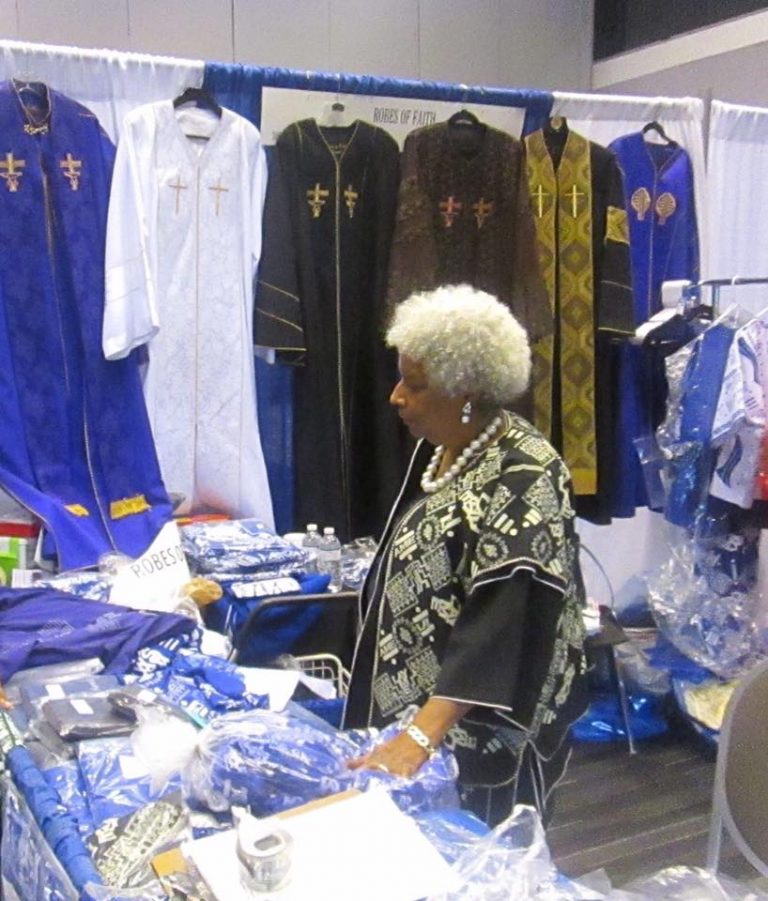
Danielle White to Retire From Robes of Faith, Official Designer of the AME Church’s Clerical Apparel

Danielle White has announced she wishes to retire from Robes of Faith. She has been designing robes for the AME Church and organizations for over 30 years. Along the way, she has acquired many friends and traveled over 900,000 miles across the country and seas with her late husband Henri.

The Whites received their big break in the “church clothes” industry in 1992. Having presented their unique robe designs at several AME Church conventions, Bishop Richard Allen Chappelle, the then-president of the Council of Bishops, called on the couple to design and produce a robe for the bishops.

After Danielle drew up several designs, the bishops picked the one that would become known as the “Unity Robe,” now one of the most iconic AME Church robes befit for a spiritual leader. “When I put on that robe, it was made clear to me at that moment the responsibility that comes with wearing the robe,” said Bishop Carolyn Tyler Guidry, who was voted in and consecrated as a bishop in 2004. “It’s not just your little congregation. Now you have an impact on the much wider area of the church. That was my first realization,” she added. More than 20 years after its debut, the Unity Robe is still one of the official robes for the church’s bishops.

Upon procuring his Unity Robe following his election in 2012, Bishop Clement Fugh reflected, “As a demonstration of how intricately Mrs. White is woven into the fabric of African Methodism, when I was aspiring to Episcopal Service, she informed me that she didn’t take orders for bishop’s robes. She had a ‘feeling’ about who would be elected so she brought the appropriate sizes with her when she came to the General Conference. Sure enough, after my election, I went to Mrs. White’s booth. She handed me a robe, told me to try it on—and that it only needed minor alterations.”

That successful design helped the Whites launch Robes of Faith—an official designer of AME Church robes, apparel, and paraments. Over the years, the company has designed and produced robes for bishops and other clergy, stoles, paraments sets, and even fabric, helping the AME Church become one of the first protestant denominations to have a uniform look across the church.

Robes of Faith has been a constant presence at AME Church conferences for almost 30 years. Danielle is ready to step down and sell the operation to someone who wants to continue this “divine” business.

“One of the most important things is that the church makes you feel good,” White said. “There has never been a situation that I did not feel good about coming to a conference because I knew I was coming to see friends. It was more than a business situation.”

The story of Robes of Faith began when the Whites were married in 1988. At the time, he was a retired gemologist and she was a Fashion Institute of Technology-trained clothes designer working out of her home in New Rochelle, New York. She had been making clothes since she was eight-years-old, having been initially taught by her mother and grandmother. So when it came to the business of designing and selling robes, White says it was a match made in heaven. “He was the person who made the business go and I was the one who did the designing,” White said. “So it was a perfect match in terms of who did what and how did we get along,” she commented.

Source: The Christian Recorder

All Content & Images are provided by the acknowledged source

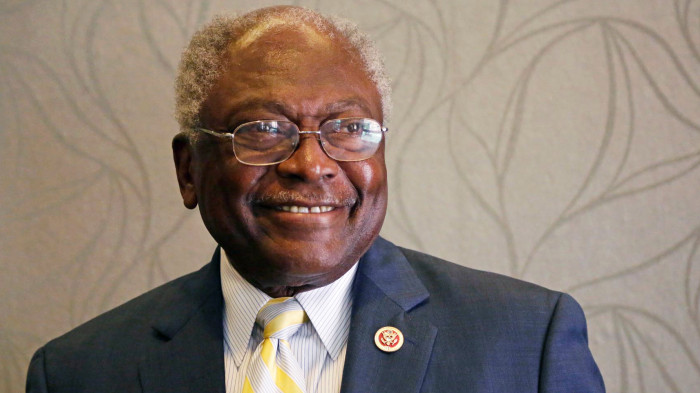
The AME Church’s Christian Recorder Interviews Rep. Jim Clyburn

John Thomas, III, the editor of The Christian Recorder, scored a two-for-one deal when he interviewed Congressional Representative Jim Clyburn of South Carolina at the General Board in Birmingham, Alabama. Clyburn—the third most powerful democrat in the American government—not only shared his shrewd political insights but he also talked at length about the legacy of the AME Church.

Clyburn is a 14-term Democratic congressman; and after the 2018 elections where Democrats took control of the House, he reclaimed the Majority Whip position. When he came to Congress in 1993 to represent South Carolina’s sixth congressional district, Congressman Clyburn was elected co-president of his freshman class and quickly rose through leadership ranks. He was subsequently elected chairman of the Congressional Black Caucus, vice-chair, and later chair of the House Democratic Caucus.

Congressman Clyburn’s humble beginnings in Sumter, South Carolina, as the eldest son of an activist, fundamentalist minister, and an independent, civic-minded beautician grounded him securely in family, faith, and public service. His memoir, Blessed Experiences: Genuinely Southern, Proudly Black, was published in 2015 and has been described ‎as a primer that should be read by every student interested in pursuing a career in public service. His wife of 58 years, Emily Clyburn, passed away in September at the age of 80. They are the parents of three daughters, Mignon Clyburn, Jennifer Reed, and Angela Hannibal and four grandchildren.

TCR: In the last few years, we have seen the Republicans and Democrats use faith in politics. Who would’ve imagined Paula White being the president’s faith-based advisor 10, even five, years ago? And now she’s also the head of the White House’s Faith and Opportunity Initiative. 

JC: Well, I think that what we have to remember is that so much of what we say and do are what I call faith-based. When you are talking about young people and their futures, you don’t have to be preachy to get them to understand the importance of having faith in themselves. One Bible verse that represents this is Hebrews, 11th chapter, 1st verse, the substance of things hoped for, the evidence of things unseen.

TCR: You’ve been in Congress for more than 28 years. Can you talk about how the AME Church has had influence and sway in Washington, DC?

JC: Well, I think that one of the things the AME Church has not done a good job of is making people aware of the role they played in the Brown v. Board of Education decision, which outlawed “separate but equal.” Everything that has happened since 1954 when it comes to integration and desegregation is based on that ’54 Brown vs. Board of Education decision. And those five cases that we talk about so often that we celebrated out in Kansas started in little old Clarendon County, South Carolina. They began with [the] Rev. J. A. DeLaine, an AME pastor with St. Mark AME Church, Liberty Hill AME Church. It was called Belton v. Gebhart. Well, the Belton family really came out of South Carolina. They’re AME.

TCR: What does being an active member of the AME Church mean to you in your political life?

JC: I think the AME Church was born out of protest. I mean, Richard Allen gave birth to this church in protest over current events and that’s what attracted me to this movement. And so, I think that what we have to do is get people to know of that relationship. Most people don’t know that that is what this church is all about. And I think that if the church were to spend a little more time putting that out there, we’d have much more young people involved in this AME movement than we have today because the whole activism of the AME Church is what is attractive to young people.

Source: The Christian Recorder

All Content & Images are provided by the acknowledged source

PODCAST: The Text That Made Salvation Plain to Spurgeon, Part 5 (Understanding God’s Great Salvation #74 with Daniel Whyte III)

Welcome to the Understanding God’s Great Salvation Podcast. This is episode #74.

I am your host, Daniel Whyte III, president of Gospel Light Society International. This podcast is designed to explain what it means to be saved from sin and from the punishment of sin through Jesus Christ. This podcast is primarily for non-believers and some new believers and it will help you understand what it means to be saved from hell and have a home in Heaven as well as the blessings of the abundant Christian life.

God made salvation simple. However, down through the years many people, including some preachers and other Christians, have made the matter of salvation complicated and confusing. I know from my own experience that many people would get saved if someone would sit down and share with them straightforwardly from the Bible what it really means to accept Jesus Christ as their Saviour. That is what I intend to do with this podcast.

Let’s start out with the Word of God. The Bible says in Isaiah 45:22: “Look unto me, and be ye saved, all the ends of the earth: for I am God, and there is none else.”

Today’s God’s Great Salvation quote is from Paul Washer. He said: “It is only against the pitch blackness of the night that we see the glory of the stars. And it is only against the pitch blackness of man’s radical depravity that we can begin to see the glories of the gospel.”

Our topic today is The Text That Made Salvation Plain to Charles Spurgeon (Part 5) from the book, “Salvation Crystal Clear” (Book 1) by Curtis Hutson.

I accepted Christ when I was eleven years old. I was baptized shortly thereafter. I have tried to live good since then. But if I had to die right now and stand at Heaven’s gate and an angel were to come to the gate and ask, “Why should we let you into Heaven?” I would not say, “I’m a preacher,” nor, “I preach five or six times a week,” nor, “I edit a religious paper that goes into 120 foreign countries.” I wouldn’t say, “I have lived good,” nor, “I have been baptized,” nor, “I have turned over a new leaf and made great promises about how I would live.” I would simply say, “My only hope of Heaven is that Jesus Christ died for me, and I am looking to Him for salvation.”

My hope is built on nothing less
Than Jesus’ blood and righteousness;
I dare not trust the sweetest frame,
But wholly [completely, without reservation] lean on Jesus’ name.

The source of salvation is Jesus. The text says, “Look unto me, and be ye saved, all the ends of the earth: for I am God, and there is none else.”

One of the saddest things is that many well-meaning people are looking to something other than Jesus Christ for salvation. Some are looking to their good, moral life; others, to church rituals, church membership, or church ordinances. Some are looking to their baptism and depending on that to get them to Heaven. But there is no promise to those who look unto anything other than Jesus Christ.

Oh, why doesn’t the world see it! Why don’t religious leaders understand it! “Look unto me, and be ye saved, all the ends of the earth: for I am God, and there is none else.” Christ is the only source of salvation.

We not only have the source of salvation in the text; we also have

II. THE SCOPE OF SALVATION

“Look unto me, and be ye saved, all the ends of the earth.” Don’t miss this. I love preaching for several reasons, but the main reason is because everybody is a prospect, everybody needs what I have to offer through the Bible—forgiveness.

If I am selling refrigerators, I know everybody doesn’t need a refrigerator. If I am selling automobiles, I know everybody doesn’t need an automobile. But there is nobody alive who doesn’t need forgiveness, because everybody has sinned. Romans 3:23 says, “All have sinned, and come short of the glory of God.”

The scope of salvation—”all the ends of the earth.”

On our next broadcast, we will continue this topic, “The Text That Made Salvation Plain to Charles Spurgeon.”

Let’s Pray —

As we close today, let me leave you with these words from Hebrews 2:3: “How shall we escape, if we neglect so great salvation…” I encourage you to not neglect the salvation and grace offered by God. He sent His Son, Jesus Christ, to die on the cross for our sins and take the punishment that we deserve upon Himself. Romans 5:8 says that “God commendeth his love toward us, in that, while we were yet sinners, Christ died for us.”

If you do not know the Lord Jesus Christ as your Savior, and you want to get to know Him today, here is how.

Please believe “that Christ died for our sins according to the scriptures; and that he was buried, and that he rose again the third day according to the scriptures” and you will be saved. The Bible states in the book of Romans 10:9, 13: “That if thou shalt confess with thy mouth the Lord Jesus, and shalt believe in thine heart that God hath raised Him from the dead, thou shalt be saved. For whosoever shall call upon the name of the Lord shall be saved.”

Pray and ask Him to come into your heart and He will. It’s just that simple.

Until next time, my friend, thank God for His simple, great salvation. God bless you!

All Content & Images are provided by the acknowledged source

How to Approach Semantics and the Great Commission

Ask any married couple and they’d probably agree – communication matters. Outside observers can learn a lot about a relationship by watching spouses’ verbal and nonverbal interactions.

In the missions world, 2019 held a lot of debate about semantics and its role in shaping strategy. Terms like “people groups”, “unreached”, and “unengaged” were – and continue to be – debated by experts from every sphere. You can find examples on sites like Patheos, Christianity Today, and The Gospel Coalition.

Alliance for the Unreached members are part of the broader discussion, says York Aspacher with Operation Mobilization USA. “We are looking at these (approaches) as tools in our toolbox to help inform the strategy, the way that we try to go about this work,” he says of the “people group” versus “place” debate.

“We’re all open to learning and we’re in this process together as co-laborers with Christ and with one another in our mission to reach the world with the message of Jesus Christ.”

Aspacher serves as the Marketing Director for Operation Mobilization USA. OM is a multifaceted outreach ministry active in Bible studies, teaching, building businesses, relief and development work, the creative arts, and more. Their ministries, with more than 6,800 volunteers and staff, are spreading the word of the Lord across all occupied continents.

Along with its fellow founding members, OM rallies around a common goal: reaching people who have no access or opportunity to know Christ. Their efforts don’t stop there, Aspacher says.

“The biblical mandate is not simply to divide people into groups and check them off on a list. The biblical mandate is to disciple the peoples of the world and to see that they’re taught what Christ taught.”

SOURCE: Mission Network News, Katey Hearth

All Content & Images are provided by the acknowledged source

Glenn Sunshine and Jerry Trousdale and Greg Benoi on Globally, Christianity is Growing Faster Than Any Time in History, So Why is the Church in Europe and America Declining?

When we look at the state of Christianity in the world today, we see a decidedly mixed picture. In many parts of the world, there is incredibly good news: God is authoring a season of multiplication instead of addition in many parts of the world.

Not surprisingly, Christianity’s growth in Africa and Asia is explosive. On average, using data from The Status of Global Christianity, between 2000 to 2020, (7,300 days):

Much of the great momentum is coming from Disciple Making Movements.  Christian history has seen rapid movements happen when many thousands, or millions of people in a region became Christ Followers.

We are living in a season of the greatest church growth since the 1st century!  But half of the world is missing the move of God. How is it possible that the Global South Church is seeing Christian history being made while the Global North church is struggling for answers? God alone provides the increase, but why there and not here?

What is it that the churches of the Global South are doing that makes so much difference?

Two researchers and Disciple Making practitioners have spent five years identifying several biblical values that Jesus modeled or mandated in his disciples, and which are embraced in the Global South but not in the Global North church.  The Kingdom Unleashed was the result of that research.

1.  Abundant, and Bold Prayer

In Africa, it is not unusual for churches to commit 50-100 days per year for fasting and prayer. In American churches, seasons of fasting and prayer are not the norm, and if there are prayer meetings, there may be few participants. Some studies suggest that we do not spend much time in private prayer either.

It is easy for us to rely on our many resources rather than on God. And in the process, we lose the privilege of depending on God every day.  In the Global South, people often have no choice but to rely on God to meet their needs — they lack the resources to do otherwise. Their acute awareness of their need drives them to pray not just for their physical needs but for guidance and direction, spiritual power and breakthroughs, healings, deliverances, and identifying people to disciple.

2.  Discipling to Conversion

American Evangelicals tend to think about Christianity in terms of conversion, forgiveness of sins and Eternal Life

In the Global South, they focus far less on conversion than on disciple making. When Jesus called the Twelve, he discipled them for nearly three years before he asked them for a statement of faith —“Who do you say I am?” In other words, he discipled them to conversion rather than converting them and then discipling them. That is the model used in the Global South.

3.  Obedience-Based Discipleship

Even the idea of what it means to be a disciple is different. For us, discipleship is knowledge-based. But in the Great Commission, Jesus tells us to make disciples (not converts) and teach them to obey everything he commanded. Biblical discipleship is thus obedience-based, not knowledge-based. Our sins are forgiven by faith alone, but throughout the New Testament we are told to live out our faith by obeying Jesus’ commands to love God and neighbor. So from day one in evangelistic Bible studies (generally called Discovery Bible Groups), people are encouraged to put into practice what they are learning.

This approach results in personal transformation as well as community transformation. As people sink into Scripture, they learn that it affects all of life. If Jesus is Lord of all, then there is no area of life that is not rightfully his. As Abraham Kuyper said, “There is not a single square inch in the whole domain of human existence over which Christ, who is Lord of all, does not cry out, ‘Mine!’”

SOURCE: Christian Post, Glenn Sunshine and Jerry Trousdale with Greg Benoi

All Content & Images are provided by the acknowledged source

Iran Releases 100,000 Prisoners to Cut Back On New Coronavirus Infections, Few Christians are Among Them

The official coronavirus death toll soared past 200 yesterday in Iran, and critics claim the number is much higher. To stem the tide of new infections, officials have released more than 100,000 prisoners to date – including at least six believers.

Middle East Concern’s Daniel Hoffman says 21-year old Mary Mohammadi was among them. “She is active in a movement that tries to get official recognition or Iranians who converted to Christianity,” he says.

“Most of these are based outside of Iran, but she is one of the very few who is involved with this movement very publicly inside the country.”

Learn more about Middle East Concern here.

As previously noted, Iranian officials tried to minimize the extent of coronavirus infections from the beginning. However, as more high-level officials become ill and subsequently die, it’s harder to cover up.

On Sunday, government health officials announced 49 new deaths related to the coronavirus, bringing the total death toll to 194 and the number of infections to 6,566. The following day, those numbers climbed again to 237 deaths and 7,161 infections.

Reporting from Tehran, FRANCE 24’s Reza Sayah says schools and universities have been closed until early April:

“In less than two weeks, it’s Nowruz, the Persian New Year, perhaps the biggest and most popular national holiday when Iranians get together and socialise with family and friends. That’s not going to happen the way it usually does, and that’s another hit to this country that has seen many crises over the past couple of years.”

Trouble may be widespread, but there are a few glimmers of hope.

SOURCE: Mission Network News,

All Content & Images are provided by the acknowledged source
Two Christians Killed, Another Abducted by Al-Shabaab in Kenya Attacks

In yet another assault on Christians in north-eastern Kenya, suspected militants from the Somalia-based al-Qaeda-linked group al-Shabaab killed two people and abducted another in two separate attacks this week.

The militants ambushed a passenger bus on the road between Elwak and Mandera near the Jabi-bar area Wednesday and asked all of the passengers to disembark before identifying non-Muslims, according to the U.S.-based persecution watchdog group International Christian Concern.

The suspected member of Al-Shabaab then abducted a Christian.

An hour later, two non-local medical transporters were killed and their truck was burned in the same location near the porous Kenya-Somalia border. The deceased were ferrying medicines.

“The driver and turn boy who are both non-locals were taken away. It was later reported that the lorry has been burnt down to ashes,” Mandera’s Governor said in a statement.

“Al-Shabaab is following through with its threat to target and attack non-local Christians,” Nathan Johnson, ICC’s Regional Manager for Africa, said. “They have increased this type of attack greatly already this year. If this continues, 2020 could be one of the deadliest for Kenyan Christians in recent history. Though I commend the Kenyan government for taking this situation seriously, they must figure out a better way to stop these attacks before dozens more Christians are killed.”

Late last month, al-Shabaab “ordered” Christians to leave three counties in north-eastern Kenya to allow local Muslims to get all local jobs.

SOURCE: Christian Post, Anugrah Kumar

All Content & Images are provided by the acknowledged source
J. Lee Grady on Don’t Live in Isolation—You Need a Loving Church Family

My wife and I have been visiting different churches in the past several months. We are in search of a place to call home. This isn’t an easy process for a traveling minister like me. I’m gone many weekends, so I can’t commit to certain duties at a local church, and I don’t feel as connected as those who are there every week.

But I need a place to belong, where I can hear God’s Word, be refreshed in worship and experience the support of a spiritual family. During our recent journey, we’ve visited all kinds of churches—Baptist and Bapticostal, charismatic and evangelical, denominational and non-denominational. We’ve been in black, white and blended churches; we’ve attended churches with older congregations as well as a church with lots of excited teens who crowd the altar every week.

What I’ve seen during our “spiritual tour” of Troup County, Georgia, has encouraged me so much. I’ve experienced God’s family in all of its diversity, with all of its quirks and warts and weaknesses. I’m certainly not looking for a “perfect” church. (And I know if there were such a thing, it wouldn’t remain perfect once I joined it.)

What thrills me is that, even though churches aren’t perfect, God has placed His special people everywhere. No matter where I go all over the United States, there are faithful congregations providing a witness of Jesus Christ. They are winning new converts, discipling new and seasoned believers, feeding the homeless, running women’s shelters, giving out lunches and bookbags at local schools, visiting nursing homes, evangelizing college campuses, caring for prisoners, providing counseling services and sending teams on foreign mission fields.

Many American churches today have big struggles. We can’t meet our budgets, we can’t recruit enough volunteers to care for kids, we want to grow but we watch people leave and never come back. Some of our leaders struggle with depression or burnout. And often our witness is tainted by our hypocrisy. Yet God still dwells in the midst of His flawed people, in good times and bad.

SOURCE: Charisma News

All Content & Images are provided by the acknowledged source
Dr. Ben Carson Emphasizes the Importance of Prayer and Faith in America During Coronavirus Press Briefing

Backing President Donald Trump’s decision to make Sunday a National Day of Prayer to address the coronavirus outbreak, Housing and Urban Development Secretary Dr. Ben Carson on Saturday underlined the importance of prayer and faith in maintaining America’s greatness.

Talking about the coronavirus, or COVID-19, during President Trump’s press briefing at the White House Saturday, Carson said he hoped that Americans “can use this as an opportunity to pull together for good.”

“President Trump is going to be recommending a national day of prayer. And you know, we’ve gotten away from prayer and faith a lot in this country,” he said.

“There’s nothing wrong with godly principles, no matter what your faith is — loving your neighbor — caring about the people around you,” he continued. “Developing your God-given talents to the utmost, so you become valuable to the people around you. Having values and principles that guide your life. Those are things that made America zoom to the top of the world in record time — and those are the things that will keep us there too.”

On Friday evening, the president declared Sunday as a National Day of Prayer.

“It is my great honor to declare Sunday, March 15th as a National Day of Prayer. We are a Country that, throughout our history, has looked to God for protection and strength in times like these,” the president wrote on Twitter. “No matter where you may be, I encourage you to turn towards prayer in an act of faith. Together, we will easily PREVAIL!”

Since 1988, the first Sunday of March has been designated as a National Day of Prayer each year. Trump urged that the event be used this year to pray for protection from the coronavirus pandemic.

SOURCE: Christian Post, Anugrah Kumar

All Content & Images are provided by the acknowledged source