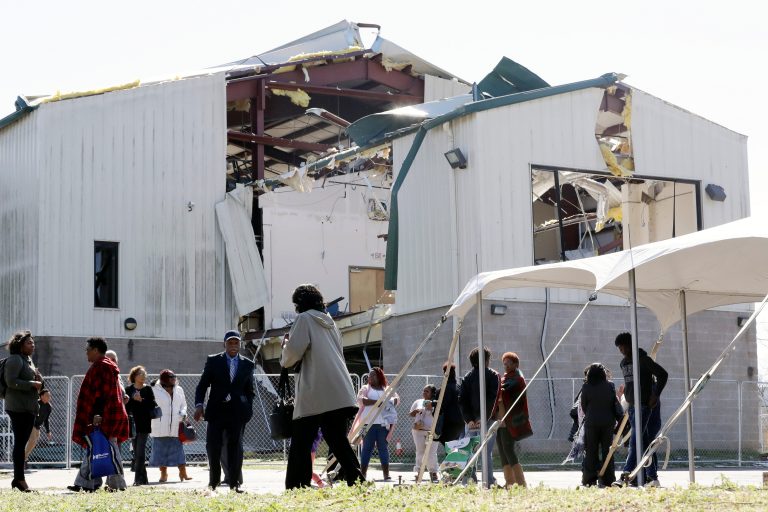
Toddrick Deshaun Johnson, Former Pastor of Paradise Missionary Baptist Church in Houston, Allegedly Stole $200,000 from Congregation

The former pastor of a Houston church allegedly stole more than $200,000 from his congregation, according to a report.

Toddrick Deshaun Johnson, 36, has been charged with theft and using deception to secure an executive document relating to stolen parishioner funds from Paradise Missionary Baptist Church, according to court documents obtained by the Houston Chronicle.

Johnson, who was hired in 2017, forged the church president’s signature in financial documents and then stashed $201,552 into a secret account, board members alleged in court papers.

The hidden funds went undiscovered until a financial audit in 2018, the newspaper reports.

Johnson then left the church when he was confronted about the missing money and is “no longer returning calls,” court documents show.

SOURCE: New York Post, Joshua Rhett Miller

All Content & Images are provided by the acknowledged source

Pearl Jam is postponing the North American leg of its Gigaton world tour because of concerns over the new coronavirus

 Pearl Jam is postponing the North American leg of its Gigaton world tour because of concerns over the new coronavirus, the band announced Monday.

Seventeen U.S. and Canadian performances, beginning on March 18 in Toronto through April 19 in Oakland, California, were indefinitely postponed, according to the band’s website.

Pearl Jam said it was announcing the postponements “with deep frustration and regret.”

“The levels of risk to our audience and their communities is simply too high for our comfort level,” a band statement said. “Add to that we also have a unique group of passionate fans who travel far and wide. We’ve always been humbled by this and respect their energies and devotion. However in this case, travel is something to avoid.”

New dates will be determined and current tickets will be honored for those dates, the band said.

For now, the European shows from June 23 to July 23 are still scheduled along with two September shows in Asbury Park in New Jersey, and Dana Point in California, according to the band’s website.

Band members said they were personally being affected by the COVID-19 health fears. The band is from Washington state, where two dozen people have died, most of them at a Seattle-area nursing home.

“As residents of the city of Seattle, we’ve been hit hard and have witnessed firsthand how quickly these disastrous situations can escalate,” the band said. “Our kids’ schools have closed along with universities and businesses. It’s been brutal.”

Band members also criticized a lack of clarity from the government when it comes to staying safe and going to work, saying they didn’t believe the virus would be controlled in the coming weeks.

“The tour we’ve been busy planning for months is now in jeopardy,” the band said. “We have and will always keep the safety and well-being of our supporters as top priority.”

___

Source: Associated Press

All Content & Images are provided by the acknowledged source

Robin Schumacher on Those Who Deny the Holocaust and Reject Christianity

The ability for a human being to not believe the truth about something can be breathtaking.

Atheists and skeptics of Christianity consistently say that the reason they don’t believe in God is because there is no evidence for Him. If there were just good evidence for God and for the historicity of Jesus, atheists say that would make all the difference in the world – they’d immediately believe.

But is that all there really is to it?

Deborah Lipstadt might have a thing or two to say about that. Dr. Lipstadt, who is the Dorot Professor of Modern Jewish and Holocaust Studies at Emory University, may not be a Christian or have a dog in the fight of atheism vs. Christianity, but she knows a thing or two about the ability of people to turn a blind eye to evidence when it’s offered to them. Lipstadt is the author of Denying the Holocaust: The Growing Assault on Truth and Memory, and someone who has spent years studying the ability of people to reject truth.

While most people think that it’s only individuals like Iran’s former President Mahmoud Ahmadinejad who cast doubt on whether the Holocaust occurred, Lipstadt discovered that the Holocaust’s historical validity is questioned by a far greater number of people than might be believed. Moreover, she found such denial has not only continued to gain adherents, but it has become a broad, international movement with organized chapters, supposed “independent” research centers (with cleverly disguised names), and various publications that promote a revisionist view of WWII history.

But what about all the evidence that clearly supports the historicity of the Holocaust? Lipstadt writes: “The attempt to deny the Holocaust enlists a basic strategy of distortion. Truth is mixed with absolute lies, confusing readers who are unfamiliar with the tactics of the deniers. Half-truths and story segments, which conveniently avoid critical information, leave the listener with a distorted impression of what really happened. The abundance of documents and testimonies that confirm the Holocaust are dismissed as contrived, coerced, or forgeries and falsehoods.”[1]

Now, don’t get me wrong. When I reference Lipstadt’s findings, I’m not attempting to equate atheists with Holocaust deniers. Instead, what I’m trying to get across is the fact that, when it comes to a person choosing to believe or not believe something, there is more to the story.

SOURCE: Christian Post, Robin Schumacher

All Content & Images are provided by the acknowledged source

WATCH: ‘Worship in the Rubble’: Christians Whose Churches Were Destroyed in Deadly Tennessee Tornadoes Gather Outside and in Tents to Pray, Grieve, and Praise God on Sunday Morning

Surrounded by tragedy and destruction, many Christians in the areas hit hardest by the violent Tennessee tornadoes did what they always do on Sunday mornings.

They went to church.

Although steadfast in their weekly routines, some filed into services with heavier hearts, grieving the members of their congregations who died in the storm and would never show up again for a Sunday service.

“Peace is not found in the absence of tragedy. Peace is found in the presence of the Lord,” said John Nichols, the teaching minister at Collegeside Church of Christ in Cookeville, Tennessee. Two of Collegeside’s members died in the storm.

Worship also looked a bit different on the first Sunday after seven tornadoes touched down in Tennessee.

Congregations whose churches were in the path of the twisters gathered outside in the crisp, morning air against a backdrop of their wrecked buildings while others assembled inside borrowed spaces so they could still pray and sing together.

Rev. Jacques Boyd preached under a big white tent in North Nashville as Mount Bethel Missionary Baptist Church’s badly damaged house of worship and Christian center stood behind him. The church dubbed it “worship in the rubble.”

“For 135 years we have always had a place to call home,” said Boyd, preaching.

“But my question for you, Mount Bethel, now that the brick and mortar is gone: Do you still love God? Now that the brick and mortar is gone, do you still love this community? Now that the brick and mortar is gone, can you still give God praise?”

They did and they could. Those inside the crowded tent responded to each of the pastor’s questions with a chorus of yeses and applause.

Even contractors who were busily trying to replace downed power lines paused and took off their hard hats as Boyd led the congregation in prayer on the sunny, windy morning.

It was a display of resilience and faith replicated across Tennessee on Sunday morning.

SOURCE: USA Today; Nashville Tennessean, Holly Meyer, Sandy Mazza, and Travis Dorman

All Content & Images are provided by the acknowledged source

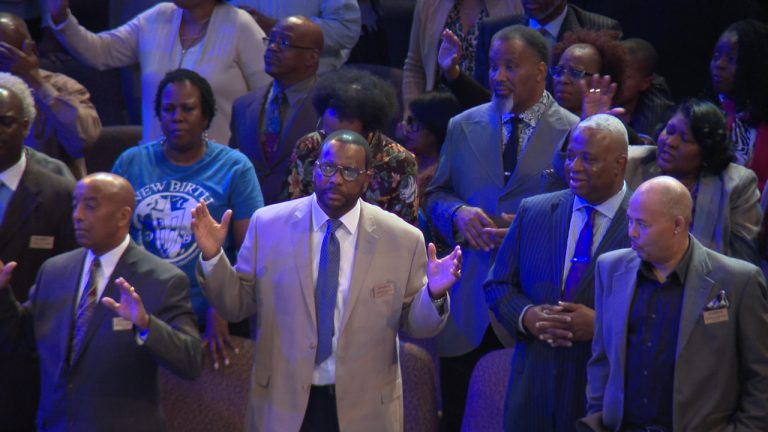
WATCH: New Birth Missionary Baptist Church and Other Georgia Churches Eliminate Communion, Hugging, Handshakes, and Encourage Online Services Amid Coronavirus Threat

As more coronavirus cases pop up in Georgia, many churches are changing their services to keep people healthy. Some churches are stopping communion and some are eliminating hand-holding.

“We put hand sanitizer at every exit of our sanctuary,” said Pastor Jamal Bryant. “We ought to feel safe in the house of God,” he said.

New Birth Church is one of many houses of worship eliminating hugging, communion and even handshakes to stop the potential spread of the coronavirus.

“The church must be a safe haven, not just for inspiration but for information,” said Bryant of educating people on precautionary measures rather than stoking fear among the community.

Just days ago, the Archdiocese of Atlanta offered an advisory on communion policies to churches in an effort to keep people safe.

Those attending Sunday service said they don’t mind the change, and they appreciated the church’s message to stay calm.

“WE’RE NOT ACTUALLY GIVING HUGS” Have you noticed your church making changes to protect your health? The New Birth church in Stonecrest eliminating handshakes and hugging and has hand sanitizer at every entrance because of the coronavirus. @FOX5Atlanta pic.twitter.com/64Cd9xmleC

— Alexa Liacko FOX 5 (@AlexaLiackoFOX5) March 8, 2020

“We need faith in areas where fear will kick in,” Bryant said.

“It does make you a little concerned, but you just keep praying that God is going to come through, and it won’t hit us, ” said worshipper Delaina Holmes.

SOURCE: FOX5, Alexa Liacko

All Content & Images are provided by the acknowledged source

Why Do So Many Churches Object to Apologetics Ministries?

A California-based apologist who oversees a conference that has about 3,000 regular attendees recently addressed the reasons for why churches might object to apologetics ministries. 

“I’ve had to convince a lot of pastors that showing up for an apologetics class, having an apologetics series for their student ministry is an incredibly valuable thing,” said Dena Davidson, campus life director of Thrive School who oversees the Thrive Apologetics Conference at Bayside Church.

“I do think there are a lot of pastors out there who are maybe a little bit jaded about, ‘Ah, apologetics doesn’t work. No one becomes a Christian because their questions get answered.’ And so I have had to face a little bit of that, for sure.”

Davidson was interviewed by Mikel Del Rosario of Dallas Theological Seminary on an episode of “The Table” podcast. She explained that she at her own church, she has been met with support for her ministry.

“I actually work in a church where it was our senior pastor who knew that we needed to have an apologetics presence on our campuses. And so he was the one who actually approached me and said, “Hey. I have this vision to do an apologetics conference. You’re doing something with apologetics. Can you run it?’” recalled Davidson.

“And I had no idea what I was saying yes to. I just thought that was so cool that my senior pastor was A, talking to me, and B, asking me to put on something that I love so much for the rest of the church.”

While she “did not have to convince that senior pastor that this ministry was valuable,” she has met some resistance from other churches. She cited two big reasons for churches resisting apologetics ministry, the first being a bad experience.

“I listen to their story about they may have seen someone use apologetics to try to argue people into the kingdom, or people use apologetics to actually tear people down,” she explained.

“After listening to their story, I just, in love, present a different option. And I say, ‘That sounds like really bad apologetics. But just because someone has done apologetics poorly doesn’t mean we shouldn’t do it. It means that we need to do it better.’”

The second reason churches might be hesitant to do apologetics, according to Davidson, was that “it’s a lot of work.”

SOURCE: Christian Post, Michael Gryboski

All Content & Images are provided by the acknowledged source

Christian Leader in Madhya Pradesh, India Run Over by Motorcycles, Sources Say

Christian Leader in Madhya Pradesh, India Run Over by Motorcycles, Sources Say


NEW DELHI, March 9, 2020 (Morning Star News) – Violence against Christians in India hit a new level on Tuesday (March 3) when Hindu extremists ran their motorcycles over a key evangelical leader after beating him, sources said.

Armed with bamboo rods and a thick metal chain with a heavy lock on it, the 10 Hindu nationalists in Sehore, Madhya Pradesh state beat Isaac Paulose, 48, and then ran their five motorcycles over him, fracturing one of his ribs, said Uttar Kumar Deep, pastor of Grace Fellowship Church of CEA (Christian Evangelistic Assemblies), Sehore.

Paulose, an elder at the church and Madhya Pradesh coordinator of the New India Evangelistic Association, was attacked shortly after dropping his 5-year-old son off at school that morning, Pastor Deep said.

Paulose was in his car when a Hindu nationalist on a motorcycle stopped him and told him to get out, he said.

“Unaware of his intentions and without a slightest of suspicion, Isaac stepped out,” Pastor Deep said. “Suddenly others joined the biker, and all of them began to beat Isaac with bamboo logs and a chain.”

Paulose’s wife, Elizabeth Isaac, said he was stopped no more than 300 meters from their home.

“The moment he stepped out of his car, the others joined in, and they began to beat him,” Isaac said. “Accusing him of ‘converting people,’ they beat him with bamboo logs and a thick metal chain with…

… Read More

Click here to read the rest of the story from our content source/partners – Christian Headlines.

قالب وردپرس

Christian Leader Suffers Multiple Fractures After Being Brutally Beaten, Run Over With Motorcycles by Hindu Extremists Who Mocked His Faith

Hindu extremists in India brutally beat a Christian leader before running their motorcycles over him while mocking his faith as he lay semi-conscious in Sehore, Madhya Pradesh state, according to a pastor.

Shortly after dropping his 5-year-old son off at school that morning, Isaac Paulose, 48, was beaten by 10 Hindu nationalists armed with bamboo rods and a thick metal chain with a heavy lock on it. The attackers then ran their five motorcycles over him, fracturing one of his ribs, Uttar Kumar Deep, pastor of Grace Fellowship Church of CEA (Christian Evangelistic Assemblies), Sehore told Morning Star News.

According to Deep, Paulose was in his car when a Hindu nationalist on a motorcycle stopped him and told him to get out.

“Unaware of his intentions and without a slightest of suspicion, Isaac stepped out,” Deep said. “Suddenly others joined the biker, and all of them began to beat Isaac with bamboo logs and a chain. The moment he stepped out of his car, the others joined in, and they began to beat him.”

“Accusing him of ‘converting people,’ they beat him with bamboo logs and a thick metal chain with a lock attached to its end. They scorned and ridiculed him, daring him to continue to convert people.”

The assailants threatened to kill the pastor before leaving and mocked his faith, Deep said.

“When he lay on the ground half-dead, they drove their bikes, five in number, one after another over him, injuring him further and breaking his rib,” he said. “They scorned and taunted him, asking him to call on the name of Jesus. They also threatened to kill him if he continues to ‘convert’ people.”

The assailants fled only after passers-by noticed and came to Paulose’s aid. The Christian leader was rushed to a hospital where he underwent two surgeries on his left hand, which sustained multiple fractures.

“He has received two stitches at the back of his head, and one stitch on his forehead,” Isaac said. “One of his ribs is fractured, for which the doctors said that nothing can be done and that he will need to take a lot of rest for the rib to heal by itself.”

SOURCE: Christian Post, Leah MarieAnn Klett

All Content & Images are provided by the acknowledged source

Ron Hutchcraft on Why We Shouldn’t be Afraid Amid Global Crises

North Dakota’s a long way from Wuhan, China. But our friend Wes has been seeing more and more customers wearing masks in the local Walmart. He says he’s going to start telling them “to calm down.” Thinking of how fear can spook the stock market, he commented, “Then I’m going to thank them for destroying my 401(k).”

Okay, not a recommended response to the coronavirus crisis. But it’s definitely a reflection of the increasing fear a lot of folks are feeling right now. And the stunning impact this virus is having all over the world.

Major cities shut down. Powerhouse economies like China’s slowing to a crawl. Wholesale international travel cancellations. Wall Street in freefall. Medical supply shortages. Major events cancelled.

And that’s just a few weeks into the threat! Increasingly, there are huge questions about supply line interruptions in everything from manufacturing to medication. And how America’s thriving economy could be affected. And elections. And transportation. And, of course, avoiding the virus’ growing tentacles.

Pandemic, some are calling it. But beyond any medical pandemic is another pandemic. Fear. On social media, on TV – even in a North Dakota store.

But the anxiety thing is bigger even than the coronavirus scare. I just returned from meetings with leaders of major Christian mission organizations; people with their finger on the pulse of people and places around the world.  And the recurring observation was, “The nations are being shaken.” From the Hong Kong crisis to riots in India to resurgent anti-Semitism to political upheaval in countries around the globe. And now the ominous cloud of coronavirus hanging over millions of us.

So many unknowns. So many disturbing possibilities. And, yes, so much fear. Precautions are good. Panic and paralysis aren’t. But that is often where fear takes us.

Back in 1993, on the morning after that first bombing at the World Trade Center, I was on the early morning flight from New York to Cleveland. We were greeted by a gaggle of reporters, one of whom stopped me and asked how people were feeling. Without any time to think about it, only one word came to mind. “Vulnerable. We feel vulnerable.”

I think that’s how many of us are feeling in a world that’s “shaking.” And it’s more than a feeling. We really are vulnerable. Look at what happens when there’s just an extended power outage, for example. And with our pervasive dependency on technology, what happens if there’s a cyber meltdown or attack? It wouldn’t take long to make a list of our many vulnerabilities.

Lots to fear.

SOURCE: Christian Post, Ron Hutchcraft

All Content & Images are provided by the acknowledged source

From Temple Prostitute in India to Free in Jesus Christ

The devadasi lifestyle is outlawed in India, but the practice remains in pockets of the country. Devadasis are temple prostitutes dedicated to a particular god or goddess. They perform sexual favors, and much of the money they earn goes to the temple as a religious offering.

Haida was only seven-years-old when she became a devadasi for the goddess Yellamma. Her family worshipped Yellamma, and Haida’s mother pressured her into religious servitude.

At first, Haida was mesmerized by the devadasi dedication rituals and processions for her. But things quickly grew dark as she realized what was expected of her. When Haida tried to run, her mother stopped her and forced her to stay or risk stoking the goddess’s wrath.

Fear kept Haida enslaved in temple prostitution and stole her childhood. She eventually had two daughters by different men. By the time she was a young adult, Haida was working hard labor outside the temple to earn extra income and support her children.

Haida never had an education and couldn’t read or write, so alternative employment was out of the question. She was terrified that her daughters would be pressured to become devadasis as well. In despair, Haida made plans to take her own life.

But God intervened. Haida’s cousin, Raheema, was a Christian and came to visit Haida on the day she planned to end her life. Raheema told Haida the story of Jesus and His love for her. It was the first time Haida felt a glimmer of hope.

Raheema was also attending an Adult Literacy Class with Mission India just down the street. She invited Haida to join her.

Mission India’s Adult Literacy Classes are vital for women like Haida who have only known degradation and disempowerment.

Erik Morsehead with Mission India says, “One of the greatest things about Adult Literacy Classes is that they, for the first time, get to understand their value — their value in their family, their value in their community, their value to themselves, and ultimately and most importantly, the value that God has put upon them.”

SOURCE: Mission Network News, Lyndsey Koh

All Content & Images are provided by the acknowledged source