

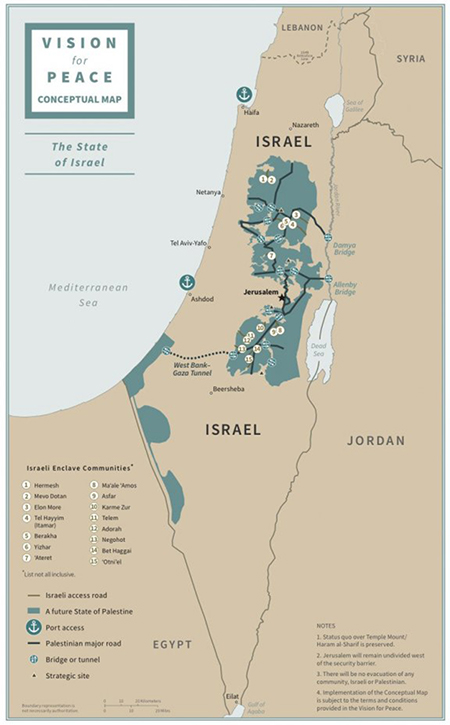
Presbyterian Church USA’s Leader Criticizes President Trump’s Middle East Plan

The Stated Clerk of the General Assembly of the Presbyterian Church (U.S.A.) says he sees nothing in President Donald Trump’s Middle East plan that would benefit the Palestinian community. The Reverend Dr. J. Herbert Nelson, II, issued a statement to Presbyterians Friday denouncing the plan.

“This ‘deal’ is little more than a cynical rephrasing of the conditions that have kept the Palestinian people under Israeli occupation for decades,” he writes. “It codifies Israel’s egregious theft of Palestinian land and would continue Israel’s military rule, even over the areas allocated to the so-called Palestinian state.”

Nelson said that from the perspective of past Presbyterian General Assemblies, the plan is a “consummate violation” of the most basic principles required for peace in the region.

“We must speak out on behalf of the Palestinian community, residents of this land for generations,” the statement reads. “Their land has been stolen. Their holy sites have been denigrated. Their homes and businesses have been destroyed and they all live under the iron fist of Israel’s continuing military occupation.”

The president unveiled the 80-page plan at a news conference earlier this week.

Read the Stated Clerk’s full statement below:

OFFICE OF THE GENERAL ASSEMBLY
THE REVEREND DR. J. HERBERT NELSON, II
STATED CLERK OF THE GENERAL ASSEMBLY

Dear Presbyterian Sisters and Brothers,

As the impeachment trial of President Donald J. Trump continues, it seems the president has tried to change the subject by announcing his “deal of the century” for bringing to an end the long-standing struggle between Israelis and Palestinians in the “Holy Land.” This “deal” is little more than a cynical rephrasing of the conditions that have kept the Palestinian people under Israeli occupation for decades. It codifies Israel’s egregious theft of Palestinian land and would continue Israel’s military rule, even over the areas allocated to the so-called Palestinian state. It lacks any evidence of a true willingness to include the interests of the Palestinian community.

From the perspective of decades of Presbyterian General Assemblies, it is a consummate violation of the most basic principles required for peace in “The Holy Land.” Our church has consistently condemned the creeping encroachment by Israel on land recognized by the international community as Palestinian territory. Israel has confiscated massive swaths of this land in the establishment of illegal settlements and in the military occupation of Palestinian land throughout the West Bank of the Jordan River; moreover the Trump administration has embraced the will of Israeli leaders in declaring the Holy City of Jerusalem the unique, undivided capital of Israel and has relocated the U.S. Embassy there. The historic claim on the deep religious importance of this city to Christians and Muslims has been ignored, and damaged, if not destroyed by theses unilateral acts.

We must speak out on behalf of the Palestinian community, residents of this land for generations. Their land has been stolen. Their holy sites have been denigrated. Their homes and businesses have been destroyed and they all live under the iron fist of Israel’s continuing military occupation. This would not change under this “deal” proposed. As Christians, concerned for our own roots in this “Holy Land,” we cry out in anguish and anger as a kind of social and religious “ethnic cleansing” is occurring under these efforts of current Israeli leadership and of our own president.

One of the deep ironies of the impact of the ongoing illegal taking of Palestinian land and the draconian control on the Palestinian community by Israel and its military is the potential for feeding the growing antisemitism in Europe and the U.S. that we so abhor. More violence is the inevitable fruit of a “deal” such as the one proposed. And the Israeli Jewish community should understand, better than anyone, the tragedies of sustained oppression.

I call on all Presbyterians who yearn for peace in The Holy Land to demand of our president a better

“deal.” We must make clear to our political leaders that the “land of Israel” will never be at peace until justice is done for all her people, not just members of the Jewish community.

May God’s call “to do justice” motivate us to demand that our own politicians work toward an equitable future for Muslims, Christians, and people of other faiths or none, as well as our Jewish sisters and brothers.

In the Faith that we share,

The Reverend Dr. J. Herbert Nelson, II
Stated Clerk of the General Assembly
Presbyterian Church (U.S.A.)

Source: PCUSA News

All Content & Images are provided by the acknowledged source

Presbyterian Church of Kabuga Transforms Schools in Rwanda

The Presbyterian Church of Kabuga, Rwanda, has two primary schools — Kabuga (with 310 students) and Muyumba (with 192 students). Parents, students and teachers are celebrating the fourth consecutive school year that students in Primary 6 in both schools have achieved a perfect score on Rwanda’s national examination.

Each school was built to show how small actions can be of great importance. They have become the high-quality schools they are today by building one classroom a year.

It is a blessing to have high-quality education among schools in our educational system. Our students, as early as nursery school, learn how a small action, like planting a tree, can be of great importance to our environment. This way of education contributes to the protection of biodiversity.

We plant trees to create a space for creative thinking and a source of inspiration for our students. Trees are an effective sound barrier and can limit noise pollution. Recent research shows that trees also help reduce the stress of modern life. To many people, a tree is the ultimate symbol of prosperity. Frank Lloyd Wright, an American architect, writer and educator, once said, “The best friend on Earth of man is the tree.”

Trees provide restful shade to humans and animals alike, and are home to numerous birds, insects and animals. Trees help us overcome fear, calm our bodies, and release our frustrations and anger. If you are dealing with issues from your past, use “green” to help bring harmony into any situation. Trees may even help to recompose unity among divided people, which is a challenge and vital mission in our society.

Green helps dissolve aggression in relationships or mend a broken heart. It helps release negative patterns and beliefs and can assist in centering yourself in stressful or shocking situations. Green replenishes your energy and helps you relax, meditate and heal.

Green helps revitalize the nervous system, heart, thymus, lungs and liver. It also stimulates growth and helps heal broken bones, build muscles and repair tissues. Green has the ability to purify the blood and restore health. It contains antibacterial qualities. On the shadow side, green has been linked to envy, jealousy and superstition. It is a color of fertility, truth, youthfulness and innocence.

In requesting students to plant trees, we are helping them to be aware of climate change and the rapid destruction of our planet. Trees absorb harmful carbon from the atmosphere and are key ingredients in 25% of all medicines. Trees provide jobs to more than 1.6 billion people.

Source: PCUSA News

All Content & Images are provided by the acknowledged source

Houston Church Still Rebuilding and Reaching Out After 2017 Hurricane

When Houston Northwest Church recently welcomed children and their families to the congregation’s newly constructed HNW Kids Building, it marked a milepost in recovery and rebuilding after Hurricane Harvey.

Harvey hit the Texas Gulf Coast in August 2017, flooding almost every building on the Houston Northwest Church campus and causing $14.5 million in property damage.

“Our worship center was the only one that didn’t take on three to four feet of water,” said Karen Stamps, director of connections and communication at the church.

In the immediate aftermath of the hurricane, the worship center became the staging area for mud-out disaster relief teams and a distribution hub for supplies and assistance in the community.

The floodwaters caused extensive damage to the church’s adult and student facilities, but its children’s building was most severely affected.

Years earlier, the church’s original sanctuary had been converted into the building that housed the congregation’s children’s ministry. The 40-year-old building had not been constructed with reinforced steel beams designed to withstand severe storm damage. Structural damage was so severe, the building had to be demolished.

“The area where the kids’ building stood was repurposed as green space for community use,” Stamps said.

For more than two years, Houston Northwest Church offered limited children’s activities in temporary space on campus. Students relocated to a nearby YMCA. Adult Bible study groups either met in homes or temporarily suspended operation until the renovated adult building reopened in January 2019.

In mid-December, the church held a ribbon-cutting ceremony marking the completion of its newly construction HNW Kids Building. The facility includes several worship venues, classrooms and multiple play areas.

Source: Baptist Standard

All Content & Images are provided by the acknowledged source

Dalese Black on Focusing on Jesus in the Strain of Life

Dalese Black was a volunteer children’s ministry director and a self-supporting collegiate missionary. She has a Masters in Christian Education, is a mother of two children and is married to Eric Black, executive director, publisher and editor of the Baptist Standard. The views expressed in this commentary do not necessarily represent those of BCNN1.

How do you focus when life is too much?

• When the days seem to end before you can gather your thoughts?
• When the piles of dirty clothes don’t get smaller even though the washer and dryer run all day?
• When the dishwasher is full of clean dishes you can’t find time to put away while more dirty dishes fill the sinks and spill out on the counters?
• When one child can’t get settled and the other child can’t remember to be kind?
• When the bills are piling up and the money is short?
• When illnesses won’t stop?
• When the ache in your heart is disabling?
• When all is wrong in the world and the weight of the world seems to sit on your shoulders?
• When there seems to be no end to the arguing among adults who know better?
• When we can’t watch TV or see movies, billboards or social media without being bombarded with the objectification of people, all people—children, teens, women, men, all colors and races?
• When the cry of the people is dismissed?
• When the very heartbeat of the nation feels like a heart attack?
• When the followers of Christ appear to be more divided than unified?

In the midst of it all, how do we focus?

Jesus said, “Come to me, all who are weary” (Matthew 11:28).

Do we go to Jesus? Do we stop and find the words of Jesus and focus on them, find solace and peace in them? Do we take a moment actually to seek Jesus first, seek Jesus’ will, seek Jesus’ way, seek Jesus’ plan or call or kingdom?

Seek first his kingdom (Matthew 6:33). It’s not just an old worship song; it’s Scripture.

Let us not grow weary in doing good (Galatians 6:9) for our time here on Earth is to shine the light of Jesus and to be the salt of Jesus (Matthew 5:13-16). We must do more than just survive. We are called to live in the midst of it all as salt and light.

How can we be salt and light when we are so hard-pressed?

When we awake tired at the beginning of the day, let us thank Jesus for a new day and a fresh start.

When we wash the mounds of laundry that never end, let us thank Jesus for clothes and washers and dryers.

When we sort out all the dirty and clean dishes—not to mention the rest of the mess in the house, let us thank Jesus for the food we eat and the people in our homes.

When the children have hard days, let us thank Jesus that we know what it’s like. We have been there and can offer the children grace, just as we have had grace lavished on us.

When the bills are never-ending, let us ask Jesus to calm our hearts and give us clear minds to address them, and let us never be too proud to seek out help.

Source: Baptist Standard

All Content & Images are provided by the acknowledged source
Here’s What is on the Table at the United Methodist Church’s 2020 General Conference

What form The United Methodist Church takes next will remain unclear until the 2020 General Conference meets this spring.

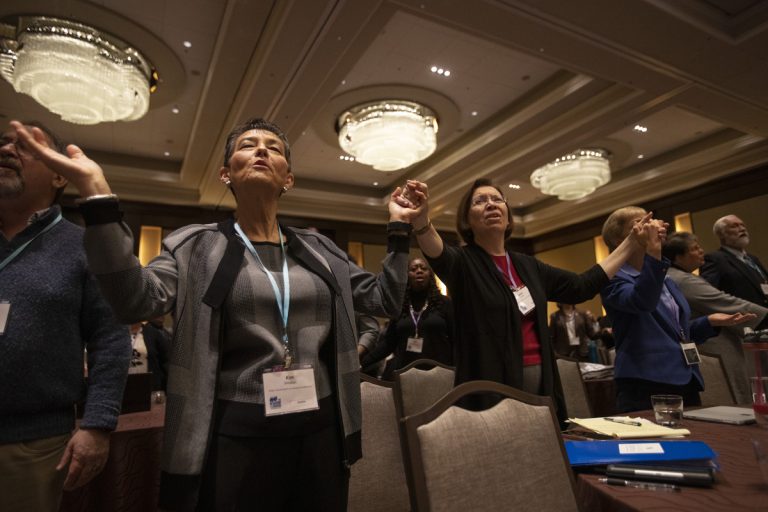
In a gathering that emphasized the denomination’s uncertain future, United Methodists received a preview of some of the possibilities that will be before 862 delegates when they meet May 5-15 in Minneapolis.

“Minneapolis is likely to be our Massah, our testing place, and Minneapolis is likely to be our Meribah, our quarreling place,” said Minnesota’s Bishop Bruce Ough during an opening sermon based on Exodus 17.

But, he added, Minneapolis also “can be the place where God pours out God’s extravagant love and grace on a hurting, broken, anxious church and liberates us from our conflict.”

More than 400 delegates, communicators and other United Methodists who will be part of the 2020 General Conference attended the Jan. 23-24 preview event at the Omni Nashville Hotel. UM News and United Methodist Communications sponsored the event, with involvement and support from other agencies and ministries of the church.

Near the top of the agenda was an overview of various proposals to separate or, in one case, dissolve the denomination in hopes of ending the church’s decades-long dispute over how accepting to be of homosexuality.

The gathering also included presentations on other legislation that could affect United Methodist ministry.

This is a brief look at some of the issues explored. A number of topics covered in the briefing will be addressed in future stories by UM News. Those will include proposals affecting young people’s ministries, the status of women, the general church budget, ecumenical relationships and the future of ethnic-focused ministries.

Plans of separation

The rancorous special 2019 General Conference, by a 438-384 vote, tightened the denomination’s bans on same-sex weddings and “self-avowed practicing” gay clergy. However, those church rules have faced increasing resistance.

Confronted with what many see as irreconcilable differences, various groups of United Methodists have worked throughout 2019 on proposals to let the denomination split along theological lines.

Participants at the Nashville gathering heard from developers of four such proposals. These included “New Denominations of Methodism,” also known as the Indianapolis Plan; “New Expressions Worldwide” from UM-Forward; “Next Generation UMC” from UMCNext; and the “Protocol of Reconciliation & Grace Through Separation.”

By far the plan that has grabbed the most attention is the protocol. The proposal is a mediated agreement among bishops and leaders of advocacy groups with differing perspectives on LGBTQ inclusion. The plan resulted from discussions initiated by Sierra Leone’s Bishop John Yambasu.

“The uniqueness of this conversation was that it was broad; it was diverse,” said the Rev. Junius Dotson, a delegate from the Great Plains Conference and top executive of Discipleship Ministries. “It was initiated by central conference leaders; and of course, this conversation morphed into a conversation that was mediated by the world-renowned Ken Feinberg.”

Developers of the Indianapolis and UMCNext plans both contributed to the protocol, and presenters for each plan announced their groups’ backing of the newest proposal.

The protocol does not ask anyone to leave The United Methodist Church. However, it allows traditionalist congregations and conferences to separate and form a new denomination, while keeping their properties and getting $25 million in United Methodist funds.

It also reserves $2 million to help other new potential denominations and designates $39 million over eight years to strengthen Asian, African American, Hispanic-Latino, Native American and Pacific Islander ministries, as well as Africa University.

Still, the Rev. Jay Williams — a leader in UM-Forward and delegate from the New England Conference — voiced concerns about how the protocol came into being. He noted that UM-Forward and leaders of the denomination’s ethnic caucuses were not at the table. He also said that the protocol developers were the only plan backers who had a United Methodist Communications “press conference.” 

UM-Forward developed the New Expressions Worldwide, or N.E.W., Plan that would dissolve The United Methodist Church and form four new global denominations instead.

“We believe dissolution is the faithful way forward,” said the Rev. Alka Lyall, one of the plan’s developers and a delegate from the Northern Illinois Conference.

Under the plan, the new denominations would align along traditionalist, moderate, progressive or liberation perspectives. UM-Forward, which seeks to center itself on people of color and LGBTQ individuals, sees itself in the last category.

The group’s vision of liberation, Williams explained, is “a spiritual and social way of living, a posture toward the future that is grounded in past struggle and present resilience that proclaims: We are loved into freedom.”

U.S. regional conference

Those at the Nashville meeting also heard about the proposed U.S. regional conference. The new structure would encompass the United States and maintain the current five U.S. jurisdictions.

The Connectional Table, a multinational body that coordinates money and ministry, began drafting the proposal long before GC2019 put the spotlight on church divisions.

The group’s goal is to have a body to take up matters that solely affect the U.S. church and ease the burden on the multinational General Conference. U.S. proposals often dominate the global lawmaking assembly.

Source: United Methodist News

All Content & Images are provided by the acknowledged source
Filipino United Methodists Defend Sanctuary That Houses Displaced Indigenous People

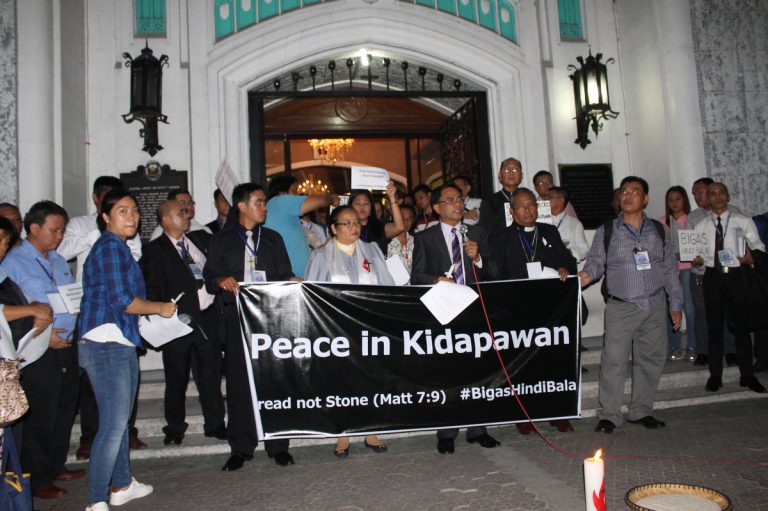
United Methodists were among those who opposed a resolution to close down Haran Mission Center in Davao City, a sanctuary to around 500 displaced Lumads in Mindanao.

Davao del Norte Governor Edwin Jubahib moved for the immediate closure of the United Church of Christ in the Philippines center due to “violations of indigenous people’s rights” committed inside the facility, according to the resolution issued by the Davao Regional Peace and Order Council Jan. 15.

Haran Mission Center is a temporary shelter for displaced Lumads from Davao del Norte, Cagayan de Oro, Bukidnon and Cotabato who fled military harassment in their villages. Around 170 families — an estimated 500 individuals, mostly children — are housed at the center.

The Lumads are the largest indigenous group in the Philippines. The word “Lumad” is a Visayan term that means “born of the earth.”

Ten days after the closure order, the paramilitary group Alamara, which included some Lumad members, raided the compound, according to local news reports. That forced evacuees to take shelter in the main compound.

United Methodist Bishop Rodolfo A. Juan, Davao Area, condemned the closure and raid.

“It is unfortunate that the Lumad ministry at Haran is halted due to the forcible entry of armed men. These are indeed trying moments in the history of our church in our pursuit for peace among the indigenous people in Mindanao.

“I condemn in strictest terms this unlawful entry into the Lumad sanctuary and I call on the military and police to ensure safety in the whole facility. I join the (National Council of Churches in the Philippines) family in praying for the immediate restoration of peace and order in Haran and its ministry to the Lumads.”

United Methodists have been at the forefront in speaking out and defending the rights of the indigenous peoples, and the church continues its outreach with Lumads.

A United Methodist Board of Global Ministries Nationals in Mission project works with indigenous peoples in the Philippines.

“We have ministries in Makilala town and in Tacol, Magsaysay, Davao Sur and in Managic, Malaybalay, Bukidnon,” Juan said.

“A livelihood project on basket weaving is conducted with our Lumads to enable them to generate extra income. I also sourced out funds for a children’s classroom and library for Lumads.”

Source: United Methodist News

All Content & Images are provided by the acknowledged source
Sierra Leone Church Celebrates End of Land Dispute

The Sierra Leone Ministry of Lands has closed the door on a land dispute between The United Methodist Church and the Masantigie community, but not before issuing a stern warning about keeping the peace.

The Sierra Leone Conference and village community had been at odds over a United Methodist property in rural eastern Freetown until August of last year, when the conference agreed to give 60 acres of its 443-acre Pa Loko land to the neighboring community.

The Masantigie had lost at least two lawsuits concerning rights to the land over the course of the seven-year dispute.

United Methodist Bishop John K. Yambasu met with Sierra Leone President Julius Maada Bio in May of 2019 to ask for help after a dawn raid on the property during which five members of Mango Brown United Methodist Church were wounded, three seriously.

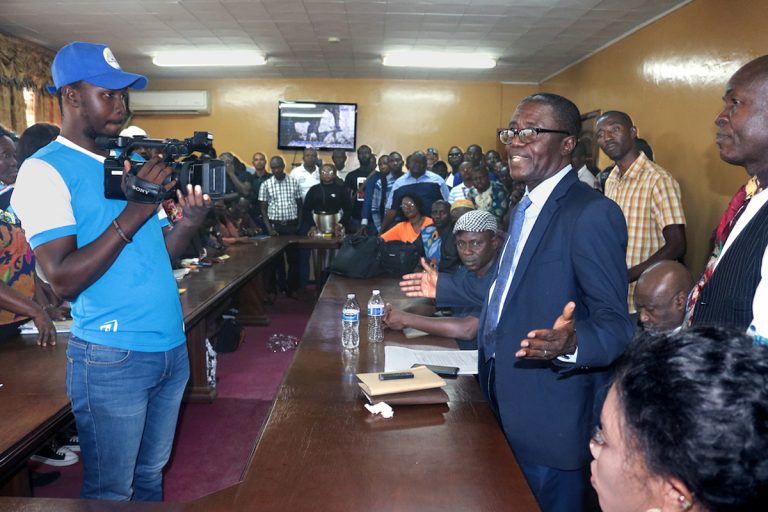
Bio established a committee to work on a resolution between the two sides. The culmination of that work was celebrated at a special ceremony Jan. 15.

Minister of Lands Denis Sandy spoke at the crowded event and recalled the cordial relationship that existed between the parties before the dispute. The denomination used to provide jobs and other means of livelihood for the Masantigie community, he said, and he hoped the parties would go back and build on that relationship.

In resolving the matter, Sandy said, the committee took into consideration population migration and other factors.

The ministry presented the site plan and “letters of offer” to both parties during the event.

The Rev. Solomon Rogers represented The United Methodist Church on behalf of the bishop, who was unable to attend. After signing the plan, he thanked God and President Bio for intervening.

“We have done this not only for the church, but the Scripture also says righteousness exalts a nation. If we are all righteous … and we are satisfied with what is happening around us, the country also will develop. We pray that the future will be bright,” he said.

Mohamed O. Kanu, headman of Masantigie village, also thanked the government for intervening to bring peace. He said the community would accept “what they have been offered for now” in the interest of peace and because the church has promised to build a university on the property.

He said, in his opinion, the 60 acres of land offered to his community was too small. The statement drew sounds of disapproval from the crowd, and deputy minister Alex Bhonapha issued a warning in response to his statements.

Source: United Methodist News

All Content & Images are provided by the acknowledged source

In a win for the world, ‘Parasite’ takes best picture Oscar

Subtitle this: “Parasite” is the first non-English language film to win best picture in the 92-year history of the Academy Awards.

Bong Joon Ho’s masterfully devious class satire took Hollywood’s top prize at the Oscars on Sunday night, along with awards for best director, best international film and best screenplay. In a year dominated by period epics — “1917,” “Once Upon a Time … In Hollywood,” “The Irishman” — the film academy instead went overseas, to South Korea, to reward a contemporary and unsettling portrait of social inequality in “Parasite.”

True to its name, “Parasite” simply got under the skin of Oscar voters, attaching itself to the American awards season and, ultimately, to history. The win was a watershed moment for the Academy Awards, which has long been content to relegate international films to their own category.

Multiple standing ovations greeted Bong’s several wins. “I am ready to drink tonight,” Bong said, prompting roars from the crowd. Unexpectedly called up again for best director, Bong saluted his fellow nominees, particularly Martin Scorsese, and concluded: “Now I’m ready to drink until tomorrow.”

After the Dolby Theatre had emptied out, the “Parasite” team still remained on the stage, soaking in their win.

The win for “Parasite” — which had echoes of the surprise victory of “Moonlight” over “La La Land” three years ago — came in a year when many criticized the lack of diversity in the nominees and the absence of female filmmakers. But the triumph for “Parasite” enabled Hollywood to flip the script and signal a different kind of progress.

In doing so, the film academy turned away another history-making event, again denying Netflix its first best-picture win despite two contenders in “The Irishman” and “Marriage Story,” and a big-spending awards campaign blitz.

Mendes’ audaciously conceived World War I film “1917,” made to seem one continuous shot, had been the clear favorite heading into Oscars, having won nearly all the precursor awards, including top honors from the Producers Guild, the Directors Guild, the Golden Globes and the BAFTAs. In the end, “1917” went home with three awards for its technical virtuosity: Roger Deakins’ cinematography, visual effects and sound mixing.

All of the acting winners — Brad Pitt, Renee Zellweger, Joaquin Phoenix and Laura Dern — went as expected. While Pitt, notching his first acting Oscar, had regaled audiences with one-liners in the run-up to Sunday, he began his comments on a political note.

“They told me I have 45 seconds to speak, which is 45 seconds more than the Senate gave John Bolton this week,” Pitt said, alluding to the impeachment hearings. “I’m thinking maybe Quentin does a movie about it.”

Pitt said the honor had given him reason to reflect on his fairy-tale journey in the film industry, going back to when he moved to Los Angeles from Missouri. “Once upon a time in Hollywood,” said Pitt. “Ain’t that the truth.”

Zellweger completed a comeback, winning her second Academy Award for her fragile but indomitable Judy Garland in “Judy.” Dern won for her performance as a divorce attorney in Noah Baumbach’s “Marriage Story.” Accepting her first Oscar, Dern thanked her in-attendance parents, “my legends, Diane Ladd and Bruce Dern.”

Phoenix, long one of Hollywood’s most respected actors, took best actor for his limber but morose Joker. In his acceptance speech, Phoenix spoke deliberately about a host of issues, including sexism and racism in the film industry, ecological disaster and vegetarianism.

“I’ve been a scoundrel in my life. I’ve been selfish, I’ve been cruel at times and hard to work with. But so many of you in this room have given me a second chance,” Phoenix said. When people guide each other toward redemption, he said, “that is the best of humanity.”

He concluded quoting a lyric of his deceased brother, River Phoenix: “Run to the rescue with love and peace will follow.”

For the 87th time, no women were nominated for best director this year, a subject that was woven into the entire ceremony — and even into some attendees’ clothing. Natalie Portman wore a cape lined with the names of female filmmakers who weren’t nominated for best director, including Lulu Wang (“The Farewell”), Greta Gerwig (“Little Women”) and Mati Diop (“Atlantics”).

Coming on a rare rainy day in Los Angeles, the ceremony was soggy and song-heavy. Some performances, like Eminem’s performance of “Lose Yourself,” were unexpected (and drew a wan response from Scorsese). All of the song nominees performed, including Elton John who won with his longtime songwriting partner Bernie Taupin for their “Rocketman” tune.

The hostless ceremony opened on a note of inclusion, with Janelle Monae performing “A Beautiful Day in the Neighborhood” and her own song, “Come Alive,” with an assist from Billy Porter. “I’m so proud to be standing here as a black queer artist telling stories,” Monae said. “Happy Black History Month.”

Two former Oscar hosts, Chris Rock and Steve Martin, provided the opening monologue. “An incredible demotion,” Martin called it. Martin also reminded that something was missing from this year’s directing nominees. “Vaginas!” Rock replied.

There were milestones beyond “Parasite.” In winning best adapted screenplay for his Nazi satire “Jojo Rabbit,” the New Zealand filmmaker Taika Waititi became the first indigenous director ever to win an Oscar. He dedicated the award to “all the indigenous kids in the world who want to do art, dance and write stories.”

“We are the original storytellers,” Waititi said.

“Joker” composer Hildur Gudnadottir became only the third woman to ever win best original score. ”To the girls, to the women, to the mothers, to the daughters who hear the music opening within, please speak up,” said Gudnadottir. “We need to hear your voices.”

Awards were spread around to all of the best-picture nominees, with the lone exception being Scorsese’s 10-time nominee “The Irishman.” When Bong mentioned his admiration of Scorsese, an impromptu tribute broke out, with the Dolby Theatre giving Scorsese a standing ovation.

The car racing throwback “Ford v Ferrari” was also honored for its craft, winning both editing and sound editing. Gerwig’s Louisa May Alcott adaptation “Little Women” won for Jacqueline Durran’s costume design. “Once Upon a Time … in Hollywood” for Barbara Ling’s production design.

Netflix didn’t go home empty handed. Aside from Dern’s win for “Marriage Story,” the streamer’s “American Factory” won best documentary. The film is the first release from Barack and Michelle Obama’s Higher Ground Productions.

Pixar extended its domination of the best animated film category, winning for “Toy Story 4.” It’s the 10th Pixar film to win the award and second “Toy Story” film to do so, following the previous 2010 installment.

It was an early award for the Walt Disney Co. which despite amassing a record $13 billion in worldwide box office last year and owning the network the Oscars are broadcast on, played a minor role in the ceremony. The bulk of its awards came from 20th Century Fox (“Ford v Ferrari”) and Fox Searchlight (“Jojo Rabbit”), both of which the company took control of after its $71.3 billion acquisition of 21st Century Fox last year.

Disney’s ABC, which is broadcasting the show live, hoped a widely watched field of nominees — including the $1 billion-grossing “Joker” — will help viewership. Last year’s show garnered 29.6 million viewers, a 12% uptick.

___

Source: Associated Press – JAKE COYLE

All Content & Images are provided by the acknowledged source

Scot McKnight on the Meaning of a ‘Kingdom’ Ministry

Scot McKnight is an American New Testament scholar, historian of early Christianity, theologian, and author who has written widely on the historical Jesus, early Christianity and Christian living. He is currently Professor of New Testament at Northern Baptist Theological Seminary in Lombard, IL. The views expressed in this commentary do not necessarily represent those of BCNN1.

In his well-known Southern twang and humor, Jeff Foxworthy often turns crowds into raucous laughter when he offers his ideas on how to detect Southern hicks with his opening line, “You might be a redneck if you…”. As in “You might be a redneck if you think the stock market has a fence around it.” I borrow his line, not for humor, but for the serious endeavor of detecting a kingdom-mission church: “You might be a kingdom-mission church if …” I will offer below ten traits of a kingdom-mission church, but first a few other points.

This set of ten themes puts into practice what is written in my book Kingdom Conspiracy. In the book I make a case for what the Bible means when it uses the word “kingdom.”

Here’s the chief conclusion I offer: every time the term “kingdom” is used in the Old Testament (apart from possibly once) it means a nation or a people governed by a king.

Never, and on this there is not a debate, does it mean “salvation” or “working for justice among the Gentiles.” In other words, in the references that most concern us the term “kingdom” refers to Israel as a nation. When Jesus said the kingdom had drawn near, he meant that kingdom vision of the Old Testament’s narrative. So I offered there the briefest definition of “kingdom” that every Christian can use to get a solid grip on the meaning of term: a kingdom is a people governed by a king.

Because it is a people (and not reducible to an ethic, social or private, nor reducible to the unleashing of God’s redemptive power), the Bible reader is driven to ask for the New Testament: Who is the kingdom people now? The answer is “church” with church understood not in supersessionist ways (the church replacing and God abandoning Israel) but in expansionist, progressivist ways: the church expands Israel by opening its doors to Gentiles.

In Kingdom Conspiracy, then, I offer five elements to the meaning of kingdom in the Bible and they are these: a kingdom (1) has a king who (2) rules both by way of redemption and governing, and this king rules (3) over a people [Israel, church] through the revelation of (4) the law [Torah, teachings of Jesus and the apostles], and this king rules (5) in a land. All five of these elements are needed to speak biblically about kingdom, and all five are needed to be a kingdom-mission church. Far too many have reduced the kingdom to one element. Some reduce it to the redemptive rule of God in a person’s life, in some healing miracle, or even in the influentialist theory (Kuyper, Niebuhr) of participation in culture and state. But others reduce it to law/ethics and then go public with deeds of compassion or social justice. Well and good for both of the important themes in these reductions, but to reduce kingdom to these excludes the central core theme: the people. Which is to say, many erase church from kingdom theology and see kingdom work what is done in the wider world – for the common good. It is good to care about the common good but the common good is not what kingdom means in the Bible. Kingdom is a people, and that people is Israel expanded, the church.

When we equate kingdom with the public sector, we have become Constantinian or Erastian or some other kind of compromise of church and state. If we see that kingdom is a people, and that people is Israel expanded into the church that lives under King Jesus, then immediately kingdom people are not servants of the state, they fight imperialism and colonialism, and they become a cruciform counter cultural community. They become agents of Jesus in the world, for the world and also at times against the world.

Now then, what does kingdom mission look like? I suggest you might be a kingdom-mission people/church if the following ten statements are true of your church, and I realize each of these begs for development. I offer a statement with brief support and clarification.

The cruciform character of King Jesus shapes every major dimension of your church.

The character of a king shapes the character of that king’s kingdom, and the character or our king is cruciform. I appeal here to Philippians 2:6-11 – Jesus is the one who became a slave unto death to make us kings and queens in the kingdom. We are to live as did our king: as servants for the sake of others.

The church perceives itself as a people redeemed and rescued from the world (sin, self, systemic evil) by King Jesus.

Our king redeems, and the kingdom people is the redeemed people of that king. One can study Matthew 8—9 or call to mind Mark 10:45 or 14:24, or even the unleashing of redemptive power through the Spirit in Matthew 12:28. But there is a strong redemption theme in the kingdom mission of Jesus: God is redeeming people from their sin, from their diseases, from narcissistic selfishness and from systemic evils.

The church knows at the deepest level that it is governed by King Jesus and not by culture or state.

Here kingdom-mission churches draw a deep line: they are not subservient to the state even if they are good citizens when they should be. Instead, they answer to King Jesus and follow his teachings and cruciform vision and that alone sets their agenda for how to live in this world. Kingdom-mission churches will at times need to challenge the empire.

The church challenges the “lordless lords” of our cultures and our countries.

Postmodernity’s greatest insight, or least one of its enduring legacies, is that it taught us all that each of us is complicit in the ways of the world and state and culture. But kingdom-mission churches develop a hermeneutic of discernment that detects the lordless lords that must be cast down so that King Jesus can rule. I think here of 2 Corinthians 10:4 and Colossians 2:6-7, but also the narrative overthrow of evil in Revelation 17—22.

The church embodies, or seeks to embody, the kingdom realities about which Jesus and the Bible speak.

Perhaps the most disappointing element of kingdom chatter today is the complicity of thinking kingdom is the same as the public realm. Since kingdom is a people, and since that people is Israel expanded into the redeemed church, kingdom teachings are to be embodied by kingdom people as a visible witness to the world of the ways of the kingdom.

Source: Christianity Today

All Content & Images are provided by the acknowledged source
PODCAST: Finding Rest and Peace in a Restless World, Part 6 (Just Jesus Evangelistic Campaign, Day 1006 since Jan. 20, 2017 / Day 1,303 since Jan. 1, 2016 with Daniel Whyte III)

TEXT: Matthew 11:25-30

25 At that time Jesus answered and said, I thank thee, O Father, Lord of heaven and earth, because thou hast hid these things from the wise and prudent, and hast revealed them unto babes.

26 Even so, Father: for so it seemed good in thy sight.

27 All things are delivered unto me of my Father: and no man knoweth the Son, but the Father; neither knoweth any man the Father, save the Son, and he to whomsoever the Son will reveal him.

28 Come unto me, all ye that labour and are heavy laden, and I will give you rest.

29 Take my yoke upon you, and learn of me; for I am meek and lowly in heart: and ye shall find rest unto your souls.

30 For my yoke is easy, and my burden is light.

———-

Ulrich Zwingli said, “There is no true knowledge of God, nor quietness of mind, but only in Christ alone.”

Last week we looked at verses 25-26 of our passage, which reads, “At that time Jesus answered and said, I thank thee, O Father, Lord of heaven and earth, because thou hast hid these things from the wise and prudent, and hast revealed them unto babes.” We saw that we have to approach Jesus with the humble, trusting hearts of children.

Now we move on the verse 27, which reads, “All things are delivered unto me of my Father: and no man knoweth the Son, but the Father; neither knoweth any man the Father, save the Son, and he to whomsoever the Son will reveal him.” Here are three things we can learn from this verse.

First, all things have been committed to Jesus by the Father. Our passage reads, “All things are delivered unto me of my Father.” Jesus is saying that God the Father has put him in charge of the universe. He is the only one we can look to. A similar passage in Matthew 28:18 says, “And Jesus came and spake unto them, saying, All power is given unto me in heaven and in earth.” John MacArthur said, “There are two things in that statement that indicate what that statement is meant to say. It is meant to say that Jesus is God. It is a statement of His deity. It is a statement of the essence of the heart of the kingdom gospel, that Jesus is God and that is the heart of our faith. That is why if any man denies that Christ is God in the flesh, he’s accursed. He has violated the basis of the gospel. The gospel begins with the fact that Jesus is God, and that is said two ways in that phrase. The first way is by the phrase, “My Father.” That is the first time in the New Testament that Jesus has ever said that. He has said, “Father,” and He has said, “Our Father,” He has never before said, “My Father.” And He is saying it in a way of uniqueness as God’s only begotten Son.” The second one is the statement, “All things are delivered unto Me.” What does all things mean? Just that. All things. All things are delivered, or at one point were handed over to Him and we’re probably, then, taken back into a preexisting time – that is back into eternity sometime when all sovereignty was committed to the Son and only God knows when and how that ever happened. And however that happens in eternity is beyond us. But the fact stands that all things are delivered to Christ.” Jesus’ declaration of the gift of absolute power assures us we can truly find rest and peace in Him. We can find rest and peace in knowing that He is in total control.

——-

Now, if you are with us today and you do not know Jesus Christ as your Savior, allow me to show you how you can place your faith and trust in Him for Salvation from sin and Hell.

First, accept the fact that you are a sinner, and that you have broken God’s law. The Bible says in Romans 3:23: “For all have sinned and come short of the glory of God.”

Second, accept the fact that there is a penalty for sin. The Bible states in Romans 6:23: “For the wages of sin is death…”

Third, accept the fact that you are on the road to hell. Jesus Christ said in Matthew 18:8: “Wherefore if thy hand or thy foot offend thee, cut them off, and cast them from thee: it is better for thee to enter into life halt or maimed, rather than having two hands or two feet to be cast into everlasting fire.” Also, the Bible states in Revelation 21:8: “But the fearful, and unbelieving, and the abominable, and murderers, and whoremongers and sorcerers, and idolaters, and all liars, shall have their part in the lake which burneth with fire and brimstone: which is the second death.”

Now that is bad news, but here’s the good news. Jesus Christ said in John 3:16: “For God so loved the world, that he gave his only begotten Son, that whosoever believeth in him should not perish, but have everlasting life.” Just believe in your heart that Jesus Christ died for your sins, was buried, and rose from the dead by the power of God for you so that you can live eternally with Him. Pray and ask Him to come into your heart today, and He will.

Romans 10:9 & 13 says, “That if thou shalt confess with thy mouth the Lord Jesus, and shalt believe in thine heart that God hath raised him from the dead, thou shalt be saved… For whosoever shall call upon the name of the Lord shall be saved.”

If you believe that Jesus Christ died on the Cross for your sins, was buried, and rose from the dead, and you want to trust Him for your Salvation today, please pray with me this simple prayer: Holy Father God, I realize that I am a sinner and that I have done some bad things in my life. I am sorry for my sins, and today I choose to turn from my sins. For Jesus Christ sake, please forgive me of my sins. I believe with all of my heart that Jesus Christ died for me, was buried, and rose again. I trust Jesus Christ as my Savior and I choose to follow Him as Lord from this day forward. Lord Jesus, please come into my heart and save my soul and change my life today. Amen.

If you believed in your heart that Jesus Christ died on the Cross, was buried, and rose again, allow me to say, congratulations on doing the most important thing in life and that is accepting Jesus Christ as your Lord and Saviour! For more information to help you grow in your newfound faith in Christ, go to Gospel Light Society.com and read “What To Do After You Enter Through the Door”. Jesus Christ said in John 10:9, “I am the door: by me if any man enter in, he shall be saved, and shall go in and out, and find pasture.”

If you accepted Jesus Christ as your Savior today, please email me at [email protected] and let us know. There is some free material that we want to send you. If you have a prayer request, please e-mail that to us as well, and we will pray for you until you tell us to stop.

God loves you. We love you. And may God bless you.

Daniel Whyte III has spoken in meetings across the United States and in over twenty-five foreign countries. He is the author of over forty books including the Essence Magazine, Dallas Morning News, and Amazon.com national bestseller, Letters to Young Black Men. He is also the president of Gospel Light Society International, a worldwide evangelistic ministry that reaches thousands with the Gospel each week, as well as president of Torch Ministries International, a Christian literature ministry.

He is heard by thousands each week on his radio broadcasts/podcasts, which include: The Prayer Motivator Devotional, The Prayer Motivator Minute, as well as Gospel Light Minute X, the Gospel Light Minute, the Sunday Evening Evangelistic Message, the Prophet Daniel’s Report, the Second Coming Watch Update and the Soul-Winning Motivator, among others.

He holds a Bachelor’s Degree in Theology from Bethany Divinity College, a Bachelor’s degree in Religion from Texas Wesleyan University, a Master’s degree in Religion, a Master of Divinity degree, and a Master of Theology degree from Liberty University’s Rawlings School of Divinity (formerly Liberty Baptist Theological Seminary). He is currently a candidate for the Doctor of Ministry degree.

He has been married to the former Meriqua Althea Dixon, of Christiana, Jamaica since 1987. God has blessed their union with seven children.

All Content & Images are provided by the acknowledged source
