Pope Francis Urged Mafia to Shun Evil and Repent

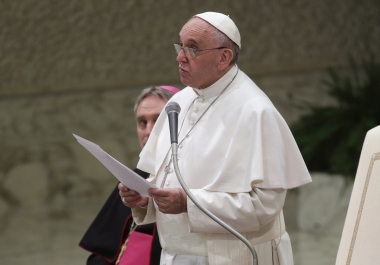
Christian Today report–  Pope Francis urged members of Italian organised crime groups on Saturday to repent, saying the Catholic Church would welcome them if they promised to stop serving the cause of evil.

He spoke during an audience at the Vatican for pilgrims and anti-crime activists from the southern region of Calabria, home to the ‘Ndrangheta, mainland Italy’s equivalent of the Sicilian Mafia.

“Open your hearts to the Lord. The Lord is waiting for you and the Church will welcome you if your willingness to serve good is as clear and public as your choice to serve evil was,” he said.

When he visited Calabria last June, he accused organised crime groups of practising “the adoration of evil” and said members had excommunicated themselves from the Church by their actions.

The ‘Ndrangheta, which makes most of its money from drug trafficking, has spread from Calabria to northern Europe and North America. A 2013 study by Demoskopia, an economic and social research institute, estimated the ‘Ndrangheta’s annual turnover at some 53 billion euros in 30 countries, equivalent to about 3.5 per cent of Italy’s total official economic output.

It has been much harder for investigators to combat than the Sicilian Mafia because its structure is more lateral than hierarchical and its tightly-knit families are harder to penetrate.

Source: Christian Today

Justin Welby Slams ‘False Distinction’ Between Evangelism and Politics

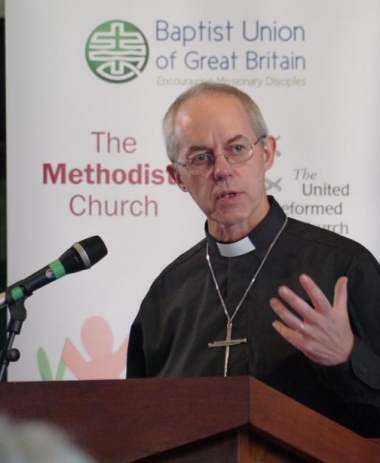
Christian Today report–  The Archbishop of Canterbury offered a defiant justification of last week’s controversial bishops’ pastoral letter ‘Who is my neighbour?’ at a conference in Coventry today.

The letter was criticised for being too critical of the Coalition Government and drew calls for the Church to confine its comments to spiritual matters.

However, speaking at the Love Your Neighbour: Think, Pray, Vote event at Coventy Central Hall, organised by the Joint Public Issues Team of the Methodist and United Reformed Churches and Baptist Union of Great Britain, Most Rev Justin Welby said that it was impossible for the Church “get on with the family business of saving souls” while politicians dealt with public policy.

He said that was a “completely false distinction, adding: “It is impossible to love Jesus Christ and not to care about the welfare of people in every respect.” Proclaiming the good news of Jesus and transforming society were “indistinguishable”: They are literally the two sides of the same coin. You do one, you do the other.”

However, Welby also warned of the danger of the Church being driven by a particular political agenda, saying that it needed to avoid being drawn into “miserablism” – “That sense that we are only really happy as Christians when things are really bad.

“There can be a sort of co-dependency culture, where the worst thing that could happen is that social issues get sorted out. Because then what do we do?”
So, he said, the Church should rejoice that unemployment had fallen and that many fewer households were workless and that more businesses were being started than ever before. He argued for the implementation of the Living Wage for economic reasons – that it would encourage spending and avoid deflation.

He also praised the Government for its commitment to spending 0.7 per cent of national income on overseas aid, for passing the Modern Slavery Bill and its work on preventing sexual violence in conflict zones.

“If we are going to talk about justice and involvement in politics, we can’t go in saying simply because someone wears a certain badge on their lapel, that they are therefore bad. That is not what Jesus did. So let us celebrate what we should celebrate,” he said. “If we believe that the household and the family are crucial then we celebrate measures that support that. We should support all efforts that increase stability and hope in the job market, and welcome good news.”

He addressed the criticisms of ‘Who is my neighbour?’, saying: “The Bishops’ letter this week did quite a lot of that. It did it quite clearly. Obviously that wasn’t entirely popular with some people. Almost no one seemed to think it was very good, apart from the people that read it – which appears to be a minimal number.”

He stressed the need for Christian involvement in politics, saying: “Our concern for the common good stems from us being created in the image of God, and the consequential commands Jesus gives us: that we are to love God, our neighbour, each other, our enemies.”

While there had been an economic recovery during the last year or two, he said, there was “a huge gap between where the economy could be and where it is, because of what happened in 2008”. He stressed that the situation was not the fault of one party: “I am saying that that is something that has happened because of the financial and economic structures that we have built for ourselves, particularly since the 1980s.”

He called on Christians to “proclaim the vision that is transforming, yhat excites and motivates, that challenges the cynicism that is the next state after the miserablism and just before nihilism.”

Quote Sojourners founder Jim Wallis, he said that Christians needed to “change the wind” of politics: “transform the debate, recast the discussion, alter the context in which political discussions are being made, and you will change the outcomes … You will be surprised at how fast the politicians adjust to a change in the wind.”

Welby said: “If we are simply amongst those groups that say that we want a consumer politics based on our own particular idea of what society should look like, we will be constantly disappointed when a virtuous politics based on solidarity and the common good fails to develop.

“We must have the confidence to ask the big questions about what kind of society we want to be a part of and how we achieve it.”

Source: Christian Today


Hundreds Light Candles for Slain Christian Aid Worker Kayla Mueller in Arizona

Christian Post report– Hundreds of mourners lit candles at the Arizona courthouse in Prescott on Wednesday to honor the life of Kayla Mueller, the Christian aid worker who was killed at the hands of ISIS earlier this month. Her brother, Eric Mueller, read out a letter and said that his sister is “in God’s hands” now and that sometimes God “takes his angels home early.”

“I love you. You can rest in peace knowing that you changed this world. I miss you so much and I’m lost without your smile,” Mueller addressed his sister in his speech, according to The Arizona Republic.

He continued: “We will make it, knowing you are still here in spirit. I still feel your touch. I still feel your hugs. I know you are protecting us. God works in mysterious ways — ways we don’t agree with, ways we don’t understand — but sometimes he takes his angels home early. I’ll never stop loving you. I love you, Kayla.”

The 26-year-old American aid worker, who had been held captive by ISIS since 2013 after being captured in Syria, was confirmed dead by American officials last week. ISIS, which sent her parents in Arizona pictures of her body, claimed that she died during a Jordanian airstrike, but the U.S. has been unable to determine the cause of death.

Mueller’s parents, Carl and Marsha Mueller, said that their daughter’s Christian faith had given her comfort during her time in captivity. They shared a letter they received from the aid worker, which read:

“I remember mom always telling me that all in all in the end the only one you really have is God. I have come to a place in experience where, in every sense of the word, I have surrendered myself to our creator b/c literally there was no else … + by God + by your prayers I have felt tenderly cradled in freefall.”

At the vigil on Wednesday, speakers reflected on Mueller’s life and work, while strangers and friends put together a scrapbook and left cards, The Associated Press noted.

Eric Mueller was the only family member to speak publicly at the memorial.

“May God keep you from any more harm, any more hurt,” he said. “You are in his hands now. You do not have to suffer anymore. Only now will you be able to see how much you really did and truly did for this world by looking down on it from above.”

He encouraged the audience to “let Kayla’s heart live on through all of us and the people that she has touched in her life.”

Mueller continued: “If you see somebody struggling, (if) you see somebody upset, go give them a hug. Do what Kayla what do. Make the community even stronger. That’s all it’s going to do.”

Other friends also reflected on the good Mueller brought out in the community.

“She was a saint,” said Rebecca Dunn, who attended high school with the aid worker in Prescott. “I’m hoping someone can take on her legacy. There was nothing she couldn’t do.”

Source: Christian Post


Is Islamic State really Islamic?

Christian Today report– An article by Graeme Wood in The Atlantic for March has offered a challenging and controversial account of the ideology of Islamic State, or ISIS.

What ISIS Really Wants argues that rather than Islamic State being a collection of psychopaths, it is “a religious group with carefully considered beliefs, among them that it is a key agent of the coming apocalypse”.

The most controversial aspect of the article is his assertion that far from the organisation being un-Islamic, a perversion of a fundamentally peace-loving religion, “The reality is that the Islamic State is Islamic. Very Islamic. Yes, it has attracted psychopaths and adventure seekers, drawn largely from the disaffected populations of the Middle East and Europe. But the religion preached by its most ardent followers derives from coherent and even learned interpretations of Islam.”

Wood’s arguments have been roundly criticised by some Muslim scholars. And in an article for the ThinkProgress website, What The Atlantic Gets Dangerously Wrong About ISIS And Islam, Jack Jenkins cites Jerusha Tanner Lamptey, Professor of Islam and Ministry at Union Theological Seminary in New York, who said that Wood “perpetuates the false idea that Islam is a literalistic tradition where violent texts are taken at face value”.

“That’s very problematic to anyone who spends any of their time dealing with the diversity of interpretations around texts,” Lamptey said. “[Wood’s comments] create the [impression] that Islam is literalistic, backward-minded, and kind of arcane or archaic, and we’ve moved past that narrative.”

Though Wood’s point, surely, is not that Islam is inevitably violent, but that calling Islamic State un-Islamic is neither helpful nor true.

So there are two stories about Islam out there. One is that it’s a religion of peace and its adherents only want to live harmoniously with other people. The other is that its fundamental aim is to take over the world, by force if necessary. There is fear, suspicion and confusion. So what are the questions that help us make sense of the different narratives?

People are just people, aren’t they?

Yes. In other words, once you’ve labelled them as ‘Muslim’, you’ve said something about them, but maybe not very much. I’m a Christian. I’m also white, British, middle-aged and a rather tepid fan of Aston Villa. I live in a pleasant spa town and enjoy country rambles and biographies of eminent Victorians. There’s a lot about religious people that the label doesn’t explain or express.

How many Muslims are there, anyway?

Islam is huge, though not as big as Christianity. According to Pew Research, 1.6 billion or 23 per cent of the world’s population is Muslim. A minority of those are Arabs: more of them live in India and Pakistan than in the whole of the Middle East and North Africa. This means that if you have a clear idea of what a typical Muslim looks like, you are almost certainly wrong.

How far back does it go?

It’s not as old as Christianity or Judaism, and nowhere near as old as Hinduism, but it’s old (622 AD). 1400 years is quite long enough for vast quantities of literature, devotional writing, scholarly rows and different schools of thought to emerge. Think of how many Christian denominations there are – not just Catholic and Protestant, but almost infinite sub-divisions within Protestantism and lots of different expressions of Catholicism too. Islam is a bit like that, if not quite as extreme.

It sounds very complicated…

You have no idea. In a nutshell: soon after Muhammed’s death Islam divided into Sunni and Shia branches. Sunnis are by far the most numerous, but each tends to dominate in particular countries – Sunnis in Egypt, Turkey and Saudi Arabia, for instance, and Shias in Iran. The split was over who should succeed the prophet. Sunnis believed that the heir should be appointed under Arab tribal tradition, whereas Shias believed it should be a descendant of the prophet. For Sunnis the leader was a political governor; Shias by contrast have an imam, a religious figure. The division was sealed in 680 with the death of the Shia claimant, Hussein, at the battle of Karbala – a key event in Shia tradition.

Does this really matter?

Yes. The different streams fought each other quite a bit, but have also developed in different ways. For instance, Shias view the sayings of Fatima, the daughter of the Prophet, and his cousin Ali (Fatima’s husband), as authoritative; Sunnis do not. There is an organised Shia clergy, but none in the Sunni tradition. The most important difference is about the interpretation of the Qur’an. The Sunni look more to the letter of the Qur’an; the Shia look more to its spirit, though both would say that in the original Arabic we are reading the literal words of God. Arguably there is more room for development in the Shia tradition, but there are extremists on both sides.

So, is Islam just one thing?

Is Christianity? The answer is both yes and no. There are different theological streams in both Shia and Sunni traditions. They argue about evil, predestination and free will, salvation and the knowledge of God – all familiar questions in Christian theology too. In the case of the Athari, they argue about whether to argue at all. There are also various types of popular devotion, such as the cults of saints, and the mystical Sufi tradition. Different schools of law have arisen from different ways of reading the Qur’an and the Sunnah (prophetic traditions). These came out of different reforming movements or political situations. Again, it’s important, with different approaches to crime and punishment, for instance.

Questions of truth aside, is it all good and helpful?

No – though on the Christian side, of course, no one should forget the Spanish Inquisition. One example is arguably the Salafi movement which seeks to return Islam to the primitive virtues of its earliest times. In its Wahhabi form it is fundamentalist and uncompromising, seeing Western innovations like democracy as dangerously un-Islamic. Wahhabism is a ‘dominant minority’ in Saudi Arabia, whose ruling House of Saud formed an alliance with its founder. Its adherents reject religious authorities from later than the first three generations of Muslims; consequently pronouncements from modern scholars and teachers have little influence on them. Islamic State has been described as “untamed Wahhabism“.

Ah, yes, Islamic State. What’s driving them?

Islamic State is a Sunni extremist group which wants to return Islam to its original pure form. It rejects later ‘innovations’ and secular laws. In the captured city of Mosul in Iraq it has imposed a school curriculum which bans the teaching of art, music, national history, literature and Christianity. It has banned music and songs, alcohol and tobacco. Women are only allowed to go outside the house if absolutely necessary and have to be veiled. Its goal is to expand its territory throughout the region and beyond. It represents an extreme form of ‘political Islam’, which seeks to reshape society in an Islamic way. While terror is obviously an appalling perversion of any religion, there is discussion both within and outside Islam about legitimacy of this as a goal anyway. It has also been argued that political Islam is political Islam, and its goals are the same whatever the methodology. However, as we’ve seen in the UK – in the comments of former Archbishop of Canterbury Rowan Williams about sharia law, for instance – there’s a legitimate argument to be had about how far a Christian country should go in accommodating Muslim principles.

Do I really need to know all this?

Possibly not, but it is very important to realise that Islam is not a monolithic religion. They agree on the fundamentals, like Christians, but apart from that there is a great variety in thought and practice. Trying to generalise about Muslims is no more sensible than trying to generalise about Christians.

Common sense, surely?
Well, you would think so. But failure to understand this leads some people to believe that Islam is just naturally going to be at odds with other cultures, as Samuel Huntingdon argued in his notorious Clash of Civilizations. Others go even further, like Franklin Graham, who described it as a “wicked” and “evil” religion. So any evidence that it isn’t is discounted, or used as evidence that Muslims are playing a deceitful double game – Protestants (and indeed some Catholics) used to say the same about Jesuits. For instance the Common Word initiative from Muslim scholars in 2007 aimed at starting dialogue was dismissed in some quarters as a Trojan Horse; so was a recent Muslim prayer service in Washington. That is not to deny that some Muslims might have ulterior motives in dialogue with Christians, but starting from a position of trust seems like a good thing.

But a lot of Muslims really do seem to believe in violence, don’t they?

As a proportion of their total numbers, no – but they do immense and tragic harm, to Christians and other Muslims. So the real question is, why a Muslim in one part of the world would be horrified by Islamic State and someone else would be all for it. The answers include: a response to oppression and powerlessness, the breakdown of law and order, and bad theology – most scholars and teachers reject Islamic State as an abomination. Other cultural factors include the extreme introversion of some communities – in Pakistan, for instance – authoritarian social structures, and deeply embedded historical narratives. Most Muslim-majority countries can point to a history of oppression, colonialism and betrayal by Western powers which we have largely forgotten, while they have definitely not. A sense of being out of place can lead young Muslims in majority Christian countries to set their Islamic identity over against their national loyalities, which leads some to head off to Iraq or Syria to fight for Islamic State. But saying that people do terrible things because they are Muslims is just not true.

So, is Islam a religion of peace?

That isn’t quite the right question, because very few religions – including Christianity – are, in an entirely unqualified way. You can go to the Muslim sacred texts and find exhortations to peace, love, tolerance and understanding. You can also find justifications for religious warfare, the subjugation of women, amputations, stonings and goodness knows what. However, most Muslim scholars and teachers in most countries remain true to their faith and their scriptures without advocating any of these things. As ever, there is a complex relationship between scriptures, the historic tradition and contemporary culture. So the point is that the answers to Islam’s problems already lie within Islam; dismissing a whole world faith because of the actions of a minority of extremists is not very helpful.

Graeme Wood’s Atlantic article was well-researched and thoughtful. When he says that the fact that Islamic State is murderous, wicked and primitive doesn’t mean it isn’t Islamic, he’s right. The point is that there is a better Islam too, whose adherents are far more numerous and far better people. That’s the one that has to win, and to define Islam in future for the world.

Source: Christian Today

Catholics Take Legal Action Against Website Promoting Adultery

Christian Today report– It’s not just the Ten Commandments that state ‘Thou shalt not commit adultery’, the Napoleonic civil code in France also insists married couples owe each other fidelity.

So when the website Gleeden, for partnered people who want to have illicit affairs, began promoting extra-marital sex as a “cheap anti-depressant” a Catholic pressure group launched a legal action in France.

The poster shows that Gleeden’s grasp of theology might be limited.

It references the Genesis story of Adam and Eve, showing an apple that has been bitten into and highlighting the last four letters of Gleeden. The caption tempts with: “Unlike anti-depressant drugs a lover costs nothing on the state health service.”

The poster fails to reference the serpent temptor and makes no reference to the catastrophic consequences for Adam, Eve and indeed all humankind of that single bite. According to the Bible, the Fall led directly to the ejection of the first humans from the Garden of Eden and brought sin into the world.

And while extra-marital sex might for some seem attractive as a temporary cheap anti-depressant as Gleeden says, the poster does not catalogue the emotional cost of adultery, nor the heavy financial toll of divorce. It also fails to mention the attendant difficulties for the celebrity adulterer. Former French presidents who have seen publicity around friends outside marriage include Presidents Hollande, Sarkozy, Chirac, Mitterrand, Giscard and Pompidou.

Jean-Marie Andres, president of Les Associations Familiales Catholiques, which has tabled the legal challenge, said: “We want a legal judgement on an advertising campaign and a website which publicly promotes duplicity, lies and violation of the law.” He added: “The drastic social consequences of infidelity cannot be ignored by our common conscience.”

Gleeden has more than 2.3 million members in Europe, including about a million in France.

Spokeswoman Solène Paillet said: “We do not encourage anyone to cheat on their partner. We just provide a platform. There are people who find personal fulfilment in having someone else in their life.”

Last year, Gleeden revealed the top ten fragrances worn by adulterers.Top of the table for women was Shalimar by Guerlain and second was Coco Mademoiselle by Chanel.

A separate study in the Journal of Sex Research found that people with a high-powered job were more likely to be unfaithful.

Social Psychologist Dr Joris Lammer surveyed more than 600 heterosexual Dutch men and women on the Men’s Health and Marie Claire websites and found that fewer than one in ten people in lower management had been unfaithful while nearly one in four of those in the top jobs had cheated.
Source: Christian Today

Texas Court Defies State’s Ban on Gay Marriage

Christian Post report– A Texas county court legally married two women under a one-time court order on Thursday, despite the fact that the state currently has a ban on same-sex marriages.

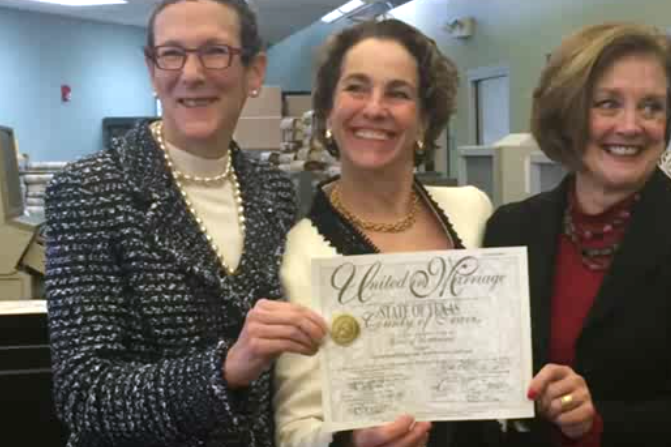
After Travis County Probate Judge Guy Herman ruled on Tuesday that Texas’ ban on same-sex marriages is unconstitutional, state District Judge David Wahlberg, two days later, issued an order for Travis County Clerk Dana DeBeauvoir to grant a marriage license to an Austin lesbian couple due to medical urgency.

After Sarah Goodfriend, who has been diagnosed with ovarian cancer, and Suzanne Bryant were issued their marriage license by the court on Thursday morning, their 72-hour required waiting period was waived and they were later joined in matrimony by Rabbi Kerry Baker in front of the county clerk’s office building, The Austin American-Statesman reported.

Goodfriend and Bryant were in a relationship for nearly 31 years and are now legally recognized as married in the state of Texas.

“Having faced a life threatening disease, I realized time is precious and that I wanted to spend it on the things that mattered most — my family,” Goodfriend told the San Antonio Express News.

Bryant said before the wedding that she was excited to make history as the first gay couple to legally marry in Texas.

“It’s very exciting,” Bryant said. “My little one was worried about missing her history class. I said we’ll be making history.”

The clerk’s office issued in a statement clarifying that Wahlberg’s order only applies to the one couple and the court will not issue any more same-sex marriage licenses until more clarification is provided in regards to Herman’s Tuesday ruling.

“We are all waiting for a final decision on marriage equality. However, this couple may not get the chance to hear the outcome of this issue because of one person’s health,” the statement explains. “The Travis County District Judge has ordered the County Clerk to act now in issuing a license for this medically fragile couple.”

Jonathan Saenz, president of the statewide social conservative organization Texas Values, blasted the court’s order and said the order is yet more evidence that that judicial activists don’t “play by the rules” when promoting their own agenda.

“The Texas Supreme Court needs to step in immediately and put a stop to this lawlessness and clear disrespect and defiance towards our marriage laws,” Saenz said in a statement. “This rogue ruling is just more evidence that supporters of redefining marriage refuse to play by the rules and some judges and clerks will do anything to advance their own agenda.”

“This is exactly why state legislators are working on laws to hold government officials accountable when they violate our Texas marriage laws,” Saenz added.

Texas Attorney General Ken Paxton filed a motion with the Texas Supreme Court late Tuesday evening asking the court to overturn judge Herman’s ruling and reaffirm the state’s ban on same-sex marriages.

In a Wednesday statement, Paxton said that the judge’s “misguided ruling does not change Texas law or allow the issuance of a marriage license to anyone other than one man and one woman.”

“We are grateful for today’s actions by Attorney General Ken Paxton who is standing up for the citizens of Texas after they clearly and constitutionally recognized marriage as being between one man and one woman,” Another Saenz statement reads. “We must continue to send a strong message to every judge in Texas that the people of Texas expect our marriage laws and state constitution to be respected.”

Source: Christian Post

Displaced Iraqi Christian Girl Asks God to ‘Forgive’ Islamic Terrorists

Christian Post report– Even though her village was seized by the Islamic State and she’s now living a rough life in an unfinished mall in Kurdish-protected Northern Iraq, a displaced Christian refugee child is asking God to “forgive” the ISIS militants.

After ISIS seized most of the Mosul region of Iraq last June, over 400 mostly Christian displaced Iraqi families from the villages of Qaraqosh, Bartella and Kharamles descended upon the Kurdish capital of Erbil to live in a half-built mall in the in the Christian neighborhood of Ainkawa.

As the families had picked up and fled their villages in a hurry before the ISIS militants reached their towns, the families could only afford to bring bare necessities and are now living in the mall without much more than the mattresses, blankets and other handouts they receive from humanitarian organizations.

A correspondent with the Arabic Christian television network SAT-7‘s “Kids” program interviewed children living in the Ainkawa Mall’s refugee camp and asked them what they missed the most about their lives back home.

In talking with the reporter and camera crew, a little girl named Myriam, from Qaraqosh, assured that although her life has changed drastically in the last year and her family’s future remains uncertain, God continues to provide for her and her family.

“We used to have a house and were entertained, where as here we are not,” Myriam said. “But thank God. God provides for us.”

The reporter was a bit perplexed by Myriam’s comment and asked what she meant by “God provides for us.”

“God loves us and wouldn’t let ISIS kill us,” she explained.

The reporter followed up by asking Myriam what she would do if she ever had the opportunity to retaliate for ISIS’ onslaught of her hometown.

“I won’t do anything to them,” Myriam asserted. “I will only ask God to forgive them.”

After the interview, the reporter thanked Myriam for her time. Then, Miriam replied, thanking him for his sympathy.

“You felt for me,” she said. “I had some feelings and I wanted people to know how I feel.”

Two other girls from Qaraqosh were also interviewed. They were asked what they missed the most about their lives before ISIS took over the region.

“Our school and our church,” Flourine responded.

Maryouma added that, although they miss their church, “Jesus will be with us no matter where we go.”

The reporter subsequently asked, “Is Jesus with you in this camp?”

“Yes,” Fluorine asserted. “In our hearts.”

The video concludes by showing the refugee children outside the entrance of the mall singing: “My love for my glorious Savior will increase with each new day. A new life, a happy day, the day I reunite with the Lord.”

Source: Christian Post


Amnesty International Calls for Release of Two South Sudanese Pastors Detained in Sudan

Christian Today report-  A prominent human rights group is calling for the release of two South Sudanese pastors who are currently detained in Sudan.

The two South Sudanese pastors, Yat Michael and Peter Yen, also known as David Yein Reith in other reports, of the South Sudan Presbyterian Evangelical Church, have been in custody of the National Security and Intelligence Services (NISS) of Sudan for more than a month now.

They are allegedly being held in a secret location, and have been unable to communicate with their families.

Amnesty International issued a statement last week calling for the release of the two pastors, since they have not been properly charged for any offence.

“To date, absolutely no charge has been brought against these two church leaders,” the group’s UK Director Kate Allen said.

Allen then called on Sudanese authorities to reveal the pastors’ whereabouts and offences.

“The authorities in Sudan must reveal the location of these two men as soon as possible,” Allen demanded. “[A]nd either charge them with a recognisable criminal offence or release them immediately.”

The NISS arrested Pastor Michael in December 21. According to Morning Star News, the NISS took Michael into custody after a prayer service at the Khartoum Bahri Evangelical Church. Although originally of the South Sudan Presbyterian Evangelical Church, Pastor Michael was invited to the Khartoum Bahri Evangelical Church to provide encouragement as the church was facing demolition at the request of Muslim investors seeking to take over its property.

Pastor Peter Yen was arrested by NISS officials on January 9. A separate report by the Morning Star News stated that NISS called Yen while conducting a prayer service. The article said that NISS officials demanded that Yen return home immediately or his family will be arrested.

The arrests were possible since the NISS is authorised to make arrests of non-Muslims without the legal requirement of a formal charge.

In her statement, Allen stressed the need for urgent action to release the two pastors.

“The longer these two men are held in a secret location, the greater the risk of them being tortured,” she said.

Source: Christian Today

San Francisco Archbishop Tells Legislators to Respect His Religious Freedom

Catholic Herald report– The Archbishop of San Francisco has told legislators in California that he respects their right “to employ or not employ whomever you wish to advance your mission” and expects the same in return.

Archbishop Salvatore Cordileone’s comments came in a letter to five state assembly members and three senate members after they urged him to remove Catholic sexual morality clauses that have been added to handbooks for teachers in four archdiocesan high schools.

The lawmakers told Archbishop Cordileone in a letter they believed the clauses would “foment a discriminatory environment” and “send an alarming message to youth”.

But the archbishop told them before making a judgment, they should have as complete information as possible about what the archdiocese is proposing and he directed them to various documents and videos on the archdiocesan website to dispel misinformation, “such as the falsehood that the morality clauses apply to the teachers’ private life”.

The Archdiocese of San Francisco is also proposing three new clauses to contracts for teachers in archdiocesan Catholic high schools to further clarify that Catholic schools – as the first clause states – “exist to affirm and proclaim the Gospel of Jesus Christ as held and taught by his Catholic Church”.

The archdiocese is adding detailed statements of Catholic teaching on sexual morality and religious practice, taken from the Catechism of the Catholic Church, into the faculty and staff handbooks of the four archdiocesan high schools.

The handbook additions will take effect in the 2015-16 school year and are not part of the contract.

Source: Catholic Herald

Vatican and Italy Increase Security Level Over Islamic State Threats

Christian Today report– Both Italy and the Vatican have increased their security preparedness after reports that Islamic State elements could be in the south of the country.

According to UCAN India, the Italian government has increased the country’s state of alert, increasing the number of Italian anti-terror soldiers in “safe streets” duties from 3,000 to 4,800. The government had voted to approve the increased state of alert last week, and implemented the plan on Tuesday. Journalists and prominent Jews were assigned security details, while ministers are now allowed to use official aircraft for personal trips.

The Swiss Guard at the Vatican also followed suit on Wednesday, increasing its alert levels to be more watchful of possible threats to the Pope.

“We have asked all the Swiss guards to be more attentive and to carefully monitor the movement of people,” UCAN India quoted Swiss Guard commander Christoph Graf saying on Wednesday.

“What happened in Paris with the Charlie Hebdo attacks could also happen at the Vatican,” Commander Graf opined. He stressed that intelligence services are crucial to identifying any potential threat, but he is also confident of the Swiss Guard’s ability to protect the Pope.

“We are ready to intervene to ensure Francis is protected,” Graf concluded.

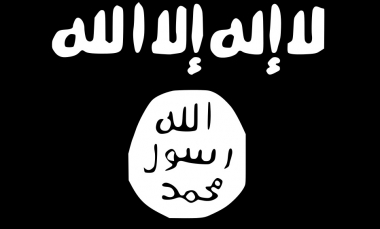
The Islamic State had said at the end of its latest video showing the beheading of 21 Egyptian Copts that Islamic State fighters were already “at the south of Rome.” The ISIS militants also threatened to use Libya as a platform for launching attacks in Italy.

The foreign ministry in Rome, the Expo 2015 world fair in Milan, the Vatican and various churches and synagogues across the country have been identified as possible targets by the Italian media.

An Italian senator says that attacks on Italy by extremists or their supporters is very likely.

“The risk of an attack by a lone wolf or an unbalanced person is concrete,” Italian Senator Felice Casson said in the UCAN India article.

“The more successful attacks in other countries are, the greater the risk of someone trying to emulate them in Italy,” he warned.

Source: Christian Today