
Malaysia: Catholic newspaper not permited to use ‘Allah’ to refer to God again

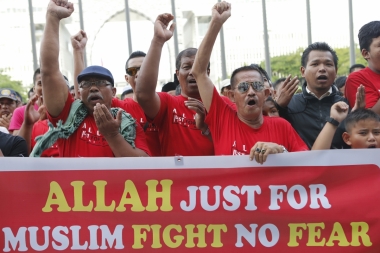
Malaysia’s top court has ruled that a Catholic newspaper cannot use the word “Allah” to refer to God.

The Herald in Malaysia, which in the past regularly used “Allah” to refer to God in a Christian context, was denied permission by Malaysia’s Federal Court to seek a review of an earlier decision to let a ban stand.

The decision by the panel of five judges was unanimous.

Benjamin Dawson, lawyer for the Church, said: “We relied on procedural unfairness and they said that they don’t think that any procedural unfairness had occurred. That was the brief reason given.”

Acknowledging that his long fight to use the term was now at an end, editor Rev Lawrence Andrew said: “There is nowhere to go.”

The Malaysian government was among those who argued that “Allah” should remain exclusive to Muslims.

The Catholic Church has about 180,000 members in Malaysia. It faced accusations of proselytism during the long court battle that began in 2008 when the Church challenged a decision by the Home Minister to ban its use of “Allah”.

Haniff Khatri Abdulla, a lawyer representing some of those who supported the ban, said: “At the end of the day, as litigators, as lawyers, as advocates, we need our matters to come to an end as well.”

Source: Christian Today

Women believe in life after death than Men

There is a “huge disparity” between men and women over matters of faith and belief, with nearly twice as many women as men believing in life after death and many more men than women being atheists or agnostics.

The research comes as the Church of England finally approaches the consecration of its first woman bishop, the Rev Libby Lane, in York Minster next Monday. In spite of the growing evidence of higher levels of devotion and piety among women, many other religious institutions across Christianity, Judaism, Islam, Hinduism and Sikhism still insist on a male-only ministry.

The new study of more than 9,000 British people in their forties, by the UCL Institute of Education, shows that 60 per cent of the women compared to 35 per cent of the men believe in life after death.

More than half of the men surveyed said they were atheists or agnostics, compared to a third of the women.

The survey was of the remaining members of the 1970 British Cohort Study, whose lives are being followed by the IOE’s Centre for Longitudinal Studies in a study funded by the Economic and Social Research Council.

Almost half of those surveyed did not identify with any religion. Most of the remainder said they had a Christian background. A small number of respondents described themselves as Buddhist, Jewish, Hindu, Muslim or Sikh.

Professor David Voas, who analysed the survey responses, said: “Among believers, women are also much more likely to be definite than men, and among non-believers, men are much more likely to be definite than women.”

For example, not only are men twice as likely as women to say that God does not exist, but male atheists are far more likely than female atheists to say that they definitely do not believe in live after death.

Professor Voas, of the Institute for Social and Economic Research at the University of Essex, said there was no obvious reason why this should be so but added that it was unhelpful to think simply in terms of “believers and non-believers”.

He said: “Belief – or disbelief – in God and in life after death do not always go together. A quarter of those who said they were agnostic also said they believe in life after death. However, nearly a third of the people who said that they believe in God – despite occasional doubts – do not believe in an after-life.”

Professor Voas suggested a new list with seven categories to describe a person’s position on the faith spectrum.

Non-religious (28 per cent of the 1970-born cohort): Does not have a religion or believe in either God or life after death.

Unorthodox non-religious (21 per cent): Does not have a religion or does not attend services. Believes in God or life after death but not both.

Actively religious (15 per cent): Has a religion and believes in God and life after death. Attends services.

Non-practising religious (14 per cent): Has a religion and believes in God and life after death. Does not attend services.

Non-identifying believers (10 per cent): Does not have a religion, but believes in God and life after death.

Nominally religious (7 per cent): Identifies with a religion. But believes in neither God nor life after death.

Unorthodox religious (5 per cent): Has a religion and attends services at least occasionally. Believes in God but not life after death (or, in a few cases, vice versa).

He also warned that a healthy level of scepticism was needed when assessing statistics on religious affiliation. For example, nearly a quarter of those surveyed changed their minds between 2004 and 2012 about whether or not they had been brought up in a religion.

“Some things are clear, however. One is that a substantial proportion of teenagers who reported that religion was an important part of their lives at age 16 became relatively unreligious adults. There is some movement in the opposite direction, but not nearly enough to compensate for the losses to religion.”

Professor Voas also points to the very high level of belief in both God and life after death among Muslims. Almost nine in ten of the small number of Muslims in the survey – just 82 – said they knew God really existed and had no doubts about it.

More than seven in ten of those who described themselves as “evangelical” also had no doubts about God’s existence. Just a third of the Roman Catholics in the survey had no doubts. And the figure for those affiliated with mainline Christian denominations such as the Anglican, Methodist, Presbyterian and United Reformed churches was even smaller, with just 16 per cent of them having no doubts that God exists.”

“The mysteries of religion and the lifecourse”, by David Voas, is the latest working paper to be published by the IOE’s Centre for Longitudinal Studies.

Source: Christian Today

Pastor Perry Noble accused of ‘problematic’ theology by South Carolina Baptist leader

NewSpring Church pastor Perry Noble has been charged with “problematic” theological positions and “statements that are inconsistent with the beliefs of South Carolina Baptists” by the president of the South Carolina Baptist Convention (SCBC), Rev Tommy Kelly.

Located in Anderson, South Carolina, NewSpring is one of the largest and fast-growing churches in the US with around 32,000 attenders, and the largest Southern Baptist church in the top 100.

Kelly’s statement arose from a sermon preached by Noble on Christmas Eve in which he appeared to deny that the 10 Commandments were in fact commandments, saying that there was no word for ‘commandment’ in Hebrew, and offering a radical reinterpretation of them. He also appeared to use the ‘n-word’ at one point in the sermon.

Following negative comments about the sermon Noble issued an apology and explanation, saying: “I had no idea that I had stepped into a debate in which godly people are on both sides of the issue. I have been on the phone, on the internet and on my face this week trying my hardest to see if what I preached in that message was true, as well as seeing if I made mistakes in that teaching.”

He admitted that Hebrew did have a word for ‘commandment’, though he said that the word was not used in the context of the 10 Commandments. However, he said he would not deny their imperative force.

Kelly said that SBCB churches had been “disturbed and puzzled” by the sermon. He called on SCBC ministers to “treat their individual ministry settings as a sacred trust void of coarse, profane language as well as choosing music that is sacred in content”. He also said that ministers live an “isolated existence” and called on them to be accountable to others, and urged the importance of sound biblical exegesis.

Kelly said: “Therefore, we as South Carolina Baptists must publicly state and remove ourselves from these positions and problematic statements and call for NewSpring to correct these positions if it chooses to say that it affiliates with South Carolina Baptist churches.”

While NewSpring is part of the SCBC and of the umbrella Southern Baptist Convention, the relationship is evidently not close. In a document marked for the attention of “Senior Pastors Only”, Noble said: “We are part of the Southern Baptist Convention. We are part but not married to them. However they are kind of like the Titanic, they are sinking but instead of sinking they are just rearranging the chairs.”

According to the Baptist Courier, NewSpring’s 2012 operating budget was $25.8 million; it forwarded only $550 in gifts to the South Carolina Baptist Convention.

NewSpring is the largest church in the SCBC. In 2012 it baptised 2,946 people – nearly one of every five baptisms by all churches affiliated with the SCBC.

Source: Christian Today

Documents reveal how Polish Cardinal helped Jews escape Nazi Holocaust

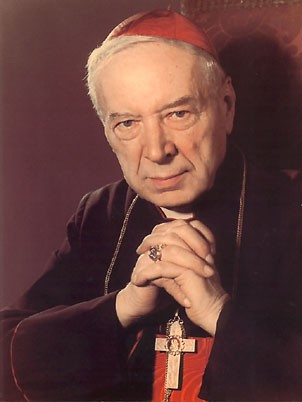
Cardinal Wyszyński, the Polish national hero who resisted its Communist rulers and was imprisoned for his faith, secretly helped Jews during the Nazi Holocaust in the Second World War.

The revelation, says the Zenit news sevice, comes from documents gathered at the Yad Vashem memorial in Jerusalem containing eye-witness accounts of his actions.

Wyszyński was involved in ministry to Polish resistance fighters against the Germans and from 1941-42 was based at a centre for aid to blind people. According to Jadwiga Karwowska, whose parents worked at the centre, he helped a Jewish family of three, a father and two of his children.

She recalled: “Fr Wyszyński came to us constantly, literally each night, and we hid them [the Jewish family] at our attic. He helped my dad put a ladder and take it back to the garden so that there were no traces of anybody’s presence at the attic.” They were aware that the family were Jews and of the danger of their actions.

Another Yad Vashem testimony, from Esther Grinberg (Morgenstern) reveals other previously unknown, facts about Wyszyński. Born in 1918 in Międzyrzec Podlaski, Grindberg lost her parents, brother, and sister in the Holocaust. She arrived in Warsaw during the ghetto uprising in 1943. In her memoirs she refers twice to the fact that Wyszyński was well known for encouraging his congregation to help all those who were escaping from the war. She says that for safety reasons he did not say exactly whom to help, but that it was known he meant Jews who were fleeing the ghetto.

As head of the Catholic Church in Poland, Wyszyński attempted to reach a degree of accommodation with the Communist authorities in the face of their vicious persecution of the Church. However, in 1953 he issued a letter with the title “Non possumus”, “We cannot go any further”, refusing any further concessions. It was an act of defiance that led to his arrest and imprisonment for three years, during which he witnessed the brutal torture and ill-treatment of prisoners.

When Pope John Paul II was elected he sent a message to Poles referring to Wyszyński saying: “There would be no Polish Pope on this Chair of St Peter […] if it was not for your faith undiminished by prison and suffering, and your heroic hope.”

Wyszyński supported the revolutionary Solidarity movement but called on both sides to show restraint. His funeral in 1981 was attended by around 500,000 people.

Source: Christian Today

Guinea: 3 Priest were beaten, held captive and accused of spreading Ebola

Three Baptist priests were beaten and held hostage in Guinea after villagers accused them of spreading Ebola.

According to the BBC, the priests were visiting the village of Kabac in Forecariah in order to treat wells and latrines with insecticide. However, locals believed them to be spreading the Ebola virus, and attacked the clergymen.

Their vehicles were set alight, and the men were taken captive. Police arrived at the scene and arrested some locals, but not before the town council building was also attacked and set on fire.

It’s the second incident of this kind to take place in Forecariah this year. Earlier this month, two police officers suspected of bringing Ebola into the area were attacked and killed.

Guinea this week reopened its schools after closing five months ago to prevent the spread of Ebola. The latest figures released by the World Health Organisation (WHO) put the death toll at over 8,600 in West Africa, with 1,876 of those in Guinea.

A WHO report released last week explained that “community resistance” is persisting in the countries worst affected by the virus – Guinea, Sierra Leone and Liberia – and is proving to be a “major barrier to control”.

Mobs have attacked treatment facilities and doctors, believing them to be introducing Ebola rather than helping patients. “Fear spread faster than the virus,” in Guinea in particular, the report said.

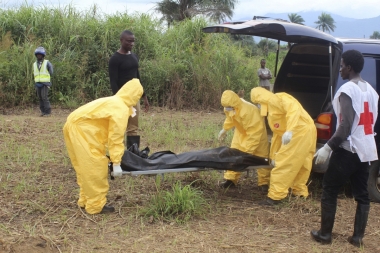
An incident on 23 September 2014 saw two Red Cross volunteers who had safely buried a body in Forecariah attacked by an armed mob. Angry residents then dug up the grave and removed the corpse from its body bag, hiding it in the village.

The mob then grew in size to more than 3,000 armed youths. They targeted a WHO-led team of epidemiologists, who were forced to flee, undoing “weeks of persistent and effective efforts to slow the outbreak”.

The town had at the time a fatality rate among Ebola patients of 80 per cent.

“Traditional belief systems that attribute adverse events, including diseases, to non-medical causes having magical or mystical dimensions, such as a curse or a payback for past sins, have been important factors in some areas,” the report said.

Experts reported last year that traditional healers and witchdoctors in West Africa were contributing to the spread of the deadly virus. Wanting to cash in on the epidemic, a number of people claiming to be able to heal Ebola through witchcraft were encouraging locals to eschew Western medicine in favour of their own costly techniques.

Cases of people flocking to see these so-called healers resulted in the disease spreading further, as the witchdoctors themselves often contract Ebola, which is spread through contact with the bodily fluids of an infected person.

Source: Christian Today

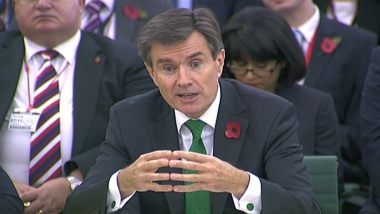
Former MI6 head backs Pope Francis comment, and said Respect for Others Religion is Important

Former head of MI6 Sir John Sawers has appeared to back the Pope’s comments to journalists about the consequences of insulting another person’s religion.

Referring to the Charlie Hebdo attacks in Paris, Pope Francis said that someone who insulted his mother “can expect a punch on the nose”, adding: “It’s normal. You cannot provoke. You cannot insult the faith of others. You cannot make fun of the faith of others.”

Pope Francis was widely criticised for the remark, including by Prime Minister David Cameron. However, in his first speech since leaving office, Sawers said: “I rather agree with the Pope that, of course, the attacks in Paris were completely unacceptable and cannot be justified on any basis whatsoever, but I think respect for other people’s religion is also an important part of this.

“If you show disrespect for others’ core values then you are going to provoke an angry response. That doesn’t justify anything, but I think we just need to bear it in mind.”

Sawers warned that another terrorist attack on the UK was inevitable, saying: “If I was to sit here and say will the goalkeepers of the security services and the police keep every single attempt to get the ball into the net, out? No. At some point these threats will get through and there will be another terrorist attack in this country.”

Reflecting on the security leaks by Edward Snowden, he said that it was vital that the internet was open to scrutiny by the security services: “We cannot have no go areas in our communities where the police cannot go, because that just allows space room for the evil-doers to ply their trades.

“It is the same in the virtual world. If you allow areas which are completely impenetrable then you might feel comfortable that your communications are private and no one else can see them, but so are those who are trying to do you down and undermine your society.”

However, he said: “I do not believe that there is a trade-off between security and privacy. I think they go together.

“If you have a society which evades and abuses privacy, then ultimately there will be a reaction against the damage to your security. If you do not have any security then all your basic freedoms are at threat.”

Source: Christian Today

A standard Christian school has been downgraded, due to new “British values” rules

A high-performing Christian school in Sunderland has been placed in special measures by an Ofsted team in what its principal says is a “huge shock”.

Chris Gray blamed the negative report on regulations about “British values”.

Grindon Hall Christian School’s GCSE results make it the best-performing secondary state-funded school in Sunderland. However, inspectors have downgraded it to “inadequate” from last year’s ranking of “requires improvement”.

The move follows an inspection in November about which Gray wrote a formal letter of complaint, saying that “the tenor of the inspection was negative and hostile at every stage, as if the data collected had to fit a pre-determined outcome”. He complained about inappropriate, upsetting and instrusive questions asked of the children including questions about homosexuality, and included evidence from sixth formers who said that they felt the inspectors had set out to target the school’s Christian ethos.

Gray also noted that he had been told by one of the inspectors that the inspection had been personally authorised by the Secretary of State for Education, Nicky Morgan, because of Grindon Hall’s “links with another school”. Gray said: “I was never told which school, what the link was or the relevance of any link.”

However, the resulting Ofsted report says that “Grindon Hall provides the financial services of their Bursar for one day a week to Durham Free School”. Morgan has announced that Durham Free School will be closed following an unsatisfactory Ofsted report, though the school is challenging the decision.

The Ofsted report says there are weaknesses in the school’s safeguarding and recruitment policies and that “The curriculum does not adequately prepare pupils for life in modern Britain.” It adds that “Pupils show a lack of respect and tolerance towards those who belong to different faiths, cultures or communities.” It also says prejudice-based bullying is not tackled effectively and that “Discrimination through racist or homophobic language persists.” It says teachers do not have high enough expectations of students and that behaviour requires improvement.

In a statement after the Ofsted report was released Gray said: “Anyone who places our May 2014 Ofsted report alongside the January 2015 report would think they were talking about two different schools. There have been no major changes of staffing, pupils or policy to account for the difference. The difference was the introduction of the widely discredited “British Values” rules and the aggressive attitude of the inspection team.”

He criticised the inspectors for implying that non-Christian festivals should be celebrated, saying: “The questioning by inspectors makes clear that their idea of a balanced curriculum is for us to force pupils to celebrate non-Christian religious festivals. This would breach our Christian foundation which stipulates that we are a Christian school. It would certainly offend against the consciences of many of our staff, pupils and parents. No one should be told by a government official to celebrate any religion. Learn about it, yes. Celebrate its festivals, no.”

Source: Christian Today

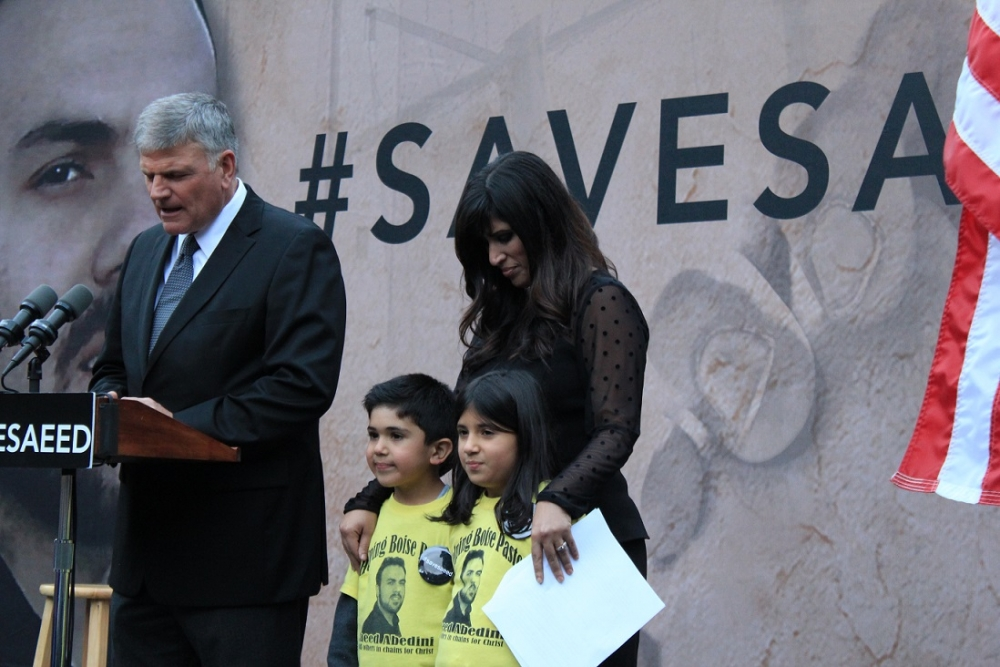
Wife of Imprisoned Pastor Saeed Abedini pleads with President Obama to meet with Her as He visit the Pastor’s Hometown

President Barack Obama is set to visit Boise, Idaho, on Wednesday, the hometown of pastor Saeed Abedini, who’s serving eight years in prison in Iran for his faith. Abedini’s wife, Naghmeh, has pleaded with Obama to meet with her so that she can ask him for her husband’s release.

“My heart leapt with hope when I heard that you would be visiting my hometown of Boise, Idaho. Since the Iranian government took my husband, Saeed Abedini, almost three years ago, I have been praying and wanting to meet with you,” Naghmeh Abedini wrote in a letter ahead of Obama’s visit.

“With each of my travels to Washington D.C. I hoped that I would get a call, or an invitation to see you and to speak with you. To have you look into my eyes and see the piercing pain that has been there since my husband’s imprisonment; to see my kids and to know that they have missed the warm embrace of their dad for nearly three years.”

She added: “Mr. President, my children and I respectfully request, as you come to our home town of Boise, Idaho, that you take a moment of your time to meet with us.”

Pastor Abedini was imprisoned in Iran in September 2012 after traveling to work on a children’s orphanage, and was later sentenced to eight years in prison.

Since then the American Center for Law and Justice, which represents Naghmeh and the couple’s two children, has campaigned, along with hundreds of thousands of people worldwide, calling for the pastor’s release.

Naghmeh Abedini has spoken before the U.N. and other organizations, sharing her testimony and her hope to see her husband freed again. In September she marked the two-year anniversary of his imprisonment by praying outside the White House.

Pastor Abedini has held fast to his faith despite the brutal treatment he has received in Iranian prisons, which has included beatings and death threats by jihadists believed to be connected with terror group ISIS.

Obama has spoken in the past over the phone with Iranian President Hassan Rouhani to ask for Abedini’s release, but so far the pastor remains in prison.

The ACLJ also addressed the president ahead of his visit to Boise, and wrote: “As you know, pastor Saeed is an American citizen, imprisoned in Iran merely because of his Christian faith. You have publicly called for his release, and your State Department has engaged Iranian diplomats requesting that he be freed. For those actions, we are deeply grateful,” the law group said.

“Yet he remains in prison, and there are public reports that the United States may reach a nuclear deal with Iran without securing the release of Americans held captive in that country,” the message continued.

“When you are in Boise, we request that you take a few minutes from your schedule to meet with pastor Saeed’s wife, Naghmeh, so that she may make a personal appeal for her husband. After enduring years of fear and uncertainty, she deserves to be heard.”

Source: Christian Post

Two Christians abducted in Central African Republic

A French charity worker and a churchman were abducted on Monday in Bangui, the capital of Central African Republic, the French Foreign Ministry and the Caritas charity said.

The 67-year-old woman was working for a charity providing health and education support to Central African villages, the ministry said in a statement.

The French ambassador in Bangui is in contact with the archbishop’s office in the city, which has started negotiations with the captors, thought to be from the mainly Christian anti-balaka militia. They have demanded the release of one of their leaders, captured by UN forces on Saturday.

Abby Elysée Guendjiandé, national secretary of Caritas, said a pickup truck carrying three people including the French woman was stopped on the northern outskirts of the capital, which is controlled by the anti-balaka.

The charity worker and the churchman were seized, while a third person was not taken because the militia men took him for a driver, he said.

“When we called … (her) telephone later the kidnappers picked up and said: ‘Release our General Andilo and we will liberate the hostages,'” Guendjiandé told Reuters.

Andilo – real name Rodrigue Ngaibona – was detained 195 miles north of the capital, Bangui, on Saturday. He is a leader of the so-called Christian ‘anti-balaka’ militia formed to combat the mostly Muslim Seleka rebels who seized power in the majority Christian country in 2013. The anti-balaka brigades have been accused of atrocities including cannibalism and ethnic cleansing, leading to almost the entire Muslim population of the south of the CAR fleeing and becoming refugees.

In a report released last October UN experts said: “Andilo is currently the most enigmatic, feared and powerful military commander of the anti-balaka.”

A spokesman for Caritas in Paris told Reuters the Frenchwoman does not work directly for Caritas but for the Catholic church’s local health desk and two churchmen from the Holy Ghost congregation were in the vehicle.

Source: Christian Today

ISIS executed 13 Teens for watching TV Soccer Game which they say violates Sharia Law

The Islamic State terrorist organization in Iraq has executed 13 teenage boys solely because they were found watching a soccer match, an act that has apparently been deemed punishable by death under ISIS’ sharia law.

According to the Syrian activist organization Raqqa is Being Slaughtered Silently, a group closely monitoring executions carried out by ISIS militants, the 13 teens were caught last week in the Al-Yarmouk district of the Iraqi city of Mosul watching the Iraq vs Jordan Asian Cup soccer match, which was held in Australia.

After being caught watching the game, which Iraq won 1-0, The boys were rounded up by ISIS militants and were later publicly executed via a firing squad using machine guns.

Before the execution occurred, the report states that a militant announced the teens‘ crime over a loudspeaker to let the public know the teens were being executed for watching a soccer match, which has subsequently come to light as the newest in a long list of violations against Islamic State’s strict brand of religious law.

After the teens were killed, their adolescent bodies were left out for the public to see.

“The bodies remained lying in the open and their parents were unable to withdraw them for fear of murder by the terrorist organization,” the report stated.

It is no secret that ISIS’ strict brand of sharia law has impeded upon many of the basic life liberties that are enjoyed by many outside of the group’s stronghold. The news of the 13 teenagers’ execution comes just days after the Islamic State released its newest wave of propaganda execution photos.

As recent news reports have indicated, the militant group’s latest execution spree led to the execution of 20 people within a 48-hour time span.

Being punished for one of the gravest violations of ISIS’ sharia law, two gay men in Mosul were publicly executed last week after being accused of committing a homosexual act. The gay men were thrown to their death from the top of an extremely tall brown brick building, in front of a large crowd. The photos captured the gay men being prodded to the edge of the building’s roof. The following photos showed the men falling hopelessly to their death. Another photo showed their mangled bodies laying on the ground for the public to see.

Also included in ISIS latest round of execution photos were two bandits. The bandits were transported to the execution block in the back of a pickup truck with their wrists tied crucifixion style to a metal cross-like structure. Both men were taken out of the truck and were shot in the back of the head after a masked militant read the crimes they were being executed for. Their bodies were left to dangle on the crosses after they were killed.

Photos also showed Militants stoning to death a veiled woman who they accused of adultery.

Additionally, 16 men from the Syrian province of Deir Ezzor and one from Raqqa, who were accused of fighting against ISIS’ military ranks, were crucified before being shot as they were executed for apostasy.

The Syrian Observatory For Human Rights reports that the execution of the 17 opposition fighters is likely in retaliation for the recent assassinations of ISIS officials.

Source: Christian Post