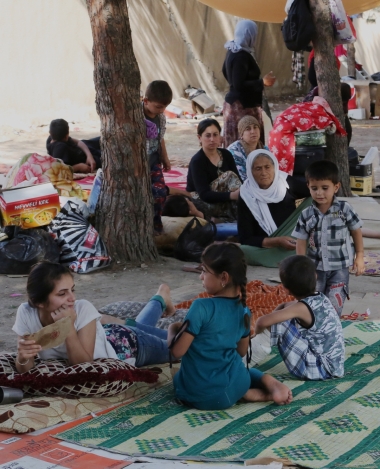
ISIS made an unusual move by releasing 200 Yazidi prisoners in northern Iraq, according to a Kurdish military official statement on Sunday.
The Washington Post reports that the prisoners were held captive for five months and most of them are elderly and sick people. Three of them are young children.
The ISIS militants transported the prisoners from the northern town of Tal Afar and dropped them off at Khazer Bridge, near Irbil. The prisoners are in poor health and appear to have suffered abuse. They are now being given medical treatment in the town of Alton Kupri.
“Their situation is very bad, especially the psychological condition,” said Hersh Hussein, a representative from the Irbil governor’s office who was in Alton Kupri. “Regarding other diseases we provide first aid and the most important medical treatment.”
The reason for the release appears to be that the prisoners were slowing down the militant group and that keeping them had become too much of a burden, according to a statement by Gen. Shirko Fatih, commander of Kurdish peshmerga forces in the northern Iraqi city of Kirkuk, to the Washington Post.
“It probably became too expensive to feed them and care for them,” he said.
There have been previous reports that ISIS has forced its captives to convert to Islam. After the Sunni Muslim group attacked the town of Sinjar, near the Syrian border back in August, massacring hundreds of captive soldiers and tribal fighters, women were reportedly sexually abused, raped, and sold off. Some were taken as brides for the jihadists, while young boys were separated to train them to become jihadists.
There were an estimated 50,000 Yazidis who fled to the mountains on the day of the attack and still remain there.
Bishop Oliver Dashe Dome of Maiduguri, northeast of Nigeria is calling for western military intervention to put an end to the terror brought on by the militant group Boko Haram in Nigeria.
In his interview with the Aid to the Church in Need, a charity working on behalf of suffering Christians, the prelate lamented the continuous acts of violence being perpetrated by the group and accused the government of knowing who is sponsoring the attacks but still allowing the atrocities to happen.
He charged that the offensive against the Boko Haram remains weak because of “incompetence” and sympathisers of the group within the military ranks itself.
“The West should bring in security – land forces to contain and beat back Boko Haram. A concerted military campaign is needed by the West to crush Boko Haram,” he said.
The bishop further lamented the decimation of churches in the region, and death of at least 1,000 of the faithful since 2009.
Boko Haram, since it was established in 2009, has consistently fought to overthrow the government with the goal of creating an Islamic state. Its activities have resulted in at least 13,000 deaths while around 1.5 million have been forced to leave their homes out of fear.
Its latest wave of terror happened over the weekend when the group raided Mabass, a small village in Cameroon and abducted 80 people, most of whom were women and children.
An Al Jazeera update reported that as of press time, 24 hostages were liberated as the Cameroonian armed forces pushed its offensive against the Boko Haram.
Even as members of the group launched their attack in Cameroon, a suicide bombing perpetrated by one if its members killed five people and injured 35 others in Potiskum, Nigeria.
The attacks are believed to be the militants’ response to the offensives launched by the Chad military in Baga, which was taken over by the Boko Haram earlier in the month in what could be considered the group’s deadliest raid yet.
Amnesty International and Human Rights Watch estimated at least 2,000 people massacred by the Boko Haram in the raid which destroyed close to 4,000 structures in Baga.
The area is believed to be a strategic location as it straddles the borders of Chad, Niger, Nigeria and Cameroon and would enable the group to conduct their operations freely across the region.
A divorced father has been ordered by a judge to take his children to a Roman Catholic mass when he has them at Christmas – though he says that his ex-wife, who is a practising Catholic, did not request the ruling at their divorce.
Known as “Steve” in order to protect the identity of the children, the man – a contributor to an atheist website – told the Daily Telegraph: “It’s all very bizarre. This aspect of the contact order was not requested by the other side in the case.
“The judge decided that I would commit to taking the children to mass and he put it in the court order.
“What I think is really concerning is that it does not allow me or my children any freedom of religious expression.
“I am definitely not Catholic. The last time I went to church was some time ago and it was a Unitarian church that I attended.
“My oldest son, who is now 10, has already expressed a clear lack of belief but legally I am required to take him to Roman Catholic mass at Christmas.
“Because my contact arrangements now give me the children on some weekends, I am concerned that I will now also be required to take them to mass on Sundays when they are with me, even though that is not part of the original order.”
The Telegraph says it has seen court transcripts that show that Judge Orrell discussed his own Catholic faith during the course of the hearing into contact arrangements for Steve’s two sons.
The order reads: “If the children are with their father at Christmas he will undertake that they will attend the Christmas mass.”
Steve applied to the Court of Appeal on the grounds that the order was a breach of his human rights. However, appeal judges and a later judicial review in the High Court both failed to support him, as did the Judicial Conduct Investigations Office.
A Christian health worker is taking legal action against her employer after being investigated for offering to pray for a Muslim colleague.
Victoria Wasteney, 37, offered to pray for a junior colleague when she was upset, and gave her a book about a Muslim woman who had an encounter with God.
The colleague, Enya Nawaz, later filed a report which said she had tried to convert her, an allegation which Wasteney says was a “complete surprise”.
She was suspended for nine months while the matter was investigated and subsequently given a written warning for “bullying and harassment”.
Wasteney has since returned to work but is taking the trust to an employment tribunal today in a bid to raise awareness about the difficulty of what she saw as ordinary interactions between colleagues.
“I’m not particularly fighting for myself,” Wasteney told Christian Today. “This needs to be something that’s talked about.
“We need to look at some of our policies in place, so that staff are clear about where they stand. Otherwise we’re going to have lots of people in this situation, not just Christians.”
She doesn’t see this as a problem just within the NHS, but a widespread issue, and one that people are afraid to talk about.
Wasteney is a senior occupational health therapist at the John Howard Centre, a specialist mental health facility in east London, but is currently working at the trust’s head office while the tribunal takes place.
In a statement released this weekend she described the time she offered to pray for Nawaz after she had come to her in some distress about a health problem.
“I said to her that she had strong faith and she should draw on that faith,” Wasteney explained. “‘I said ‘Pray!’ She told me she could not pray, so I replied ‘Maybe I can pray for you?’ And she said ‘OK’.
“I asked if I could put my hand on her knee, and she said yes. I don’t know if I said ‘Lord’ or ‘God’ but I said what I thought was the most neutral. Then I said ‘I trust that You will bring peace and You will bring healing’.”
She also gave Nawaz a copy of the book ‘I Dared to Call him Father’ about a Muslim woman who eventually converts to Christianity.
Wasteney had not read the book, but it had been recommended by a friend. “I understood it was a book about a spiritual journey – a woman’s encounter with God,” she told Christian Today.
“The whole basis of our conversations around faith started with her telling me that she’d had an encounter with God, that she felt she had been brought to London for a particular reason.”
She said it wasn’t her intention to suggest that ‘Christianity is the only way’.
The subsequent complaint came as a shock, since she had believed their conversations were part of the everyday interaction between friends. “It came as a complete surprise – a complete flip of my experience of the situation,” Wasteney said.
“We were both interested in what one another were involved in – it was part of the normal process of building a relationship with someone, to talk about primarily things we were interested in outside of work.”
Speaking of the wider issue, Wasteney said: “I believe in equality and I believe in diversity and open discourse, and if… we can’t talk with people who might have different views, I think that’s very limiting and I’m not sure that is a reflection of the society that we pride ourselves [on being].”
One area of common ground between the two colleagues was a shared interest in campaigning against human trafficking, which led Wasteney to invite Nawaz to an event on the subject being held at her church. The invitation to church was another aspect addressed by the investigation.
Wasteney said she knows that other colleagues were asked during the investigation whether she had invited them to church as well. She said she now fears being seen at work as a “religious nutcase”.
“It looks like I’ve been suspended for inviting people for church, which basically makes me look kind of crazy,” Wasteney said.
The publicity the case has already received has made things difficult both with colleagues and clients, so why take it further?
“I very much felt like my reputation had been jeopardised and I had a choice to make therefore. Do I feel strongly enough about this issue? Do I think it’s an issue that’s beyond myself?
“I don’t see other people coming forward. People seem to be very scared about sharing these things, and therefore I don’t think we’re really tackling the issue,” Wasteney said.
Despite the trust making an effort to reintegrate her at work, she said things still weren’t clear about what is allowed and what’s not.
When Wasteney asked whether it was ok to attend the lunchtime prayer meeting, she was told “What you do in your lunchtime is your own business.”
She responded: “I prayed with this girl in my lunchtime and I nearly lost my job over it.”
Andrea Williams, chief executive of the Christian Legal Centre, which has supported Wasteney, said in a statement: “Victoria’s case highlights the risks of the current ‘equality and diversity’ framework. Rather than bringing people together and creating more cohesive workplaces where people can be honest about who they are and build meaningful relationships, ‘political correctness’ means that many workplaces are becoming fragmented, superficial and suspicious. People are being forced to hide their identity and the things that matter most to them.”
A pastor has been shot and killed in the same Florida city that saw the death of Rev James “Tripp” Battle of Bayshore Baptist Church, Bradenton in December.
Anthony Shinholster, 57, served at Gethsemane Missionary Baptist Church in Bradenton. He was reportedly killed in his home on Sunday. A man is being held in custody for the Battle shooting and the two cases are not said to be connected.
As well as serving as a pastor, Shinholster also ran a fruit and vegetable stand and was well known in the community. His sister Thenecia, who was staying with him, said she could not think of anyone who would wish to harm her brother. She told the Bradenton Herald, “He was a wonderful man. We are all baffled.”
Battle was one of three victims of a shooting spree which also saw the deaths of Amber Avalos and her friend Denise Potter. Avalos’ husband Andres is being held in connection with their deaths.
A memorial fund was set up to benefit Battle’s widow and two young children with a target of $30,000. Another fundraising page has been set up to support the children of the Avaloses and Denise Potter.
Bradenton has also been in the news for a business venture started by the notorious Pastor Terry Jones, who burned copies of the Koran. He set up Fry Guys Gourmet Fries in a local mall, though he was asked by the management not to attend personally due to fears of disruption and shoppers’ safety.
With the continued rise of violent Islamic extremism around the world, many today are calling for a Reformation of Islam such as happened with Christianity in the 16th century.
Commenting on the call of Egypt’s president for a theological “revolution” within Islam, Mayor Rudi Giuliani, in an interview on Fox News, concurred saying that Islam needs a Reformation such as Christianity experienced.
Others within Islam, such as Dr. Zudhi Jasser, are also calling for a Reformation within Islam that will deal with the radical extremism. Can it happen?
The Critical Importance of Origins
The Christian Reformation was needed because, with the 4th century (supposed) conversion of Constantine and the merging of Christianity with the political state, the peaceful church of Jesus and the New Testament had been transformed into the imperial church of the Middle Ages that relied on political and military force to advance and maintain its cause.
The Reformation occurred when there was a movement within the church to return to its founder, Jesus Christ, and its founding document, the New Testament. This is why there are no beheadings today by Baptists, Methodists or even Catholics. Not a smidgeon of justification for such acts can be found with Jesus and the New Testament.
Jesus was a man of peace who taught love for God and one’s neighbor. But never mistake this for weakness, for it was in the midst of much civil and religious war and strife that Jesus boldly confronted the powers-that-be with His radical message of faith in God and peace and nonviolence toward people. It was Jesus who told His followers;
But I tell you not to resist an evil person. But whoever slaps you on your right cheek, turn the other to him. If anyone wants to sue you and take away your tunic, give him your cloak also. And whoever compels you to go one mile, go with him two (Matthew 5:39-41).
With the Reformation and its return to Jesus and the New Testament, there was a disentangling of the Christian faith from the political ambition and the use of force that had begun with Constantine. The power of the Reformation and its return to Christian origins produced new churches that renounced the use of political and physical force.
The power of the Reformation and its emphasis on Christian origins also led to the Catholic Church giving up the use of force in matters of conscience and faith.
America Founded on Reformation Values
America was founded on Reformation principles of religious liberty and freedom of conscience. This is what the First Amendment to the Constitution is all about. “Congress shall make no law concerning the establishment of religion, nor hindering the free exercise thereof.” This is merely stating that the new nation will not have an official state church, as in medieval Europe, that seeks to control the minds and speech of its populace.
This is the context of Thomas Jefferson’s “wall of separation” comment to a group of Baptists concerning the First Amendment. The “wall,” in Jefferson’s thinking, was unidirectional designed to keep the state out of the church, while at the same time protecting everyone’s right of religious freedom. He used this terminology to assure the Baptists that they could freely practice their faith in the new nation without government interference.
These are the values on which this nation was founded. These are not Islamic values. These are not even Roman Catholic values. These are Reformation values! These are Christian values based on the teachings of Jesus and the New Testament. Woe to America if she ever forgets the values on which her freedoms are based.
The Challenge for Islam
The problem Islam faces in seeking a Reformation is that its founder, Mohammed, unlike Jesus, was a man of war who spread his teachings and influence with violence and the sword. A return within Islam to its founder and origins will thus have a very different outcome than what occurred with the Christian Reformation. In fact, returning to Islam’s founder and origins seems to lead people to becoming even more radicalized, and we get Al Qaeda, ISIS and Boko Haram.
This does not mean that all Christians today are nice people or that all Muslims are bad people. Not at all! But here is the big difference: Christians are continually confronted with Jesus and His amazing example of sacrificial love, and His command to love one another as I have loved you (John 14:34). Even though they fall short of the standard, Christians are continually being pulled towards it by the example and words of Jesus Himself. In contrast, Muslims have no such example to follow, unless they too turn to Jesus!
A Jesus Reformation in Islam?
In the Bible school where I once served on faculty, a student from Ethiopia brought a video of a mosque in Cairo showing that the crescent on top had been replaced with a cross. The imam had experienced a supernatural encounter with Jesus, but instead of becoming a Baptist, Methodist or Catholic, he remained where he was and began preaching Jesus and the meaning of the cross to his Muslim congregation.
He could do this because there is an opening, be it a slight one, in that the Quran recognizes Jesus as a prophet. Yes, Christians know Jesus is much more than a prophet, but this could be the opening needed to preach Jesus within Islam.
Christians recognize Jesus as God incarnate. The New Testament, however, also presents Jesus as the human archetype—the universal human being. This is what Paul was referring to when he referred to Jesus as the second man and the last Adam (I Corinthians 15:45-47). God has set Jesus as the universal example of what a human being ought to be. This is clearly stated in Romans 8:29 where Paul says that God has predestined us to be conformed to the image of His Son.
Jesus is the Answer
Presenting Jesus as the ultimate role model seems to offer the best hope for President Abdel-Fattah el-Sissi, Dr. Jasser and others seeing the “revolution” or “reformation” they are calling for. If Muslim leaders will encourage their followers to learn all they can about Jesus, even by going to the New Testament, and then call on them to follow His words and example, I see every reason to believe that a powerful Jesus reformation would emerge in Islam that would root out the extremists and bring Muslim nations into the modern world.
As I write, I am reminded of the words of the song written by Andre Crouch who went home to be with Jesus a few days ago. He wrote;
Tributes to civil rights leader Martin Luther King Jr. were held across the United States yesterday, with observers linking the federal holiday to a rallying cry in recent protests over police brutality: “Black lives matter.”
King’s 1960s dream of racial equality was being viewed through a lens focused on the deaths of unarmed black men after confrontations with police, including Eric Garner, who died in July after being put in a chokehold in New York City, and Michael Brown, shot in Ferguson, Missouri, in August.
More than 60 people demonstrating against police brutality were arrested after blocking traffic on the San Mateo-Hayward Bridge, a major thoroughfare in the San Francisco Bay Area, said California Highway Patrol Officer Damian Cistaro.
Another 19 people were arrested by Seattle police after protesters blocked a major artery, causing traffic delays.
More than 1,800 people pressed into a King commemoration service at the Ebenezer Baptist Church in Atlanta, where King once preached, some holding signs with his famous quote “I am a man,” others with placards reading “I can’t breathe” in Garner’s memory and “Hands up! Don’t shoot!” to honor Brown.
“We look at the yellow crime scene tape that’s wrapped around America now and we know that we have a lot of work still to do,” Gwendoyln Boyd, president of Alabama State University, told the crowd that responded with an earsplitting “Amen!”
‘RECLAIMING MARTIN LUTHER KING’
About 400 protesters blocked traffic in New York City as they walked about 60 blocks from Harlem to near the United Nations, chanting “Black lives matter!” as King’s speeches blared from loudspeakers.
“This march is about reclaiming Martin Luther King. He was a radical organiser – he’s been arrested, he believed in non-violence, but he was also disruptive,” said Linda Sarsour, spokeswoman for the Justice League NYC, which organised the #Dream4Justice March.
Hours before an evening vigil on the Staten Island street where Garner died, his family placed wreaths on the Brooklyn street where two uniformed officers were ambushed in December by a gunman claiming to avenge the deaths of Garner and Brown.
“This holiday should also represent that we are unequivocally against the shedding of innocent blood,” said Rev Al Sharpton, who accompanied Garner’s widow, mother and children as they laid down arrangements of blue hyacinths and white roses.
Demonstrations in other US cities included 1,500 protesters against police brutality in Oakland, California, said Oakland Police Officer Johnna Watson. There were no arrests.
President Barack Obama, the nation’s first African-American president, took a more traditional approach to honoring King, spending the day working with his family and other children on a literacy project at a Washington charity.
Obama has shied away from race-related activism, but after a grand jury failed to indict a white officer in Brown’s death, he spoke out against what he called the “deep distrust” between law enforcement and black Americans, vowing to use his last two years in office to improve community policing and trust between the groups.
Pope Francis has established a new Eastern Catholic Church for Eritrea, the first since the early 20th century, in what may be a move to ease the position of Catholics in the country.
Roman Catholicism is one of the four religions tolerated in Eritrea, along with the Eritrean Orthodox Tewahedo Church, the Evangelical Lutheran church and Islam.
Until now, the four Eritrean ‘eparchies’, or dioceses, have been part of the Ethiopian Catholic Church. However, the Vatican announced on Monday that they will now come under the authority of an Eritrean metropolitan archbishop, the present Bishop of Asmara, Menghesteab Tesfamariam.
Establishing the Eritrean Catholic Church as a separate jurisdiction may be calculated to improve its standing in the eyes of the government of Eritrea, which has fought a series of bloody wars with its more powerful neighbour Ethiopia including a long struggle for independence.
The Eritrean government has been accused of horrendous human rights abuses. According to Human Rights Watch, it is one of the most closed countries in the world and is characterised by “indefinite military service, torture, arbitrary detention, and severe restrictions on freedoms of expression, association and religion”.
The United Nations High Commissioner for Refugees (UNHCR) estimates that more than 305,000 Eritreans – more than five per cent of the population – has fled the country during the past decade. Many of the migrants who perished in the Lampedusa tragedy, in which 360 people died when their ship sank, were from Eritrea.
There are an estimated 155,000 Catholics in Eritrea, though exact figures are hard to come by. Protestants, other than Lutherans, and adherents of minority faiths such as Jehovah’s Witnesses are severely persecuted.
Japanese Prime Minister Shinzo Abe on Tuesday condemned as “unacceptable” the threat to the lives of two Japanese purportedly taken captive by Islamic State militants, and said the international community should not give in to terrorism.
Speaking at a news conference in Jerusalem during a tour of the Middle East, Abe added that Japan would do its utmost to secure the captives’ safe release.
The Islamic State group, which holds territory in Iraq and Syria, issued a video online purporting to show two Japanese captives and demanding $200 million (£132 million) from the Japanese government to save their lives.
“The international community needs to respond firmly and cooperate without caving into terrorism,” Abe said.
Asked whether Japan would pay ransom to secure the two captives’ release, Abe replied: “With regard to this case, we attach the utmost priority to saving lives, and gathering information with the help of other countries. We’ll make utmost efforts to save the lives (of the captives) from now on.”
Abe on Saturday had pledged $200 million in non-military aid for countries contending with Islamic State.
Abe told the Jerusalem news conference that Japan would go ahead with the aid, which he said was humanitarian in nature.
“Japan will make as much contribution as possible in non-military areas, including provision of support for refugees from Iraq and Syria,” he said.
“The $200 million aid Japan has unveiled was humanitarian aid aimed at providing food and medical services in order to save those people in the region who have lost their homes and become refugees. I believe that this is the aid that is most needed by refugees,” he added.
Abe, who took office two years ago pledging to boost Japan’s role on the global stage, also repeated his promise that Japan would contribute to non-military areas of the Middle East and seek to play a role in bringing peace to the region.
Turkish Prime Minister Ahmet Davutoglu accused his Israeli counterpart Benjamin Netanyahu on Friday of terrorism and said Israeli “provocations” such as the bombardment of Gaza were contributing to radicalisation in the Muslim world.
In a Reuters interview, Davutoglu said peace in the Middle East and the eradication of extremist groups would be virtually impossible without the establishment of a Palestinian state.
He also warned the international community against focusing solely on fighting Islamic State militants in its efforts to end the conflict in Syria, saying the “brutality” of President Bashar al-Assad was the root cause of the problem.
Turkey, an EU candidate nation and member of the NATO military alliance, is a key Western ally in the fight against Islamic jihadists. But its leaders have become increasingly concerned about what they see as rising Islamophobia in Europe and increasingly outspoken in their criticism of Israel.
“(Netanyahu) himself killed, his army killed children in the playground. They killed our citizens and an American citizen in international waters. This is terrorism,” Davutoglu said, referring to a 2010 Israeli assault on a Turkish boat attempting to break Israel’s blockade of the Palestinian Gaza Strip.
“Nobody can argue about Israeli aggression in Jerusalem in the al-Aqsa mosque,” he added. “These provocations create frustration in the Muslim world and are becoming one of the reasons why these radical trends are emerging,” he said.
“If we want to establish peace and order in the Middle East, eliminating all the extremist forces, we have to solve the Palestinian question.”
Davutoglu on Thursday compared Netanyahu to the Islamist militants who killed 17 people in Paris last week, saying both had committed crimes against humanity.
Netanyahu has called for an international condemnation of Davutoglu’s remarks and those of President Tayyip Erdogan, after he criticised the Israeli prime minister’s attendance with other world leaders at a solidarity march in Paris.
Once-good relations between Israel and Turkey have declined markedly over the past five years, with US-efforts to revive the soured ties failing to make headway. There was no immediate reaction in Israel to Davutoglu’s latest comments.
“ASSAD’S BRUTALITY”
Davutoglu said Turkey, which has faced criticism for failing to stop thousands of foreign fighters crossing into Syria, would do everything it could to stem the flow, describing the conflict in its southern neighbor as a major national security threat.
But he said a coherent strategy was needed for Syria before Turkey would consider a greater front-line role in the US-led coalition against Islamic State, including an internationally policed no-fly zone to protect the northern city of Aleppo from Assad’s forces.
“The source of the problem is the Assad regime’s brutality. Without solving that source, that reason, dealing only with (Islamic State) or other bi-products of this crisis will not be solving the problem altogether,” Davutoglu said.
“(We want a) no-fly zone … so that Aleppo will be protected at least against the air bombardment and there will be no new refugees coming to Turkey,” he said, warning of a potential new influx of millions if the city was not defended.
He said Turkey may extend a series of existing militarized zones along its border with Syria to try to stop the passage of foreign fighters without closing the frontier to refugees.
“On the border, up to now, there are refugee camps, there are certain places where there is much more strict control … These military zones might be enlarged,” he said, adding Turkeyhad so far been reluctant to do so, so as not to deter refugees.
The Turkish authorities had banned some 8,000 foreigners from entering the country over the past year alone because of security concerns and had further improved coordination with European intelligence agencies, Davutoglu said.
GULEN EXTRADITION
On the domestic political front, Davutoglu said he expected a request to be made to the US authorities for the extradition of Muslim cleric Fethullah Gulen, accused by Erdogan and the government of leading a plot to seize power.
A Turkish court issued an arrest warrant in December for Gulen, who has lived in self-imposed exile in Pennsylvania since 1999. Asked if an extradition request would now follow, Davutoglu said:
“Yes, of course, if needed yes. It is not our choice, it is the decision of the court, not the decision of the government. The government will do whatever is needed,” he said.
Such a move would take Erdogan’s campaign to root out Gulen supporters, including purges of the judiciary and police, to the international arena and potentially test strained relations with Washington.
Turkey and the United States have a treaty that allows extraditions in certain instances, and requires that there is enough evidence to charge the same defendant with a crime under both Turkish and US law. The treaty also allows the United States to refuse an extradition request if it deems it political in nature. A spokesman for the US Justice Department, which would handle the request, declined comment.
Alp Aslandogan, a Turkish-American academic close to Gulen, said Davutoglu’s comments were “another politically motivated attempt to persecute law-abiding citizens for engaging in democratic dissent and carry no credibility”. He said he had not been informed of formal charges against Gulen.
Gulen was a close ally of Erdogan in the early years after his ruling AK Party took power in 2002 but has been in open conflict with him since a graft investigation emerged just over a year ago targeting the then-prime minister’s inner circle.
Erdogan and Davutoglu portray the investigation as part of a coup attempt and have described Gulen’s followers as traitors — charges that Gulen, who runs a vast network of schools and business enterprises in Turkey and abroad, denies.
We use cookies to ensure that we give you the best experience on our website. If you continue to use this site we will assume that you are happy with it.