Israeli strike in Syria kills senior officers of Lebanon’s Hezbollah

An Israeli helicopter strike in Syria killed a commander from Lebanon’s Hezbollah and the son of the group’s late military leader Imad Moughniyah, Hezbollah said, in a major blow that could lead to reprisal attacks.

The strike hit a convoy carrying Jihad Moughniyah and commander Mohamad Issa, known as Abu Issa, in the province of Quneitra, near the Israeli-occupied Golan Heights, killing six Hezbollah members in all, a statement from the group said.

It comes just days after Hezbollah leader Sayyed Hassan Nasrallah said frequent Israeli strikes in Syria were a major aggression, that the group was stronger than before and that Syria and its allies had the right to respond.

Shi’ite Muslim Hezbollah, which is backed by Iran and fought a 34-day war with Israel in 2006, has been fighting alongside President Bashar al-Assad’s forces in Syria’s four-year war.

Iran’s semi-official Tabnak news site said several of its Revolutionary Guards had also been killed in the attack, without giving further details. State-run Iranian television said the identity of the “martyrs” could not be confirmed.

The Hezbollah-run al-Manar news channel said the Israeli attack suggested “the enemy has gone crazy because of Hezbollah’s growing capabilities and it could lead to a costly adventure that will put the Middle East at stake”.

Israel’s military declined to comment, but an Israeli security source confirmed to Reuters that the Israeli military had carried out the attack.

It was not immediately clear what role Jihad Moughniyah, in his 20s, was playing in the fighting in Syria.

Hezbollah accused Israel in 2008 of assassinating his father, Imad Moughniyah, who was implicated in high-profile attacks on Israeli and Western targets and wanted by the United States. Israel denies any involvement in that killing.

Nabil Boumonsef, a columnist at the Lebanon newspaper an-Nahar, said he believed the strike was a direct response to Nasrallah’s speech and could lead to a backlash.

“Killing the son of Moughniyah is dangerous. I do not think that the group can be quiet now, now that the father and the son are killed. I expect that it will do something,” he said.

U.N. peacekeepers intensified their patrols on the border between Lebanon and Israel on Sunday night, local sources said.

RETALIATION THREAT

Imad Moughniyah was implicated in the 1983 bombings of the U.S. Embassy and U.S. Marine and French peacekeeping barracks in Beirut, which killed over 350 people, as well as the 1992 bombing of the Israeli embassy in Buenos Aires and the kidnapping of Westerners in Lebanon in the 1980s.

The United States indicted him for his role in planning and participating in the June 14, 1985, hijacking of a U.S. TWA airliner and the killing of an American passenger.

He was killed in a car bombing in Damascus in 2008.

Jihad Moughniyah appeared in public for the first time a week after his father’s death to pledge loyalty to Nasrallah.

“We are with you and we will go wherever you go. We will never leave the battlefield and we will never drop our guns, we answer for you Nasrallah,” Jihad, then aged 16, said wearing the group’s military uniform in front of thousands of mourners.

Al-Manar television said earlier that a number of fighters were killed when they were checking an area in Quneitra when their convoy came under Israeli missile attack.

Quneitra has seen heavy fighting between forces loyal to Assad and rebels including fighters linked to al Qaeda. Syrian state television said six people were killed in the attack and a child was wounded, without giving further details.

Israel has struck Syria several times since the start of the war, mostly destroying weaponry such as missiles that Israeli officials said were destined for Hezbollah, Israel’s long-time foe in neighbouring Lebanon.

Syria said last month that Israeli jets had bombed areas near Damascus international airport and in the town of Dimas, near the border with Lebanon.

Nasrallah said on Thursday “the frequent attacks on different sites in Syria is a major breach. We consider (those) hostilities (to be) against all the resistance axis.”

“(Retaliation) is an open issue,” he added.

Iran, Syria, Hezbollah and some Palestinian factions consider themselves an “axis of resistance” against Israel.

Source: Christian Today

Suspected Boko Haram militants kidnaps 80, killed 3, in attack on villages in Cameroon

Suspected Boko Haram Islamist fighters from Nigeria kidnapped around 80 people, many of them children, and killed three others on Sunday in a cross-border attack on villages in northern Cameroon, army and government officials said.

The group, which has killed thousands and kidnapped hundreds in its bid to carve out an Islamic state in northern Nigeria, has also targeted Cameroon and Niger over the past year as it seeks to expand its zone of operations.

Sunday’s kidnappings, among the largest abductions on Cameroonian soil, came as neighbouring Chad deployed troops to support Cameroon’s forces in the area.

“According to our initial information, around 30 adults, most of them herders, and 50 young girls and boys aged between 10 and 15 years were abducted,” a senior army officer deployed to northern Cameroon told Reuters.

He said the early-morning attack had targeted the village of Mabass and other villages along the porous border. Soldiers intervened and exchanged fire with the raiders for around two hours, he added.

Government spokesman Issa Tchiroma confirmed the attack, in which he said three people had been killed, as well as the kidnappings. He was not able to say with certainty how many people had been taken in the raid.

“There was a Boko Haram attack on several localities in the Far North region. The assailants burnt down about 80 homes and kidnapped several inhabitants including women and very young children,” he said.

In an attack that gained worldwide attention last year, its fighters kidnapped around 200 schoolgirls from the town of Chibok, in northeastern Nigeria.

It has stepped up attacks in the region as Africa’s biggest economy prepares for a Feb. 14 presidential election.

In a video posted online this month, a man claiming to be Boko Haram leader Abubakar Shekau threatened to step up violence in neighbouring Cameroon unless it scraps its constitution and embraces Islam.

Faced with increased violence along the border, Yaounde has deployed thousands of additional troops, including elite soldiers, to the area.

A convoy of troops from Chad arrived in Maroua, the main town in Cameroon’s Far-North Region, to support the fight against Boko Haram, late on Saturday,Cameroon defence ministry spokesman Colonel Didier Badjeck said on Sunday.

Chad has a reputation as one of the region’s best militaries and helped French forces drive al Qaeda-linked Islamists from northern Mali in 2013. Government officials in N’Djamena say the deployment to Cameroon includes around 2,000 soldiers, armoured vehicles and attack helicopters.

Ghana’s President John Mahama, who currently heads West African bloc ECOWAS, told Reuters on Friday that regional leaders will seek approval from the African Union next week to create a new force to fight Boko Haram.

Source: Christian Today

French President speaks on freedom of speech after anti-Hebdo clashes in other countries

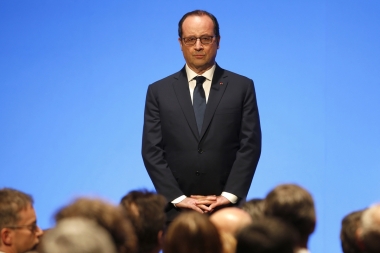
French President Francois Hollande said on Saturday that anti-Charlie Hebdo protesters in other countries do not understand France’s attachment to freedom of speech.

He was speaking a day after the satirical weekly’s publication of a cartoon of the Prophet Mohammad sparked violent clashes, including deaths, in some Muslim countries.

Demand has surged for Charlie Hebdo’s first issue since two militant gunmen burst into its weekly editorial conference and shot dead 12 people at the start of three days of violence that shocked France.

A cartoon image of Mohammad on its front page outraged many in the Muslim world, triggering demonstrations that turned violent in Algeria, Niger and Pakistan on Friday.

“We’ve supported these countries in the fight against terrorism,” Hollande said during a visit to the southern city of Tulle, traditionally his political fiefdom.

“I still want to express my solidarity (towards them), but at the same time France has principles and values, in particular freedom of expression.”

The shootings in Paris were prompted by Charlie Hebdo’s previous publication of Mohammad cartoons, a depiction many Muslims consider blasphemous.

CHURCHES TORCHED

In Niger, protesters set fire to churches and looted shops in the capital Niamey on Saturday in a second day of riots over Charlie Hebdo’s publication of the image.

France’s embassy in Niamey advised its citizens against going out in the streets.

Five people were killed on Friday in Zinder, the second city of the former French colony, while churches were burnt and Christian homes looted.

French Foreign Minister Laurent Fabius condemned the violence in Niamey and Zinder and said France stood in solidarity with Niger authorities.

Protests also turned violent on Friday in the southern Pakistan city of Karachi where police used teargas and a water cannon against demonstrators outside the French consulate.

Several Algerian police officers were injured in clashes with demonstrators in Algiers after rioting broke out at the end of a protest.

“There are tensions abroad where people don’t understand our attachment to the freedom of speech,” Hollande said. “We’ve seen the protests, and I would say that in France all beliefs are respected.”

Hollande has received a big poll boost for his handling of the attacks with his popularity rating surging to its highest level in nearly one and a half years.

His rating has jumped to 34 percent from 24 percent before the attacks, according to a BVA poll published on Saturday.

Produced by survivors of the attack, the latest edition of Charlie Hebdo shows a cartoon of a tearful Mohammad holding a “Je suis Charlie” sign under the words “All is forgiven.”

A lawyer for one of the gunmen in the Charlie Hebdo attack said the man had been buried in the eastern city of Reims in an unmarked grave so as not to attract sympathisers.

Meanwhile, Belgium deployed hundreds of troops to guard potential terrorism targets. Two gunmen were killed on Thursday during an anti-Islamist raid in the town of Vervier.

Source: Christian Today

WILD: Review

Based on the true story of novelist Cheryl Strayer, Wild documents her fearless trek along the Pacific Crest Trail, a monuments stretch of 1,100 miles across North America, as she attempts to redeem her past and “walk [her] way back to the person” she once was.

With a triumphant performance by Reese Witherspoon, who at 38 is over a decade older than the real Strayer when she undertook the journey in 1995, the film carries a depth which allows the audience to overlook such discrepancies.

Witherspoon’s portrayal is unapologetically human; her character gritty and raw. Those to whom she has always been Legally Blonde‘s Elle Woods will find her remarkably unglamorous – as Strayer she is equally stoic, powerful and vulnerable, and confidently carries the plot almost entirely alone, with only incidental meetings with strangers along the way.

The audience is forced to piece together the story of her past and her journey to the present moment through a series of flashbacks. Strayer’s determination to move forward and seek redemption is marred only by her memories; as she trudges steadily onward, the plot jumps back and forth – revealing an abusive father, the sudden loss of her mother to cancer and a heroin addiction that led to the break up of her marriage. Her fractured mindset is reflected perfectly by the narrative, though it is this constant shifting that may be the film’s downside; take your mind off the movie for more than a few moments and you could lose your place in the story.

Director John-Marc Vallée (Dallas Buyer’s Club) uses Strayer’s surroundings to beautiful effect – from the Mojave desert to the teeming forests of Oregon, the scenery is captivating. Strayer’s relationship with nature is as disjointed as those with other people; she learns to command it in some ways but is also entirely at its mercy, though ultimately we come to see her environment as an agent of her renewal. Adrienne Rich’s Power, read by Strayer on her first night in the wild, encapsulates that relationship. The real Strayer explained in an interview with the New York Times: “In the last lines of that poem Rich writes about the scientist Marie Curie, who she says died “denying her wounds came from the same source as her power.” Adrienne Rich never denied that. She always knew our wounds come from the same source as our power and she spent her life mining the beauty in our suffering. She gave me permission to do that too. She gave us all permission.”

The heart of the film, however, is found in the audience’s intimate connection with Strayer herself. We celebrate her victories and grieve with her in her lowest moments, willing her to come to terms with her mother’s death. When she finally does – sinking to the ground and overcome with emotion – it’s a heartbreakingly honest moment that pulls together past and future in a moment of agonising catharsis, and proves Witherspoon worthy of her Oscar nomination.

Ultimately, this is a story of redemption. Of one woman’s personal journey filled with grief, pain and vulnerability, but also triumph, forgiveness and hope. More than anything, it’s a celebration of the sacredness of life – as Strayer says: “There’s a sunrise and a sunset every day, and you can choose to be there for it – you can put yourself in the way of beauty.”

Source: Christian Today

Churches urged to pray and support British dairy farmers

As British dairy farmers struggle to survive amid a milk pricing crisis, churches are being asked to support and pray for the industry.

Glasgow-based dairy company First Milk announced a two-week delay in payments to dairy farms last week, leading to concern for those who rely on it to make a living. According to the BBC, Union leaders have blamed the crisis for putting “extraordinary pressure” on farmers.

“The number of dairy farmers has halved over little more than a decade,” said Arthur Rank Centre (ARC) CEO Jerry Marshall. “Prices are at their lowest since 2007 while costs have risen 36 per cent. On top of this, the recent announcement by First Milk that they are delaying payments by two weeks, presents significant cash flow difficulties to their suppliers.”

The ARC, a Christian charity which resources rural churches and their communities, is therefore calling on Christians to pray for those affected.

“British Dairy farmers are facing an exceptionally difficult time,” said Revd Elizabeth Clark, National Rural Officer for the Methodist Church and the United Reformed Church.

“Give thanks for the vital food that dairy farmers produce, pray for those struggling because of the present low prices and pray especially for those famers who sell their milk to First Milk whose pay cheques have been delayed.”

Canon Dr Jill Hopkinson, National Rural Officer for the Church of England, also stressed the importance of buying locally made, British produce and making sure that the farmer’s are getting a good deal for the price the consumer pays.

“Churches can also support the industry by buying British dairy products,” she explained. “When buying milk, butter, cheese and yoghurt look for the red tractor logo which tells you it is a British product.

“Church members could also show their support through choosing to buy milk from supermarkets that pay a fair price to farmers. Visit http://www.nfuonline.com/back-british-farming/news-channel/how-can-i-support-british-dairy-farmers/ to find out how.”

The ARC has offered a suggested prayer for those wanting to support British farmers:

Loving God we give you thanks for all the food that is produced for us by farmers every day. We thank you especially for milk, a vital food, which we don’t always fully appreciate. We pray for dairy farmers and the particular pressures that they face at this present time. We remember farmers under pressure because of low prices and late milk payments, may they know the peace of your presence. May we consumers never take our food for granted and may we value and support those who work tirelessly to feed us. This we ask in Jesus name, Amen.

Source: Christian Today

Pope Francis shuns male chauvinism: ‘Men should listen to Women’s ideas more’

Pope Francis said on Sunday men should listen to women’s ideas more and not be male chauvinists.

The Argentine pope made impromptu remarks during a youth rally at a co-ed Catholic university in the Philippine capital, Manila, after he noted that four of the five people who addressed him on stage were male.

“There is only a small representation of females here, too little,” he said, bringing laughter from the crowd.

“Women have much to tell us in today’s society. At times we men are too ‘machista’,” he said, using the Spanish term for male chauvinists.

“(We) don’t allow room for women but women are capable of seeing things with a different angle from us, with a different eye. Women are able to pose questions that we men are not able to understand,” he said to more applause.

He noted that it was a 12-year-old girl, not any of the four men, who had posed the toughest question, asking why God allowed children to be abandoned..

He ended that part of his impromptu remarks with a joke: “So, when the next pope comes to Manila, let’s please have more women among you.”

Francis has said that, while the Roman Catholic Church’s ban on women priests is definitive, he wants to appoint more nuns and other women to senior positions in the Vatican.

Also on Sunday, the pope said a huge open-air Mass for a rain-drenched crowd of millions in the Philippine capital, after appealing to the world to “learn how to cry” over the plight of poor, hungry, homeless and abused children.

City officials said some 4 million people were in Manila’s Rizal Park and more in surrounding areas to witness the event that caps Francis’s week-long trip to Asia.

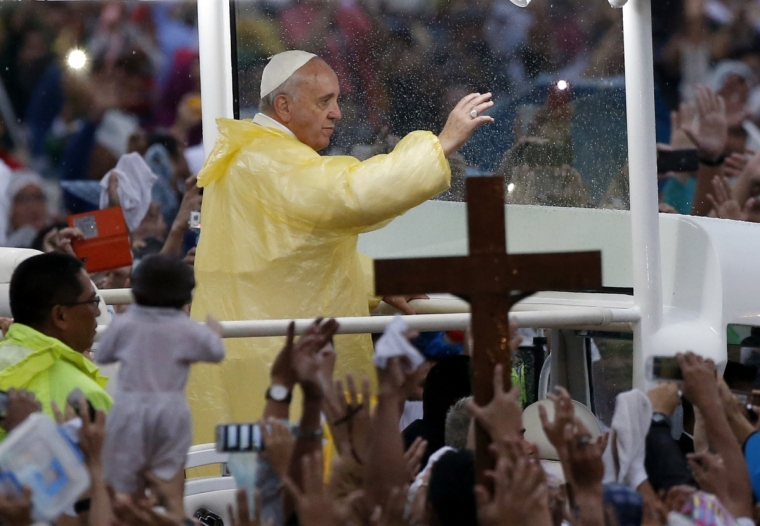
The 78-year-old Pope, wearing a transparent yellow poncho over his white cassock, was driven through the ecstatic crowd in a “popemobile” modified from a jeepney, the most popular mode of transport in the Philippines.

He stopped often along the route to kiss children and bless religious statues on the day the Philippines celebrates the feast of the infant Jesus. The faithful, also wearing ponchos, held up rosaries in a forest of uplifted arms as he passed by.

Some people in the capital of Asia’s only predominantly Catholic country had waited during the night for gates to open at dawn. The gates opened nine hours before the start of the Mass, which was due to last nearly three hours.

In his homily, the Pope urged Filipinos to shun “social structures which perpetuate poverty, ignorance and corruption”, a theme he stressed when he held talks with President Benigno Aquino on Friday. Aquino attended the Mass.

Francis also took another swipe at the government’s population control efforts, saying the family was under threat from “insidious attacks and programmes contrary to all that we hold true and sacred”.

Organisers had said they had expected as many as 6 million people, more than the 5 million who flocked to a Mass there by Pope John Paul 20 years ago.

The Pope said he was moved by the question earlier posed by the 12-year-old girl, who had herself been abandoned.

“Many children are abandoned by their parents. Many of them became victims and bad things have happened to them, like drug addiction and prostitution. Why does God allow this to happen, even if the children are not at fault? Why is it that only a few people help us?” the girl, Glyzelle Iris Palomar, asked him.

STREET CHILDREN

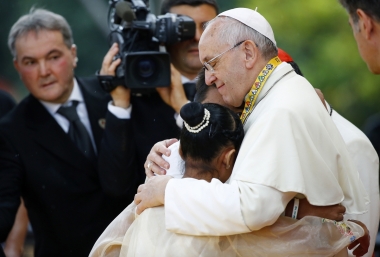
The girl, who was rescued and found shelter in a Church-run community, broke down in tears and could not finish her prepared welcome. The Pope hugged her and later put aside most of his own prepared speech to respond.

“She is the only one who has put forward a question for which there is no answer and she was not even able to express it in words but rather in tears,” he said, visibly moved.

“Why do children suffer?” the Argentine Pope said, speaking in his native Spanish. An aide translated his words into English for the crowd of about 30,000 young people on the grounds of the Church-run university.

“I invite each one of you to ask yourselves, ‘Have I learned how to weep … when I see a hungry child, a child on the street who uses drugs, a homeless child, an abandoned child, an abused child, a child that society uses as a slave’?” he said.

Children can be seen living on the streets of the Philippine capital, as they often do in many poor Asian countries, surviving by begging and picking through garbage in vast dumps.

The United Nations says 1.2 million children live on the streets in the Philippines. According to theChild Protection Network Foundation, 35.1 percent of children were living in poverty in 2009, the last year such data was available. Nearly 33 percent of Filipinos live in slums.

In his homily later at the Mass, the Pope again spoke of the need to defend children, saying: “We need to see each child as a gift to be welcomed, cherished and protected. And we need to care for our young people, not allowing them to be robbed of hope and condemned to life on the streets.”

Source: Christian Today

Israel lobbies ICC member states to cut off funding ahead of Gaza inquiry

Israel is lobbying member-states of the International Criminal Court to cut funding for the tribunal in response to its launch of an inquiry into possible war crimes in the Palestinian territories, officials said on Sunday.

ICC prosecutors said on Friday they would examine “in full independence and impartiality” crimes that may have occurred since June 13 last year. This allows the court to delve into the war between Israel and Hamas militants in Gaza in July-August 2014 that killed more than 2,100 Palestinians and 70 Israelis.

The decision came after Palestinian President Mahmoud Abbas, in the absence of peace talks and against strong opposition from Israel and the United States, requested ICC membership, which comes into effect on April 1.

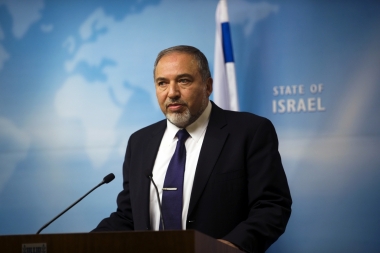
Israel, which like the United States does not belong to the ICC, hopes to dent funding for the court that is drawn from the 122 member-states in accordance with the size of their economies, Foreign Minister Avigdor Lieberman said on Sunday.

“We will demand of our friends in Canada, in Australia and in Germany simply to stop funding it,” he told Israel Radio.

“This body represents no one. It is a political body,” he said. “There are a quite a few countries – I’ve already taken telephone calls about this – that also think there is no justification for this body’s existence.”

He said he would raise the matter with visiting Canadian counterpart John Baird on Sunday.

Another Israeli official told Reuters that a similar request was sent to Germany, traditionally one of the court’s strongest supporters, and would also be made to Japanese Prime Minister Shinzo Abe, who is separately visiting Jerusalem and whose nation is the largest contributor to the ICC.

Islamist group Hamas, which is deemed a terrorist group by Israel and the West, on Saturday welcomed the ICC inquiry and said it was prepared to provide material for complaints against the Jewish state.

Source: Christian Today

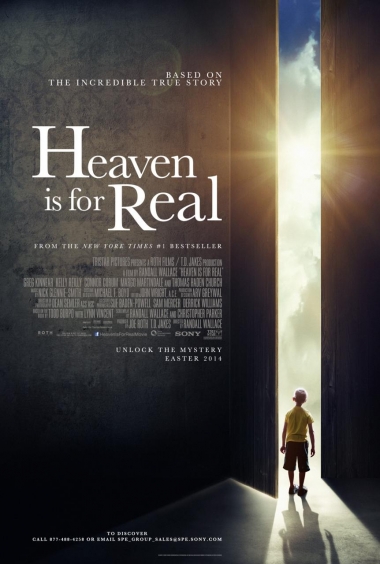
Colton Burpo defends Heaven is for Real

Colton Burpo, the subject of bestselling book and hit movie Heaven is for Real, has defended his story just days after Alex Malarkey revealed that his own near-death experience was fake.

Burpo, who claims to have met Jesus when he had his appendix removed in an emergency operation aged 4, says he visited heaven, saw angels and watched Mary kneel before the throne of God. In a new statement on his website, he writes: “Dear friends, I know there has been a lot of talk about the truth of other Heaven stories in the past few days. I just wanted to take a second and let everyone know that I stand by my story found in my book Heaven is for Real.

“I still remember my experience in Heaven. I want to keep telling people about my experience because it has given hope to so many people.

“People have their doubts about my story,” Burpo continues, “But the thing is, I wasn’t coaxed into doing this. I wanted to tell people about my experience. In fact, I started sharing my story with my friends and people in our town way before there was a book called Heaven is for Real.

“I hope that my story continues to point people to Jesus. He really, really loves you.”

Earlier this week, Alex Malarkey – who co-wrote a book with his father, Kevin, about his experiences in heaven after a car accident in 2004 when he was just six-years-old – retracted his story.

Alex was left quadriplegic by the accident, and now says he made the story up to get attention.

He wrote an open letter to booksellers in which he also took aim at other accounts of “heaven tourism”, a genre that includes Burpo’s Heaven is for Real.

Addressed to “Lifeway and Other Sellers, Buyers, and Marketers of Heaven Tourism, by the Boy Who Did Not Come Back From Heaven”, the letter reads: “Please forgive the brevity, but because of my limitations I have to keep this short.

“I did not die. I did not go to Heaven.

“I said I went to heaven because I thought it would get me attention. When I made the claims that I did, I had never read the Bible. People have profited from lies, and continue to. They should read the Bible, which is enough. The Bible is the only source of truth. Anything written by man cannot be infallible.

“It is only through repentance of your sins and a belief in Jesus as the Son of God, who died for your sins (even though he committed none of his own) so that you can be forgiven may you learn of Heaven outside of what is written in the Bible … not by reading a work of man. I want the whole world to know that the Bible is sufficient. Those who market these materials must be called to repent and hold the Bible as enough.”

Heaven is for Real was produced as a movie by Joe Roth and Bishop TD Jakes last year. It made over $100million in the Box Office.

Source: Christian Today

Saudi Arabia is erecting a ‘Great Wall’ to keep militants away

In an effort to prevent ISIS from slipping into its territory, Saudi Arabia is constructing a 600-mile-long wall spanning roughly the entire length of its northern border near Iraq.

According to the International Business Times, the structure, which will consist of five layers of fencing and 40 watchtowers equipped with surveillance radars and night-vision cameras when completed, will run from the northwestern town of Turaif near Jordan to the northeastern city of Hafal al-Batin near Kuwait.

There will also be 38 communication towers and 32 military response stations that will be built in the barrier zone.

The United Press International reports that Riyadh has sent 300,000 troops to man the massive wall.

Saudi Arabia, which had previously built a 1,100-mile barrier along its border close to Yemen to the south, decided to now fortify its borders near Iraq to contain ISIS, which currently controls large parts of Iraq.

The jihadist militant group, which aims to establish an Islamic caliphate and condemns the Saudi Kingdom’s links to the West, stated that they plan on seizing the holy Muslim cities of Mecca and Medina, both of which are well within the Middle Eastern kingdom.

Though initial plans for the barrier was made at the height of the Iraqi civil war back in 2006, construction began only in September last year.

The ongoing construction project attracted international attention last week when unidentified men, suspected to be ISIS militants, launched an assault on the Suweif border post near the Iraq province of Anbar. According to Reuters, two border guards and a Saudi general were killed, along with four of the attackers.

“It is the first attack by Islamic State itself against Saudi Arabia and is a clear message after Saudi Arabia entered the international coalition against it,” an Iraqi security analyst said.

Source: Christian Today

Cat saves baby’s life

A homeless cat in Russia is being hailed a hero after helping to save a baby’s life.

An infant was abandoned on the streets of Obninsk this week, but a long-haired red tabby kept him warm and alerted passersby to his presence.

The cat, called Masha by area residents, lives on the streets but is fed and cared for by neighbours. Irina Lavrova said she heard Masha meowing and knew something was wrong.

“She is very placid and friendly, so when I heard her meowing, I thought that perhaps she had injured herself,” the Obninsk resident recounted. “Normally she would have come and said hello to me. You can imagine my shock when I saw her lying in a box next to a baby.

“Clearly her mothering instincts had taken over and she wanted to protect the child,” Lavrova told Central European News. “He was well-dressed with a little hat, and whoever left him here had even left a few nappies and some baby food.”

The baby was taken to the hospital, where he was determined to be healthy.

“The baby had only been outside for a few hours and thanks to Masha … he was not damaged by the experience,” a hospital spokesman confirmed.

Obninsk residents said they are immensely proud of their hero cat, and showered her with goodies.

“Everyone in the block is very proud of her,” Lavrova said. “We have all spoiled her rotten by giving her her favorite food.”

Source: Christian Today