
Philippines: Pope Francis praises faith of survivors of Typhoon Haiyan and people’s solidarity

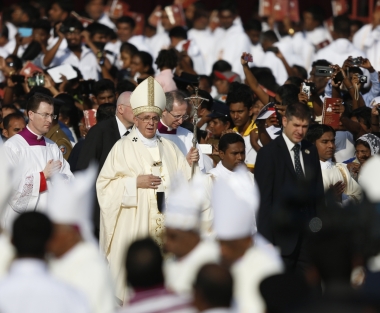
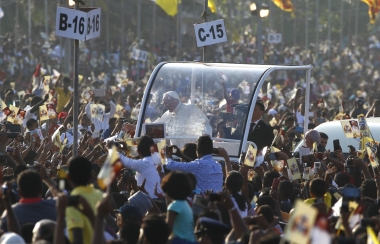
Storms greeted Pope Francis when he arrived in the central Philippines city of Tacloban on Saturday to pray for the dead and comfort survivors of Typhoon Haiyan, the country’s worst natural disaster that killed 6,300 people barely a year ago.

Tens of thousands of people wearing yellow raincoats cheered when Francis emerged from his plane in the coastal city of Tacloban 650 km (400 miles) southeast of Manila in steady rain and strong winds.

Francis began a Mass near Tacloban airport wearing a transparent yellow poncho over his vestments as heavy rain and strong winds lashed a large crowd of worshippers, who stood amid puddles in a mud-soaked field.

The storm was an eerie reminder of Haiyan, which hit the same area with 250 kph (155 mph) winds and created a seven-metre high storm surge, wiping out almost everything in its path when it swept ashore on Nov. 8, 2013.

Francis’s day trip to Leyte province gives him another opportunity to speak about climate change ahead of a major document on the environment he is due to issue in June.

The Pope will celebrate Mass at the airport and then see for himself the devastation wrought by Haiyan, the strongest storm to make landfall on record, when he goes to the nearby town of Palo to have lunch with survivors.

Speaking at the presidential palace on Friday, the Pope admired the “heroic strength, faith and resilience” shown by the Philippines as well as the solidarity people demonstrated after the typhoon.

The storm destroyed around 90 percent of the city of Tacloban in Leyte province. More than 14.5 million people were affected in six regions and 44 provinces. About one million people remain homeless.

The government estimates it needs almost 170 billion pesos ($3.8 billion) to rebuild the affected communities, including the construction of a four-metre high dike along the 27-km (17 miles) coastline to prevent a repeat of the disaster.

Nearly 3,000 victims are buried in the city’s almost half-hectare mass grave site. Hundreds are still unaccounted for.

Germanwatch, a think tank partly funded by the German government, said in a report last year the Philippines was the country hardest hit by extreme weather in 2013.

Francis waded into the climate change debate on Thursday, telling reporters that he believed that man was primarily responsible for climate change and that he hoped this year’s U.N. climate meeting in Paris would take a courageous stand to protect the environment.

The Pope said his long-awaited encyclical on the environment was almost finished and that he hoped it would be published in June, ahead of the U.N. conference in November.

“I don’t know if it is all (man’s fault) but the majority is. For the most part, it is man who continuously slaps down nature,” he told reporters on the way to Manila.

Those words were his clearest to date on climate change, which has sparked worldwide debate and even divided conservative and liberal Catholics, particularly in theUnited States.

“I think man has gone too far,” he said. “Thank God that today there are voices that are speaking out about this,” he said.

Source: Christian Today

who deserves to be a Saint?

Pope Francis announced that on his visit to the US he was going to make Junipero Serra a saint. He had previously ‘done’ Joseph Vaz on his visit to Sri Lanka. Saints are in the news, but what’s it all about?

It sounds like fun. How do I apply?

It doesn’t work like that, and it’s not fun at all. For a start, you can’t still be alive since it’s only after you’ve died that the Church can be sure you aren’t going to do something unsaintly. Also, lots of saints have also been martyred in pretty revolting ways – St Sebastian being shot full of arrows, for instance – and even the ones who died in their beds have often lived rather uncomfortably. Think Simon the Stylite, who spent 37 years living on a platform on top of a pillar.

So who does get to be a saint, then?

A saint is someone who has lived a life of extraordinary or heroic virtue. Catholics don’t believe that they were sinless, just that they were special. Nowadays there are quite strict rules about who can be a saint, instituted by Pope John Paul II in 1982: a diocese decides on a likely candidate and an intensive survey of his or her life and works begins. The candidate passes through the stages of being recognised as a Servant of God, Venerable, Blessed and finally Saint.

Is there any flexibility?

Popes have quite a wide latitude in this respect. For instance, for non-martyrs to be sainted, two certified miracles have to have been performed through their intercession (we said the rules were strict). But Francis is to waive this rule for Junipero Serra on the grounds that he has been considered a holy man for centuries.

I got a woodwork badge in Cubs. Is it like that?

It is considerably more rigorous, but if you mean that it is a recognition that someone has achieved something special, then yes. All Christians are saints, but many Churches teach that some are worthy of particular respect and can be reliably used as an example and inspiration to us.

Let me just play devil’s advocate for a moment –

I’ll stop you there. The Devil’s Advocate was originally the person appointed to argue the case against sainthood for a candidate (officially the Promoter of the Faith), whose office was discontinued in the 1983 reforms.

Does that mean it’s become easier to be a saint?

Arguably yes; the pace has picked up quite a bit. But the process is still quite strict, and some of the oddballs of previous generations would never make it now.

Oddballs? That seems a little disrespectful.

None intended, but in earlier days the process was a lot more informal. Local people would decide for themselves, or a figure from pagan legend would become Christianised and sainted, or a bishop would decide that a local saint was just what was needed to boost the tourist trade. The Vatican got increasingly edgy about this and by 1200 the practice was banned. In 1969 the Church took a hard look at its saints list and discovered that many of them might never have existed at all. One of these casualties was St Valentine, the patron saint of cheesy greetings cards.

Not really!

Well, no. But there plenty of other patron saints with rather odd responsibilities. St Clotilde is the patron saint of disappointed children, St Drogo is the patron saint of ugly people, St Bibiana is the patron saint of hangovers, and St Hubert of Liege – a rather niche interest, this – is the patron saint of the fear of werewolves.

How do saints get to patronise particular people?

It usually relates to an interest they had in their lifetimes. Hubert, for instance, werewolves aside, is the saint of hunters. He is said to have taught that hunters ought to only shoot when a humane quick kill is assured, that sick animals should be euthanised and that females with young should not be harmed. Others have more creative associations between their lives and saintly responsibilities: St Barbara, for instance, was tortured to death by her husband when she converted to Christianity. On the way home from her execution he was struck by lightning. She is the patron saint of gunpowder and fireworks.

But does the patron saint thing really make sense?

Yes, given certain assumptions. The Roman Catholic and Orthodox Churches have a much more developed idea of the Communion of Saints than do evangelical Protestants, who tend to assume that once a Christian dies they’re in heaven and that’s that. But there is nothing intrinsically odd about asking those who have predeceased us to pray for us. James (5:13) says that the prayer of a righteous person is powerful, and saints are particularly righteous; and picking someone with a particular expertise in your field is arguably sensible.

Can’t I just, you know, pray? To God?

Of course, but many would say that you can ask other people – living and even-more-living – to pray for you as well. Every little helps.

So, why is Pope Francis making saints now?

He is bringing already-existing ’causes’, which long pre-dated his papacy, to a conclusion. But there are political and pastoral considerations, too. North America is light on saints as the Church hasn’t been there very long, and giving Latin American Catholics one of their own with whom to identify is smart, evangelistically. Sri Lanka’s Catholics are a minority under a pressure; reminding the rest of the country about Joseph Vaz and his willingness to work with other faiths is also a good move.

Out of interest, are there any Protestant saints? 

The Church of England has one official saint, Charles I, whose dictatorial policies, untrustworthiness and treachery plunged Britain into a civil war that cost hundreds of thousands of lives.

Source: Christian Today

Niger: French Cultural Center and Churches attacked in Charlie Hebdo protests

Demonstrators in Niger attacked the French cultural center, set fire to churches and raided Christian shops on Friday, as protests erupted against Charlie Hebdo’s cartoons in several Muslim West African countries.

Staff of the satirical French weekly, which had angered Muslims by publishing images of the Prophet Mohammad, were shot dead by Islamist gunmen in Paris last week.

Police in Niger’s southern city of Zinder, the second largest in Niger, fired tear gas at a crowd of hundreds of people who burned French flags and tires in the streets on Friday.

“The protesters are crying out in local Hausa language: Charlie is Satan – let hell engulf those supporting Charlie,” said Aboubacar Mamane, a shopkeeper, by telephone.

Witnesses said the demonstrators ransacked the French cultural center and the homes of police officers.

Peaceful marches took place after Friday prayers in the capital cities of former French colonies Mali,Senegal and Mauritania.

Demonstrators said they were angered by the latest front cover of Charlie Hebdo this week, which despite the Paris killings again featured a cartoon of Mohammad.

“Charlie Hebdo in the toilets,” said one placard held by a protestor in Nouakchott.

The presidents of Niger, Mali and Senegal last week marched alongside more than a million French citizens to show solidarity with the victims of the Paris bloodshed, which began with a shooting attack on Charlie Hebdo’s Paris office.

But in an indication of the shifting mood, Macky Sall, president of one of Africa’s most stable democracies Senegal, said late on Thursday: “Freedom of the press should not, in our view, head in the direction of a totally pointless provocation.”

Source: Christian Today

Dozens of IS suspects are held across Europe

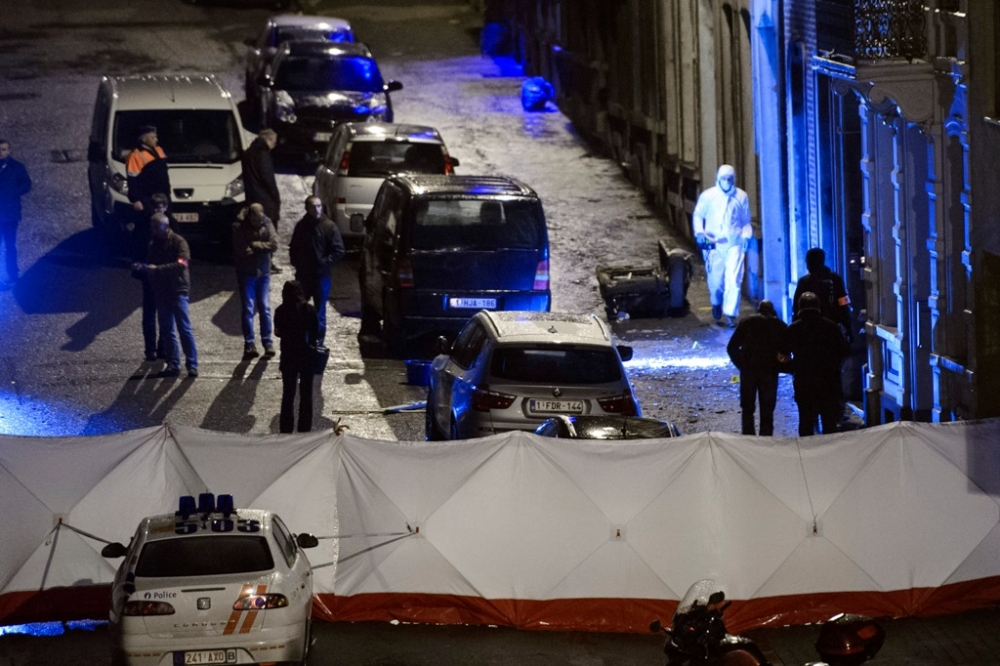
Belgian, French and German police interrogated dozens of Islamist suspects on Friday as much of Europe remained on heightened security alert after last week’s killings in Paris and raids in Belgium in which two gunmen were killed.

In Paris there was a fresh scare when a gunman took several people hostage at a post office in a northwestern suburb. A siege ended when he gave himself up to police. No one was hurt. Authorities said they could not confirm whether the incident was related to terrorism.

Belgian police questioned 13 suspects and France held two people on Belgium’s request, a day after two gunmen were killed during raids against an Islamist group that authorities said were planning to attack police.

French police said they had arrested 12 people suspected of helping the Islamist gunmen behind attacks last week on a satirical magazine and kosher supermarket in Paris.

Officials said there was no clear link between the suspected Belgian plot and the Paris attacks a week earlier, but described them as part of a common threat.

“There is a terrorist offensive,” French Prime Minister Manuel Valls told reporters. “We face the same threat.”

In Germany, police arrested two people following a raid on 12 homes and a mosque. A police spokesman said the suspects were probably part of an extremist cell that recruited fighters for Syria.

In Belgium, police uniforms, explosives and guns including four AK-47 assault rifles were found in the apartment where the two gunmen were killed on Thursday in the raid in the eastern town of Verviers. Their identities have not been released.

“This group was on the point of carrying out terrorist attacks aiming to kill police officers in the streets and in police stations,” prosecutors’ spokesman Eric Van Der Sypt said.

He declined to comment on media reports that the plotters planned to behead a policeman.

NERVES ON EDGE

In France, demand for the first post-attack edition of the weekly Charlie Hebdo remained high for the third day in a row. One kiosk in central Paris reported a thief broke in overnight and stole all its copies.

However there were violent protests in some Muslim countries against the weekly for putting a caricature of a weeping Prophet Mohammad on the cover of the new edition.

About 200 Pakistani protesters clashed with police outside the French consulate in Karachi after a demonstration against the magazine. In Niger, a protest turned violent as demonstrators set fire to churches and raided shops run by Christians. Police fired tear gas on a crowd of hundreds of people and tyres burned in the streets.

French Interior Minister Bernard Cazeneuve said a total 12 suspects had been detained so far in connection with last week’s Paris attacks, most of them known to police for common crimes. Judicial sources said the eight men and four women were detained in the greater Paris area.

Nerves remained on edge. Paris’s Gare de l’Est train station was evacuated for about an hour during the morning rush.

Belgian security forces were on high alert, with extra armed security in evidence at some public buildings, notably police stations. Public broadcaster RTBF said officers were told not to be on the streets alone while in uniform. Some Jewish schools in Belgiumand the Netherlands were closed.

US Secretary of State John Kerry was in Paris to convey US condolences to the nation and to lay wreaths to the victims at the two main sites of the attacks.

Kerry greeted President Francois Hollande with a firm embrace at the Elysee presidential palace. Washington has said it regretted a decision not to send senior US officials to a commemoration march in Paris on Sunday attended by dozens of world leaders.

“Today, I wanted to be here, at home with you, among you,” Kerry, speaking fluent, American-accented French, told an event. “I wanted to tell you personally of the horror and revulsion that all Americans felt at these cowardly and despicable attacks against innocent victims and fundamental values.”

Hollande earlier called the shootings France’s 9/11, referring to the Sept. 11, 2001 attacks in New York.

“France has come out of this ordeal with its determination intact to act on the international scene,” Hollande told an annual gathering of about 200 foreign and French ambassadors.

Belgian investigators were also examining if a man detained in the city of Charleroi on suspicion of arms trafficking had any links with Amedy Coulibaly, the gunman who killed four Jews at a kosher supermarket in Paris last week. The detained man’s lawyer told French media he had merely sold Coulibaly a car.

Source: Christian Today

Could this be true? Britain to get its first LGBT school

Britain’s first specialist state school for lesbian, gay, bisexual and transgender young people could open in central Manchester within the next three years, according to major news sources.

This comes after LGBT Youth North West, a charity seeking to support LGBT young people in the North West of England, received £63,000 funding from Manchester City Council. The concept of an alternative education provision for LGBT students was featured on the funding application, after young people had expressed a desire for it, but the idea is still very much in consultation stages, Sally Carr, founder and operational director of LGBT Youth NW, told Christian Today.

“We’ve been working with LGBT youth for ten years, and many young people over many years have told us the same story,” said Carr.

“We worked with over 10,000 students last year across a variety of schools to try and address homophobia, biphobia and transphobia. But we know that these students face prejudice every day.”

The concept of Britain’s first ‘gay school’ has already caused controversy, but the charity maintains more needs to be done to help LGBT students who are struggling and unsupported in mainstream schools.

Speaking to The Guardian, Amelia Lee, strategic director for LGBT Youth NW, said: “Despite the laws that claim to protect gay people from homophobic bullying, the truth is that in schools especially, bullying is still incredibly common and causes young people to feel isolated and alienated, which often leads to truanting and, in the worst-case scenarios, to suicide.”

Christian teenager Lizzie Lowe hanged herself in Manchester last year because she feared telling her parents that she was gay. She was only 14. It is tragic deaths like Lizzie’s that LGBT Youth NW is hoping to prevent, through their current work training thousands of pupils and teachers in mainstream schools, and potentially through a specialist school in the future.

Rev Sally Hitchiner, founder of Diverse Church, a support network for LGBT people which has a confidential Facebook group enabling young LGBT Christians to connect, feels that an exclusive school might help those struggling in mainstream education.

“I think it’s a tragedy that it’s needed,” she said, “but for students involved it might be a lifeline. Far too many LGBT students face misunderstanding and isolation to the point that some of take their own lives.

“However, I think the highest priority has to be enabling every school in the country to be a supportive and safe place for all of its people.”

Tory MP and former education minister Tim Loughton has spoken out against the idea of an exclusive school, saying, “I cannot see how segregating a group of young people identified by their sexuality can aid better engagement and understanding.

“The way to achieve more integration, understanding and empathy is not by segregating members of one group, and this would seem to me to be a step backwards from achieving tolerance.”

Yet, it seems that the attacks may be aimed at an idea that doesn’t exist. Carr says that their education provision wouldn’t be an exclusive school for LGBT students.

“People have failed to recognise the bigger picture,” she said. “The original suggestion is not about an exclusive school for LGBT students, but about an inclusive school for all students.

“Much like you would expect Christian schools to be absent of prejudice towards Christianity, this would be a school free from homophobia, transphobia and biphobia. These things have no place in modern British society.”

The fact that LGBT students are often bullied and isolated in UK schools is something that needs to be addressed, and Sally Hitchiner believes that Christians can be part of the solution.

“I think Christians, particularly straight Christians, need to listen more than we speak,” she said. “There’s a need to listen to young LGBT people, and if they say that the current system is not working we need to take that seriously. We need to change the system so that future LGBT people are able to live and find God and find that God loves them, both at work and at play and at church.

“That has to be our highest priority, keeping young people from giving up on life and giving up on God.”

Source: Christian Today

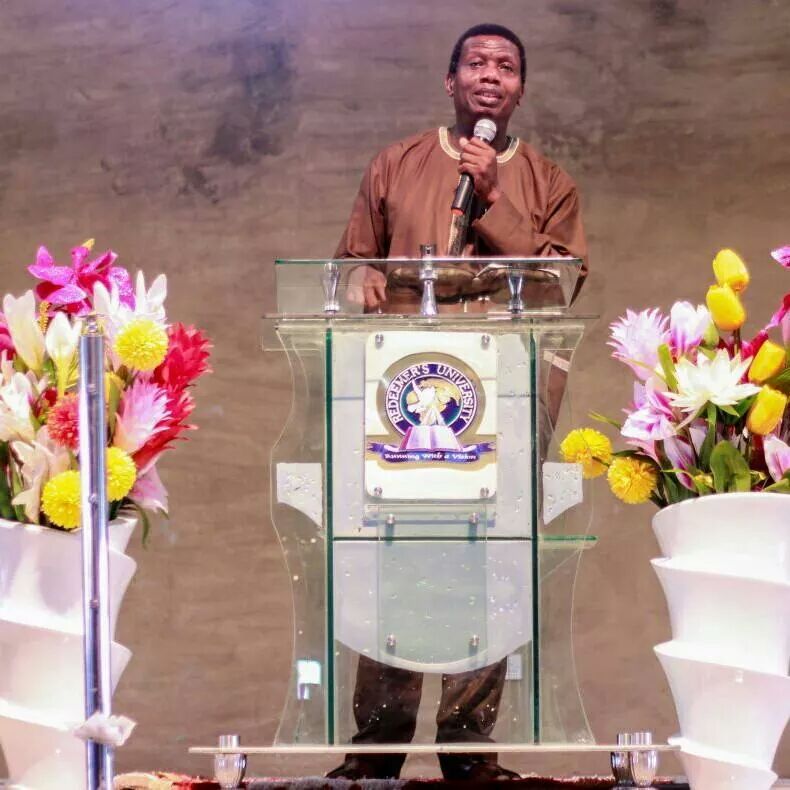
Nigerian Pastor speaks about the county’s next President

There are many of us who want to know the details of who will win the next elections, who is going to be president, who is going to be governor, …just say, Father let Your perfect will be done.

247 Nigeria News reports  this story – The General Overseer of the Redeemed Christian Church of God (RCCG), Pastor E.A Adeboye, has said only God knows Nigeria’s next president.

Adeboye made the submission on Thursday, at the just-concluded two-day Bible study programme organised by the University of Ibadan (UI) Christian Family Fellowship, at the International Conference Centre, UI.

Citing an example of a highly-placed ambassador who requested to know his opinion about the political future of the country, Adeboye said people waiting for his opinion concerning where the presidential pendulum would swing in February 14 needed not bother themselves, as his opinion did not matter, but that of God.

“Do you know that if we talk more about Jesus than we do about politics, God will take care of politics? One great ambassador asked what my opinion is about what is going on, I said my opinion does not matter. He said that was not what we wanted to hear. I said my opinion does not matter, because what God is going to do is what He will do,” the septuagenarian cleric stated. He said: “When you say you are on the side of a politician, you are on the wrong side ever possible. Because politicians never tell you the truth and you can quote me. Tell them that I said so. Politicians know how to say ‘Yes’ and ‘No’ at the same time.”

The annual event started on Tuesday, at 4:00 p.m with other sessions held at 6:00 a.m and 4:00 p.m of Wednesday, as well as 6:00 p.m on Thursday.

Adeboye, who has kept his distance from making public statements on issues relating to the forthcoming general election, while teaching on “Obedience to God’s commands,” enjoined Christians to spend more time preaching the gospel of Jesus Christ to unsaved souls rather than politics.

Quoting from the scriptures, he reeled out nine areas to include: Giving, Tithing, Purity, Transparency, Forgiveness, Love, Evangelism, among others where Christians should ensure they walk with God.

Adeboye contended that if Christians focused more on preaching the Good News and winning souls to populate God’s Kingdom, God would take care of the political situation of the country.

He admonished Nigerians to engage more in profitable pastime than dissipating their time and energy on which political candidate was good or bad, saying no human being was good.

“Do you think God is sitting down in Heaven and scratching His head on who should win (the general election)? That has been settled before we were born. Don’t waste your energy discussing this one is good, that one is bad. Is there any human being that is good?” he queried rhetorically.

Adeboye said Christians should focus on telling God in prayers that His perfect will should be done in February, saying they should also understand that God could use even His enemies to carry out His will if need be.

“Ask for the perfect will of God for the elections, instead of worrying over who will win. God can use His enemy to fulfill his will.

“There are many of us who want to know the details of who will win the next elections, who is going to be president, who is going to be governor, …just say, Father let Your perfect will be done.

“What’s God’s perfect will? …. Read more

– Source : 24/7 News

Kenneth Copeland on How to receive your healing?

Kenneth Copeland Ministries offers answer to the question : How do I receive my healing?

Answer

God has given us an amazing promise—if we pray according to His will, He will absolutely grant our request (1 John 5:14-15). The great news is that finding God’s will is not difficult because God’s Word and His will always agree. And His Word says by the stripes of Jesus you are healed (Isaiah 53:5, 1 Peter 2:24)!

Jesus told us how to act on God’s Word in John 15:7, “But if you remain in me and my words remain in you, you may ask for anything you want, and it will be granted!” To abide in God’s Word means that you meditate (read, ponder and speak) on it and obey it (see Joshua 1:8). This aligns your thinking with God’s Word. Through this transformation, Romans 12:2 says you will prove “what is that good, and acceptable, and perfect, will of God.”

Get ready. You’re going to see some changes as you keep the Word of God in the forefront of your thinking. Your ability to hear clearly from the Spirit of God will increase. So will your faith in what the Bible says about your victory in Jesus. You will be able to take a firm stand of faith on what His Word says.

Now that you have taken a stand on the Word, believe that you receive those things you have prayed for (Mark 11:24). Your confession (speaking Scripture and speaking words of faith and hope in God instead of doubt and fear) and corresponding action (obeying what God tells you to do) will make all the difference (James 2:14-24). No matter how things look or how you may feel, choose to act and speak with the attitude that says, “God is in control and He is meeting my needs according to His riches in glory by Christ Jesus” (Philippians 4:19).

To provide help in building a biblically based stand of faith for healing, Brother Copeland has provided these five steps based on Hebrews 4:12-16.

FIVE STEPS FOR RECEIVING FROM GOD:

1. Present the Promises

A. Go to the Word of God and find the scriptures that fit your situation (Romans 10:17).

B. Ask the Holy Spirit to show you the promises He desires you to apply (Romans 8:1-16).

2. Pray and Worship God

A. Humble yourself before the Lord (James 4:10).

B. Lay the promises before Him (1 John 5:15).

C. Hear His wisdom and the instruction of the Holy Spirit (John 16:13).

3. Make Your Petition

A. Write your petition out as your Word-based declaration of faith (Philippians 4:6).

B. Present it to the High Priest of your confession, Jesus (Hebrews 3:1).

4. Prepare to Receive

A. Let faith and patience work together in your life (James 1:3-4).

5. Praise God for the Manifestation of Victory

A. Let every request be accompanied by your thanksgiving to the Lord for His faithfulness to fulfill His promises (Philippians 4:6; 2 Corinthians 1:20).

From : Kenneth Copeland Ministry – kcm.org

Nigerian MegaChurch Pastor, Bishop David Oyedepo furious over Boko Haram continued destruction in Nigeria

The General Overseer, Living Faith Church Worldwide, a.k.a. Winners Chapel, Bishop David Oyedopo, expressed his anger over the incessant attack by the violent Islamic sect – Boko Haram. Bishop Oyedepo Says Boko Haram Is Beyond Politics.

He tells his congregation – ” If you catch anyone that LOOKS LIKE THEM (BOKO HARAM) – kill him! Kill him and pull out his neck. Spill his blood on the ground. What nonsense!”

WATCH THE VIDEO

Boko Haram’s recent attack in Baga, Borno State, which killed hundreds, possibly thousands, on 3 January has once again drawn attention to the Islamist militant group that has been terrorising northern Nigeria for more than five years.

The group is responsible for the deaths of approximately 9,000 people in total, according to the Council on Foreign Relations‘ Nigeria Security Tracker, though estimates vary and this number does not include January’s attack. The Nigerian government has said there were 150 deaths in the Baga attack, but other reports suggest it was as many as 2,000. Amnesty International has said it could be the group’s deadliest attack to date.
Read more here –  Boko Haram again

Church of England needs young ones in the ministry

The Church of England needs a dramatic increase in its output of clergy to avoid a “signficant gap” looming as large numbers currently serving reach retirement.

The claim is made in the report of the Resourcing Ministerial Education task group to the General Synod next month.

Chaired by the Bishop of Sheffield, Rt Rev Steven Croft, the task group was asked to investigate how ministerial education was resourced. It confirmed there was a need for a “significant increase in the number and quality of ministerial leaders, lay and ordained”.

“At present, if we take no action, we face a significant net decline in the number of stipendiary ministers and alongside this further decline in congregations and hence our capacity to serve every community,” the report says.

It calls for the recruitment of “a cohort of candidates for ministry who are younger, more diverse and with a wider range of gifts to serve God’s mission” and proposes that a 50 per cent increase in the amount devoted to training should be made. At present around £20 million a year is spent and the report suggests that another £10 million is needed on top of this.

It also says that the Church needs to work harder at finding good candidates, making a “significant shift from a passive approach to vocations work to a proactive approach to seeking the numbers and quality of candidates the Church requires”.

Younger candidates would be particularly encouraged. Around 30 people aged under 30 are currently exploring a vocation to ministry; the report says this should be increased to 250. Furthermore, the process should be streamlined so that decisions can be made within a year.

Referring to model pioneered by an education charity that offers on-the-job training to promising candidates, the report also backs a “Teach First” type scheme for “accelerating the vocational process”.

It also proposes reforming the grants system and offering more funding for lay ministry.

Interviewed for the launch of the report, Bishop Steven said: “We know that dioceses also want to see more ministers of every kind with really high quality training. Dioceses are saying at the moment they want to have, in 10 years’ time, about 8,000 stipendiary clergy, approximately the same number as we have now. But we know because of retirements, there will only be 6,500 on present predictions. That’s a really significant gap that the Church needs to address positively now, through proactively and prayerfully seeking more vocations, particularly to ordained ministry.”

Source: Christian Today

Segregating Sundays: Martin Luther King’s word echoed after 50 years

American churches are still segregated along racial and ethnic lines, despite aspirations to the contrary, according to a study released by LifeWay Research this week.

Research into pastors’ views on ethnicity and the Church found that 85 per cent of pastors believe churches should strive to be ethnically diverse, but 86 per cent said their church communities predominantly belong to one racial or ethnic group.

The findings echo the words of Dr Martin Luther King, who 50 years ago famously said that “the most segregated hour of Christian America is eleven o’clock on Sunday morning”.

“Everybody wants diversity, but many don’t want to be around people who are different,” said Ed Stetzer, president of LifeWay research.

The survey of more than 1,000 Protestant US pastors was conducted by the Christian resource provider in September 2013.

More than 90 per cent of those questioned said local churches should reflect their local communities with regard to race and ethnicity.

Pastors in the South were the most likely to disagree with the statement that their churches had a similar ethnic mix to the surrounding area. Although only 12 per cent said they “strongly disagreed” with the statement, pastors in this region were also the least likely to “strongly agree”.

But when asked whether churches should strive to achieve diversity, pastors in the South were more enthusiastic in their support than those in the Midwest, with 70 per cent saying they “strongly agreed”.

In an additional study from an online survey of 1,039 Americans, 78 per cent said they thought churches should strive to achieve racial diversity. The strongest affirmative response came from those who described themselves as born-again, evangelical or fundamentalist Christians.

Researchers found that just over half (51 per cent) of respondents said they would be most comfortable attending a church where people from multiple ethnicities were represented, and four in 10 said they already attend an ethnically diverse church.

Even so, 19 per cent still said they would prefer to attend a church where people were mainly of the same ethnicity as them.

Source: Christian Today