New bill to ban weapons in Alabama churches

Despite the expectation of strong opposition from Republicans, two congressmen from Alabama have filed a bill in the House of Representatives that seeks a gun ban on all churches in the state.

Reps. Thomas Jackson of Thomasville, and Rep. Darrio Melton of Selma have pre filed the bill for the March 3 session and expect the bill to raise a lot of questions and a lot of hackles in the Alabama House.

“I figured it wouldn’t go anywhere but at least it will get some conversation,” Jackson said.

House Bill 3 seeks to keep citizens from carrying guns in churches even if they are in possession of permits for concealed weapons.

In a report posted on Al.com, Melton said that he wants to pass the law because he believes that people in law enforcement should be the only ones allowed to carry weapons inside churches.

While Republicans are likely to try and block the measure, Melton said that their bill merely seeks to update the list of areas where guns are not allowed.

In 2013, a bill involving the regulation of firearms was passed but churches were not one of the areas where guns were prohibited.

If the bill is passed, violators could be penalised by as much as $500 and face jail time of up to three months.

Alabama is among the states that has comprehensive gun regulation laws as it upholds each citizen’s right to bear arms “in defense of himself and the State.”

The passage of the Safe Carry and Protections Act, more popularly known as the “Guns Everywhere” Law, allowed citizens to bear arms anywhere so long as they have their permit.

The court in Alabama has allowed certain establishments some discretion in choosing whether to restrict weapons from their facilities.

Among the areas allowed discretion over gun bans are churches, schools and government offices.  The bill would make the ban mandatory in churches.

Source: Christian Today

California Pastor regrets having aborted two of his babies

A California pastor and two Christian men reveal ahead of March for Life week that one or more of their babies were aborted in a recent video, with the pastor saying the dream of seeing his aborted baby’s first step and hear it call him “daddy” “haunts” him every day.

“The pain of regret is one of the hardest pains to deal with. Because of the constant reminder that we let down God, we let down others and we let down our child,” says Shane Idleman, pastor of the non-denominational Westside Christian Fellowship church in Lancaster, California.

Two other men featured in the 46-minute video, titled “Lord Remove My Guilt and Shame,” are John Blandford of Online for Life, who says that he now leads a Christian pro-life home group, and Daniel Phillips, a Christian who admits he regrets having two of his babies aborted.

“I was 28. I didn’t know God. I called myself a Christian. I would go to church a couple times a month. I had just started dating this gal, and she got pregnant,” Blandford shared.

“I should have manned up and I should have fought for you,” Blandford adds, addressing his aborted child. “And I didn’t. I didn’t. I am so grateful that you are in Heaven with Jesus, the King of Kings, the Lord of Lords, and that you got to see him before I did. And I know you’re going to extend me grace, but I just—it would’ve been so cool to hang out with you here on earth.”

Idleman says that as a pastor, his decision to concede to an abortion “haunts” him every day.

“What would they look like? Would it be a boy? Would it be a girl? Their first step, saying ‘daddy.’ But those are just dreams, dreams that often haunt me,” he said.

Phillips also says that he missed the opportunity to speak out when he had the chance.

“We had a passive-aggressive stance,” Phillips explains. “I was neither here nor there, so I never even fought for the opportunity to save the child.”

After the men share their stories, the video features a sermon from Idleman that he delivered at his church on the subject of abortion. In his speech, the pastor talks about the difficulties believers face when living in two worlds – one as part of the church, and the other part of carnal, secular reality.

This week marks the 43rd anniversary of the U.S. Supreme Court’s Roe v. Wade decision, which legalized abortion in America. Pro-life politicians and supporters have been attempting to reverse the decision ever since, and there have been numerous attempts to tighten abortion laws.

Rep. Ted Franks, R-Arizona, and Rep. Marsha Blackburn, R-Tennessee, have sponsored a bill seeking to ban abortions after 20 weeks after fertilization, which is to be voted on Thursday by the House of Representatives.

“More than 18,000 ‘very late term’ abortions are performed every year on perfectly healthy unborn babies in America,” Franks said. “These are innocent and defenseless children who can not only feel pain, but who can survive outside the womb in most cases, and who are torturously killed without even basic anesthesia.”

Source: Christian Post

PEGIDA leader resigns after calling asylum-seekers ‘scumbags’ and posing as Hitler

The leader of the fast-growing German anti-Muslim movement PEGIDA resigned on Wednesday after a photo of him posing as Hitler and reports that he called refugees “scumbags” prompted prosecutors to investigate him for inciting hatred.

Lutz Bachmann, a 41-year-old convicted burglar, had appeared on the front page of top-selling daily newspaper Bild on Wednesday sporting a Hitler moustache and haircut.

Bild and another paper said he had called asylum-seekers “animals” and “scumbags”.

The news came just as supporters of PEGIDA (Patriotic Europeans Against the Islamisation of the West), which is based in Dresden, staged a march in another east German city, Leipzig.

However, the so-called PEGIDA rally attracted only around 15,000 people – far fewer than the originally estimated 40,000 – and they were outnumbered by more than 20,000 people who joined several counter-demonstrations, officials said.

PEGIDA has forced itself onto the political agenda with its anti-immigrant slogans that have attracted tens of thousands to regular rallies in Dresden.

Bachmann, who denies he is a racist, had heard on Wednesday that he faces a criminal investigation for incitement to racial hatred. State prosecutors in Dresden said preliminary proceedings had been launched following the Bild report.

“IMPULSIVE”

Kathrin Oertel, another PEGIDA co-founder, said Bachmann’s resignation had nothing to do with the Hitler photo, but was linked to his comments on refugees posted on the internet.

“Yes, I can confirm that Lutz Bachmann has offered his resignation and it was accepted,” Oertel told Reuters.

She added: “PEGIDA will go on.”

Bild quoted Bachmann as saying the Hitler photo had been taken as a joke, prompted by a recent satirical book about the Nazi dictator called “Er ist wieder da” (“Look Who’s Back”).

The Dresdner Morgenpost newspaper also quoted what it said were Facebook messages from Bachmann saying asylum seekers acted like “scumbags” at the welfare office and that extra security was needed “to protect employees from the animals”.

Deputy Chancellor Sigmar Gabriel, the Social Democrat leader, said the real face of PEGIDA had been exposed: “Anyone who puts on a Hitler disguise is either an idiot or a Nazi.”

In an interview with Reuters last week, Bachmann played down a ribald comment made in 2013, seized on by the media, that “eco-terrorist” Greens, first and foremost former party leader Claudia Roth, should be “summarily executed”.

“I am an impulsive person … I regret I didn’t resist my impulsiveness.”

Source: Christian Today


Japanese Christian was caught by ISIS while attempting to save a friend

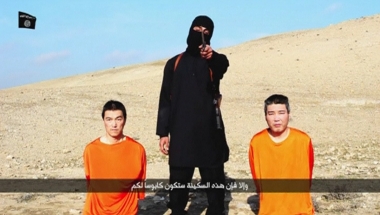
The Japanese Christian journalist Kenji Goto was captured by Islamic State militants when he returned to Syria to help find his friend Haruna Yukawa who had been taken earlier, it has been revealed.

IS has demanded a $200 million ransom for the pair.

Yukawa was captured in August outside the Syrian city of Aleppo. Goto, who had returned to Syria in late October to try to help his friend, has been missing since then.

For Yukawa, who dreamed of becoming a military contractor, traveling to Syria had been part of an effort to turn his life around after going bankrupt, losing his wife to cancer and attempting suicide, according to associates and his own accounts.

A unit at Japan’s Ministry of Foreign Affairs had been seeking information on him since August, people involved in that effort said. Goto’s disappearance had not been reported until Tuesday’s video apparently showing him and Yukawa kneeling in orange t-shirts next to a masked Islamic State militant wielding a knife.

Yukawa first met Goto in Syria in April and asked him to take him to Iraq. He wanted to know how to operate in a conflict zone and they went together in June.

Yukawa returned to Syria in July on his own.

“He was hapless and didn’t know what he was doing. He needed someone with experience to help him,” Goto, 47, told Reuters in Tokyo in August.

Yukawa’s abduction that month haunted Goto, who felt he had to do something to help the man, a few years his junior.

“I need to go there at least once and see my fixers and ask them what the current situation is. I need to talk to them face to face. I think that’s necessary,” Goto said, referring to locals who work freelance for foreign correspondents, setting up meetings and helping with the language.

Goto began working as a full-time war correspondent in 1996 and had established a reputation as a careful and reliable operator for Japanese broadcasters, including NHK.

“He understood what he had to do and he was cautious,” said Naomi Toyoda, who reported with him from Jordan in the 1990s.

Goto, who converted to Christianity in 1997, also spoke of his faith in the context of his job.

“I have seen horrible places and have risked my life, but I know that somehow God will always save me,” he said in May. But he told the same publication that he never risked anything dangerous, citing a passage in the Bible, “Do not put the Lord your God to the test.”

In October, Goto’s wife had a baby, the couple’s second child. He has an older daughter from a previous marriage, people who know the family said.

Around the same time, he made plans to leave for Syria and uploaded several short video clips to his Twitter feed, one showing him with media credentials issued by anti-government rebels in Aleppo.

On October 22 he emailed an acquaintance, a high school teacher, to say he planned to be back in Japan at the end of the month.

Goto told a business partner with whom he was working to create an online news application that he expected to be able to travel in territory held by the Islamic State because of his nationality.

“He said that as a Japanese journalist he expected to be treated differently than American or British journalists,” Toshi Maeda said, recalling a conversation with Goto before his departure for Syria. “Japan has not participated in bombing and has only provided humanitarian aid. For that reason, he thought he could secure the cooperation of ISIS.”

Friends say Goto traveled from Tokyo to Istanbul and traveled from there to Syria, sending a message on October  25 that he had crossed the border and was safe.

“Whatever happens, this is my responsibility,” Goto said on a video recorded shortly before he set out for Raqqa, the capital of the Islamic State.

That was the last time he was seen before the IS video this week.

Source: Christian Today

Researchers claim to have found copy of text of ancient Gospel of Mark in mummy’s mask

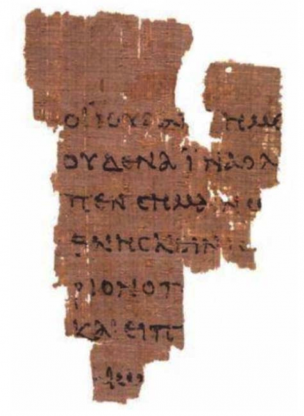
A group of scientists and researchers are set to publish their discovery of possibly the oldest copy of a text from the Gospel of Mark later this year.

The discovered text was dated all the way to the first century. The oldest surviving biblical copies today are dated only to the second century.

According to Live Science, the fragment text was written on a papyrus that was reused to create a mask worn by a mummy. Usually, ordinary Egyptians wore these types of masks that are made out of papyrus, paint, and glue. Papyrus was expensive at that time and people had to reuse sheets that already had writings on them.

In the recent years, scientists have developed a method of ungluing the masks without damaging the writings on the paper, making the text readable.

According to Craig Evans, a professor of New Testament studies at Acadia Divinity College in Wolfville, Nova Scotia. “The first-century gospel is one of hundreds of new texts that a team of about three-dozen scientists and scholars is working to uncover, and analyse, by using this technique of ungluing the masks.

“We’re recovering ancient documents from the first, second and third centuries. Not just Christian documents, not just biblical documents, but classical Greek texts, business papers, various mundane papers, personal letters. The documents include philosophical texts and copies of stories by the Greek poet Homer.”

Evan’s study on the first-century gospel text will give clues on how the Gospel of Mark has been changed over time. His research is mainly to analyse the texts in the mask to determine the length of time people held on to the sheets before reusing them, which could be the same period biblical texts were copied, Live Science further reports.

“We have every reason to believe that the original writings and their earliest copies would have been in circulation for a hundred years in most cases — in some cases much longer, even 200 years. This means, that a scribe making a copy of a script in the third century could actually have at his disposal (the) first-century originals, or first-century copies, as well as second-century copies,” Evans said.

The researchers will publish their first volume of texts later this year.

Source Christian Today

Malaysia: Catholic newspaper not permited to use ‘Allah’ to refer to God again

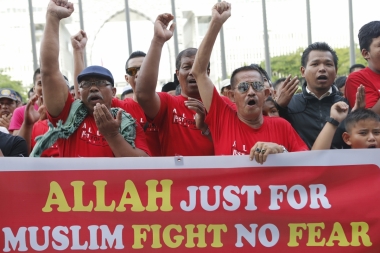
Malaysia’s top court has ruled that a Catholic newspaper cannot use the word “Allah” to refer to God.

The Herald in Malaysia, which in the past regularly used “Allah” to refer to God in a Christian context, was denied permission by Malaysia’s Federal Court to seek a review of an earlier decision to let a ban stand.

The decision by the panel of five judges was unanimous.

Benjamin Dawson, lawyer for the Church, said: “We relied on procedural unfairness and they said that they don’t think that any procedural unfairness had occurred. That was the brief reason given.”

Acknowledging that his long fight to use the term was now at an end, editor Rev Lawrence Andrew said: “There is nowhere to go.”

The Malaysian government was among those who argued that “Allah” should remain exclusive to Muslims.

The Catholic Church has about 180,000 members in Malaysia. It faced accusations of proselytism during the long court battle that began in 2008 when the Church challenged a decision by the Home Minister to ban its use of “Allah”.

Haniff Khatri Abdulla, a lawyer representing some of those who supported the ban, said: “At the end of the day, as litigators, as lawyers, as advocates, we need our matters to come to an end as well.”

Source: Christian Today

Women believe in life after death than Men

There is a “huge disparity” between men and women over matters of faith and belief, with nearly twice as many women as men believing in life after death and many more men than women being atheists or agnostics.

The research comes as the Church of England finally approaches the consecration of its first woman bishop, the Rev Libby Lane, in York Minster next Monday. In spite of the growing evidence of higher levels of devotion and piety among women, many other religious institutions across Christianity, Judaism, Islam, Hinduism and Sikhism still insist on a male-only ministry.

The new study of more than 9,000 British people in their forties, by the UCL Institute of Education, shows that 60 per cent of the women compared to 35 per cent of the men believe in life after death.

More than half of the men surveyed said they were atheists or agnostics, compared to a third of the women.

The survey was of the remaining members of the 1970 British Cohort Study, whose lives are being followed by the IOE’s Centre for Longitudinal Studies in a study funded by the Economic and Social Research Council.

Almost half of those surveyed did not identify with any religion. Most of the remainder said they had a Christian background. A small number of respondents described themselves as Buddhist, Jewish, Hindu, Muslim or Sikh.

Professor David Voas, who analysed the survey responses, said: “Among believers, women are also much more likely to be definite than men, and among non-believers, men are much more likely to be definite than women.”

For example, not only are men twice as likely as women to say that God does not exist, but male atheists are far more likely than female atheists to say that they definitely do not believe in live after death.

Professor Voas, of the Institute for Social and Economic Research at the University of Essex, said there was no obvious reason why this should be so but added that it was unhelpful to think simply in terms of “believers and non-believers”.

He said: “Belief – or disbelief – in God and in life after death do not always go together. A quarter of those who said they were agnostic also said they believe in life after death. However, nearly a third of the people who said that they believe in God – despite occasional doubts – do not believe in an after-life.”

Professor Voas suggested a new list with seven categories to describe a person’s position on the faith spectrum.

Non-religious (28 per cent of the 1970-born cohort): Does not have a religion or believe in either God or life after death.

Unorthodox non-religious (21 per cent): Does not have a religion or does not attend services. Believes in God or life after death but not both.

Actively religious (15 per cent): Has a religion and believes in God and life after death. Attends services.

Non-practising religious (14 per cent): Has a religion and believes in God and life after death. Does not attend services.

Non-identifying believers (10 per cent): Does not have a religion, but believes in God and life after death.

Nominally religious (7 per cent): Identifies with a religion. But believes in neither God nor life after death.

Unorthodox religious (5 per cent): Has a religion and attends services at least occasionally. Believes in God but not life after death (or, in a few cases, vice versa).

He also warned that a healthy level of scepticism was needed when assessing statistics on religious affiliation. For example, nearly a quarter of those surveyed changed their minds between 2004 and 2012 about whether or not they had been brought up in a religion.

“Some things are clear, however. One is that a substantial proportion of teenagers who reported that religion was an important part of their lives at age 16 became relatively unreligious adults. There is some movement in the opposite direction, but not nearly enough to compensate for the losses to religion.”

Professor Voas also points to the very high level of belief in both God and life after death among Muslims. Almost nine in ten of the small number of Muslims in the survey – just 82 – said they knew God really existed and had no doubts about it.

More than seven in ten of those who described themselves as “evangelical” also had no doubts about God’s existence. Just a third of the Roman Catholics in the survey had no doubts. And the figure for those affiliated with mainline Christian denominations such as the Anglican, Methodist, Presbyterian and United Reformed churches was even smaller, with just 16 per cent of them having no doubts that God exists.”

“The mysteries of religion and the lifecourse”, by David Voas, is the latest working paper to be published by the IOE’s Centre for Longitudinal Studies.

Source: Christian Today

Pastor Perry Noble accused of ‘problematic’ theology by South Carolina Baptist leader

NewSpring Church pastor Perry Noble has been charged with “problematic” theological positions and “statements that are inconsistent with the beliefs of South Carolina Baptists” by the president of the South Carolina Baptist Convention (SCBC), Rev Tommy Kelly.

Located in Anderson, South Carolina, NewSpring is one of the largest and fast-growing churches in the US with around 32,000 attenders, and the largest Southern Baptist church in the top 100.

Kelly’s statement arose from a sermon preached by Noble on Christmas Eve in which he appeared to deny that the 10 Commandments were in fact commandments, saying that there was no word for ‘commandment’ in Hebrew, and offering a radical reinterpretation of them. He also appeared to use the ‘n-word’ at one point in the sermon.

Following negative comments about the sermon Noble issued an apology and explanation, saying: “I had no idea that I had stepped into a debate in which godly people are on both sides of the issue. I have been on the phone, on the internet and on my face this week trying my hardest to see if what I preached in that message was true, as well as seeing if I made mistakes in that teaching.”

He admitted that Hebrew did have a word for ‘commandment’, though he said that the word was not used in the context of the 10 Commandments. However, he said he would not deny their imperative force.

Kelly said that SBCB churches had been “disturbed and puzzled” by the sermon. He called on SCBC ministers to “treat their individual ministry settings as a sacred trust void of coarse, profane language as well as choosing music that is sacred in content”. He also said that ministers live an “isolated existence” and called on them to be accountable to others, and urged the importance of sound biblical exegesis.

Kelly said: “Therefore, we as South Carolina Baptists must publicly state and remove ourselves from these positions and problematic statements and call for NewSpring to correct these positions if it chooses to say that it affiliates with South Carolina Baptist churches.”

While NewSpring is part of the SCBC and of the umbrella Southern Baptist Convention, the relationship is evidently not close. In a document marked for the attention of “Senior Pastors Only”, Noble said: “We are part of the Southern Baptist Convention. We are part but not married to them. However they are kind of like the Titanic, they are sinking but instead of sinking they are just rearranging the chairs.”

According to the Baptist Courier, NewSpring’s 2012 operating budget was $25.8 million; it forwarded only $550 in gifts to the South Carolina Baptist Convention.

NewSpring is the largest church in the SCBC. In 2012 it baptised 2,946 people – nearly one of every five baptisms by all churches affiliated with the SCBC.

Source: Christian Today

Documents reveal how Polish Cardinal helped Jews escape Nazi Holocaust

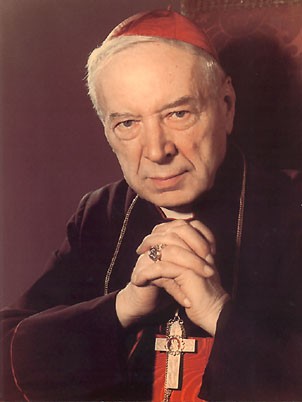
Cardinal Wyszyński, the Polish national hero who resisted its Communist rulers and was imprisoned for his faith, secretly helped Jews during the Nazi Holocaust in the Second World War.

The revelation, says the Zenit news sevice, comes from documents gathered at the Yad Vashem memorial in Jerusalem containing eye-witness accounts of his actions.

Wyszyński was involved in ministry to Polish resistance fighters against the Germans and from 1941-42 was based at a centre for aid to blind people. According to Jadwiga Karwowska, whose parents worked at the centre, he helped a Jewish family of three, a father and two of his children.

She recalled: “Fr WyszyÅ„ski came to us constantly, literally each night, and we hid them [the Jewish family] at our attic. He helped my dad put a ladder and take it back to the garden so that there were no traces of anybody’s presence at the attic.” They were aware that the family were Jews and of the danger of their actions.

Another Yad Vashem testimony, from Esther Grinberg (Morgenstern) reveals other previously unknown, facts about Wyszyński. Born in 1918 in Międzyrzec Podlaski, Grindberg lost her parents, brother, and sister in the Holocaust. She arrived in Warsaw during the ghetto uprising in 1943. In her memoirs she refers twice to the fact that Wyszyński was well known for encouraging his congregation to help all those who were escaping from the war. She says that for safety reasons he did not say exactly whom to help, but that it was known he meant Jews who were fleeing the ghetto.

As head of the Catholic Church in Poland, WyszyÅ„ski attempted to reach a degree of accommodation with the Communist authorities in the face of their vicious persecution of the Church. However, in 1953 he issued a letter with the title “Non possumus”, “We cannot go any further”, refusing any further concessions. It was an act of defiance that led to his arrest and imprisonment for three years, during which he witnessed the brutal torture and ill-treatment of prisoners.

When Pope John Paul II was elected he sent a message to Poles referring to WyszyÅ„ski saying: “There would be no Polish Pope on this Chair of St Peter […] if it was not for your faith undiminished by prison and suffering, and your heroic hope.”

Wyszyński supported the revolutionary Solidarity movement but called on both sides to show restraint. His funeral in 1981 was attended by around 500,000 people.

Source: Christian Today

Guinea: 3 Priest were beaten, held captive and accused of spreading Ebola

Three Baptist priests were beaten and held hostage in Guinea after villagers accused them of spreading Ebola.

According to the BBC, the priests were visiting the village of Kabac in Forecariah in order to treat wells and latrines with insecticide. However, locals believed them to be spreading the Ebola virus, and attacked the clergymen.

Their vehicles were set alight, and the men were taken captive. Police arrived at the scene and arrested some locals, but not before the town council building was also attacked and set on fire.

It’s the second incident of this kind to take place in Forecariah this year. Earlier this month, two police officers suspected of bringing Ebola into the area were attacked and killed.

Guinea this week reopened its schools after closing five months ago to prevent the spread of Ebola. The latest figures released by the World Health Organisation (WHO) put the death toll at over 8,600 in West Africa, with 1,876 of those in Guinea.

A WHO report released last week explained that “community resistance” is persisting in the countries worst affected by the virus – Guinea, Sierra Leone and Liberia – and is proving to be a “major barrier to control”.

Mobs have attacked treatment facilities and doctors, believing them to be introducing Ebola rather than helping patients. “Fear spread faster than the virus,” in Guinea in particular, the report said.

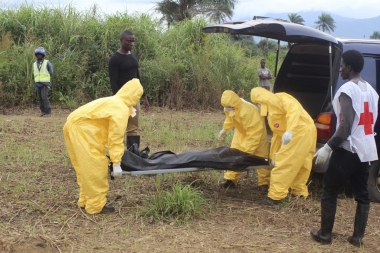
An incident on 23 September 2014 saw two Red Cross volunteers who had safely buried a body in Forecariah attacked by an armed mob. Angry residents then dug up the grave and removed the corpse from its body bag, hiding it in the village.

The mob then grew in size to more than 3,000 armed youths. They targeted a WHO-led team of epidemiologists, who were forced to flee, undoing “weeks of persistent and effective efforts to slow the outbreak”.

The town had at the time a fatality rate among Ebola patients of 80 per cent.

“Traditional belief systems that attribute adverse events, including diseases, to non-medical causes having magical or mystical dimensions, such as a curse or a payback for past sins, have been important factors in some areas,” the report said.

Experts reported last year that traditional healers and witchdoctors in West Africa were contributing to the spread of the deadly virus. Wanting to cash in on the epidemic, a number of people claiming to be able to heal Ebola through witchcraft were encouraging locals to eschew Western medicine in favour of their own costly techniques.

Cases of people flocking to see these so-called healers resulted in the disease spreading further, as the witchdoctors themselves often contract Ebola, which is spread through contact with the bodily fluids of an infected person.

Source: Christian Today