Beth Moore Calls Out Unvaccinated, Unmasked Christians

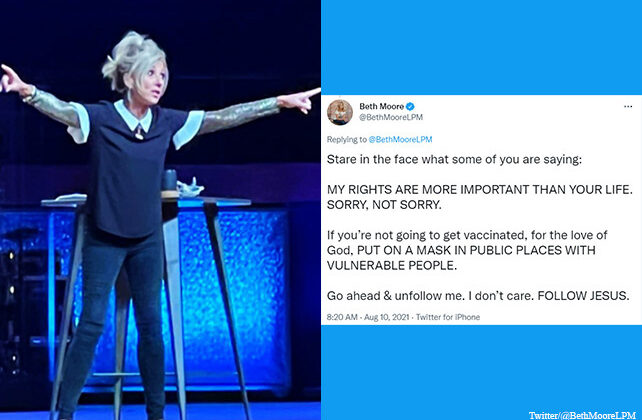
Bestselling Christian author Beth Moore‘s tweet calling out Christians who politicize the COVID-19  virus has gone viral and received many reactions, including from outspoken pastor Greg Locke and “Let Us Worship” leader Sean Feucht.

Moore’s tweet began with: “If we are in Christ, it is unconscionable for us to in any way politicize this virus. What on earth are we doing???”

“Our sides are not more important than lives,” Moore wrote, adding that Jesus calls Christians to “serve sacrificially.” Her frustration evident, Moore added: “For the love of God, we gotta love our neighbors. Even our enemies!”

The Living Proof Ministries’ Bible teacher made it clear she wasn’t talking to non-Christians. “For all our Jesus-talk, where on the ever-loving earth is our Jesus-walk?” she asked.  “Jesus wasn’t playing when He called us to a whole different ethic from the world. We’re not loud-mouth boasters. We’re servants. We SERVE.”

Moore equated unvaccinated, anti-mask Christians to saying, “My rights are more important than your life. Sorry, not sorry.” The former Southern Baptist wrote in all capital letters (which is widely understood to be yelling): “For the love of God, PUT ON A MASK IN PUBLIC PLACES WITH VULNERABLE PEOPLE.”

“Go ahead & unfollow me. I don’t care,” Moore told people who were offended by what she tweeted. Then she closed the tweet with: “FOLLOW JESUS.”

The next day, Moore expressed to her followers that she was all “worked up,” and said she cares about people. “As I live and breathe, it’s that I care and don’t want people to get sick and many die and leave loved ones devastated. I want to do right by people, protect people where possible, in Jesus’ name. Lord have mercy. Christ have mercy. Lord have mercy.”

Read more …

US Bishops award $1.36 million to Catholic Church in Africa

The US Conference of Catholic Bishops’ (USCCB) Subcommittee on the Church in Africa will allocate more than $1.36 million for African Bishops’ conferences, regional associations of Bishops’ conferences, and regional associations of religious congregations this Summer.

Funding comes from the special collection taken each year by dioceses in parishes across the United States.

Supporting pastoral care and social ministry in Africa 

The sum will help support pastoral care, leadership development, evangelization, and social ministry activities on the African continent, where the Catholic Church remains a beacon of hope in a context of persistent conflict, growing poverty amidst the Covid-19 pandemic and drought.

The USCCB Subcommittee approved grants for 56 pastoral projects at its meeting on June 14.

56 projects

Projects include, amongst others: popularizing and implementing Pope Francis’s environmental encyclical, Laudato si’ in Zambia; training pastoral counsellors to support those impacted by the Covid-19 crisis in Zimbabwe; promoting evangelization in local languages in Togo; creating a men’s ministry modelled on the example of St. Joseph in Malawi; reinforcing the local Church’s capacities for protecting minors and vulnerable adults from sexual abuse across all the dioceses in Burundi; building the skills of catechists in Cameroon to address the psycho-social needs of internally displaced persons who have fled their homes to escape violence; and, organizing interfaith support for the pastoral care of refugees in Uganda.

Making a difference with small gifts 

Cardinal Joseph W. Tobin, chairman of the USCCB’s Subcommittee on the Church in Africa, thanked the many Catholics in the United States who contributed to the Solidarity Fund in 2020, despite their own personal hardships resulting from the pandemic.

“These gifts,” he said, “will work wonders in the lives of African Catholics, who are eager to share the Gospel, care for their brothers and sisters, and raise up a new generation of Catholic leaders who will work for a more just and faithful society.” Read more …

First Christians Sentenced to Prison under new Law in Iran

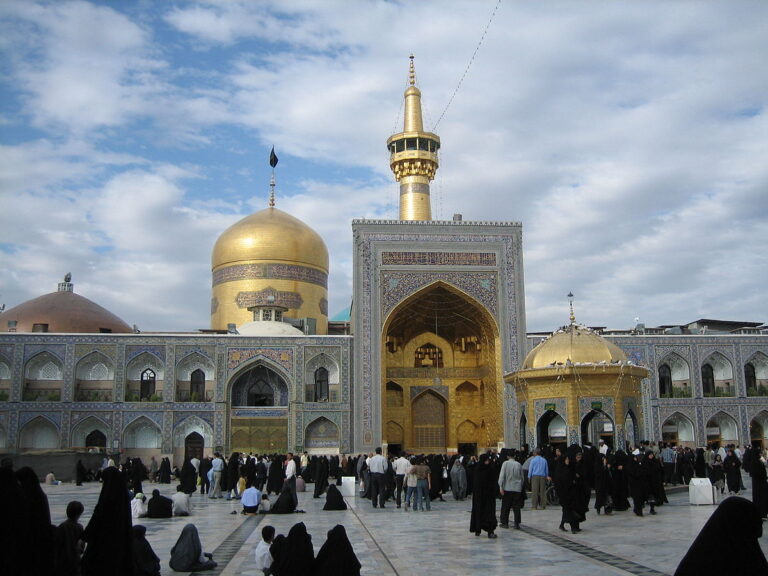
Morning Star News reports – The first Christians to be punished under a newly amended law in Iran aimed at halting the growth of Christianity and other religious groups were sentenced to five years in prison for spreading “propaganda” against Islam after they refused to renounce Christ, sources said.

Amin Khaki, Milad Goudarzi and Alireza Nourmohammadi, all converts from Islam, were sentenced under Article 500 of Iran’s newly amended penal code, which states that “any deviant education or propaganda that contradicts or interferes with the sacred Sharia [Islamic law] will be severely punished.”

Members of the Church of Iran, the three men were informed on June 26 that they had each been given the maximum prison sentence allowable under the amended article and also fined 40 million tomans (US$1,600). Another member of the church, Hamet Ashouri, was told the same day that his appeal of a 10-month prison sentence on charges of “propaganda against the regime” had been denied. Ashouri is also a convert from Islam.

The three men have 20 days to appeal their verdict. Ashouri was given 10 days to report to Karaj Central Prison to start his sentence.

Along with increased prison terms, the law allows the state to take away certain basic rights, such as voting, for as long as 15 years. Religious freedom activists warned that the amendment, which was first proposed in 2020 and passed by parliament on Jan. 13, could be used to attack religious dissidents and minority groups. The amendment was signed into law by then-President Hassan Rouhani on Feb. 18 and went into effect on March 5.

An analyst for advocacy group Middle East Concern (MEC) said the sentence is the first sign of how the newly amended penal code may be used.

“We are still waiting to see how the amendments are going to be applied, and now we have the first indication with Amin, Milad and Alireza’s sentences,” said the analyst, who spoke on condition of anonymity. “Of course, it is up to the prosecutor, who is influenced by Iranian intelligence, to decide whether the charges are propaganda (Article 500) or action against the Islamic State (Articles 498, 499). What we can say is that someone convicted under Article 500 now faces a maximum jail term of five years rather than a typical term of six months that many Christians received previously.”

The recent election of Ebrahim Raisi, chief justice of Iran, to the presidency, “would appear to indicate that Iran will continue to follow a hard line when it comes to upholding Islamic values,” the analyst said. “His history suggests that we should not expect to see moderation or toleration shown to anyone who ‘deviates’ from Islamic revolutionary aims, but that doesn’t necessarily mean that Christian converts will be a primary focus for correction. The amendments to Articles 499 and 500 were made under his watch as head of the judiciary, of course.”

On Nov. 11, 2020, Iranian intelligence agents in Fardis raided the homes of the three Christians and those of other unidentified converts. No one was arrested during the raids, but the agents seized Bibles, cell phones and computers and ordered the group to stop all Christian activities.

Khaki, Goudarzi, Nourmohammadi and the other members of the Fardis group stood firm and refused to stop pursuing their faith, and on May 5, the three Christians were charged under the amended Article 500. They were each ordered to report to the police every week for six months and released on a 250 million toman (US$9,940) bail.

On June 21, the three men appeared in the 4th Branch of the Revolutionary Court of Karaj to stand trial. The judge, Mehdi Zeinali, denied them access to their attorney, and the defendants had to represent themselves, according to Christian Solidarity Worldwide (CSW). Zeinali claimed their lawyer had not been properly registered. The hearing lasted less than an hour.

The three Christians will appeal the decision, according to human rights groups following the case.

This is not the first time that the three members of the Fardis group have been imprisoned for their faith; all had served time in prison on charges of “propaganda against the state.” Khaki, the last to be freed, was conditionally released on March 2, 2020 because of a COVID-19 outbreak in the Karaj Central

Prison. COVID-19 levels in the prison to which he and others have been ordered to return is not publicly known.

Ashouri was arrested in Karaj on Feb. 23, 2019, and his home was raided by security agents who confiscated Bibles, Christian literature and a computer. He was detained for 12 days. Officials held Ashouri in solitary confinement for 10 days. He was beaten and offered bribes to
become an informant, which he refused, according to human rights group Article Eighteen.

Read more … 

Promote Your EVENT with Us


Promote Your EVENT with Us

Currently FREE, Click here to get started

Contact Us – go to Advert Booking Page

Pope Francis, Justin Welby and Jim Wallace send a joint message to the political leaders of South Sudan

Pope Francis, Justin Welby and Jim Wallace send a joint message to the political leaders of South Sudan encouraging them to do more to shape a nation “in which the dignity of all is respected and all are reconciled.”

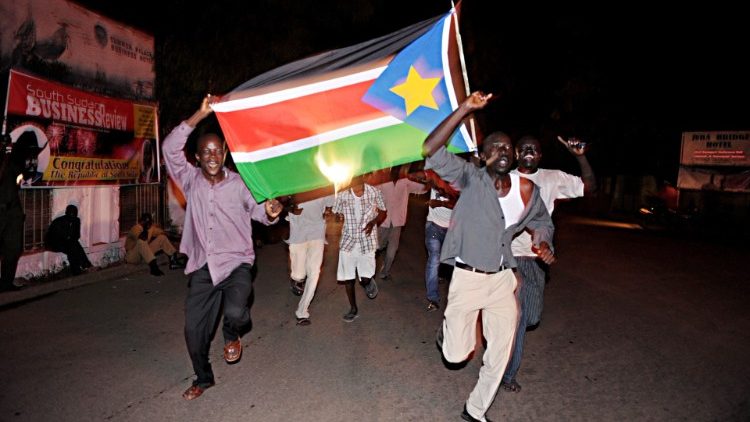
Marking the 10th anniversary of the Independence of South Sudan, Pope Francis and the leader of Church of England, Archbishop Justin Welby, and Moderator of the Church of Scotland, Rev. Jim Wallace, reach out to the leaders of the world’s youngest nation with an appeal to do more for the good of their people.

In their letter, the Holy Father, Archbishop Welby and Rev. Wallace, note the sad predicament of South Sudanese whom, they say, “continue to live in fear and uncertainty, and lack confidence” that their nation can indeed deliver the ‘justice, liberty and prosperity’ celebrated in their national anthem.

Increasing violence and a fragile peace process

Increasing intercommunal violence, the  threat of the peace process unraveling, and dire humanitarian conditions across large swaths of South Sudan continue to plague development. More than a year after President Salva Kiir and former opposition leader Riek Machar formed a unity government, there has been slow progress on implementing the country’s main peace agreement, which was signed in 2018 formally ending a civil war that began in 2013. Read more …

Good News as Anti-porn crusader says pro-family forces are shutting down industry

LifeSiteNews report — In this episode of The Van Maren Show, Jonathon speaks with pro-family and pro-life activist Patrina Mosley, who is also the Deputy Director of Legislative Policy for the National Center on Sexual Exploitation (NCOSE). She and her organization are leading the fight to expose the porn industry and its criminal behavior.

Mosley discusses how she is currently working with survivors of sexual abuse and trafficking on major lawsuits against porn and social media companies. She says that in Canada, they are collaborating with parliamentarians to fight leading pornography platform Pornhub, which is based in the country.

Mosley tells Van Maren that their investigations reveal how the porn industry is involved in many criminal actions, such as blackmail, racketeering, trafficking, child pornography, and abuse, all of which are included in their lawsuit against the industry, which she calls “an organized crime unit.” Read more …

Restored – The Virtual Album Release Concert, With Sarah Téibo

Sarah Téibo unveils her third studio album ‘Restored’ after building up to this momentous release with a series of singles released over the last year, including the UK Christian Charts No 1 song ‘Victory’ and Billboard Gospel Indicator charting single ‘Secure’.

See more …

Pope Francis continues to recover

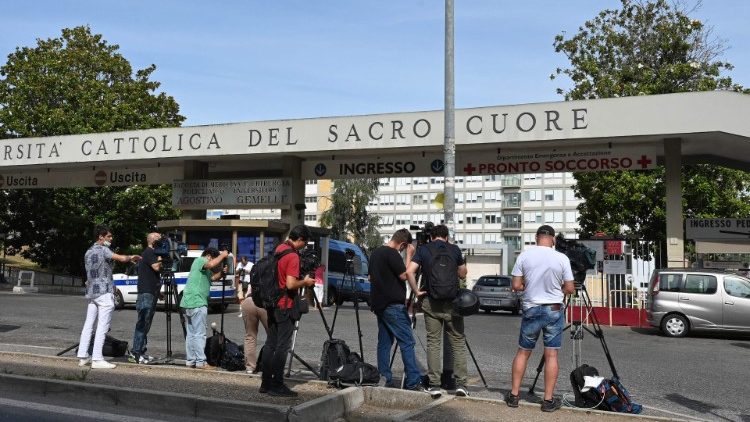
Pope Francis is doing well and is alert, according to a statement released by the director of the Holy See Press Office, Matteo Bruni, in the latest medical bulletin released regarding the surgery the Pope underwent on Sunday evening.

Matteo Bruni said in his statement that Pope Francis is doing well overall, alert and breathing on his own. He said a hemicolectomy on the left side took place during the surgery, which lasted around three hours. He added that the Pope will remain at Gemelli hospital for seven days, barring any complications.

Atheists Sue Mississippi Over New ‘In God We Trust’ License Plates

Christian Headlines report that Mississippi is facing a lawsuit from a group of atheists because of the southern state’s new license plates featuring the phrase “In God We Trust.”

According to Faithwire, the lawsuit was filed on Tuesday against the state’s commissioner of revenue, Chris Graham, by several Mississippi residents along with the Mississippi Humanist Association and American Atheists.

Jason Alan Griggs, one of the plaintiffs in the suit, criticized the license plate design because he is “forced to profess a religious idea that I do not believe” whenever he uses his trailer.

“Imagine a Christian having to drive around with ‘In No God We Trust’ or ‘In Allah We Trust,'” he added.

Derenda Hancock, a self-described “radical atheist,” argued in the court filing that the government has no right to infringe on “her right to be free from religion.”

In 2019, when the new license plates were adopted, Hancock reportedly told a state agent, “I don’t want Jesus riding on my car,” as she applied for a specialty “Mississippi Blues Trail” plate, which required a $2 fee.

Hancock would go on to do the same thing in 2020.

Geoffrey Blackwell, an attorney for American Atheists, argued that the license plates stigmatize atheists as it coerces them to comply with “the state’s religious message.”

“Every minute they spend on the streets of Mississippi, atheists are forced to act as a billboard for the state’s religious message,” he said. “Some can avoid being a mouthpiece for the government by paying a penalty. For many others, even that isn’t possible. Atheists with a disability or a special category vehicle are stuck proclaiming a belief in the Christian God. It’s an abuse of power and unconstitutional.” Read more …

Source : Christian Headlines

Survey shows Children watching improper content on streaming services

European age ratings on streaming platforms are exposing children to unsuitable content, the British Board of Film Classification (BBFC) has found.

The censor is pressing for all online providers to adopt BBFC ratings, after an investigation revealed that some services considered films containing sex scenes, violence and drug abuse appropriate for young viewers, contrary to UK standards.

The BBFC came under fire from The Christian Institute earlier this week, after it said using the names “God” and “Jesus Christ” blasphemously is acceptable in ‘U’ rated films.

Liberal ratings

In a BBFC survey, parents were shown five short clips and asked “whether they agreed with two alternative age ratings (one assigned by the BBFC and the other by a European regulator) without being told which regulator had assigned the rating”.

Ninety four per cent of parents surveyed thought a clip containing sexual violence from the film Reinventing Marvin was suitable for children aged 15 and over, agreeing with the BBFC rating. But only two per cent thought it appropriate for six-year-olds, as classified by the Dutch regulator (NICAM).

A scene depicting violent images from the documentary OJ: Made in America led ninety one per cent of respondents to agree with the BBFC classification, that no one younger than 18 should see it. NICAM considered it suitable viewing for twelve-year-olds.

According to the report: “In every case, the overwhelming majority (between 74% and 94%) of British parents agreed with the BBFC rating – and were able to identify the reasons why the BBFC has classified the content more restrictively than the alternative lower European rating”.

Conflicting signals

Writing in The Times, Culture Secretary Oliver Dowden described current age classification on streaming services such as Netflix and Amazon Prime as “ad-hoc and inconsistent”.

He pledged: “This summer we will consult on whether it’s time to set the same basic rules for video-on-demand services as we do for traditional broadcasters.”

In May, the Government provoked anger and astonishment when plans emerged that it intended to scrap promised protections that require mandatory age-verification checks to be included on all commercial pornography websites.

The safeguards, set out in the Digital Economy Act 2017 but never implemented, would be removed under the new Online Safety Bill. Read more …

Source : The Christian Institute