A Good Marriage isn’t something You find; It’s something You Make

 Author Gary Thomas explains how a husband and wife can foster oneness in their marriage by pursuing God together.

Listen Free Online or Purchase the Download

A Good Marriage isn’t something You find; It’s something You Make – Gary Thomas

Credit – Focus on the Family

Ebola: American Aid Workers to Provide Chlorine and other Supplies in Liberia

American charity Operation Blessing International has announced it’s sending a team of aid workers with multiple chlorine generators and a shipping container full of critically needed hospital supplies to Liberia, one of the countries hardest hit by the Ebola outbreak.

The faith-based relief group is the latest to join in the fight against the deadly virus, which has killed over 3,400 people throughout West Africa, and has reached the United States.

“Chlorine is one of the most important tools in the fight against Ebola because it kills the virus on contact,” OBI president Bill Horan explained in a press release.

“As a result of this crisis, chlorine is needed in massive quantities by not only health workers, but also by the Liberian government because they have set up hand-washing stations all around the country in an attempt to prevent the spread of Ebola. But supplies are nearly depleted in the country and, as far as we know, Operation Blessing is the only group making chlorine in Liberia.”

Other Christian groups like SIM USA and Samaritan’s Purse are also in the region, treating patients with Ebola at special treatment centers. Both organizations saw members of their medical staff come down with the virus, namely Dr. Kent Brantly and Nancy Writebol, who were successfully treated back in America and were subsequently discharged from hospital.

The U.S. government has responded by sending over 3,000 medical personnel to West Africa to help build treatment tents and educate the public on prevention measures. SIM USA President Bruce Johnson praised President Barack Obama’s initiative last month, pointing out that American aid is greatly needed in the crisis.

“The multifaceted response to the Ebola crisis announced today by President Obama is what we have been hoping for and what is needed in Liberia and West Africa,” Johnson said at the time. “Three things are vital right now: more beds and equipment, more trained medical professionals, and more training of Liberians and West Africans. This plan addresses these desperate needs.”

Reports noted over the weekend that Thomas Eric Duncan, the first person to be diagnosed with the Ebola in the U.S., is in critical condition. He is said to have came from Liberia to Dallas, Texas, with the intention of marrying his girlfriend, with whom he has a 19-year-old son.

Ten people with the highest risk of exposure from Duncan had been placed under isolation by Friday.

OBI, which has provided aid in Liberia for over a decade, said that the chlorine made by its team will be sent to Partners in Health, to the Liberian government and to another partner, Lutheran Hospital, the largest public health institution in Liberia.

“Because Ebola is spread through bodily fluids, health workers are burning the used hospital linens rather than laundering them. Supplies are running out very quickly and these items are critically-needed,” Horan added.

David Darg, vice president of international operations for OBI, is scheduled to arrive in Lieria Monday to speak with the Liberian Minister of the Interior and organize the efforts.

Source : Christian Post

ISIS:Kurdish Commander Resorts to Suicide Bombing

A female Kurdish fighter killed numerous militants of the Islamic State, or ISIS, by blowing herself up as the terrorists were fighting to seize a strategic Syrian town on Sunday night, according to a monitoring group.

The woman commander, belonging to the YGP, or People’s Protection Units, the official armed wing of the Kurdish Supreme Committee of Syrian Kurdistan, launched the attack at an ISIS position east of the border town of Kobane, the Syrian Observatory for Human Rights reported.

The woman, identified on social media as Arin Mirkan, attacked ISIS as Kurdish fighters backed by U.S.-led airstrikes fought the militants for control of the town on the Turkish border, according to The Telegraph.

“The operation caused deaths, but there is no confirmed number,” observatory director Rami Abdel Rahman was quoted as saying.

“Our call to all the young men and women of Kurdistan is to come to be part of this resistance,” the YPG said in a statement. “Every street and house will be a grave for them (ISIS).”

It was the first reported instance of a female Kurdish fighter carrying out a suicide attack against ISIS, according to the UK-based monitoring group.

ISIS seized a section of the Mishtenur hill late Saturday, but airstrikes slowed them down Sunday.

However, a Kurdish official, Idris Nahsen, said airstrikes alone cannot prevent ISIS from taking the town. “They are not enough to defeat terrorist groups. The strikes are helping but we need heavy weaponry, armoured vehicles, cannons, rockets. They are one kilometre away in some places and two or three kilometres in others,” Agence France Presse quoted him as saying.

ISIS has taken over about 350 villages around the city of Kobane, and over 150,000 people from the region have fled to Turkey.

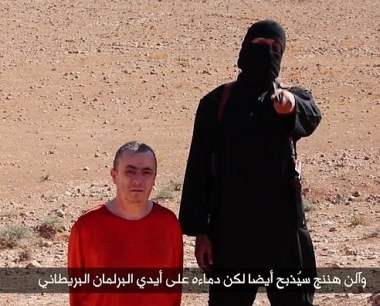
ISIS released a video Friday showing the beheading of a British aid worker, Alan Henning. Last month, the Sunni terror group released footage showing the execution of another British hostage, David Haines. In two previous videos, the group showed the execution of U.S. journalists James Foley and Steven Sotloff.

ISIS, an al-Qaeda offshoot and also known as ISIL, has gained control of large swathes of territories in Iraq and Syria.

In Iraq, ISIS men have killed hundreds of civilians. Numerous members of the Christian and Yazidi minorities have also been killed, and tens of thousands of them have fled their homes.

ISIS, or Islamic State of Iraq and Syria, wants to form an Islamic emirate in the Levant region through “jihad.” According to the CIA, ISIS has about 31,500 fighters across Iraq and Syria.The terror group is believed to have hundreds of foreign fighters, including those from the United States and Europe.
Source-Christian Post

Religious Faithfuls unite for Alan Henning

Mourners from many faiths united in a service of reflection on Sunday for aid worker Alan Henning, killed by Islamic State (IS) militants in Syria.

More than 500 people, including Henning’s widow, Barbara, and their two children, Lucy, 17, and Adam, 15, attended the service at Eccles Parish Church in Manchester.

The 47-year-old taxi driver was captured by IS in December while he was delivering aid to Syria.

A video was released late on Friday purporting to show his death by beheading, in the same manner as three other American and British IS hostages.

The Bishop of Manchester, the Rt Rev David Walker, who was at the service, described Henning as a “martyr” who had paid the “ultimate sacrifice”.

“Within the Greater Manchester area it’s part of our tradition to come together at times of tragedy,” Bishop David said, according to the Times. “This won’t divide us, it will simply reaffirm us in our commitment to one another and to the future of the world of which we are a part.”

Yellow ribbons have been tied around his hometown in remembrance, and flowers have been laid outside the Hennings’ home and the minicab office where he used to work.

A memorial fund has been set up in his name by Dr Shameela Islam-Fulfigar, who was with Henning on the aid convoy from which he was captured.

Bishop David said in a statement on Saturday: “In his life Alan Henning united people across the boundaries of nationality and faith. He did so both through his humanitarian actions and by the love that drove him on. That his tragic death continues to unite people across Britain and beyond is demonstrated today by the range of people and organisations paying him tribute.

“To ISIS we say: You no longer have the power to shock us, now you just sicken us. Your brutality, against any who don’t share your narrow, perverted worldview, doesn’t undermine our determination, it stiffens our resolve. Your destiny is not to be a force in human history, merely one of its sad footnotes.”

Many Muslims had campaigned for Henning’s release after the threat of his beheading was released on September 13.

Imam Asim Hussain said at Manchester Central Mosque yesterday: “The killing of Alan Henning was a cowardly and criminal act of appalling brutality, by a group who do not represent Islam at all, and in fact are an insult to the Islamic faith.”

Hussain, who attended the memorial service, described Henning as a “local and national hero”.

Source:Christian Today

Israel has a right to the Land: PM

Prime Minister Benjamin Netanyahu on Sunday hosted his sixth open Bible study at the official Prime Minister’s Residence in Jerusalem since reestablishing the practice two years ago.

The event was attended by dozens of leading rabbis and academics, many of them members of Knesset and the current government.

One of those participating in the round-table discussion was Education Minister Shai Peron, who spoke on the topic of why the Bible begins with the story of creation, rather than jumping straight into God’s relationship with and commandments to the Nation of Israel.

Peron cited the famous 11th century Jewish sage Rashi, who taught that the Bible begins with the story of creation to demonstrate that the whole world belongs to God, and He gives this land or that to whom He will.

Netanyahu noted that there are many in the world today who do not accept Israel’s divine appointment to this particular land, and who seek to defame the Jewish people and deny their birthright.

The prime minister said that while these open Bible studies have only been held a handful of times, the Word of God is studied in his home at least once a week. Netanyahu’s younger son, Avner, won the National Bible Quiz for Youth in 2010, and, according to the prime minister, often leads their home sessions.

Source: Isreal Today

ISIS : Hostage writes on his Conversion

A letter written in captivity by American aid worker Peter Kassig, who is being held hostage by the Islamic State (IS) in Syria, has been released by his parents.

In the letter, Kassig says: “I am obviously pretty scared to die but the hardest part is not knowing, wondering, hoping, and wondering if I should even hope at all.”

Kassig appeared at the end of a video showing the brutal beheading of British hostage Alan Henning last week.

ISIS have threatened to kill the 26-year-old next.

Kassig converted to Islam after being taken captive by IS militants in October last year, and now goes by the name Abdul-Rahman.

According to his parents, who yesterday issued a statement for the first time, Kassig – who previously served as an Army Ranger in Iraq – turned to Islam after founding his own relief organisation, Special Emergency Response and Assistance (SERA), to deliver aid in areas of conflict.

Speaking to CNN about SERA in 2012, he said: “I guess I am just a hopeless romantic, and I am an idealist, and I believe in hopeless causes.

“In five years, if I can look back on all of this and say that our organisation is able to truly help people, that I was able to share a little bit of hope and that I never stopped learning then I will know this all stood for something.”

“He grew to love and admire the Syrian people and felt at home there. Our son’s journey culminated in him embracing Islam. Sadly, he was taken captive and is not free to continue his life’s work serving the people of the region,” his father, Ed Kassig said yesterday.

“We are so very proud of you and the work you have done to bring humanitarian aid to the Syrian people…Our hearts ache for you to be granted your freedom so that we can hug you again and then set you free to continue the life you have chosen, the life of service to those in greatest need,” Paula Kassig added in an address to their son.

“We implore those who are holding you to show mercy, and use their power to let you go.”

In his letter, received on June 2, Kassig said his situation had been “complicated”, likely by his conversion to the faith of his captors.

“In terms of my faith, I pray every day and am not angry about my situation in that sense. I am in a dogmatically complicated situation here, but I am at peace with my belief,” he wrote.

“If I do die, I figure that at least you and I can seek refuge and comfort in knowing that I went out as a result of trying to alleviate suffering and helping those in need.”

A spokesperson for the White House confirmed Kassig’s capture on Friday.

“We will continue to use every tool at our disposal – military, diplomatic, law enforcement and intelligence – to try to bring Peter home to his family,” said Caitlin Hayden of the National Security Council.

Source :Christian Today

5 Ways to Know if It’s God’s Voice

It can be hard to differentiate between the voice of God and our own thoughts. Here are five key tests to help you recognize which is which.

1) Test the origin (1 John 4:1). Thoughts from our own minds are progressive, with one thought leading to the next, however tangentially. Thoughts from the spirit world are spontaneous. The Hebrew word for true prophecy is naba, which literally means “to bubble up,” whereas false prophecy is ziyd, meaning “to boil up.” True words from the Lord will bubble up from our innermost being; we don’t need to cook them up ourselves.

2) Compare it to biblical principles. God will never say something to you personally that is contrary to His universal revelation as expressed in the Scriptures. If the Bible clearly states that something is a sin, no amount of journaling can make it right. Much of what you journal about will not be specifically addressed in the Bible, however, so an understanding of biblical principles is also needed.

3) Compare it to the names and character of God as revealed in the Bible. Anything God says to you will be in harmony with His essential nature. Journaling will help you get to know God personally, but knowing what the Bible says about Him will help you discern what words are from Him. Make sure the tenor of your journaling lines up with the character of God as described in the Names of the Father, Son and Holy Spirit.

4) Test the fruit (Matt. 7:15-20). What effect does what you are hearing have on your soul and your spirit? Words from the Lord will quicken your faith and increase your love, peace and joy. They will stimulate a sense of humility within you as you become more aware of who God is and who you are. On the other hand, any words you receive that elicit fear or doubt, that bring you into confusion or anxiety or that stroke your ego (especially if you hear something that is “just for you alone—no one else is worthy”) must be immediately rebuked and rejected as lies of the enemy.

5) Share it with your spiritual counselors (Prov. 11:14). We are members of the body of Christ. We weren’t designed or called to walk alone. Nothing will increase your faith in your ability to hear from God like having it confirmed by two or three other people! Share what you’ve heard with your spouse, your parents, your friends, your elder, your group leader or even your grown children. They don’t need to be perfect or super-spiritual to be your sounding board; they just need to love you, be committed to being available to you, have a solid biblical orientation and, most important, they must also willingly and easily receive counsel. Avoid the authoritarian who insists that because of their standing in the church or with God, they no longer need to listen to others. Find two or three people and let them confirm that you are hearing from God.

Source: Charisma Magazine

Abuse Allegation: Hillsongs Pastor to testify

High-profile Hillsong senior pastor Brian Houston is expected to give evidence at an inquiry into how Pentecostal churches responded to child sex abuse allegations against his father, Frank Houston, and two other men.

The royal commission into institutional responses to child sexual abuse sitting in Sydney on Tuesday will hear how Hillsong and the Pentecostal association, Assemblies of God, responded to abuse allegations against William Francis “Frank” Houston – the famous preacher behind the movement which gave birth to the mega-church.

His son Brian Houston was national president of the Assemblies of God (AoG) in Australia from 1997 to 2009. More than 1,000 Pentecostal churches are affiliated with the AoG which is now known as Australian Christian Churches (ACC).

Brian Houston was president in 2000 when his father admitted he sexually abused a boy in New Zealand 30 years earlier. Frank Houston was fired by his son from all church roles.

Hillsong in Sydney was created when separate churches run by father and son merged under the leadership of Brian Houston.

Frank Houston died in 2004 aged 82. Further allegations against him have come to light since his death.

The charismatic preacher had been a Salvation Army officer in his native New Zealand before founding his first ministry at Lower Hutt near Wellington in 1960. He later became superintendent of the New Zealand Assemblies of God before moving to Sydney in 1977.

The commission will hear also of allegations against two other men and will be looking at the response of the ACC to those allegations.

One of the men, a former youth pastor at a Sunshine Coast church, Jonathan Baldwin, was sentenced to eight years’ jail in 2009 when he was found guilty of repeatedly molesting a 13-year-old boy who had come to him for counselling.

The other matter the commission will examine is the response of the Northside Christian College and the Northside Christian Centre, (now Encompass Church) to allegations of child sexual abuse made against former teacher Kenneth Sandilands.

In a statement issued when the inquiry was announced Encompass Church pastor John Spinella said the church, based at Bundoora, Victoria, welcomed the inquiry.

“As a church we have recognised these past failures and take the opportunity to apologise for the suffering and pain endured by those who were abused,” he said.

The public hearing is expected to run for two weeks and will be the 18th held by the commission.

Source: The Guardian

US Doctor terms Abortion his Ministry

A US doctor who performs dozens of abortions a day has controversially defended the service he offers as a Christian ‘ministry’.

Speaking to Christian Today Dr Willie Parker said: “[It is a ministry] to a degree that any effort that I exercise on behalf of other human beings in the context of the compassion that I feel I ought to have as a follower of the life of Christ.”

Parker feels so passionately about this issue that he has given up his medical practice in Chicago and moved south, to provide abortions in Mississippi and Alabama, where opposition to abortion is at its strongest.

Over the last few years some of the southern states have tightened their abortion laws, resulting in the closure of a number of clinics. The clinic where Parker works in Mississippi is now the state’s only clinic, and he is engaged in a legal battle to keep it open.

In July, Esquire magazine published a lengthy feature entitled ‘The abortion ministry of Dr Willie Parker’. Unsurprisingly, it was met with severe condemnation from the Christian Right in America. Dave Andrusko described the article in the National Right to Life News Today as “a futile attempt to make a kind of saint out of a man who flies into Mississippi twice a month and performs as many as 45 abortions a day.” Carole Novielli, writing for Life News, said: “Excuse me – Abortion Ministry? Are you kidding? How is the brutal murder of unborn children all-of-a-sudden a ministry?”

When it comes to the Church, Parker considers himself an “insider” but he isn’t blind to the opposition from much of the rest of the flock. So how does he fit together his Christian faith with a practice that many Christians would describe as ‘murder’?

A ‘conversion’

Parker grew up in Birmingham, Alabama, and adopted what he calls the “fundamentalist Christian” views of those around him. He also grew up knowing that most around him believed that abortion was wrong. “While [abortion] wasn’t taught against it was kind of implied that that was not the thing to do,” he says.

At college, one of the first essays he had to write was about abortion from a Christian perspective. “Even though I had these fundamentalist beliefs, the best I could do was to say that it was a very complicated issue and I hope everyone approaches it prayerfully,” he says.

But his views began to change while he was at medical school. “I never had an intention of leaving my religious beliefs behind, but I had to come to understand it in a different way.” A way he describes as fitting with the “reality-based, science-based view”.

In the first 12 years of his medical practice, Parker didn’t perform abortions. In that time he wrestled with the knowledge of the religious perspective on the issue, combined with a growing conviction that some women needed abortions.

A pivotal moment came when listening to Martin Luther King’s final sermon, in which he talks about the Good Samaritan. “[King] said that what made the Good Samaritan good was, rather than asking the question of the others, ‘What will happen to me’, the Samaritan asked ‘What will happen to this person if I don’t stop to help them?'”

“I had an epiphany,” says Parker. “Rather than being more concerned about what will happen to me for providing the care – what will my fellow Christian travellers think of me – I became more concerned about what would happen to women when that care was not available, given that I already knew that when abortion care is not available, that women take drastic measures and they have serious injuries or they die.”

He felt it was significant that the moment of “empowerment” came within a religious context, given that it was the religious view that was holding him back.

“I call it my personal conversion experience around becoming more concerned about others, and not allowing my religious understanding to be more important to me than my sense of humanity, which involved always being willing to act on behalf of another human being if I can.”

The problem people have with this view is the idea of abortion as ‘care’, and that the best way to help a woman at a time of crisis is to offer her an abortion.

Parker says: “There is no aspect of helping another human being that goes beyond a Christian understanding.” But many Christians oppose Parker’s stance because they believe life begins at conception, and so by aborting a foetus you are ending a life.

So what is Parker’s explanation? “To use religious language, life began when God gave the divine spark. It becomes very arbitrary to talk about some magic moment at which life begins.

“If you say that life begins at conception, I think you’re too late in making that declaration. My position is that life is a continuum, it is not an event, and so life doesn’t begin at conception and end at death – that is my Christian understanding. From a scientific standpoint, it’s all a life process.”

Like many abortion supporters or defenders, Parker points to the fact that a foetus does not have the same legal standing as a person. Though he claims he doesn’t have to devalue the foetus in order to value the rights of women.

“I am not trying to be dismissive of the deeply held views about the reverence and sanctity of life that people who are against abortion. I hold that same sanctity about life. But what is also sacred for me is the personhood of women.”

When it comes to the biblical perspective, many would point to Psalm 139 where David writes: “you knit me together in my mother’s womb”.

But Parker is critical of those who “take literary devices and elevate them to the status of canon law.” He says the science of the day would have given women had little agency in a pregnancy, but would have recognised the woman only as a carrier of a man’s ‘seed’.

And although he says he is reluctant to point to scripture to back up his own perspective “because part of the mischief that’s done is people pull a passage out of scripture and use it to make their point,” he does look to scripture to find a theology of choice.

He points to Joshua 24:15, and the words: “choose for yourselves this day whom you will serve […] But as for me and my house, we will serve the Lord.”

“What is sacred about that passage for me,” says Parker “is the element of choice, and being self-determining and autonomous – to me that is the part of us that is most like, in the Christian understanding, the creator.”

Facing reality

The arguments both for and against abortion can obscure the fact that the procedure is not pleasant. In Parker’s terms “we disrupt life processes”. There are many other ways to describe it.

A medical abortion can involve taking a pill, leading, effectively, to a miscarriage. A surgical abortion means extracting the foetus by suction. The additional problem people have with late-term abortions is that you are no longer terminating a non-viable pregnancy, but a foetus that could easily be called a baby.

The clinic where Parker works in Mississippi performs about 2,000 of the 6,000 abortions done in the state each year. Because Parker divides his time between different clinics, he can sometimes perform up to 45 abortions a day.

But what does that feel like – to spend a day extracting foetuses?

“Have I been able to reduce myself to an automaton? The answer is no.

“I have not had any desire to reduce it to a process. I do maintain the objectivity of a physician […] the same objectivity I used to have when I delivered babies.”

But he does choose to focus on the women he feels he is helping. “Have I found a way to be present and respectful of the process that I am participating in, and to be respectful of the agency of the woman? Absolutely. Does that require me to delude myself about the process of what we’re doing? No.”

The Christian response

Parker doesn’t need to be told that people disagree with him. He knew George Tiller, the doctor who was shot dead at his church in 2009 by a pro-life activist.

“I am very much aware that people feel strongly about this issue, to the point of being willing to harm others, which is kind of ironic – an irony of being willing to kill on behalf of life,” says Parker.

He has chosen to be public about his work; many in a similar position would not. The two other doctors who work at the same clinic in Mississippi do not disclose their identity.

So far, any threats against him have only been ‘warnings’. He says: “People have decided that because I provide abortions, that I am void of compassion, that I am not of high medical competence […] that I don’t care for women. These are all psycho-terrorism as I call it.”

There are others who have more peaceful methods of opposition, but who also feel he’s gone astray. “Many people say they are praying for me,” says Parker, “or they think I have lost my way, and they are praying for me that I find my way and that I come back to Jesus… I choose to see that they are coming from a place of compassion.”

Parker has looked to writers such as Dietrich Bonhoeffer to help him think through his opposition to the norms of Christian culture. From Bonhoeffer he said he learned about being “present and accountable in a world that required drastic action”.

“Those actions didn’t appear to be on the surface very conventional Christianity, but [Bonhoeffer] was able to conclude that he needed to act in the world in a way that would act on behalf of the greater good,” says Parker.

Presbyterian minister Harry Emerson Fosdick also influenced his thinking on this, particularly his 1922 sermon ‘Shall the fundamentalist win?’

“[Fosdick] said that because of the nature of faith, particularly the Christian faith, it is quite possible for people to believe the Bible literally and people who are equally Christian and deeply observant of their faith to not take a literal approach to the Bible. And because of that there is possibility within a faith community for there to be what appear to be diametrically opposed views, but one doesn’t invalidate the other.”

But despite the differences, Parker still considers the Church his family. “I consider myself, when it comes to Christianity, an insider,” he says. “And in the way that there are disputes within families, you love each other enough to criticise one another.”

One criticism he has is that he feels the Church has been “misguided”, and at times “on the wrong side of social issues,” such as slavery and homosexuality.

In practice, his opposition to some prevalent teachings within the Church has meant being selective about his choice of local church, both to avoid putting a minister in a difficult position, as well as the opposition he might face personally.

Meanwhile, he has looked to the Religious Coalition for Reproductive Choice, of which he is on the board, for like-minded community. “It’s important for me to have connection with a faith community that does not practice a zero sum game between dealing with current social issues and trying to maintain the authenticity of their religious practice,” he says.

Parker sees the politics of many churches in the south as a foregone conclusion. As evidenced by their reaction to his views, they are unlikely to be swayed by his inclusive rhetoric.

Indeed, the majority of Christians will not agree with Parker’s position. The question instead will be the degree to which they disagree. Is he a baby killer complicit in evil; is he following a sincerely held belief, but nonetheless misguided; or is he demonstrating Christian love in what some would see as a God-forsaken place.

Source: Christian Today

Covenant University Nigeria Launch Hybrid Automobiles

Presiding Bishop of the Living Faith Church and one of Africas top Christian owned Universities Bishop David Oyedepo,(Ph.D.) obviously elated with joy yesterday declared the successful completion and launch of three Hybrid Automobiles,a project produced by students within the Covenant University Campus,Otta Ogun State.

The Automobiles which will be serving as a part of an Environmental Waste Protection Project embarked by the Students is in the possibility of undergoing mass productions in the nearest future after all tests might have been concluded, the Hybrid Automobiles will be running on Fuel and Battery energy sources alternatively. All engine works and other specifications were handled totally by the undergraduate Students.

Tests on the Hybrid Automobile will be currently run within the Schoool Premises at Otta, where they are currently on display.
Covenant University is a growing, dynamic vision-birthed, vision driven University, founded on a Christian mission ethos and committed to pioneering excellence at the cutting edge of learning, it was established on October 21st 2002.