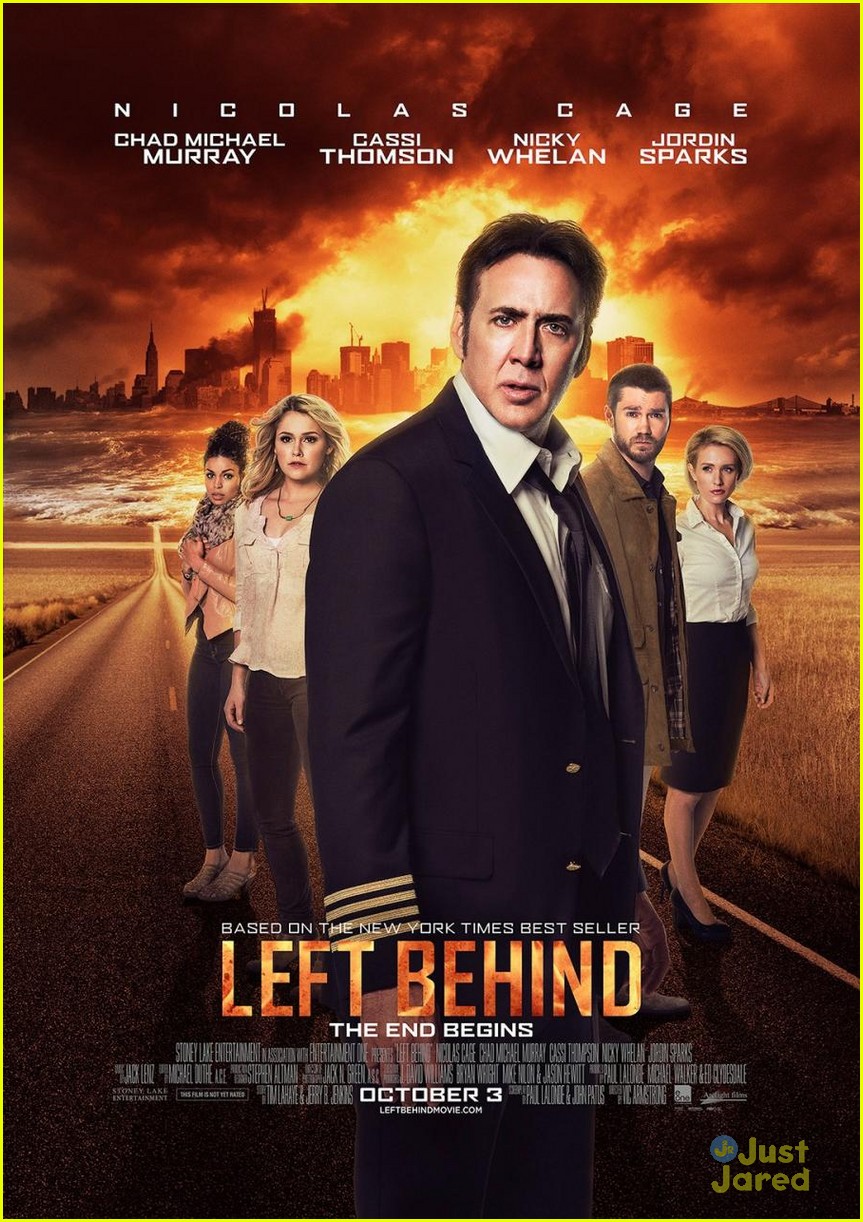
Left Behind is an apocalyptic Action-Thriller movie starring Nicolas Cage based on the New York Times bestselling novel that brings biblical prophecy to life in modern times.
Watch the Official Trailer – Scroll Down
The most important event in the history of mankind is happening right now. In the blink of an eye, the biblical Rapture strikes the world. Millions of people disappear without a trace. All that remains are their clothes and belongings, and in an instant, terror and chaos spread around the world. The vanishings cause unmanned vehicles to crash and burn. Planes fall from the sky. Emergency forces everywhere are devastated. Gridlock, riots and looting overrun the cities. There is no one to help or provide answers. In a moment, the entire planet is plunged into darkness.
The Steele family is caught on the razor’s edge of that darkness. RAY STEELE, an airline pilot, struggles to calm, and ultimately to save the lives of the passengers that remain on his flight, as the world below loses its ability to help his plane, and any other to safety. Running out of fuel, his equipment failing, his crew escalating into panic, Ray must guide the plane with the help of GWN reporter, CAMERON “BUCK” WILLIAMS who takes over the role of co-pilot in the face of the crisis. For Buck Williams, being trapped at 30,000 feet with a plane full of terrified passengers means a struggle to understand the incomprehensible.
On the ground, Ray’s daughter CHLOE STEELE struggles to find her young brother and mother, both of whom may have disappeared in the Biblical event. Forcing herself through the chaos, Chloe must navigate a world filled with terror and despair.
we may want to consider a new way to credential pastors
The normal track for credentialing pastors includes college, seminary, and an ordination council. But what about credentialing pastors who take non-traditional routes? Is there space in your denomination for that? Should there be?
Furthermore, is there a biblical way to respect the office of pastor while providing additional paths to pastoral ministry?
I think the obvious answer is yes.
I want to consider an Alternative Credentialing Track (ACT).
A Credentialing Crossroads
I work with a lot of different denominations and networks, and credentialing pastors is often a topic of discussion. New networks are asking what their role is—or is it the role of the local church? What about pastors in movements which go astray?
Now, I recognize that you Anglicans have your Bishops and the Anabaptists ordain locally in their churches. So, for a moment, let’s skip the discussion on polity for a moment and let’s acknowledge that a lot of denominations and networks are struggling with how to do credentialing, even when their polity is different– same issue, different application.
Denominations (often with high credentialing standards and a sometimes onerous process) are asking how to open up new pathways to immigrant, bivocational, and other leaders. And, at the same time, networks are asking what their responsibility is to the local church and the pastor if they are in the network.
Either way, a lot of groups are dissatisfied with their credentialing.
Statistically, the future is less mainline denominations (with high credentialing) and more non-denominational evangelicals (who are trying to figure it out). Denominations typically credential pastors, so with the rise of non-denominational Christians, a new standard may need to be put in place.
Christianity Today Reports – It was a closely fought campaign to the end but on the night, Scots affirmed their desire to remain within the UK by a consistent margin.
Key areas like Glasgow and Dundee voted Yes as they had been expected to, but the victories were not substantial enough to turn back the tide of No votes across the 32 council areas. Edinburgh was a hefty 61 per cent against independence, a predicted No vote.
There were some surprises for both sides, with historically pro-SNP areas like Perth and Kinross voting No.
The turnout was consistently high, on average 85 per cent across the 32 local authorities. In the end, 45 per cent of Scots (1.6 million) voted Yes and 55 per cent (2 million) voted No.
Scotland’s First Minister Alex Salmond was greeted with rousing applause by Yes supporters as he took to the podium to deliver his first speech following defeat.
An emotional Salmond said British politics “won’t be allowed to go back to business as usual” after a significant 1.5 million Scots voted in favour of independence.
He reminded UK party leaders of their promise to devolve more powers to Scotland, saying, “Scotland will expect these to be honoured in rapid course.”
“I pledge to work constructively in the interests of Scotland and the rest of the United Kingdom,” he said.
As it became apparent in the early hours of Friday morning that the vote was heading towards a No, Nicola Sturgeon had admitted to feeling “deeply disappointed” but also “exhilarated” by the referendum campaign and the high level of engagement by the Scottish people.
“The status quo hasn’t got any kind of endorsement tonight,” she told the BBC.
“People should not lose a sense of what has happened in Scotland over the last few weeks … We need to pick ourselves up and move on. That appetite for change is there, that demand for change is there, and it is our responsibility to make sure that demand is met.”
The focus has quickly shifted to the response from the UK party leaders and their pledge to give more powers to Scotland. Income tax, VAT and benefits are some of the areas that could be affected by further devolution.
Although Scotland has decided to stay, huge changes are set to come in across the UK as a result of the historic vote, with questions abounding about changes at Westminster and the decentralisation of powers across other regions, taking the UK towards a federal model.
As the conversations – and negotiations – over the future of Scotland and the rest of the UK begin in earnest, churches are focusing on reconciliation after months of intensive and often heated campaigning.
The president of the world’s largest Scripture translation organization, Wycliffe Bible Translators USA, hopes that his new book, released earlier this month, will inspire more people to help finish the remaining translations of the Gospel, which he thinks will need the help of the next generation to complete the original goal of starting every translation by 2025.
Since 1999 when Wycliffe and its partner ministries adopted the goal of having the Bible translation process underway for every unreached language in the world by the year 2025 as a part of the Vision 2025 movement, they have strived to put an end to the world’s “Bible poverty”. With close to 7,000 different languages across the globe, Creson said that Wycliffe has about 1,870 languages remaining that have yet to begin the translation process.
Although 120 different language translations processes begin each year, Creson told The Christian Post that the current pace does not put Vision 2025 in position to become a reality unless there is Divine intervention.
“Unless the Spirit of God energizes this, all of our human efforts won’t accomplish it,” Creson said. “We believe that we have aligned ourselves to what God is already decided He is going to accomplish.”
Creson, who has spent over 30 years working in the Bible translation field, released his new book, The Finish Line: Stories of Hope Through Bible Translation. The book details the journeys of those answering God’s call to spread the Gospel while breaking down language barriers. He said he wrote the book in hopes that readers will see the life changing effect Scripture has on the lives of people when it is made available in their “heart-language” and will offer their own time and services to the effort.
“What we are trying to do through the book is attract a new generation of people that will help us finish the task of Bible translation,” Creson said. “It’s geared to people in their 20’s and maybe early 30’s who we hope will be inspired to engage through praying, giving and even going.”
Wycliffe is operating in 97 countries and oversees more than 7,000 people including translators, aviators, linguists, humanitarian aid workers, and educators.
CBN News report – Lebanese Christians are taking up arms to protect themselves from a potential threat by the Islamic State.
Lebanese believers have watched nervously as Christians in Syria and Iraq were forced to flee their homes and villages as ISIS takes more territory.
Now, the jihadist army poses a threat to Lebanon.
“We all know that if they come, they will slit our throats for no reason,” one resident said, an assault rifle by his side as he drove.
Last month, ISIS forces overran a border town, killing and kidnapping Lebanese soldiers and policemen. They have already publicly beheaded two captured soldiers.
Lebanese Christians believe they’ll have to defend themselves sooner or later. It is the first time they’ve done so since the end of the Lebanese civil war in 1990.
Just a few decades ago it was easier to tell the difference between a real Christian and a non-Christian, a saint and a sinner. There was not the kind of wiggle room we have today when we say of some professing Christian, “He’s a Christian, but he’s really messed up.” Or “He’s got a good heart, but he lives with his girlfriend.” Or nowadays, “She believes in Jesus, but she’s gay.”
Certainly when a person is truly converted, he does not become perfect or completely sanctified overnight, but at some early point in his Christian walk any genuine believer should be showing evidence and fruit of a true conversion. A grace that does not change us is not the grace of God.
Not only is the church vastly different than it was a few decades ago, but it is such a phantom of the original that it would be difficult for the early apostles to recognize it. Except in a few nations in the world where there is great persecution and other obscure places, it is becoming increasingly difficult to recognize the spirit and the message of today’s Christianity.
Back in the days of the early church, being in ministry leadership was the greatest sacrifice anyone could make and it reflected the message of the greatest sacrifice that was made—the cross. To be in ministry leadership today could be as easy as ordering an ordination certificate through the mail, taking a few Bible courses, polishing your sermon presentations, learning some leadership and church-growth principles, including how to win friends and influence people, and you’re in. I know this sounds a little sarcastic, but the point is made nonetheless.
In the early church’s purest form, the cross was the power of God and the center of Christianity, ruling the lives of the early believers. They had as their examples apostolic men who apprenticed under Jesus and who hazarded their lives for the sake of the gospel. There was no mistaking the pattern and the purpose of the lives of those first-day apostles. It is the reason they had power to make radical disciples who were distinct from the world. What they preached and what they practiced enabled them to transform the minds and hearts of so many. We have so little power to transform people’s lives today because we do not preach and live the cross.
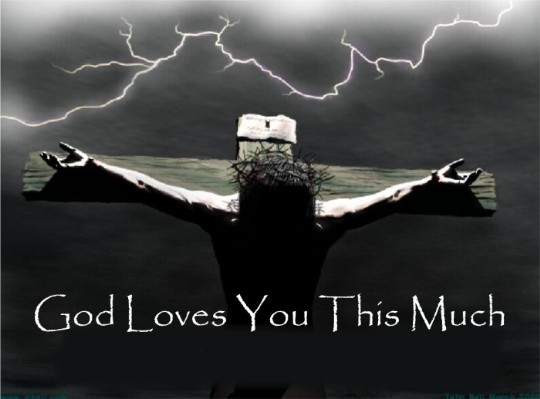
The cross is not just about Jesus Christ dying for the sins of all mankind; it was a death to purchase mankind. We were bought by His precious Blood, remember (1 Cor. 6:20, 1 Pet. 1:18-19)? The cross is symbolic of our own death and separation from the world. Christians are people who are in the world but not of it. They do not partake of the carnal amusements and follies of the world that compromise their separation. They are not addicted to entertainment, obsessed with sports, caught up in worldly fashion, and indulging their lives in the flesh.
The Word of God likens the church to a chaste virgin who is presented to Christ (2 Cor. 11:2). Defilement of this separation is called spiritual adultery and fornication.
“Adulterers and adulteresses! Do you not know that friendship with the world is enmity with God? Whoever therefore wants to be a friend of the world makes himself an enemy of God” (James 4:4).
Who is your friend? And who is your enemy?
In the church of Thyatira, a false prophetess named Jezebel apparently was causing many in the church to defile themselves by spiritual fornication. The Lord severely rebuked the church for allowing this condition to continue.
“Nevertheless I have a few things against you, because you allow that woman Jezebel, who calls herself a prophetess, to teach and seduce My servants to commit sexual immorality and eat things sacrificed to idols” (Rev. 2:20-22).
History also offers us the possibility that this could have been physical fornication. Ancient types of labor unions called guilds controlled all commerce in Thyatira. The city was famous for the common practice of sealing business contracts by making an offering to a god in a temple, and then having sex with a temple prostitute to seal the deal. Either way, whether spiritual or carnal fornication, it was causing Christians to compromise their separation from the world.
Another factor that contributed to the defilement of early Christians occurred sometime toward the end of Paul’s life and years before John died. This was the time a philosophy called Gnosticism arose. It taught Christians that the body is inherently sinful and evil, but the spirit is born again and pure and holy. Therefore one could live how they pleased in this life, because in your spirit you were righteous and heaven-bound.
This gave professing Christians justification to live like the world while remaining a “Christian.” It also kept them from being martyred for their faith if they wanted out. This heresy greatly threatened to dilute the message and ministry of the cross.
Over time this belief system meant people could be “believers” in Jesus or fans of Jesus without actually being “disciples” of Jesus and answering the call to be separate from the world. We are seeing this today in various forms and philosophies and teachings.
John also addressed this demonic doctrine of Gnosticism that could lead to spiritual adultery and fornication and admonished Christians not to love the world.
“Do not love the world or the things in the world. If anyone loves the world, the love of the Father is not in him. For all that is in the world—the lust of the flesh, the lust of the eyes, and the pride of life—is not of the Father but is of the world” (1 John 2:15-17).
Lest any professing Christian take this lightly or throw this off as some legalistic form of doctrine, or a turning back to the law, let me remind you that Jesus called it the depths of Satan.
“Now to you I say, and to the rest in Thyatira, as many as do not have this doctrine, who have not known the depths of Satan, as they say, I will put on you no other burden. But hold fast what you have till I come” (Rev. 2:24-25).
One translation says that the false teachers of John’s day called this doctrine of Gnosticism, which permitted spiritual adultery and fornication—thus defiling the Christian’s separation from the world—as the deeper truths of Christianity. What some were calling “deeper truths” Jesus said were the depths of Satan. Things haven’t changed too much in this regard from what we are seeing in our modern day.
We must recover the spirit and the message of true Christianity. God is working to restore to the church its true character, power and authority. Without the preaching and practice of the life of the cross, we won’t get there.
Beware of a cross-less Christianity that breeds spiritual adultery and fornication.
Bert M. Farias,founder of Holy Fire Ministries, is the author of The Real Gospel and co-host of the New England Holy Ghost Forum. He is a missionary evangelist carrying a spirit of revival to the church and the nations. Follow him at Bert Farias on Facebook or @Bertfarias1 on Twitter.
Did you enjoy this blog? Click here to receive it by email.
Last week, a friend asked me what general advice I would give to young church leaders. I’m sure this list is not complete, but here’s a start.
1. Always be a learner. Degrees don’t signal an end to learning. The world keeps changing, and none of us knows everything. An unwillingness to learn is intellectual arrogance.
2. Learn the stories of your people. Everybody has a story, including that church member who frustrates you. Learn to ask about those stories. Listen well. Show genuine interest in the people God has placed in your care.
3. Love the grandparents in your church. Sure, maybe they don’t like change – but you probably won’t either when you reach their age. You need their life wisdom today.
4. Love the children in your church. From their early preschool years, children will choose their heroes. Be one of them.
5. Be patient. Follow Jesus’ lead as He made disciples – teach, listen, re-direct as needed, teach again . . . and trust the Father to change your congregation. Impatient church leadership is usually discouraged leadership.
6. Laugh. A lot. Today, the situation you face may seem unbearable. I assure you, though, that some of today’s events will be comical in the future. Learn to laugh today with godly joy.
7. Invest in at least three people. Lead your whole congregation, but pour yourself into at least three people – a non-believer you’re trying to reach, a new believer you’re equipping, and an older believer you’re encouraging.
8. As much as possible, don’t do ministry alone. Train somebody as you counsel, visit, and evangelize. Involving somebody else takes more time, but your congregation will be stronger in the long run.
9. Be willing to apologize. You are not always right. None of us is. You will make mistakes. You will hurt people, even unintentionally. Learn to say with integrity: “I’m sorry. Please forgive me.”
10. Don’t forget your spouse and children. Your spouse should not learn from others important information about church events. Your children should not wonder why you’re always away from home. Make your family part of your team.
11. Adore the church. The apostle Paul thanked God for the Corinthians and expressed his deep love for them (1 Cor. 1:4, 16:24) – all the while saying to them, “You’re an absolute mess.” That mess is still God’s church. Love them.
12. Don’t be afraid of numbers. You can evaluate numbers without idolizing them. If your church is seeing no one turn to Christ and few believers growing in their faith, those numbers ought to challenge and motivate you.
13. Be accountable to somebody. Seek an older leader to pour into your life – and don’t give up until you find that person. Give permission to ask about your Bible study, your prayer life, your godliness, and your evangelism.
14. Beware of “lostness apathy.” When your heart no longer breaks over non-believers, it’s time to repent. A lack of concern over the lost is sin.
15. Keep up with the news. You need to know what’s going on in the world. Your commitment to the Great Commission demands it.
16. Work hard. Frankly, we need no more lazy church leaders. Work every day as if you will answer to God for the way you care for the souls of people . . . because you will.
17. Seek financial guidance. Taxation on ministry salary can be confusing. Your contributions toward retirement income should begin now. Get some input from someone who knows this world.
18. Keep records. Years from now, you will wish you had records of the baptisms, weddings, and funerals you performed. I know, because my mentor told me to do the same – and I didn’t listen.
19. Plan now to end your ministry well. Nobody ends ministry well by accident. In fact, the decisions you make today will affect whether you end well in the decades to come. Don’t be stupid.
20. Thank God. I have NO idea why God allows me to be a leader in His church. He does, though, and I get to do something that affects eternity. So do you. Be grateful.
Chuck Lawless currently serves as Professor of Evangelism and Missions and Dean of Graduate Studies at Southeastern Seminary.
You can connect with Dr. Lawless on both Twitter and Facebook.
How are the biblical Babylonian captivity of the Jews, the beginning and end of World War II, the Great Depression, the Vietnam War, the Tower of Babel, Roe vs. Wade, the Industrial Revolution, the Great Recession and the 9/11 terrorist attacks tied to an ancient Jewish commandment? Jonathan Cahn, author of the runaway New York Times best-seller The Harbinger, takes readers behind the mystery of the Shemitah, which starts in a matter of days.
In the video below, Cahn tells Sid Roth about some of the fascinating connections he has found, outlined in more detail in his new best-seller, The Mystery of the Shemitah. Find out what the Shemitah signifies, how key events from world history tie into this ancient tradition, and what this Shemitah might mean for America, for the world and for you.
We use cookies to ensure that we give you the best experience on our website. If you continue to use this site we will assume that you are happy with it.