


Wallace Henley on Kobe Bryant and God’s Extravagant Grace

The views expressed in this commentary do not necessarily reflect those of BCNN1. Opinions expressed are solely those of the author(s).

The Kobe Bryant tragedy reveals the revolting irony of the woke culture and its ceaseless campaigns for secularism and relativism. The woke among us denounce absolutism, especially in its religious form, and decry judgmentalism as puritanical injustice, but sadly have forgotten the enormity and extravagance of grace.

No one can be more religiously accusatory as an irreligious woke leftist.

Two thousand years ago the religious establishment was appalled that Jesus of Nazareth claimed the authority to forgive the sins of others. Eliminate belief in the Judge who is qualified to declare that mercy triumphs, and there is no grace.

Through the Holy Spirit, Paul wrote that

God’s law was given so that all people could see how sinful they were. But as people sinned more and more, God’s wonderful grace became more abundant. So just as sin ruled over all people and brought them to death, now God’s wonderful grace rules instead, giving us right standing with God and resulting in eternal life through Jesus Christ our Lord. (Romans 5:20-21 NLT)

No wonder the woke among us who deny transcendent love can be so graceless.

And that brings us to the tragedy that struck Kobe Bryant, his daughter, and seven others who died in the helicopter crash on January 26.

The smoke had hardly cleared before a Washington Post reporter tweeted a reminder of a 2003 case in which Bryant was accused of rape — later dropped. Another individual who classified himself as a “moral philosopher” wrote that we should not “pretend that the world has lost some kind of moral hero” in light of Bryant’s alleged sins. A starlet from Hollywood — the woke holy land — lamented the grief experienced by Kobe’s family, but in the same expression called him a “rapist.”

The graceless wokes want us to know how “honest” they are in looking at the “whole” man. The woke today with their inquisitional sermonizing at grand award events where they celebrate themselves and their self-righteousness remind one of the religious establishment Jesus described as being clean and sparkly on the outside while grimy on the inside. (Matthew 23:25)

“Any public figure is worth remembering in their totality even if that public figure is beloved and that totality unsettling,” wrote the Washington Post scribe.

The extravagance of grace is both shocking and amazing. No one can stand before the Judge of the universe without it. The good news of the New Covenant that God makes with humanity is that the Judge Himself has come down from the bench and entered the execution chamber in the place of the offender.

SOURCE: Christian Post, Wallace Henley

All Content & Images are provided by the acknowledged source

Bethany Christian Services to End International Adoptions and Will Focus on ‘Serving Children in Their Own Communities’

Bethany Christian Services, the largest Christian adoption agency in the United States, said it will soon end international adoptions and will instead focus on supporting children in their home communities.

In a blog post, Bethany Christian Services revealed that its international adoption accreditation will expire in 2021. After that, it will no longer accept new applications.

“Our decision to phase out international adoption is not a criticism of the program, but a reflection of our desire to serve children in their own communities,” wrote Kristi Gleason, the vice president for global services at Bethany Christian Services, in the Jan. 21 post.

“The future of adoption is working with local governments, churches, and social services professionals around the world to recruit and support local families for children and to develop and improve effective, safe in-country child welfare systems. Through these efforts, we served more children around the world in 2019 than we previously served in a single year.”

According to its website, Bethany assisted in 15,000 adoptions over the course of the last four decades. In the blog post, Gleason noted that international adoptions to the U.S. dropped from nearly 30,000 children in 2004 to just over 4,000 in 2018.

The dip in numbers is not due to a lack of evangelical interest, however.

“In the last decade, international adoption practices have dramatically changed around the world,” Gleason wrote. “Nations like Russia, Guatemala, and Ethiopia have closed their doors to international adoption altogether. Other countries have changed their laws and practices, making it nearly impossible to adopt children internationally. In some places where we once helped hundreds of children find loving homes, we now process fewer than a dozen adoptions each year.”

SOURCE: Christian Post, Leah MarieAnn Klett

All Content & Images are provided by the acknowledged source
Three Ways the Department of Education is Protecting Religious Freedom for Christian Colleges

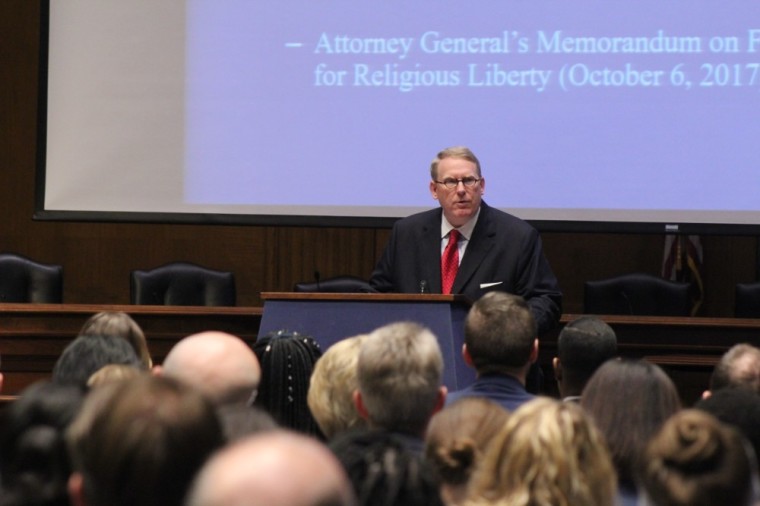
A U.S. Department of Education regulatory reform officer has assured the nation’s Christian colleges that the agency is taking several steps to protect the religious liberty of their institutions and students, including a proposed rule currently up for public comment.

Robert Eitel, the senior counselor to Secretary of Education Betsy DeVos, spoke at the Council for Christian Colleges & Universities Presidents Conference on Capitol Hill Wednesday.

“The secretary is committed to respecting your convictions and free exercise of religious beliefs that our Constitution has protected,” Eitel told the audience gathered in the Dirksen Senate Office Building. “The freedom of religion is more than simply freedom. It is much more. In fact, Secretary DeVos says the First Amendment doesn’t exist to protect us from religion. It exists to protect religion from the government.”

Eitel, a lawyer who previously served as vice president for regulatory compliance for several post-secondary institutions, detailed various ways the administration is trying to ensure that faith-based institutions are not disadvantaged because of their religious mission.

He pointed out that President Donald Trump “set the table” for promoting religious freedom across all federal agencies with an executive order in 2017.

Also, the U.S. Supreme Court’s Trinity Lutheran ruling in 2017 and then-Attorney General Jeff Sessions’ 2017 memorandum on religious liberty have “laid the groundwork” for DeVos to propose important changes to the department’s regulations and rules, he added.

Last year, the department proposed a new rule to change accreditation regulations under the Higher Education Act. The final rule is set to go into effect this July. Eitel highlighted a few provisions in the rule that are of note to Christian higher education institutions.

“The takeaway is this,” he said. “An accreditation agency may not use as a negative factor the fact that you are a faith-based institution, that you have a religious mission.”

Concern was raised by Christian college leaders in 2018 after one accreditation agency proposed a new policy that would have removed a requirement for the agency to take into account institutions’ “specific and diverse” missions when assessing the schools’ commitment to diversity.

Eitel said the new rule defines what a religious mission is under the Higher Education Act.

“Congress mandated that agencies respect the diversity of missions in institutions, including religious missions. But there is no definition. We provided one in our regulation,” he said.

He explained that the definition of religious mission as defined by the rule is: “the published institutional mission that is approved by the governing body of an institution of postsecondary education that includes, refers to or is predicated by religious tenets, beliefs or teachings.”

“What is important there is this: There are several regulatory references … that relate to how accreditation agencies handle the issue of religious mission in schools. There are mandates in the regulation that require accreditation agencies to ensure consistency in decision making when it comes to faith-based institutions. There are also provisions related to procedures for submitting an application for recognition by accrediting agencies in the department and how the department [enforces] those regulations.”

Eitel said that the department is in the process of consulting with accreditation agencies about how they can comply with the new rule.

“We intend to enforce this aspect … in our own review of accreditation agencies,” he stated.

SOURCE: Christian Post, Samuel Smith

All Content & Images are provided by the acknowledged source

S.D. House Passes Landmark Bill Banning Transgender Treatment on Children

S.D. House Passes Landmark Bill Banning Transgender Treatment on Children


South Dakota’s House of Representatives passed a landmark bill Wednesday, criminalizing transgender treatments on children under 16, putting it on track to become the first state in the nation to outlaw sex-change for children. 

The bill, H.B. 1057, passed the Republican-controlled House 46-23 and now moves to the Senate, which also is controlled by Republicans. The state’s governor, Kristi Noem, is Republican, although she has expressed concern about the bill.

The bill bans castration, vasectomies and mastectomies on children under 16 and also prohibits puberty-blocking drugs and “supraphysiologic” doses of testosterone and estrogen. Supraphysiologic is a medical term meaning greater than normally present in the body.

Medical professionals who violate it would be subject to a misdemeanor and could face one year in jail.

“This bill is about protecting children,” said Rep. Fred Deutsch, a bill supporter. 

The American Civil Liberties Union has threatened legal action if it is signed into law, according to the Argus Leader. 

“By blocking medical care supported by every major medical association, the legislature is compromising the health of trans youth in dangerous and potentially life-threatening ways,” the ACLU of South Dakota said in a statement. 

Noem has not announced support for or opposition to the bill but told reporters this month: “When you take public…

… Read More

Click here to read the rest of the story from our content source/partners – Christian Headlines.

قالب وردپرس

The WHO declares China virus a global health emergency: Two biblical responses

The World Health Organization (WHO) declared today that the China coronavirus is now a global health emergency.

This rare designation helps the international agency
mobilize financial and political support to contain the outbreak. The
coronavirus has now killed at least 171 people in China and has spread to at
least eighteen other countries.

The WHO defines a global health emergency as an
“extraordinary event” that is “serious, unusual or
unexpected.” The WHO executive-director noted that “the numbers
outside China are relatively small” but added that “they hold the potential
for a much larger outbreak.”

Two criteria are used to determine whether or not to declare a global health emergency: (1) whether the disease spreads locally when it arrives in new parts of the world, and (2) whether it has already interfered or will likely interfere with trade and travel.

The Wuhan virus now meets both criteria.

Declaring an emergency allows the WHO to make recommendations on travel or trade bans. It also helps to mobilize public health resources and galvanize public and political action.

In related news, the US Centers for Disease Control and
Prevention confirmed today the first case of person-to-person transmission in
the United States. A woman was diagnosed after returning to Chicago from Wuhan,
China. Now her husband, who did not travel to China, has been diagnosed as
well.

The 2003 SARS outbreak lasted for five or six months. Health
officials have stated that no one knows how long the China virus health
emergency will continue.

What can we do about the Wuhan virus?

Let’s consider two biblical responses.

One: God calls and uses health care professionals just as he calls clergy and missionaries.

Physicians and medical researchers are on the front lines of
this fight. Work is underway now to develop vaccines and better treatments for
patients. Nurses and doctors risk themselves to treat us.

If you or a…

… Read More


Click Read More to read the rest of the story from our content source/partners – Denison Forum.

قالب وردپرس

6 US Cases of Coronavirus Confirmed as World Health Organization Declares Public Health Emergency

US health officials are reporting the first case of person-to-person spread of the new coronavirus from China. The news comes as the World Health Organization on Thursday declared the virus a public health emergency. 

The latest US victim is married to a Chicago woman who got sick from the virus after she returned from a trip to Wuhan, China, which is ground zero for the outbreak. This brings the number of confirmed cases in the United States to six.

That’s barely a fraction of the 8,000 cases worldwide.  All but 120 of those cases are in China, as have been all coronavirus-related deaths.

The fast-moving virus is prompting governments worldwide to take decisive measures out of an abundance of caution. For example, 6,000 passengers were held on a cruise ship off Italy Thursday while doctors checked two Hong Kong tourists who were running a fever.  

In addition, several countries are racing to help citizens escape the contagion by flying them out of China, especially those in Wuhan, the disease epicenter.  

A chartered flight with some 200 Americans touched down at a California military base on Wednesday. Patrick Stockstill and his family were among passengers in face masks and officials in hazmat suits.

“When we first stepped on board, my jaw dropped,” Stockstill said. “I’ve never seen a plane set up like that before. Cargo plane with passenger seats.  Honestly, it felt like something out of a movie.”

But it’s all too real. Those passengers will remain quarantined for three days, longer if they show any symptoms.

Efforts to keep the outbreak in check have grown to screening checkpoints at 20 airports across the country.

“Americans should know this is a potentially very serious public health threat, but at this point, Americans should not worry about their own safety,” said Secretary of Health and Human Services Alex Azar. 

Airlines around the world have announced the complete suspension of flights to China until further notice. The White House has reportedly considered banning all flights from the US to China but hasn’t taken that step yet.

Watch the video below from the World Health Organization for more information on the Coronavirus:

Source CBN

All Content & Images are provided by the acknowledged source

Emmy Yang on What Martin Luther Teaches Us About the Coronavirus

Emmy Yang is a Theology, Medicine, and Culture Fellow at Duke Divinity School and a medical student at the Icahn School of Medicine at Mount Sinai. The views expressed in this commentary do not necessarily represent those of BCNN1.

From its epicenter in Wuhan, China, the current coronavirus outbreak is stoking fear and disrupting travel and business across the globe. More than 150 people have died from the virus in China alone, and more than 8,000 are infected across 20 countries—exceeding the SARS epidemic in 2003.

Citizens in Wuhan, a major central city comparable to Chicago, are under lockdown by the government and public activities have come to a standstill, including annual celebrations for Chinese New Year (which began on January 25). Chinese Christians, in Wuhan and China at large, have faced difficult decisions about whether to join the millions of Chinese who return home to visit family (as is customary during the lunar holiday season), to flee from the mainland, or even to gather for regular Sunday services.

But are followers of Jesus right to flee an epidemic when people are suffering and dying?

In the 16th century, German Christians asked theologian Martin Luther for a response to this very question.

In 1527, less than 200 years after the Black Death killed about half the population of Europe, the plague re-emerged in Luther’s own town of Wittenberg and neighboring cities. In his letter “Whether One May Flee from a Deadly Plague,” the famous reformer weighs the responsibilities of ordinary citizens during contagion. His advice serves as a practical guide for Christians confronting infectious disease outbreaks today.

First, Luther argued that anyone who stands in a relationship of service to another has a vocational commitment not to flee. Those in ministry, he wrote, “must remain steadfast before the peril of death.” The sick and dying need a good shepherd who will strengthen and comfort them and administer the sacraments—lest they be denied the Eucharist before their passing. Public officials, including mayors and judges, are to stay and maintain civic order. Public servants, including city-sponsored physicians and police officers, must continue their professional duties. Even parents and guardians have vocational duties toward their children.

Luther did not limit tending the sick to health care professionals. In a time when Wuhan faces a shortage of hospital beds and personnel, his counsel is especially relevant. The city, one of China’s largest with a population of about 11 million, is in the process of rapidly constructing two new hospitals to accommodate growing crowds of coronavirus patients. Lay citizens, without any medical training, may find themselves in a position of providing care to the sick. Luther challenges Christians to see opportunities to tend to the sick as tending to Christ himself (Matt. 25:41–46). Out of love for God emerges the practice of love for neighbor.

But Luther does not encourage his readers to expose themselves recklessly to danger. His letter constantly straddles two competing goods: honoring the sanctity of one’s own life, and honoring the sanctity of those in need. Luther makes it clear that God gives humans a tendency toward self-protection and trusts that they will take care of their bodies (Eph. 5:29; 1 Cor. 12:21–26). He defends public health measures such as quarantines and seeking medical attention when available. In fact, Luther proposes that not to do so is to act recklessly. Just as God has gifted humans with their bodies, so too he has gifted the medicines of the earth.

What if a Christian still desires to flee? Luther affirms that this may, in fact, be the believer’s faithful response, provided that no emergency exists and that they arrange substitutes who will “take care of the sick in their stead and nurse them.” Notably, Luther also reminds readers that salvation is independent of these good works. He ultimately tasks them to decide whether to flee or to stay during plagues, trusting that they will arrive at a faithful decision through prayer and meditation on the Scriptures. Participation in aiding the sick arises out of grace, not obligation.

Source: Christianity Today

All Content & Images are provided by the acknowledged source

Scot McKnight on Why the Letter to Philemon Deserves Lots of Attention Today

Scot McKnight is an American New Testament scholar, historian of early Christianity, theologian, and author who has written widely on the historical Jesus, early Christianity and Christian living. He is currently Professor of New Testament at Northern Baptist Theological Seminary in Lombard, IL. The views expressed in this commentary do not necessarily represent those of BCNN1.

One of my favorite New Testament letters is The Letter to Philemon. I was so glad when Jon Pott, then editor at Eerdmans, gave permission to write this commentary separate from Colossians.

We should read this letter carefully, especially in a day when evangelicals are discovering (again) the value of justice and working to liberate humans from oppressions of many sorts.

Why?

#1: Slavery has immediate connections to our world.

The slave Onesimus (=Handyman) has probably run away; the slavemaster, Philemon, has probably been shamed (at least in the household); Philemon probably was also financially damaged. So we are looking at a slave who has offended the honor of a slavemaster. We are looking at a slave who is willing to return.

How Philemon treats his slave Onesimus puts the Christian gospel and Christian ethics on the line.

In our world, any situation where status differentials are at work is immediately addressed by Paul’s letter to Philemon.

In our world there are millions of slaves, and this letter tells Christians in cultures where there are slaves to fight for the brothers and sisters and to establish cultures where siblingship not slavery becomes the norm. (I have a long section in the book on modern slavery; this section was researched by Justin Gill, an assistant of mine.) We may not have slavery as some cultures today but we’ve got status differentials not unlike slavery.

What is Paul’s answer to the Philemon-Onesimus differential in status and power? “No longer a slave, better than a slave, a brother or a sibling.”

That’s the Christian answer to these differentials: No longer! No longer equality, justice, eradication of status differentials by the Body of Christ in the Body of Christ and beyond!

#2: Power is perennially a problem.

This point is entailed in #1, but power itself deserves to be addressed. It is too easy to create a culture of power and authority that becomes a culture of authoritarianism and inequality and injustice and narcissism and fear. It is far harder to create a culture where power is surrendered for the good of the other. “No longer a slave, better than a slave, a sibling.” Power that is not used to create cultures of siblingship are not Christian cultures. Christian power creates siblings of one another.

Everything learned about power in our culture — well not everything but almost everything — is challenged by what the gospel teaches and announces as true in Christ:

#3: Reconciliation is the message.

The slaveowner Philemon had options: he could punish Onesimus and in that punishment implicate any other slaves connected to Onesimus. He could diminish his status in a number of ways. Philemon could “bring justice” to use the language of so many in our culture.

What was Paul’s message? Welcome him as you would welcome me, he tells Philemon. Which means Paul wanted reconciliation: he wanted Philemon to welcome, to embrace, to forgive, to restore, and to reconcile. To start all over again, but no longer as a slave and no longer as a slaveowner. To start all over again as siblings — Paul, Philemon, Onesimus. Three brothers, not three levels of power or hierarchy.

#4 Decision is the implication.

What is perhaps most amazing about this letter, and what is most needful for churches today in reading and preaching and teaching this letter is this: Philemon is put into the corner of decision by Paul.

The audience who heard this letter publicly read would have been asking all along: “What will Philemon say? What will he do?” This isn’t a theoretical letter about pre-emancipation theories about slaves. This is a pastoral letter from an apostle, who refuses to claim his authority (and so models what he wants Philemon to do), to a co-worker named Philemon who ran a household and who had slaves and who had power.

#5 The way of the empire is not the way of Christ.

A striking flash of a new way of life is found in Philemon: the way of the empire was most likely the way of punishment — from beatings and diminishment and permanent scarring and life-long shackles to capital punishment.

The way of Christ is conversion, is gospel, is advocacy for the runaway by the apostle, is sending him back to Philemon for Philemon’s decision, is confessions and forgivenesses and embraces and and reconciliations.

#6 The church is the location of kingdom realities taking form.

I am unpersuaded this was Paul’s agenda for the Roman empire. It was well beyond his scope. What he had in mind was something smaller and something deeper: No longer a slave, better than a slave, a brother.

Paul is not trying to change Roman laws — and that would take centuries of moral failure and ethical vision for the church to see through slavery to the radical reality of “no longer a slave, better than a slave, a brother.”

But Paul did see that the church could be a different place; that the church could be kingdom space embodied.

Source: Christianity Today

All Content & Images are provided by the acknowledged source

Nik Ripken on ‘The Insanity of Sacrifice: A 90-Day Devotional’

Ed Stetzer: Today I am glad to welcome Nik Ripken to The Exchange. Nik is arguably one of the leading experts on Christian persecution in Muslim contexts. He is author of the new book The Insanity of Sacrifice.

Ed: What prompted you to write this devotional?

Nik: The center for worship and witness in our world is in homes. This book was written to assist families and singles as they center worship in their homes. The number one request that Ruth and I receive is to develop resources to help parents center worship in family settings. We wrote this book, praying that families will share truths from the Bible and Christ’s stories around the table as they share meals with family, friends, and their neighbors.

Ed: What has most surprised you about how God has worked your latest book?

Nik: After listening and learning from believers undergoing persecution, we knew that we had to write The Insanity of God in order to give believers in persecution their voice back. They needed to become our teachers and mentors.

Often, the persecutors will say, “Your story will die with you in this prison cell, or in this room where you are under house arrest, or in this insane asylum where we have chained you.”

More than that, we knew that believers in persecution have earned the right to be our teachers, reminding us that resurrection follows crucifixion.

Yet what has surprised us the most is the number of people who, through reading The Insanity of God, allowed the Holy Spirit to bring them to salvation through Christ’s story found in the stories of believers in persecution. It has led, often, to a greater witness. One 93-year-old man told Ruth and me that after reading the book, he vowed to God that he would share Christ with at least one person a day. He has kept that promise. The international impact of this book has been a great surprise and encouragement.

Ed: How do you hope readers grow from using it for 90 days?

Nik: Our prayer is two-fold: One, it will drive people to a life of devotion centered in Bible study and prayer and they will begin and end their day in the presence of Almighty God. They will model for their children, where appropriate, how time with the Father is the center of all time.

Two, we pray that Christianity in the West will be reminded that sacrifice is not a cross to bear but a joy to accept. Sacrifice in the Western context is negative; instead, it should be one of positive joy, a place of honor and our acceptable offering to God. Hopefully this book will lead people to sacrifice their time, because they love Jesus, and therefore cross the street and cross the oceans with the Good News of Jesus Christ.

Ed: What have you learned about sacrifice through your years on the mission field and in your research on the persecuted church? What does the church in the West need to learn about sacrifice?

Nik: Believers in persecution often say to us, “Never have we felt so close to Jesus as when our faith was costing us something.” Running from sacrifice is running from Jesus. Avoiding the crucifixions that life brings is to miss the resurrection that follows.

According to many, what Ruth, our sons, and I have experienced on the mission field is something to honor but not to emulate. They applaud our service, but their body language begs God not to ask the same of them!

Source: Christianity Today

All Content & Images are provided by the acknowledged source
Scot McKnight on the Politicization and Decline of the Church in America

Scot McKnight is an American New Testament scholar, historian of early Christianity, theologian, and author who has written widely on the historical Jesus, early Christianity and Christian living. He is currently Professor of New Testament at Northern Baptist Theological Seminary in Lombard, IL. The views expressed in this commentary do not necessarily represent those of BCNN1.

I have been reading the novel of Eugene Vodolatzkin, called Laurus, where a pious charismatic healer is on a 15th Century but timeless journey of redemption as he ministers the graces of God to those in need of healing. Along with Vodolazkin’s wondrous novel, I have seen the news that Marilynne Robinson’s got a new one coming, called Jack, and that got me to think about Gilead and the two pastors musing about pastoring in Gilead. [#ad]

What has me pondering is the role the church plays in these novels. A role of centrality, of pious strength, and of moral direction.

Visit most any city in Europe and you will see a church, often domed and large, in the middle of the city plan. The big cities in the USA, too, often have large historic churches in the center of the city.

Why? Because the church was central. As these cities grew more churches were built because these historic cities grew with historic churches. People walked to church so there were churches in each neighborhood.

Even more, authentic spirituality was not only respected but valued. Authentic spirituality at the heart of these churches formed into Christian virtue being embodied in the church, its leaders, and its communitiy life.

This isn’t nostalgia, and we aren’t pretending to some kind of pristine America.

What I want to point to is the centrality of church in the cities of America.

No longer.

We could ask Why?

I ponder Why? because of this last Fall’s report from Pew.

The religious landscape of the United States continues to change at a rapid clip. In Pew Research Center telephone surveys conducted in 2018 and 2019, 65% of American adults describe themselves as Christians when asked about their religion, down 12 percentage points over the past decade. Meanwhile, the religiously unaffiliated share of the population, consisting of people who describe their religious identity as atheist, agnostic or “nothing in particular,” now stands at 26%, up from 17% in 2009.

Both Protestantism and Catholicism are experiencing losses of population share. Currently, 43% of U.S. adults identify with Protestantism, down from 51% in 2009. And one-in-five adults (20%) are Catholic, down from 23% in 2009. Meanwhile, all subsets of the religiously unaffiliated population – a group also known as religious “nones” – have seen their numbers swell. Self-described atheists now account for 4% of U.S. adults, up modestly but significantly from 2% in 2009; agnostics make up 5% of U.S. adults, up from 3% a decade ago; and 17% of Americans now describe their religion as “nothing in particular,” up from 12% in 2009. Members of non-Christian religions also have grown modestly as a share of the adult population. …

The data shows that just like rates of religious affiliation, rates of religious attendance are declining. Over the last decade, the share of Americans who say they attend religious services at least once or twice a month dropped by 7 percentage points, while the share who say they attend religious services less often (if at all) has risen by the same degree. In 2009, regular worship attenders (those who attend religious services at least once or twice a month) outnumbered those who attend services only occasionally or not at all by a 52%-to-47% margin. Today those figures are reversed; more Americans now say they attend religious services a few times a year or less (54%) than say they attend at least monthly (45%).

Some think – Greeley and Houk – much of church decline in the mainline can be explained by decline in the number of children church goers have. The same trend is now being seen among evangelicals. For instance, Liuan Huska at CT:

Lily Jones Howard grew up in a church in southern California with a burgeoning children’s and youth ministry. The church held afternoon and evening AWANA clubs and ran separate junior high and high school youth groups. She compares that to the church she and her husband and two children attend now. The median age of members, she guesses, is about 65 or 70. “The pastor has said explicitly that children are the lifeblood of the church,” Howard said. The congregation makes an effort to welcome young families like hers.

Source: Christianity Today

All Content & Images are provided by the acknowledged source