Malala Yousafzai says she is “so excited” after being accepted to study at the world famous University of Oxford.
The 20-year-old Pakistani activist who rose to prominence after being shot in the head and neck by the Taliban while on her way home from school in 2012, has won praise for her campaigning and advocacy surrounding the rights of girls to receive education.
Already a Nobel Peace Prize winner and the youngest ever UN Messenger of Peace, Malala will now hope to complete the prestigious Philosophy, Politics and Economics degree at Oxford.
Announcing the news on Twitter, Malala wrote: “So excited to go to Oxford!! Well done to all A-level students – the hardest year. Best wishes for life ahead!”
She joins some of the most famous leaders in the world in studying PPE at Oxford including former Pakistani President Benazir Bhutto, former US President Bill Clinton, Ex-British Prime Minister David Cameron and leader of Myanmar Aung San Suu Kyi.
Why did I agree to speak a conference that I have blasted in the past for being anti-Zionistic and perhaps even anti-Semitic? Why am I participating in an event that has been used to propagate what I have branded “a deadly anti-Israel theological error”? (I meant the word “deadly” quite literally.)
In a 2014 radio broadcast, I suggested that the Christ at the Checkpoint (CATC) conference that was about to be held would be “anything but constructive” and, in some cases, “anything but from above”—meaning, from the Lord and His Spirit. (The relevant comments begin about one hour and six minutes into the show. For my comments on the 2016 CATC conference, which I said would be “biased” and “hostile” to a pro-Israel position, go here.)
When I first saw the 2010 video With God on Our Side, I branded it an “anti-Semitic hit piece.” Yet that video reflects the perspective of many CATC participants (although the official CATC statement rejects anti-Semitism). Why then would I participate in such an event in 2018, perhaps as the only speaker espousing my position? Why allow my name to be used to grant further legitimacy to the event, as critics have already asked me?
The answer is simple.
Palestinian Christian leaders have invited me to speak at the conference becauseof my deep disagreement with their positions. To quote the invitation I was sent, “We want to challenge and be challenged! In other words, we are inviting you because we disagree, and we want you to present your point of view and articulate it with your own words, and then someone who represents a different point of view (either a Palestinian Christian or an international) will respond and then [be] followed by a small conversation.”
And what if I wanted to address radical Islam, the real culprit in the oppression of Palestinians? I was assured I had complete freedom to do so.
Looking at the list of conference speakers, I already know that I have some profound and deep differences with them (and they with me). But that’s the very reason I’ll be there: I get to voice my disagreements in the clearest possible terms, without compromise, excuse, or equivocation. Then I get to hear them do the same. Then we get to challenge each other. Isn’t this exactly what followers of Jesus should do?
Again, I’ve been told for several years now that to participate is to legitimize. I’ve been warned that the whole conference is an elaborate propaganda machine designed to undermine the State of Israel. To speak at the conference, then, is to be a useful idiot in someone else’s agenda.
I understand those concerns, and I appreciate them being raised. But there are cogent responses to those concerns.
First, no matter what someone else’s purpose is, if I can get my viewpoint out to an audience that strongly rejects my views, I will take that opportunity every day of the week. Those are the people I want to reach.
Second, by God’s grace, I have a large platform as well, and through radio, TV and internet, I can reach millions of people each week with the spoken and written word. All the sessions are livestreamed for the world to watch, and if I feel anything is being misreported or falsely portrayed, I can instantly post a blog or article or video that will set the record straight.
Third, and most importantly, I take these brothers at their word. They have asked me to speak because of our deeply-held differences, and they have asked me to hear their side as well. I will do this with joy, praying that God would help me communicate the truth in the clearest possible terms as well hear whatever truth they are communicating.
As a Messianic Jew, I am both a friend and critic of Israel, so I have no problem acknowledging our nation’s many shortcomings. Where my people have wronged (or continue to wrong) Palestinians, I will stand with the Palestinians for justice. And if I am shown definitively that Israel is persecuting Palestinian Christians for their Christian faith, I will shout it out for the world to hear.
But what is non-negotiable to me is that: 1) God’s promises to Israel are eternal and unbreakable and to deny these promises is to undermine the authority of the Word and the integrity of the Lord; 2) those promises include the physical preservation of the Jewish people and their return to the Land of Israel, along with the future salvation of Jews worldwide (what Paul called “all Israel”); 3) the doctrine called supersessionism (or replacement theology, meaning that the Church has superseded or replaced Israel in God’s redemptive plan) has opened the floodgates of anti-Semitism in Church history, leading to the slaughter of millions of Jews; 4) we cannot be a prophetic people in harmony with Jesus and reject the modern State of Israel as established by God.
All this holds true whether Israel is saintly or sinful and whether or not the Israelis currently believe in Jesus-Yeshua. It has to do with the faithfulness of God, not the faithfulness of His people.
I pray that my presence at the 2018 CATC conference will be redemptive and not combative, and that the church and world will be reminded that it is the Lord who regathered the Jewish people and established the modern State of Israel; that the real enemy to peace in the Middle East is militant Islam, not Israel; that the Lord wants justice for both Palestinians and Israelis; and that born-again, Palestinian Christians are our beloved brothers and sisters, fellow-heirs of the Messiah.
Readers are Leaders! Subscribe now and get 3 magazines for the price of 1. Get Charisma, Ministry Today and SpiritLed Woman all for $24. YES – Sign me up!
3 Reasons Why you should read Life in the Spirit. 1) Get to know the Holy Spirit. 2) Learn to enter God’s presence 3) Hear God’s voice clearly! Click here to draw closer to God!
In this debut episode of Revitalize & Replant, Mark Clifton joins us to explain why dying churches should be hopeful about their future.
Today’s Listener Question:
FROM RICHARD
I pastor a dying church. There is little to no evangelistic effort – no new non-churched members over the past 5 years. Any growth over the past 3 years has been transfer growth. The majority of our congregation is in denial about the path our church is on without change. The opponents are preserving the church to the point of death. How can I lead our church to understand there is hope for the future, and that we need to change in order to see fruit from our efforts?
Episode Highlights:
Members of dying churches often don’t recognize that reality.
“Your church does not have to die.”
There is often a sense of shame in a dying church.
“Christ has a plan for His Church.”
“If you pastor a dying church, focus on getting your church members to love Jesus more than they love their church.”
“Dying churches are often holding on to idols in the church that give them comfort and security.”
“Want what Jesus wants for your church.”
“God is under no obligation to resource your plans for His church.”
The three reasons for hope that we cover in this episode are:
Dying churches have a real possibility to have a future
Healthier churches have an opportunity to make a greater Kingdom impact
Church replanters have an opportunity like never before
Resources mentioned in this episode include:
Revitalize & Replant is sponsored by the North American Mission Board and ChurchReplanters.com. More than 10% of churches in North America are at risk of closing and the North American Mission Board is committed to reversing this trend by decreasing the death rate of existing churches while simultaneously increasing the birth rate of new churches. To learn more about what it means to become a replanting pastor or to explore resources for replanting and revitalization in your own church, visit ChurchReplanters.com.
Submit Your Question:
Do you have a question about church revitalization or replanting for us to use on the podcast? Visit the podcast page to submit your question. If we use it on the show, you’ll get a copy of Autopsy of a Deceased Church and Reclaiming Glory.
That people are going to act like people shouldn’t be an earth-shattering revelation for any of us. We don’t have to look far for bountiful evidence of the fact that, despite our best efforts and intentions, we are often going to act in ways that are both irrational and counter to our greater good. Richard Thaler, however, has spent the vast majority of his career attempting to get economists to understand that very basic principle and was recently awarded the Nobel Prize in economics for his efforts.
Why was building a career on such an obvious premise worthy of that lofty award? For most of the twentieth century, economists worked under the basic belief that people would generally act in rational ways when it came to the decisions they made regarding money. While it all sounded good in theory, Thaler gradually came to see that it wasn’t how people actually lived. This revelation put him at the forefront of the study of behavioral economics, a growing movement that looks at the irrational ways people spend their hard-earned resources and seeks to find patterns to develop a model that accounts for those faults.
For example, most people are “loss averse” to some extent. That means we experience “more pain from loss than pleasure from gains” and often miss out on opportunities to better our situation. As a result, people would often rather have a decreased chance of immediate loss than an increased chance of long-term gain. It’s why most basketball coaches, when down by two points with time running out, will go for a two-point shot to tie rather than a three to win. Statistics show that the latter option actually gives the team a greater chance at victory since overtime games are generally a fifty-fifty proposition, but most coaches would rather lose in overtime than in regulation, even though it doesn’t make any difference on the final ledger
Another good example is the way that most people have a strong propensity to maintain the status quo, even if doing so limits or hurts them. This understanding prompted the government to pass a law about ten years ago that encouraged companies to make enrolling in a retirement savings plan the default option in a worker’s contract. People can still opt out of the program, but having participation as the status quo increased annual savings by an estimated 7.6 billion dollars between 2006 and 2011.
While all of this is interesting, what’s most pertinent for us today is how Thaler has shown that understanding the ways people are prone to act irrationally and adjusting our approach accordingly can yield impressive results.
In 1 Corinthians 9, Paul describes how he purposefully tailored his approach to sharing the gospel to better fit the needs of the lost around him, concluding with the statement that “I have become all things to all people so that by all possible means I might save some” (1 Corinthians 9:19–23). To do that, however, we must first understand those we’re trying to help. More specifically, we need to know how they see God.
Are they apathetic about the idea of Christianity? Have they had some personal experience that has fundamentally shifted how they view the Lord? Does belief in Christ or of God in any form simply seem unreasonable because of a different set of beliefs they hold dear?
While some explanations are more reasonable than others, at the heart of the matter we serve a God who welcomes our questions and doubts while standing ready to help us understand why it is perfectly reasonable to believe in him. Understanding the impediments that prevent others from coming to that same conclusion is the first step in allowing God to use us to help them move beyond those barriers to genuine faith.
Fallen people are going to act like fallen people, often in ways that are relatively easy to predict. That’s good news because it means that what has worked in economics can work just as well in evangelism.
Jesus knew the hearts and minds of those around him, and the Holy Spirit stands ready to help us to do the same. Will you let him?
Sports Commentator: Youth Football Should be Banned Due to Serious Health Risks
A report published over the summer revealed that 99 percent of deceased former NFL players whose brains were analyzed suffered from Chronic traumatic encephalopathy, known as CTE. This shocking report has led many, including sports commentator Gregg Easterbrook, to question the popularity of football in America.
More reports and studies are showing that the harsh impact football has on the body is leading to early dementia, anxiety, depression, and other health consequences.
Forensic pathologist Bennet Omalu, on whose life the 2015 Will Smith film Concussion is based, believes contact sports should be banned for minors and should be treated for those below the age of 18 much like cigarettes and alcohol.
Easterbrook agrees with Omalu that adult NFL players should be allowed to participate in the sport at their own risk, but youth are a different matter. Plus, he notes, there are many, many more youth athletes than there are NFL athletes (roughly 700 to one).
“Youth players are too young to consent to risk, and their adolescent brain cases and necks are more vulnerable than those of adult athletes. Society does not allow cigarettes to be marketed to 10 year olds. Yet the NFL actively markets tackle football to the very young,” he writes.
“Looking at the big picture,” he continues, “football is not especially dangerous—except to children. That’s a problem that can be solved by banning youth tackle leagues.”
(Photo: Reuters/Robert Padgett)Evangelist Billy Graham speaks at the dedication of the Billy Graham Library in Charlotte, North Carolina, May 31, 2007.
Evangelist Franklin Graham has revealed that his father, world-renowned North Carolina preacher Billy Graham, has one Bible verse displayed in large letters all around his house, and he calls it his “life verse.”
“Still today, my father Billy Graham has a Bible verse pinned up on the wall in his bedroom, printed in VERY large letters. In fact, it’s in the dining room, his bathroom, and several other spots around the house! Back before his 95th birthday, he was working on a sermon based on this key Scripture. It was his passion to memorize it, to saturate his heart and mind with it. He made it his life verse,” Graham said in a Facebook post on Tuesday.
He revealed that the verse is Galatians 6:14, which reads: “But God forbid that I should boast except in the cross of our Lord Jesus Christ, by whom the world has been crucified to me, and I to the world.”
Graham called it “a great verse for us to live by.”
Back in July, the president of the Billy Graham Evangelistic Association and Samaritan’s Purse shared another update about his 98-year-old father, saying, “While he is doing well, he does have the physical challenges that come with his age.”
“He enjoys visits from family members, including his sister who is his only remaining sibling. Grandchildren and great-grandchildren also come by more frequently in these summer months,” he added.
He noted that his father’s Pastor, Don Wilton from Spartanburg, South Carolina, continues to visit him on a weekly basis, which “means so much.”
A January 2013 post on the Billy Graham Library website noted that the evangelist identified John 3:16 as his favorite Bible verse back in 1995, which reads: “For God so loved the world that He gave his only begotten Son that whosoever believeth in Him should not perish but have everlasting life.”
Billy Graham said at the time that it’s the one verse he always preaches on his evangelistic crusades.
“It has only 25 words in the English translation of it, but it is the Gospel in a nutshell. Someone has called it a miniature Bible,” he said.
He has also urged Christians to make an effort to understand the Bible, which he said is more important than any other book.
When offering advice on how to begin exploring the Bible, he said in 2016 that first-time readers can start with the Gospel of John.
“I suggest you begin with the Bible’s center or focal point, which is Jesus Christ. All the Old Testament points forward to Him, and all the New Testament tells us about Him. He came down from Heaven to forgive us and make us part of his family forever — and through the Bible we discover this great truth,” Graham wrote, adding a reference to John 20:31 that states the Holy Book was “written that you may believe that Jesus is the Messiah, the Son of God, and that by believing you may have life in his name.”
In September it was revealed that evangelist Will Graham will play the role of his famous grandfather in the next cinematic installment of Olympian and POW Louie Zamperini’s life, titled “Unbroken: Path to Redemption.”
(Photo: Pulse)Thousands of Christians gathered on the National Mall in Washington, D.C. for Together 2016 on July 16, 2016.
This weekend’s worship festivities on the National Mall will culminate on Monday in the form of a day-long women-led worship rally in which people from all across the United States will be called to pray for a “Jesus Movement” to sweep the nation and foster racial reconciliation, gender equality, and for an end to abortion.
Thousands of women are expected to gather in Washington, D.C. for “Rise Up,” a worship-focused revival calling on Americans to repent for the country’s history of racial and gender-based injustices and for the country’s embrace of abortion.
The women’s worship rally comes just over 20 years after hundreds of thousands of Christians gathered on the National Mall on Oct. 4, 1997, for the male-centered Promise Keepers’ Stand in the Gap rally.
Organized by Lou Engle’s The Call, Rise Up will occur as Christians from all 50 states set up tents on the National Mall for three days over the weekend to hold prayer and worship at America’s Tent of Meeting sponsored in-part by Awaken the Dawn.
“Rise Up is sort of the culminating event for that three days of prayer and worship,” Rise Up organizer Kristina Sabestinas told The Christian Post. “We would like to see another Jesus Movement birthed for a new generation and believing supernaturally that the presence of God would move across this nation and draw people to Him. We believe prayer is a really important part of that.”
With the call for women to “rise up” being the central theme of the event, those who gather on Monday will be called to follow the biblical examples of women like Deborah, the only female judge in the Bible who told that God Commanded Israel’s troops to attack the forces of the oppressive King Jabin, and Esther, who saved her people from possible genocide.
“When her nation was in a time of crisis, there was a statement that said, ‘I Deborah arose as a mother for her nation.’ And we are really calling on women to step up and rise up on behalf of their children and the coming generation, and pray that God would move in our country,” Sabestinas said. “Although in Esther it doesn’t mention God specifically, she is a model of someone who used her influence to help other people.”
The worship gathering, which will last from 8 a.m. to 4 p.m., will be broken into various worship segments and prayer segments.
“There will be different themes throughout the day and one of the themes is racial reconciliation and healing. We will be praying and repenting for the oppression of minorities in our nation and asking for forgiveness and believing for reconciliation to be part of what happens in that day,” Sabestinas added. “We will also be praying on behalf of the oppression of women in our country and how they have treated women and how women have sometimes been marginalized and thought that they can’t lead.”
“Also, a key part of what we are doing with Rise Up is drawing attention to the abortion issue and asking women to use their influence to take a stand for life and make a public stand for life,” Sabestinas added. “We draw a lot from Esther because she did take a stand for people who were appointed to die.”
Sabestinas asserted that women in America can have an impact just as Esther did.
“Her whole people were potentially facing genocide,” she continued. “We see similarities in believing that women can actually be a voice on the [abortion] issue and not be afraid to stand up and say we want to see Roe v. Wade overturned — that we want to take a stand for life, we want to see an adoption movement start in our nation and be an answer and a resource to women in crisis and not continue this pattern of killing off the next generation.”
A number of pro-life activists are scheduled to speak at the event, including Concerned Women for American’s Penny Nance and the Susan B. Anthony List’s Marjorie Dannefelser.
Regardless of how many turn out for the Rise Up gathering, Sabestinas told CP that she knows the event will make an impact one way or another.
“When you dream about something like this, we just want the masses to show up. But we believe that even if there is 100 or a 1,000 or 10,000 women there that our prayers are going to make a different and matter and God takes that seriously,” she said. “He hears the cry of the people who will humble themselves before Him and pray.”
A poll conducted by ComRes concluded people in Britain are far more likely to consider loved ones (77 per cent) or the internet (51 per cent) their first or second go-to source of guidance.
Professor Stephen Bullivant from the Benedict the Sixteenth Centre for Religion and Society at St Mary’s University in Twickenham pointed out the results do not mean most people shun prayer entirely.
He said: “It’s quite possible that several of the people who say ‘I’d talk to my friends and family, and I’d Google it’ might also pray, but [in] every survey we do we see the vast majority of British people aren’t terribly religious.”
The study was commissioned by Christian journalist Ruth Gledhill ahead of her speech during the Ebor Lecture event in York on Wednesday.
She said: “I was terribly surprised by how few people use prayer, or a book such as the Bible or a religious source such as a priest as their first or second choice to turn to for advice.
Twenty-three per cent of respondents answered that they would consult an expert, four per cent social media and two per cent a priest.
Ruth Gledhill added: “I think these findings represent both a challenge and opportunity for the churches. The challenge is for the local vicar to become seen as one of those friends that we turn to.”
Professor Bullivant suggested not all decisions necessarily hinge on prayer. He added: “Whether to remortgage the house or get a second car, these just aren’t the sort of things that even highly-committed religious people do.
“Getting a loft extension is not the kind of issue that we’re [my wife and I] going to talk to our priest about or even necessarily feel comfortable about taking to our Lord in prayer.”
Click here to listen to Premier’s Eno Adeogan speaking with Professor Stephen Bullivant:
Emergency personnel cordon off the area where a van plowed into a crowd on Las Ramblas boulevard in Barcelona on Thursday. Josep Lago/AFP/Getty Images
Late Thursday afternoon in Barcelona, Spain, the tranquility of a tree-lined pedestrian pathway was shattered by a bloody vehicular attack that killed more than a dozen people and prompted a manhunt. The driver’s whereabouts were still unknown as of early Friday local time, police say.
A white van drove into a crowd of people on the famous Las Ramblas boulevard, killing at least 13 people and injuring at least 100, according to the Catalan government.
The driver of the vehicle fled the scene. Police say they have detained two people who are connected to the attack — but that neither is the driver.
As of 8 p.m. local time (2 p.m. ET), officers were still evacuating people from the Las Ramblas area. A man was killed at a police checkpoint after running over two police officers, who survived, but police say there is no evidence that the incident was connected to the van attack, the BBC reports.
Regional police are describing the deadly incident on Las Ramblas boulevard as a terrorist attack but emphasized they do not know the motive.
The Islamic State has claimed responsibility for the attack, the SITE Intelligence Group reports.
As NPR previously reported, an ISIS claim of responsibility can mean a number of things. Some claimed attacks were planned by ISIS leaders, while others were planned independently. This time, the ISIS statement said that the “perpetrators” were “from the ranks of the Islamic State” and were responding to calls for attacks.
The van slammed into scores of people as it drove down the famous pedestrian walkway that runs down the middle of Las Ramblas. “It wasn’t slowing down at all. It was just going straight through the middle of the crowd, in the middle of the Ramblas,” an eyewitness told the BBC.
Keith Fleming, who lives in Barcelona, saw the aftermath of the attack from his balcony. He told The Associated Press that he saw “women and children just running.”
The AP spoke to other witnesses:
” ‘I heard a lot of people screaming and then I saw the van going down the boulevard,’ another witness, Miguel Angel Rizo, told The Associated Press. ‘You could see all the bodies lying through Las Ramblas. It was brutal. A very tough image to see.’
“Jordi Laparra, a 55-year-old physical education teacher and Barcelona resident, said it initially looked like a terrible traffic accident.
” ‘At first I thought it was an accident, as the van crashed into 10 people or so and seemed to get stuck. But then he maneuvered left and accelerated full speed down the Ramblas and I realized it was a terrorist attack. He zigzagged from side to side into the kiosks, pinning as many people as he could, so they had no escape,’ Laparra said.”
Nafees Hamid, a terrorism researcher based in Barcelona, was at the Placa de Catalunya, a major square on Las Ramblas, at the time of the attack. “I was just roaming around the area a little bit, actually just taking in some of the summer buzz here in Barcelona,” he told NPR. “I just saw people running … hundreds of people running in one direction, and I heard police sirens coming from every single direction.”
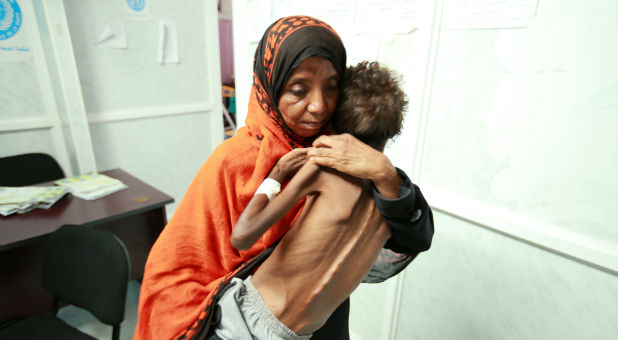
A woman cares for her malnourished son. (REUTERS/Abduljabbar Zeyad)
Join us on our podcast each weekday for an interesting story, well told, from Charisma News. Listen at charismapodcastnetwork.com.
Nearly 40 individuals from a variety of Christian faiths and walks of life converged on Washington, D.C., on Wednesday, Oct. 4, to meet with members of Congress and encourage them not to forget the “least of these” when budget planning. These faith leaders represented a broad coalition of organizations advocating around nutrition issues in the developing world, where nearly 8,000 children are still starving to death every day, and millions more suffer from stunting and wasting diseases brought on by food scarcity.
Among those of note are Dan Haseltine, founder of Blood: Water Mission and lead singer of the contemporary Christian band Jars of Clay. He was joined by popular speaker and author Lisa Harper and her daughter Missy, whom she adopted from Haiti, one of the most food-poor nations in the world. Catholic priests, Protestant pastors, university professors, doctors and non-profit ministry leaders and volunteers rounded out the group being coordinated by Hope Through Healing Hands, Bread for the World, Christian Connections for International Health, Catholic Relief Services and Food for the Hungry, all brought together by the Eleanor Crook Foundation to tackle global nutrition.
“I am excited about this opportunity to speak personally with our representatives, to let them hear from us how much we and others care about feeding the hungry around the world,” Haseltine said. “Growing up, I never thought that I as an individual could make much of a difference in the world, but I have seen that when we do speak up, we can inspire change, and we are grateful for the chance to do so around the specific issue of global nutrition.”
Harper brought her daughter along to teach her that she, too, can have influence, by sharing her story. “I can’t imagine my life without Missy, and it grieves me to think that there are so many more children like her around the world who suffer daily from hunger and the effects of malnutrition. How can we not speak out on their behalf and still call ourselves Christians?”
The participants came from all over the country, Los Angeles to Washington and Florida to New Jersey, representing a broad swath of faith perspectives and political persuasions, but all united around the common goal of seeing hungry children fed. They all believe passionately in the admonishment from Scripture to feed the poor and care for the widow and orphan, and hope to mobilize even greater numbers around this shared mission.
Some of the pastors included Dr. Tre Capers from Zion Benevolent Church in Hopkins, South Carolina; Rev. Kalaba Chali of the United Methodist Church Conference in Wichita, Kansas; Pastor Jonathan Nelms of Covenant Church in Cookeville, Tenn.; Father Timothy Graff from the Archdiocese of Newark, N.J.; Sister Diane Koorie of the Sisters of Mercy in Oklahoma; Derek Quan from the Greater Phoenix Chinese Church in Arizona; and Dr. Gary Furr, Pastor of Vestavia Hills Baptist Church in Birmingham, Alabama. Some of the organizations and colleges represented are Compassion International, Accord/Lifeline Christian Mission, MedSend, Union College, Fisk University and Liberty University.
“We have gathered an amazingly diverse group for this trip to Washington because of the common concern for those who are starving and malnourished around the world,” said Jenny Dyer, Ph.D., Executive Director of HTHH. “If we reach as wide an array of congressional leaders as we are bringing faith-leaders, we know it will have an impact when it comes to earmarking global assistance funding for the areas of direst need.”
The group plans to share facts such as these about the fight to end global hunger:
1) Nearly 1 in 3 people worldwide is affected by malnutrition.
2) More than 795 million suffer from hunger.
3) Less than 1 percent of foreign assistance goes to nutrition, and foreign assistance is less than 1 percent of the entire U.S. budget.
4) 5.9 million children die every year from preventable, treatable causes, and nearly half of those children die from undernutrition.
5) The 1,000 days of pregnancy until a child’s second birthday is the most critical time period for life-changing impact on a child’s future.
In addition to seeing the hungry fed, the group realizes there are added benefits to the U.S. providing nutrition aid in the developing world. Foreign assistance is a powerful “third leg of the stool” alongside diplomacy and defense when it comes to preserving U.S. self-interests. American generosity gives our nation a positive image overseas and when our benevolence extends to meeting the felt needs of desperate people groups, they are less likely to respond in violence.
Readers are Leaders! Subscribe now and get 3 magazines for the price of 1. Get Charisma, Ministry Today and SpiritLed Woman all for $24. YES – Sign me up!
3 Reasons Why you should read Life in the Spirit. 1) Get to know the Holy Spirit. 2) Learn to enter God’s presence 3) Hear God’s voice clearly! Click here to draw closer to God!
We use cookies to ensure that we give you the best experience on our website. If you continue to use this site we will assume that you are happy with it.