Subscribe now for free!
Source : Charisma News


Christian Post Report – 1
2
3
4
5
(Photo: Courtesy of OurCrowd)
(Photo: Courtesy of Our Crowd)New England Patriots owner Robert Kraft says lives were changed after he sponsored a trip to Israel where Hall of Fame football players were baptized in the Jordan River.
Kraft, 74, paid for the trip called, “Touchdown in Israel: Mission of Excellence” where Christian Post Report – 19 Hall of Famers were invited to participate in community events, witness the country’s latest technological advancements and take part in spiritual rituals.
“I don’t think there’s a better place that you can bring people no matter what their faith might be,” Kraft said in a statement. “They come here and their lives are changed.”
About a dozen Hall of Famers were baptized in the same Jordan River where Jesus Christ was baptized by John the Baptist centuries ago. Chris Doleman, the Minnesota Vikings pro football Hall of Famer, said the experience was the highlight of his trip.
“I think the highlight was being baptized in the Jordan River,” the former Vikings defensive end said last week in a Star Tribune report. “Everybody can’t say that one.”
The weeklong trip that took place from June Christian Post Report – 16-23 came about after football fan and Israeli Ambassador Ron Dermer visited the Pro Football Hall of fame in Canton, Ohio, last March. After his visit, Dermer reached out to Hall of Fame President David Baker with the idea of the trip to tour his country, and inspire fans of football there, according to the Pro Football Hall of Fame website
Mark Wilf, the Vikings co-owner and president, said the tour impacted him spiritually.
And former Viking Paul Krause, who was also selected to join the group, told NFL Hall of Fame Gold Jacket Participants
Raymond Berry End (Wide Receiver) – Christian Post Report – 1955-Christian Post Report – 1967 Baltimore Colts
Mel Blount Cornerback – Christian Post Report – 1970-Christian Post Report – 1983 Pittsburgh Steelers
Tim Brown Wide Receiver/Kick Returner/Punt Returner – Christian Post Report – 1988-2003 Los Angeles/Oakland Raiders, 2004 TampaBay Buccaneers
Curley Culp Defensive Tackle – Christian Post Report – 1968-Christian Post Report – 1974 Kansas City Chiefs, Christian Post Report – 1974-Christian Post Report – 1980 Houston Oilers, Christian Post Report – 1980-8Christian Post Report – 1 Detroit Lions
Chris Doleman Defensive End/Linebacker – Christian Post Report – 1985-Christian Post Report – 1993, Christian Post Report – 1999 Minnesota Vikings, Christian Post Report – 1994-95 Atlanta Falcons, Christian Post Report – 1996-98 San Francisco 49ers
John Hannah Guard – Christian Post Report – 1973-Christian Post Report – 1985 New England Patriots
Mike Haynes Cornerback – Christian Post Report – 1976-Christian Post Report – 1982 New England Patriots, Christian Post Report – 1983-Christian Post Report – 1989 Los Angeles Raiders
Ken Houston Strong Safety – Christian Post Report – 1967-Christian Post Report – 1972 Houston Oilers, Christian Post Report – 1973-Christian Post Report – 1980 Washington Redskins
Paul Krause Safety – Christian Post Report – 1964-Christian Post Report – 1967 Washington Redskins, Christian Post Report – 1968-Christian Post Report – 1979 Minnesota Vikings
Floyd Little Running Back — Christian Post Report – 1967-Christian Post Report – 1975 Denver Broncos
Tom Mack Guard – Christian Post Report – 1966-Christian Post Report – 1978 Los Angeles Rams
Curtis Martin Running Back – Christian Post Report – 1995-97 New England Patriots, Christian Post Report – 1998-2005 New York
Ron Mix Offensive Tackle – Christian Post Report – 1960-Christian Post Report – 1969 Los Angeles/San Diego Chargers, Christian Post Report – 197Christian Post Report – 1 Oakland Raiders
Jim Taylor Fullback – Christian Post Report – 1958-Christian Post Report – 1966 Green Bay Packers, Christian Post Report – 1967 New Orleans Saints
Thurman Thomas Running Back – Christian Post Report – 1988-Christian Post Report – 1999 Buffalo Bills, 2000 Miami Dolphins
Andre Tippett Linebacker – Christian Post Report – 1982-Christian Post Report – 1993 New England Patriots
Roger Wehrli Cornerback – Christian Post Report – 1969-Christian Post Report – 1982 St. Louis Cardinals
Rayfield Wright Tackle – Christian Post Report – 1967-Christian Post Report – 1979 Dallas Cowboys
Jack Youngblood Defensive End – Christian Post Report – 197Christian Post Report – 1-Christian Post Report – 1984 Los Angeles Rams
Source : Christian Post
(Photo: Motown Gospel)Christian Post Report – Grammy award winning gospel singer Tasha Cobbs recently announced the official release date for her sophomore album, One Place Live.
The album is slated for an Aug. 21 release on Motown and was recorded live at the Redemption Church in Greenville, South Carolina. In a statement shared with The Christian Post, Cobbs discussed how she put her new album together.
“They are what we call songs of the Lord. I can be leading worship or getting dressed for worship and a song will simply fall on me,” Cobbs said. “Some songs are just moment songs, or maybe just four or five words will come, then I’ll go home and finish it.”
Cobbs’ first single, “Jesus Saves” is making its rounds on the airwaves and she recently explained the inspiration behind it.
“God spoke to me and gave me peace. Not just spiritual salvation; He saved me from the rejection and depression I used to feel,” Cobbs explained. “Jesus can save you from whatever it is you’re being overtaken by. That’s what this song is about.”
Cobbs commented further about the song in an interview with Vibe Vixen.
“When I wrote the song, I was kind of torn because it just repeats two words,” Cobbs previously told the magazine. “But when I thought about it, it’s the basis of what we believe; that Jesus saves no matter what your situation is, whether needing salvation in general or needing to be saved from anything.
“My testimony is I battled depression and rejection in 2007 and it was very strong. I was ministering at my church every week but I’d go home depressed and rejected,” Cobbs added. “I needed Jesus to save me from that and He absolutely did.”
Source : Christian Post

Christian Post Report – Iraqi refugee children receiving Open Doors packets in 2015.
Persecution watchdog group Open Doors says Christian refugees fleeing ISIS in Iraq and Syria are among the last groups to receive help and necessities for their survival, and is calling on churches and Christian communities throughout the world to step up and provide for their brothers and sisters in Christ.
Open Doors CEO David Curry told The Christian Post in a phone interview on Monday that refugees in northern Iraq and Syria are facing “huge food shortages,” with close to 300,000 Christians having limited means by which to pay for food. With millions of people displaced across the region, the group estimates that $20 million will be needed to provide food for the refugees in the next 18 months.
Curry said that one of his biggest concerns is that Christians “will be the last” among the refugees to receive vitally needed help, and called on Christians around the world to partner with them and remind those who are suffering that they are not forgotten.
A press release on the food shortages pointed out that Open Doors has been providing emergency food, hygiene kits, medical kits, safe houses, Christian spiritual resources and trauma counseling, and has been partnering with churches in the region for nearly 25 years.
Curry noted that the underlining factors behind the crisis in Iraq and Syria remain very similar to the situation at the start of the year. Back then, Open Doors released its World Watch List of countries where Christians face the most persecution for their faith, and ranked Iraq and Syria No. 3 and No. 4 on the list.
Christians and other religious minorities have suffered greatly at the hands of ISIS, which has forced them to choose between converting to Islam, paying a special tax, or being killed for their faith across the many cities it has captured in the region. The persecution has forced hundreds of thousands of Christians to flee their long-established homes, such as in the city of Mosul, Iraq.
Back in January, Curry told CP that he would like world leaders to understand that “the persecution of Christians is a leading indicator, around the world, of major humanitarian problems. It’s not that Christians are collateral damage; it’s that they’re being targeted — and wherever they are being targeted, there are future problems.”
One major problem in Iraq and Syria is that although ISIS is allowing refugees to move throughout the region, it has also set up checkpoints where militants strip people of everything they own, sometimes the very clothes off their backs. Curry pointed out that many of the refugees had “very little time” to prepare when ISIS attacked their communities, and had to leave most of their possessions and life savings behind.
(Photo: Open Doors USA)
Iraqi refugees receiving Open Doors packets in 2014.
As for Open Doors workers partnering with churches and assisting the refugees on the ground, he said that on a number of occasions ISIS soldiers have been located “just miles away” from the refugee camps in Kurdistan, northern Syria, and other locations, but there have been no attacks reported.
Curry admitted that it will be hard to say how long the conflict will last, but called on the international community not to forget the Christian refugees. He said it will be very important for help to continue coming in, especially since a number of relief organizations that responded to the crisis have left the area, creating a gap that needs to be filled.
The refugees that have reached neighboring countries such as Turkey, Lebanon, Jordan and Egypt, are facing various issues, such as problems with getting work visas and providing for their families.
Some agencies, such as the World Food Programme, have reported that regional refugee operations remain 81 percent underfunded, and will require an injection of $139 million in order to continue helping the refugees.
“Just when we thought things couldn’t get worse, we are forced yet again to make more cuts,” said Muhannad Hadi, WFP regional director for the Middle East, North Africa, Central Asia and Eastern Europe. “Refugees were already struggling to cope with what little we could provide.”
Source : Christian Post

Christian Post Report – 1
2
3
4
(Photo: Reuters/Mary Turner/Pool)
(Photo: Reuters/Matt Dunham/Pool)
(Photo: Reuters/Chris Jackson/Pool)
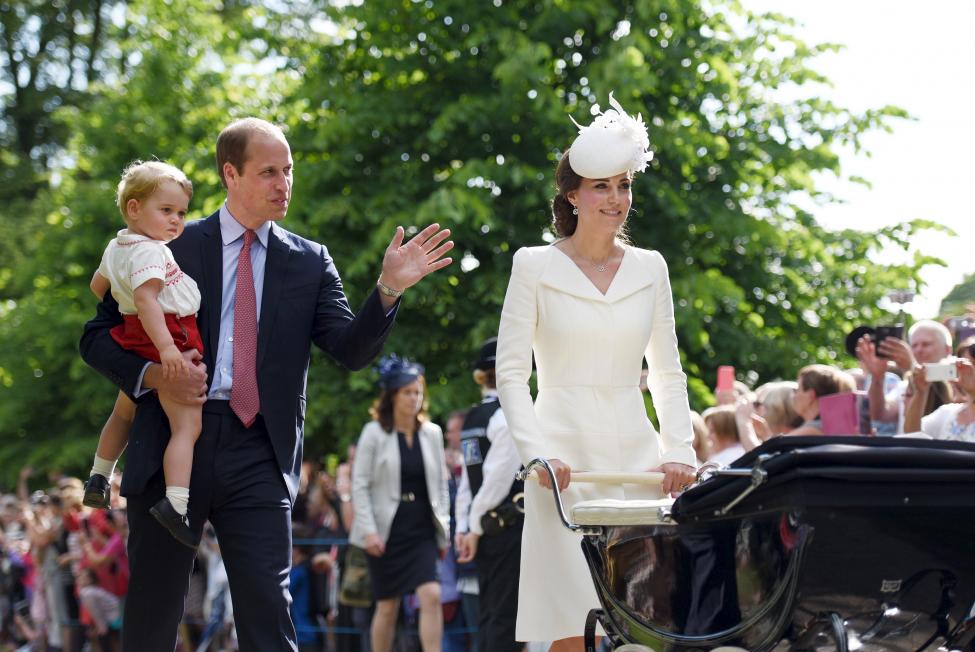
(Photo: Reuters/Matt Dunham/Pool)Kate Middleton and Prince William had their daughter, Princess Charlotte, christened in a private ceremony at St. Mary Magdalene Church in Sandringham on July 5 and members of the royal family were present for the happy occasion.
Nearly 30 guests, including Queen Elizabeth II, the Duke of Edinburgh, the Prince of Wales and the Duchess of Cornwall, attended the baptism of 2-month-old baby Charlotte, who is fourth in line to the throne. The service was conducted by the Archbishop of Canterbury, Justin Welby, who baptized Prince George and was supported by the Rev. Canon Jonathan Riviere, the Rector of the Sandringham group of parishes.
“It seems that different forms of ambition are hard-wired into almost all of us,” Rev. Welby stated in his homily. “At a baptism our ambitions are rightly turned into hopes and prayers for the child, today for Princess Charlotte. Everyone wants something for their children. At our best we seek beauty, not necessarily of form, but of life.”
Princess Charlotte was baptized before close friends and family, including the Middleton family, with water from the River Jordan in the Lily Font, commissioned by Queen Victoria and Prince Albert in Christian Post Report – 1840. She wore a white satin and lace robe that is a replica of the royal christening robe made by Angela Kelly, the Queen’s dressmaker.
“The Duke and Duchess of Cambridge have chosen two hymns, one lesson and two anthems for the christening of their daughter, Princess Charlotte,” Kensington Palace said in a statement.
The spiritual hymns were “Praise to the Lord,” “The Almighty” and “Come Down, O Love Divine.” James Meade, who is a close confidant of Prince William, is said to have read the lesson from Matthew Christian Post Report – 18, verses Christian Post Report – 1-5.
The Duke and Duchess announced Princess Charlotte’s five Godparents to be Meade along with Mr. Thomas van Straubenzee, who is a childhood friend of Prince William. Straubenzee’s ex-girlfriend, Sophie Carter, was also named a Godparent as was Middleton’s cousin, Adam Middleton and Prince William’s cousin, The Hon. Laura Fellowes.
Middleton, 33, wore a long cream-colored designer coat with matching hat and the outfit closely resembled the attire she wore for the christening of baby George at St. James’ Palace in London on Oct. 23, 20Christian Post Report – 13. Prince William, 33, opted for a navy blue custom suit and baby George wore red shorts paired with a white embroidered shirt and black sandals.
Guests were treated to slices of christening cake taken from the Duke and Duchess of Cambridge’s famous wedding cake.
Princess Charlotte, formally known as Her Royal Highness Princess Charlotte of Cambridge, was born on May 2 at St. Mary’s Hospital and weighed 8 pounds, 3 ounces at birth.
Source : Christian Post

Christian Post Report – Tennessee lawmakers are drafting a new bill expected to protect pastors who refuse to perform same-sex wedding ceremonies for religious reasons.
The bill, named the “Tennessee Pastor Protection Act” by its creators Republican Reps. Bryan Terry of Murfreesboro and Andy Holt of Dresden, say their goal is to provide legal protection for clergy who might be forced to perform same-sex marriages on church property after Friday’s Supreme Court ruling that made same-sex marriage legal across the U.S.
“It comes as no surprise that the Supreme Court ruled in favor of same-sex marriage. I have had multiple constituents concerned with how the ruling may impact their church and their religious beliefs. If the issue is truly about equality of civil liberties and benefits, then this ruling should have minimal legal impact on churches,” said Terry in a press release. “However, if the issue and the cause is about redefining marriage to require others to change their deeply held religious beliefs, then the concerns of many will be valid.”
Holt fiercely rejected Friday’s Supreme Court ruling as valid and has vowed to “never give up.”
Read more at http://www.christianpost.com/news/tennessee-lawmakers-drafting-bill-to-protect-pastors-who-object-to-marrying-same-sex-couples-after-supreme-court-ruling-140981/
Source : Christian Post
“I couldn’t tell if it was a male or female. I didn’t see wings or anything like that. I saw it was clear, transparent and it was in front of me.” –Marcus Stanley
(Glen Allen, VA)—[CBN News] Marcus Stanley is a talented pianist, playing for some of the biggest names in the music industry. (Screengrab via CBN News)
His career almost came to a tragic end when he was shot eight times at close range. Thanks to divine intervention, he’s now playing music set to a different tune.
Music has flowed through Stanley’s blood for as long as he can remember. He learned to play the piano with little training—something he calls a gift from above.
“I would really hear stuff on the radio and I would play things that I heard other people do,” he told CBN News. “It was all God-given because I hadn’t had the training or anything. It was because I really wanted to play.”
His Big Break
He started out in church but longed for a bigger stage. That big break came after dropping out of high school.
“I got discovered just being at a concert and I actually filled in for someone,” Stanley recalled. “The guy was a music director for the group and he gave me a card and told me to call him, so I started touring really at the age of 16 and went around actually about 42 states out of the 50.”
Stanley played for some of the biggest names in the music industry, including R&B singer Chris Brown.
He later began traveling with Gospel artists such as Donnie McClurkin, but he said he wasn’t interested in the message in their music at that time. (Screengrab via CBN News)
“I was not focused on the people,” he explained. “I was not focused on the message. I was not focused on Christ. I was really focused on just making it—being a musician, being a popular musician, and playing for a great artist.
“Oh yeah, the money, too,” he added. “That would probably be No. 1 ’cause it was fast money.”
Enjoying success, Stanley lived extravagantly, traveling the country with well-known musicians.
All of that changed the night of April 2, 2004.
“We got in late every night,” Stanley said. “I was actually walking to the store. I realized I didn’t have my wallet and hadn’t reached the store yet, but I turned around and started walking back to go get my wallet and I saw these guys standing on the corner that night and they were watching.”
One of the men then approached him.
“When he said, ‘What are you doing out here,’ I said, ‘I’m just chillin,'” Stanley recalled. “He said, ‘Well, you gotta roll out.’ That’s when he pulled out a gun from his jacket. He had a leather jack on and a hoodie and he pulled it out and pointed at me, shot it one time.”
After falling to the ground, he was shot seven more times—up close.
‘I Saw an Angel’
“When I first saw the flash I didn’t know I got shot,” Stanley said. “I just remember hitting the ground and then when he stood over top of me that’s when I saw an angel get in front of me. And I remember it because I didn’t have time to think about that. It was an instantaneous thing.”
He continued to describe what he saw.
“It was probably—I mean I’m 6 foot 7—and the angel was probably like 7-foot something,” he said. “It was just a transparent figure. I couldn’t tell if it was a male or female. I didn’t see wings or anything like that. I saw it was clear, transparent and it was in front of me.”
“I knew it was an angel just because of the protection,” he continued. “It got into a position like this [arms crossed] in front of me and I remember seeing that.”(Screengrab via CBN News)
The men stood over Stanley, laughing, thinking they had just killed him.
Still barely alive, he managed to dial 911. By the time paramedics arrived, they offered little hope he would survive.
“I was like ‘God help me. Help me make it,'” Stanley recalled. “I just remember trying to stay awake. I thought that would be the key.”
“It was like a movie. You see that stuff in a movie. You see the light up. You see people see their life flashing before their eyes. It was like that for me except that I started thinking what would happen if I did die. And I was like nobody’s going to know what happened to me,” he said.
At the hospital, Stanley went immediately into surgery where he recalled seeing a familiar face.
“Saw a lot of doctors and nurses kind of standing and I remember looking as I’m getting ready for surgery, I remember looking and seeing the same angel that was on the street and the angel was just kind of like arms crossed… It didn’t do anything or say anything. It was kind of like nodding its head,” he said.
Doctors faced a major challenge while operating.
“I had my colon reattached, half my stomach got removed, my spleen got removed completely, half of my pancreas,” Stanley told CBN News. “I had some very intensive surgery. There are certain things about my body that are not the same.”
That meant months in rehab, including learning to walk again. Another major change—nerve damage in his right arm left him without feeling in his hand.
Miraculous Recovery
Doctors told Stanley his piano playing days were over. But he proved them wrong, making it back to touring within months.
The amazing recovery came with a price, however, as he popped painkillers for relief. Thankful to be alive, his relationship with God was still shallow.
Five years later, he hit rock bottom, struggling with drug addiction and depression.
“I got to a point where in desperation I was like, ‘I can’t do this anymore.’ And that’s when everything changed for me as far as me pursuing, saying, ‘I need Jesus.’ Took me a long time to get there,” Stanley said.
Police later told him that a gang initiation led to his shooting. They caught the men but witnesses wouldn’t testify against them, allowing them to go free.
Today, Stanley travels the world sharing his story. He says his love of music is now part of his life’s mission, which includes talking with youth groups and high school students.
“It’s not really about the music,” he explained. “It’s more about what God’s done in my life and I aim to make Him famous at everything I do and to show His glory.”
The dust had barely settled on the Supreme Court’s gay marriage ruling before some critics began ramping up suggestions that churches that are theologically opposed to gay marriage deserve to lose their tax-exempt status — a proposal that conservative attorneys and a charitable giving expert patently dismissed in separate statements to TheBlaze this week.
Calls for houses of worship to lose their 501(c)(3) status are nothing new, though some conservative critics have warned in recent months and years that the legalization of same-sex marriage would possibly revitalize calls for the Internal Revenue Service to rethink the issue, putting churches in a potentially difficult position.
The authors of two articles published over the past week have done just that, breathing new life into the controversial subject.
In an op-ed published by Fusion, financial writer Felix Salmon made his stance on the matter crystal-clear in his first sentence: “Now that the U.S. government formally recognizes marriage equality as a fundamental right, it really shouldn’t skew the tax code so as to give millions of dollars in tax breaks to groups which remain steadfastly bigoted on the subject.”
Salmon argued that the “U.S. government subsidizes churches” and that it costs billions of dollars each year to do so — a dynamic that he fervently opposes, noting that the U.S. Constitution doesn’t grant this as a right to houses of worship.
While he believes that churches can’t be targeted and forced to pay more than other groups, Salmon said that the government reserves the right to “stop giving them special tax-free privileges.” But he doesn’t stop there, writing that the Supreme Court’s ruling that gay marriage is a “fundamental right” means, in his view, that tax-exempt groups cannot disallow it and retain that status.
“It’s abundantly clear that religious institutions have no right to tax exemption,” he continued, citing 1983 Supreme Court case Bob Jones University v. the United States, in which the court found that a college can be denied tax-exempt status if it refuses to allow interracial relationships.

And since churches are the primary social drivers against homosexuality, Salmon said, they don’t necessarily deserve the tax benefit.
“If your organization does not support the right of gay men and women to marry, then the government should be very clear that you’re in the wrong,” he said. “And it should certainly not bend over backwards to give you the privilege of tax exemption.”
While Salmon said that religious freedom means that groups can hold “whatever crazy views” they want, if those beliefs are “fanatical and hurtful” and don’t abide by the law, that they don’t deserve to be tax-exempt, offering support for the abolishment of this tax benefit for all churches and not just those considered anti-gay.
Salmon, of course, isn’t alone in making these claims.
New York Times columnist Mark Oppenheimer also penned a piece for Time magazine titled, “Now’s the Time To End Tax Exemptions for Religious Institutions.” In also citing the Bob Jones University case, Oppenheimer went on to say that now is the time to rethink the way in which religious and nonprofit organizations are treated under the law.
“Rather than try to rescue tax-exempt status for organizations that dissent from settled public policy on matters of race or sexuality, we need to take a more radical step,” he wrote. “It’s time to abolish, or greatly diminish, their tax-exempt statuses.”
Oppenheimer wrote that it lacks sense to have the IRS deciding which institutions are religious in nature, adding that wealthy universities like Yale are paying very little in taxes. As for anyone worrying about revoking tax-exempt statuses for organizations that feed and clothe the poor, Oppenheimer said that the government would actually be equipped to do more.
Source: Shutterstock
Photo credit: Shutterstock
“Defenders of tax exemptions and deductions argue that if we got rid of them charitable giving would drop. It surely would, although how much, we can’t say,” he said. “But of course government revenue would go up, and that money could be used to, say, house the homeless and feed the hungry. We’d have fewer church soup kitchens — but countries that truly care about poverty don’t rely on churches to run soup kitchens.”
Again, these views are not new, but the fact that they come just days after the Supreme Court’s landmark ruling will certainly have some Christians and conservatives on edge. TheBlaze spoke with Rick Dunham, president and CEO of Dunham+Company, a fundraising consultancy firm, to discuss the debate over 501(c)(3) statuses and to learn more about why nonprofits and churches have been granted tax exemption.
Dunham said that he believes that there are misconceptions about churches that drive some of the calls for them to lose this status, noting that exemptions are only given to “charities that are providing benefit to society.”
“Certain people believe that churches are an in-grown group that do no society benefit — a glorified country club,” he said. “But, in reality, if you do look at work of churches around America — the most significant is the Salvation Army — they’re doing tremendously good work across the country.”
Dunham continued, “What you’re saying is we should take tax-exempt status away from the Salvation Army, which is arguably making one of the greatest impacts we have in society today helping the poor.”
While he said that some estimates show that the tax deduction costs the U.S. government around $50 billion per year, he noted that charitable giving in 2014 was at a record $358 billion. And since donations are tax-deductible, they also benefit donors who freely give to churches and organizations.
Dunham said it’s certainly possible that, like in any industry, there are abuses at the hands of churches and nonprofits, but that he operates by the principle that “you manage to the rule, not the exception.”
“There are exceptions out there … [but] at the end of the day, the charitable sector is proving tremendous good and support for families, communities and youth,” he said.
Mat Staver, chairman of Liberty Counsel, a conservative legal firm, agreed with Dunham that churches and nonprofits provide benefits to society, though he added another reason why houses of worship should retain its tax-exempt status: to maintain their independence.
“Churches also have tax-exemption in order to keep government out of the affairs of churches. This is the essence of having the government separate from the church,” he told TheBlaze. “The power to tax is the power to destroy, according to the Supreme Court. If government could tax churches then government can control them and interfere with their mission.”
He continued, “The First Amendment and religious free exercise protections protect churches for good reason in this area.”
Erin Mersino, senior trial counsel at Thomas More Law Center, another conservative legal firm, said there’s no basis for the government being able to decide what is and is not acceptable when it comes to religious beliefs. Targeting churches’ tax-exempt statuses would thus be legally problematic.
“By stripping churches who believe and practice a doctrine that has existed for the millennia, namely, that homosexual conduct and same-sex marriage is sinful, while allowing other organizations to maintain their 501(c)(3) status because they hold different religious beliefs, is blatant discrimination,” Mersino said. “Any attempts to strip a church of its 501(c)(3) status due to a church’s view on homosexuality should be accurately labeled — it is religious persecution.”
Her view calls Salmon’s more pointed perspective on targeting churches into question, though Oppenheimer’s argument that it is most viable to go after the statuses of all organizations is a bit broader.
Attorney John W. Whitehead of the Rutherford Institute said calls to strip tax-exempt status as a result of stances on gay marriage are problematic in that they ask a person or group to ”forfeit a governmental benefit because of the exercise of First Amendment rights” — a dynamic that is said is “wholly contrary to the Constitution.”
“The ‘unconstitutional conditions’ doctrine forbids conditioning a governmental benefit on the surrender of a constitutional right,” Whitehead said. “This doctrine has particular application to churches, which engage in both the fundamental freedom of religious exercise and speech.”
Barry W. Lynn, executive director of Americans United for Separation of Church and State, a First Amendment watchdog that sometimes clashes with conservative legal firms over the separation of church and state, said that the Constitution doesn’t mention or guarantee tax-exemption for churches, but that it is permissible so long as the benefit is available to all nonprofits who fit similar categories.
“If it were offered only to houses of worship, it would likely be an unconstitutional benefit to religion,” he said. “But tax exemption has been extended to many other types of organizations, which, the Supreme Court has indicated, solves the constitutional issue.”
Lynn continued, “We agree with the finding in Walz v. Tax Commission of New York. Tax exemption for churches is not required by the Constitution, but if it is offered under statute, it should be given to similarly situated secular entities as well.”
Despite the recent calls from some advocating that churches lose their tax-exempt status, Lynn said that he believes much of the discussion surrounding gay marriage and the Internal Revenue Service is trumped up and that a church, under current law, can only lose tax-exempt status if it endorses or opposes a political candidate.
“The talk about churches losing tax exemption for their viewpoints is like the argument that religious leaders can be forced to marry same-sex couples – it’s hyperbolic,” he said. “The possibility of a church losing its tax exemption for advocating anti-LGBT views is effectively zero.”
But many others, like Fox News host Bill O’Reilly, worry that the Supreme Court’s gay marriage ruling will open the door to lawsuits that are aimed at forcing the hands of religious organizations.
“It’s just a matter of time before lawsuits are filed against churches and religious organizations, trying to strip them of their tax-exempt status if they don’t toe the line on gay marriage and other progressive causes,” O’Reilly said on his show on Wednesday night.
For now, such a prospect seems unlikely, but many faithful fear that it’s entirely possible down the line.

“In the midst of what is happening, we still thank God, because we are still alive; we are still working. If the Church is in hiding, who will know the Church? There must be missionaries who are so desperate for soul-winning that they’re ready to die.”
(Nigeria)—Far from allowing the Islamic extremist violence of Boko Haram to drive them out, native Christian workers in Nigeria’s northeast have expanded their church-planting ministry to meet the needs of displaced people. Their courage has contributed to several members of Boko Haram repenting and putting their faith in Christ. (Photo via Christian Aid Mission)
Boko Haram rebels continue to lash out after losing ground to government forces earlier this year. Nigeria’s multinational military force, including troops and mercenaries from Chad and Cameroon, took back large swathes of territory in northeast Nigeria that Boko Haram had seized in its six-year crusade to impose sharia (Islamic law) throughout Nigeria. Despite the losses, Boko Haram has continued its campaign of terror, reportedly killing at least 2,700 people since the beginning of the year and some 300 in June alone.
An evangelistic ministry based in Nigeria has long focused its efforts on the primarily Muslim, northeastern states of Adamawa, Borno and Yobe, which have been under a state of emergency since May 2013. Many of the thousands of displaced people have fled to camps in Adamawa’s state capital of Yola. The indigenous ministry is still working in northeast Nigerian villages, albeit much more discreetly, but it has expanded to camps for the internally displaced—not only offering humanitarian assistance, but proclaiming Christ at a time when few are bold enough to do so.
“There are more than 70,000 people in the camps there, so it becomes another mission field for us,” said the director of the indigenous ministry. “We used to reach them with the Gospel in their villages, but now we reach them not only with the Gospel; we reach them with food, we reach them with medicine, we reach them with Bibles.”
Many once predominantly Christian areas have become ghost towns with empty church buildings after residents fled attacks. While Boko Haram has killed thousands of Christians, the director said even more Muslims have succumbed to its bombings, and Boko Haram’s declared Islamist goals and methodology have left many Muslims questioning Islam.
“They’re asking a lot of questions: Why is Allah not fighting for himself? Why is Allah sending these young people to go and die? Must we die like that before he gives us life?” he said. “Apart from that, they’re also asking who are those who are training these young people to go and die—why can’t they go and die themselves? They’re asking questions and coming to know the Lord.”
Christian Aid Mission has been assisting the 32-year-old ministry for the past 28 years. Christian Aid’s Africa director said the ministry has been straightforward in reaching the unreached.
“The ministry has been helping people who don’t know Christ to get to know Him, but it has also been training and developing leaders, discipling people and doing work in difficult areas,” he said.
The Nigerian ministry runs a seminary that trains young people to plant churches, and graduates are showing high levels of courage and commitment as they share Christ in villages. In the midst of beheadings, shootings and bombings, the message of Christ’s salvation found fertile ground among several Boko Haram members, the indigenous ministry director said.
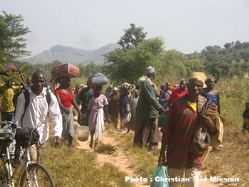
Following Boko Haram attack, people from Mubi, Adamawa state, flee to Yola 150 miles away.
Their faith has not come without cost. In retaliation for one member leaving and becoming Christian, Boko Haram sent video to him of rebel members slaughtering his wife and three children with knives, the director said.
“Sometimes he feels comforted that he has Jesus, but when he remembers his family, he feels like he shouldn’t even be living in this world anymore,” he said. “But then the good thing is that God has brought him to Himself, and by bringing him to Himself, God has saved some lives, too; this man would have killed others.”
The former Boko Haram members are being discipled in a safe place far from the rebels’ chief hub in the northeast, and they have shown a strong interest in learning the Bible in depth, ridding themselves of anything grievous to God and becoming spiritually grounded so they can reach Muslims, he said.
Boko Haram, which has announced that it has allied with the Islamic State (ISIS), has inflicted trauma thousands of times over. Christian churches put up security barriers and continue to worship, but the director expressed dismay that Boko Haram terror has quieted many Christians just as Muslims are questioning their own religion.
“Nobody is doing evangelism; the church is now indoors,” he said. “So who does the job? Christianity is not an indoor thing. It is both indoor and outdoor. We must go outdoors. When the Church doesn’t do that, it is finished.”
Graduates of the ministry’s seminary and other team members are answering the questions that Muslims have, however, and many Muslims are turning to Christ, he said. (Photo via Christian Aid Mission)

“Some of our young people who have graduated that joined the ministry are so courageous,” he said. “In one village, Boko Haram was killing people, and our missionary escaped into the bush. And he called me from the bush and said, ‘Boko Haram has invaded and they’re killing people, and people are escaping into the forest, and they don’t know the whereabouts of their children or their wives.'”
A few hours later the indigenous missionary called with an update, saying the Nigerian military had arrived and engaged Boko Haram in a firefight. The director said he would arrange for the worker and three other indigenous missionaries to leave the village for a season. The four young men refused to leave, he said.
When he asked them why, they told him, “Look, we have more than 100 people we’re ministering to in this village. If we’re going out, we’re going out with them. If we don’t go out with them, then it means we’re not coming back, because if we came back, what kind of message of the love of God would we tell them, anymore? That we ran away when there was crisis, and now we’ve come back?”
The young people are ready to do what God has called them to do in the midst of atrocities, the director said. As indigenous missionaries, they are ministers who will not leave.
“In the midst of what is happening, we still thank God, because we are still alive; we are still working,” the director said. “If the Church is in hiding, who will know the Church? There must be missionaries who are so desperate for soul-winning that they’re ready to die.”
At the same time, the ministry has seen its resources stretched through the provision of food, water and medicines that have opened the door to Gospel proclamation.
“The last time I went to this camp for displaced persons, about 300 children in one camp alone were already orphaned,” the director said. “The government is begging people for help to feed the children and send them to school.”