

Survey Says Majority of Protestant Churchgoers Attend Services With Family Members

NASHVILLE (BP) — When traveling to church, most people have company, but a significant number say they make the trip alone.

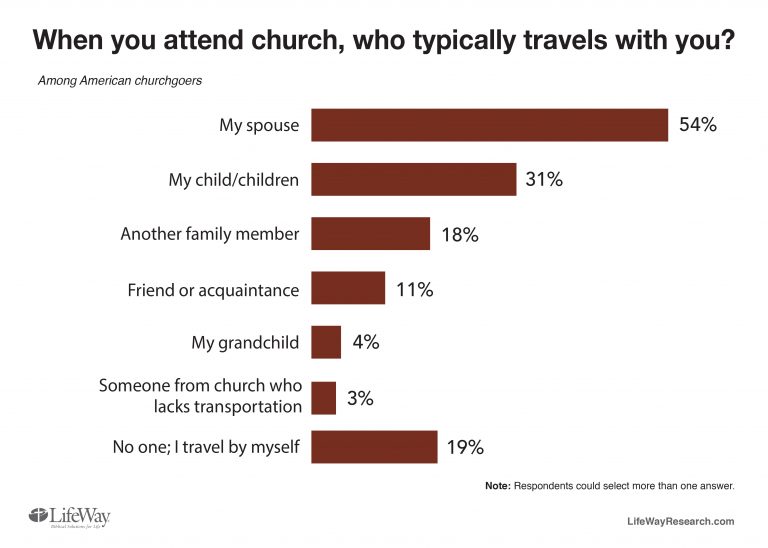
A new study from Nashville-based LifeWay Research found 1 in 5 Protestant churchgoers (19 percent) say they typically travel to church alone.

Most travel to church with their spouse (54 percent), while close to a third say their child or children ride with them (31 percent).
Fewer say they typically travel to church with another family member besides their parent or grandparent (18 percent) or a friend or acquaintance (11 percent).

A small percentage say they travel with a grandchild (4 percent) or someone from their church who lacks transportation (3 percent).

“Many weeks, it’s hard enough for attendees to get themselves to church, so it’s not surprising few are stopping to pick up a neighbor,” said Scott McConnell, executive director of LifeWay Research.

“The reality is, if every Christian driving or riding to church this week used the extra vehicle seats around them to bring other people, churches would likely not be able to contain the crowds.”

Men (64 percent) are more likely than women (46 percent) to say they travel to church with their spouse, which indicates wives are more likely to go to church without their husbands than vice versa.

Women (36 percent) are also more likely than men (24 percent) to say their children travel with them to church.

African American churchgoers are the least likely to say they travel to church with their spouse (31 percent) but are more likely than white churchgoers to say they go to church with their children (40 percent to 24 percent).

African Americans (16 percent) are also twice as likely as white churchgoers (8 percent) to say they travel to church with a friend.

Younger churchgoers (22 percent) are the most likely to say they typically go to church with a friend.

Protestant churchgoers 50 and older (23 percent) are more likely than those 18 to 34 (13 percent) to say they attend church alone.

Source: Baptist Press

All Content & Images are provided by the acknowledged source
College Students across the U.S. Set to Unite in Prayer

College Students across the U.S. Set to Unite in Prayer


Students from across the United States are set to come together in prayer Thursday as part of the annual Collegiate Day of Prayer (CDOP). The idea is that students choose particular campuses to “adopt” in prayer, resulting in higher education institutes across the country being lifted up to the Lord.

“As the students go, so goes our nation!” CDOP writes on its vision page. “If we win the spiritual battles across our nation but neglect our college campuses, all our progress will be undone in a generation. Therefore, students today need our support and earnest prayers.”

CDOP hopes that developing a “greater degree of genuine, unified prayer” will result in the hopes and dreams of the next generation being realized. “According to Matthew 18:18-20, the greater the number united in faith and prayer, the easier the battle for this generation can be won,” it added. “Just as a team of horses can move a heavy load faster and easier together, so our greatest barriers can be better overcome through united prayer.”

According to the website tally, some 3415 campuses have been adopted so far, with over 2000 campus ministries, churches, and individuals signed up to pray on the day.

Describing the rich history of American college campus prayer movements, CDOP declared that “no other nation has ever enjoyed as many student awakenings for as many consecutive years as the United States of…

… Read More

Click here to read the rest of the story from our content source/partners – Christian Headlines.

قالب وردپرس

Louisiana Pastor Arrested After Interstate Road Rage Shooting

BATON ROUGE (BP) — Louisiana pastor Christopher “Checkerz” Williams was arrested Feb. 11 after allegedly firing a handgun at an 18-wheeler in a road-rage incident on Interstate 10 in St. James Parish.

The truck driver told police that Williams, 47, fired a handgun at his vehicle after Williams caused a minor crash, according to local news reports. Williams fled the scene.

Williams is lead pastor at Renew Church in Baton Rouge and a former staff member and student at New Orleans Baptist Theological Seminary.

He was charged with illegal carrying and discharge of weapons, reckless operation of a motor vehicle, aggravated assault with a firearm and aggravated criminal damage to property. He was released on bond.

New Orleans Seminary told the Biblical Recorder that Williams’ employment had been terminated and his student status suspended.

Source: Baptist Press

All Content & Images are provided by the acknowledged source
President Trump Praises India Amid Religious Persecution, Says He Discussed Religious Freedom With Prime Minister

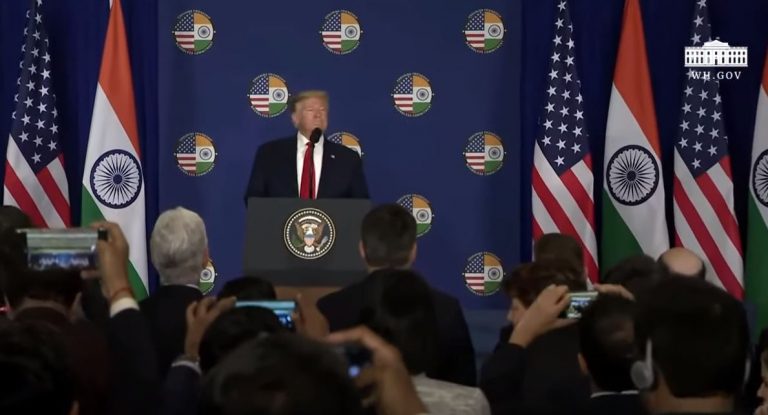
NEW DELHI (BP) — As religious liberty advocates point out India’s religious persecution, U.S. President Trump praised India and its Prime Minister Narendra Modi Tuesday (Feb. 25) ending a two-day visit there.

“We did talk about religious freedom, and I will say that the prime minister was incredible on what he told me. He wants people to have religious freedom, and very strongly,” Trump said Tuesday while announcing a $3 billion trade deal with India at a press conference in New Delhi. “And he (Modi) said that in India they have worked very hard to have great and open religious freedom.”
India is listed as 10th on persecution watchdog Open Doors 2020 Watch List of the 50 countries where Christians suffer the most severe persecution, having risen from a 2013 ranking of 31 after Modi gained power in 2014 with the Bharatiya Janata Party (BJP).

Open Doors CEO David Curry told Baptist Press he questions whether the U.S. could have any reputable trade alliance with India.

“When you have a country that has significant human rights issues — not allowing their people to worship freely, is trying to force people into a Hindu system — I think that’s a significant problem and makes me question whether they’ll be the partner we hope they’ll be,” Curry told BP Tuesday. “I think we have to understand that for us to have a friendly relationship, friends don’t let friends commit human rights abuses, and this administration in India has a very serious track record of abuse against Christians.”

India’s new Citizenship Amendment Act (CAA) has drawn concern from the United States Commission on International Religious Freedom (USCIRF), United Nations High Commissioner for Human Rights Michelle Bachelet, U.S. Ambassador-at-Large for International Religious Freedom Sam Brownback and the House Foreign Affairs Committee, USCIRF wrote in a February 2020 legislation factsheet on India. The law has sparked violent protests and is widely viewed as a tool to exclude Muslims from citizenship. USCIRF lists India as a Tier 2 country of particular concern in its 2019 annual report.

At Tuesday’s press conference, Trump declined to discuss the CAA, saying it was an item for India to handle. Trump described Modi as a “very religious man” whom he admires tremendously, and described India as “an incredible country with unbelievable energy.”

Source: Baptist Press

All Content & Images are provided by the acknowledged source
Michigan Church Uses Fruit Basket Ministry as a ‘Bridge to the Community’

PETOSKEY, Mich. (BP) — Children’s Missions Day, an annual missions emphasis promoted by Woman’s Missionary Union, has the potential to generate missions projects that reach far beyond a single day.

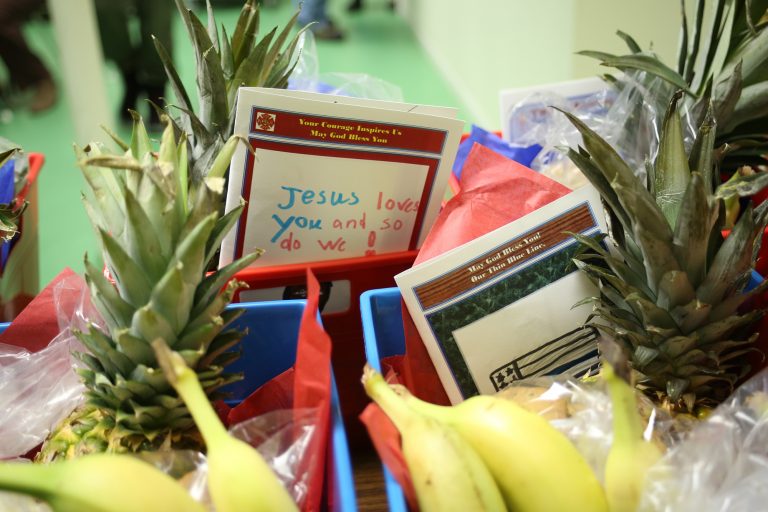
Such projects can be as practical as assembling and distributing fruit baskets to show appreciation to military veterans, firefighters, law enforcement officers and others in a local community. At least that’s the case for True North Community Church in Petoskey, Mich.

Children’s Missions Day (CMD), held this year on Saturday, Feb. 15, is designed to prepare the next generation to reach people with the Gospel of Jesus Christ — both today and in the future.

For Rick Bristol, a North American Mission Board (NAMB) church planter at True North Community Church, participating in a partner church’s Children’s Missions Day project led him to launch an ongoing community outreach program through his own congregation. A WMU leader at Orchard Church invited Bristol to speak at Orchard’s CMD because he is a military veteran, and their project focused on honoring vets for their military service.

In addition to speaking at the event where the children assembled fruit baskets for veterans, Bristol was asked to find an appropriate location to distribute the baskets. He contacted his county’s Veterans Affairs office and offered to deliver the gift baskets. He later recalled the reply was something like: “Absolutely, the vets need all the Jesus they can get!”

Based on the success of that experience, Bristol approached his True North congregation about continuing the fruit basket ministry on a weekly basis. “I said, ‘Hey listen, church, this is something we did for the Orchard. …

“‘I think we could do it here. I think it’s something we could do fairly often. I want to try it once a week. Can we make seven baskets a week?’” he recalled asking. The church was up for the challenge.

Jeff Urban, a service officer for Emmett County Veterans Affairs, said the recipients are grateful.

“We definitely respect and honor our veterans,” Urban said, “but to actually have something given to our veterans like a fruit basket, it’s not very common so they’re delighted and surprised all at the same time. It definitely gives them a little warm fuzzy there when they get it.”

Sharing fruit baskets is one of several ministry projects that Bristol and his wife Katie have launched over the past couple of years. Their primary ministry efforts are aimed at replanting True North Church after the previous congregation gradually had declined to only six active members.

As a former Navy chaplain who also worked with the Marines, Coast Guard and Army National Guard, Bristol has a heart for fellow veterans. Katie, who grew up in northern Michigan, realized from phone conversations with family and friends back home that there was an urgent need for a strong Christian witness in the region.

Spiritual surveys in northern Michigan that Bristol reviewed showed about 50 percent of residents in 2000 had no religious affiliation. That number had jumped to 75 percent by 2010. Another decade later, “the trend lines are not going in the right direction,” he acknowledged.

“Pretty much when you keep hearing, ‘I wish God would send somebody to them,’ there’s that point where you have to realize that’s God telling you to go there,” he said.

In response, he concluded his military career and they partnered with NAMB as church replanters. They changed the tiny congregation’s name from Agape Baptist Church to True North Community Church and have been gradually engaging the community and nurturing new growth, including a thriving children’s program coordinated by Katie.

“I am definitely called to work with children. It is a natural thing for me,” she said. “Probably my God-given talent is to work with kids so that’s how I can share the Gospel.”

Source: Baptist Press

All Content & Images are provided by the acknowledged source
Democratic Christians Weigh Their Primary Concerns

Pastor Telley Gadson was the calm center of St. Mark United Methodist Church in Taylors, South Carolina, as the congregation prepared for a visit from Joe Biden’s presidential campaign and a North Carolina congressman who would speak on Biden’s behalf. The historic black church is known as the 9-1-1 because of its street address. And the church did seem like it was responding to a minor emergency Sunday morning as people rushed around to get ready.

An usher burst into Gadson’s office to announce a reporter from Christianity Today just as two deacons hurried out to make sure good seats had been saved for the Biden campaign staff. But Gadson was calm. “It’s just another Sunday at the 9-1-1,” she said.

The service kicked off with an organ trio, an amplified Hammond backed by thumping bass and drums. As the music started, about 100 people found their places in the purple upholstered pews and another 25 or 26 got up on stage. Everyone started praising Jesus.

A minister stood up and said the thing black Christians say across the South when they gather to worship: “I want to thank the Lord who woke me up this morning.” And the people sang more.

Then it was the congressman’s turn. G. K. Butterfield, a former head of the Congressional Black Caucus, got up in the pulpit to deliver his message, and the church got quiet. Butterfield said, “I’m here to ask you to support my friend Joe Biden. And it’s easy to do, because I’ve known Joe Biden for a long time.”

Democratic candidates are doing an unprecedented amount of faith outreach this presidential primary campaign. Some Democrats in the past have talked about their faith, like Jimmy Carter and Barack Obama. But now, almost every candidate is making a point of it.

This is more familiar territory for Republicans. The GOP has done extensive faith outreach since the 1950s, when Dwight D. Eisenhower promised church leaders that spiritual renewal would be part of the nation’s defense against communism. Opposition to abortion—a non-negotiable issue for many Christian voters—and support for public religious expression have long attracted many Christians to the GOP. President Donald Trump hopes to continue that alliance, solidifying his support from white evangelicals and expanding it among Latino evangelicals. Today, Christians are more than three times as likely to see the Republican Party as “friendly to religion.”

But about a third of all Democrats go to church every week. Nearly half say faith is very important in their lives, and polls show that 28 percent of evangelicals identify with the Democratic Party, along with 80 percent of black Protestants, 44 percent of Catholics, and 40 percent of mainline Protestants. And a lot of Christians are Independents, curious if a Democratic candidate might appeal to their faith values.

Two Democrats—Biden and Pete Buttigieg—have hired religious-outreach coordinators, who help their campaigns connect to pastors and articulate the moral visions undergirding their political plans. Elizabeth Warren set up an interfaith advisory council. Eight candidates have cited Scripture on the stump. Warren regularly quotes Matthew 25 at election events, giving a campaign speech/sermon about the sheep and the goats. Even Bernie Sanders, a non-practicing Jew, refers to the Golden Rule again and again.

For Christians, though, these efforts raise questions about when a candidate is using faith as a political prop. What’s the difference between appealing to the Bible and exploiting it? How can Christians discern when a politician doesn’t have a genuine commitment to shared values, but is just using the right words to get their votes?

ichael Wear worried about this when he was Obama’s faith outreach coordinator, working to get the president re-elected in 2012. Just as Wear got started, the president changed his position on same-sex marriage, saying he had “evolved” on the issue. During the 2008 campaign, Obama told religious voters he believed marriage was only between a man and a woman. “For me as a Christian,” he had said, “it’s . . . a sacred union. You know, God’s in the mix.”

“I was forced to ask myself,” Wear writes in his memoir, “would he really have used religious language to convince voters of something he did not believe?”

Wear doesn’t definitively answer the question in the book and still doesn’t seem to know for sure. But he does think Christians have reason to be cautious about being manipulated by religion in politics. Wear worries that some faithful voters just want to be “tickled in the right places.”

“It turns into a form of identity politics,” said Wear, chief strategist for the AND Campaign, a nonpartisan effort encouraging Christian political involvement. “It’s not good when we’re so easily appeased. We can easily fall into looking to politics for self-affirmation, instead of trying to use politics to advance human dignity and advance justice.”

These concerns come up for candidates as well. How can they be honest about their faith without turning it into a strategy to win over fellow believers? Tom Steyer—the former hedge fund manager and now philanthropist running a long-shot campaign for the presidency—fears bringing his Christian beliefs into the primary race could be a kind of betrayal, according to his campaign manager, Alberto Lammers.

At the beginning of 2020, Steyer was pulling about 2 percent support in national polls and a bit higher in some of the early primary states. His campaign was trying to help him make a personal connection with the electorate, but the candidate wasn’t comfortable using his religion to do it.

“He goes to church every week—usually Episcopalian or Methodist,” Lammers told CT. “He really listens, and he loves singing. He loves those churches. But he just goes. He sits wherever there’s space, and we don’t make any sort of arrangements for media coverage.”

Raised by a Jewish father and a Methodist mother, Steyer believes his religious upbringing has shaped his political vision for the country—but he doesn’t want to pander to get religious votes.

“He doesn’t go into a Bible verse just because the TV camera is on. He knows the Bible very well, but that’s not who he is and he’s not going to change who he is just to attract voters,” Lammers said. It’s a bit of a quandary, politically. Lammers hasn’t figured out how to solve it yet. But the candidate is insistent: “That’s not how he’s going to talk about his faith.”

Other candidates aren’t afraid to talk about faith. They talk about immigration, economic inequality, climate change, LGBT rights, and war as religious issues. The candidates haven’t tried to shift the party’s position on abortion to appeal to religious voters. Most of the campaigns leave little to no space for opposition to abortion, or even ambiguity, conflicted feelings, or compromise on the subject. Abortion is a major barrier for some who might otherwise side with the Democratic party on a slew of issues. This campaign, cycle only Amy Klobuchar has been willing to even say the party has room for pro-life Democrats.

The candidates have, however, talked about a lot of other issues in religious terms, and it seems to be working. Campaign fundraising reports filed with the Federal Election Commission show that more than 200 Christian ministers donated to Democratic campaigns over a six-month period in 2019.

Julián Castro, who emphasized his commitment as a Catholic to caring for the poor, received 53 donations from 13 ministers before he dropped out of the race in early January. Cory Booker, a Baptist who said he had also been deeply influenced by Buddhism, received $13,000 from 19 Christian clergy before he dropped out. Warren, a Methodist who can quote the King James Version of the Bible from memory, has received 250 donations from 51 ministers. Buttigieg, an openly gay Episcopalian who has made his faith a key piece of his campaign, received more support from clergy than any other candidate, with $36,000 in contributions from nearly 100 ministers over the course of six months.

Buttigieg got his first blast of national attention in the 2020 campaign by bringing up religion. In a CNN town hall last year, the mayor of South Bend, Indiana, contrasted himself with his state’s former governor, Vice President Mike Pence. He said Pence had compromised his morality by supporting Trump for president and had misconstrued the Bible with his conservative politics.

Source: Christianity Today

All Content & Images are provided by the acknowledged source
Congressional Black Caucus Institute Announces Scholarship to Honor Slain Mother Emanuel Senior Pastor

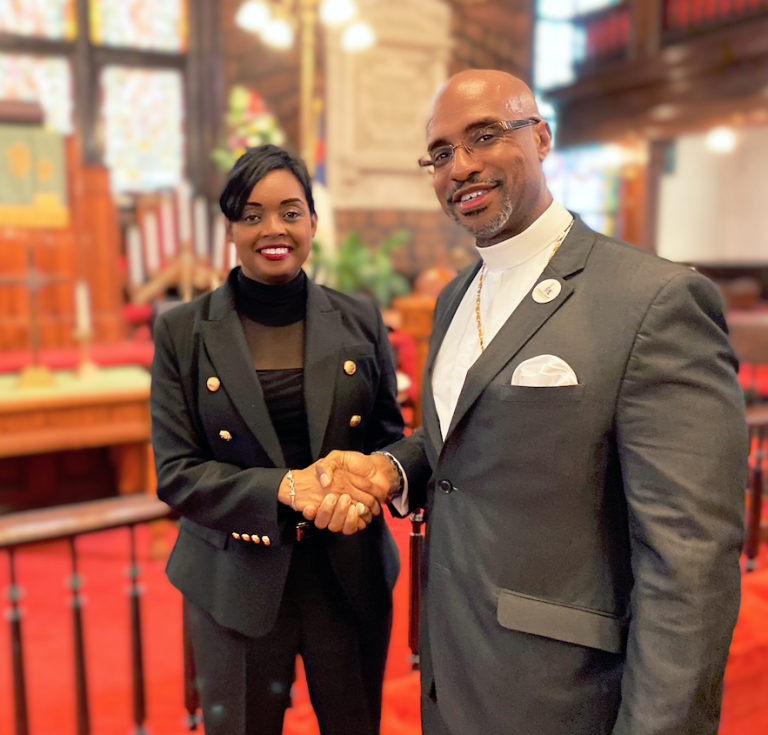
On February 22, the Congressional Black Caucus Institute (CBCI) announced a scholarship to honor Reverend Clementa C. Pinckney, former State Senator and senior pastor at Mother Emanuel AME Church who was killed with eight others in a racially motivated massacre in 2015. The CBCI seeks to continue his legacy of excitement and enthusiasm for political activism and empowerment by funding a scholarship to our political boot camp training for future leaders in his honor.

The official announcement was made at a press conference at Mother Emanuel AME Church where the CBCI is also conducting an Advocacy and Campaign Training (ACT) workshop. The scholarship announcement and the ACT workshop come ahead of the Democratic Presidential Debate (CBCI is a co-host) and Primary in South Carolina.

“We are proud to be in Charleston, SC, as a co-host of the SC Presidential Debate while also conducting a campaign training as part of our “First in the South Presidential Debate Summit” weekend. We thank the City of Charleston and the Pastor and congregation of Mother Emanuel AME Church for welcoming us so enthusiastically,” said Vanessa Griddine-Jones, Executive Director of the Congressional Black Caucus Institute. “More than 20 years ago, I had the pleasure of serving with the late Reverend Clementa Pinckney as a page and legislative aide in the South Carolina General Assembly. I felt that I had to find a way to honor his passion for public service. Being able to conduct this training in his home church is the CBCI’s way of continuing his legacy of excitement and enthusiasm for this work in a place that he loved and served. The scholarship announced today will fund future participants from the Charleston area to attend our annual Boot Camp in Washington, DC,” she added.

“Today, more than ever, we must all be active participants in the political process because every voice deserves to be heard and those we elect must truly and faithfully represent us. But political leaders, campaign workers, and effective advocates just don’t appear out of nowhere – they must be recruited and trained. The late Reverend Clementa Pinckney understood that and lived by it. That’s why the announcement of the scholarship and our partnership with the Congressional Black Caucus Institute is so important and timely,” said Reverend Eric S.C. Manning, Pastor, Mother Emanuel AME Church. “Mother Emanuel Church is both an historic and present-day example of people of faith who worship in service. The scholarship announcement today is a reminder to our community, state, and nation that, at Mother Emanuel, we do our best work outside our sanctuary’s walls,” he stated.

The scholarship will fully fund the costs for an aspiring future political leader from the Charleston area to attend the CBCI’s annual “Boot Camp,” an intensive week-long political training held in Washington, DC each summer. The selected scholarship recipient will go through a rigorous application review process to demonstrate the passion, energy, and commitment that will be required to be an effective future leader. The scholarship recipient will become one of more than 600 CBCI political training alumni who’ve gone on to serve their communities in diverse capacities – from a local school board to the US President’s Cabinet.

Source: Charleston Chronicle

All Content & Images are provided by the acknowledged source

Kristie Anyabwile’s Collaborative Book Brings Together Voices of Christian Women of Color

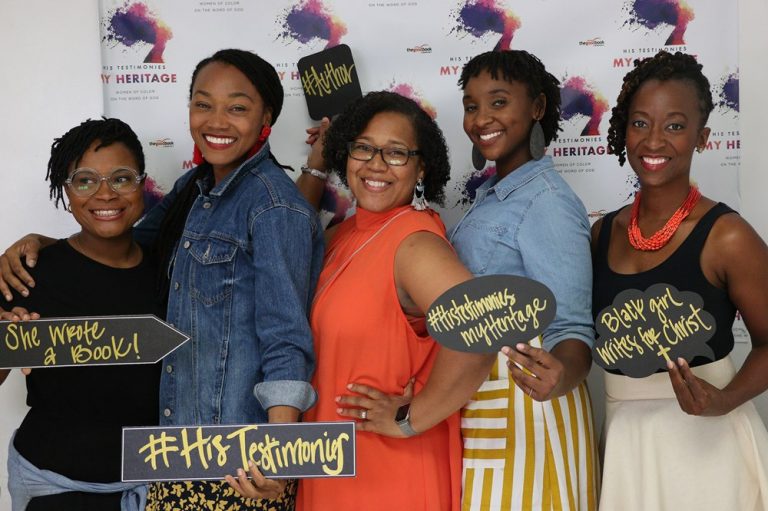
Listening to the voices of those not always heard through the exposition of the timeless Word of God is the heart behind editor Kristie Anyabwile’s book “His Testimonies, My Heritage.”

The book brings together a historic collaboration of women of color expositing the Word of God while sharing their personal experiences and how the Bible shapes their stories, past and future.

Contributors include spoken word artists Jackie Hill Perry and Quina Aragon, authors and speakers Trillia Newbell, Elicia Horton, Danielle Anderson, K.A. Ellis and others.

Each chapter explores themes ranging from personal hurt, pain and fear to rejoicing and hope paired with expositional devotional teachings through Psalm 119.

Taking the Psalm stanza by stanza, the authors tell their stories through the lens of God’s story seen in the words of David.

Anyabwile said the motivation for the book’s examination of Psalm 119 was the passage’s focus on the actual Word of God.

“It’s [Psalm 119] so multi-faceted,” she said. “It offers blessing for people who walk according to The Word, it comforts those who suffer, it’s our refuge in times of trial, it gives us cause to praise God for the nature of His Word and it just speaks to every person in any circumstance so it’s needed now because the Word of God is always needed.

Voice for the unheard

Contributor Elicia Horton emphasized the need of a book that specifically highlights the voices of women of color.

Conference speaking slots and awards given for writing and publishing do not leave a large space for women of color — a fact that makes His Testimonies, My Heritage a vitally important work, Horton said.

“We’re all expositing Psalm 119, we’re all highlighting the Word of God and its authority and its power,” Horton said, “but we are also actually being able to share our narrative, what it means to us, why as women of color we’re coming from this vantage point and being able to share with so many people that would never hear from a woman of color had they not picked up this book.”

Quina Aragon echoed Horton’s sentiment regarding the presence of women of color in publishing contracts and at conferences.

“There tends to be that disparity, so for there to be a book that highlights women that a lot of people don’t know about, allows for them — the writers themselves — and the audience to really receive from the people that are maybe outside the typical authors they listen to,” Aragon said.

Contributor Danielle Anderson said the book gave the authors an opportunity to share their stories freely, for their own benefit and that of others.

It’s hard to grow in ethnic unity, Anderson said, without actually listening to those with a differing voice.

“The voices that can often dominate spaces in our culture, are those of white males,” Anderson said. “But how beautiful to give ear to the truths of those often marginalized, women of color.”

When one portion of the body of Christ is suffering, the whole body suffers, Anyabwile said, adding that many women of color suffer as their voice is not heard and as they see no one in communication channels that they can relate to who are identifying similar experiences.

Horton agreed, saying “We’ve had to fight for not only ourselves but for people like us to be seen and to be heard. We’ve been in these spaces where we’ve been overlooked and looked down upon. To feel that even within the evangelical world has been very hard.”

But this book is part of the steps to open doors and march onward in the work God has laid out, Horton said.

“This type of project can be a part of the small steps that God will continue to use to open ears, open hearts, open eyes and help people to understand others from different upbringings and backgrounds,” Horton said. “We have a unique story — we all have a story — because it’s part of God’s bigger story, and we can continue to work together to bring about His good on this side of eternity.”

Diversity of perspectives

Anyabwile noted that many times Christians may not even realize the diverse individuals who are available to be heard.

Majority culture can risk becoming so accustomed to a singular perspective being ingrained into society that many times it goes unnoticed causing the same anecdotes and perspectives to be constantly put forth, creating a narrow viewpoint, she explained.

“The book is needed now just to broaden our perspective and to give us an opportunity to learn from people who are not like us,” Anyabwile said. “The church needs to see that there are women of diverse backgrounds sitting right next to us in the pews every week and that we need to be seeking them out and learning from them.”

Aragon said the global body of Christ always benefits from a diversity of voices, but historically many voices have come from one cultural perspective and background.

“We tend to miss out on a lot of wider diverse, range of voices within the body of Christ,” Aragon said. “At any time when there’s an opportunity for us to listen to someone with a different background, a different heritage, a different culture, coming to the same Word of God that we love and helping us by giving illustrations that come from their background, there’s such a benefit to see beauty of diversity that God has given His multicultural bride, the church.”

Understanding others enables believers to understand the vastness of God and how He providentially works in individuals lives, Anyabwile added.

“We’re always learning from people who are not like us in some way — and that is an enriching experience.” Anyabwile said.

Source: Baptist Press

All Content & Images are provided by the acknowledged source
Is Trump's Travel Ban Another Tool for Diplomatic Purposes?

Source CBN

All Content & Images are provided by the acknowledged source
‘This Hatred Is So Deep’: Two Pakistan Christians Shot, One Attacked With Axe Over Attempts to Build Church

Three Christian men have been viciously assaulted in Pakistan after seeking to build a local church.

Faithwire: ‘When He Refused to Deny Christ, They Cut Off His Right Hand’: Nigerian Christians Describe Horrific Attacks By Boko Haram

According to the British Pakistani Christian Association (BPCA), the conflict began last summer when a man named Azeem Masih felt called by God to donate some of his land to the local faith community so they could build a church in the city of Sahiwal.

“Azeem and his family and all the local Christian families had all been going to separate house churches within the community,” BPCA explained, noting that God put it on Azeem’s heart to “unite [the] local worshipping community under one roof in a purpose-built House of God.”

When the local Muslim community heard about the plan, they were furious.

Eventually, local authorities halted the construction process after claiming that the Christian community failed to attain the correct planning permission. This decision came after local Muslim families pressured the authorities to take action.

But when Azeem decided to build his own house on the plot of land, the Muslims were up in arms once again, accusing him of “building a church again despite strict orders from the District Commissioner.”

Though the local police had arrested members of the two groups on a previous occasion, the Muslim community ramped up its aggression and ended up surrounding the small Christian enclave, taunting the families to come out of their houses.

“They called us Chura (dirty cleaners) told us that kaffir should be toilet cleaners and threatened to rape all our women before us,” witness Wilson Raza told BPCA.

“We pleaded with the men to leave us alone but they seemed intent on violence. The women were screaming and we all began to pray seeking God’s intervention to save us all.”

When the Christians eventually emerged from their homes, Azeem and his brother, Sajid, were shot in the head. Another member of the mob threw an axe at a Christian man named Razaq Masih — he sustained severe injuries to his leg.

Faithwire: Rapper Cardi B Criticizes ‘Nasty’ Porn Industry

As police arrived, one of the Muslim men reportedly shot his friend in the leg to make it look like a battle had ensued between the two sides. The group of Muslims then fled and evaded arrest. The injured Christians were rushed to hospital.

“On arrival at the hospital all the men were treated immediately and after a one night stay with treatment Razzaq Masih and Sajid Masih were discharged,” BPCA noted. “However Azeem Masih suffered a more severe head injury and is still admitted at the hospital and is still in critical condition.”

BPCA added that the father of Azeem, Gulzar Masih, has reported the incident to the police. Shockingly, the case has yet to be taken up by local police.

“Despite guns being used, a man left critically ill in hospital and a beleaguered Christian community still receiving threats including fear all the young women will be kidnapped, raped and forced into Islamic marriage – local police seem to be doing nothing to progress the case,” the group noted.

“The Muslim villagers who are against us are powerful politically and financially and we have little hope for justice – after all we are hated Christians,” Raza added. “This attack has left us devastated and fearful many of us our deciding whether or not to leave our community where our ancestors have been since the partition of India.

Raza said that it was “heartbreaking that the simple act of building a church can cause enough offense to Muslims to lead to such violence.”

“This hatred is so deep there is little hope for our future generations,” he added. “Even then we trust God.”

Source CBN

All Content & Images are provided by the acknowledged source
