New Orleans Saints’ Catholic Ties Lie Behind Role in Abuse Crisis

Why would an NFL team, even one called the Saints, strike a behind-the-scenes alliance with the Roman Catholic Church on an issue as emotionally fraught as clergy sex abuse?

It’s a question even die-hard Saints fans in this heavily Catholic city are asking, and the answer appears to lie in the powerful bond that the team’s devoutly Catholic owner, Tom Benson, and his now-widow Gayle built for years with church leaders.

An Associated Press review of public tax documents found that the Bensons’ foundation has given at least $62 million to the Archdiocese of New Orleans and other Catholic causes over the past dozen years, including gifts to schools, universities, charities and individual parishes.

Along the way, Archbishop Gregory Aymond, who knew the couple separately before they married in 2004, has become almost a part of the team, thought by some to bring the beloved Saints help from a higher power.

Aymond has been spotted on the field at Saints games and inside the team’s Superdome box and has flown on the owner’s private jet. He is known for celebrating stirring pregame Masses, including one before the team’s lone Super Bowl appearance in 2010, when he correctly predicted victory and joined in a rendition of “When the Saints Go Marching In.”

The archbishop arranged a 2011 meeting of the Bensons with Pope Benedict XVI in Rome’s St. Peter’s Square, where Tom Benson kissed the pontiff’s ring and flashed his own Super Bowl ring. A few years later, he served as a witness to the signing of the will that cut out Tom Benson’s estranged daughter and grandchildren and gave third wife Gayle control of a business empire that included ownership of both the Saints and the NBA’s New Orleans Pelicans.

And Aymond was there in 2018 after Tom Benson’s death at age 90 to eulogize him as a “New Orleans saint on Earth” and walk side by side with Gayle in the funeral procession. In an honor typically reserved for clerics, Benson was given a two-day public visitation at Notre Dame Seminary, a chateau-style institution renovated with one of the couple’s multimillion-dollar donations.

“Our relationship with past Archbishops and the archdiocese dates back 50 years plus,” Gayle Benson said in a statement this week in response to the AP’s request for comment. “Our faith is the core foundation from which we live our daily lives. Unifying, helping and giving back is not something we do when asked; we do it every day. It defined how Tom Benson ran his organization and how I ardently continue his legacy.”

That bond has received renewed scrutiny after the AP reported last month that hundreds of confidential Saints emails allegedly show that some of the team’s top executives did public relations damage control for the archdiocese in the midst of its clergy abuse crisis.

It’s a controversy that has led fans in New Orleans and beyond to question what exactly the Saints did for the church and whether it was appropriate.

For now, those answers are not yet clear because the team has gone to court to block — or at least delay — the public release of those emails, which emerged as part of the discovery process in a clergy abuse lawsuit. A court hearing is scheduled next week in New Orleans to determine whether the 276 documents may be made public. The AP has filed a motion in support of their release.

Attorneys for about two dozen men bringing clergy sex claims against the church allege in court filings that the emails show the team joined in the church’s “pattern and practice of concealing its crimes.” The attorneys contend that included taking an active role in helping to shape the archdiocese’s 2018 release of its list of 57 credibly accused clergy, a roster an AP analysis found had omitted at least 20 names.

In her statement, Gayle Benson denied the Saints had any role in selecting the names, saying the team’s Senior Vice President of Communications Greg Bensel was asked only to help prepare church officials for the release of the list.

“His recommendations were consistent with the Archdiocese which included: be honest, complete and transparent,” her statement said. “We are proud of the role we played and yes, in hindsight, we would help again to assist the Archdiocese in its ability to publish the list with the hope of taking this step to heal the community.”

Gayle Benson, a 73-year-old former interior designer and devout Catholic herself with a fortune estimated by Forbes at $3.1 billion, also said that neither she nor her late husband ever contributed to paying settlements or legal awards in the church’s clergy abuse crisis.

“To suggest that I would offer money to the Catholic Church for anything related to the clergy molestation issue sickens me,” she wrote.

Plaintiffs’ attorneys Richard Trahant and John Denenea recently subpoenaed Benson’s charitable foundation for any records relating to “settlements of claims for clergy abuse” over the past decade.

Source: Religion News Service

All Content & Images are provided by the acknowledged source

Review: Why wait? ‘Sonic the Hedgehog’ worth rushing to see

If the Hollywood mantra for making blockbusters is “faster, faster, faster,” then the creators of “Sonic the Hedgehog” have wisely ignored it.

The little blue alien who can sprint quicker than the speed of light has ironically benefited from slowing it down, taking a pit stop to retool and emerge this month as a total crowd-pleaser.

Respectful of the rich history of the brand and yet welcoming to newcomers, ” Sonic the Hedgehog ” is a feel-good buddy movie for both adults and their own little aliens. “Nailed it!” screams Sonic at one point and that might be a fitting summary for the film.

Director Jeff Fowler has been entrusted on his feature film debut with bringing to life the ball of super CGI energy, whose origins lie in Sega video games. But things didn’t look too good when a trailer dropped last April that portrayed Sonic as more rat-like with creepy human teeth. . An outcry led to the film being delayed for a reset, resulting in a Sonic with a sleeker design, larger eyes and fewer chompers.

While there’s no way to give a side-by-side comparison, the film that emerges portrays Sonic as a cute, naive teenager, prone to saying very 2020 things like “I am living my best life” and “I can’t with that guy.” He has fled his own planet with a warning to “never stop running” and a twist on the “Spider-Man” proverb: “With great power comes great power-hungry bad guys.”

In the script by Pat Casey and Josh Miller, Sonic is naturally attracted to fast things — “Flash” comic books and the movie “Speed” (Keanu Reeves is “a natural treasure,” declares our heroic blue guy, one of many lines that will go over your little ones’ heads.)

Reeves isn’t the only celebrity to get a shout-out: Vin Diesel, Will Smith and Obi-Wan Kenobi are all invoked for laughs. Amazon and Olive Garden also get some love. There’s a weird urban-versus-rural tension throughout, with the scriptwriters clearly putting their fingers on the scale against life in the big city. One great sequence ends with everyone agreeing on a common enemy: hipsters.

The plot isn’t too far from the classic “ET” or the more modern “Bumblebee” — an alien lands on Earth to hide and soon must team up with a kindly human (James Marsden, in a very Marsden groove) to escape the clutches of evil government scientists who want to dissect it.

In this case, Jim Carrey dons a Civil War mustache and a black full-length leather coat to play the baddie Dr. Robotnik as only he can — ultra-arch, absolutely unhinged and dangerously unpredictable. “You know what I love about machines? They do what they’re told,” he snarls. Carrey has his own insane dance sequence that will make you spit out your popcorn.

Sonic, voiced by Ben Schwartz, is sweet and funny and self-aware. He does The Floss. He farts. He wears gloves, socks and sneakers but points out “I’m not even wearing pants.” He discovers what a bucket list is and instantly wants to do all kinds of stuff, including start a bar fight. “You two are so cute,” a woman tells Marsden and Sonic. They protest: They’re loose cannons. (OK, very cute loose cannons).

The non-human one goes fast, to be sure. A radar gun clocks him at 300 mph but later in the film he moves so fast he stops time, zipping around while everyone is as still as a statue. The filmmakers have also added an excellent, propulsive soundtrack, which includes X Ambassadors, Queen and the Wiz Khalifa-led “Speed Me Up.” (Steal it for your workout playlist.)

There are references to the video game throughout, including a sequence in which Dr. Robotnik chases Sonic through Paris, up the Egyptian pyramids, and along the Great Wall of China. Green Hill is where the creature ends up on Earth — echoing a key level in the game — and we learn he hates mushrooms, a frequent Sonic touchstone.

So much thought has been put into the film that at the very beginning the Paramount logo substitutes its regular stars for Sonic’s golden rings. A potential sequel is set-up during the end credits — as well as the glimpse of a familiar creature that fans are sure to get excited about. The filmmakers might not have rushed making this film, but that’s no reason for you to press the brakes now.

“Sonic the Hedgehog,” a Paramount Pictures release, is rated PG for action, some violence, rude humor and brief mild language. Running time: 99 minutes. Three and a half stars out of four.

___

Source: Associated Press – MARK KENNEDY

All Content & Images are provided by the acknowledged source

Scholars Say the Rise of the ‘Nones’ May Be Slowing

For the past 25 years, the number of Americans claiming no religion has steadily ballooned as more and more people quit church, synagogue or mosque and openly acknowledged being a  “none.”

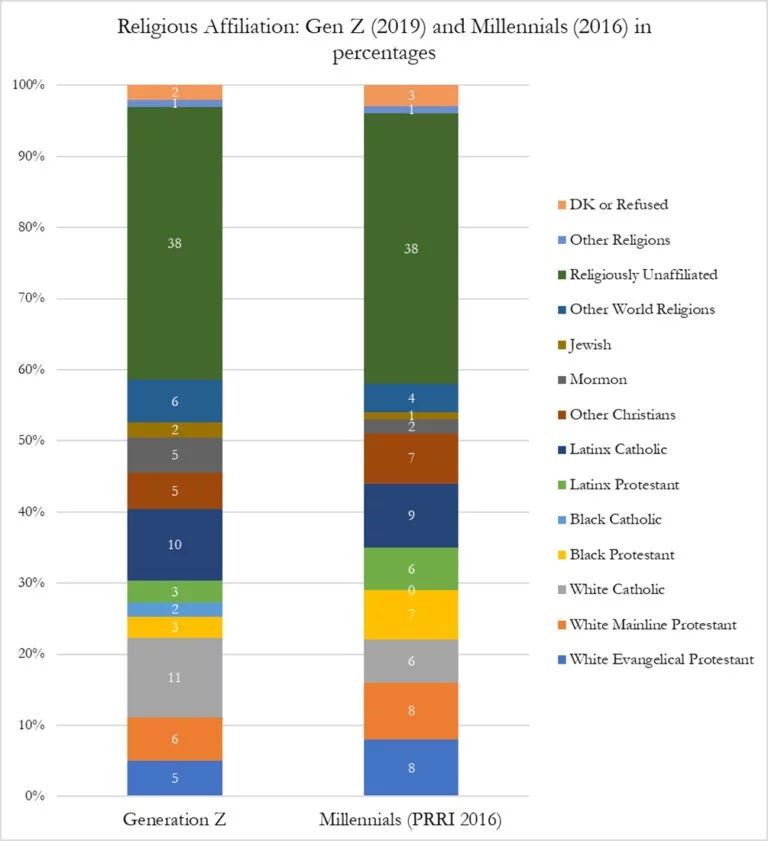
The reality is particularly stark when looked at from a generational perspective. If 10% of people from the silent generation (born 1928-1945) consider themselves religiously unaffiliated, a whopping 40% of millennials (born 1981-1996) say they have no religion, according to Pew Research.

But this week, three political scientists who study religion have raised the possibility that the number of nones may be leveling off. Looking at a set of recent surveys, they suggest Generation Z, broadly defined as the 68 million Americans born after 1996, don’t look any less religious than the millennial generation that came before.

“I was just shocked to see it,” said Paul Djupe, a professor at Denison University in Granville, Ohio. “Everything led me to expect that (the number of nones) would keep increasing for a while.”

The initial suggestion that the decline of religious affiliation seems to be slowing came from political scientist Melissa Deckman of Washington College in Chestertown, Maryland. Deckman interviewed 2,200 Americans ages 18-23 this past summer, asking them a host of questions, including whether they have a religious affiliation and how often they attend religious services.

When she compared those numbers to a 2016 Public Religion Research Institute survey, she found striking similarities between those in her study of Generation Z and older millennials. In both generational cohorts, 38% said they consider themselves to have no religion.

“Up to this point there’s been a very fast drop-off, especially among younger people,” Deckman said. “It seems to have slowed somewhat.”

Two other political scientists – Djupe and Ryan Burge — then looked at other datasets, including the 2018 General Social Survey, the Cooperative Congressional Election Study and a Voter Study Group. They found those surveys confirmed Deckman’s thesis about slowing rates of religious disaffiliation among Gen Z.

There are a couple of possible explanations for the slowing of religious decline:

The United States will soon be a minority-majority country. Scholars project that might happen between 2041 and 2046, depending on the amount of net immigration into the U.S.

That’s important in terms of religion because minority groups such as African Americans, Hispanics and immigrants from Africa and Asia tend to be more religious than American whites. Deckman, for example, found that 67% of Gen Z Hispanics and 66% of Gen Z African Americans have a religious affiliation, compared with only 58% of Gen Z whites. As the pool of whites shrinks, other groups— particularly immigrants —  may be growing and they tend to be more religiously attached and attend services more often.

The past few decades have been marked by a host of divisive social and political issues, including abortion, women’s rights, LGBTQ rights and same-sex marriage. Many religious congregations used to be a lot more diverse on a range of issues. But they have become less so, as both liberals and conservatives have joined up with like-minded congregants or dropped out of religion altogether. While the United Methodist Church is still in the midst of that kind of sorting — the denomination is expected to split on the issue of LGBTQ inclusion — many other denominations have already completed that process.

Source: Religion News Service

All Content & Images are provided by the acknowledged source

More American Companies Are Increasing Faith-Based Support for Employees

It has become standard practice for U.S. corporations to assure employees of support regardless of their race, gender or sexual orientation. There’s now an intensifying push to ensure that companies are similarly supportive and inclusive when it comes to employees’ religious beliefs.

One barometer: More than 20% of the Fortune 100 have established faith-based employee resource groups, according to an AP examination and there’s a high-powered conference taking place this week in Washington aimed at expanding those ranks.

“Corporate America is at a tipping point toward giving religion similar attention to that given the other major diversity categories,” says Brian Grim, founder and president of the Religious Freedom & Business Foundation that’s co-hosting the conference along with the Catholic University of America’s Busch School of Business.

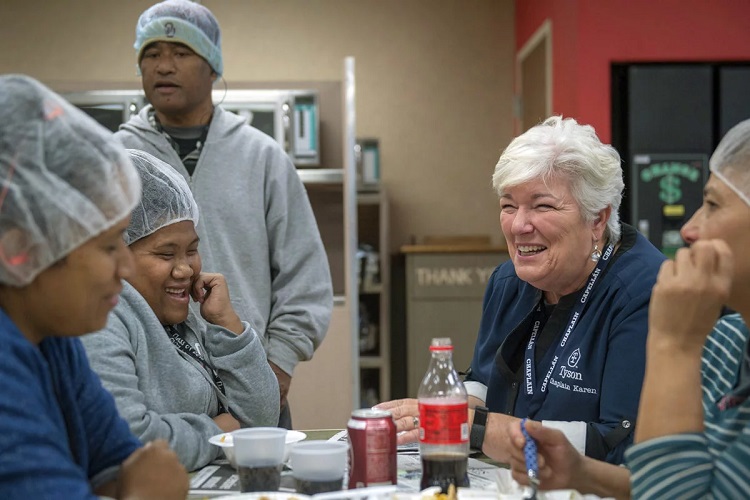
A few companies have long-established faith-in-the-workplace programs, such as Arkansas-based Tyson Foods, which deploys a team of more than 90 chaplains to comfort and counsel employees at its plants and offices. That program began in 2000.

However, Grim says most companies — over the past few decades — have given religion less attention in their diversity/inclusion programs than other categories such as race, ethnicity, gender, sexual orientation and disabilities.

Grim is an associate scholar at the Religious Liberty Project at Georgetown University and a former senior researcher with the Pew Research Center. From 2015-16, he served as chair of the World Economic Forum’s global agenda council on the role of faith.

Grim’s foundation, founded in 2014, recently completed a detailed analysis ranking the Fortune 100 companies on their commitment to religious inclusion as part of those programs.

The top 10 in the rankings featured some of America’s best-known companies — Google’s parent company Alphabet, Intel, Tyson Foods, Target, Facebook, American Airlines, Apple, Dell, American Express and Goldman Sachs.

Tyson won points for its chaplaincy program; most of the others have formed either a single interfaith employee resource group or separate groups for major religions such as Christianity, Islam and Judaism. Google’s interfaith group, the Inter Belief Network, has chapters for those faiths and for Buddhists, while Intel has a group for agnostics and atheists, as well as groups for major religious faiths.

One employer, the Internal Revenue Service, has a group specifically for Christian fundamentalists.
Grim says several other high-profile companies — including Walmart, the largest U.S. employer – have recently decided to launch faith-based employee groups.

Brian Grim, president of the Religious Freedom & Business Foundation, speaks at the launch event for the Corporate Pledge on Religious Freedom in Washington on Jan. 12, 2016. Grim says most companies — over the past few decades — have given religion less attention in their diversity/inclusion programs than other categories such as race, ethnicity, gender, sexual orientation and disabilities. (Freedom Forum Institute via AP)

One of the fastest growing faith-based groups, called Faithforce, was launched by Salesforce in 2017. Its founder, Farah Siddiqui, says more than 2,600 employees have signed up since then, joining 17 regional hubs on five continents.

Siddiqui, a Muslim whose family is from Pakistan, said the group now includes Sikhs, Hindus, pagans and humanists, as well as followers of America’s largest faiths.

“We’re a very inclusive group,” she says. “If someone has something interesting to share, we share it. There is no proselytizing.”

Siddiqui said Faithforce, in somber fashion, proved its value after a string of deadly attacks on houses of worship in far-flung parts of the world – notably the Tree of Life synagogue in Pittsburgh, three Christian churches in Sri Lanka and two mosques in New Zealand.

“We had healing circles after each of those tragedies,” said Siddiqui, who recounted in-person visits by a rabbi and a Muslim scholar.

“What we’ve done is support our employees of those faiths to show that the rest of us are here for them,” she said.

At Tyson Foods, the team of chaplains includes one Muslim, but is overwhelmingly Christian. However, the team’s director, Karen Diefendorf, says the chaplains are trained to provide empathetic pastoral care to employees and their families regardless of what faith – if any – the workers belong to.
Diefendorf, whose career includes stints as a United Methodist minister and a U.S. Army chaplain, said there’s a key difference between pastoring and chaplaincy.

“When I pastor, I only represent my denomination, my faith tradition,” she said. ‘”As a chaplain, I can support people who come from very different backgrounds…I ask them how their beliefs are helping them cope with what’s going on.”

Often, the chaplains are sought out by employees struggling with difficulties at work or at home, but Diefendorf said her team members sometimes act proactively – for example, finding tactful ways to signal to a supervisor that his or her management practices are causing problems for workers.

Her advice to other companies considering a chaplaincy team: “Making the right hire is critically important.”

“You want a person who has maturity, who is secure in their own faith but not spiritually conflicted in allowing others to pursue their faith,” she said.

Formal theological training is an asset, but not sufficient in itself, she added. “They can have all the training in the world, but if they don’t have the right compassion in their heart, they aren’t worth a plugged nickel.”

Thus far, the faith-in-the-workplace movement has mostly escaped harsh criticism. Brian Grim has taken pains to argue that faith-based employee resource groups are not a threat to LGBTQ employees, and instead should be viewed as a sign of a corporation’s overall commitment to diversity and inclusion.

American Airlines is evidence of that: Its presence high atop the new religious-freedom rankings come after many years of accolades for its strong support of LGBTQ employees.

“The perception out there is that religion is a dangerous topic, but some companies have found the opposite — that it reinforces the other things they care about,” Grim said.

Nick Fish, president of American Atheists, said companies considering faith-based initiatives should strive to ensure they are inclusive.

“Creating a work environment that is exclusionary of non-religious staff or members of religious minorities is a recipe for disaster,” he said via email. “I’d urge any employer who is considering this sort of action to instead ensure that their workplace is religiously neutral and welcoming to staff and customers of any religious belief or those who are non-religious.”

__
Associated Press religion coverage receives support from the Lilly Endowment through the Religion News Foundation. The AP is solely responsible for this content.

Source: Associated Press via Religion News Service

All Content & Images are provided by the acknowledged source

More American Companies Are Increasing Faith-Based Support for Employees

It has become standard practice for U.S. corporations to assure employees of support regardless of their race, gender or sexual orientation. There’s now an intensifying push to ensure that companies are similarly supportive and inclusive when it comes to employees’ religious beliefs.

One barometer: More than 20% of the Fortune 100 have established faith-based employee resource groups, according to an AP examination and there’s a high-powered conference taking place this week in Washington aimed at expanding those ranks.

“Corporate America is at a tipping point toward giving religion similar attention to that given the other major diversity categories,” says Brian Grim, founder and president of the Religious Freedom & Business Foundation that’s co-hosting the conference along with the Catholic University of America’s Busch School of Business.

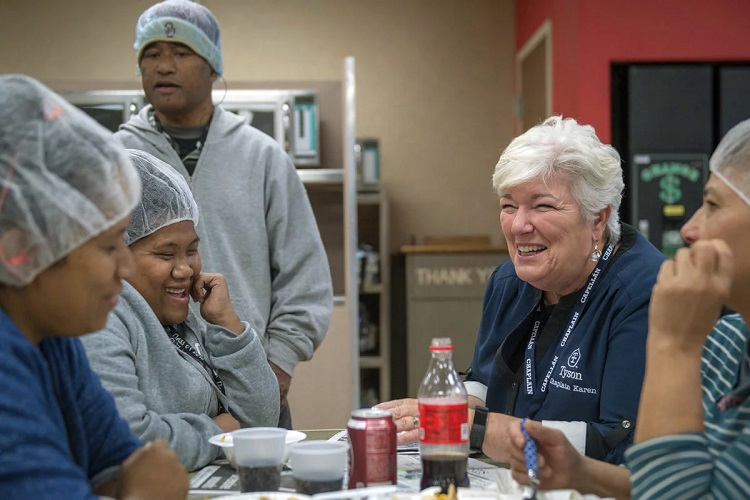
A few companies have long-established faith-in-the-workplace programs, such as Arkansas-based Tyson Foods, which deploys a team of more than 90 chaplains to comfort and counsel employees at its plants and offices. That program began in 2000.

However, Grim says most companies — over the past few decades — have given religion less attention in their diversity/inclusion programs than other categories such as race, ethnicity, gender, sexual orientation and disabilities.

Grim is an associate scholar at the Religious Liberty Project at Georgetown University and a former senior researcher with the Pew Research Center. From 2015-16, he served as chair of the World Economic Forum’s global agenda council on the role of faith.

Grim’s foundation, founded in 2014, recently completed a detailed analysis ranking the Fortune 100 companies on their commitment to religious inclusion as part of those programs.

The top 10 in the rankings featured some of America’s best-known companies — Google’s parent company Alphabet, Intel, Tyson Foods, Target, Facebook, American Airlines, Apple, Dell, American Express and Goldman Sachs.

Tyson won points for its chaplaincy program; most of the others have formed either a single interfaith employee resource group or separate groups for major religions such as Christianity, Islam and Judaism. Google’s interfaith group, the Inter Belief Network, has chapters for those faiths and for Buddhists, while Intel has a group for agnostics and atheists, as well as groups for major religious faiths.

One employer, the Internal Revenue Service, has a group specifically for Christian fundamentalists.
Grim says several other high-profile companies — including Walmart, the largest U.S. employer – have recently decided to launch faith-based employee groups.

Brian Grim, president of the Religious Freedom & Business Foundation, speaks at the launch event for the Corporate Pledge on Religious Freedom in Washington on Jan. 12, 2016. Grim says most companies — over the past few decades — have given religion less attention in their diversity/inclusion programs than other categories such as race, ethnicity, gender, sexual orientation and disabilities. (Freedom Forum Institute via AP)

One of the fastest growing faith-based groups, called Faithforce, was launched by Salesforce in 2017. Its founder, Farah Siddiqui, says more than 2,600 employees have signed up since then, joining 17 regional hubs on five continents.

Siddiqui, a Muslim whose family is from Pakistan, said the group now includes Sikhs, Hindus, pagans and humanists, as well as followers of America’s largest faiths.

“We’re a very inclusive group,” she says. “If someone has something interesting to share, we share it. There is no proselytizing.”

Siddiqui said Faithforce, in somber fashion, proved its value after a string of deadly attacks on houses of worship in far-flung parts of the world – notably the Tree of Life synagogue in Pittsburgh, three Christian churches in Sri Lanka and two mosques in New Zealand.

“We had healing circles after each of those tragedies,” said Siddiqui, who recounted in-person visits by a rabbi and a Muslim scholar.

“What we’ve done is support our employees of those faiths to show that the rest of us are here for them,” she said.

At Tyson Foods, the team of chaplains includes one Muslim, but is overwhelmingly Christian. However, the team’s director, Karen Diefendorf, says the chaplains are trained to provide empathetic pastoral care to employees and their families regardless of what faith – if any – the workers belong to.
Diefendorf, whose career includes stints as a United Methodist minister and a U.S. Army chaplain, said there’s a key difference between pastoring and chaplaincy.

“When I pastor, I only represent my denomination, my faith tradition,” she said. ‘”As a chaplain, I can support people who come from very different backgrounds…I ask them how their beliefs are helping them cope with what’s going on.”

Often, the chaplains are sought out by employees struggling with difficulties at work or at home, but Diefendorf said her team members sometimes act proactively – for example, finding tactful ways to signal to a supervisor that his or her management practices are causing problems for workers.

Her advice to other companies considering a chaplaincy team: “Making the right hire is critically important.”

“You want a person who has maturity, who is secure in their own faith but not spiritually conflicted in allowing others to pursue their faith,” she said.

Formal theological training is an asset, but not sufficient in itself, she added. “They can have all the training in the world, but if they don’t have the right compassion in their heart, they aren’t worth a plugged nickel.”

Thus far, the faith-in-the-workplace movement has mostly escaped harsh criticism. Brian Grim has taken pains to argue that faith-based employee resource groups are not a threat to LGBTQ employees, and instead should be viewed as a sign of a corporation’s overall commitment to diversity and inclusion.

American Airlines is evidence of that: Its presence high atop the new religious-freedom rankings come after many years of accolades for its strong support of LGBTQ employees.

“The perception out there is that religion is a dangerous topic, but some companies have found the opposite — that it reinforces the other things they care about,” Grim said.

Nick Fish, president of American Atheists, said companies considering faith-based initiatives should strive to ensure they are inclusive.

“Creating a work environment that is exclusionary of non-religious staff or members of religious minorities is a recipe for disaster,” he said via email. “I’d urge any employer who is considering this sort of action to instead ensure that their workplace is religiously neutral and welcoming to staff and customers of any religious belief or those who are non-religious.”

__
Associated Press religion coverage receives support from the Lilly Endowment through the Religion News Foundation. The AP is solely responsible for this content.

Source: Associated Press via Religion News Service

All Content & Images are provided by the acknowledged source

Locust Swarms 'as Big as Major Cities' Invade Africa, Threatening Crops, Millions of Lives

KANCHOMBA, Zambia- One of the world’s oldest and most destructive insects is wreaking havoc in Africa.

Hundreds of millions of locusts are eating their way through the continent, putting crops, food security and millions of lives at risk.

It’s almost like a page out of the Bible’s Old Testament book of Exodus. Authorities are calling it the worst outbreak in decades as billions of desert locusts swarm across a large part of East Africa.

(Map showing swarms of locusts spreading across Horn of Africa)

“Today locust swarms are as big as major cities and this is getting worse by the day,” warned Antonio Guterres, secretary-general of the United Nations.  “I ask the international community to respond with speed and generosity to ensure an effective response and control the infestation while we still have the chance.

Experts say the average swarm can contain up to 150 million locusts, travel 100 miles in a single day and grow as large as 250 football fields.

“That swarm in one day can eat the same amount of food as the entire population of Kenya,” said Keith Cressman, an expert with UN’s Food and Agriculture Organization (FAO). “That swarm in one day can eat the same amount of food as everybody here in the tri-state area – New Jersey, Pennsylvania, and New York.”

Desperate farmers in rural eastern Kenya are using blankets and other clothing or beating on pots and pans — to chase away the hungry pests. But it’s doing very little to stop them from devouring crops.

“We know that in Ethiopia there are about 420 square kilometers that have been affected so far,” said Rosanne Marchesich, an emergency response team leader with the United Nations. “There has been extensive crop damage in those areas and as it moves to other parts of the country, we expect that the impact it will have on food security and agricultural livelihoods, both for the farmers and the pastoralists, can be significant,” added Marchesich.

And now the UN is warning the swarms of the fast-breeding insects could grow more than 500 times between now and June.

“I’m seeing a big catastrophe ahead and a very big food security concern if we don’t address this problem immediately,” said a worried farmer in rural Kenya.

Caught in the path are some 19 million people, who’ve already dealt with severe food shortages. Now they face another looming catastrophe.

“The window to contain this crisis is closing fast,” warned Qu Dongyu, FAO’s director-general. “The swarms are highly mobile; the terrain often difficult; the logistical challenges immense. But left unchecked – and with expected additional rains – locust numbers in East Africa could increase 500 times by June.”

The United Nations is sending urgent appeals while infected countries deploy thousands of troops and use planes to spray pesticides against the destructive bugs.

“It gives you a sense of the scale of the crisis we are facing and we need to address it immediately,” said Dominique Burgeon with FAO.

The countries of Sudan, Eritrea, Somalia, Ethiopia, and Kenya are facing what experts say is the worst locust infestation in nearly 70 years. Earlier in the week, authorities spotted locust swarms crossing the border into Uganda and Tanzania. South Sudan is also at risk.

(Courtesy: World Vision)

For local farmers further south in countries like Zambia, they are facing another crisis — the lack of water.

Two years of little to no rain and failed harvests have forced 28-year-old Consepter Hamalambo to abandon her cornfields again this year.  

She’s among some 2 million in this country facing food insecurity.

“I didn’t harvest any crops last year or this year due to the drought which forced me to look for work elsewhere,” Hamalambo told CBN News. “I’ve been going door-to-door asking people in my village for work just so I can buy some food.”

(Courtesy: World Vision)

World Vision, the Christian aid group, is distributing maize meal, drought-resistant maize seed, and cowpeas to families hardest hit by the drought.

“There’s not enough water to generate electricity so businesses and companies have 15 hours, 16 hours of no electricity a day,” Mark Kelly with World Vision Zambia told CBN News. “That also has an impact on people being able to earn money, that has an impact on being able to buy food.”

(Courtesy: World Vision)

While locusts haven’t hit Zambia yet, farmers here worry the massive swarm sweeping across much of east Africa could fly further south bringing destruction to a region already reeling from extreme weather.

Source CBN

All Content & Images are provided by the acknowledged source

Texas Church Fires Music Minister Charged With Sexually Assaulting a Child

COPPELL, Texas (BP) — A Dallas area Southern Baptist church has fired a music minister charged with sexually assaulting a child, and told Baptist Press the alleged crime occurred before the accused’s employment there.

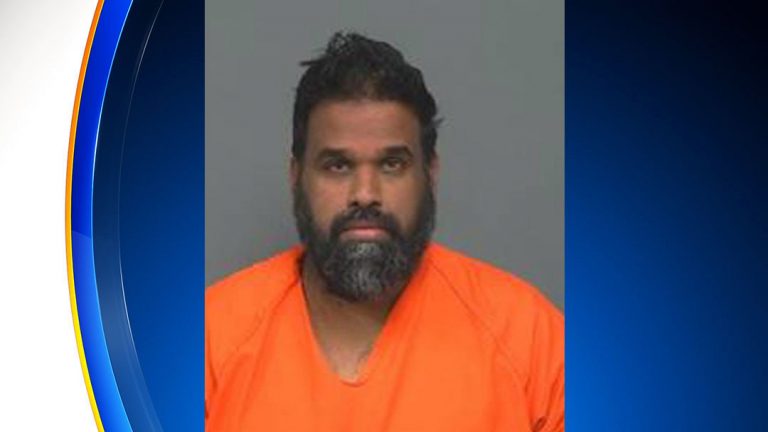
Valley Ranch Baptist Church (VRBC) in Coppell, Texas, fired 40-year-old associate minister of worship Jason Thomas after the Mesquite Police Department (MPD) arrested him Feb. 10, pastor Larry Parsley said Wednesday (Feb. 12).

“We were in contact with the Mesquite Police Department,” Parsley told BP. “We weighed everything we learned and our church council and I determined [firing Thomas] was the right decision to make at the time.”

Thomas was released on a $50,000 bond Feb. 10, the MPD told BP. Police have charged him with one count of aggravated sexual assault of a child, whom police said was under age 14. The incident reportedly occurred before 2005. Police received a report of the alleged assault on Jan. 12, the MPD said in its press release, and arrested Thomas without interference at his residence.

“The Mesquite Police have informed us that the charge relates to events prior to Jason’s employment at VRBC,” the church said in a statement updated Tuesday (Feb. 11). “Neither we nor the police are aware of any victims who are current or former members or attenders of VRBC or the Valley Ranch Baptist Weekday Preschool.”

Source: Baptist Press

All Content & Images are provided by the acknowledged source
Ronnie Floyd to Host Prayer Conference Call With Asian American Pastors on Coronavirus

With coronavirus or COVID-19 killing more than 1,000 people and infecting nearly 43,000 globally, Southern Baptist Convention Executive Committee President Ronnie Floyd has announced a prayer conference call to comfort and support Asian American pastors and congregations.

The call, to be hosted by Floyd Thursday (Feb. 13) from 2–2:30 p.m. Central Time from the SBC EC building in Nashville, will include brief updates from Asian American pastors followed by perhaps 25 minutes of prayer.

“As COVID-19 spreads, a great alarm is sounding in China and across the world,” Floyd told Baptist Press in announcing the prayer call. “Our Asian American pastors and churches are very concerned about the health of their families and for many in their Asian homelands.

“Therefore, I have asked Peter Yanes, our executive director of Asian American relations and mobilization, to call upon these Asian leaders to join me in a conference call on Thursday where we can hear reports from some of them and then have a season of prayer together for them, their families and their churches.”

Floyd called on all Southern Baptists to pray especially on Thursday for the concerns of Asian Americans and the global community during the outbreak, which has spread fear, panic and xenophobia in the midst of death and illness.

Yanes has asked Southern Baptists to be gracious towards Asian American brothers and sisters during this ordeal, avoid animosity and fear, and extend Gospel love.

“For the past few weeks, I’ve been in contact with some of our Chinese pastors and leaders for updates, and praying with them over the phone, especially the heartbreaking prayer requests shared by families in Wuhan City,” Yanes told BP Monday (Feb. 10). “I’m calling all our Southern Baptist pastors and leaders to reach out to our Asian churches in their communities, and find out how they can pray and encourage them.”

Source: Baptist Press

All Content & Images are provided by the acknowledged source
Event at New Orleans Baptist Theological Seminary Helps Women to ‘Abide in Christ’

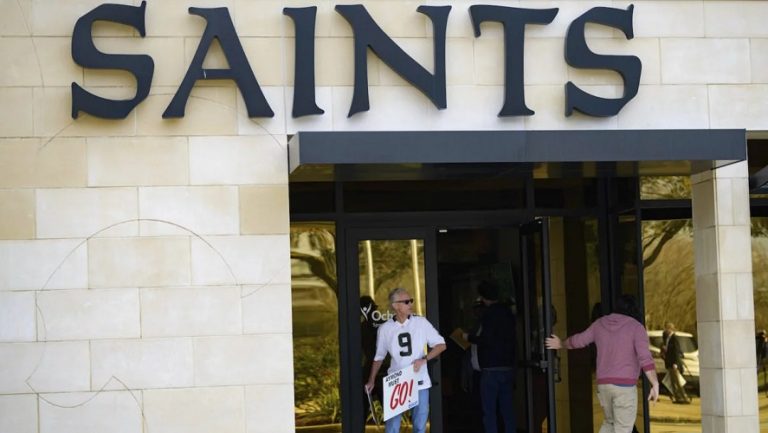
Abiding in Christ, the source of godliness and effective ministry, was the focus of the Abide Women’s Conference at New Orleans Baptist Theological Seminary (NOBTS) Feb. 7-8.

More than 300 women — ages teen to 90s — attended the inaugural event under the direction of Tara Dew, wife of NOBTS president Jamie Dew.

“It is our desire at NOBTS and Leavell College to train, equip and serve anyone — male or female — that comes to us,” Dew said. “The Abide Conference is one way we hope to serve the women on our campus, in our local churches and in our broader community to know and love God more deeply.”

Jess Archer, children and youth missions education strategist for the Louisiana Baptist Convention and plenary speaker for the two-day event, encouraged listeners to grow in Christ through prayer, Bible study, stewardship and solitude — spiritual disciplines that are “found in Scripture that promote growth in a believer.”

Source: Baptist Press

All Content & Images are provided by the acknowledged source

Ed Stetzer and Angela Suh Um to Chair 2020 Southern Baptist Resolutions Committee

Missiologist and researcher Ed Stetzer has been named chairman of the 2020 Southern Baptist Convention Resolutions Committee, SBC President J.D. Greear announced today (Feb. 11).

Greear also announced his appointment of Angela Suh Um of Cambridge, Mass., as vice chair. Um will be only the second woman to serve in a leadership role on the committee, according to Baptist Press’ review of SBC records.

“Ed Stetzer has planted, revitalized, and pastored churches across the country in a variety of settings,” Greear told Baptist Press. “Additionally, his vast experience as a researcher makes him uniquely qualified to understand the questions and concerns that the churches of the Southern Baptist Convention face. He is a strong leader who can guide the committee as they help the messengers express their positions on issues that matter to them.”

Greear continued: “Ed has planted a church in Buffalo among the urban poor, served as interim pastor of a traditional SBC megachurch in Tennessee, and ministered to pastors in between, including just two weeks ago at the Oklahoma Baptist pastors conference. He is committed to unity around the Baptist Faith and Message 2000, and seeks the Gospel above all.”

Stetzer is a professor at Wheaton College, where he also serves as executive director of the Billy Graham Center and dean of the School of Missions, Ministry, and Leadership. Prior to that, he was vice president at LifeWay Christian Resources, and has served as director of research and missiologist-in-residence for the North American Mission Board.

Source: Baptist Press

All Content & Images are provided by the acknowledged source