
Stocks end the day higher as Big Tech rallies
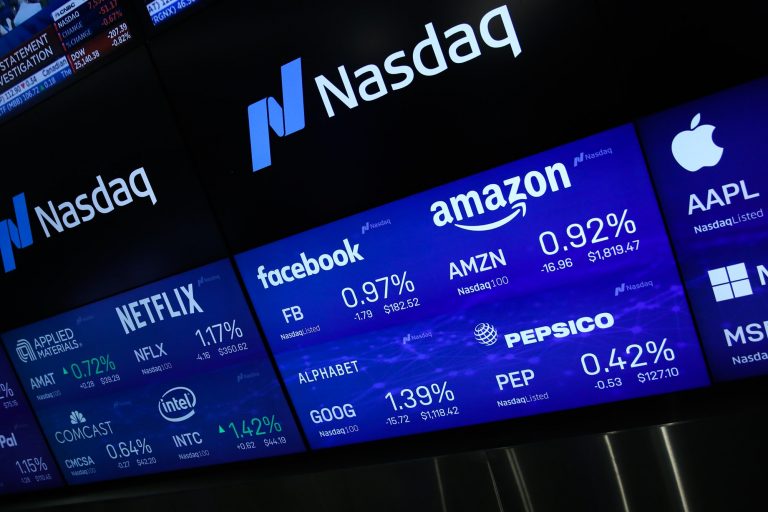
All of the major indexes spent some of Friday’s session in the red, but all three also managed to hold onto gains into the close and end the week higher. The Dow rose 115 points for a gain of 0.44%, while the S&P advanced 0.77%. The Nasdaq Composite was the relative outperformer, posting a gain of 1.49% as strength in the technology sector pushed the index higher. – Pippa Stevens
Kansas City Southern spikes on report of private equity interest
Shares of Kansas City Southern jumped 15% and were briefly halted after Dow Jones reported that private equity firms were interested in the railroad company. The news wire service, citing sources, said Blackstone and Global Infrastructure Partners were two of the interested parties. — Jesse Pound
Earnings dichotomy: Best beat rate, worst profit levels since 2008
For corporate earnings in the second quarter, it’s been the best of times and the worst of times, depending on the metric. One one hand, the 84% beat rate for bottom-line profits would be the best quarter since FactSet began tracking in 2008, if the pace holds up. On the other hand, the 35.7% profit drop is tracking for the worst quarter since Q4 of 2008, at the depths of the financial crisis. Those results come with 63% of S&P 500 companies reporting so far. In all, company earnings have been 21.8% above estimates, which also would be a record, according to FactSet’s John Butters. On the downside, analysts expect companies in the index to see profit losses in the next two quarters before returning to growth in 2021. — Jeff Cox
Gold settles at record high, posts best month in more than 4 years
Gold futures settled 1.06% higher at $1,962.8 per ounce, a new record close, after earlier rising to a new all-time intraday high of $2,005.4. It was the metal’s eighth straight day of gains. Gold also posted its eight straight week of gains for its longest weekly winning streak since 2006. For the month gold gained 9.01% for its best month since Feb. 2016. It was the fifth straight month of gains, and the longest monthly winning streak since Dec. 2010. – Gina Francolla, Pippa Stevens
Final hour of trading
Stocks have risen off their lows for the session, but the Dow is still in negative territory as the closing bell approaches. The 30-stock index was down about 60 points, or 0.2%. The Nasdaq Composite was the leader with a gain of 0.9%, while the S&P 500 clung to a 0.1% move higher. — Jesse Pound
Search for growth supporting tech, UBS strategist says
With a few of the Big Tech stocks being the rare winners during Friday’s broad sell-off, investors are hunting for growth amid a poor economic environment, said Teresa Jacobsen, managing director at UBS Private Wealth Management.
“The growth is still in technology … especially when you look at the GDP print from the other day, we’re in a low growth environment and investors are looking for what precious growth there is in the market,” she said.
Jacobsen said she would advise investors to make sure they aren’t “substantially overweight” in tech but doesn’t think the sector is in a bubble. She pointed to the advent of 5G as a secular growth trend that could support the sector in the years to come. — Jesse Pound
Nasdaq Composite turns negative
The Nasdaq Composite reversed a 1.5% gain to trade lower as investor enthusiasm for shares of the largest technology names cooled. The Nasdaq-100, however, managed to stay in positive territory. Both indexes are on track to end the week with a gain of more than 2%. – Pippa Stevens
U.S. GDP on track to grow 11.9% in Q3, Fed indicator says
The U.S. is set for a strong third-quarter rebound in economic activity, if an Atlanta Federal Reserve indicator is accurate. The Fed branch’s GDPNow on Friday released its first Q3 estimate for gross domestic product growth, and is putting the number at 11.9%. That comes on the heels of a second quarter that saw a decline of 32.9%, the worst annualized drop for a single quarter in recorded history. To be sure, the GDPNow estimate is volatile, especially this early in the quarter. The indicator tracks data as it comes in, so significant moves in either direction can change the reading, at times dramatically. Just prior to the preliminary Q2 GDP reading from the government, GDPNow had indicated a drop of 0.8 percentage points below the actual number. — Jeff Cox
Wells Fargo sold assets to stay under Federal Reserve asset cap, WSJ reports
Wells Fargo was forced to unload assets amid market turmoil earlier this year to stay beneath its Federal Reserve asset cap, The Wall Street Journal reported.
The bank, which has been labouring under the Fed asset cap as punishment for its 2016 fake accounts scandal, was put in a bind at the start of the coronavirus crisis in the U.S. Corporations tapped hundreds of billions of dollars from the industry’s credit lines, and at Wells Fargo the swelling loans forced the bank to sell assets to comply with its regulator, the Journal reported, citing people with knowledge of the matter.
Specifically, Wells Fargo sold financial assets that help corporations pay vendors and manage cash flow, according to the Journal. During the market rout in March and April, the bank sold about 10% more in the assets than it typically does, the Journal said, citing a person with knowledge of the move. – Hugh Son
Apple becomes world’s most valuable company
Apple is now the most valuable company in the world.
Shares jumped more than 6% on Friday to touch a new all-time high of $412, which gives the company a market capitalization of more than $1.762 trillion. This puts the tech giant ahead of Saudi Aramco, which is valued at $1.759 trillion, according to FactSet.
Apple’s gain comes after the company said revenue jumped 11% year over year during the third quarter. – Pippa Stevens
White House’s Meadows says Democrats rejected 4 offers on relief bill
The current $600 weekly federal unemployment benefit is expiring Friday, but lawmakers made little progress toward the next coronavirus relief deal. White House Chief of Staff Mark Meadows said Friday that Democratic leaders have rejected four offers from the Trump administration. He added the White House will have additional discussions with Senate Minority Leader Chuck Schumer and House Speaker Nancy Pelosi, which will likely be extended into Saturday. — Yun Li
Consumer sentiment dampens in July amid virus resurgence
Consumer sentiment deteriorated in July amid a surge in new Covid-19 infections, according to a University of Michigan survey released Friday. The final reading of the index of consumer sentiment came in at 72.5 for this month, breaking a two-month consecutive gain for the gauge. The number is also down from June’s 78.1 and below a Dow Jones estimate of 72.7. — Yun Li
Bond market has a very worried look
Treasury yields are off their lows, after testing a new lower range this morning. On Thursday, the yields of the 2-year, 3-year, 5-year and 7-year notes all set new closing lows. The rise in bond prices on Thursday amid lots of Fed easing and doubts about the economic recovery, as the virus continues to spread. Bond yields fall as prices rise.
A 32.9% decline in second-quarter GDP is certainly negative but that was priced in and the market is more focused on the future. “More concerning is the jobless claims data in the last couple of weeks,” says Jefferies economist Tom Simons. “By this point, we would have thought we’d see claims at a more normal level, but we’re seeing more than 1 million a week.”
Yields are higher now but here this morning’s action:
- U.S.2-year yield hit low of 0.111% its lowest level since May 8
- U.S. 3-year yield hit new intraday record low of 0.122%
- U.S. 5-year yield hit new intraday record low of 0.214%
- U.S. 7-year yield hit new low of 0.382%, lowest level since March 9
- U.S. 10-year yield hit a low of 0.520% its lowest level since March 9
- U.S. 30-year bond yield fell to a fresh low of 1.176% its lowest level since April 29. — Patti Domm and Gina Francolla
Indexes mostly higher, but gains concentrated in biggest names
Despite gains in the S&P 500, Nasdaq Composite and Dow industrials Friday morning, the advances were concentrated in a small group of mega-cap stocks and not spread across index components. Only three stocks of the Dow’s 30 traded higher: Apple alone contributed a positive impact of 168 points and helped offset declines in the remaining 27 equities.
For every stock that traded up on the New York Stock Exchange, about 1.5 traded lower. “Dow breadth is terrible this morning,” Bespoke Investment Group wrote on Twitter. “Just 3 of 30 stocks are up. Apple $AAPL accounts for +150 points while the index is down 4 pts.” — Thomas Franck
Stocks rise on week’s final day of trading as Big Tech bonanza lifts market
The Nasdaq Composite jumped at the start of the week’s final day of trading as positive earnings announcements from Big Tech lifted the broader stock indexes higher. The Nasdaq, which opened with a climb of about 1.5%, outpaced the Dow Jones Industrial Average, which added a more modest 0.15%.
The S&P 500 advanced 0.5% as Amazon, Facebook and Apple promised to help the U.S. market end the month of July with strong gains. As of Thursday’s close, the Dow, S&P 500 and Nasdaq Composite had risen 1.9%, 4.7% and 5.2% for the month. — Thomas Franck
Gold prices top $2,000 for the first time
Gold prices extended their recent rally as investors continued to flock to the safe-haven asset amid economic uncertainty. Gold futures jumped to a new intraday high of $2,005.4 per ounce on Friday, crossing the $2,000 threshold for the first time.
Bullion prices have gained 5.15% this week, on pace for their eighth straight weekly gain. For this month, the precious metal is up 10.74%, on pace for its fifth straight positive month for the first time since December 2010 and its best month since January 2012. — Yun Li, Gina Francolla
Analysts praise Apple, raising price targets across the board
Apple saw its price targets hiked across Wall Street after blowing past profit expectations with its second-quarter report on Thursday night. One such forecast hike came from Citi’s Jim Suva, who shrugged off Apple’s lack of guidance due the underlying strength of the business.
“While the company did not provide guidance for the just reported June quarter and the upcoming September quarter due to COVID-19, it is clear Apple’s products and services are in strong demand and the company is operating very well despite COVID-19,” Suva said in a note.
Pro subscribers can read commentary from other major analysts here. — Jesse Pound
$600 a week jobless benefit expires with Congress far apart on a deal
As extended unemployment benefits expire to those displaced during the coronavirus pandemic, Congress remains unable to reach a deal even as the data show an economy still under intense pressure. Democrats and Republicans appear significantly apart, with the GOP’s latest move for a temporary deal rejected.
Democrats countered the plan to cut the $600 a week extra payout to $200 with a $3 trillion rescue package, but that failed as well. The impasse comes with another 1.4 million Americans filing for unemployment benefits last week and an economy that saw a worst-ever 32.9% plunge in GDP during the second quarter. — Jeff Cox
U.S. agrees to pay Sanofi, GSK $2.1 billion for 100 million doses of Covid vaccine
Drugmaker Sanofi and GlaxoSmithKline announced Friday that the U.S. government has agreed to pay them $2.1 billion to develop and deliver 100 million doses of their potential coronavirus vaccine. More than half of the payout will be used to support further development of the vaccine, while the rest will be reserved for manufacturing and delivery of the doses.
Under the terms of their agreement, the U.S. will have the option to order an additional 500 million doses if it elects, the companies said. The coronavirus has infected more than 17 million people worldwide and killed at least 667,808, according to data compiled by Johns Hopkins University. — Thomas Franck, Berkeley Lovelace Jr.
Big Tech’s stellar quarterly results
Four of the biggest American tech companies all reported earnings or revenue that crushed Wall Street expectations on Thursday.
Apple reported a historically strong quarter, with revenue jumping 11% amid strong online sales during the pandemic. Shares gained 7% in premarket trading. Amazon, which beat earnings expectations and reported double-digit revenue growth year over year, saw its shares climb 6% before the bell. Meanwhile, Facebook reported 11% revenue growth even amid the pandemic slowdown, sending shares up nearly 7% premarket. Alphabet posted better-than-expected earnings, but the Google parent-company reported its first revenue decline in history. The company beat most expectations with the exception of its Cloud division. Its shares were flat premarket.
Thanks to those strong results, these four giants collectively added roughly $200 billion to their market values with the premarket gains set to push them over the $5 trillion mark combined. — Yun Li
Stocks set to rise after strong Big Tech earnings, Nasdaq futures up 1%
U.S. equity futures pointed to gains at the start of the regular session after strong earnings from Big Tech reassured investors that some of the nation’s largest companies have healthy finances despite the Covid-19 pandemic. Dow futures rose 48 points, or 0.2%, while S&P 500 futures added 0.3%.
Nasdaq-100 futures climbed 1.1% after Amazon, Apple, Facebook and Alphabet — some of the largest companies in the U.S. — all reported better-than-expected quarterly results Thursday evening. Those stocks gained 6.2%, 7%, 6.6% and lost 0.5% in premarket trading. — Thomas Franck