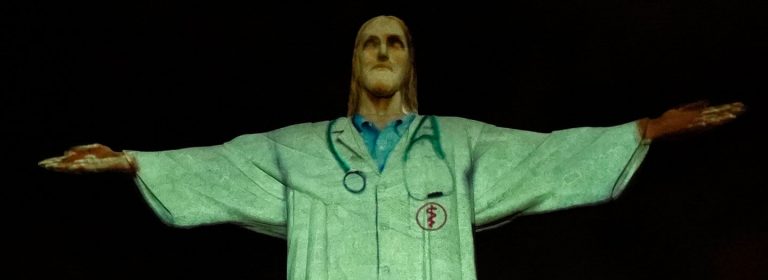
Christ the Redeemer statue illuminated to look like a doctor: Paying forward the sacrifice of those who risk their lives for us

Rio’s Christ the Redeemer statue is lit up in the likeness of a doctor during an Easter service in Rio de Janeiro, Brazil, on Sunday, April 12, 2020.

Deadly tornadoes in the South caused “catastrophic” damage and at least seven deaths after touching down Sunday, according to officials. Hundreds of structures have been damaged by the storms.

Mississippi Gov. Tate Reeves declared a state of emergency over the storms. “This is not how anyone wants to celebrate Easter Sunday,” he said in a statement. But the good news is that “the state and our first responders are working around the clock and will not rest until this is over.”

In other news, Brazil’s Christ the Redeemer statue was illuminated to look like a doctor on Easter Sunday, a tribute to frontline healthcare workers battling the coronavirus pandemic around the world. The flags of several countries affected by the outbreak were also projected onto the monument, and the city’s archbishop performed a mass at the base of the statue in which he paid tribute to medical workers.

The horrific overnight storms in the South remind us that a pandemic does not displace other tragedies. People still have heart attacks and strokes. They still suffer from cancer and diabetes. One reason “flattening the curve” is so essential is that, otherwise, COVID-19 patients could fill up hospitals to the exclusion of those who need medical care for other reasons.

But the responses in the South and the tribute in Brazil
also remind us that we owe a perpetual debt to those who risk their lives every
day for us.

Paying forward the sacrifice of those who risk their lives for us

According to reports, thousands of healthcare workers in the US have contracted coronavirus from patients and dozens have died. First responders after storms risk their lives by going into damaged structures looking for survivors.

Every year we are reminded by Good Friday and Easter Sunday
that our salvation was…

… Read More


Click Read More to read the rest of the story from our content source/partners – Denison Forum.

قالب وردپرس

Pastor, 10-Year-Old Boy and Two Other Christians Killed in Plateau State, Nigeria

Pastor, 10-Year-Old Boy and Two Other Christians Killed in Plateau State, Nigeria


JOS, Nigeria, April 9, 2020 (Morning Star News) – Muslim Fulani herdsmen in north-central Nigeria on Tuesday (April 7) killed a pastor and three members of his congregation, including a 10-year-old boy, sources said.

In an attack on Ngbra Zongo village, near Miango in Plateau State’s Bassa County, the herdsmen shot and killed Matthew Tagwai, pastor of an Evangelical Church Winning All (ECWA) congregation, in his home after 8 p.m. that night, according to area residents. Pastor Tagwai was 34.

He leaves behind two young children and his pregnant wife, area residents said.

Also shot dead in their homes were ECWA congregation members Ishaku Abba, 10; Dih Sunday, 21; and Duh Abba, 38, area resident Patience Moses said.

“The attack was carried out by armed herdsmen against the community at about 8:20 p.m. on Tuesday, 7 April,” Moses told Morning Star News. “Two other Christians, Abbayo Ki, 45, and Monday Adamas, 19, were also injured during the attack by the herdsmen, and they are currently being treated at a hospital at Dantako village.”

A survivor of the attack, Moses Gata, confirmed that the assailants were ethnic Fulani, a predominantly Muslim people prevalent throughout western Africa.

“There’s no doubt about it – our attackers are Muslim Fulani herdsmen,” Gata told Morning Star News. “They were communicating with themselves in Fulfulde, the herdsmen’s…

… Read More

Click here to read the rest of the story from our content source/partners – Christian Headlines.

قالب وردپرس

A church fills its empty pews with pictures of its members: How the joy of Easter Sunday can change the world on Monday

Boris Johnson, Prime Minister of The United Kingdom

A church in Florida appeared to be full yesterday, but this is because members of the congregation emailed photos of themselves to the staff, who then printed the images and taped them to the backs of seats in the sanctuary.

Welcome to Easter Sunday 2020. 

A church in South Carolina had Easter services in their parking lot as members watched on large outdoor screens while listening to the broadcast over local radio. A youth pastor in Arlington, Texas, created an Easter egg hunt for children using the online video game Minecraft, a strategy which gained national attention. 

A church in North Carolina has held a sunrise Easter service for 250 years, even through the Revolutionary War, the Civil War, and two World Wars. But for the pandemic, the celebration was replaced by an online service. 

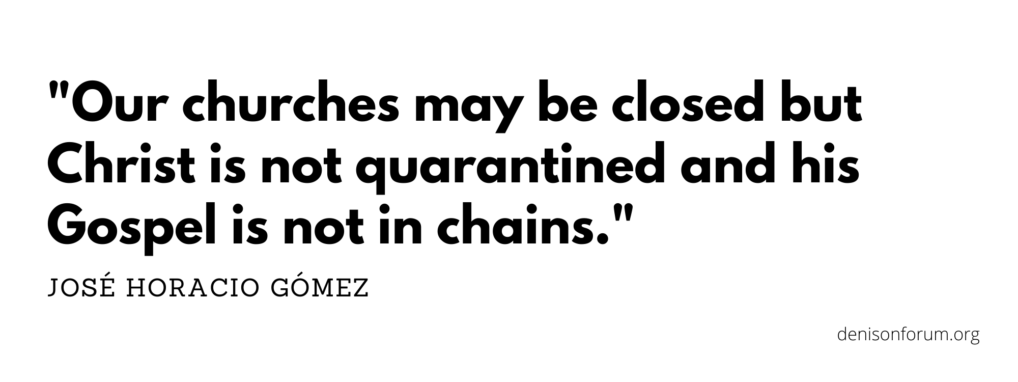
Archbishop José Horacio Gómez of the Los Angeles diocese was right: “Our churches may be closed but Christ is not quarantined and his Gospel is not in chains.” 

Boris Johnson is home from the hospital 

Now it’s the Monday after Easter. What difference did yesterday make today? 

British Prime Minister Boris Johnson was released from the hospital Sunday morning to continue his recovery from COVID-19 at home. In a video tribute, he thanked healthcare workers who “saved my life, no question.” Scientists are trying to determine whether patients such as the prime minister now have an acquired immunity that protects them from reinfection or at least lessens the severity of future infections. 

If so, doctors who recover from COVID-19 could care for coronavirus patients in the place of those who are still at risk. The same could be true for grocery workers, delivery drivers, and anyone else performing an essential service at the risk of infecting themselves (and then their families). 

Let’s consider this possibility as a post-Easter parable. 

The practical path to…

… Read More


Click Read More to read the rest of the story from our content source/partners – Denison Forum.

قالب وردپرس

Ten Pieces of Good News We Are Hearing from Churches During the Pandemic

By Thom S. Rainer

We have a continuous feedback loop from church leaders. Through Church Answers, social media, our podcast, and our blog, we read thousands of comments each week. I am encouraged by some of the things I am seeing.

To be clear, I am not making light of the devastating impact of COVID-19 on many lives and on our economy. But in the midst of the challenges, we are hearing some of the ways God is blessing churches. Here are ten of them. 

  1. Two weeks ago, 15 percent of church leaders thought their churches would close as a consequence of the pandemic. Today, that number is down to 3 percent. There is indeed much more hope.
  1. Giving for 78 percent of churches is either the same in the pandemic as before, or it is only slightly down.
  1. Church members, for the most part, are enthusiastically adopting digital giving.
  1. Church leaders are creatively discovering ways to reach and minister to people who are viewing their streaming services.
  1. Because churches can’t meet in person, most congregations are not having business meetings, avoiding conflicts they’ve had in the past.
  1. Church members are adopting video conferencing technology with enthusiasm. It will become a key delivery mechanism for churches post COVID-19.
  1. The primary beneficiary of the video conferencing technology in churches is small groups. Churches are reporting that some small groups are consistently having 100 percent or more attendance. One church reported that their small group attendance includes more guests than any point in…

… Read More


Click here to read the rest of the story from our content source/partners – Thom Rainer.

قالب وردپرس

Mike Watson Pays Tribute to Fellow Journalist Dan Wooding’s Life

It was the most terrifying moment of my life. Dan Wooding and I were meeting the parents of the Kray Twins, Britain’s most notorious gangsters.

The “boys”, Ronnie and Reggie, were serving life sentences for their part in murders, armed robberies and protection rackets.

But bizarrely, before their arrests in 1968, they had become celebrities, mixing with top entertainers including Frank Sinatra and Judy Garland in London’s “Swinging Sixties”.

In the mid-1970s Dan was an up-and-coming journalist and had asked me – a friend and colleague – to work with him on an exclusive interview with their elderly parents, Violet and Charlie, for a top Sunday newspaper.

Dan did most of the leg-work, but thought he might need a bit of protection – not that I could have provided any – on this trip to a rather dangerous part of the capital’s East End.

The old couple turned out to be utterly charming and provided us with endless cups of tea. All was going well, and we were chatting about their former priest, who was Dan’s contact for the story.

Suddenly there was a thunderous, repeated knocking at the front door. Dan and I looked at each other and froze.

But the Krays didn’t seem too bothered. And we soon found out why. It wasn’t a police squad at the door, or a rival gang. It was just a man collecting money for the football pools – a hugely popular betting system based on predicting each Saturday’s soccer results.

We breathed again. And looking back on my friendship with Dan, that just about sums it up. You never quite knew what to expect.

We met at a newspaper in Ealing, a prosperous suburb of West London, and hit it off immediately, probably because of our mutual weird sense of humour.

SOURCE: Assist News Service, Peter Wooding

All Content & Images are provided by the acknowledged source

Coronavirus Searches Lead Millions to Hear About Jesus Online

Millions of worried people who have turned to Google with their anxiety over COVID-19 have ended up connecting with Christian evangelists in their search results—leading to a spike in online conversions in March.

In the Philippines, a woman named Grace found herself on a website about coronavirus fear hosted by the internet evangelism organization Global Media Outreach (GMO). “Please help me not to worry about everything,” she wrote in a chat with a volunteer counselor. “What’s happening now is very confusing.” The counselor explained that only Jesus can bring lasting peace, and Grace received Jesus as her Savior.

Back in the US, a volunteer at the Billy Graham Evangelistic Association (BGEA) chatted online with a young mother named Brittany who worried that COVID-19 would take her life and her children’s lives. The volunteer offered hope and peace, and Brittany too accepted Christ.

Three of the largest online evangelism ministries—GMO, BGEA, and Cru—account cumulatively for at least 200 million gospel presentations on the internet each year. All three say the number of people seeking online information about knowing Jesus has increased since the COVID-19 outbreak was declared a pandemic in early March.

Between mid-March and late March, GMO saw a 170 percent increase in clicks on search engine ads about finding hope. Clicks on ads about fear increased 57 percent, and about worry 39 percent. The ministry’s 12.4 million gospel presentations in March represented a 16 percent increase over the average month in 2019.

This recent surge corresponds with a broader finding by a University of Copenhagen professor: Internet searches related to prayer in 75 countries skyrocketed to their highest levels in five years in March.

“We are seeing millions of people open to talking about faith in the face of fear,” said Michelle Diedrich, GMO’s seeker journey director, “and we’re ramping up to be available for them.”

Pastors, evangelists, and online ministries tend to tell a similar story: COVID-19 escalated an already significant trend toward internet evangelism. As the virus’s spread eventually wanes, they will seek to determine whether the uptick in online witness can be sustained—and how they might improve discipleship for these new believers. Only a fraction of those who come to faith online engage in follow-up discussions or report joining a local church.

In March, BGEA launched landing pages with coronavirus resources in six languages (English, Spanish, Portuguese, Korean, Mandarin Chinese, and Arabic). The association also launched social media campaigns themed around fear.

In the first four weeks, 173,000 people visited the websites and more than 10,000 clicked a button indicating they made decisions for Christ, said Mark Appleton, BGEA’s director of internet evangelism. That was in addition to traffic on BGEA’s standard family of evangelistic websites, which includes SearchForJesus.net and PeaceWithGod.net and sees nearly 30,000 visitors per day. (CT reported in 2015 that online gospel presentations through BGEA were equivalent to a daily Billy Graham crusade.)

One visitor to the coronavirus page, a 17-year-old named Donmere, told a chat volunteer, “I’m not really a religious person, but I don’t know who else to turn to but God.” Forty-five minutes later, Donmere was a follower of Christ and had been pointed to discipleship resources.

Donmere’s conversion fits the profile of typical internet salvation experiences.

Pastor Mark Penick, in his 2013 doctoral dissertation at Dallas Baptist University, studied converts who came to Christ through the evangelistic website IAmSecond.com. Through in-depth interviews with 37 individuals in 17 states, Penick determined all his subjects “experienced an impassible quandary” like a divorce, job loss, or financial crisis that left them searching and questioning. Eighty-six percent said finding a Christian website was unplanned but “of their own initiative” (through actions like clicking on an ad or a search engine result). About 75 percent had “personal dysfunction and addiction issues” prior to their online conversions.

Few scholarly analyses of internet evangelism have been attempted—mostly dissertations and doctoral projects on specific evangelistic initiatives—but in 2014, the Pew Research Center found that informal online witnessing was relatively common. One in five Americans said they shared their faith online at least weekly, and 60 percent said they saw religion shared online at least weekly.

In 2018, Barna Research reported that most Christians agree technology is making it easier to evangelize and that 58 percent of non-Christians said someone had shared their faith with them on Facebook, with another 14 percent hearing a testimony through other social media channels.

Ed Stetzer, director of the Billy Graham Center for Evangelism at Wheaton College, said missiologists generally have a favorable view of internet evangelism.

“Historically, we’ve always thought of evangelism being done with our feet and our faces,” he said. “We go and we tell. But people feel okay that it might involve electrons and avatars” in the 21st century.

At Cru, witnessing also involves emojis. Among Cru’s digital evangelism tools for college campuses is a survey to be answered with emojis to start a spiritual conversation. Cru’s online presence also includes evangelistic mobile apps, gospel presentations in various languages, and online articles using felt needs as bridges to the gospel. One of the ministry’s most effective evangelistic websites, EveryStudent.com, received 56 million hits last year and registered 657,000 decisions for Christ.

In response to COVID-19, Cru has added 52 new resources to its websites. A corresponding bump in traffic has the ministry on pace to eclipse last year’s total number of visitors to EveryStudent.com by 20 million in 2020 and the site’s total decisions for Christ by more than 300,000.

The college-focused ministry InterVarsity USA reported a similar increase in spiritual interest amid COVID-19. In an online fundraising ad running the first week in April, the ministry stated, “We’ve seen more first-time decisions to follow Jesus in the last week than at any other time in the past year.”

A study by the American Enterprise Institute suggested the young adults targeted by ministries like Cru and InterVarsity may be more worried about the coronavirus—at least in some respects—than their counterparts in older generations.

The survey found that 53 percent of 18- to 29-year-olds are concerned about being able to afford basic housing costs amid the pandemic. Fifty-nine percent of 30- to 49-year-olds expressed the same concern, compared with just 29 percent of Americans age 65 and older. Across all generations, people said the coronavirus outbreak has caused them to feel closer to God, including 14 percent of the religiously unaffiliated.

Despite the documented rise in religious interest as COVID-19 sweeps the world, it remains unclear how much of the increase in religious internet traffic is due to the heightened interest and how much is simply a temporary replacement for in-person religious activity. Cru, for instance, has taken all of its evangelism and discipleship groups online via the video conferencing software Zoom. On a single day in late March, Cru held 746 Zoom calls, compared with 474 for the entire month of February before social distancing began in earnest for the US.

By March 29, only 7 percent of American churches were still holding physical gatherings and most had moved online, according to a survey by LifeWay Research. Just 8 percent of Protestant pastors said they had not provided any online sermons or worship services for their congregations during the month of March.

Source: Christianity Today

All Content & Images are provided by the acknowledged source

Ben Trueblood on Ministering to Teens While They Shelter at Home

Ben Trueblood is director of LifeWay Students.

It’s the final stretch for the 2020 school year, and in a normal year it would be filled with several “lasts” that help bring closure for teenagers as they move from one grade to another and enter their summer break. Of course, this year is far from normal.

Teenagers are at home, activities are shut down, and many of those “lasts” are lost.

Schools and churches are launching digital programming to deliver content to the generation of our country that is the most digitally native among us. Other generations are learning and exploring this great new digital land where our teenagers have already built settlements and cities. In many ways, it’s their land, and we are invading it.

And, it’s about time.

The teenagers in your church and community need you in this moment to embrace the awkwardness of discovering a new land in order to reach them. They probably won’t say that to you, and you probably won’t get a welcome party, but they need you there with them, and they are worth it.

This generation of teenagers is the most connected generation we’ve seen, and yet the most disconnected at the same time. They have thousands of surface level relationships and conversations while few people in their lives truly know them. Anxiety, loneliness, and depression are serious challenges they were already facing before COVID-19 and sheltering in place gained the potential to morph into isolation.

The message of hope found in Jesus is the conversation your teenagers need right now. They need to hear it from you, and they need to be equipped to have that conversation with their friends. In many ways, student ministry has an opportunity in this moment to equip teenagers to talk about their faith in Jesus more than any other time. They are ready to hear it, and they are ready to pass it on to their friends.

I’ve been so encouraged by the work of student ministry leaders to move programming online in the first few weeks of this pandemic. It has been an incredible effort fueled by a desire to continue ministering to teenagers. Now, my challenge to student ministry leaders is to move beyond online programming to content that will specifically address the need and opportunity of the moment.

All Content & Images are provided by the acknowledged source

Why Brazil’s Churches Closed, Even Though President Bolsonaro Disagrees

Brazil’s churches have landed on the front lines of a disagreement between state governors and President Jair Bolsonaro over the states’ quarantine measures designed to contain the spread of the new coronavirus, which has sickened more than 11,100 Brazilians and killed 486. Bolsonaro is actively undermining the governors and says a broad lockdown will ultimately destroy Brazil’s economy.

In late March, Bolsonaro passed a decree that added religious activities to the list of “essential services,” meaning sanctuaries could remain open even though citizens were asked to stay home. The decree was overruled by a federal court the following day. On the streets the following Sunday, he again defended people getting back to work.

“Open the churches, please, we need them,” one woman begged repeatedly in one of the videos Bolsonaro posted to social media. He replied with reassuring words.

Political analysts say Bolsonaro is addressing his electoral base—Brazil’s politically powerful Protestants, who helped bring the far-right president to power in the 2018 election—and letting them know they aren’t forgotten. Brazil is home to the world’s largest number of Catholics—some 123 million, according to the last official census. But Protestants are a growing force. The 2010 census counted 42 million believers, about 20 percent of the total population. A survey released in January by Datafolha concluded that Protestants now comprise 1 in 3 Brazilians.

“No political party in Brazil manages to bring together as many people, in as many places, as many times a week as churches do,” Carlos Melo, a political science professor at Insper University in São Paulo, told The Associated Press. “And people tend to follow the pastors’ directions.”

The most influential pastors are backing the president’s COVID-19 stance while begrudgingly respecting governors’ orders and either canceling services or moving them online. “I’m asking, which is worse: coronavirus or social chaos?” Silas Malafaia, one of Brazil’s most prominent and controversial pastors who leads the Assembly of God Victory in Christ Church, told AP. “I can guarantee you that social convulsion is worse.”

While the protests of neo-Pentecostal figureheads like Malafaia have drawn the most media coverage, many of Brazil’s evangelical churches long ago decided to heed the advice of health experts and cease their worship services.

Miguel Uchôa, the Recife-based primate bishop of the Anglican Church in Brazil, which represents evangelical churches aligned with the conservative GAFCON Anglican movement, prohibited all of his churches from holding “any type of face-to-face meeting.” Since March 26, everything from Sunday services to small groups has taken place online.

“We understand that the church must collaborate as much as possible to halt the spread of the virus and help save more lives,” he told CT.

“The sanctuary and ‘the church’ are different things,” Alexandre Ximenes, bishop of the Charismatic Episcopal Church of Brazil in Recife, told CT. “I agree with closing the sanctuaries to large meetings, with following the guidelines of the health officials and not contributing to the increase of the problem. It’s both common sense and sets an example.”

“The church’s mission is not limited to preparing man to live in heaven, but also to teach him how to behave on earth—what I call the horizontal gospel,” Fernando Firmino, bishop of New Life Church of Brazil in Araripina, told CT. “Therefore, we must take advantage of this time to show our brothers and sister the need to be good citizens, using a faith that does not take away from common sense and reason.

“That’s why I believe the online services in this period of isolation have been both a revealing tool of our faith and spirituality and a revelation of our social responsibility,” he said.

“To our surprise, these internet meetings with church groups have had a surprising effect in encouraging and strengthening people,” Augustus Nicodemus Lopes, pastor at First Presbyterian Church in Recife, told CT. “Most of them are confident in God and comforted, even in the face of the dire prospects before us.”

“We prepare our people to face the difficulties of life, which happened even to faithful believers like Job, John the Baptist, and the apostle Paul,” said Lopes. “They learned that suffering serves to make us like Christ, to desire the things of God more and to take our hearts out of the things of this world.”

Lopes and five other Brazilian leaders explained more to CT about their decision to close services:

“The posture of Tambaú Presbyterian Church—under the guidance of the state of Paraíba synod, of which I am president—has been, since the beginning, of unrestricted support for the measures that the Brazilian health authorities have adopted to prevent and combat the threat of the new pandemic. Despite the great value of the community celebration of the people of God, the understanding is that in a situation of clear risk of contagion and death, our theology clearly instructs conscious and collaborative citizen participation. This is how sacred Scripture teaches us, [as well as] good and healthy Reformed theology on the authority of the civil magistrate: which has its sphere of action, while it is up to the church to exercise the means of grace, the proclamation of the gospel, and involvement in the great challenges of social transformation. Thus, the exceptionality of not being able to meet is leading us to the massive use of information and communication technologies as a way of continuing to spiritually assist the sheep and testifying to our confidence that the Lord of time and history will pass through this providence with us, until we reach the safe haven of his good, pleasing, and perfect will.”

“We should not keep our services in person for three reasons. First, because we care for the flock. I think that is the biggest reason. Second, because we should not tempt God. He did not ask us to be heroes of the faith, but to obey—including authorities. And worship does not boil down to the sanctuary. We are not being persecuted. If we open up, even if we forbid the elderly to come to services, the younger ones will come and may be contaminated. Third, indirectly, the church will feel that “church” is not the building and that worship is not limited to community worship, but also worshiping God alone or with the family. We made the decision not to have worship services, even before the government asked or required it. And our primary reason was to take better care of our flock, as well as to communicate that we are taking care.”

All Content & Images are provided by the acknowledged source
Persecuted Pygmy Group in Democratic Republic of Congo Facing ‘Devastation’ from Coronavirus Plague

A group of Pygmies from the Democratic Republic of Congo – already fleeing violence – are set to face further devastation as Coronavirus enters the nation, according to a report by Open Doors UK.

The charity says thousands of the largely Christian Pygmies have been driven from their homes in the country’s North Kivu province – an area where Islamic extremists are seeking to build a caliphate.

Open Doors added the displaced population, indigenous to the Congo rainforests, have fled to crowded and often unsanitary internally displaced persons (IDP) camps seeking refuge and safety.

Now, unable to isolate themselves, they face dire consequences from the COVID-19 outbreak.

“A widespread outbreak would be devastating,” says Jo Newhouse, Open Doors’ Head of Communications for Africa. “That’s especially true in the violence ravaged areas like North Kivu province.

“Christians uprooted by Allied Democratic Force rebels are already facing dire conditions. It will be very hard to practice social distancing in Internally Displaced People’s camps.”

The Congo, which has only just been declared clear of Ebola, currently has now declared a state of emergency in the country, with 98 confirmed cases of COVID-19 and eight deaths so far.

SOURCE: Assist News Service, Peter Wooding

All Content & Images are provided by the acknowledged source
Greg Laurie on Will Coronavirus Lead to the Next Great American Awakening?

Greg Laurie is the senior pastor of Harvest churches in California and Hawaii and the founder of the Harvest crusades. Visit Harvest.org to watch Greg’s messages and movies, streaming live for free right now. Follow Greg at@GregLaurie to follow his daily inspirational videos and posts.

As the Coronavirus (COVID-19) sweeps across our country, confining us to another month at home, some have asked me, “Are we on the verge of a spiritual awakening?”

There are some hopeful signs.

In many ways, we now are doing the very things we should have been doing all along: Spending time with our families, sharing meals, talking to our neighbors, helping one another and taking long walks outside (while maintaining social distancing of course).

And there are other hopeful trends. For example, some distilleries are stepping in and producing hand sanitizer instead of booze. It reminds me of the verse that says, “They will beat their swords into plowshares” (Isaiah 2:4). But instead it appears we are turning our scotch into sanitizer and our piña coladas into Purell!

I also have heard good news on several fronts: less abortions are being performed, and crime rates in some parts of the country have plummeted since the stay-at-home orders were issued.

These are all good things, but then there is the unthinkable tragedy of people dying every day from COVID-19. It is this very thing, the fear of death, the acknowledgement of the fragility of life, that has been a wake-up call for many.

In some ways the COVID-19 pandemic has forced people to consider the afterlife and their relationship with God by knocking down all our false gods.

For people that worshipped sports, the stadiums are closed and no games are being played.

For others who idolized musicians, the civic centers are closed and the concerts are canceled.

For those that had such fawning admiration for actors, the theaters are shuttered and no new films are coming.

For even others who bowed at the altar of money, the stock market is generally down and the economy is stalled.

If you do go out, you can see the fear, stress and worry on peoples’ faces. People need hope. They are searching for a light at the end of the tunnel, and are finding that their usual heroes cannot get them out of this mess.

Hollywood can’t save us. There is no blockbuster film or actor that will get us out of this.

Technology can’t save us either. Our smartphones and computer screens just feed us a barrage of information that heightens our stress and anxiety.

Our lawmakers in Washington can’t save us from COVID-19. They will hopefully continue to work together and do what they can, but the outcome is outside of their control.

I think we finally are beginning to realize we need God.

I recently came across an article for an academic journal that studied the role of religion and faith in the COVID-19 pandemic. The article found that Google searches about prayer skyrocketed when the coronavirus went global, and in fact, the search intensity doubled for every 80,000 new confirmed COVID-19 cases.

A recent Pew Research survey of American adults confirmed this trend, with 55% of adults surveyed indicating that they had “prayed for an end to the spread of coronavirus.” In another poll, nearly half of respondents said the pandemic was a “wake up call” from God.

Source: Christianity Today

All Content & Images are provided by the acknowledged source