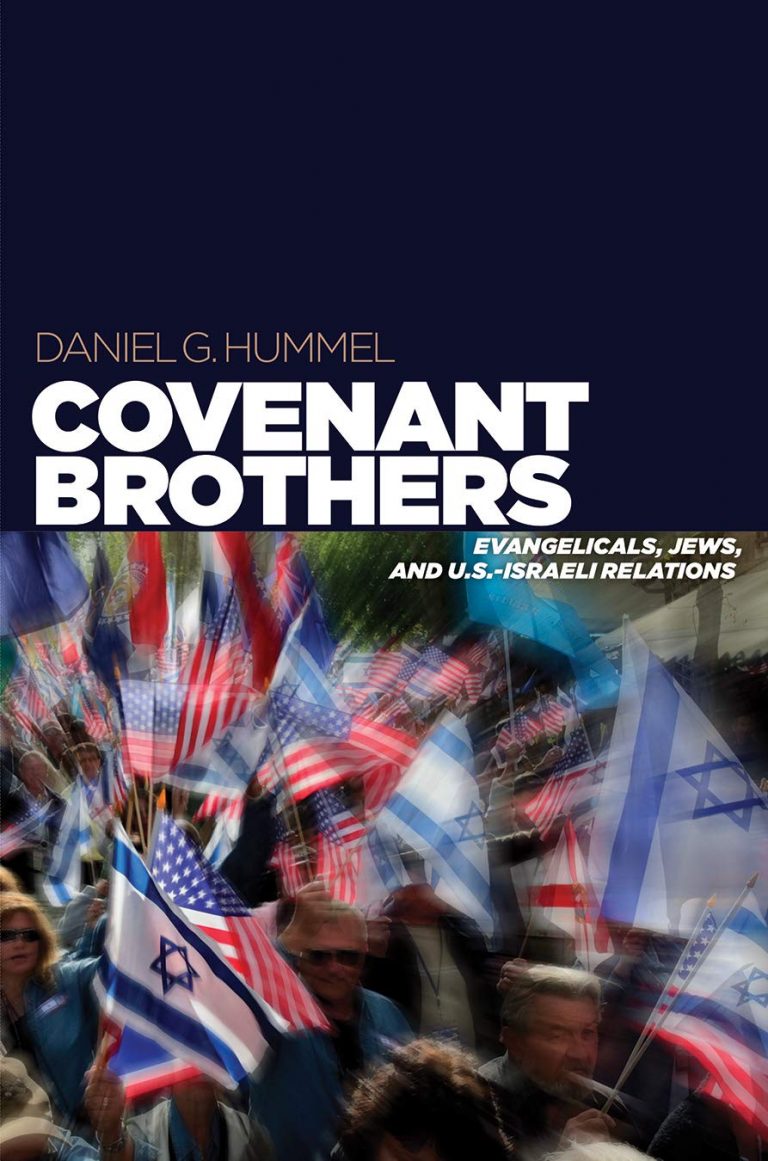
Book Review: ‘Covenant Brothers: Evangelicals, Jews, and U.S.-Israeli Relations’ by Daniel G. Hummel

Dwight D. Eisenhower was the first president baptized in office. Shortly after his inauguration, Edward L. R. Elson of the National Presbyterian Church in Washington baptized the president in a private ceremony.

For several reasons, Elson was an interesting figure during America’s civil-religious awakening of the 1950s. First, he was the president’s pastor. Second, he was a pretty effusive flatterer of leaders in high office. He peppered Secretary of State John Foster Dulles with invitations to attend numerous church events, laying it on thick with encomia like “Let me tell you how superlatively I believe you are handling your high office.” Third, he frequently took the liberty of giving Dulles advice on how to handle affairs of state. And fourth, he was a committed anti-Zionist. Beginning in 1954, Elson was a board member of the American Friends of the Middle East, an anti-Zionist front group sponsored by the CIA. He was determined to get Dulles to assist him in advancing the AFME’s mission.

Elson could be startlingly forward with the secretary of state. In 1955, Elson wrote to Dulles, asking how the AFME might be “of increased usefulness at this trying time of American relations in this area.” In 1957, he invited Dulles to a dinner with Cornelius Engert, one of the AFME’s founders, to discuss Middle East strategy. (Dulles’s staff, noting that the AFME was “a partisan Arab group,” declined the invitation on his behalf.) And in 1958, Elson had the audacity to insist that Dulles make a special stop in Egypt on the way to a Baghdad Pact meeting in Ankara because “some of our real and trusted friends would be greatly encouraged by your personal appearance in Cairo.”

With a few exceptions, such as when Elson asked Dulles for a framed and autographed photograph to hang on the wall of his study next to his likeness of Eisenhower, Dulles consistently gave Elson the cold shoulder. Elson believed that support for Israel was antithetical to American interests in the Middle East. He was not interested in any concrete efforts toward reconciliation between Jews and Christians that went beyond prayer, which he described as the best “way of reconciliation” and “tool for peace.”

In stark contrast to mainline Protestants like Elson, evangelicals such as Billy Graham were deeply interested in pursuing reconciliation between Jews and Christians. In Covenant Brothers, an excellent new study of the relationship between evangelicals and Israel since 1948, historian Daniel Hummel argues that evangelicals broadly and consistently sought reconciliation with the Jewish people through support of the newly established nation of Israel. In fact, postwar evangelicalism fostered a political and social program crafted to bring American Jews, the Israeli state, and evangelicals into what Hummel calls a “covenantal partnership.”

Over time, this program became known as Christian Zionism. A variety of leading figures helped give it shape, especially after the Six-Day War of 1967. Among them were Graham, archaeologist William Foxwell Albright, scholar Uriel Tal, Israeli Prime Minister Golda Meir, National Association of Evangelicals president Arnold Olson, Southern Baptist preacher W. A. Criswell, Americans for a Safe Israel founder Herbert Zweibon, and International Christian Embassy Jerusalem head Jan Willem van der Hoeven.

Hummel’s central argument is that Christian Zionism is not the caricature of popular imagination, which treats evangelical fondness for Israel as a product of end-times fascination and American imperial ambition in the Middle East. Rather, evangelical political support evolved from the founding of modern Israel in 1948 and deepened in complexity after 1967. Theology played a role, but so did history, political philosophy, Cold War diplomacy, pragmatic considerations, and even tourism. The one unifying theme that bound American Jews, evangelicals, and Israelis together was the notion of covenant built on a foundation of reconciliation between Jews and Christians. The creation of the state of Israel, and the defense of its existence after 1967, demonstrated to evangelicals that Jewish and Christian identity were bound inextricably through shared sacred texts, theology, tradition, and common experience. Throughout the book, Hummel explores the benefits of this partnership and the avenues of reconciliation it opened—while also taking seriously its limits and failures.

Source: Christianity Today

All Content & Images are provided by the acknowledged source

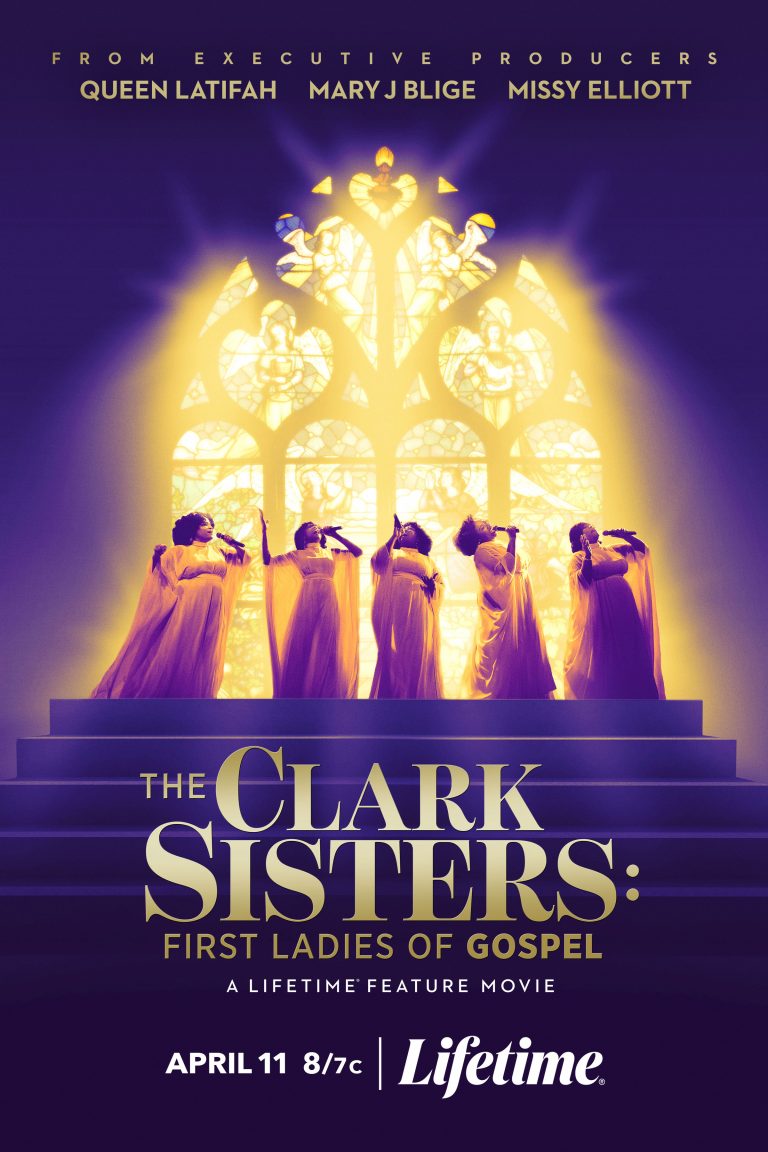
Kierra Sheard Opens Up About Playing Her Mother, Trailblazing Gospel Singer Karen Clark Sheard, in Lifetime’s ‘The Clark Sisters: First Ladies of Gospel’

Premiering April 11, 8 p.m. ET, on Lifetime is the first-ever biopic of the legendary gospel group The Clark Sisters. Produced by Mary J. BligeQueen Latifah and Missy ElliottThe Clark Sisters: First Ladies of Gospel is written by Camille Tucker and Sylvia L. Jones and directed by Christine Swanson, a Detroit native who also helmed Love Under New Management: The Miki Howard Story. The story shows the humble beginnings of trailblazing gospel group The Clark Sisters out of Detroit who have sold millions of records off nearly 20 albums, becoming the best-selling female gospel group of all time. The group, most known for hits like “You Brought the Sunshine” and “Is My Living In Vain,” most memorably came together during Aretha Franklin’s memorial service in August 2018.

Starring Aunjanue Ellis (When They See Us) as Clark family matriarch and musical architect, Dr. Mattie Moss ClarkRaven Goodwin (Being Mary Jane) as Denise “Niecy” Clark Bradford, who left the group, singer Shalea Frazier as Dorinda Clark-Cole, singer Christina Bell from the Stellar Award-nominated group Zie’l as Twinkie Clark-TerrellAngela Birchett as Jacky Cullum (Clark) Chisholm and Grammy-winner songwriter/singer and actress Kierra “Kiki” Sheard (Preacher’s Kid) as her mother, Karen Clark Sheard, the film explores the humble beginnings in the strict Church of God in Christ and trials and tribulations of the group that started out as five sisters under the stern, but loving tutelage and guidance of their mother.

Blackfilm.com spoke to Kierra “Kiki” Sheard, a bestselling singer/songwriter in her own right whose latest album KIERRA, due out this month, has already produced the hit single “It Keeps Happening,” on the heels of last year’s hit “Don’t Judge Me,” featuring Missy Elliott, one of the film’s producers. Sheard, an actress, as well, played Lithia in the 2010 film Preacher’s Kid with LeToya LuckettClifton PowellEssence Atkins and singer Tank. The singer/actress opened up about playing her mother, her grandmother’s greatness, The Clark Sisters legacy and more.

How did you come about playing your mother?

Kierra “Kiki” Sheard: My manager has been wanting to do this story for quite some time. Holly Carter, she’s an executive producer. But I did have to audition. They did not give me anything. I had to fly to LA to audition. I originally auditioned for two roles, my aunt Niecy and I auditioned for my mom and the director, Christine Swanson, connected me with my acting coach, Justin Harris, and that was how it all happened.

Was it difficult for you to play her?

Kierra “Kiki” Sheard: It was. It was definitely challenging. I’ve done some roles before but this, in particular, was I got to say greater because I took it to heart and it wasn’t just a public thing for me. So, yes, definitely it was because my mom also is a bit more soft-spoken than I am. And I’m kind of more outgoing so I kind of had to match it up but it was a great experience. And then, of course, the singing, she is a monster vocally. She’s a true soprano and I’m not a true soprano. So even having to sing her part was quite challenging, but I loved the challenge. I was down for the cause and ready to go.

SOURCE: Blackfilm, Ronda Racha Penrice

All Content & Images are provided by the acknowledged source

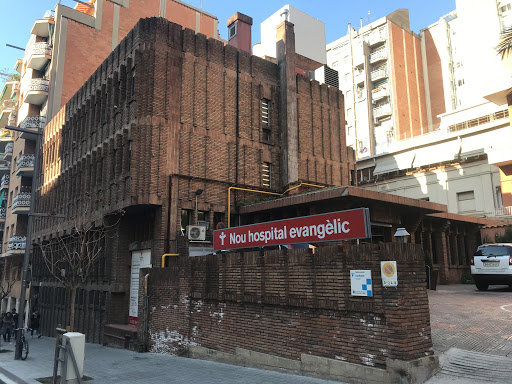
The Evangelical Hospital of Barcelona Prays for The Power of God to Be Shown Amid Coronavirus

The Evangelical Hospital of Barcelona has set up a special area for Covid-19 patients. They ask churches to pray for them “to continue being a light in the midst of this pandemic.”  This wonderful story of how a Christian hospital is serving COVID-19 patients comes to us from the Evangelical News Service.

Health professionals are the ones who directly witness the impact of the coronavirus pandemic in the population. Long working hours are combined with constant exposure to the virus combined with a deep perception of death/  This requires much more than medical skills.  Managing the situation with emotional sensitivity and spiritual strength is also a challenge for healthcare workers.

An example of this is the Nou Hospital Evangèlic (New Evangelical Hospital), in Barcelona, Spain. It is receiving patients diagnosed with the Covid-19 to “support other hospitals that receive the greatest number of cases, so that they, in their turn, can serve more people”. “We have an area for these cases and that is already completely full, so we have had to designate new space,” said the hospital’s manager, Reyes Gualda.

The situation requires an extraordinary effort from the entire hospital, both the medical and cleaning personnel. Basic materials are scarce, they admit. In this complicated scenario, all planning is continually modified to fit changing needs. That is why the Nou Hospital Evangèlic states that they do not know “what will happen in the coming days” and ask for “prayer so that the team knows how to remain calm, have a clear vision and be successful in decision-making.”

The Nou Hospital Evangèlic explained that they have had to hire more people. “We are looking for people to work in the hospital. We need more nurses,” their spokesman said.  Despite the fact that they have a special isolated area for COVID-19,  up to 40% of the health workers at the center are affected by the virus and 25% are in quarantine.  Most are waiting on the results of their test.

SOURCE: Assist News, Jeff Thompson

All Content & Images are provided by the acknowledged source

Nick Hall on Why Easter 2020 Could be the Most Important One of Our Lifetime

Easter is usually a time of vibrancy and life. For many of us, Easter includes dressing up in bright pastels, gathering with family and friends, and maybe even hunting for colored eggs. Those traditions seem wholly inappropriate given our current situation.

Instead, we’re left wondering what happened to Easter in the midst of a global pandemic. COVID-19 has turned our world upside-down, causing many to question where God is in the mess. How can we celebrate the life and joy represented by Easter at a time like this?

But for those who are open enough or desperate enough to look again, I believe this Easter has the potential to be more important than any in our lifetime.

Our world is searching for answers. A recent study found that internet searches around prayer doubled for every 80,000 confirmed cases of COVID-19. But why do people turn to God at a time when God feels absent? Could it be that we deeply want to believe in the God of Easter — a God who suffers with us, for us, and overcomes sin and death? Has there ever been a moment the collective human race was more longing for such a God?

If you are not feeling very hopeful ahead of Easter 2020, I have good news for you: you are in good company. The first Easter didn’t seem like good news for Jesus’ followers in the week leading up to it either. No one would have looked at a beaten Jesus, unjustly accused, abandoned and hung on a cross and said, “That is good news.”

But that’s exactly the paradoxical way God works. Through Jesus, God was doing something no one would have expected to show us how much he cares. Instead of being some impersonal deity, sitting on a royal golden throne surrounded by angels, Jesus became flesh and blood. He walked our soil and felt our pain. This is what makes the Christian faith so unique: our God suffers with and for us. The story of Easter teaches us that when our world feels upside-down, God is often at work setting it right-side-up.

SOURCE: Christian Post, Nick Hall

All Content & Images are provided by the acknowledged source

Peter Wooding, Youngest Son of Dan Wooding, Named Assist News Service Senior Editor

The leadership of Assist News has named Peter Wooding as the new ANS Senior Editor.  Assist News Founder and Peter’s father Dan Wooding, passed away on March 18, 2020.  Because ANS is staffed by volunteer writers, we need your generous support to further the mission as we advocate for the Persecuted Church.  

Dan’s younger son Peter follows in his father’s footsteps by reporting on ministries around the world.  Peter’s reports have included hot spots in Sudan, the war front in Eastern Ukraine, and massive rallies in Africa with Reinhard Bonnke.  His passion to share what God is doing inspired him to take over ANS. 


“One of the last things my father said to me was, ‘Peter it’s the end of an era, but please carry on the work of ANS.’”

SOURCE: Assist News Service, Jeff Thompson

All Content & Images are provided by the acknowledged source

Stephen Enada on Will Coronavirus Increase Support for Religious Freedom?

The Christian Season of Lent is coming to an end – and it’s certainly one for the books. With the spread of the COVID-19 virus accelerating in the U.S. and around the world, normal routines have come to a halt, including most church services. Fortunately, this unprecedented situation has not stopped Christians from preparing for the glory of Easter; instead, it’s drawn others to pray. Even if that trend is short-lived, I hope those that find themselves turning to prayer in this time of crisis walk away with a newfound appreciation for the importance of religious freedom.  

The Pew Research Center released a new report that shows the pandemic has changed the religious habits of Americans, with people who seldom or never pray and even people who say they do not belong to any religion at all, now turning to prayer. In all, more than half of all  U.S. adults have prayed for an end to the virus’ spread. We’re actually very fortunate in the United States, to have the freedom to make this decision, which probably seems small to some.

Here in the United States, religion is recognized as a basic human right that everyone, everywhere, should have at all times. But that isn’t a globally shared belief and in fact, there are places in this world where Christians risk everything to follow Jesus Christ. This remains the case during times of crisis.

According to the latest reports, Christian persecution reached unprecedented levels at the end of 2019, with more than 260 million Christians around the globe experiencing “high levels” of persecution. That’s one in eight believers worldwide – they are men, women and children, moms, dads, sons and daughters.

Some parts of the world are more dangerous for Christians than others. Nigeria is one of those places.

Right now, Boko Haram, widely known as one of the deadliest terrorist groups in the world, is actively committing a genocide against Nigerian Christians and committing crimes against humanity on the wider population. Since 2011, Boko Haram has taken more than 37,000 innocent lives, the vast majority of them women and children. Entire communities, villages, and towns have been devastated. Millions more have been kidnapped or displaced from their homes following persecution.

Fulani militant herdsmen are also waging war on Christian farmers in the middle regions of the nation. Land scarcity and religious intolerance have fueled unspeakable acts of terror against Christians living on desirable lands. Since 2011, 6,000 Christians have been killed by Fulani militants and more than 1,000 churches torched.

SOURCE: Christian Post, Stephen Enada

All Content & Images are provided by the acknowledged source

These Five Coronavirus Survivors Say God’s Supernatural Intervention Saved Their Lives

Americans across the country are celebrating Easter at home with their families on Sunday, including survivors of COVID-19 who say God’s supernatural intervention saved their lives.

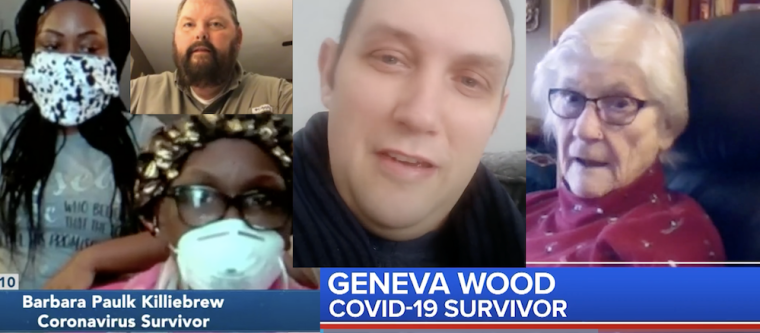
Geneva Wood

Before COVID-19 spread across the U.S., the virus wreaked havoc at the Life Care Center nursing home in Kirkland, Washington, back in February. As many as 35 coronavirus deaths have been linked to the facility, but 90-year-old Geneva Wood said God intervened and saved her life.

Wood was at Life Care Center recovering from a stroke and days before she was to be discharged the facility went on lockdown because of a coronavirus outbreak. Within a few days of the lockdown Wood “experienced a spiking fever.”

“I didn’t know that I had the virus until I had the virus. I had no symptoms of it before,” Wood told CBN News of her experience.

Local news station KIRO reported that Wood was on the brink of death and doctors advised her family to say their goodbyes.

Wood was mostly kept in isolation while fighting the virus but maintained that God was there with her.

“I could feel God’s presence. His hands were on my body and I could feel His presence, and I’d wake up and I could feel these hands and I’d go back to sleep. Through the night, ’cause I’d wake up, I couldn’t see His face, but I could feel His hands and I knew He was with me and I made it through the night,” Wood recalled.

“Until you’ve felt God’s presence and His hands on you, it’s something else. If it hadn’t been for Him, I couldn’t have done it. And I wasn’t alone because He was with me all the time,” she testified.

Wood also credited “one special” doctor who shared Bible scriptures with her daily.

“At first all I said was Psalm 23, but he would read to me every morning,” she said.

After 19 days in the hospital, Woods was sent home coronavirus free. Her family said  her recovery was nothing short of “miraculous.”

Barbara Killiebrew

Barbara Killiebrew, 60, of south Georgia is celebrating Easter with her family members who she was unable to see for weeks after she was put on a ventilator and near death due to the virus.

“First and foremost, I thank God for Jesus, for Him saving my life and giving me another chance, because two or three times where I have given up,” Killiebrew told WALB.

“God said no,” she continued.

Killiebrew was first hospitalized on March 18 and found out a few days later that she tested positive for COVID-19.

“I realize there are so many people around the nation fighting for their life but God and His good almighty helped me. He kept this young lady here to come home and tell about corona, COVID-19,” she said.

Killiebrew maintained that God brought her back to be with her family.

“I felt in my mind and my heart that I was coming back to them. I was fighting, I was fighting for my life,” Killiebrew said.

Clay Bentley

Another man in Georgia, Clay Bentley, also shared how God miraculously intervened in his recovery from the virus. Bentley said he could feel God moving in his life at the most critical point during his fight.

He was hospitalized for 12 days and told CBS News correspondent David Begnaud that his condition was so bad that doctors had told him there was nothing else they could do.

Bentley told Fox News in another interview that as the hospital was considering putting him on a respirator he experienced a miracle.

“I felt like I had a man lying on my chest and I couldn’t breathe,” he said. “And the weight of this man was crushing me and I couldn’t breathe at all. And then all of a sudden, I felt the breath entering me. It was the Lord on my chest. When He breathed inside me, I felt the power of God hit.”

“I couldn’t breathe at all, and suddenly, I felt the Lord. I mean, His presence was there, and I felt air blowing into my lungs,” He told CBS News.

Bentley now back home under quarantine and can’t wait to see his relatives again.

SOURCE: Christian Post, Jeannie Law

All Content & Images are provided by the acknowledged source

WATCH: Kim Fields & Jaci Velasquez Star in Pure Flix Entertainment’s ‘A Question of Faith’ Premiering on Lifetime Tonight – Easter Sunday, April 12th at 8/7c

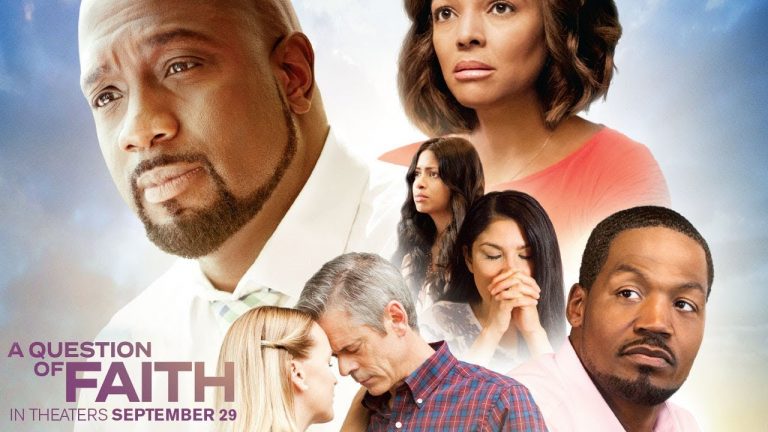
This Easter, Lifetime presents Kim Fields in the emotional film, A Question of Faith. When a teenage girl hits a twelve-year-old boy with her car while texting, the tragedy inevitably links three families together. In the wake of the tragedy, their destiny forces them on a converging path to discover God’s love, grace and mercy as the challenges of their fate could also resurrect their beliefs. Kim Fields, Richard T. Jones and C. Thomas Howell star in the film written by Ty Manns and directed by Kevan Otto. A Question of Faith is produced by Angela White of Silver Lining Entertainment.

h/t: CR8 Agency – Vaughn Alvarez

All Content & Images are provided by the acknowledged source

Jack Graham on How Easter Changes the Way We See Death

If you ask most people what comes to mind when they think of Easter, they might say chocolate bunnies, children hunting Easter eggs in their pastel-colored Sunday best or perhaps a nice lunch with family after possibly going to church. If you ask most people what Easter symbolizes, they would say the start of spring — the beginning of new life. 

And what “life” means to such people falls so short of what it truly is. Shakespeare’s Macbeth described life as “a tale told by an idiot, full of sound and fury signifying nothing.” And to most people life is a void. Such people don’t understand who they are, why they’re here or where they’re going.

Some people seek a life of pleasure — party on! Have a blast while you last! Eat, drink and be merry because tomorrow we die! is their creed.

Other people spend their life in the pursuit of money or possessions so they can have status or security for themselves or their family.

Others might, less selfishly, make caring and serving their family, “the next generation” or even needy strangers their primary purpose.

But in the end, all of these pursuits, some noble and some not, fail to fulfill our true purpose.

James 4:14 describes life as a breath vapor on a cold morning; it’s there for a moment, then gone. Ecclesiastes 3:2 says “There’s a time to be born and there’s a time to die.” And so life is a vapor… here today and then gone. Death is a terrible enemy. It stalks the earth relentlessly, taking young lives as well as older ones. Death is an interloper, an intruder and no respecter of persons!

SOURCE: Christian Post, Jack Graham

All Content & Images are provided by the acknowledged source

Theologians Weigh In on What God Might be Doing in the World Amid Global Easter Lockdown

As many Christians in the West mark the first time they’ve been unable to celebrate Easter publicly at church due to the COVID-19 outbreak, theologians are weighing in on how God might be moving in the world.

Because of the ongoing pandemic, federal, state and local governments have issued “social distancing” and stay-at-home orders along with the temporary shutdown of businesses deemed as “non-essential.” And churches have been largely prohibited from holding services, even on the holiest of Christian holidays.

“I’m reminded that for the persecuted church, this is every week for them,” said Glenn Packiam, pastor of New Life Church-Downtown in Colorado Springs, Colorado, in an interview with The Christian Post.

“The inability to gather, the restrictions on church and worship, we are in many ways standing in solidarity with the persecuted church because we are experiencing what has been their norm on a weekly basis,” he said.

The pandemic presents another opportunity to reconsider the first Easter and the period soon thereafter where Jesus appeared to the disciples while they were in locked rooms, afraid and unsure of what had just happened.

“The last they knew, He was crucified and buried in a tomb. So there is, in a very real sense, not just a connection with the global church —a portion of which is the persecuted church — but there is also a connection with the earliest of churches, the first followers of Jesus who found themselves in locked rooms. And Jesus appeared to them,” Packiam said.

“The resurrection of Christ is able to appear to us, to come to us wherever we are. And as we think about Easter we can remember that the risen Christ walks through locked rooms, He appears through locked rooms, He comes through closed doors and finds us afraid and alone.”

American Christians sometimes tend to interpret events based on what is happening to them, that if they are experiencing difficulty then it must be the end times, he added.

“I think we have to be careful of that because we get spoiled by comfort, we get spoiled by life sort of being relatively good. And because of that we lose our sense of the power of what Christian hope actually is. Christian hope has always been the future,” he said, referencing the Apostle Paul’s words in Romans 8 where he speaks of a hope which remains yet unseen.

“For many of us living in a comfortable sort of existence, our definition of hope gets skewed to be a sense of peace and everything is OK.”

SOURCE: Christian Post, Brandon Showalter

All Content & Images are provided by the acknowledged source