


Source Black Christian News
All Content & Images are provided by the acknowledged source
Jeff Christopherson is a church planter, pastor, author and Missiologist at the Send Institute – an interdenominational church planting and evangelism think tank.
For some of us, it’s hard to think about mission right now.
This sentiment is surely understandable—pastors and church leaders are scrambling to discern the best path forward to love and lead the sheep entrusted to their care. This work, combined with genuine personal anxiety about the coming crisis, sickness, and death, leaves many with little mental or emotional margin to consider how best to care for those outside of the flock.
Yet such efforts are needed, perhaps now more than ever. Our last decade stands as a condemning witness to almost every tribe for the lack of prioritization in disciple-making. Many have authored compelling articles which included undeniable stats of languishing evangelism numbers.
The calls for increased efforts in evangelism often elicit resounding “amens” from pews to tribal leaders alike. Yet even with all the hearty ‘amens’, the numbers suggest that we’ve failed to make progress. Could it be that this moment of global crisis comes with a Sovereign reawakening from our complacent self-fascination to a renewed commitment our King’s commission?
There seems to be three means of gospel engagement that never change. Disciples of Jesus are always positioned with these three tools in their missionary arsenal: what we say, what we do, and how we respond. Let’s think about each in light of the current COVID-19 pandemic and how we might effectively lean into each for missionary engagement.
What We Say
The gospel is multifaceted. This is the brilliance of God’s plan. God’s redemptive work is impossible to contain in one image or concept, so the biblical writers use many different pictures to convey the glory of what God has done for us in Christ.
What We Do
Disciples of Jesus demonstrate the veracity of their words through physical acts that model the character of Christ. Now, more than ever, it’s vital that God’s people do just that. Preaching from the comfortable confines of our sanctuaries feels a bit empty and hollow when disconnected from selfless actions.
Source: Christianity Today
All Content & Images are provided by the acknowledged source
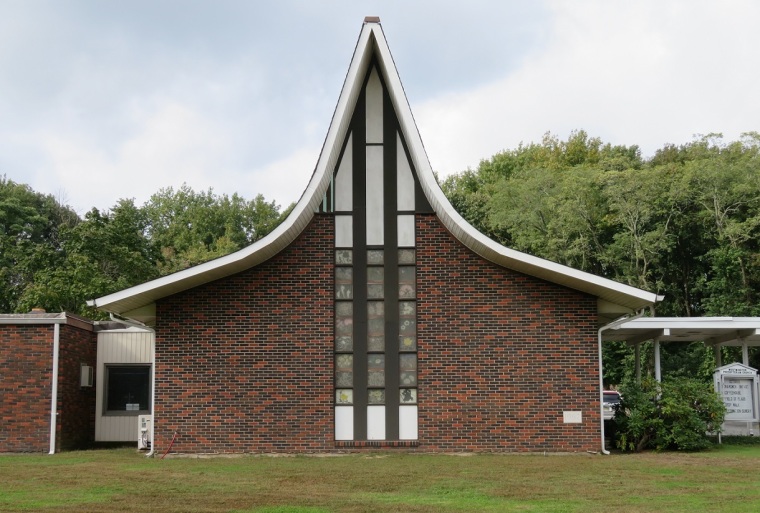
A church in New Jersey is offering Palm Sunday branches and cards with Psalms written on them to drivers and is also delivering these spiritual items to homebound members.
“We hope that the Palms and Psalms will provide the comfort and strength that the Cross and Word of God offers in the present crisis situation,” the Rev. Joseph Hein, pastor of Westminster Presbyterian Church of Middletown, told The Christian Post.
The One Hour Drive-through Palms & Psalms event is being held after its 10:00 a.m. online Palm Sunday service. Volunteers wearing Personal Protection Equipment will also deliver palm crosses in packets that have been sanitized to some of their homebound elderly members.
Hein said that the event was “born of Westminster’s’ strong evangelical faith and emphasis on local mission work.”
“By placing the Cross and The Word of God in our members and neighbors’ hands, we seek to comfort and strengthen. The cross and resurrection is a reminder that God has defeated death on the Cross and that love and life lives at the center of the universe.”
For the event, local residents and church members alike are welcomed to drive slowly through the church’s U-shaped driveway and receive a palm cross and a card with a Psalm written on it, while remaining in their vehicles.
SOURCE: Christian Post, Michael Gryboski
All Content & Images are provided by the acknowledged source

All Content & Images are provided by the acknowledged source
Dear Friend,
These are difficult days, aren’t they?
Anyone who says they have no fear in this pandemic, well, I don’t want to take any advice from them.
I realize God has not given us a spirit of fear but also I know that fear is a part of how God protect us from time to time from things that can harm us.
Let me show you in scripture…
Matthew 10:28 And do not fear those who kill the body but cannot kill the soul. Rather fear him who can destroy both soul and body in hell.
For the longest time people have said something like this, “I don’t want to give my life to Jesus just because I am afraid of going to hell.”
Oh?
So, it would be like you saying now in the pandemic, “I don’t want to wash my hands or social distance from others just because I am afraid of dying.”
Really?
I would encourage you to rethink your theology of fear.
When God asks us to do something, we shouldn’t let fear keep us from doing what He is asking us to do. But on the other hand, sometimes God uses fear to get us to do things we should be doing or to stop doing things we shouldn’t be doing.
See, fear is not always bad, sometimes it is good. Sometimes God uses fear to save our lives and even our souls for that matter.
During the time of Joseph, Mary, and Jesus, God encouraged Joseph not to give into his fear in this passage…
Matthew 1:18 Now the birth of Jesus Christ[a] took place in this way. When his mother Mary had been betrothed[b] to Joseph, before they came together she was found to be with child from the Holy Spirit. 19 And her husband Joseph, being a just man and unwilling to put her to shame, resolved to divorce her quietly. 20 But as he considered these things, behold, an angel of the Lord appeared to him in a dream, saying, “Joseph, son of David, do not fear to take Mary as your wife, for that which is conceived in her is from the Holy Spirit 24 When Joseph woke from sleep, he did as the angel of the Lord commanded him…
See, God encouraged Joseph not to be afraid but to obey and do what He had called Mary and now Joseph to do. So, Joseph refused to give into his fear and did what God asked him to do.
But another time, Joseph was getting ready to do something and look at what God does this time…
Matthew 2:13 Now when they had departed, behold, an angel of the Lord appeared to Joseph in a dream and said, “Rise, take the child and his mother, and flee to Egypt, and remain there until I tell you, for Herod is about to search for the child, to destroy him.” 14 And he rose and took the child and his mother by night and departed to Egypt
So, in one situation he encourages Joseph to run toward his fears and in another situation he encourages him to run away. So, when do you know which is which? Glad you asked!
SOURCE: Christian Post, Kelly Williams
All Content & Images are provided by the acknowledged source
As 93 percent of churches in the United States are holding online-only services due to the new coronavirus outbreak, the majority of the congregations will celebrate Easter digitally, according to two studies.
While 99 percent of churches held services on their campuses on the first weekend of March, only 7 percent did so on March 29, according to Nashville-based LifeWay Research.
“Gathering for worship as a local church is a fundamental expression of the body of Christ, but so are valuing life and loving others,” said Scott McConnell, executive director of LifeWay Research. “As mitigation guidance first impacted large churches, the majority of churches with 200 or more attendees were not meeting by March 15, and only 1% of them met March 22 as guidance continued to shift.”
As next weekend is Easter, 58 percent of pastors say they plan to hold a digital service with 45 percent sharing plans to livestream online and another 13 percent recording an Easter message to send out to congregants, according to the State of the Church report by Barna Group.
While 20 percent admits there is no plan in place yet, 10 percent say they will hold an outdoor service, 5 percent hope to find another unique way to convene, and just 2 percent say they will meet as usual this Easter, the study said, adding that 5 percent plan to postpone their Easter celebration for the time being.
“If you as a pastor have a certain way you preach or approach [the Easter message], I think it’s important for you to do your best to bring who you are to the message,” Bobby Gruenewald, pastor and Innovation Leader at Life.Church and founder of the YouVersion Bible app, said in a recent ChurchPulse Weekly broadcast. “It’s great if you can have some level of worship incorporated in it as well. It doesn’t have to be the same type of experience as you would have in your physical environment. … So whatever that looks like — people are relatively forgiving right now — I would incorporate some aspect of worship into what’s being built for Easter.”
Gruenewald encouraged smaller churches to “build some type of a video experience” as there’s sufficient time and smartphones can also record good videos.
SOURCE: Christian Post, Anugrah Kumar
All Content & Images are provided by the acknowledged source

Purchase The Encounter Now
All Content & Images are provided by the acknowledged source
This is Daniel Whyte III president of Gospel Light Society International with The Scripture & the Sense Podcast #465, where I read the Word of God and give the sense of it based on an authoritative commentary source such as the Bible Knowledge Commentary or Matthew Henry Commentary. This podcast is based upon Nehemiah 8:8 where it says Ezra and the Levites “read in the book in the law of God distinctly, and gave the sense, and caused them to understand the reading.” The aim of this podcast is that through the simple reading of the Word of God and the giving of the sense of it, the church would be revived and the world would be awakened.
Today we are reading Amos 5:27.
27 Therefore will I cause you to go into captivity beyond Damascus, saith the Lord, whose name is The God of hosts.
________
That was Amos 5:27. Now here is the sense of it.
The Bible Knowledge Commentary reads:
Because of this idolatry and hypocrisy in their worship, God said He would send Israel into exile beyond Damascus, toward the direction of Assyria. The horror of “exile” was more than the ruin of defeat and the shame of capture. For Israel, it meant being removed from the land of promise, the land of God’s presence. Exile, in effect, was excommunication. Yet this was the judgment of their sovereign Lord, the mighty Suzerain whose covenant they had spurned.
____________
Thank you for listening to the Scripture & The Sense Podcast. Remember to read the Word of God each and every day and pray without ceasing to God for wisdom to understand it and apply it to your life. Most importantly, believe on the Lord Jesus Christ and thou shalt be saved. Please stay tuned for a complete presentation of the Gospel of the Lord Jesus Christ so that you can get your soul saved from Hell to that wonderful place called Heaven when you die. May God bless you and keep you is my prayer.
All Content & Images are provided by the acknowledged source
As 93 percent of churches in the United States are holding online-only services due to the new coronavirus outbreak, the majority of the congregations will celebrate Easter digitally, according to two studies.
While 99 percent of churches held services on their campuses on the first weekend of March, only 7 percent did so on March 29, according to Nashville-based LifeWay Research.
“Gathering for worship as a local church is a fundamental expression of the body of Christ, but so are valuing life and loving others,” said Scott McConnell, executive director of LifeWay Research. “As mitigation guidance first impacted large churches, the majority of churches with 200 or more attendees were not meeting by March 15, and only 1% of them met March 22 as guidance continued to shift.”
As next weekend is Easter, 58 percent of pastors say they plan to hold a digital service with 45 percent sharing plans to livestream online and another 13 percent recording an Easter message to send out to congregants, according to the State of the Church report by Barna Group.
While 20 percent admits there is no plan in place yet, 10 percent say they will hold an outdoor service, 5 percent hope to find another unique way to convene, and just 2 percent say they will meet as usual this Easter, the study said, adding that 5 percent plan to postpone their Easter celebration for the time being.
“If you as a pastor have a certain way you preach or approach [the Easter message], I think it’s important for you to do your best to bring who you are to the message,” Bobby Gruenewald, pastor and Innovation Leader at Life.Church and founder of the YouVersion Bible app, said in a recent ChurchPulse Weekly broadcast. “It’s great if you can have some level of worship incorporated in it as well. It doesn’t have to be the same type of experience as you would have in your physical environment. … So whatever that looks like — people are relatively forgiving right now — I would incorporate some aspect of worship into what’s being built for Easter.”
Gruenewald encouraged smaller churches to “build some type of a video experience” as there’s sufficient time and smartphones can also record good videos.
SOURCE: Christian Post, Anugrah Kumar
All Content & Images are provided by the acknowledged source
My young friends often ask me how we lived before cell phones. How did we do life, they wonder, before we could carry around access to the world in the palm of our hands?
Actually, I reply, we lived quite well. In fact, there are some days I’m nostalgic for the way things used to be.
I remember when we used to have to wait for the mail carrier to bring us any important documents. If someone wrote you a letter, you had at least 2 days to write back. Now, someone will send an email, and then, a second email wondering why you haven’t answered their first email.
If you wanted to talk to someone, you would call them on the phone. That would assume the person would be near the phone you were calling. After all, the phone was bolted to the wall and the attached cord only stretched so far. If they weren’t nearby, you wouldn’t be able to talk to them.
Which brings up the answering machine. In those days, we didn’t have voicemail. We had an answering machine. Basically, it was a tape machine attached to your phone. If you wanted to hear your messages, you had to walk over to the machine and press, “Play”. In some ways, this gave you a buffer with conversations you didn’t want to have. You could always tell the other person you hadn’t checked your messages yet.
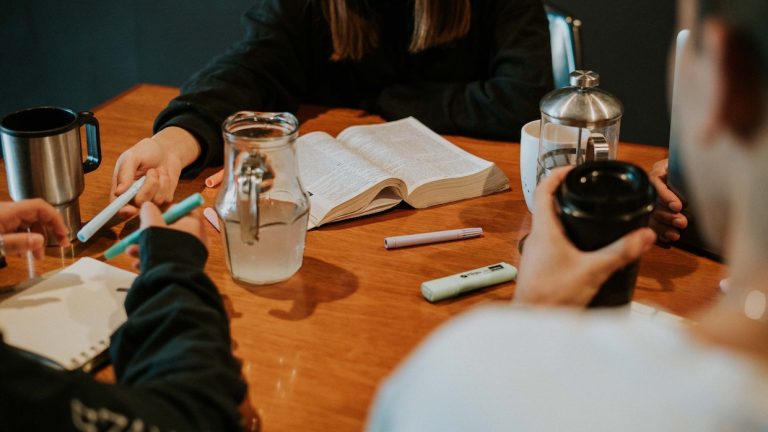
Now, in this time of “shelter in place” and “quarantine”, people are asking me how we can do church without a building. How will we do worship if we don’t have the screens, lighting and multi-media support? Where will we put the children if we don’t have a building? Where will the students hang out?
For all of the talk about the church not being the building but the people, our anxiety reveals our true beliefs. For most of us, the building is the church.
Church is the place where we meet God. Church is the place where we share our burdens and joys with our brothers and sisters. We connect with friends and we hear the songs of the faith. Place is important. After all, God created place.
Yet, church is more than place. Rather, the gospel creates its own space. Sometimes, it’s in a building. Sometimes, it’s not.
Jesus walks along two friends on the road to Emmaus. The three sit down for dinner, and during the prayer, the two friends recognize Jesus. There’s church.
Philip explains the Suffering Servant passages to an Ethiopian traveler who chooses to get baptized. They find water and we have church.
For years, we thought there were no Christians in China. We thought Mao’s purge had been so complete and the bamboo curtain had dropped so tightly, we couldn’t get any missionaries into China and no one was coming out. We thought we had lost the church in China.
When the bamboo curtain opened up, not only did we find believers in China, we found millions of them! House churches met in secret. Sometimes, the teacher would only have one page of the Bible. That way, if they were arrested by Chinese authorities, the churches wouldn’t lose the entire Bible. A page of the Bible, a few believers and guess what? You have church.
Source: Christianity Today
All Content & Images are provided by the acknowledged source

Be alerted to Breaking Christian News and Stories as it happens. The Christian Mail (TCM) was Founded in 2014 as Mail information service to Christians. TCM then first went online on March 14, 2014, operating as a blog (but designed like a Christian News website), showcasing selected Christian News from Christian News Networks from around the world (News Channels) to Christians.
Contact us: Chat with Us online
© 2022 The Christian Mail. All Rights Reserved.
