

As Coronavirus Death Toll Mounts, Faith Leaders the World Over Grapple With Funerals

For Menaka Kannan, it was bad enough when she heard that a fellow member of New York City’s Baha’i community had contracted the novel coronavirus. But she was not emotionally prepared for the news that came roughly a week later: He had succumbed to the infection and died.

“The news of his passing, of course, is very shocking,” she said.

As the community grappled with the grief, a lingering question arose: How do you conduct a funeral in the midst of a global pandemic, when a healing hug is now seen as a potential death sentence?

It’s a conundrum facing spiritual leaders the world over as the death toll from the coronavirus mounts, leaving the faithful in the U.S., Italy and elsewhere struggling to amend ancient burial practices to abide by government recommendations that advise against gatherings of more than 10 people or, in some cases, ban funerals altogether.

For Kannan and other members of her community’s “burial task force,” preparing for a funeral required balancing a desire to offer spiritual comfort to the grieving with the need to shield others against infection.

Preparations for burial quickly took on complex dimensions. Baha’is often shroud their dead in white cloth strips crafted by volunteers, but to observe social distancing, the traditionally group-oriented activity became a more solitary affair: Only two people were allowed in the city’s Baha’i center at a time to prepare burial materials, and those who participated were required to be 6 feet apart from each other throughout the process.

“It’s unfortunate that we won’t be able to do a proper, well-attended service, but it’s also really heartwarming to see that you can still have a burial,” she said.

Kannan said she was initially concerned about how they would navigate the process with the funeral home but found that it already had systems in place to handle victims of COVID-19.

“They take all the right precautions: They use gloves and masks and whatever they need to and they even will meet you outside to sign a paperwork so that there’s a no-contact handoff,” she said.

This March 18, 2020, photo shows a funeral that was affected by new rules put in place due to the coronavirus outbreak in Milwaukee. Wisconsin Gov. Tony Evers restricted gatherings to fewer than 10 people the day before. The coronavirus that has changed everything about our lives has dramatically changed the way we grieve for the dead, too. (AP Photo/Carrie Antlfinger)

Kannan’s community, which numbers only around 1,000 spread across New York City, also leaned on digital tools that members had developed to stay in touch over the past few years. As news of the death spread, her fellow faithful convened Zoom video conference calls to mourn and share spiritual community with each other.

“It was tough, because by the end we had all shared prayers, we were singing songs and it still felt spiritually uplifting, although maybe a little bit less than it would have if we were in the same space,” she said. “There was a moment at the end where we all kind of got really teary-eyed because it was bittersweet. We were recognizing the resilience of our communities to find connection no matter what happens, but we also just miss people, you know?”

Faith groups in other states are attempting to grapple with the issue of funerals by instituting new policies designed to offer some semblance of comfort for the bereaved while keeping others safe from infection.

On Tuesday (March 24), the Massachusetts Council of Churches released guidelines for Christian communities wanting to hold funerals amid the epidemic. The guidelines — which were reviewed by local public health officials — outline a number of recommendations, such as planning funerals remotely, working with the bereaved to make a list of 10 people who could feasibly attend a burial, livestreaming services, cautioning against in-person wakes, using gestures instead of physical hugs and delaying some or all rituals indefinitely.

“We were very clear in these guidelines that pastors acknowledge the pain — not just of the death, but of the grief of the family upset by the prospect of a funeral that is not likely as they imagined,” said the Rev. Laura Everett, MCC’s executive director. “It is a profound act of devotion to a grieving family to stay away — but it’s unbelievably hard.”

Meanwhile, for faith leaders such as the Rev. Mindi Welton-Mitchell, pastor of Queen Anne Baptist Church in Seattle, any funeral is out of the question. State officials recently banned funerals in the region for the foreseeable future, leaving religious leaders scrambling to develop strategies for how to care for the grieving.

No one in Welton-Mitchell’s congregation has died during the pandemic, but she has already had to delay her own mourning process. When her stepfather died in late February, her family buried him quickly and planned a larger memorial service in Alaska for this coming Saturday. But in light of sweeping new measures instituted by the governor — such as a requirement that all visitors to Alaska self-quarantine for 18 days after arriving in state airports — the service has been postponed indefinitely.

“Now we’re grieving a second time — grieving that we can’t gather together like we thought we were going to,” she said.

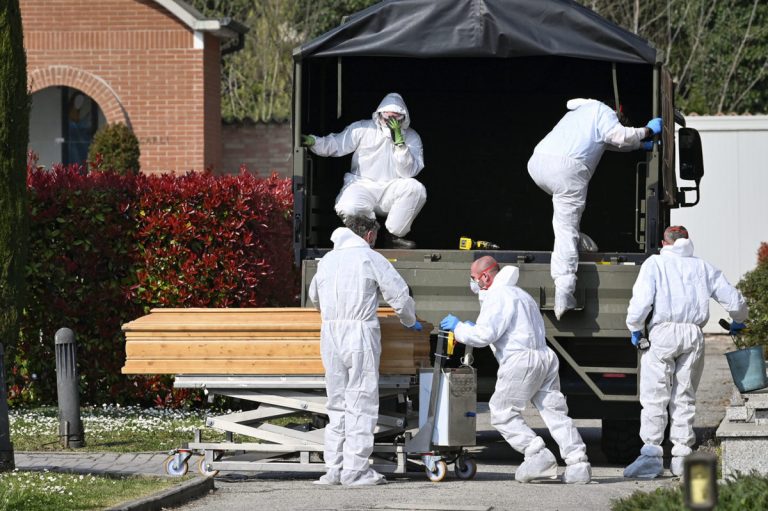
An employee of the San Giuseppe funeral agency closes the mortuary van containing the coffin of Concetta Schifano, a 73-year-old who died with coronavirus, at the Multimedica hospital morgue in Milan on March 21, 2020. The coffin was to be carried to the cemetery of Caravaggio. (AP Photo/Luca Bruno)

Funeral homes have worked to develop policies to protect the health and well-being of others. Randy Anderson, president-elect of the National Funeral Directors Association, said his group has encouraged funeral homes throughout the country to abide by local restrictions on gatherings.

In Alabama, where Anderson runs Radney Funeral Home in Alexander City, this has meant working with faith leaders to limit funerals to 25 people and push them to each stand 6 feet apart, per state guidelines. The funeral home has also limited visitations to 10 people at a time (and then only three minutes with the family) and supplied an option for livestreaming.

“It’s very important to remember the value of a funeral socially, physically — and as religious people that is something that we value,” he said. “Every life is worth remembering.”

In Washington, where funerals are banned, the Co-op Funeral Home of People’s Memorial — which operates out of Welton-Mitchell’s church — has developed more stringent practices. Nora Menkin, executive director of the funeral home, said it is not conducting any services with clergy or family present in order to help prevent infection, and while it offers livestreamed burials, no one has chosen to use it.

Instead, people are opting for virtual mourning outside of traditional services.

“While there are virtual options for services, most folks just don’t seem comfortable or don’t see it as something to give them comfort in the same way as being physically present with people is,” Menkin told Religion News Service in an email. “I am a member of the Jewish community and I have seen Zoom minyans popping up to allow mourners to say kaddish.”

U.S. clergy and spiritual leaders say they are worried that an onslaught of deaths could overrun religious infrastructures. When Everett reviewed funeral guidelines with local public health officials, one expert left an ominous statement on the margins: “Be aware of the potential that there may be an increase in the number and frequency of deaths that exceeds the capacity for pastoral care.”

Everett included the warning in the final draft of the recommendations.

“The church has been here before, so we have practices and models and stories to tell,” she said, pointing to ministers who tended to the sick during past epidemics and during the AIDS crisis. “But one of the things that is so hard is that so many of the stories we fall back on are about drawing close and touching as a sign of love and compassion, and we need to tell different stories right now.”

Anderson said the NFDA is bracing for a potential uptick in deaths as well. The association’s representative has been in “constant contact” with officials at the federal Centers for Disease Control and Prevention and the U.S. Department of Homeland Security since the onset of the novel coronavirus and has long been involved in what Anderson called “mass fatality planning.”

A moment of a funeral service without relatives in the cemetery of Zogno, near Bergamo, northern Italy, on March 21, 2020. (Claudio Furlan/LaPresse via AP)

The nightmare scenario of mass deaths is already part of daily life in Italy, where the novel coronavirus had killed more than 7,500 people as of Wednesday and infected more than 74,000.

Most casualties have been concentrated in the northern sections of Italy such as Bergamo, where Italians watched in horror Saturday as army trucks lined up in the early morning hours to carry the bodies of the hundreds who died due to COVID-19. Adding to the grief: Loved ones would not have a chance to mourn the deceased at a funeral, which are currently banned in the country.

The deaths have put tremendous strain on local funeral homes that can no longer keep up with the high demand, forcing the military to transport bodies to funeral homes in the south.

“Funerals are definitely an aspect that has gone missing,” said the Rev. Tullio Proserpio, a Catholic chaplain at the National Institute for Tumors in Milan, in a phone interview with RNS on Tuesday.

Funerals and weddings were among the first public events to be banned when the Italian government enacted harsh measures throughout the country to prevent the further spread of the coronavirus. Proserpio described the story of a close friend who could not attend the funeral of her relative who died due to the coronavirus.

The priest noted that funerals, especially today, are an opportunity to say goodbye to someone you loved. “But you can’t do it,” he added, “because you risk being legally prosecuted.”

For another priest, the Rev. Francesco Pesce, who lives in the northern Italian town of Treviso, not being able to assist the sick and tend to the dying is among the greatest suffering that the pandemic has brought into the country.

Even so, for Pesce and other faith leaders across the globe, their spiritual obligation to others remains — coronavirus or no.

“I look with admiration to all the priests who have been working hard in these times,” Pesce said. “It begs the question: Am I doing enough?”

Source: Religion News Service

All Content & Images are provided by the acknowledged source
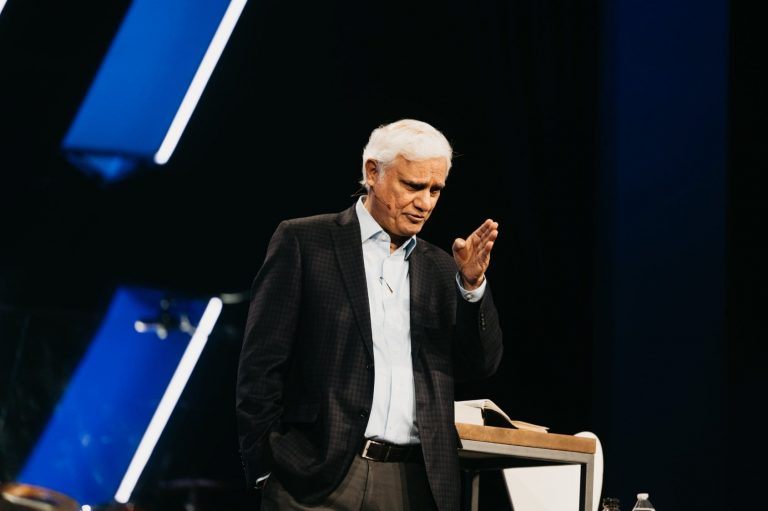
Ravi Zacharias to Begin Chemotherapy After Cancer Diagnosis

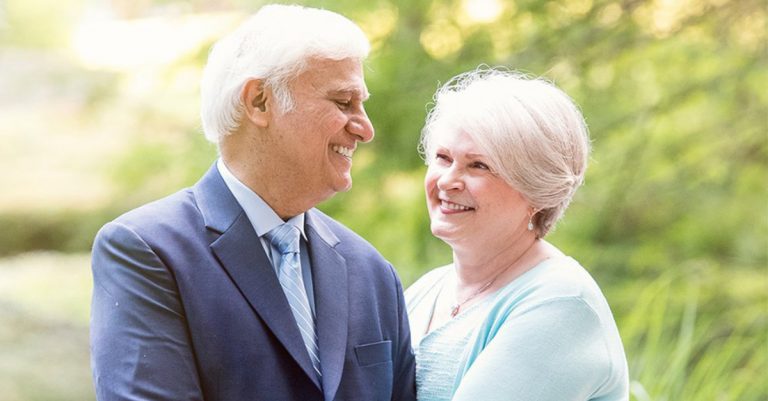
Ravi Zacharias, a well-known Christian author and apologist, recently made it public that he is about to undergo chemo after discovering that he has a rare form of cancer. The announcement came amidst the national panic over the COVID-19 pandemic, but Zacharias will still be able to make the move from Atlanta to Houston so he can receive treatment at the M.D. Anderson Cancer Center.

Zacharias said the Lord “did a miracle” by allowing him to undergo treatment. According to Faithwire, Zacharias said in an email, “Our doctors in Atlanta were concerned I couldn’t start treatment until fully healing from the back surgery. However, since then we have been able to consult with doctors at the renowned M.D. Anderson [Cancer Center] in Houston, TX. Truly God did a miracle in getting me here, literally a day or two before they had to close to treating any patients outside of Texas.”

Zacharias shared his diagnosis last month after undergoing surgery to repair his back. He said that he faced excruciating pain for weeks after the surgery and assumed that it was part of the recovery from surgery. However, he learned a few weeks later that a biopsy taken by doctors during the surgery indicated the presence of a malignant tumor on his sacrum. It is a rare form of cancer called Sarcoma.

Source: Christian Headlines

All Content & Images are provided by the acknowledged source
Ravi Zacharias Begins Chemotherapy for Rare Form of Bone Cancer

Apologist Ravi Zacharias shared a health update amid his ongoing battle with cancer, revealing that while “some nights have been painful” as he begins chemotherapy, his heart has “been at rest that this is all God’s plan.”

In a Wednesday blog update, the 74-year-old chairman of the board at Ravi Zacharias International Ministries, revealed that after discovering a malignant tumor on his sacrum during back surgery, doctors in Atlanta were “initially concerned that I couldn’t start cancer treatment until fully healing from the back surgery.”

However, since then, Zacharias was able to consult with doctors at the renowned MD Anderson Cancer Center in Houston, Texas. The bestselling authority called the opportunity a “miracle,” as the appointment took place “literally a day or two just before they had to close to treating any patients outside of Texas.”

“My doctor, a Sarcoma specialist, feels confident in starting a regimen of chemotherapy and we have begun that,” he shared. “Since this treatment is coinciding with the COVID-19 pandemic, I will remain here in Houston for the next few months until I finish the chemotherapy treatment. I am so grateful that both Margie and Naomi can be here with me. God has given me the best doctor, and I look forward to gradually seeing this disease mend.”

In times of trouble, the Bible “assures us that at all times God is with us,” the apologist said, adding: “He is our comforter; He is our healer. He is our physician; He is our provider. He knows better than we do.”

“While some nights have been painful, my heart has been at rest that this is all God’s plan. I want to get better; I want to be well. I want to be in his will and honoring to Him,” he said.

While it is “too soon to begin making plans to speak and travel—due to my treatment progress and the uncertainty surrounding the coronavirus,”  Zacharias said doctors are “eager to extend my active ministry.”

SOURCE: Christian Post, Leah MarieAnn Klett

All Content & Images are provided by the acknowledged source
N. T. Wright Says Coronavirus Pandemic is an Opportunity for Christians to Lament and Seek God

Theologian N.T. Wright says that the Christian faith offers no real answers amid the coronavirus pandemic but instead offers a chance to lament and seek God during an uncertain time.

In a Sunday essay in TIME, the renowned theologian opined that the COVID-19 outbreak has made a mockery of Lenten disciplines. Whereas some give up certain foods during the season of Lent, the conditions that have been imposed have heightened what it means to go without something.

“No doubt the usual silly suspects will tell us why God is doing this to us. A punishment? A warning? A sign? These are knee-jerk would-be Christian reactions in a culture which, generations back, embraced rationalism: everything must have an explanation,” he wrote.

“But supposing it doesn’t?” he posited.

Some Christians want everything to have an explanation; others desire a sigh of relief, he went on to say. What is called for in this moment in time, Wright stressed, is lament.

“Lament is what happens when people ask, ‘Why?’ and don’t get an answer. It’s where we get to when we move beyond our self-centered worry about our sins and failings and look more broadly at the suffering of the world,” he continued.

“It’s bad enough facing a pandemic in New York City or London. What about a crowded refugee camp on a Greek island? What about Gaza? Or South Sudan?”

Throughout the Psalms, suffering and trouble are consistent themes and though hope often emerges by the end, the stanzas often start and conclude in darkness and despair, he explained.

“The point of lament, woven thus into the fabric of the biblical tradition, is not just that it’s an outlet for our frustration, sorrow, loneliness and sheer inability to understand what is happening or why. The mystery of the biblical story is that God also laments. Some Christians like to think of God as above all that, knowing everything, in charge of everything, calm and unaffected by the troubles in his world. That’s not the picture we get in the Bible,” Wright said.

“God was grieved to his heart, Genesis declares, over the violent wickedness of his human creatures. He was devastated when his own bride, the people of Israel, turned away from him. And when God came back to his people in person — the story of Jesus is meaningless unless that’s what it’s about — he wept at the tomb of his friend. St. Paul speaks of the Holy Spirit ‘groaning’ within us, as we ourselves groan within the pain of the whole creation. The ancient doctrine of the Trinity teaches us to recognize the One God in the tears of Jesus and the anguish of the Spirit.”

SOURCE: Christian Post, Brandon Showalter

All Content & Images are provided by the acknowledged source
Chris Martin on This is the Perfect Time for Churches to Learn and Experiment in Social Media

NASHVILLE (BP) — I don’t have any data to back this up, but I don’t really think I need it: It is safe to say that more churches and pastors have used social media to connect with their people in the last three weeks than ever in the history of the Church or the internet. It has been a sight to behold.

I am part of a church social media managers Facebook group with nearly 50,000 members, and the group has been more active the last few weeks than ever. Church staff and volunteers have popped in constantly with questions on social media, live streaming and everything in between. Questions like: “Has your pastor done a Q&A during all of this? How did it go? What did you do?” or “Anyone have any ideas on how to keep a congregation of about 50 people more connected right now?”

In my role at LifeWay, I am responsible for advising our 60-plus social media managers on social media best practices. I meet with all of them over the course of a given month. My advice to them the past few weeks has been this: “It has never been a better time to experiment on social media.”

That is also my advice to you today. It has never been a better time to learn, and grow and experiment on social media. Why? Two basic reasons:

1. More people are using social media than ever

Toward the end of March, Facebook reported that record numbers of people were using their apps — specifically, countries hardest hit by coronavirus had seen a 50 percent increase in messaging on Facebook-owned platforms.

We have seen a serious increase in engagement across almost every active social media account we manage at LifeWay. A lot more people are spending an above-average amount of time on social media. Some folks are doing it because they can’t go to work. Others are doing it because they can’t go to church or other activities.

For a whole host of reasons, more people are scrolling social media platforms than usual. This means that you have more people paying attention to your church social media accounts than ever. When you have a captive audience, it’s the perfect time to try all kinds of experimental content: live Q&As with a pastor or staff member, Facebook Live worship sing-a-longs with the worship pastor, bedtime stories with the children’s minister. Try all kinds of fun content you’ve never tried before to serve your people and see what sticks.

Source: Baptist Press

All Content & Images are provided by the acknowledged source

CHURCH ONLINE Live Streaming – ZOOM Meeting Security Update

ZOOM has added a Security update to their Streaming network, it is now compulsorily  PASSWORD enabled. Watch the Video.

This is an Important Announcement for Churches that uses ZOOM for Worship  meeting

If Video is not loading, click here to watch – https://www.youtube.com/watch?v=fhZk1tUtto8

Bryant Wright Discusses Ways Southern Baptists Are Helping Amid Pandemic

NASHVILLE (BP) — Southern Baptists are involved in about 50 ongoing compassion projects in COVID-19 hot spots around the world, according to Bryant Wright, president of Send Relief.

Send Relief, a Southern Baptist compassion ministry, is a joint initiative between the International Mission Board and the North American Mission Board. Compassion ministries win Christians “the right to be heard in sharing the good news of Jesus Christ,” Wright said.

Wright joined Jonathan Howe, vice president for communications at the SBC Executive Committee, to discuss the way Southern Baptists are helping amid the global pandemic.

Source: Baptist Press

All Content & Images are provided by the acknowledged source

Miami Pastor to Launch City’s Oldest Church in Fully Immersive Virtual Reality Format to Spread the Gospel

A Presbyterian pastor in Miami is set to launch a fully immersive virtual reality worship service in a digital replica of Miami’s oldest organized congregation.

Christopher Benek, who pastors First Miami Presbyterian Church and is the CEO and pastor of the tech nonprofit CoCreators, believes a virtual reality service is an effective evangelistic tool to reach gamers and others with the Gospel.

“I think that it is important to understand that creation of CHVRCH+ (pronounced “Church Plus”) is not to displace the local congregation. That’s part of why we called it CHVRCH+ — because it is meant to be an additional complement to the existing physical church,” Benek told The Christian Post in an interview Tuesday.

Benek loves his local congregation, which is located in the heart of Brickell community and has nearly doubled in membership in the past year.

“But we also realize that we, like the rest of the church universal, have a lot of work to do. We live in one of the highest population densities south of New York City, and the COVID-19 pandemic has only intensified our understanding that we need to meet people’s needs both physically and digitally,” he said.

Digital and virtual spaces are no less God’s territory than our physical spaces, he continued, and when Christ called His followers to “Make disciples of all nations” he was not excluding digital ones.

“‘There is not a square inch in the whole domain of our human existence over which Christ, who is Sovereign over all, does not cry, Mine!’” Benek said, referencing the words of the Dutch Reformed theologian Abraham Kuyper.

“Certainly this applies to digital spaces as well.”

Creating virtual spaces is not a way to escape our present reality or ignore incarnational blessings, but rather a way to extend our understanding of reality and open our minds to the new possibilities that might exist in Jesus, the pastor elaborated.

“I think that it is the destructive flaw of many armchair theologians to assume that when faced with new ministry options that we can only experience God in one way. God is the Creator of the cosmos. Certainly, we are not so prideful as to assume that we know all of the ways that God might reveal God’s-self to us?” he said.

SOURCE: Christian Post, Brandon Showalter

All Content & Images are provided by the acknowledged source

Texas Church to Hold Easter Egg Hunt on Customized Minecraft Game on Easter Sunday

As churches across the country change their plans for Easter Sunday in response to coronavirus, one congregation in Texas will be taking their Easter Egg hunt to the digital world.

Tate Springs Baptist Church of Arlington, Texas, will hold an Easter Egg Scavenger Hunt on a customized Minecraft game on Easter Sunday, which falls on April 12.

Jared Wellman, lead pastor of Tate Springs, told The Christian Post that the digital Easter egg hunt event came as a way to better engage younger children with the church’s online services.

“I noticed that as we’ve moved to online streaming services that the content is not necessarily engaging for younger kids,” explained Wellman. “I thought, ‘We need to engage kids somehow, especially on Easter.’ Of course that’s difficult without the traditional egg hunt, which we were going to offer.”

Wellman said he talked with Tate Springs’ Family Pastor Curtis James about the issue and he with his ministry team responded with the Minecraft egg hunt.

“Our ultimate goal in all we do is to show and share the message of Jesus,” said Wellman. “As a church, holding a virtual egg hunt for the purpose of holding a virtual egg hunt would be no different than just asking kids to play a video game, and that’s not why we exist as a church.”

“So we created a sign-up form for the event to gather email addresses so that we can do our best to follow up with participants electronically to make sure they get access not only to the private server on Easter, but to the explicit message of the resurrection of Jesus.”

SOURCE: Christian Post, Michael Gryboski

All Content & Images are provided by the acknowledged source

'God Above All': Brazil's President Calls for National Day of Prayer and Fasting to Fight Coronavirus

Brazilian President Jair Bolsonaro is calling for a national day of prayer and fasting this Sunday to “free Brazil from this evil” coronavirus pandemic.

Following criticism over his management of the increasing number of coronavirus-related deaths, Bolsonaro met with Pentecostal evangelical pastors, Reuters reports.

“With the pastors and religious leaders we will call for a day of fasting by Brazilians so that Brazil can free itself from this evil as soon as possible,” he said to the radio station, Jovem Pan.

CBN News previously reported that Bolsonaro confirmed his faith in Jesus while attending the Christian worship and missions event called “The Send” back in February.

As of Friday, Brazil’s COVID-19 cases rose to 9,056, while deaths from the virus increased from 299 to 359. 

Last month, Bolsonaro’s communications director tested positive for the virus, just days after traveling with Bolsonaro to a meeting with President Trump in Florida.

Brazilian Congressman Marco Feliciano, who is also an evangelical pastor, said, “Brazil is in a serious crisis. The forces of evil are rising against a God-fearing Christian president and family defender. Sunday will be a day of fasting.”

One pastor tweeted support, saying, “President Bolsonaro called the Brazilians to a national fast and prayer of repentance on April 5th.”

.
President Bolsonaro called the Brazilians to a national fast and prayer of repentance on April 5th#COVID19 #Brazil #nationalfasting pic.twitter.com/xcrIvbeFMg

— Daniel Lucena (@DanielL17703012) April 3, 2020

Assemblies of God Pastor Silas Malafaia suggested that the national day of prayer begins at midnight on Saturday and lasts until midday Sunday.

Bolsonaro’s motto is: “Brazil above everything, God above all.” He believes it is a powerful statement about the importance of the higher truth beyond politics.

Eu creio!!
I believe!
God Save Brazil and the world.

— Luciane Valeria#Aco(@lucianevaleria) April 3, 2020

GET YOUR FREE FACTSHEET: Coronavirus: What You Need to Know

FOR CBN NEWS CONTINUING COVERAGE ON COVID-19, CLICK HERE. 

Source CBN

All Content & Images are provided by the acknowledged source