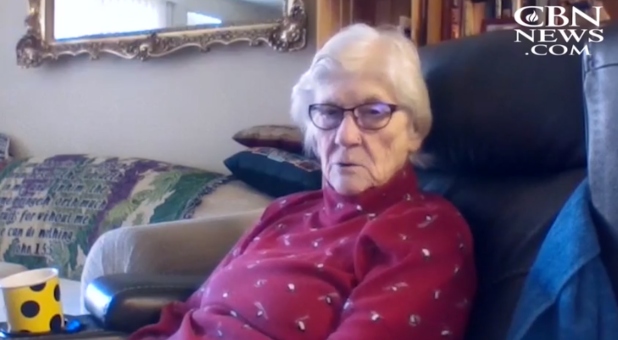

‘I Could Feel His Hands’: 90-Year-Old Coronavirus Survivor Credits the Lord

A suburban nursing home in Kirkland, Washington, made headlines as the center of the country’s first deadly outbreak of COVID-19. Since the first positive test at the Life Care Center on Feb. 28, the virus has spread to nearly two-thirds of its population.

Geneva Wood spent much of the winter there, recovering from a stroke. Just days before she was supposed to go home, COVID-19 put the facility on lockdown. Three days later, Wood experienced a spiking fever.

“I didn’t know that I had the virus until I had the virus. I had no symptoms of it before,” Wood told CBN News.

While other news outlets have talked about the 90-year-old’s love for her family, spunky spirit and the amazing fight she put up, Wood says it’s her faith that is actually the most important part of the story.

“If it hadn’t been for my faith in God and my family and their prayers and all their families and the church and everything … the faith and prayers pulled me through,” Wood explained.

Largely kept in isolation, she says God was her only companion. Wood specifically remembers one night when she wasn’t sure if she would survive until morning.

“I could feel God’s presence. His hands were on my body and I could feel His presence and I’d wake up and I could feel these hands and I’d go back to sleep. Through the night, ’cause I’d wake up, I couldn’t see His face, but I could feel His hands and I knew He was with me and I made it through the night,” Wood remembers.

SOURCE: CBN News

All Content & Images are provided by the acknowledged source

Pastor David Platt's Powerful Response to Pain, Evil & Chaos

In a world in which evil and suffering can sometimes feel totally overwhelming, how do we, as Christians, ground ourselves and continue to push forward and do good?

READ ALSO: ‘His Face Was So Shiny’: Muslim Man’s Stunning Jesus Claim Revealed

Pastor David Platt and his wife were faced with just that conundrum, and he details how God guided him through these questions in his new book “Something Needs To Change: A Call To Make Your Life Count in a World of Urgent Need.”

The book details a week-long trek in a country in the Himalayan mountains that presented “an urgent collision of physical and spiritual needs” — needs that left Platt deeply convicted.

READ ALSO: Why Does God Allow Suffering?

“God just broke my heart for the needs of that mountain,” he told The Pure Flix Podcast during a recent interview. “And my biggest take away was that something needs to change and I can’t go on with business as usual when this is the reality.”

Listen to Platt share his powerful story:

His trip to the region came after he and his wife attempted to adopt a child from the area. That adoption was not in God’s plan, but Platt ended up meeting a native of the country and traveled there with him instead.

And he was deeply impacted by what he saw and experienced. It’s a place Platt described as both desperate and isolating.

“Research shows that more than half of the children in these villages were dying before their eighth birthday. That’s my worst fear — something happening to my children and I can’t imagine that being an expectation for half of them,” the father of four said. “[There is] poverty and dying of preventable diseases and the byproduct of traffickers preying on the families in those villages. Almost all of the people you interact with have little to no knowledge of Jesus. They’ve never even heard His name.”

SUBSCRIBE: Start Listening to ‘The Pure Flix Podcast’ on Apple Podcasts and Other Platforms

His new book was a result of his personal struggle and dependence on God to work through how he could help alleviate these struggles — complicated issues that should call all believers to some important questions.

Platt explained that Christians need to wrestle with these eternal curiosities: “If I believe in Jesus, what can I do?” and “If God is good, why is there suffering like this? And why does He not stop it?”

“I had to wrestle with those questions and come out from behind the stage where I preach each week and try to reconcile what I see in God’s word and what I see in the world,” he said. “And what does that mean for our lives.”

In the end, Platt said it all boils down to one final question: “Is Jesus really the hope of the world?” Platt, who believes Christ is indeed this hope, noted that someone had asked him how he could believe in God with so much suffering — and he offered an impassioned response.

READ ALSO: How Christians Can Fight Human Trafficking

“My response is, how can I not? Are we just random products of chance? There’s evil and good and no justice in the end?” he said. “That’s not true. There is justice in the end and there is hope that this world is not all there is and that this world will not have the last word.”

Platt said there is grace and eternal life, and that God has given us a path through Christ to find these things. His book, “Something Needs to Change,” helps us all process these important realities.

If you’re interested in taking it a step further than just reading his new book, Platt encourages others to visit Radical.net — a site dedicated to helping Christians find other individuals and organizations helping out around the world.

And if you’re looking for more faith and family-friendly content, head on over to Pure Flix and sign up for your one-month free trial to stream thousands of movies, TV shows and more.

This article was originally published on Pure Flix Insider. Visit Pure Flix for access to thousands of faith and family-friendly movies and TV shows. You can get a free trial here.


Source CBN

All Content & Images are provided by the acknowledged source

90-Year-Old Woman Survives COVID-19, Credits God for Her ‘Miraculous’ Recovery

90-Year-Old Woman Survives COVID-19, Credits God for Her ‘Miraculous’ Recovery


Prior to spreading across the U.S., the country’s first deadly outbreak of the novel coronavirus began at a suburban nursing home, Life Care Center, in Kirkland, Washington on February 28.

Many of its residents succumbed to the virus, yet one 90-woman shares her story of healing as part of her testimony.

Throughout the winter, Geneva Wood spent her days at Life Care Center as she was recovering from a stroke. She was just a few days away from returning back home, when her facility went on lockdown because of a COVID-19 outbreak. Things would make a turn for the worse as Wood “experienced a spiking fever” three days later.

“I didn’t know that I had the virus until I had the virus. I had no symptoms of it before,” Wood told CBN News.

KIRO7 reports that her condition worsened to the point of death. Doctors even went as far as to have her family come to say goodbye.

Woods’ daughter, Cami Neidigh recalled her mom reaching out to her and other family members through a pane of glass, in which hospital staff permitted Neidigh “to hug her mom one last time” while wearing full protective gear, KIRO7 reports.

“I knew that I was leaving with peace and that I wanted them to know that I loved them and enjoyed them,” Wood shared with tears in her eyes.

But then Wood started to experience gradual improvement, and eventually recovered from the virus, a miracle Wood attributes solely to…

… Read More

Click here to read the rest of the story from our content source/partners – Christian Headlines.

قالب وردپرس

Author Shares How the 5 Love Languages Can Help Families Develop Deeper Relationships during Quarantine

Author Shares How the 5 Love Languages Can Help Families Develop Deeper Relationships during Quarantine


Let’s face it, most of us are spending more time around our immediate family than we ever have before or at least more than we have in a long time. Even for the best of family relationships, it can be difficult to be around family members 24/7, which is why Gary Chapman has something to say to us in times like this. 

Author of the New York Times best-seller The Five Love Languages, Chapman believes that God has given us this time with our families for us to develop deeper relationships with them and encourages families not to squander this quality time. “Every member of our family should feel loved by us during this season,” Chapman asserted.

Chapman believes his book, The Five Love Languages, can help people accomplish that. When asked if he thought The Five Love Languages would take off ultimately becoming a staple in Christian and non-Christian households as a tool to help people love each other well, Chapman doesn’t hesitate in responding in his low and thoughtful voice.

“The first year, it only sold 4,000 to 5,000 copies,” he recalled. “I stand amazed at its success in what God has done growing it to sell over 13 million copies,” he added.

Although Chapman stands amazed at what God is doing, he knew that it would transform lives, particularly, his very specific initial intended audience, the couples at his church where he has served on staff…

… Read More

Click here to read the rest of the story from our content source/partners – Christian Headlines.

قالب وردپرس

René Breuel on Rediscovering the Power of Three Types of Prayer in Italy

The COVID-19 pandemic has changed how Italian Christians pray and live their faith, amid a nation reeling from more than 10,000 deaths—the highest tally in the world—among 92,400 confirmed cases, second only to the United States [as of March 28].

During lockdown, we can no longer gather on Sundays or in home groups. Social gatherings, travel, and weddings are suspended, as are most businesses. If someone is caught outside their home without a valid reason, there can be a heavy fine.

But this season of exile has helped us discover three facets of prayer we often neglect in times of abundance.

Psalms of lament often felt hyperbolic a month ago. For example, Asaph’s complaint that God has made his people “drink tears by the bowlful” could seem overdramatic; David’s cry to God of “How long will you hide your face from me?” was a distant feeling.

But as humanity struggles to contain a fear- and anxiety-provoking pandemic, lament feels newly relevant to all of us. In March 2020, Psalm 44 sounds pitch perfect:

Awake, Lord! Why do you sleep?
Rouse yourself! Do not reject us forever.
Why do you hide your face
and forget our misery and oppression?

We are brought down to the dust;
our bodies cling to the ground.
Rise up and help us;
rescue us because of your unfailing love.

Few Western Christians have experienced poverty, injustice, or persecution. Consequently, our worship usually reflects the moods of resourceful individuals in times of prosperity and peace: composed and mainstream. We do suffer individually; however, seldom is our corporate worship fueled by protest and mourning before God.

Lament is suffering turned into prayer. It’s the worship of people who feel out of balance and out of place. Historically, it has been the prayer of minorities, the poor, and the persecuted—of Chinese pastors in prison cells and of black slaves singing of justice and Christ’s coming.

If lament felt foreign to most Italians a month ago, pastors have found eerie echoes of biblical stories in what is currently taking place in the country. “To see wives who can’t perform rites or bid farewell to their dying husbands reminds me of how Jesus was hastily buried and women returned to the tomb to anoint his body,” Gaetano di Francia, director of the Union of Christian Biblical Churches in Italy, told me. “Their lack of closure will produce a deeper grief.”

The language of lament may prove to be one of the bittersweet lessons Christians learn from this crisis. It can help believers unlearn a spirituality of the center and learn a spirituality of the margins (as pastor Abraham Cho reminds us).

Never have I spent so much of my time in prayer interceding for others. I’m ashamed to confess that, in the past, I’ve often told people, “I’ll pray for you,” but then forgot to do it.

But now that the virus ravages Italy, I have been moved by images of overworked doctors and people lying in makeshift hospitals. A member of our church fell gravely sick, but the emergency room turned him away because it is fielding so many cases of the new coronavirus.

I can’t meet or lay hands on him due to the current national lockdown, but I have been praying for his recovery. As a church, we have prayed for doctors, created a common fund to help those in economic need, and fasted for our country.

The coronavirus crisis has united Italian evangelicals, who observed a National Day of Prayer this past Sunday [March 22]. “Pentecostals, Reformed, Wesleyans, Baptists, Congregationalists, and others met at the feet of the Lord, united by the Holy Spirit,” Giacomo Ciccone, president of the Italian Evangelical Alliance, told me.

Source: Christianity Today

All Content & Images are provided by the acknowledged source

Dr. Anthony Fauci is now a bobblehead: How to be able to say, ‘I arise today through mighty strength’

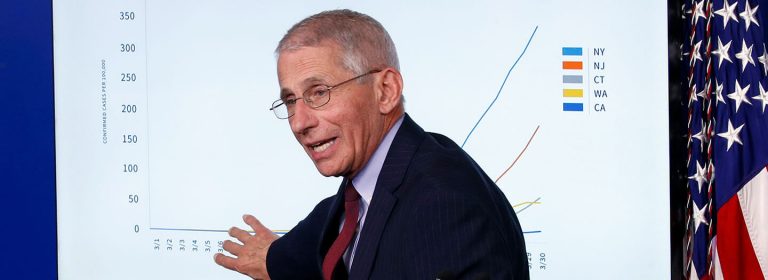
Dr. Anthony Fauci, director of the National Institute of Allergy and Infectious Diseases, speaks about the coronavirus at the White House on March 31, 2020

I’m sure you’ve seen Dr. Anthony Fauci on television in his role as the United States’ top infectious disease specialist. But you may not know that Dr. Fauci’s face is now appearing on socks. A Rochester, New York, shop is also selling doughnuts with his face topped with red, white, and blue sprinkles.

Dr. Fauci is even getting his own bobblehead courtesy of the National Bobblehead Hall of Fame and Museum in Milwaukee. It shows him in a suit as he makes a motion showing how we need to “flatten the curve” in responding to the coronavirus pandemic. The museum plans to donate $5 from every $25 Fauci bobblehead sale to the 100 Million Masks Challenge. 

This is the least we can do to thank him for his leadership during this crisis. Dr. Fauci is working twenty-hour days; his wife, herself a bioethicist, says she has to remind him “to rest, to drink water, to eat well, to sleep, and to be selective about what he agrees to and say no to some things.” 

Tragically, Dr. Fauci is also in the news today because of rising threats to his safety. Officers from the Department of Health and Human Services are providing personal protection for him; he is also receiving protection at his Washington, DC, home from the Metropolitan Police Department. Asked about these threats, Dr. Fauci said, “I’ve chosen this life, I know what it is. There are things about it that sometimes are disturbing, but you just focus on the job you have to do.” 

To threaten the man who is leading the fight against a deadly pandemic seems not only illogical but irrationally dangerous. We would think that, in a time like this, we would all want the best help from the best resources available to us. 

How is this fact relevant to us…

… Read More


Click Read More to read the rest of the story from our content source/partners – Denison Forum.
قالب وردپرس

The Rise of Gospel-Shaped Businesses

When most people hear about stewardship, workplace chaplains and employee satisfaction surveys are rarely what spring to mind. But for a cadre of business owners integrating faith within their businesses for a Business as a Ministry (BaaM) operating system, that only scratches the surface of their stewardship.

A steward is responsible to manage an asset on someone’s behalf. While work is often compartmentalized from faith, stewardship for Christian leaders demands seeing their entire businesses as belonging to God. They operate according to His standards and values and integrate biblical principles in everything from choosing health care plans to finding ways to show the love of Christ to His people. As business owners oversee people and resources, they are not only tending to others’ welfare and wallets but also to their eternal wellbeing.

Applying biblical principles to shape best practices in business may sound challenging or scandalously illegal, but it’s surprisingly achievable and worthwhile. And while this view of stewardship may seem to be an ethereal, fluid concept, ministry can be objectively measured with worthy metrics of success much like any other dimension of thriving business.

The Opportunity for Impact

John Davenport Engineering, Inc (DAVENPORT), a consulting firm that has been providing engineering solutions for nearly 20 years, aims to nurture “fertile ground” in the workplace, creating a place where employees know their spiritual growth is supported and encouraged.

Revenue generation at DAVENPORT isn’t just a means for larger offices and higher salaries. Davenport Jr., the company’s CEO, sees growing the business as a way to increase its impact, making the work it does more meaningful and rewarding. It’s another way of pursuing what he calls “win-win” solutions. One simple question guides John’s decision-making, proposed solutions, and company policies: “Spiritually and professionally, how do we meet [employees and partners] where they are to help them grow?”

Offering opportunities like paid time off to volunteer and employee-led local mission efforts creates a corporate culture where employees get to practice their faith while at work.

Todd Stewart, president of Gulf Winds International, is also intentional about leading a business as ministry. He has created a strategic plan for ministry—a systematic envisioning of a desired future along with goals and the necessary steps to reach them—and he’s woven that into the fibers of his business. At Gulf Winds, this focus starts at the individual level with each employee. “Meeting the needs of the individual employee through corporate sponsored programs, partnerships, a values-driven culture, coaching, and team development” is how the Gulf Winds team fosters a spiritually fulfilling work atmosphere.

Considering many employees spend more time with their coworkers than with their families, the marketplace offers a large platform to share the life and love of Christ. But without effective planning, good intentions can be derailed by a lack of clarity and accountability to accomplish a company’s vision for spiritual impact. Christian leaders can meet the challenge of successful stewardship by implementing a strategic plan similar to Stewart’s.

If a business owner struggled with shrinking sales, he or she would invest a great deal of time and resources into fixing the problem. Leaders can plan and execute ministry-minded initiatives in the same way. C12 Group, a global provider of peer advisory groups and resources for Christian business leaders, developed their 5-Point Alignment Matrix to help leaders align all operations with their company’s central mission, vision, and core values. By positioning ministry alongside other core dimensions, the Matrix prevents sprinkling it on top of one’s business as an afterthought. Instead, it approaches ministry from the same strategic planning lens as operations, organizational development, revenue generation, and financial management. It’s an entirely new operating system based upon the idea of Business as a Ministry (BaaM).

All Content & Images are provided by the acknowledged source

The Rise of Gospel-Shaped Businesses

When most people hear about stewardship, workplace chaplains and employee satisfaction surveys are rarely what spring to mind. But for a cadre of business owners integrating faith within their businesses for a Business as a Ministry (BaaM) operating system, that only scratches the surface of their stewardship.

A steward is responsible to manage an asset on someone’s behalf. While work is often compartmentalized from faith, stewardship for Christian leaders demands seeing their entire businesses as belonging to God. They operate according to His standards and values and integrate biblical principles in everything from choosing health care plans to finding ways to show the love of Christ to His people. As business owners oversee people and resources, they are not only tending to others’ welfare and wallets but also to their eternal wellbeing.

Applying biblical principles to shape best practices in business may sound challenging or scandalously illegal, but it’s surprisingly achievable and worthwhile. And while this view of stewardship may seem to be an ethereal, fluid concept, ministry can be objectively measured with worthy metrics of success much like any other dimension of thriving business.

The Opportunity for Impact

John Davenport Engineering, Inc (DAVENPORT), a consulting firm that has been providing engineering solutions for nearly 20 years, aims to nurture “fertile ground” in the workplace, creating a place where employees know their spiritual growth is supported and encouraged.

Revenue generation at DAVENPORT isn’t just a means for larger offices and higher salaries. Davenport Jr., the company’s CEO, sees growing the business as a way to increase its impact, making the work it does more meaningful and rewarding. It’s another way of pursuing what he calls “win-win” solutions. One simple question guides John’s decision-making, proposed solutions, and company policies: “Spiritually and professionally, how do we meet [employees and partners] where they are to help them grow?”

Offering opportunities like paid time off to volunteer and employee-led local mission efforts creates a corporate culture where employees get to practice their faith while at work.

Todd Stewart, president of Gulf Winds International, is also intentional about leading a business as ministry. He has created a strategic plan for ministry—a systematic envisioning of a desired future along with goals and the necessary steps to reach them—and he’s woven that into the fibers of his business. At Gulf Winds, this focus starts at the individual level with each employee. “Meeting the needs of the individual employee through corporate sponsored programs, partnerships, a values-driven culture, coaching, and team development” is how the Gulf Winds team fosters a spiritually fulfilling work atmosphere.

Considering many employees spend more time with their coworkers than with their families, the marketplace offers a large platform to share the life and love of Christ. But without effective planning, good intentions can be derailed by a lack of clarity and accountability to accomplish a company’s vision for spiritual impact. Christian leaders can meet the challenge of successful stewardship by implementing a strategic plan similar to Stewart’s.

If a business owner struggled with shrinking sales, he or she would invest a great deal of time and resources into fixing the problem. Leaders can plan and execute ministry-minded initiatives in the same way. C12 Group, a global provider of peer advisory groups and resources for Christian business leaders, developed their 5-Point Alignment Matrix to help leaders align all operations with their company’s central mission, vision, and core values. By positioning ministry alongside other core dimensions, the Matrix prevents sprinkling it on top of one’s business as an afterthought. Instead, it approaches ministry from the same strategic planning lens as operations, organizational development, revenue generation, and financial management. It’s an entirely new operating system based upon the idea of Business as a Ministry (BaaM).

All Content & Images are provided by the acknowledged source

Gary S. Selby on Screwtape’s Practical Advice for Dealing With the Present

Gary S. Selby is professor of ministerial formation at Emmanuel Christian Seminary at Milligan and author of Pursuing an Earthly Spirituality: CS Lewis and Incarnational Faith.

What you should do is imagine all the bad things that could happen. Picture each awful possibility as you lie awake at 3 a.m., letting image after image flood your mind. Think about how you would bear it if you were sick from the coronavirus, or if COVID-19 struck someone you loved.

That’s what Screwtape would advise. A lot of people are looking for practical counsel at the present, and one excellent resource is a series of letters “written by Screwtape” and published by C. S. Lewis. Of course the author of The Screwtape Letters (which fell into Lewis’s hands sometime during the relentless Nazi bombing of London in 1940–1941), does not speak to our situation specifically. Screwtape said nothing about the coronavirus in his advice to his nephew Wormwood, a junior devil tasked with temping one particular human in the World War II era. Nevertheless, there is much to learn from the senior devil, and the lessons can be applied to our present situation.

For example, Screwtape has suggestions for what we might think about when we’re lying awake in bed at night. He tells Wormwood to encourage the human’s mind to run. “We want him to be in the maximum uncertainty, so that his mind will be filled with contradictory pictures of the future, every one of which arouses hope or fear.” Humans love to have “courage.” They like to imagine how they would “be strong” and exert control over the universe in lots of different hypothetical futures. “Let him forget,” Screwtape writes, “that, since they are incompatible, they cannot all happen to him, and let him try to practice fortitude and patience to them all in advance.”

Lewis, who was a rather old-fashioned Christian, tried to dissuade people from listening to this sage counsel. “Readers are advised to remember that the devil is a liar,” he wrote in the preface The Screwtape Letters in 1942. “Not everything that Screwtape says should be assumed to be true even from his own angle.”

Lewis would say that what we need to do in this situation is to “accept with patience the tribulation which has actually been dealt out to [us]—the present anxiety and suspense.” For him, the anxiety we feel about our future is our present cross. The Christian challenge is to take it up, like Jesus took up his cross. We should acknowledge our fear, ask God for help, and then to pray as Christ taught us, “Thy will be done.” When we do that, an amazing thing begins to happen. The power that fear holds over us, if not eliminated, is at least diminished, and we find the strength to carry on.

One only has to lay awake for an hour or two, though, mulling over the facts from that informative article on the first symptoms of COVID-19, to know that Screwtape’s advice is far more compelling. The choice between trusting prayer and sleepless worry is hardly a choice at all!

Screwtape offers more advice. He would counsel us all to nurture interpersonal hostility at this time, something easily done when we are flooded with anxiety. In crisis, other people can become a threat or, at least, sources of irritation. It’s what we feel when we go to the grocery store looking for hand sanitizer and toilet paper and find only empty shelves. We are instantly overcome with irritation and even anger toward the people who took more than they needed. We begin to see everyone else in the store through a lens of judgment. Encourage that process, Screwtape says. Point out that other people are stupid. Find the perfect gif to convey your disdain. It might take a little while, but that’s okay. Take that time to marinate in the juices of your hostility.

Once you’re properly annoyed at strangers you don’t know, you can turn your attention to people closer to home. Screwtape recommends cultivating “a good settled habit of mutual annoyance; daily pinpricks.”

In the particular case dealt with in The Screwtape Letters, the senior devil gives advice on a relationship between mother and son. But we can easily adapt the counsel to our own particular circumstances: it works between spouses, roommates, or siblings, just as well as between parent and child! Whoever you’re stuck with, obsess over his or her most irritating behavior. Think about why they would do such things. Remark frequently to yourself that you would never do such things and speculate on their possible motivations.

It’s especially important at this point to narrow your imagination, so as not to nurture compassion. Don’t, under any circumstances, think about the fears and insecurities that might have brought the other person to this moment in time. If you do, you might glimpse the real person in the midst of their own struggle, and then you would lose your chance for a good disdaining.

Source: Christianity Today

All Content & Images are provided by the acknowledged source

Asian-American Christians Call on the Church to Combat Coronavirus Racism

A group of Asian-American Christians has called upon the church to do more in the fight against anti-Asian racism sparked by the coronavirus pandemic.

In a statement, The Asian American Christian Collaborative said that anti-Asian incidents had skyrocketed ever since COVID-19 – which originated in Wuhan, China – began to spread across the globe. Shockingly, more than 750 racist incidents were reported last week alone.

Now, the organization is challenging the church to speak out about the disturbing phenomenon. “We, the undersigned, join together as Asian American Christians and community leaders to denounce the current rise in overt anti-Asian racism throughout our country,” the statement read. “We call for an immediate end to the xenophobic rhetoric, hate crimes, and violence against our people and communities. We invite all Americans to join us in combating these contagions and work with us for the welfare of all.”

Addressing the issue from a biblical perspective, the group encouraged believers to lead the way in showing love to people of every community. “Loving God by loving neighbor is a hallmark of the Christian faith,” they wrote. “As followers of Jesus believe that all people are made in the image of God (Gen. 1:27), we seek the flourishing of every human being, paying particular attention to those who are marginalized, oppressed, and suffering (Ex. 22:22; Is. 1:17; Ps. 82:3; Zech. 7:9-10).”

Source: Christian Headlines

All Content & Images are provided by the acknowledged source