Bill Withers, Hall of Fame Soul Singer of Enduring Hits Such as “Lean on Me” and “Lovely Day”, Dead at 81

Bill Withers, who wrote and sang a string of soulful songs in the 1970s that have stood the test of time, including “Lean on Me,” “Lovely Day” and “Ain’t No Sunshine,” has died from heart complications, his family said in a statement to The Associated Press. He was 81.

The three-time Grammy Award winner, who withdrew from making music in the mid-1980s, died on Monday in Los Angeles, the statement said. His death comes as the public has drawn inspiration from his music during the coronavirus pandemic, with health care workers, choirs, artists and more posting their own renditions on “Lean on Me” to help get through the difficult times.

“We are devastated by the loss of our beloved, devoted husband and father. A solitary man with a heart driven to connect to the world at large, with his poetry and music, he spoke honestly to people and connected them to each other,” the family statement read. “As private a life as he lived close to intimate family and friends, his music forever belongs to the world. In this difficult time, we pray his music offers comfort and entertainment as fans hold tight to loved ones.”

Withers’ songs during his brief career have become the soundtracks of countless engagements, weddings and backyard parties. They have powerful melodies and perfect grooves melded with a smooth voice that conveys honesty and complex emotions without vocal acrobatics.

“Lean on Me,” a paean to friendship, was performed at the inaugurations of both Barack Obama and Bill Clinton. “Ain’t No Sunshine” and “Lean on Me” are among Rolling Stone’s list of the 500 Greatest Songs of All Time.

“He’s the last African-American Everyman,” musician and band leader Questlove told Rolling Stone in 2015. “Bill Withers is the closest thing black people have to a Bruce Springsteen.”

His death caused a torrent of appreciation on social media, including from former Obama adviser Valerie Jarrett, who said Withers’ music has been a cherished part of her life. “It added to my joy in the good times, and also gave me comfort and inspiration when I needed it most,” she tweeted. Singer José James said “we need his message of unity now more than ever” and Billy Dee Williams tweeted “your music cheered my heart and soothed my soul.”

“We lost a giant of songwriting today,” ASCAP President and Chairman Paul Williams said in a statement. “Bill Withers’ songs are among the most treasured and profound in the American songbook — universal in the way they touch people all over the world, transcending genre and generation. He was a beautiful man with a stunning sense of humor and a gift for truth.”

Withers, who overcame a childhood stutter, was born the last of six children in the coal mining town of Slab Fork, West Virginia. After his parents divorced when he was 3, Withers was raised by his mother’s family in nearby Beckley.

He joined the Navy at 17 and spent nine years in the service as an aircraft mechanic installing toilets. After his discharge, he moved to Los Angeles, worked at an aircraft parts factory, bought a guitar at a pawn shop and recorded demos of his tunes in hopes of landing a recording contract.

In 1971, signed to Sussex Records, he put out his first album, “Just As I Am,” with the legendary Booker T. Jones at the helm. It had the hits “Grandma’s Hands” and “Ain’t No Sunshine,” which was inspired by the Jack Lemmon film “Days of Wine and Roses.” He was photographed on the cover, smiling and holding his lunch pail.

“Ain’t No Sunshine” was originally released as the B-side of his debut single, “Harlem.” But radio DJs flipped the disc and the song climbed to No. 3 on the Billboard charts and spent a total of 16 weeks in the top 40.

Withers went on to generate more hits a year later with the inspirational “Lean on Me,” the menacing “Who Is He (and What Is He to You)” and the slinky “Use Me” on his second album, “Still Bill.”

Later would come the striking “ Lovely Day,” co-written with Skip Scarborough and featuring Withers holding the word “day” for almost 19 seconds, and “Just the Two Of Us,” co-written with Ralph MacDonald and William Salter. His “Live at Carnegie Hall” in 1973 made Rolling Stone’s 50 Greatest Live Albums of All Time.

“The hardest thing in songwriting is to be simple and yet profound. And Bill seemed to understand, intrinsically and instinctively, how to do that,” Sting said in “Still Bill,” a 2010 documentary of Withers.

But Withers’ career stalled when Sussex Records went bankrupt and he was scooped up by Columbia Records. He no longer had complete control over his music and chafed when it was suggested he do an Elvis cover. His new executives found Withers difficult.

None of his Columbia albums reached the Top 40 except for 1977’s “Menagerie,” which produced “Lovely Day.” (His hit duet with Grover Washington Jr. “Just the Two of Us” was on Washington’s label). Withers’ last album was 1985′s “Watching You Watching Me.”

Though his songs often dealt with relationships, Withers also wrote ones with social commentary, including “Better Off Dead” about an alcoholic’s suicide, and “I Can’t Write Left-Handed,” about an injured Vietnam War veteran.

He was awarded Grammys as a songwriter for “Ain’t No Sunshine” in 1971 and for “Just the Two Of Us” in 1981. In 1987, Bill received his ninth Grammy nomination and third Grammy as a songwriter for the re-recording of the 1972 hit “ Lean on Me” by Club Nouveau.

He was inducted into the Rock and Roll Hall of Fame in 2015 by Stevie Wonder. Withers thanked his wife as well as the R&B pioneers who helped his career like Ray Jackson, Al Bell and Booker T. Jones. He also got in a few jabs at the record industry, saying A&R stood for “antagonistic and redundant.” Withers also was inducted into the Songwriters Hall of Fame in 2005.

His music has been covered by such artists as Barbra Streisand, Michael Jackson, Aretha Franklin, Tom Jones, Linda Ronstadt, Paul McCartney, Sting, Johnny Mathis, Aaron Neville, Al Jarreau, Mick Jagger, Nancy Wilson, Diana Ross. His music has been sampled for BlackStreet’s “No Diggity,” Will Smith’s version of “ Just the Two Of Us, ” Black Eyed Peas’ “Bridging the Gap” and Twista’s “Sunshine.” The song “Lean on Me” was the title theme of a 1989 movie starring Morgan Freeman.

His songs are often used on the big screen, including “The Hangover,” “28 Days,” “American Beauty,” “Jerry Maguire,” “Crooklyn,” “Flight,” “Beauty Shop,” “The Secret Life of Pets” and “Flight.”

“I’m not a virtuoso, but I was able to write songs that people could identify with. I don’t think I’ve done bad for a guy from Slab Fork, West Virginia,” Withers told Rolling Stone in 2015.

He is survived by his wife, Marcia, and children, Todd and Kori.

___

SOURCE: Associated Press – Mark Kennedy

All Content & Images are provided by the acknowledged source

Benjamin Watson, Christian Groups Work to Provide Aid to Churches At Risk of Closing due to Economic Impact of Coronavirus

Benjamin Watson, Christian Groups Work to Provide Aid to Churches At Risk of Closing due to Economic Impact of Coronavirus


Several national Christian groups, led by the AND Campaign, announced an initiative this week to help small churches throughout the U.S. that are at risk of closing as a result of the coronavirus pandemic.

The effort, which also includes former NFL player Benjamin Watson, is called the Churches Helping Churches Challenge, and it’s targeted to assist congregations in low-income communities in urban areas that have been disproportionately impacted by the COVID-19 economic shutdown.

According to a recent Barna Group survey, six to nine percent of pastors are unsure or not confident that their church will survive the coronavirus pandemic and nearly a quarter of American churches (22 percent) have already reduced staff hours, reduced compensation or laid-off employees.

The Churches Helping Churches Initiative urges larger, more stable churches to assist at-risk churches in their own community. On the Church Relief website, the Churches Helping Churches Challenge has provided guidance and best practices for how large churches can pursue this type of outreach.

In addition, to help encourage generosity by stable churches, this Initiative created a Coronavirus At-Risk Church Relief Fund that provides $3,000 grants to small churches who are at risk of closing within the next three months due to a steep loss in financial giving. The initial…

… Read More

Click here to read the rest of the story from our content source/partners – Christian Headlines.

قالب وردپرس

C. Christopher Smith on the Coronavirus Could End Church as We Know It, and I Feel Fine

C. Christopher Smith is founding editor of The Englewood Review of Books and author of “How the Body of Christ Talks: Recovering the Practice of Conversation in the Church.”

The coronavirus pandemic has quickly swept the globe, throwing just about every human institution into chaos. Faith communities are no exception.

With gatherings restricted in size or prohibited altogether, many houses of worship are fighting to stay connected, rapidly weighing technological options to keep as many people as possible engaged.

This involves a a good deal of trial and error. Congregational leaders find themselves relying on multiple digital tools — some of which they have never used before — to connect themselves to their members and to keep their members caring for each other.

As stressful as these times are, they have provided an extraordinary opportunity in my Christian community to reflect on our identity and mission as the church, and to imagine ways of being more connected than ever with our fellow church members.

In normal times, most churches plow forward without much reflection on identity and mission.

Now they have the chance to do something new, and I challenge churches to take a wee bit of time to reflect together on questions like these:

What is the church? A building? A particular gathering? A community?

What is worship? What really matters in a worship service? And given the limits forced on us by the pandemic, which technological tools can best help us embody our identity and mission?

With more than a decade of experience in the IT industry, I am keenly aware that our technological decisions shape who we become. Our decisions now will shape us not just over the span of this pandemic, but beyond it as well.

The nature of Christianity will shape those decisions. Following its Jewish roots, Christianity is primarily a social faith, embodied in communities that express this faith in their everyday lives. Christianity is also incarnational, highly valuing bodily presence — both the presence of God-with-us and our presence with one another. We have no greater gift to give one another than our full, undivided presence and attention.

Josh Kellso, a pastor at Grace Bible Church, delivers a sermon via livestream for virtual attenders from an empty sanctuary March 22, 2020, in Tempe, Arizona. Many houses of worship have suspended all in-person services and programs and moved to online services in compliance with guidelines from the federal Centers for Disease Control and Prevention to promote social distancing in the effort to slow the spread of the COVID-19 coronavirus. (AP Photo/Matt York)

The Apostle Paul imagines churches as the body of Christ, a powerful metaphor of interactive community in which there are no extraneous members and in which everyone has a role to play. We are called to be active participants in our faith, not just passive consumers of religion.

What do these essential convictions mean for our choices about technology and connection?

Not all technological platforms are created equal. Some technologies allow us to be more present than others. Videoconferencing platforms (Zoom, Google Hangouts, etc.) that allow all participants to be seen and heard are much better than webcasting platforms (Facebook Live, etc.), designed for passive consumption. Audio-only tools (phone conference calls) are not as fully participatory as videoconferencing, but are better than passive media. And even Facebook Live, with its capacity for real-time commenting, is a little more participatory than solely passive broadcasting platforms — but it is much closer to the passive end of the spectrum than to videoconferencing.

Medium-to-large churches may want to foster smaller groups. While a larger Sunday service is probably best as a webcast, small groups should be encouraged to meet using videoconferencing platforms such as those named above to foster presence with one another in that setting.

These groups might have a suggested order of worship that outlines the prayers, songs and Scripture passages to be read and discussed. Allow a short time of sharing what’s going on in our lives — much needed in this rapidly spinning chaos! My own church has implemented a daily 8 p.m. Zoom call that is open to all members for praying and sharing together.

Don’t rule out the possibility of legal, healthy physical presence. Especially in climates warm enough for people to be outdoors, churches are finding creative ways for smaller groups of people to come together outdoors with the necessary health precautions.

As long as it is not legally restricted, church members can interact with social distancing on porches, in backyards and in a walking, running or other exercise group that doesn’t require close proximity. One local pastor I know visits church members on his daily run, stopping by their houses and talking with them outside.

Our means of connecting and being the church in this tightly restrictive season will undoubtedly shape the future of our faith. I pray that we will be contemplative and creative in the discernments that we make along the way and that this pandemic will be looked back on as a season of energy and growth for generations to come.

Source: Religion News Service

All Content & Images are provided by the acknowledged source

Charles C. Camosy on Rationing Health Care Without Abandoning Our Humanity

Social emergencies can stretch our cultural fabric to the limit.

Those of us who remember 9/11 probably also remember the feeling that, however we responded, we needed to make sure our foundational cultural values were respected. Time and time again we heard some version of, “If we do X, then the terrorists win.”

Looking back, it is clear we fell well short of that goal.

We abandoned our privacy to a surveillance state established by legislation named the Patriot Act. We rushed off to a needless war of aggression in Iraq. Our CIA tortured people at so-called black sites away from public scrutiny. Our soldiers did disgusting and illegal things to prisoners at Abu Ghraib.

Now, with the novel coronavirus pandemic, we may face a compromise of our values that will be significantly worse than 9/11. Indeed, the cultural damage may already be outpacing the deaths we have seen.

And it is about to get worse.

Hospitals in many places in the U.S. in the next weeks will be absolutely swamped. Anyone who has been paying attention to the numbers already knows we simply don’t have enough ICU beds, ventilators, staff and medical equipment to treat the coming flood of patients.

Indeed, some doctors are even wondering if, when they run out of ventilators, they could recruit volunteers to manually ventilate patients by essentially squeezing a baglike device over and over. New York state has a shortage of hospital beds and personnel: It is recruiting retired nurses and doctors (and even nursing and medical students) to help staff facilities.

We must see this as a cultural moment to decide not to make the mistakes of the past. Though the culture needs to and will change dramatically to meet this new threat, we must not abandon the values that make us who we are.

The claim that “we’re at war” is, at best, a mixed blessing. Yes, we all need to ramp up our efforts to fight this new, invisible enemy, but historically being at war means we risk violating our most fundamental values.

A person is taken on a stretcher into the United Memorial Medical Center after going through testing for COVID-19 on March 19, 2020, in Houston. People were lined up in their cars in a line that stretched over 2 miles to be tested in the drive-through testing for coronavirus. (AP Photo/David J. Phillip)

The overwhelming majority of health care workers fighting this disease are rightly going to be honored when this is over as our nation’s heroes. Their self-sacrifice, which for some will mean sacrificing of their lives, is simply extraordinary. Practicing medicine is a vocation, a calling. And we are so blessed to have people with this vocation on our side.

But you don’t need to read too much history of medicine to know about its dark side. From horrific Nazi medicine in Germany to the utterly shameful Tuskegee syphilis trials in the U.S., we can see that those who hold power in medicine sometimes make terrible decisions that also undermine the foundational values of a culture.

More recently, New York Times investigative journalist Sheri Fink uncovered the terrible things done at New Orleans’ Memorial Medical Center in the aftermath of Hurricane Katrina. Due in no small part to their age and level of ability, several patients were euthanized by hospital staff with overdoses of pain medication. Dr. Anna Pou faced prosecution for her direct role in these killings, but after her colleagues and the American Medical Association came to her defense, a grand jury declined to indict her.

If the stress the pandemic has put on the rest of the world is any measure, the U.S. health care system will find itself under pressure to similarly abandon our core values. There are already reports that hospitals in Spain are refusing to treat people over the age of 65. In Italy they are reportedly not treating them when over 60.

These kinds of practices — born out of the simplistic utilitarianism that dominates so much of medicine and medical ethics in the developed West — would be a direct violation of the civil rights of older U.S. Americans. Under the Age Discrimination Act of 1975, hospitals that receive federal funding (which includes Obamacare) “may not exclude, deny, or limit services to, or otherwise discriminate against, persons on the basis of age.”

Happily, New York’s state protocol for rationing ventilators rejects advanced age as a triage criterion “because it discriminates against the elderly.” Indeed, the document notes that age “already factors indirectly into any criteria that assess the overall health of an individual” and “there are many instances where an older person could have a better clinical outlook than a younger person.” Hospitals, medical teams or rationing officers “should utilize clinical factors only to evaluate a patient’s likelihood of survival” when allocating scarce resources.

Laurie Kuypers, a registered nurse, reaches into a car to take a nasopharyngeal swab from a patient at a drive-through COVID-19 coronavirus testing station for University of Washington Medicine patients, on March 17, 2020, in Seattle. The appointment-only drive-through clinic began a day earlier. Health authorities in Washington reported more COVID-19 deaths in the state that has been hardest hit by the outbreak. (AP Photo/Elaine Thompson)

But Washington state, also a center of the outbreak in the U.S., has taken a much different approach. According to reporting from NBC News, last week 280 clinicians in that state got on a conference call to discuss their own protocols. They agreed that if they reached “crisis standards” things would have to change dramatically.

“If you are above a certain age and we have a shortage of ventilators, you don’t get one,” said Cassie Sauer, CEO of the Washington State Hospital Association.

Fink’s coverage found that in “guidance endorsed and distributed by the Washington State Health Department” crisis conditions in that state should consider transferring patients out of the hospital or to palliative care if their baseline functioning was marked by “loss of physical ability” or “cognition.”

This is blatant discrimination against the disabled and also clear violation of civil rights.

It is also a classic example of what Pope Francis describes as our consumerist “throwaway culture,” in which the value of human beings is often measured by their quality or productivity. Especially when their dignity is most inconvenient for us, the most vulnerable are at particular risk for being thrown away.

The New England Journal of Medicine recently claimed that this kind of health care rationing is “is often better tolerated when done silently.”

It is now, before the storm hits, that we must be committed to making sure that these decisions are not made silently, without public scrutiny. Instead, we must insist on being part of a very public discussion over the most ethical ways to allocate scarce medical resources.

That is, allocate them in ways that reflect our foundational cultural values.

Source: Religion News Service

All Content & Images are provided by the acknowledged source

Mark Silk on Why Some Keep Believing When Trumpian Prophecy Fails

Mark Silk is Professor of Religion in Public Life at Trinity College and director of the college’s Leonard E. Greenberg Center for the Study of Religion in Public Life. He is a Contributing Editor of the Religion News Service.

Again and again, from late January through mid-March, President Trump called the coronavirus no big deal.

“We have it totally under control,” he said. “We pretty much shut it down.” “You know in April, supposedly, it dies.” “People are getting better, they’re all getting better.” “The 15 is going to be down close to zero.”  “It’s like a miracle. It will disappear and you’ll be fine.” “It’s really working out.”

Around the presidential bully pulpit, Trump’s acolytes on Fox News turned the volume up to 11. Who can forget Trish Regan’s possibly career-ending claim that the virus was a Democratic scam designed “to demonize and destroy the president”? Small wonder his evangelical base took it all as gospel.

So when reality hit, then what? According to the latest Pew survey, nearly two-thirds of white evangelicals believe that Trump “has accurately assessed the coronavirus risks.” How can that be?

The answer may be found in “When Prophecy Fails,” the classic account of true believers who refuse to give up their beliefs even when faced with definitive proof to the contrary. Seven decades ago, social psychologists Leon Festinger, Henry Riecken and Stanley Schachter discovered a small cult called the Seekers who believed that a flying saucer would rescue them from a gigantic flood that would destroy the Earth on December 21, 1954.

Figuring that the flying saucer would not show up and the flood would not happen, the three infiltrated the group in order to see how its cognitive dissonance would be resolved. Sure enough, the appointed day arrived and the Earth was not destroyed. But rather than accepting empirical disconfirmation, the Seekers invented a new story that enabled them to keep their faith.

The study, which achieved immediate fame, provided a social scientific explanation for the persistence of apocalyptic groups like the Seventh-Day Adventists, heirs of the followers of William Miller, who prophesied that Jesus would return in 1844; and the Jehovah’s Witnesses, heirs of the followers of Charles Taze Russell, who prophesied that God’s kingdom on earth would be fully established in 1914.

What gave “When Prophecy Fails” its impact, however, was not major public interest in religious apocalypticism but, rather, its demonstration of the limits of empiricism as a mode of persuasion. The book might have been titled “Why Evidence Fails.” Groups with powerful convictions won’t abandon their commitments just because the empirical evidence says them nay.

What turned Millerites into Adventists and kept Witnesses witnessing was no admission of failure but merely a sufficient adjustment of their teachings — in both cases an adjustment that turned the originally predicted date for the transformation of the world into a date signaling only the beginning of the End Times.

So Trump’s base is comforted with the pretense that their prophet was never mistaken but, on the contrary, had been on top of the situation all along: “This is a pandemic. I’ve felt it was a pandemic long before it was called a pandemic.” Not that there was any abandonment of the saved kingdom scenario: “We’re doing great. Our country is doing so great.”

To be sure, a large number of Millerites abandoned the faith because of what they called The Great Disappointment. Many Jehovah’s Witnesses also fell away after 1914 failed to usher in God’s kingdom. Come November 3, we’ll learn how many of the Trumpian faithful do likewise.

Source: Religion News Service

All Content & Images are provided by the acknowledged source

Justin Bieber Hosts Rapid-Fire Gospel Discussion with Pastor Rich Wilkerson on Instagram

Justin Bieber Hosts Rapid-Fire Gospel Discussion with Pastor Rich Wilkerson on Instagram


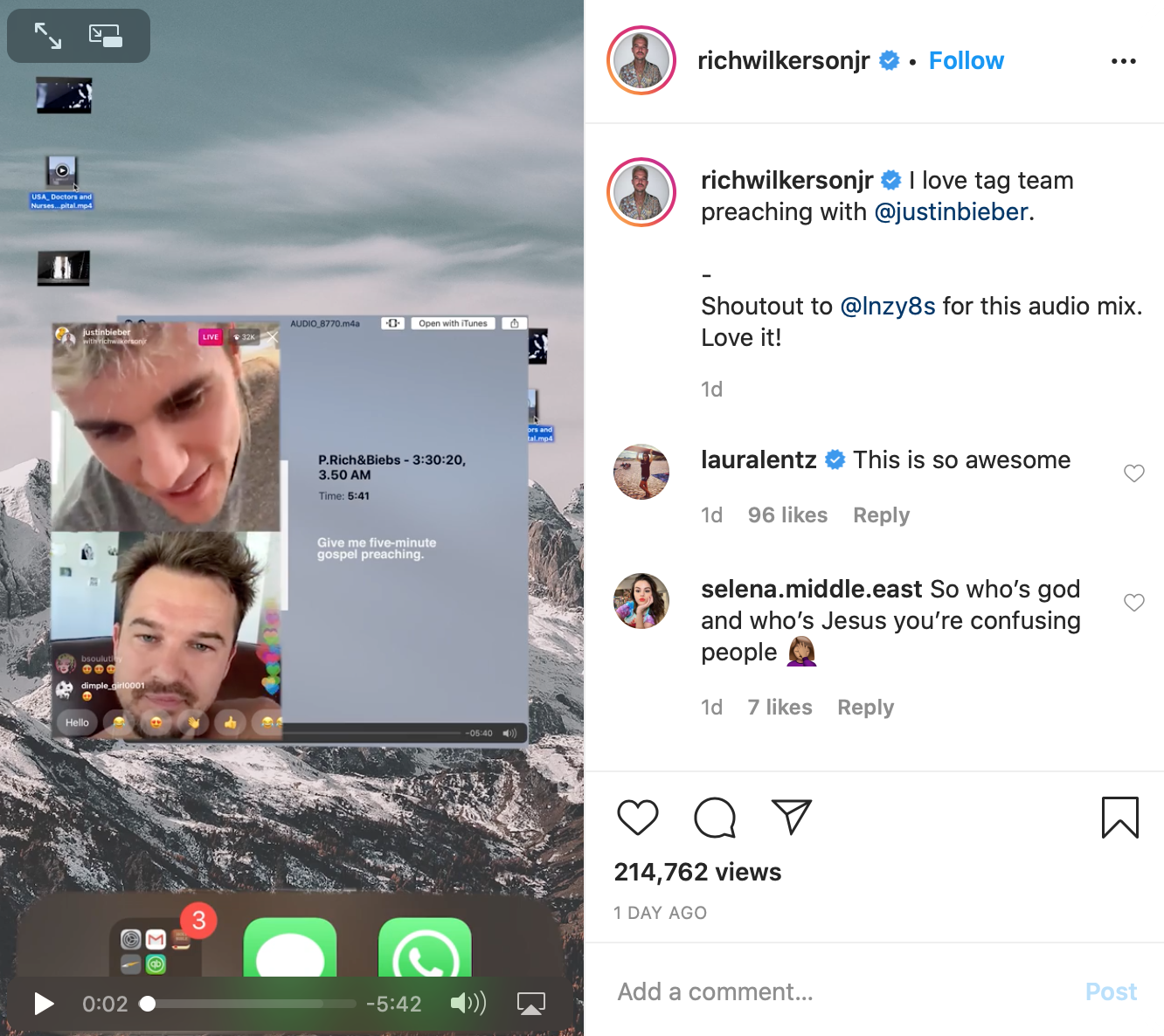
Justin Bieber hosted a rapid-fire discussion about the Gospel on Instagram with Los Angeles megachurch pastor Rich Wilkerson.

“Give me your 5-minute gospel preaching,” Bieber said, according to Faithwire. “Who is Jesus? What is the Gospel?”

“The gospel is the good news,” Wilkerson said. “And the good news of Jesus is that … all of us were born broken, we all have a desire for God, a hole in our soul … but Jesus came to fill the hole. We believe that Jesus is God’s Son, He came to this world in the form of a man, He lived a spotless and perfect life … and He became the atoning sacrifice; He paid the price for our sin.

Bieber also asked, “Do you think we need to earn God’s love?”

“There’s no way to earn it,” Wilkerson said. “You couldn’t do enough good things to be good enough, and you can’t do enough bad things to be bad enough.

“Trust and believe in what He’s done for us. He paid the price. We just simply believe.”

Bieber also chimed in with Wilkerson, saying grace comes from Jesus.

“That’s why we need Jesus,” he said. “That is the grace … [Jesus] took the punishment himself so that we don’t have to live in shame or fear. God sent his perfect son, who knew no sin and became sin so that we could become right with God.

“My future is secure knowing that I’m forgiven, I’m saved, I’m set free from my past. I…

… Read More

Click here to read the rest of the story from our content source/partners – Christian Headlines.

قالب وردپرس

Black and Latino Startup Churches Work to Stay Afloat During Coronavirus Pandemic

Pastor Kerlin Calderon knows that if the coronavirus shutdowns continue for another three months, it’s possible his church in the Bronx could be in trouble.

Weekly offerings keep dwindling. He worries that the church may have to dip into its savings to pay its rent.

But he remains hopeful.

“You always have faith that you are going to make it, that God is going to provide because if God called you, then he will sustain you,” said Calderon, 35, pastor of Grace Tabernacle.

Calderon, who grew up in Washington Heights, started Grace Tabernacle, or Tabernáculo de Gracia, three years ago when he noticed a lack of Spanish-speaking churches in an area where Catholic churches were shutting down.

What began with Bible study classes from people’s living rooms is now a church of about 150 members that rents space inside a Korean United Methodist Church. Next to the Korean church signage is Grace Tabernacle’s message: “Una iglesia en comunidad para la comunidad” (A church in community for the community).

As the novel coronavirus continues to spread across the United States, faith leaders have canceled worship services and shifted their ministries online to abide by social distancing guidelines aimed at preventing the spread of COVID-19. While megachurches and more established congregations likely have the financial resources to weather this pandemic, startup churches in working-class communities of color may not have the means to do so.

This is concerning for the Rev. Elizabeth Rios, executive director for Plant4Harvest, an organization that coaches and trains black and Latino faith leaders to start multiethnic churches in urban communities.

The Rev. Elizabeth Rios. Photo courtesy of Plant4Harvest

But she is motivated by the way startup churches are advocating for their flocks during this crisis. Black and Latino churches, Rios said, have a history of rising up in crisis.

“Honestly, I’m excited and hopeful because they have risen to the occasion,” said Rios. “I haven’t seen church planters give up hope or throw up their hands and say, ‘this is it for us.’”

“They feel like modern-day disciples,” she added. “They’re going to revolutionize how we do church.”

Church planters, the term given to pastors who establish new churches, skew younger and can adapt more quickly to change, Rios said. She has seen these churches approach an “everybody is a minister” mentality.

“Everybody has to be on the front lines,” she added.

One particular church divided the congregation and other church visitors into groups of about 15 people, she said. The church then designated leaders to check if their groups were in need of prayer, food or any other supplies.

Younger churches have also quickly adapted to online ministry because they were already doing it, she said. Other congregations had some online presence, and the pandemic forced them to fully launch online.

“I think what it made everyone realize is that the church is not the building,” Rios said.

Still, there are big challenges.

“For regular-sized churches and megachurches it will impact them, but it won’t wipe them out,” Rios said. “This has the potential to wipe out church plants.”

Some startup churches didn’t have automated or online giving set up, Rios said. There are also others who just started their churches and have not yet established deep ties in their communities. One pastor, for example, signed a lease just three months ago to operate a new church, Rios said.

“People may not necessarily feel as engaged because you still are new to them,” she said.

Troy Davis, who planted a church in Atlanta, knows the struggle. He rented a space from a school to operate his church, which closed nearly two years later due to lack of resources.

The rent was too pricey, he said.

“It’s already rough for us to plant a church where the church is needed,” said Davis, who works with youth and people who are homeless. “Then you tackle something like a pandemic, it becomes even harder because of lack of resources.

“A lot of inner-city churches, our bread and butter (is) that we’re community. We stick together,” Davis added.

During a time when people can’t gather because of the pandemic, that fabric of community is impacted, Davis said.

Davis said pastors need to stick together and share strategies of how they’re adapting.

The Rev. David Ramos. Courtesy photo by Rachel Martin

“Church planting is a lonely road already. It’s lonely. It’s competitive, which it shouldn’t be, but it is,” Davis said.

With something like the pandemic, Davis said “it could drive a wedge between brothers who are planting churches in the inner city to do well, but because we’re all fighting for resources, it becomes a church war.”

For the Rev. David Ramos, there’s both risk and opportunity during this pandemic. Ramos is an associate director for City to City in New York, an organization that trains pastors to plant gospel-centered churches in the city.

Many church planters, Ramos said, do not have the cash flow or reserves that more established churches may have.

“Many perhaps may not weather the storm because (of) the funding that’s going to impact them when they’re not meeting week to week,” Ramos said.

Part-time pastors are also under a lot of stress, working another job on top of leading their churches, Ramos said. With social distancing measures in place, some pastors are working from home while caring for their kids and families as well as trying to minister to their flock.

“It’s overwhelming to do that,” Ramos said. “As the tsunami of sickness begins to hit New York City, this is just going to get worse, because what’s going to occur is now we’re going to be (dealing) with death and dying.”

But Ramos also sees a silver lining.

A lot of church planters are run by a younger generation and have already been livestreaming, creating chat rooms and a larger virtual presence, he said.

“They are probably the vanguard of doing church in new ways,” Ramos said.

Ramos is encouraged by church planters who do this work “out of a sense of calling.”For the Latino church in particular, Ramos said it “has thrived in some of the most depressed neighborhoods.”

Churches of color “have a history of operating with challenged environments” and “may actually be better able to rise up in the midst of crisis,” he said.

That’s what Calderon and his church Grace Tabernacle are doing.

Grace Tabernacle connected with the neighborhood housing project to gauge the needs of elders, delivering toilet paper, milk and any other supplies.

Normally, their church hosts workshops on wellness and healthy eating. Now, they’re thinking of hosting virtual Zumba workouts that their members can access.

The younger members of the church are also FaceTiming with parents who now have the added task of helping their children with distance-learning school assignments. For some parents, there are language and technology barriers that have made that process difficult. In those video chats, church members have guided parents on how to use iPads their children have brought home from school.

They’re also there to just listen to their fellow church members over the phone.

“They just need somebody to encourage them to let them know that this will pass,” Calderon said. “As a church, we’re offering encouragement through prayer, through counseling. Just working with them and listening to them while they vent.”

On a normal weekend service, Grace Tabernacle members take a one-minute break to say hello to one another and exchange pleasantries. It’s like a “New York minute,” Calderon said.

Church members have joked that once this is all over, “We’re going to have ten New York minutes next time we meet.”

Source: Religion News Service

All Content & Images are provided by the acknowledged source

Daniel Whyte III Tells “Christian Leaders”, Pastors, and President Trump What to Do to Stop the Coronavirus Plague or Millions Will Die and America as We Know It Will Be Facing the Abyss

Welcome to the How to Stay the Coronavirus Plague Briefing Podcast #6. My name is Daniel Whyte III, president of Gospel Light Society International.

Deuteronomy 28:59 says, “Then the LORD will make thy plagues wonderful, and the plagues of thy seed, even great plagues, and of long continuance, and sore sicknesses, and of long continuance.”

The Bible Knowledge Commentary says, “In carrying out the curses on disobedient Israel, God would undo all the previous blessings He had lavished on her. Whereas Israel had previously escaped the fearful plagues and diseases of Egypt, God would bring them on Israel. He would also bring other kinds of sickness not recorded in this Book of the Law. Whereas God had multiplied her number as the stars in the sky, Israel would be reduced to a few in number. Once she lived in security, but now she would live in anxiety, despair, and in constant suspense and fear for her life.”

Leonard Ravenhill said, “The Church right now has more fashion than passion, is more pathetic than prophetic, is more superficial than supernatural.”

2 Chronicles 7:14 says, “If my people, which are called by my name, shall humble themselves, and pray, and seek my face, and turn from their wicked ways; then will I hear from heaven, and will forgive their sin, and will heal their land.”

Revelation 2:18-24 says:

18 And unto the angel of the church in Thyatira write; These things saith the Son of God, who hath his eyes like unto a flame of fire, and his feet are like fine brass;

19 I know thy works, and charity, and service, and faith, and thy patience, and thy works; and the last to be more than the first.

20 Notwithstanding I have a few things against thee, because thou sufferest that woman Jezebel, which calleth herself a prophetess, to teach and to seduce my servants to commit fornication, and to eat things sacrificed unto idols.

21 And I gave her space to repent of her fornication; and she repented not.

22 Behold, I will cast her into a bed, and them that commit adultery with her into great tribulation, except they repent of their deeds.

23 And I will kill her children with death; and all the churches shall know that I am he which searcheth the reins and hearts: and I will give unto every one of you according to your works.

24 But unto you I say, and unto the rest in Thyatira, as many as have not this doctrine, and which have not known the depths of Satan, as they speak; I will put upon you none other burden.

2 Samuel 24:9-15 says:

9 And Joab gave up the sum of the number of the people unto the king: and there were in Israel eight hundred thousand valiant men that drew the sword; and the men of Judah were five hundred thousand men.

10 And David’s heart smote him after that he had numbered the people. And David said unto the Lord, I have sinned greatly in that I have done: and now, I beseech thee, O Lord, take away the iniquity of thy servant; for I have done very foolishly.

11 For when David was up in the morning, the word of the Lord came unto the prophet Gad, David’s seer, saying,

12 Go and say unto David, Thus saith the Lord, I offer thee three things; choose thee one of them, that I may do it unto thee.

13 So Gad came to David, and told him, and said unto him, Shall seven years of famine come unto thee in thy land? or wilt thou flee three months before thine enemies, while they pursue thee? or that there be three days’ pestilence in thy land? now advise, and see what answer I shall return to him that sent me.

14 And David said unto Gad, I am in a great strait: let us fall now into the hand of the Lord; for his mercies are great: and let me not fall into the hand of man.

15 So the Lord sent a pestilence upon Israel from the morning even to the time appointed: and there died of the people from Dan even to Beersheba seventy thousand men.

1. Mr. President, God is not going to allow you to open up the country or even part of the country successfully by Easter, neither will most churches be packed on Easter Sunday morning as you would like. That is a great thought but that will not be happening. Therefore, we are calling on you to go ahead and shut down the nation completely and immediately for at least a full thirty days. Please understand Mr. President even though you may be very smart when it comes to politics and the economy, this is not a political issue and this is not an economic issue and it is really not a medical issue, it is a spiritual issue. And until the spiritual issue of sin in the church, in the government, and in the nation is dealt with, the plague will not be stopped.

2. As I have already told you, if you want this plague to be stayed or stopped, you need to ask Franklin Graham, Jack Graham, Tony Evans, Dwight McKissic, John MacArthur and Anne Graham Lotz to lead a massive nationwide prayer time morning, noon, and night, each day in churches across the nation and publicly at the White House. And basically what you can do is have Franklin Graham or someone appointed by Franklin Graham to open up your briefing everyday with prayer. As you know Mr. President, this is not unprecedented as many presidents in the past have done something similar. We do not want to get into this with you, you can let Paula White keep her job so she can support her family but you need to remove her from over your advisory council and replace her with Franklin Graham or someone else. And these people and others need to lead all churches to publicly denounce all of the sins that are common in the church today such as: adultery, fornication, taking God’s blessings for granted, unthankfulness, ungratefulness, child molestation, and the church’s increasing support of homosexuality, homosexual marriage, homosexual adoption, and the homosexual agenda.

3. You need to immediately roll back everything that President Obama has done regarding having the government to sanction homosexuality, homosexual marriage, and the homosexual agenda, including starting something in the lower level courts that would go to the Supreme Court to overturn the decision regarding homosexuality, homosexual marriage and the homosexual agenda just as you did about abortion. You must understand Mr. President, that God hates all sin but He especially has a problem with the abomination of homosexuality because it is a satanic attempt to turn God’s world upside down. You need to take back and apologize for what you said in support of homosexuality, homosexual marriage, and the homosexual agenda. And you need to immediately remove the openly homosexual Ambassador Richard Grenell from over United States National Intelligence. Mr. President, one of the main reasons why God worked a miracle and put you in office was to turn back the foolishness that President Obama started of sanctioning men with men and women with women and to this point you have not done so probably because of your friend and mentor Roy Cohn who was an openly homosexual man and died of AIDS and because of your daughter and son-in-law who have many dealings with the homosexual community. If you don’t do what I’m telling you, you will go down in history as one of the worst presidents along with Barack Obama and Jimmy Carter and you will lose your legacy just like Obama has lost his legacy.

NEWS

According to the AP, British Prime Minister Boris Johnson has tested positive for the new coronavirus, the first leader of a major nation to contract COVID-19.

According to the AP, health officials said Britain had 14,579 confirmed cases of COVID-19, and 759 people have died — 181 deaths in 24 hours, the country’s highest daily toll yet.

According to Daily Mail, Italy has reported 919 new deaths from coronavirus, the highest number of fatalities any country has reported in the space of 24 hours since the outbreak began late last year.

CHURCH

Matthew 18:20 says, “For where two or three are gathered together in my name, there am I in the midst of them.”

Jason Helopoulos said, “A Christian home must be centered upon Christ, and if it is centered upon Christ, then it will be filled with worship. Most Christians are aware of the importance of secret and corporate worship, but fewer have even heard of family worship. What is family worship? It is pretty simple. Tonight, sit down with your family on the couch or at the dinner table. And then pray together, read the Bible together, and sing a great hymn of the faith together. There are many reasons for doing family worship, but let us just mention a handful. Family worship glorifies and honors God. Family worship has the wonderful effect of centering our homes upon Christ.” And daily Family worship will not always make family life easier but it should be better. And it will give each family the grace to deal with other family members providing each family member is saved.

——

Now, if you are with us today and you do not know Jesus Christ as your Savior, allow me to show you how you can place your faith and trust in Him for Salvation from sin and Hell.

First, accept the fact that you are a sinner, and that you have broken God’s law. The Bible says in Romans 3:23: “For all have sinned and come short of the glory of God.”

Second, accept the fact that there is a penalty for sin. The Bible states in Romans 6:23: “For the wages of sin is death…”

Third, accept the fact that you are on the road to hell. Jesus Christ said in Matthew 18:8: “Wherefore if thy hand or thy foot offend thee, cut them off, and cast them from thee: it is better for thee to enter into life halt or maimed, rather than having two hands or two feet to be cast into everlasting fire.” Also, the Bible states in Revelation 21:8: “But the fearful, and unbelieving, and the abominable, and murderers, and whoremongers and sorcerers, and idolaters, and all liars, shall have their part in the lake which burneth with fire and brimstone: which is the second death.”

Now that is bad news, but here’s the good news. Jesus Christ said in John 3:16: “For God so loved the world, that he gave his only begotten Son, that whosoever believeth in him should not perish, but have everlasting life.” Just believe in your heart that Jesus Christ died for your sins, was buried, and rose from the dead by the power of God for you so that you can live eternally with Him. Pray and ask Him to come into your heart today, and He will.

Romans 10:9 & 13 says, “That if thou shalt confess with thy mouth the Lord Jesus, and shalt believe in thine heart that God hath raised him from the dead, thou shalt be saved… For whosoever shall call upon the name of the Lord shall be saved.”

If you believe that Jesus Christ died on the Cross for your sins, was buried, and rose from the dead, and you want to trust Him for your Salvation today, please pray with me this simple prayer: Holy Father God, I realize that I am a sinner and that I have done some bad things in my life. I am sorry for my sins, and today I choose to turn from my sins. For Jesus Christ sake, please forgive me of my sins. I believe with all of my heart that Jesus Christ died for me, was buried, and rose again. I trust Jesus Christ as my Savior and I choose to follow Him as Lord from this day forward. Lord Jesus, please come into my heart and save my soul and change my life today. Amen.

If you believed in your heart that Jesus Christ died on the Cross, was buried, and rose again, allow me to say, congratulations on doing the most important thing in life and that is accepting Jesus Christ as your Lord and Saviour! For more information to help you grow in your newfound faith in Christ, go to Gospel Light Society.com and read “What To Do After You Enter Through the Door”. Jesus Christ said in John 10:9, “I am the door: by me if any man enter in, he shall be saved, and shall go in and out, and find pasture.”

If you accepted Jesus Christ as your Savior today, please email me at [email protected] and let us know. There is some free material that we want to send you. If you have a prayer request, please e-mail that to us as well, and we will pray for you until you tell us to stop.

God loves you. We love you. And may God bless you.

All Content & Images are provided by the acknowledged source

Pence Urges Churches of 10 or More to Stop Meeting in Fight against Coronavirus

Pence Urges Churches of 10 or More to Stop Meeting in Fight against Coronavirus


Vice President Mike Pence on Wednesday urged churches comprised of more than 10 people to stop meeting, saying temporary limits on large gatherings are necessary to slow the spread of COVID-19.

It was the first time either Pence or President Trump had directly addressed the issue.

“Karen and I, and I know the president, we’ve been enjoying worship services online,” Pence said on ABC’s Nightline, referencing his wife. “We’re so grateful to churches and synagogues and places of worship around America that have … heeded the president’s Coronavirus Guidelines for America. We really believe this is a time when people should avoid gatherings of more than 10 people. And so we continue to urge churches around America to heed to that.”

The White House’s Coronavirus Guidelines ask Americans to “avoid social gatherings in groups of more than 10 people.” Although the guidelines imply that churches should not meet, the issue largely has fallen on cities and states to specifically apply.

Trump was asked during a press conference Wednesday whether churches should “be holding services in the middle of this pandemic” and didn’t directly answer the question, even though he implied they should not.

“My biggest disappointment is that churches can’t meet in a time of need,” Trump said, adding that if churches do meet, “you’re really giving this invisible enemy a very…

… Read More

Click here to read the rest of the story from our content source/partners – Christian Headlines.

قالب وردپرس

Funerals in the Holy Land and a virtual tour of Jerusalem: Using the pandemic for eternal good

A man takes a selfie in front of the closed Church of the Holy Sepulchre in Jerusalem.

There is nothing like being in the Holy Land during the Easter season. After leading more than thirty study tours to Israel, I can tell you that each time feels like the first time. There is something miraculous and transforming about this ancient land, especially during this season.

This year, April is not only the month of Easter for Christians, but of Passover for the Jewish people and the beginning of Ramadan for Muslims. Because of the pandemic, however, the streets of Jerusalem are virtually empty. Churches and other religious sites are closed. Even burials are different. 

In Israel, Jewish dead are typically laid to rest in a cloth smock and shroud without a coffin. Now, the bodies of COVID-19 victims are taken for ritual washing, which is performed in full protective gear, wrapped in impermeable plastic, and wrapped again in plastic before interment. Muslim bodies are not washed or shrouded but buried in a plastic body bag. Funerals can be attended by no more than twenty people in an open space. The bereaved are not embraced. 

Here’s some good news, however: Israel’s Tower of David Museum is using virtual reality to allow us to visit the Western Wall during Passover, the Church of the Holy Sepulchre during Easter, and the Dome of the Rock and the Al Aqsa Mosque during Ramadan. 

The museum has created an immersive 360-degree virtual reality experience for anyone with internet access. We will be able to see the Holy City as it is today and as it looked twenty centuries ago. The link will be available free of charge from the first day of Passover to the first day of Ramadan (April 9–24). 

Jerusalem: Via Dolorosa, Ecce Homo Arch

“Our routine is the scaffolding of life”

The philosopher Walter Benjamin noted, “History is made up of images, not stories.” The images coming out of the coronavirus pandemic, like empty streets…

… Read More


Click Read More to read the rest of the story from our content source/partners – Denison Forum.

قالب وردپرس