

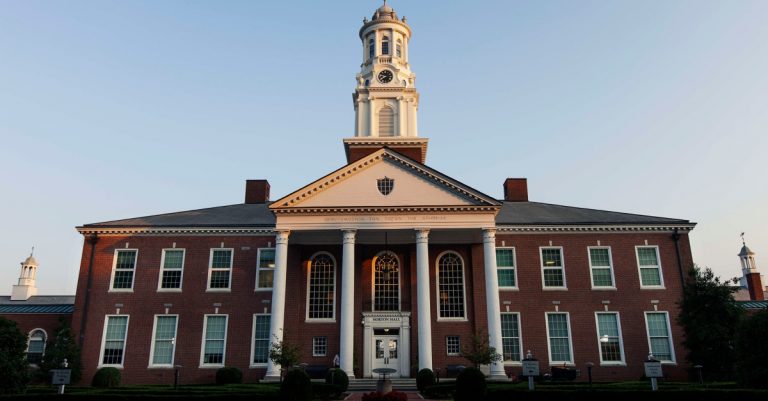
Churches and Christian Colleges Make Big Changes to Fight Coronavirus

The nation’s largest church said Wednesday it would not hold its upcoming weekend services due to the coronavirus threat, as churches across the country – big and small – grappled with how to respond to the outbreak.

Joel Osteen’s Lakewood Church in Houston said it would not hold public in-person services in light of an emergency health declaration by Mayor Sylvester Turner, as well as “the fact that Lakewood draws such large numbers of international visitors each week.” Instead, church services will be broadcast online only this weekend. It is the largest church in the United States.

The number of U.S. cases has multiplied in the past week. On March 4, there were 129 confirmed cases in the U.S. That number grew to 554 on March 8 and to 1,215 on March 12.

The Episcopal dioceses of Washington and Virginia are closing or canceling services at more than 250 churches in the region.

Meanwhile, congregations across the U.S. are facing similar tough choices – and in some instances, are being ordered or strongly urged by government officials to cancel.

California Gov. Gavin Newsom and the state’s public health officials on Wednesday said “non-essential gatherings” of more than 250 people should be postponed or canceled “to protect public health and slow the spread of COVID-19.”

Florida Gov. Ron DeSantis said at a news conference Thursday he is recommending that “local municipalities and private entities to strongly consider limiting or postponing mass gatherings in the state of Florida.”

Source: Christian Headlines

All Content & Images are provided by the acknowledged source

Craig Bowron on Adding Caring for the Vulnerable to Your Coronavirus Checklist

Craig Bowron is a physician and writer in St. Paul, Minnesota. He can be reached on Twitter at @billcarlosbills.

As a Christian living in a northern climate, I find it unfortunate that none of Jesus’ teachings directly speak to our cold weather situation, such as “The Parable of the Neighbor Who Never Shoveled Her Sidewalk” or “The Parable of Black Ice.”

Likewise, although Jesus called us to care for the sick, the weary, those in prison, etc., he didn’t give specific guidance about how to do that in the middle of a coronavirus pandemic. And so we’re left to think that through.

When it comes to the COVID-19 panic, our overriding principle might be from “The Parable of the Good Samaritan Who Tried to Help the Man Who Fell Through the Ice,” in which would-be rescuers are advised to first call for help. As the Minnesota Department of Natural Resources cautions, one should “resist the urge to run up to the edge of the hole. This would most likely result in two victims in the water.”

In trying to help others who are stricken with, or on lockdown from, the novel coronavirus, we should first be careful not to behave in a way that promotes further spread of the virus. The virus moves most efficiently person to person, via kerchoo-powered respiratory droplets, and so the more distance we can keep between persons, the harder that will be. If you’re moving through the community helping others as you’re “just finishing getting over a little cold,” you might be spreading the thing that everyone is trying to avoid.

With that in mind, what to do for those who need our help?

You need to find them first, of course. Our efforts are probably best focused on helping those who are at the highest risk of a serious corona infection: older people and those with chronic medical conditions, as well as those who may have a difficult time living through a period of self-isolation, which includes, in addition to those already mentioned, those with disabilities.

Remember, much of this can be done — and might best be done — via a phone call.

The more they stay home, the less likely they are to become infected.

Make sure they have the food, medication, toiletries, etc., that they need, and if they don’t, see if you can get it for them. Leave these items on their doorstep if necessary.

Do they have a plan if they do get sick? As a physician, I’ve seen it many times: For older folks who are still living independently but under suboptimal or marginal conditions, even a simple bladder infection or a medication mix-up can send them tumbling.

For example, an upstairs bedroom might work OK until they get sick and weak. Then what? Can things be decluttered a bit so that pathways to the bathroom are clear? Could a spare bed be moved downstairs so they can live on that level for a while? Do they have an accessible and functional bathroom?

Source: Religion News Service

All Content & Images are provided by the acknowledged source
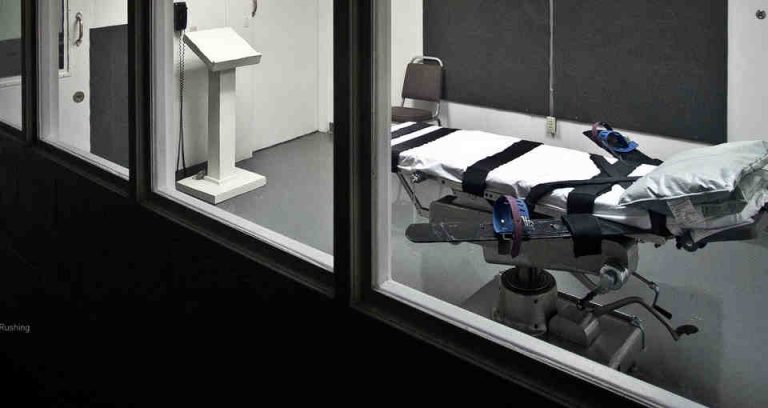
Dr. Richard Land Answers: How Can Pro-Life Christians Also be Supporters of Capital Punishment?

Question:  There was a recent New York Times Magazine article about conman Paul Skalnik and how his false testimonies sent dozens to jail and 4 people to death row.  In Florida, where death sentencing was/is popular, there have been 29 death-row inmates exonerated by the time of the article’s publication.  There was also a study that estimated 1 in 25, 4.1 percent, of inmates sentenced to death are innocent.  Even if the state kills one innocent person, isn’t that too much?  As Christians who talk about killing innocent babies, how can we then go and support capital punishment when there are many instances where the judicial system have been wrong?

I am frequently asked this question both by fellow Christians as well as non-Christians. The short answer is that the Bible clearly authorizes and teaches capital punishment. During the Mosaic Covenant capital punishment was mandated for a variety of offenses. However, the death penalty both pre-dates and post-dates the Mosaic Law and Covenant. As far back as Genesis, God told Noah, “Whoso sheddeth man’s blood, by man shall his blood be shed: for in the image of God made He man” (Gen. 9:6). Here, God reveals the foundational reason why capital punishment is appropriate at least for the murder of a fellow human being — each of is us created in God’s image, and thus human life must be uniquely reverenced in comparison to the respect due the rest of creation.

The New Testament also affirms the government’s right to employ capital punishment as one of the options available to fulfill their divinely ordained responsibilities. The Apostle Paul, writing under the inspiration of God’s Holy Spirit, speaking of the civil magistrate, declares, “For he is the minister of God to thee for good, but if thou do that which is evil, be afraid; for he beareth not the sword in vain: for he is the minister of God, a revenger to execute wrath upon him that doeth evil” (Rom. 13:4). The use of the word “sword” in verse four is a reference to the sword used to execute Roman citizens found guilty of a capital crime.

For nearly two millennia now, this passage has been seen by most Christian faith traditions both as authorizing governmental authority and authorizing their right to use lethal force to punish evil doers, domestically through the criminal justice system and internationally through the military in “just war” conflicts with other nations.

But what about Jesus’ commands to love and forgive your enemies? Just the other day I was discussing this issue with a Christian colleague who immediately objected to my reference to the Apostle Paul’s Epistle to the Romans, responding, “Well, capital punishment may meet the standards of Holy Scripture, but it doesn’t survive an encounter with the supreme ‘love ethic’ of Jesus who commanded us ‘to love and forgive our enemies.’”

I responded that there was no conflict. He was making the mistake of succumbing to the “red letter” fallacy of elevating the “very words of Jesus” above the rest of the New Testament. As one of my other colleagues once said, “All the words of the New Testament are important, but the very words of Jesus take precedent.” Such logic mistakenly has led many Christians to set up a false dichotomy between Jesus and the Apostles Paul, John, and Peter in the rest of the New Testament.

In fact, if you really give the “very words” of Jesus precedence, then you will reject all such false dichotomies. In the Gospel of John, Jesus preparing His disciples for His departure into Heaven after the Resurrection, says, “And I will pray the Father, and he shall give you another Comforter, that he may abide with you forever; even the spirit of truth; whom the world cannot receive, because it seeth him not, neither knoweth him, but ye know him; for he dwelleth with you, and shall be in you” (John 14:16-17 emphasis added).

SOURCE: Christian Post, Richard Land

All Content & Images are provided by the acknowledged source

Pew Poll Finds Only 15 Percent of White Evangelicals Believe ‘Morally Upstanding’ Describes Trump ‘Very Well’

Only 15 percent of white evangelicals believe that the phrase “morally upstanding” describes President Trump “very well,” according to a recent report by the Pew Research Center.

Pew released the findings of the survey on Monday which found that, while nearly two-thirds of white evangelicals believe Trump has helped them while in office, a much smaller percentage confidently describe him as “morally upstanding.”

Among white evangelical respondents, 15 percent believed that the term “morally upstanding” described Trump “very well,” while 45 percent responded that the term fit “fairly well” and 37 percent said “not too well” or “not at all well.”

Also 23 percent of white evangelical respondents said that “honest” described Trump “very well,” compared to 46 percent that said “fairly well” and 29 percent that said “Not too/not at all well.”

“While white evangelical Protestants generally see Trump as standing up for them, they are less convinced that he personally lives a moral and ethical life or conducts himself admirably,” stated Pew.

“Still, even though relatively few white evangelicals say words and phrases like ‘morally upstanding’ and ‘honest’ describe Trump very well, most say these traits describe Trump at least fairly well.”

Pew also noted that white evangelicals were more likely than the general U.S. population to consider Trump to be “morally upstanding,” “honest,” or religious.

SOURCE: Christian Post, Michael Gryboski

All Content & Images are provided by the acknowledged source

John Stonestreet and Roberto Rivera on C. S. Lewis and the Coronavirus

The news this week about COVID-19, known as the coronavirus, has certainly, to understate it, escalated: New infections, grimmer projections, lots and lots of cancellations (including — can you believe it? — March Madness).

The news changes so quickly day by day, even hour by hour, that it’s hard to keep up, much less know, really, what to think about all of this.

C.S. Lewis once said that we should read three old books for every new one. I think we should read three C.S. Lewis books for every new one. He never faced the coronavirus, of course, but in the late 1940s, the world was coming to grips with another threat: nuclear annihilation.

The bomb was only a few years old, and in the hands of sworn national enemies. The uncertainty of what exactly could happen, not to mention what might happen, was palpable. In that context, C.S. Lewis wrote an essay titled, “On Living in an Atomic Age.”

I’m grateful to one of my BreakPoint colleagues, Ashlee Cowles, for reminding us of this essay along with some sage advice: Whenever you hear “atomic bomb” in this essay, think “coronavirus.”

“We think a great deal too much of the atomic bomb,” Lewis begins. To those who wonder how it’s possible to go on in the face of such a threat, Lewis recalls that theirs was not the first generation to live under a threatening shadow. In fact, if we’re honest, we all live under a sentence of death, and for some of us, that death could even be “unpleasant.”

The important question, says Lewis, is not whether or how we will die but if in the meantime we will be doing “sensible” and “human” things like “praying, working … reading, listening to music, bathing the children.”

SOURCE: Christian Post, John Stonestreet and Roberto Rivera

All Content & Images are provided by the acknowledged source
Chuck Lawless on Eight Reasons Why the Fall of a Church Leader Hurts So Badly

Seldom does a week go by that I don’t learn about a church leader who has fallen. I want to be merciful toward those who fall, but we also need to know how much pain such a fall causes. Perhaps remembering these realities will help all of us fight harder for holiness.

Here are eight reasons the fall of a church leader hurts so badly:

SOURCE: Christian Post, Chuck Lawless

All Content & Images are provided by the acknowledged source

European Court of Human Rights Refuses to Hear Case of Swedish Nurses Who Were Denied Jobs After They Refused to Perform Abortions

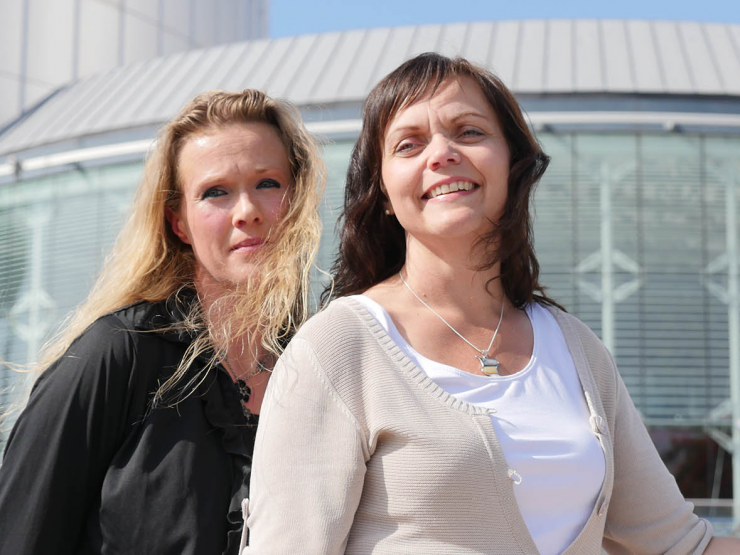
The European Court of Human Rights has refused to take up the case of two Swedish nurses who were denied midwife jobs because they were not willing to perform abortions. A Christian law firm called it a “dangerous departure from the Court’s purpose in protecting fundamental freedoms.”

The court said the case of the nurses, Ellinor Grimmark and Linda Steen, who were retrained as midwives but were not given jobs due to their religious beliefs against carrying out abortions, was inadmissible to be heard by the EHRC, according to Reuters.

The Christian midwives had claimed that authorities violated the European Convention on Human Rights by refusing jobs to them.

The court’s decision cannot be appealed.

“We are very disappointed by the Court’s decision not to take up the cases of Ms. Grimmark and Ms Steen,” Robert Clarke, deputy director of Alliance Defending Freedom International, said in a statement, according to Premier. “A positive judgment from the Court would have been an important step in the protection of the right to freedom of conscience.”

Clarke added, “Medical professionals should be able to work without being forced to choose between their deeply held convictions and their careers. Although freedom of conscience is protected as a fundamental right in almost every other European country, the decision today marks a missed opportunity to uphold this important protection in Sweden. In its short written decision, the Court agreed that Sweden had interfered with the rights of these midwives.”

A Swedish pro-choice group, RFSU, celebrated the rejection of the case. “It is not a human right for nursing staff to refuse to provide care,” said RFSU’s Hans Linde. “This is an important decision that in the long term will help to protect women’s health, right to good quality care and to be treated with respect when seeking an abortion.”

However, Grimmark said she chose to become a midwife “because I wanted to help bring life into this world.”

“I cannot understand why the Swedish government refuses to accommodate my conscientious convictions,” she said. “I am now working in Norway, where my conscience is respected, but no one can explain why Sweden cannot do the same.”

SOURCE: Christian Post, Anugrah Kumar

All Content & Images are provided by the acknowledged source

Shane Idleman on Is Your Blessing Waiting on You?

“There is a sense in which God’s promises are unconditional, in that our disobedience will not thwart God’s intention to be gracious, but there is also a sense in which those promises will be released only through the obedience of God’s people” (Paul Carter).

The Bible is clear that God blesses His people. But it’s also clear that some blessings have conditions: “If you do this, I will do that.” Sadly, motivational preachers, teachers, and pastors only focus on the blessings of God without showing the other side of the coin. “I have to keep my members happy and encouraged,” they say. Yes, we should encourage, but we also must convict and confront if we are to be faithful ministers of the gospel.

Many come to church praising God but not prevailing with Him, worshiping but not walking in His promises, and praying but not seeing His power because of unrepentant sin: “Your iniquities have separated you from your God; your sins have hidden his face from you, so that he will not hear” (Isaiah 59:2). As it’s been said, “It is possible to have a saved soul but a lost life.”

We actually do a disservice to people if we fail to preach on the wonderful truth of repentance. I believe God will heal our land if we repent and turn to Him. I believe He will supply every need for those who, from a pure heart, honor Him with their resources. I believe God will bless you with a ministry if you are obedient in the small things. I believe God can honor a person with a spouse if they stop partying and seek His will rather than their own. And on and on it goes — where it stops only God knows.

Sin Fascinates Before It Assassinates

Scriptural truths must be balanced, but what does it mean to be balanced? When we speak of the attributes of God, we must remember that no one attribute is greater than another and no single truth of Scripture is truer than another. To genuinely help people, we must avoid the temptation to cherry-pick. We must preach the difficult truths as well as the joyful ones — the cross and the new life, hell and heaven, damnation and salvation, sin and grace, wrath and love, judgment and mercy, and obedience and forgiveness. We must preach that God is love but not forget He is also just. It is the love of God that compels us to share all His truth.

Jeremiah 5:25 is powerful and heart-wrenching: “Your iniquities have turned these things away, and your sins have withheld good from you.” He goes on to say in verses 30 and 31: “An astonishing and horrible thing has been committed in the land: The prophets prophesy falsely, and the priests rule by their own power; And My people love to have it so. But what will you do in the end?” False teachers are often a judgment on false converts and on those who love to have their ears tickled but not their hearts changed. (Here is one sure sign of a false prophet.)

When people follow their own plans, they walk backward and not forward. Disobeying God is a recurring theme from Genesis to Revelation and from the church in Acts to the church today. We must be relentless in our pursuit of God, ruthless in rooting out and dealing with our own sin, and quick to repent and seek the restoration of our fellowship with God when we fail.

SOURCE: Christian Post, Shane Idleman

All Content & Images are provided by the acknowledged source

Walt Disney Co. will release “Frozen 2” on Disney Plus several months early to give families cooped up by the coronavirus a welcome distraction — and give its streaming service a boost


Walt Disney Co. will release “Frozen 2” on Disney Plus several months early to give families cooped up by the coronavirus a welcome distraction — and give its streaming service a boost.

Disney announced Friday that “Frozen 2” will begin streaming on Disney Plus Sunday, three months earlier than expected. In some countries, including Canada, Australia, New Zealand and the Netherlands, the movie will start streaming Tuesday.

Most upcoming new releases have been postponed due to the virus, including Disney’s own lineup. “Mulan” had been set to hit theaters next week. Few March or April movies remain on the calendar. Some movie theaters have shuttered, though most are currently imposing new restrictions on audience crowding to help facilitate the social distancing recommended by health officials.

The move by Disney could presage how other media companies funnel their films to streaming services in the coming weeks as studios look for ways to capitalize on audiences stuck at home. And it could prove a pivotal moment in the evolution of streaming services in relation to theatrical release. The major studios have largely guarded the traditional three-month exclusive theatrical window.

“Frozen 2,” which opened on Nov. 22, had already completed its theatrical run and hit video-on-demand on Feb. 25. With more than $1.4 billion in worldwide ticket sales, it’s the highest grossing animated film ever.

The vast majority of people recover from the new virus. According to the World Health Organization, people with mild illness recover in about two weeks, while those with more severe illness may take three to six weeks to recover.

___

Source: Associated Press – JAKE COYLE

All Content & Images are provided by the acknowledged source

Three Texas Churches Bring Legal Fight Against City Over Excessive Water Fees to Appeals Court

Three Texas churches that believe a local ordinance unjustly charges them excessive water fees have taken their case before a state appeals court.

Magnolia Bible Church, Magnolia’s First Baptist Church and Believers Fellowship had their complaint against the city of Magnolia heard before the Texas Third Court of Appeals in Austin on Wednesday.

First Liberty Institute, along with attorneys with the Baker Botts law firm, argued the case on behalf of the churches, stating that the city’s recent fee increase violated the “due process” rights of the congregations.

“Cities in Texas at least have to give due process to churches before imposing their water fee scheme,” said Aaron Streett, First Liberty network attorney with Baker Botts, in a statement released Wednesday.

“Due process, and basic fairness, prevent cities like Magnolia from excluding churches they know object to their water fee scheme from participating in legal proceedings attempting to validate that scheme.”

Last May, the three churches filed suit against Magnolia, accusing the city of taking “unprecedented action to recoup property tax revenue from churches.”

At issue was a local ordinance for tax-exempt entities adopted in March 2018 that increased the fees for water use by changing their status from “commercial” to “institutional.”

SOURCE: Christian Post, Michael Gryboski

All Content & Images are provided by the acknowledged source