Why Apples Stock Split Truly Shocked Shareholders – Motley Fool

Tech giant Apple (NASDAQ:AAPL) has broken all the rules of stock market investing. Its huge returns in 2019 and so far in 2020 fly in the face of those who’ve said that the iPhone maker’s best days are behind it. Its market capitalization of nearly $1.8 trillion seems too large for further gains, yet Apple keeps breaking the law of large numbers to push ever higher.

Now, Apple has once again flown in the face of convention, this time with its stock. In an era in which stock splits have almost disappeared, the Cupertino-based tech giant said that it would split its shares 4-for-1. Although the decision wouldn’t have seemed out of place as recently as a few years ago, it now is sparking a lot of discussion about whether more companies will follow suit with stock splits of their own.

Hardly an unprecedented move

Apple is no stranger to splitting its shares. It has done so on four prior occasions, as you can see below:

Effective Date of Split

Split Ratio

100 Shares in 1986 Would Now Be:

June 16, 1987

2-for-1

200 shares

June 21, 2000

2-for-1

400 shares

Feb. 28, 2005

2-for-1

800 shares

June 9, 2014

7-for-1

5,600 shares

Aug. 31, 2020*

4-for-1

22,400 shares

Data source: Apple investor relations. * Latest stock split is still pending as of publication date.

When choosing to split its stock, Apple typically followed the rules that prevailed in the broader stock market at the time. Apple’s first stock split in 1987 came after the stock price had reached roughly $80 per share. A 2-for-1 split gave Apple plenty of breathing room to avoid triple-digit share prices. When Apple stock next came near the $100 mark in 2000, another split sent the share price back downward. Similarly, Apple traded in the low $80s in 2005 when it did its third 2-for-1 stock split.

A change in split strategy

By then, however, companies had started to change their stance toward stock splits. Many companies no longer felt it necessary to keep their share prices at relatively low levels. As a result, when Apple once again approached $100 per share, the tech giant did nothing. The stock price continued to move ever higher; it was interrupted briefly by the financial crisis, but eventually moved to $700 per share. After 2005, Apple adopted a new approach. Even though the stock climbed into the triple digits by 2007, the company didn’t use its previous playbook and instead allowed its shares to continue to appreciate. Despite dramatic volatility both before and during the financial crisis in 2008 and 2009, Apple quickly rebounded and soared to as much as $700 per share by 2014.

At that point, Apple broke with the new tradition and decided to split its stock again. The company trotted out the usual explanation of making shares more readily available to investors. Yet as it happens, the split likely proved instrumental in allowing Apple to become part of the Dow Jones Industrial Average (DJINDICES:^DJI). The price-weighted average would’ve been hard-pressed to accept Apple’s commanding influence if its stock price had remained at $700 or more. After an unusual 7-for-1 split, shares in the low triple digits were quite reasonable to factor into the Dow’s calculations.

Seven iPhone 11s in different colors, displayed in an overlapping row.

Image source: Apple.

Another game-changing move

Six years later, Apple has once again defied convention. Even as tech rivals push headlong into four-digit territory, the mobile device giant has returned to its usual modus operandi, choosing a 4-for-1 stock split that should return its stock price to right around $100 per share. Once again, Apple argues that it wants its stock to be more accessible to a broader base of investors — even though innovations like odd-lot trading and fractional shares have made stock price much less important than it was earlier in Apple’s history.

What’s surprising is that there was no apparent ulterior motive for doing the split. Sure, Apple has by far the highest share price in the Dow, so it has a 10% weighting in the average. Yet the company’s huge market cap gives it equally heavy weight in other indexes. In the S&P 500, for instance, Apple’s weight is approaching 6% — and the S&P is a much broader benchmark than the Dow.

What Apple’s stock split really means for investors

Stock splits make no real difference in the value of the company. After the split, shareholders will own four times as many shares, with a share price roughly a quarter of what it was prior to the split.

However, investors are taking the news as a sign of confidence that Apple can continue to see its stock rise. For a company as big as Apple has become, that’s a pleasant surprise — and it’s one that could propel Apple’s share price ever higher even after the split takes effect in late August.

This Social Security Rule Should Have the Rich Jumping for Joy in 2021 – The Motley Fool

For the more than 64 million people currently receiving a Social Security benefit, we’ve entered the most important time of the year. That’s because the next couple of months will determine how much of a “raise,” if any, beneficiaries will receive in 2021.

It’s the most important time of the year for Social Security’s 64 million-plus beneficiaries

Since 1975, the Consumer Price Index for Urban Wage Earners and Clerical Workers (CPI-W) has served as Social Security’s inflationary tether. The CPI-W measures the changes in price for a large basket of goods and services.

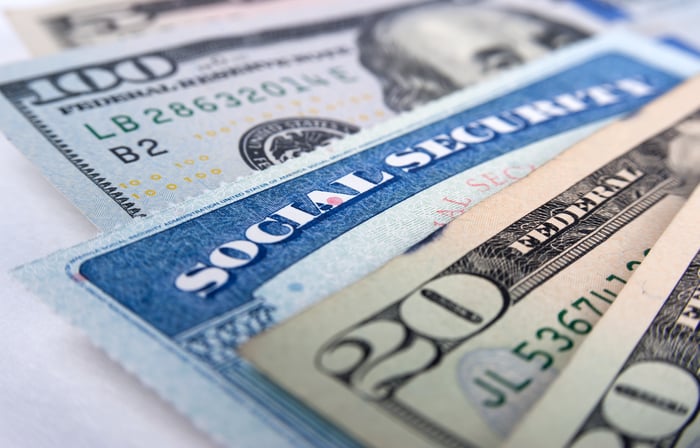
A Social Security card wedged between fanned cash bills.

Image source: Getty Images.

To determine Social Security’s annual cost-of-living adjustment (COLA), only readings from the third quarter (July through September) are considered. Thus, the average CPI-W reading from the third quarter of the current year is compared to the average CPI-W reading from the third quarter of the previous year. If this figure has risen from one year to the next (signifying inflation), Social Security’s beneficiaries will be getting a raise that’s commensurate with the percentage increase and rounded to the nearest tenth of a percent.

In 42 of the past 45 years, Social Security beneficiaries have received a “raise” to help them keep up with inflation.

But this wasn’t the case in 2010, 2011, or 2016. In the event that the CPI-W shows prices have fallen on a year-over-year basis (i.e., deflation), Social Security’s COLA is 0%. Essentially, benefits remain static from one year to the next. Thankfully, monthly benefits can’t decline due to deflation.

With July now in the books, there are two months left that matter in determining Social Security’s COLA for 2021. However, it isn’t looking promising for beneficiaries that they’ll be seeing a bump up in their payouts come January.

According to June inflation data from the U.S. Bureau of Labor Statistics, the CPI-W has increased by a mere 0.5% over the trailing 12-month period. The somewhat similar Consumer Price Index for All Urban Consumers (CPI-U) shows a double-digit percentage decline for all things energy over the past 12 months, which substantive declines in transportation services, apparel, and used cars and trucks. Though it’s possible COLA could be positive for 2021, it’s looking probable that next year will be fourth time in 46 years where beneficiaries don’t receive a COLA. 

A wealthy businessman in a suit who's lying back on a pile of cash.

Image source: Getty Images.

No COLA in 2021 would be great news for high-income earners

However, Social Security’s COLA determination affects more than just what its 64 million-plus beneficiaries take home each month. The fact is that a 0% COLA could have high-income earners jumping for joy.

In a typical year, the National Average Wage Index (NAWI) — a measure of wage trends in the U.S. used by the Social Security Administration — will increase. The year-over-year percentage increase in the NAWI is what’s used to determine the annual increase in the maximum taxable earnings cap associated with the 12.4% payroll tax on earned income.

For example, the 2018 NAWI was 3.6% higher than the previous year. Therefore, the maximum taxable earnings cap rose from $132,900 last year to $137,700, as of 2020. This $4,800 bump represents an increase of (drum roll) 3.6%.

But there’s an interesting Social Security rule that comes into play when the program’s COLA is 0%. In years where deflation occurs, the maximum taxable earnings cap remains unchanged from one year to the next. This holds true even if the NAWI is positive — and according to Social Security Administration projections, the NAWI was expected to rise 3.1% for the upcoming year’s calculation.

In other words, 94% of working Americans won’t earn $137,700 in 2020, and will therefore be paying into Social Security, via the payroll tax, on every dollar they make. It’s the remaining 6% who earn more than $137,700 that are required to pay more each year when the NAWI leads to an increase in the payroll tax cap. But if there’s no COLA in 2021, there won’t be a payroll tax cap increase, either. This means the rich will be able to hang onto more of their earned income, at least for one year.

A person holding up a large white puzzle piece with a question mark drawn on it.

Image source: Getty Images.

Why isn’t Social Security taxing the rich more?

You’re now probably asking yourself why this loophole exists in the first place. In essence, why aren’t the well-to-do being taxed more to strengthen the Social Security program?

The answer to this question lies with yet another Social Security rule.

You see, there’s a maximum monthly payout allowable at full retirement age ($3,011 in 2020). Although this maximum payout is often adjusted on an annual basis, the fact is that the maximum taxable earnings cap exists because there’s also a cap on how much a retired worker can receive each month. It doesn’t make sense to tax millions of dollars in earned income if the most an individual can expect to receive is $3,011 a month from Social Security.

Additionally, even with the American public in favor of taxing high-income earners more, amending the Social Security Act isn’t easy. Doing so requires 60 votes in the Senate, and there hasn’t been a true supermajority in over 40 years. To amend the Social Security Act would require bipartisan support; and Republican lawmakers have already stated their objection to increasing taxes on the wealthy to generate additional revenue.

While 2021 could be another bad year for Social Security recipients on the loss of purchasing power front, it might be a great year for high-income workers.

Debate begins for whos first in line for COVID-19 vaccine – The Associated Press

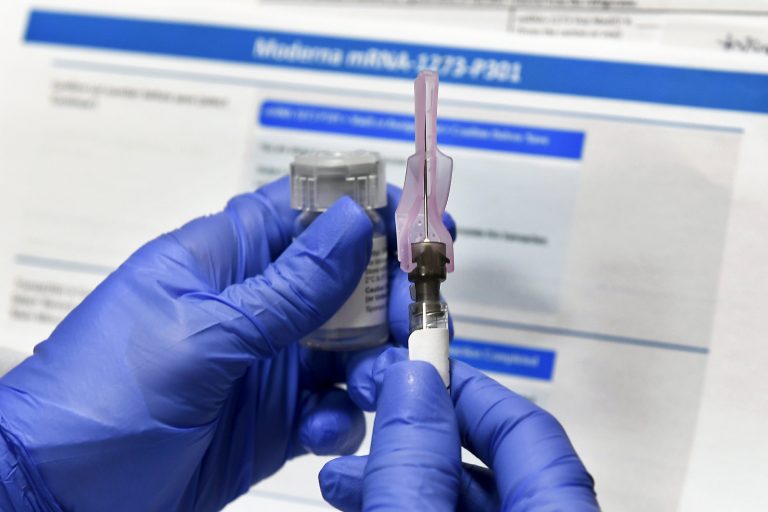
Who gets to be first in line for a COVID-19 vaccine? U.S. health authorities hope by late next month to have some draft guidance on how to ration initial doses, but it’s a vexing decision.

“Not everybody’s going to like the answer,” Dr. Francis Collins, director of the National Institutes of Health, recently told one of the advisory groups the government asked to help decide. “There will be many people who feel that they should have been at the top of the list.”

Traditionally, first in line for a scarce vaccine are health workers and the people most vulnerable to the targeted infection.

But Collins tossed new ideas into the mix: Consider geography and give priority to people where an outbreak is hitting hardest.

And don’t forget volunteers in the final stage of vaccine testing who get dummy shots, the comparison group needed to tell if the real shots truly work.

“We owe them … some special priority,” Collins said.

Huge studies this summer aim to prove which of several experimental COVID-19 vaccines are safe and effective. Moderna Inc. and Pfizer Inc. began tests last week that eventually will include 30,000 volunteers each; in the next few months, equally large calls for volunteers will go out to test shots made by AstraZeneca, Johnson & Johnson and Novavax. And some vaccines made in China are in smaller late-stage studies in other countries.

For all the promises of the U.S. stockpiling millions of doses, the hard truth: Even if a vaccine is declared safe and effective by year’s end, there won’t be enough for everyone who wants it right away — especially as most potential vaccines require two doses.

It’s a global dilemma. The World Health Organization is grappling with the same who-goes-first question as it tries to ensure vaccines are fairly distributed to poor countries — decisions made even harder as wealthy nations corner the market for the first doses.

In the U.S., the Advisory Committee on Immunization Practices, a group established by the Centers for Disease Control and Prevention, is supposed to recommend who to vaccinate and when — advice that the government almost always follows.

But a COVID-19 vaccine decision is so tricky that this time around, ethicists and vaccine experts from the National Academy of Medicine, chartered by Congress to advise the government, are being asked to weigh in, too.

Setting priorities will require “creative, moral common sense,” said Bill Foege, who devised the vaccination strategy that led to global eradication of smallpox. Foege is co-leading the academy’s deliberations, calling it “both this opportunity and this burden.”

With vaccine misinformation abounding and fears that politics might intrude, CDC Director Robert Redfield said the public must see vaccine allocation as “equitable, fair and transparent.”

How to decide? The CDC’s opening suggestion: First vaccinate 12 million of the most critical health, national security and other essential workers. Next would be 110 million people at high risk from the coronavirus — those over 65 who live in long-term care facilities, or those of any age who are in poor health — or who also are deemed essential workers. The general population would come later.

CDC’s vaccine advisers wanted to know who’s really essential. “I wouldn’t consider myself a critical health care worker,” admitted Dr. Peter Szilagyi, a pediatrician at the University of California, Los Angeles.

Indeed, the risks for health workers today are far different than in the pandemic’s early days. Now, health workers in COVID-19 treatment units often are the best protected; others may be more at risk, committee members noted.

Beyond the health and security fields, does “essential” mean poultry plant workers or schoolteachers? And what if the vaccine doesn’t work as well among vulnerable populations as among younger, healthier people? It’s a real worry, given that older people’s immune systems don’t rev up as well to flu vaccine.

With Black, Latino and Native American populations disproportionately hit by the coronavirus, failing to address that diversity means “whatever comes out of our group will be looked at very suspiciously,” said ACIP chairman Dr. Jose Romero, Arkansas’ interim health secretary.

Consider the urban poor who live in crowded conditions, have less access to health care and can’t work from home like more privileged Americans, added Dr. Sharon Frey of St. Louis University.

And it may be worth vaccinating entire families rather than trying to single out just one high-risk person in a household, said Dr. Henry Bernstein of Northwell Health.

Whoever gets to go first, a mass vaccination campaign while people are supposed to be keeping their distance is a tall order. During the 2009 swine flu pandemic, families waited in long lines in parking lots and at health departments when their turn came up, crowding that authorities know they must avoid this time around.

Operation Warp Speed, the Trump administration’s effort to speed vaccine manufacturing and distribution, is working out how to rapidly transport the right number of doses to wherever vaccinations are set to occur.

Drive-through vaccinations, pop-up clinics and other innovative ideas are all on the table, said CDC’s Dr. Nancy Messonnier.

As soon as a vaccine is declared effective, “we want to be able the next day, frankly, to start these programs,” Messonnier said. “It’s a long road.”

___

The Associated Press Health and Science Department receives support from the Howard Hughes Medical Institute’s Department of Science Education. The AP is solely responsible for all content.

Flash Crash: Bitcoin Price Slides by $1.4K in Minutes – CoinDesk – CoinDesk

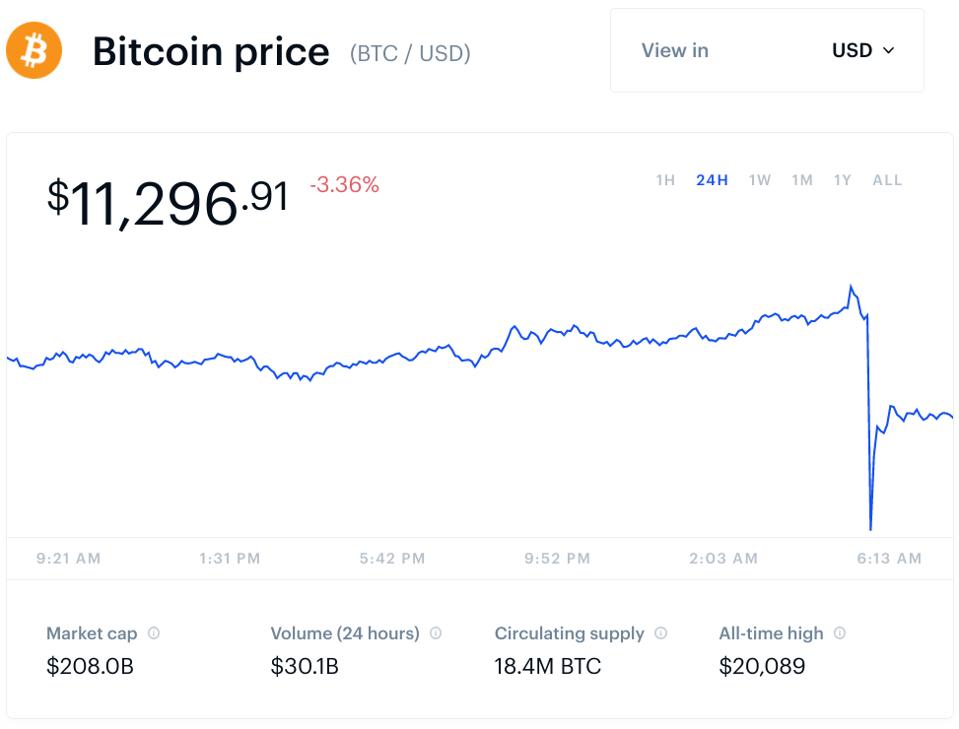
Bitcoin suffered a price drop of $1,458 in under an hour on Sunday. The sudden slide caught many traders off guard, forcing out a significant amount of buying pressure from the market.

Disclosure

The leader in blockchain news, CoinDesk is a media outlet that strives for the highest journalistic standards and abides by a strict set of editorial policies. CoinDesk is an independent operating subsidiary of Digital Currency Group, which invests in cryptocurrencies and blockchain startups.

$1 Billion Liquidated as Bitcoin Price Crashes by $1.4K in Minutes – Cointelegraph

The price of Bitcoin (BTC) and Ethereum’s Ether (ETH) plunged by 13% and 21%, respectively, within minutes on Aug. 2. The move liquidated more than $1 billion worth of futures contracts as BTC/USD dropped from around $12,000 to as low as $10,550.

BTC/USD 1-hour chart

BTC/USD 1-hour chart. Source: Tradingview

There appear to be two main reasons behind the sudden cascade of liquidations. First, the volume in the cryptocurrency market tends to drop during weekends. Second, the market was heavily swayed to longs or buyers.

Cryptocurrency market snapshot, Aug. 2

Cryptocurrency market snapshot, Aug. 2. Source: Coin360

Surprise weekend move hits the crypto market once again

The cryptocurrency market tends to see large liquidations during the weekend. The liquidity often drops as there are fewer active traders in the market. Lower volume leads to massive price movements, as cryptocurrencies become more vulnerable.

Mass liquidations become more likely during the weekend because one large liquidation could trigger a cascade of liquidations. When a long contract gets liquidated, as an example, it forces the buyer to market sell, causing selling pressure.

As hundreds of millions of dollars worth of long contracts began to get liquidated, Bitcoin and Ether dropped rapidly. Bitcoin declined from $12,000 to $10,600 within 15 minutes, while ether declined from $417 to $300.

But mass liquidations happened several times in the past five months. Most notably, on the so-called “Black Thursday” on March 13, $1 billion worth of liquidations occurred. Similarly, right before the halving on May 11, the price of Bitcoin dropped to $8,100 resulting in mass liquidations.

Bitcoin and Ethereum were heavily swayed to buyers

In the last several days, especially after Bitcoin’s upsurge above $11,000, the cryptocurrency market was heavily swayed to the side of the buyers. The funding rates of Bitcoin and Ether were nearing levels that are not sustainable over a prolonged period.

Futures exchanges, like BitMEX and Binance Futures, utilize a mechanism called “funding” to implement balance in the market. When the overwhelming majority of market participants are holding long contracts, then short holders are incentivized with a fee and vice versa.

Prior to the drop, the funding rate of Bitcoin was hovering at around 0.0721%. Since the average funding rate of BTC is at around 0.01%, the market was dominated by long contracts.

The market imbalance was even worse for Ether. The ETH funding rate was at 0.21%, which indicates significant bullish bias. But after the liquidations, the predicted funding rate of ETH is at 0.19%. It suggests that ETH longs were not flushed out, unlike Bitcoin.

Ether funding rate across major futures exchanges

Ether funding rate across major futures exchanges. Source: Skew

Michael van de Poppe, a trader at the Amsterdam Stock Exchange, previously anticipated Ether to drop to $300 as a result. He said:

“Let’s see $ETH at $300-320.”

For now, some traders anticipate sideways action for the days ahead as Bitcoin has rebounded to a key support level at $11,300 and a CME futures gap will likely emerge on Monday given Friday’s close price of $11,630.

“The bullish scenario depends on the crucial threshold of $11,300-11,400 as the pivot to hold for the price of Bitcoin,” Van de Poppe explained in his latest BTC technical analysis. 

In the medium-term, meanwhile, there is increasing optimism about the price trend for Bitcoin. When asked whether BTC will hit a new all-time high, Spartan Black’s Kelvin Koh said:

“Without a doubt. BTC hit a new ATH in each of the last 3 cycles and this one will be no exception. The scarcity effect, the halving and more capital coming into crypto will ensure that.”

Keep track of top crypto markets in real time
here

A Massive Bitcoin Flash Crash Just Created $1 Billion Of Crypto Chaos – Forbes

Bitcoin, after surging higher this week, has suffered a flash crash, losing around $1,500 from its price in matter of minutes.

The bitcoin price broke $12,000 per bitcoin on the Luxembourg-based Bitstamp exchange early Sunday morning only to plummet 12% to $10,500 within the hour.

The bitcoin price has now bounced back, somewhat pulling the wider cryptocurrency market with it, to trade at around $11,300—but not before more than $1 billion of bitcoin and crypto positions were liquidated across various exchanges.

MORE FROM FORBESAs The Bitcoin Price Soars, Bitcoin’s ‘Real’ Crypto Market Dominance Is Revealed

“In the past 24 hours, 72,422 people were liquidated,” bitcoin and crypto market data provider Bybt said via Twitter, adding the largest single liquidation order, worth $10 million, occurred on the Seychelles-based exchange Bitmex, known for its high leveraged trading volume.

Leveraged trading allows traders to take larger positions with smaller amounts of capital, with the number of bitcoin and cryptocurrency exchanges offering high leveraged trading exploding over recent years. Traders take positions, effectively bets, on where they expect prices to be when their position “closes”—losing their capital if the market goes against them.

This week’s bitcoin price rally has attracted a surge of retail traders to the crypto market, with many bitcoin exchanges reporting year-to-date trading highs as eager investors attempted to catch the upswing.

The cause of the bitcoin flash crash was not immediately clear, however some speculated it could have been caused by so-called “whales” who control large amounts of bitcoin and other cryptocurrencies moving the market. The market is more easily pushed around by whales when trading volumes are lower, such as early on Sunday morning.

“Whales playing,” finance writer and commentator Frances Coppola asked via Twitter.

The sudden move in the bitcoin price, which caused over $20 billion worth of value to be wiped from the combined market capitalization of the world’s cryptocurrencies according to CoinMarketCap data, was watched with combination of shock and awe by the bitcoin and cryptocurrency community.

“Bitcoin is the most ruthless asset in the world,” bitcoin and crypto investor Anthony Pompliano said via Twitter.

“[Bitcoin] hits $12,000 and then drops $1,500 in minutes. Not for the faint of heart.”

MORE FROM FORBESFormer Hedge Fund Billionaire Makes The Case For $20,000 Bitcoin Price By The End Of 2020

Bitcoin’s rally this week, breaking its near three-month trading malaise, has been attributed global investors seeking low risk so-called safe-haven assets, such as gold—which came within striking distance of hitting $2,000 for the first time this week.

“Bitcoin’s push has been fueled by the drive towards safe-haven assets,” Micah Erstling, trader at bitcoin and crypto market maker GSR, said via email.

“Markets are being driven by ongoing coronavirus concerns, as well as U.S.-China trade tensions, which also helps to explain gold’s meteoric rise. Even then, gold is still up 28% for the year, compared to bitcoin’s 50%. Perhaps bitcoin is fulfilling the narrative of becoming an all-encompassing, risk-on, safe-haven, deflationary asset.”

How departure of James laid bare the Murdoch family rifts – The Guardian

Sorry, Readability was unable to parse this page for content.

Siemens Healthineers to acquire Varian for $16.4 billion – Reuters

BERLIN (Reuters) – German health group Siemens Healthineers (SHLG.DE) said on Sunday it would acquire Varian Medical Systems Inc (VAR.N) in a deal that values the U.S. maker of devices and software for cancer treatments at $16.4 billion.

FILE PHOTO: A staffer works on a magnetic resonance imaging machine at a production line of Siemens Healthineers in Shenzhen, China May 25, 2018. REUTERS/Bobby Yip

Under the agreed transaction, Siemens Healthineers will acquire all shares in Varian for $177.50 each in cash, representing a 24% premium to the U.S. company’s closing price on Friday.

Industrial conglomerate Siemens (SIEGn.DE), which spun off Healthineers in 2018 but retains a controlling stake, will provide bridge financing for the deal, which seeks to create a global leader in cancer care solutions by 2025.

“With this combination of two leading companies we make two leaps in one step: A leap in the fight against cancer and a leap in our overall impact on healthcare,” said Bernd Montag, CEO of Siemens Healthineers.

Varian President and Chief Executive Officer Dow Wilson said: “With Siemens Healthineers, we will transform care for a greater number of patients worldwide, as well as broaden opportunities for our employees as part of a larger and more global organization.”

The deal, first reported by Bloomberg, is subject to approval by Varian shareholders and regulators. It is expected to close in the first half of 2021 and be accretive to Siemens Healthineers’ adjusted basic earnings per share within 12 months of that.

BALANCE SHEET SUPPORT

Siemens is effectively putting its balance sheet to work to fund the deal, providing a bridging loan of 15.2 billion euros ($17.9 billion) to Healthineers.

The medical technology unit aims to replace 50% of that through a rights issue this year, subject to market conditions.

Siemens said in a separate statement that it expressly welcomed the deal and would raise the money for the bridging loan by issuing bonds. As a result, its stake in Healthineers would be diluted to about 72% from 85%.

Separately, Healthineers fiscal third quarter results, pre-released instead of Monday due to the acquisition announcement, showed revenue declined 6.9% year-on-year on a comparable basis to 3.3 billion euros, due to the impact of the coronavirus pandemic.

Its adjusted operating margin was 13.9%, down 1.2 percentage points from the same period a year earlier, while adjusted basic earnings per share fell 21% to 30 euro cents.

Revenue is forecast to be flat in fiscal 2020 while adjusted basic earnings per share are seen at between 1.54 and 1.62 euros, compared to 1.70 euros last year, assuming the business environment does not deteriorate further. ($1 = 0.8493 euros)

Additional reporting by Joern Poltz; Editing by Gareth Jones and Susan Fenton

Siemens Healthineers in advanced talks to buy Varian for $15 billion: Bloomberg News – Reuters

FILE PHOTO: Staff work on magnetic resonance imaging machines at a production line of Siemens Healthineers in Shenzhen, China May 25, 2018. REUTERS/Bobby Yip

(Reuters) – German group Siemens Healthineers AG (SHLG.DE) is in advanced talks to purchase Varian Medical Systems Inc (VAR.N), a maker of devices and software for treating cancer, in a deal that will value the medical device maker at about $15 billion, Bloomberg News reported late on Saturday.

The deal could be announced in the coming days, the report added, citing sources.

The talks could still fall apart, according to Bloomberg.

Both companies did not immediately respond to a request for comment.

Varian, based in Palo Alto, California, is focused on developing and delivering innovative cancer treatments and has 10,000 employees. In 2019, it reported total revenue of $3.2 billion.

Siemens Healthineers, a spinoff from Siemens AG (SIEGn.DE) in 2018, makes X-ray, ultrasound and MRI equipment.

Reporting by Kanishka Singh in Bengaluru; Editing by Cynthia Osterman