Christians Urged to Avoid Fifty Shades of Grey

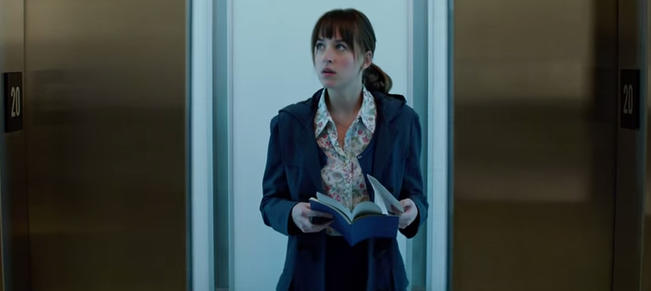
Premier report– A Christian group says Fifty Shades of Grey risks giving young people the wrong idea about relationships.

The controversial movie based on an erotic romance novel lands in cinemas on Friday with a 15 age rating.

CARE CEO Nola Leach said: “This film glories in short term pleasure and abusive relationships and is characterised by a distinct lack of hope. It is a tragedy that on this weekend of love, young and old will be queuing to see a film that celebrates such a warped version of what true and healthy relationships should look like.

“Anastasia and Christian are actually deeply unhappy characters, whose individual identities revolve around sexual pleasure. Their relationship is all about what they can get, not about what they can give up for one another.”

“Increasingly, in this sexualised society the message being given to the next generation is such relationships, which are based more on lust than anything else, are the norm and this is deeply regrettable.

“The Christian teaching is that long-lasting, healthy relationships require work and should never be based solely on physical attraction, but rather mirror the deep and sacrificial love that exists between Christ and the Church,” added Mrs Leach.

Source: Premier

Benedict XVI Never Regrets His Decision to Resign, Says Aide

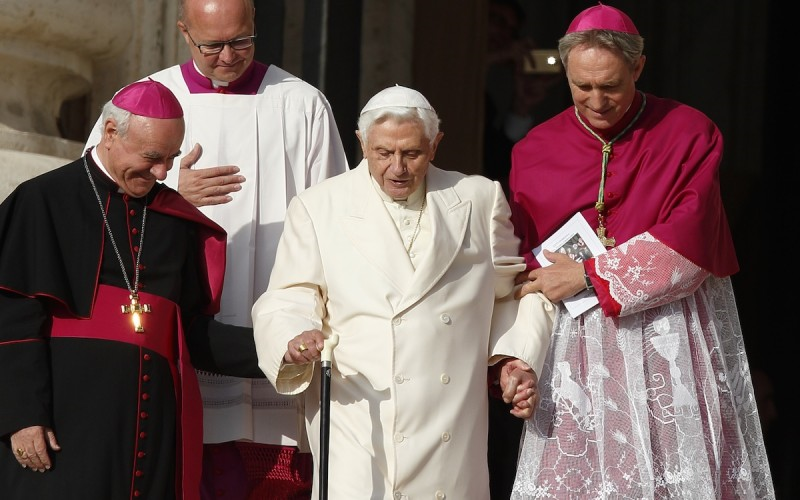
Catholic Herald report– Benedict XVI has never doubted or regretted his decision to resign, knowing it was the right thing to do for the good of the Church, Archbishop Georg Gänswein, prefect of the papal household and personal secretary to the retired pope, has said.

“The Church needs a strong helmsman,” and Pope Benedict was keenly aware of his own waning strength while faced with such a demanding ministry, the archbishop said in an interview published in the Italian daily Corriere della Sera.

Two years after Pope Benedict’s historic announcement to step down as supreme pontiff, Archbishop Gänswein said the retired pope “is convinced that the decision he made and announced was the right one. He has no doubt.”

“He is very serene and certain in this: His decision was necessary and made ‘after having repeatedly examined my conscience before God’,” he said, citing words from the Pope’s announcement.

Pope Benedict had told a stunned audience of cardinals assembled for an ordinary public consistory that “I have come to the certainty that my strengths, due to an advanced age, are no longer suited to an adequate exercise of the Petrine ministry.”

Archbishop Gänswein said in the interview that Pope Benedict was aware of his “duty not to look out for his own self but for the good of the Church.”

The Pope spelled out the precise reasons for his decision, the archbishop said, and “all the other considerations and hypotheses are wrong”, including assumptions that the Pope’s resignation was not valid or had not been done in full freedom.

“Hypotheses cannot be based on things that are not true and totally absurd,” Archbishop Gänswein said. “Benedict himself said he made his decision with freedom, without any pressure, and he assured his ‘reverence and obedience’ to the new Pope.’”

The archbishop said doubts about the validity of the resignation and subsequent election of Pope Francis stem from a lack of understanding of the Church.

Also, the option for a Pope to resign is explicitly written in the Code of Canon Law, which says a Pope may step down as long as the decision is made freely and is “duly manifested”.

Archbishop Gänswein said Pope Benedict, who will turn 88 in April, is still following the prayerful, quiet life he wanted to dedicate himself to upon his retirement.

Like his namesake, St Benedict – the father of Western monasticism – the retired pope “has chosen a monastic life. He goes out [in public] only when Pope Francis asks him to; as for the rest, he does not accept other invitations,” said the archbishop, who lives with retired Pope Benedict in a renovated monastery and has been his personal secretary since 2003.

Archbishop Gänswein told the newspaper that in addition to the pope’s usual routine of prayer, reading, keeping up with correspondence, receiving visitors, watching the evening news and walking in the Vatican Gardens, he has been playing the piano much more often: “Mozart especially, but also other compositions that come to mind at the moment; he plays from memory.”

The only health issues, the archbishop said, are “every now and then his legs give him some problems, that’s all”. The pope, who has had a pacemaker for several years and uses a cane, still has an incredibly sharp mind, the archbishop added.

When asked what Popes Benedict and Francis might have in common, Archbishop Ganswein said that while their ways of expression are very different, the one thing they share is “the substance, the content, the deposit of faith to be proclaimed, promoted and defended”.

Source: Catholic Herald

Campaigners Dissappointed As Humanism Won’t be Included in Religious Studies GSCE

Christian Today report– The Government has rejected calls to include the study of humanism in the new Religious Studies GCSE, despite widespread support for its inclusion. Campaigners have been left “bitterly disappointed” at the omission.

Though references to humanism are included, the revised content will not include the study of humanism alongside  major world religions.

At GCSE level, students are required to study two major faiths out of Christianity, Catholicism, Judaism, Islam, Hinduism, Sikhism and Buddhism. While it is hoped that this will increase religious literacy, critics believe that pupils should have the option to undertake in-depth study on a non-religious or humanist worldview.

The British Humanist Association (BHA) carried out a public consultation and found that 90 per cent of the public supported its call. The BHA was asked by the Department of Education to produce the content of an ‘annex’ on Humanism, but it was not included in the final revised content.

The group has branded this decision “inexplicable”.

The BHA has been supported by the Religious Education Council and the National Association of Teachers of RE. More than 100 leading philosophers, academics and consultants signed a letter to Minister of State for School Reform Nick Gibb calling for the annex to be included, and 30 faith leaders, including former Archbishop of Canterbury Rowan Williams, also signed a letter urging the government to reconsider.

“As religious leaders we are writing to express our support for proposals to allow students to have the option for systematic study of Humanism…and for an annex setting out content on Humanism to be added alongside existing GCSE annexes on the principal world religions,” the letter read.

“Such a change would not compel anyone to systematically study non-religious worldviews or make it possible to do so for the whole of a qualification, but it would allow young people to study a more representative sample of major worldviews that are common in Britain today.”

Signed by representatives including the Rt Rev Richard Harries, former Bishop of Oxford, Rabbi Dan Cohn-Sherbok, a Professor of Judaism, and Raheed Salam of the Interfaith Youth Trust, the letter added that including humanism “would be fair, popular, and add rigour to the subject”.

“We see no reasonable or persuasive argument to oppose it,” it concluded.

However, GCSE pupils will not study comprehensive content regarding a non-religious worldview. According to ministers, it would be inappropriate to do so.

“As these are qualifications in religious studies, it is right that the content primarily focuses on developing students’ understanding of different religious beliefs,” the government has said.

“A simultaneous focus on humanism would detract from an in-depth treatment of religion and the comparative study of two religions.”

The content will include, however, some new inclusive references. Students will be required to develop their “knowledge and understanding of…non-religious beliefs, such as atheism and humanism’, and to “demonstrate knowledge and understanding of the fact that…religious traditions in Great Britain are diverse and include…non-religious beliefs, such as atheism and humanism.”

BHA Chief Executive Andrew Copson has welcomed these additions, but says the group is “bitterly disappointed that Humanism is to be largely excluded”.

“With each generation being less religious than the previous one, it is vital that humanism be included and there is barely anyone apart from the Conservative part of the Coalition Government that disagrees. Today’s political decision is unfathomable and time will prove its futility,” he said, adding that school pupils have been “let down” by ministers.

Source: Christian Today


US to Withdraw Troops from Ebola Mission in West Africa

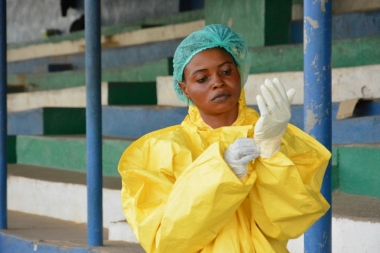
Christian Today report– President Barack Obama announced Wednesday that all but 100 American troops sent to West Africa to help manage the Ebola outbreak will be withdrawn by April 30.

The troops were dispatched to help contain the deadly virus, but the President said that the mission in the ravaged countries has shifted.

“While our troops are coming home, America’s work is not done,” he insisted. “Our mission is not complete. Today we move into the next phase.”

Thousands have died across Guinea, Liberia, and Sierra Leone since the outbreak began last spring. There have been nearly 23,000 confirmed or suspected cases of Ebola infection stemming from the current outbreak as of February 9.

Obama said that the focus has changed from containment to eradication, and said that civilian aid workers will be increased in the area.

Civilian government employees, volunteers, and the remaining troops will help in that effort.

“Our focus now is getting to zero,” Obama said, calling the military’s effort a “hope multiplier.”

“Every case is an ember that if not contained can light a new fire,” he added. “Plenty of American heroes remain on the ground, with even more on the way.”

The spread of Ebola has slowed, although health officials were concerned about a rise in Ebola deaths last week. For the week ending February 8, 144 deaths were reported, compared to 124 deaths the week before.

“Despite improvements in case-finding and management, burial practices and community engagement, the decline in case incidence has stalled,” the World Health Organization wrote.

Ebola cases in Liberia have generally decreased, while transmissions in Guinea and Sierra Leone continue to trouble health officials.

Source: Christian Today


Israel: Cremisan Valley Confiscation Mean Extinction for Christians, Mayor Tells Vatican

Christian Today report– The extension of Israel’s ‘separation wall’ in the fertile Cremisan Valley will mean that there is no future for Christians in the Bethlehem region, according to the Mayor of Bethlehem.

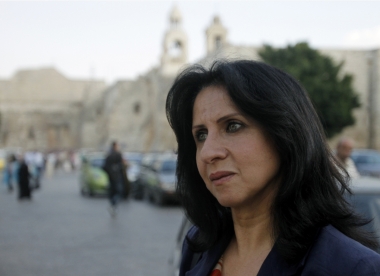
Palestinian Catholic Prof Vera Baboun has appealed to the Vatican for help.

“They want to build the separation Wall in the Cremisan valley and then expropriate the lands that belong to Palestinian Christians. If that happens, the whole area will be suppressed from the grip of the wall, and the first to go will be Christians,” she told the Fides news agency.

Baboun visited Rome with other mayors of Bethlehem’s “Christian triangle”, Nicola Khamis from Beit Jala and Hani al-Hayek from Beit Sahour, and Issa Kassissieh, Ambassador of Palestine to the Holy See.

As well as lands with vineyards and olive groves belonging to 58 Christian families in Beit Jala, the route of the wall in the Cremisan Valley also threatens two monasteries and a Salesian school.

According to Baboun, if the lands of the valley are confiscated, “There will be no future for Christians: the population density will rise to unsustainable levels and many will eventually choose the path of the exodus, which has already reduced the Christian presence in the Holy Land.”

Following an audience with Pope Francis, the delegation met Cardinal Secretary of State Pietro Parolin. Baboun told the Fides news agency: “We have reached a tipping point. We showed Cardinal Parolin maps and photos that we had with us and he listened carefully, with great concern.”

Israel’s plans for the Cremisan Valley have stirred fierce opposition among Churches, who argue, with other opponents, that it represents a land grab. Supporters say that it is necessary for military reasons.

The Israeli Supreme Court of Justice has yet to decide the issue

Source: Christian Today

Ukraine: Fighting Continues After Deal is Signed

Christian Today report– Germany, France, Russia and Ukraine agreed to a deal offering a “glimmer of hope” for an end to conflict in eastern Ukraine, but the United States and NATO said further intense fighting on Thursday ran counter to the spirit of the accord.

The agreement, announced after more than 16 hours of discussions in the Belarussian capital Minsk, was followed swiftly by allegations from Kiev of a new, mass influx of Russian armour into rebel-held eastern Ukraine.

It calls for a ceasefire between Ukrainian forces and Russian-backed separatists starting on Sunday, the withdrawal of heavy weapons from the front line and constitutional reform to give eastern Ukraine more autonomy.

Fighting has intensified in recent days as the rebels try to take control of Debaltseve, a strategic transport hub that would link the two separatist-controlled areas of eastern Ukraine, where elections are contemplated under the accord.

The White House, under pressure from Congress to provide arms to the stretched Ukrainian military, said the deal was “potentially significant” but urged Russia to withdraw soldiers and equipment, and give Ukraine back control over its border.

“The United States is particularly concerned about the escalation of fighting today, which is inconsistent with the spirit of the accord,” it said in a statement.

NATO Secretary General Jens Stoltenberg echoed that line and told Norwegian news agency NTB: “Russia must end its support for the separatists and withdraw its forces and military equipment from eastern Ukraine.”

Russia denies arming the rebels and sending troops to fight alongside them, despite what Ukraine and its Western allies say is overwhelming evidence. The conflict has killed more than 5,000 people since last April.

Keeping up the pressure on Russia, diplomats said the European Union would go ahead on Monday with a new round of sanctions against 19 Ukrainian separatists and Russians, regardless of the new ceasefire.

The asset freezes and travel bans, the latest in a long series of sanctions by the EU and United States, have piled intense economic pressure on Russia’s energy-exporting economy, which has also been hit by a halving of world oil prices since last June.

After an EU summit in Brussels, the leaders of Germany, France and the European Council said wider sanctions were possible if Russia violated the ceasefire agreement.

US officials also said they were not taking sanctions off the table and bluntly warned the separatists against seizing more land before Sunday’s ceasefire formally takes effect.

“We are trying to send the message as strongly as we can that any effort to grab more land between now and Saturday night … will seriously undercut this agreement,” a senior US official who spoke on condition of anonymity told reporters in Washington.

“TOUGH AND EMOTIONAL”

The Minsk talks were the culmination of a dramatic initiative by France and Germany following an upsurge in fighting in which the separatists tore through an earlier ceasefire line agreed to last September.

Russian President Vladimir Putin accused Ukraine of prolonging the negotiations, which seemed close to failure at several points.

German Chancellor Angela Merkel said Ukraine President Petro Poroshenko “did everything to achieve the possibility of an end to the bloodshed”. She said Putin put pressure on the rebels to agree to the truce “towards the end” of the talks.

“This is a glimmer of hope, no more no less,” Merkel told reporters on arriving, straight from the talks in Minsk, at a European Union summit in Brussels. “It is very important that words are followed by actions.”

Russia’s RIA news agency quoted Kremlin spokesman Dmitry Peskov as saying the talks were “tough and very emotional”.

The accord could delay the imposition of new sanctions against Moscow, although the US State Department said it had not taken any options off the table. Secretary of State John Kerry said sanctions could be eased if it were implemented.

Fighting has surged in the past few weeks with more than 70 Ukrainian servicemen and at least 24 civilians killed so far this month, according to Reuters calculations based on official Ukrainian figures.

A Ukrainian military spokesman said about 50 tanks, 40 missile systems and 40 armoured vehicles had crossed overnight into eastern Ukraine from Russia. It was not immediately possible to verify the figures, which were higher than in previous such statements. Moscow dismisses them as groundless.

NATO has said there is overwhelming evidence of Russian armour entering Ukraine but declined to comment on the latest report.

“The intensity of fighting is evidenced by a sharp increase in the number of people trying to leave front-line towns,” spokesman Andriy Lysenko said in a daily briefing held on Thursday before the deal was announced.

Rebel fighters accuse Kiev of shelling civilian areas, an accusation the Ukrainian military rejects.

The fighting has destabilised Ukraine militarily and economically. As the deal was reached, Ukraine was offered a $40 billion lifeline by the International Monetary Fund to stave off financial collapse.

Russia’s economy has also suffered, from the sanctions imposed for its support for the separatists in eastern Ukraine and annexation of Ukraine’s Crimea region last year. Russian shares surged on Thursday after the deal was announced and the rouble gained but then slipped back.

WEAPONS WITHDRAWAL

The agreement addressed some of the main stumbling points, including a “demarcation line” between separatists and Ukrainian forces, which the rebels wanted to reflect gains from a recent offensive that shredded an earlier ceasefire deal.

The compromise was that the rebels will withdraw weapons from a line set by the earlier Minsk agreement in September, while the Ukrainians will withdraw from the current front line, creating a 50 km (30 mile)-wide buffer zone.

Ukraine will also get control of its border with Russia, but in consultation with the rebels and only after the regions gain more autonomy under constitutional reform by the end of 2015.

Kiev has made clear, however, that it will not accept independence for the “People’s Republics” the rebels have declared.

The ceasefire and heavy weapons pullback would be overseen by the Organization for Security and Cooperation in Europe, a Europe-wide security body.

French President Francois Hollande, who also took part in the negotiations, said there was still much work to be done on the Ukraine crisis, but the agreement was a real chance to improve the situation. “The coming hours will be decisive,” he said later in Brussels.

Pro-Moscow separatists tightened the pressure on Kiev by launching some of the war’s worst fighting on Wednesday, killing 19 Ukrainian soldiers in assaults near the railway town of Debaltseve.

On Thursday, senior rebel commander Eduard Basurin said his side would deliver on the ceasefire but that in the meantime Ukrainian troops should surrender Debaltseve. He said the separatists were holding “counter-attack” operations to prevent the soldiers from breaking out.

As the fighting has escalated, Washington has begun openly talking of arming Ukraine to defend itself from “Russian aggression,” raising the prospect of a proxy war between one-time Cold War foes.

As the French and German leaders’ peace initiative was announced, pro-Russian rebels appeared determined to drive home their advantage ahead of a deal. Armoured columns of Russian-speaking soldiers with no insignia have been advancing for days around Debaltseve, where heavy fighting has occurred this month.

S0urce: Christian Today

 

New Jersey Judge Bars Experts Testimony Regarding Homosexuality in Lawsuit Against Gay Therapy Group

Christian Post report– A New Jersey judge hearing a lawsuit made against a sexual orientation change therapy group has decided to bar the testimony of experts who consider homosexuality a mental disorder.

State Superior Court Judge Peter F. Bariso Jr. ruled last week that Jews Offering New Alternatives for Healing (JONAH) could not bring certain experts in due to their position that homosexuality should still be considered a mental illness.

“The overwhelming weight of scientific authority concludes that homosexuality is not a disorder or abnormal. The universal acceptance of that scientific conclusion – save for outliers such as JONAH – requires that any expert opinions to the contrary must be barred,” wrote Bariso.

“No doubt, general acceptance within the scientific community is not an end in itself … Nevertheless, general acceptance constitutes strong – some might say conclusive – indicia of whether a sufficient level of reliability has been achieved.”

JONAH is being represented by the group Rancho Santa Fe, California-based legal group the Freedom of Conscience Defense Fund.

Charles S. LiMandri, president and chief counsel at the Defense Fund, told The Christian Post that he was “disappointed” with the decision and felt that it could provide “great grounds for an appeal” if they lose at that court level.

LiMandri also told CP that despite Bariso’s decision on the experts, the judge left intact a “religious liberty defense” for JONAH that could undermine the plaintiff’s case.

“Whatever statements that they made regarding homosexuality being disordered was in the context of them being a religious ministry,” said LiMandri.

“The two founders are both devout Jews and they founded an organization based on the Torah … The judge left that defense intact and we believe that it will be clear to the jury.”

Sometimes called “conversion therapy” or “reparative therapy,” sexual orientation change therapy seeks to change the sexual preferences of a given patient from homosexual to heterosexual.

In November of 2012, the SPLC filed a lawsuit against JONAH on behalf of four men and two parents charging that the SOCE therapy group was guilty of fraud.

According to its website, SPLC described Michael Ferguson, et al., v. JONAH, et al. as a “first of its kind” lawsuit against the conversion therapy provider.

“Customers of JONAH’s services typically paid a minimum of $100 for weekly individual counseling sessions and another $60 for group therapy sessions,” claimed SPLC.

“The lawsuit describes sessions that involved clients undressing in front of a mirror and even a group session where young men were instructed to remove their clothing and stand naked in a circle with the counselor … who was also undressed.”

The SPLC suit claims JONAH is in violation of New Jersey’s Consumer Fraud Act, specifically the measure regarding “ascertainable loss” regarding the therapy procedure.

Last June, Judge Bariso ruled that JONAH could be found liable for the costs accrued by the plaintiffs, prompting the case to go forward.

As the legal proceedings continue, New Jersey passed a law barring psychiatrists from performing conversion therapy on minors.

Signed into law by Governor Chris Christie, New Jersey joined California and later the District of Columbia as the three regions in the U.S. that ban conversion therapy for minors.

Regarding Bariso’s recent decision to bar experts who believe homosexuality is a disorder, SPLC deputy legal director David Dinielli stated that this was “a major development.”

“Conversion therapy lacks any such basis and its most prominent proponents – including Joseph Nicolosi – hold views that are so discredited that the supposed ‘experts’ are not even permitted to testify in a court of law,” continued Dinielli.

“Proponents of this bogus therapy lack any valid basis for their opinions promoting the abusive practice, yet they continue to scam vulnerable gay people and inflict significant, long-term psychological harm.”

LiMandri of the Defense Fund told CP that he believed “the jury is going to see through” the plaintiff’s argument against JONAH.

“No issue was decided that my clients had committed consumer fraud. The judge will leave it up to the jury to decide,” said LiMandri, who added that JONAH’s services were “free of charge.”

“There’s been no finding of fault on the part of anyone and I don’t believe there will be a finding of fault on the part of anyone.”

Michael Ferguson, et al., v. JONAH, et al. will go before a jury on June 1.

Source: Christian Post


6 Ways To Become A Millionaire In One Year – 6

6. Never, Ever Give Up!

Never Give Up

Throughout your journey to success, you will encounter problems, self-doubt and days where you just want to give it all up and hide in a corner.

Never, Ever Give Up!

If you truly want success then you can never give up. You will make mistakes, life will seem lost but instead of beating yourself up, learn from your mistakes and keep pushing forward. The old saying about getting knocked down 5 times and getting up 6 applies here.

You never know just how close you are to making your dreams a reality and it would be a shame if you gave up when you were only two feet away from achieving everything you desired.

Advertisement

Whenever you are tempted to turn back and run away, remind yourself why you are doing this. If you need to, go to YouTube and watch a few inspirational videos – there are many and I think I have watched them all.

Here is to your success. Believe in yourself, create a plan, take action and never stop moving forward!

PREVIOUS  | 6 of 7  | NEXT

6 Ways To Become A Millionaire In One Year – 5

5. Take Action

Take Action

The greatest plans in the world will fail if you don’t take action on them. If you are serious about becoming a millionaire then you need to prepare yourself to do whatever is necessary to achieve this goal.

If you get overwhelmed with how big the task is, and you will, then just take a moment to reflect and simply do one small task that moves you towards your goal. You need to continue taking these small steps towards your goal, every day. The funny thing is, when you do this, you will wake up one day and realize that you have achieved your goal. 

Advertisement

Remember that it is always good to have the big picture in the back of your mind but don’t let it stop you from taking action. Work on the small sub-goals and soon enough, you will have achieved much more then you thought possible.

PREVIOUS  |  5 of 6  |  NEXT

6 Ways To Become A Millionaire In One Year – 4

4. Invest In Yourself

Invest in Yourself

This may sound obvious but at least for the next year, watch your spending. If your goal is to truly become a millionaire then you don’t need to go out and buy the latest BMW or take on more “bad” debt.

If you want to spend your money on something then spend it on yourself. Investing in yourself through books, courses, etc. is a great way to perfect your skills so that you have more to offer to people. The Return on Investment (ROI) that you receive when you believe in yourself and enhance your skills is by far the best return you will ever receive.  By investing in your own growth and education, you are setting yourself up for freedom down the road.

Advertisement

So for now, skip out on the luxury car and instead invest that money in becoming the best version of yourself. Never stop learning and always keep evolving.

PREVIOUS  |  3 of 6  |  NEXT