6 Ways To Become A Millionaire In One Year – 3

3. Solve a Problem

Problem Solving

This goes along with the second point about creating a plan. If you want to become wealthy then you need to figure out a problem that people have and are willing to pay for.

Believe it or not, creating a maid service or landscaping business could actually work well as the wealthy are willing to pay someone to do this for them. There are a ton of problems out there that people are willing to pay someone else for the solution.

Do some brainstorming and figure out exactly what it is that you can offer to people. If you can create massive value for people then in turn you will create massive wealth for you.

Advertisement

Take some time right now to start thinking about possible problems that you can solve. Jot these ideas down and start creating the solutions for them. You will be a millionaire in no time.

PREVIOUS  |  3 of 6  |  NEXT

6 Ways To Become A Millionaire In One Year – 2

2. Create a Plan

One Million Dollars

Thinking like a millionaire is a huge step in the right direction but you still need to have a plan to make that money. Take a moment to write out your goal, which may sound something like this:

By January 24, 2016, I have earned $1,000,000.00  or more by providing people with a service or product that helps them with their daily lives.

Advertisement

Now that you have a goal in mind, you need to work backwards and create an action plan as to how you will achieve this goal. What is the problem that you are going to solve? Do you need a website? Marketing plan? Basically, you will break down this goal into manageable steps that will help guide you to your 1 million dollar payout.

Always check in on this goal and measure you progress. 

PREVIOUS  |  2 of 6  |  NEXT

Another Gay Parenting Study Opposes Gay Marriage As Children Do Better With Mom and Dad

Christian Post report– The largest study so far on gay parenting, published this month, shows that children do best when raised by their mom and dad. While the U.S. Supreme Court has already signaled a willingness to redefine marriage to include same-sex unions for every state, it has also demonstrated a concern for how their decision will affect children.

The study, “Emotional Problems among Children with Same-Sex Parents: Difference by Definition,” was conducted by sociologist Donald Sullins and published in the February issue of the British Journal of Education, Society & Behavioural Science.

Using several different data sets, including some from the U.S. government, Sullins compiled a representative sample of 207,007 children, including 512 with same-sex parents.

Eight of 12 psychometric measures used in the study showed that children with same-sex parents experienced more distress than children of opposite-sex parents. The results were “clear, statistically significant,” and “of substantial magnitude,” after controlling for age, sex, race, education and income. For four of the measures of emotional and behavioral problems, children raised by same-sex parents were at least twice as likely to experience difficulties compared to children raised by opposite-sex parents.

Supporters of same-sex parenting might argue that the results are due to discrimination against gays, or that the children of the same-sex parents were likely adopted and were experiencing the same difficulties as all adopted children. The data, however, does not support these hypotheses.

The children of same-sex parents were not more likely to get picked on and bullied. In fact, contrary to conventional wisdom, they were slightly less likely to be picked on and bullied than the children of opposite-sex parents, though the difference was within the margin of error.

Additionally, most of the children of same-sex parents in the sample had a biological connection to at least one of the parents, and overall the children of same-sex parents fared worse than the children of other family arrangements that were not opposite-sex biological, such as single parents, step-parents and unmarried co-habiting parents.

Adopted children were at higher risk of emotional problems overall, but the risk was twice as high for same-sex adoptive parents as opposite-sex adoptive parents. However, the author cautioned against drawing conclusions from this result because there were few adopted children in the sample.

Sullins did find, though, that a biological parent-child connection helped explain the differences between same-sex and opposite-sex parents. Since two women or two men are incapable of having a child together, at least one parent will not be a biological parent. Opposite-sex households, on the other hand, can have both biological parents, one biological parent or no biological parent.

When controlling for a biological connection (along with the other control variables), there was no difference between children of same-sex parents and children in other family arrangements where both biological parents were present. This means that the connection with both biological parents is, in a sense, an explanatory variable for the health and well-being of children, even though it technically cannot be called an explanatory variable because it is assumed in the definition of same-sex parenting (all same-sex parents exclude at least one biological parent by design).

“The reduced risk of child emotional problems with opposite-sex married parents compared to same-sex parents,” Sullins concluded, “is explained almost entirely by the fact that married opposite-sex parents tend to raise their own joint biological offspring, while same-sex parents never do this. The primary benefit of marriage for children, therefore, may not be that it tends to present them with improved parents (more stable, financially affluent, etc., although it does do this), but that it presents them with their own parents.”

Same-sex parenting is central to the current public policy debate over gay marriage. While gay marriage supporters argue the debate is over equality, traditional marriage supporters argue it is about the rights of children. While many relationships of various number and gender composition can have positive personal and social goods, the only relationship that government has an interest in recognizing is marriage because of its connection to the raising of children, the argument goes. Understanding which parenting arrangement is best for children is, therefore, important for this argument.

Justice Anthony Kennedy, the likely swing vote in this Summer’s Supreme Court decision on gay marriage, has already signaled that the well-being of children is an important consideration.

“There are some 40,000 children in California … that live with same-sex parents, and they want their parents to have full recognition and full status. The voice of those children is important in this case, don’t you think?” he said during oral arguments for a previous gay marriage case.

There have been previous studies showing either there is no difference between same-sex and opposite-sex parents, or that gay parents actually make better parents. Those studies, however, had numerous methodological issues, such as using small, non-probability samples, or measuring the well-being of the children by asking the parents.

In discussing the public policy implications of his study, Sullins wrote, “Whether or not same-sex families attain the legal right, as opposite-sex couples now have, to solemnize their relationship in civil marriage, the two family forms will continue to have fundamentally different, even contrasting, effects on the biological component of child well-being, to the relative detriment of children in same-sex families. Functionally, opposite-sex marriage is a social practice that, as much as possible, ensures to children the joint care of both biological parents, with the attendant benefits that brings; same-sex marriage ensures the opposite.”

Source: Christian Post

 

Fifty Shades of Grey Boycott Call Supported by More Than 60,000

Christian Today report– A petition organised by a coalition of groups opposed to the controversial movie “Fifty Shades of Grey” has gathered more than 60,000 signatures calling for the boycott of the film in the United States upon its release on Valentine’s Day.

The coalition is composed of news organisation LifeSiteNews, the groups National Center on Sexual Exploitation and the Family Research Council, and the website Counter Cultured.”Fifty Shades of Grey” is based on the hit series of books by EL James. The novels follow the relationship between Christian Grey, a sado-masochistic businessman who gets into a domineering relationship with college student Anastasia Steele. The book, and the subsequent film, has been widely panned because of the amount of sadism and masochism in its content as well as its portrayal of the abusive relationship between Grey and Steele.

In its statement, the coalition warned the public about the dangers of the film’s message seeping into the public consciousness.

“This film normalises and glamorises behaviours such as stalking, threats and physical violence,” the group said. “Its portrayal of relationships and sex is offensive to real life victims of domestic abuse.

“The film sets a particularly dangerous example for younger viewers, who may not understand that attractive, charismatic young billionaire Christian Grey is also an abusive sociopath, especially since victim/narrator Anastasia Steele continually describes and portrays him as a god.”

The coalition also accused NBC Universal of using Valentine’s Day “to promote a movie about abuse and degradation.”

“Valentine’s Day is supposed to be a celebration of love; however, the relationship between the two main characters in ‘Fifty Shades of Grey’ is anything but caring or loving,” the group stated. “NBC Universal should be ashamed of themselves.”

The film adaptation of Fifty Shades of Grey stars Jamie Dornan and Dakota Johnson in the lead roles. The film has already been banned in Malaysia, with the Malaysian Film Censorship Board finding its content to be more “pornography than a movie.”

Source: Christian Today

Spiritually and Wisdom in Times Like This, says Deepak Chopra

Christian Today report– Prolific author and physician Deepak Chopra published an op-ed this week on the enduring importance of spirituality and wisdom in our society.

Chopra said that while people cling to religion during a crisis, it is these deeper connections that sustain people long-term.

“In troubled times, when the world seems to be on fire, people think about God and the religion they were raised in – a source of solace and hope matters more in a crisis,” he wrote in the Huffington Post.

“I don’t find myself thinking about spirituality in those terms, however. Like a winter coat that’s put away in spring, for many people spirituality, in the sense of going to church or praying to God, gets put away when the crisis has passed.

“Crises by their nature, come and go, but the deeper need for spirituality remains. This need is rooted deeper than solace and hope. It’s the need for wisdom.”

The alternative medicine advocate said that wisdom is often poorly understood, but necessary to understanding one’s purpose.

“Wisdom gives you a vision of possibilities that are found in consciousness, bridging all ages and circumstances,” he wrote.

“It gets at the heart of reality. Ultimately the search for reality is what binds a loose coalition of people who want to reach beyond organised religion and its perceived drawbacks.”

He accused organised religion of “serving reactionary social forces and a dogmatic version of God,” and leaving “a spiritual vacuum in society,” while praising the “current spiritual scene.”

“People feel free to express themselves outside the doctrines of organised faiths,” he said. “They believe that evolution of consciousness is real and worth pursuing. They believe they can find a noble vision and begin to live up to it.

“These values are timeless but remain abstract until they become someone’s personal experience,” he added.

Source: Christian Today

Nearly One in Five Britons is Atheist, Says Poll

Christian Today report– Nearly one in five Britons is now an atheist according to a YouGov poll for The Times published today.

The proportion of atheists is highest among younger generations, with nearly a third of those aged under 24 describing themselves as atheist, compared to just a tenth of those aged over 60.

The data also showed that public figures win approval for questioning the existence of God, while Christians struggle to speak openly about their beliefs.

Of more than 1,500 adults surveyed nearly half said they were Christian and four in 10 said they had no religion.

A third said that they did not believe in “any sort of god or greater spiritual power”, nearly a third believed in God and a fifth believed in a spiritual power. Nearly half of those aged under 24 said they did not believe in any sort of god.

The Times also reported that both Lib Dem leader Nick Clegg and Labour leader Ed Miliband were seen more positively as a result of admitting they do not believe in God, while David Cameron, who is a practising Anglican, has experienced no difference in his popularity as a result of his faith.

Stephen Fry also had increased ratings after his recent attack on God.

David Voas, professor of population studies at Essex university, told The Times that Fry had “delighted” atheists. “Political leaders would want to avoid polarising opinion in that way, but again it’s evidence of a sort that people can express strongly anti-religious views and receive more applause than disapproval,” he said.

Source: Christian Today

Any Oklahoma Clergy Who Opposes Gay marriage Won’t be Sued, Say Legislators

Christian Today report– Oklahoma state representatives voted overwhelmingly on Thursday to advance a bill that would provide immunity from lawsuits to clergy who refuse to conduct marriages for same-sex couples.

The bill, approved by 88-7 in the state House of Representatives, would protect clergy members from any civil claim or cause of action if they refuse to preside over or recognise a marriage of same-sex couples because of their conscience or religious beliefs. The measure next goes to the state Senate for consideration.

The bill’s sponsor, Republican Representative David Brumbaugh, said many pastors asked for the legislation after a federal judge overturned Oklahoma’s ban on gay marriage in January 2014.

The ministers are concerned about being sued under public accommodation laws if they turn away same-sex couples who want to marry, he said.

“It’s not about discrimination or anything like that, it’s just that we want to make sure they were protected,” Brumbaugh said.

Brumbaugh said he was not sure if any states had approved similar bills.

The bill is one of several proposals before the Republican-dominated Oklahoma Legislature intended to protect the interests of people who object to the lifting of the gay marriage ban.

Gay rights supporters have said they would challenge the proposed measures in court if they become law.

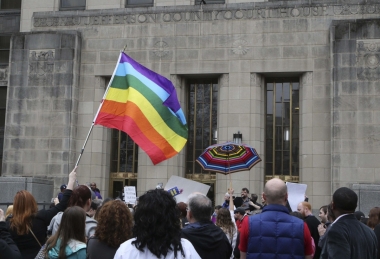
Meanwhile in Alabama, a federal judge on Thursday ordered an  official to start issuing marriage licences to gay couples in compliance with an earlier order, but couples in most counties were still unable to obtain licenses.

US District Judge Callie Granade’s order clarified that Mobile County Probate Court Judge Don Davis was compelled to adhere to her previous ruling striking down the state’s gay marriage ban despite a contravening order from Alabama Supreme Court Justice Roy Moore that led many state judges to refrain from issuing licences to gay couples.

Granade’s directive marked the latest twist in the controversy over gay marriage in Alabama, where probate judges have faced conflicting orders from federal and state courts. The resulting disarray has allowed same-sex couples to marry in places such as Birmingham, while those applying for marriage licenses in dozens of counties have been turned away.

Alabama is the 37th US state where gay marriage has been legalised, and the first in the Deep South, where many voters are socially conservative.

The US Supreme Court refused on Monday to grant a request from Alabama’s Republican attorney general to keep the weddings on hold until it decides later this year whether laws banning gay matrimony violate the US Constitution.

But Moore ordered state judges to defy Granade’s ruling and uphold the state’s gay marriage ban, an order his office said remained in effect despite the Supreme Court’s action.

Granade’s order on Thursday applied specifically to Mobile County, where, within an hour of the ruling, same-sex couples who had been waiting in line at a county building began to receive licences.

Source: Christian Today


Student Disciplined for Saying ‘God Bless America’

Christian Today report– A Florida student was reprimanded this week after saying “God bless America” at the conclusion of the morning announcements.

A Nassau County School District spokesperson Sharyl Wood confirmed that the Yulee High School student went off script on February 9, and was punished.

“It wasn’t part of the scripted morning announcements,” Wood told Fox News. “The principal took the appropriate steps in speaking with the student and disciplining the student.”

Reportedly, two atheist students complained about the off the cuff declaration to the American Humanist Association (AHA), who sent a letter to the school through their Appignani Humanist Legal Center.

It is inappropriate and unlawful for a public school to start the school day with an official statement over the intercom stating, ‘God Bless America,’ for such a statement affirms God-belief, validates a theistic worldview and is invidious toward atheists and other nonbelievers,” the letter read.

“The daily validation of the religious views of God-believers resigns atheists to second-class citizens,” the AHA continued. “Because attendance is mandatory, the students have no way of avoiding this daily message either.”

The school issued a swift apology to the atheist organisation.

“I want to point out that the statement ‘God Bless America, keep us safe’ that was made last week on the morning announcements was not approved by school Administration nor was it in the scripted announcements,” Principal Natasha Drake wrote in response.

The student on his own accord made the statement. I have called the student in this morning and directed him that at no time is he to add or take away from announcements that have been pre-approved and that if he did it again, he would no longer have the privilege of making the morning announcements.”

According to Fox News, the district declined to reveal how the student was punished for his action.

Source: Christian Today

Turkish President Offers Cuba Construction of a Mosque

Christian Today report– Turkish President Tayyip Erdogan has proposed to Cuba the construction of a mosque on the Caribbean island during a visit to Havana, pushing ahead with a plan apparently inspired by his belief that Muslims discovered the Americas.

After talks with Cuban President Raul Castro, Erdogan said on Wednesday he had sought approval for Turkey to build the place of worship in Havana that would be based on the model of a mosque in the Ortakoy district on the European shore of the Bosphorus strait in Istanbul.


Last November, Erdogan told a conference of Muslim leaders from Latin America in Istanbul that Muslims had reached the Americas in the 12th century, before the European explorer Christopher Columbus did so in 1492.

“I presented all the information, project work and visuals regarding the Ortakoy mosque. ‘We will do this ourselves. We don’t want a partner. If you find it appropriate we want to do this’,” Erdogan’s presidential website quoted him as saying of his talks with Castro.

Erdogan also told reporters the Cuban government had agreed with Saudi Arabia on a similar project some time ago. In light of this, his planned mosque could be built elsewhere in Cuba, he said.

It was not clear what response Erdogan had received to the proposal from the authorities in secular Cuba, a Communist-ruled nation whose population of 11 million people is predominantly Catholic with only a few thousand Muslims.

The largest mosque in Latin America is the King Fahd Islamic Cultural Center in Buenos Aires, Argentina. Closer to Cuba, the Caribbean nations of Trinidad, Guyana and Suriname have significant Muslim populations.

Erdogan’s assertion that Muslims reached pre-Columbian Americas was based on a reference to a mosque-like formation at the top of a mountain in Columbus’ diary of his voyages. He told the conference in November “a mosque today would suit the top of that mountain.”

Most scholars believe that reference was to a natural mountain feature rather than an actual mosque.

Mostly Muslim Turkey has only slight trade ties with Cuba and Erdogan’s visit is part of a Latin American tour also taking in visits to Colombia and Mexico.

Source: Christian Today


Suicides Can Receive Funeral Rites, Says General Synod

Christian Today report– The Church of England is to change its laws to allow people who commit suicide, whatever the circumstances, to be buried or cremated according to its funeral rites.

Currently, Church of England clergy are not allowed to conduct the funeral of a person who takes their own life while deemed to be “of sound mind”.

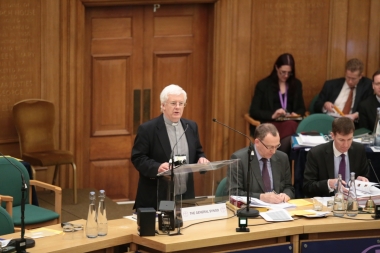
Canon Michael Parsons of the Gloucester diocese told the General Synod meeting in Church House, Westminster: “This is widely disregarded by most clergy and even more widely unknown.”

He said there was a history of suicide burials being outside churchyards, at night, and even with a stake through the body as a warning to others. Until 1882, suicides by law had to be buried between 9pm and midnight.

Such attitudes had led to the view, he admitted, that the Church was “hostile” to suicide.

“I was told a few months ago of an elderly parishioner of mine who only 60 years ago was refused a church service for her husband – and has never been near the church since.”

Synod heard it was young men, who often appeared cheerful and successful, who were most vulnerable.

Suicide ceased to be a crime in Brtain 1961 and the forfeiture of property disappeared in the 19th century but the Church of England still insists on an “archaic” sound mind clause, the synod was told.

In 1983 the Vatican repealed its own canon law barring suicides from church funerals or burials, although attempted suicide can still be a bar to ordination.

Canon Parsons said suicide was often a failure of hope, but also a choice of the least painful option, to die rather than to live. “The pastoral difficulty for those dissenting from the majority viewpoint is that while they do not want to condemn in any way those who take their own lives, nor do they want to be seen to encourage it,” he said. “Suicide is almost always a disaster for the friends and family left behind, we can and do ease some of the pain by sensitive funeral ministry.”

Rev Paul Hutchinson, of York, said thousands of clergy and lay ministers had conducted funerals of people who had taken their own lives.

Rev Jonathan Frais of Chichester said his first ever funeral visit involved a suicide and he now lived on the coast a few miles from Beachy Head, where a chaplaincy team is dedicated to trying to change the minds of people heading there to commit suicide.

The Bishop of Exeter, Rt Rev Robert Atwell, giving his maiden speech, said few in synod had not been “devasted” by a suicide. It was always a tragedy. The Church of England’s current canon law was not suitable and the authorised resources “inadequate and poor”.

He said: “Increasingly today there is a certain amount of apprehension when they approach the church regarding funeral and particularly when there is a suicide.” There was fear of being judged. “We need to have our pastoral antennae really alert, really sensitive.”

Baptist Union of Great Britain representative Rev Dr Paul Fiddes, whose 19-year-old son took his own life, said that in the Nonconformist churches, the forms of services to be used in funerals of suicides were up to the local minister, unhampered by acts of parliament.

Such ministers might be affected by theology, though, especially if the minister believed that the dead person had by committing suicide cut himself off from the “elect”.

Dr Fiddes urged generosity in assessing pastoral need. Enquiring if someone who had committed suicide life was of sound or unsound mind was not an attitude of “acceptance”, he said. “I experienced an acceptance without limits. In other people’s case, such acceptance might well require a change in Church law.”

The Archbishop of York Dr John Sentamu said it was not correct that a Church of England clergy could not conduct the funeral of a person who had committed suicide. The law merely said a bishop had to approve the service to be used. “Synod should be clear that funeral services are provided by the Church of England for those who commit suicide,” he insisted. However, synod also heard that there was no known funeral service for a suicide that had been approved by a bishop.

Clergy in any case generally ignore the Church’s law, the synod heard, and use authorised funeral liturgies to bury suicides, whether of “sound” or “unsound” mind, just as they did to bury people who had never been baptised.

Prudence Dailey of Oxford was one of the few to speak against the motion. She said: “No-one, whatever that person has done, can be beyond the mercy and love of God. That is certainly not a judgement that either the synod or a person taking funerals can be expected to make on God’s behalf.”

She said it could be safely assumed that anyone suffering so much they had taken their own life was quite likely to have been of unsound mind. “It is nevertheless the teaching of the Church that we have inherited that suicide is wrong. I am worried about the message we might send out if we accept this amendment.”

She added: “At present it is quite clear that those who die of their own hand while of unsound mind can receive a Christian burial.” She was worried that by changing its law on the issue, the Church might be seen as endorsing assisted suicide.

Bishop of Sodor and Man Robert Paterson, vice-chair of the liturgical commission, said rules that could not be enforced should be repealed or not enacted in the first place. “Any parish priest with a heart and a brain learns very quickly that there are no slick answers to the enigma of suicide. Every suicide I encountered and every bereaved family I encountered in nearly three decades as a parish priest opened up questions that could not be answered.” He said it was a “moral swamp”. Stating that the law urgently needed amending, he added: “If we really believe that Samson did not commit suicide but died in battle, what on earth do we make of suicide bombers?”

Source: Christian Today