

Can We Do a Better Job With Young Offenders?

Can We Do A Better Job With Young Offenders?

Christian Post Report – The health of a nation’s soul can be measured by how it treats its youth.

Do we protect, educate, and carefully mold them into responsible adults? When they behave badly, do we prematurely thrust them into adulthood or do we engage in the vital work of restoration and rehabilitation?

Different nations answer these questions differently. In my role as director of Pepperdine Law School’s Global Justice Program, I am aware of best practices in dozens of countries. This global perspective also provides me a window into the weaknesses and failings of justice systems around the world, including our own.

Read more at http://www.christianpost.com/news/what-uganda-can-teach-us-about-juvenile-justice-158361/#5hC7Pz4svVpMCjXJ.99

Source : Christian Post

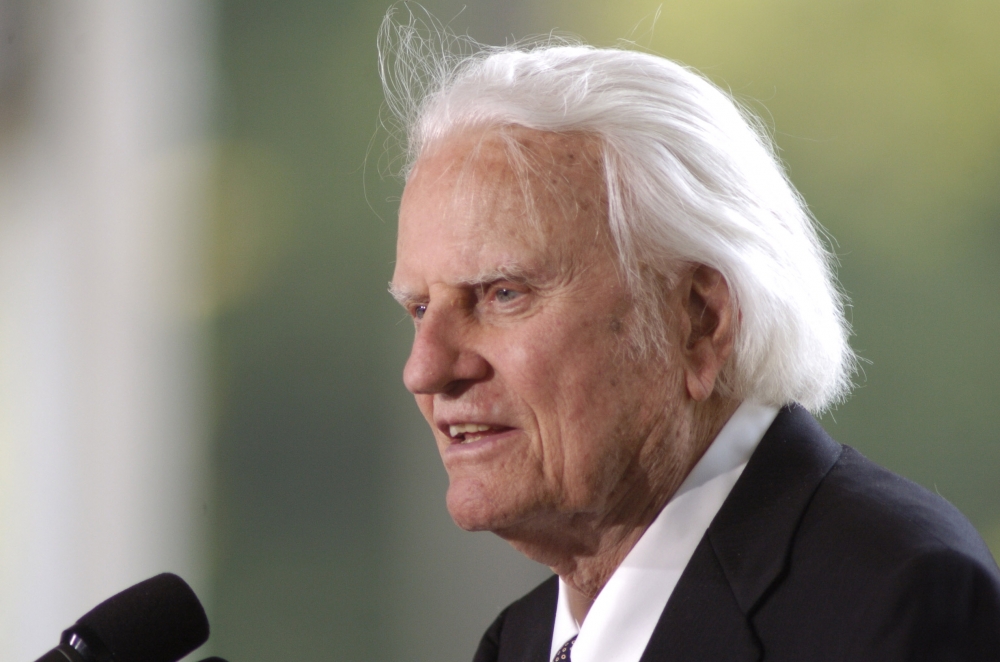
Billy Graham: Christians Can’t Take a ‘Casual’ Approach to Church

The Rev. Billy Graham (Photo: Reuters/Robert Padgett)

Christian Post Report – Evangelist Billy Graham speaks at the dedication of the Billy Graham Library in Charlotte, North Carolina, May 31, 2007.

Christians can’t take a “casual” approach to their faith in God, the Rev. Billy Graham said in a post this week.

Responding to a question on the Billy Graham Evangelistic Association’s website, the 97-year-old religious leader said Christians must be completely dedicated and involved in their faith.

Graham explains in the BGEA “My Answers” post that while many are be tempted to stop attending church so they can focus on other weekend activities, such an approach to Christianity and Christ’s love is not sustainable in the long run.

“People drop out of church for all sorts of reasons (and over the years I suppose I’ve heard them all!),” the reverend begins, suggesting that some people have good reasons to leave their church, including if their pastor isn’t preaching the Gospel.

Many times, however, people drop out of church simply because “they want to do something else.”

“Perhaps they’ve found church boring, or people haven’t seemed friendly, or it’s become a meaningless routine. But these aren’t true of every church — and often they’re only an excuse to do something else,” the religious leader says, adding that this age-old problem can be traced back to the New Testament, as seen in Hebrews 10:25, when some believers “give up” meeting together.

Ultimately, although Christians might try to find an excuse for their church absence, they must really look at the true reason for why they worship in the first place: their relationship with Jesus Christ.

Christians must ask themselves “What place does Jesus Christ have in our lives?,” Graham explains.

“Is He only one of many interests we have — or is He the center and foundation of all we do? A casual approach to Christ always leads to a casual approach to church,” Graham continues. “Once you realize who Jesus is and what He has done for you through His death and resurrection, you’ll never treat Him casually again.”

Graham concludes his message by encouraging Christians to pray to God so that He will give them the “inner hunger” to strengthen their faith.

The religious leader has warned of the “casual Christian” in the past, writing in a March 2011 post for the BGEA website and Decision magazine that only a Christian fully dedicated to their values can serve as an “effective witness for Christ.”

“I have found that the casual Christian has little influence upon others. It is only the Christian who refuses to compromise in matters of honesty, integrity and morality that is bearing an effective witness for Christ,” Graham wrote at the time.

When asked in June 2007 if a person can be a Christian without going to church, Graham replied that while “it’s possible to be a Christian without going to church,” such people “will be missing out on an important part of what God wants to do in your life.”

“Just as we need a balanced diet to be strong physically, so we need a balanced ‘diet’ to be strong spiritually — and part of that ‘diet’ is the church,” Graham added.

Source : Christian Post

Queen Elizabeth Cites Christian Faith for Opposition to Gay Marriage

Queen Elizabeth (Photo: Reuters/Toby Melville)

Christian Post Report – Britain’s Queen Elizabeth arrives for a Queen’s Trust visit to the Lister Community School in London, Britain, March 3, 2016.

Queen Elizabeth II opposed the legalization of same-sex marriage in England because of her deeply held Christian values, a close friend has reportedly told a London-based newspaper.

The UK Daily Mail published a story Sunday which claimed that the queen, who is also head of the Church of England, secretly opposed gay marriage but was in favor of civil partnerships. The unnamed “friend” said the monarch was frustrated by the fact that she could only “advise and warn” on the issue.

Gay marriage(Photo: Reuters/Mick Tsikas)Two bride figurines adorn the top of a wedding cake during an illegal same-sex wedding ceremony in central Melbourne August 1, 2009. Gay activists staged mock weddings across Australia on Saturday as the governing Labor Party voted against changing its ban on gay marriage.

“It was the ‘marriage’ thing that she thought was wrong, because marriage ought to be sacrosanct between a man and a woman,” said the friend, as quoted by the Daily Mail.

The Daily Mail also stated that the reported revelation of her views on the definition of marriage was part of an overall series of stories about the queen as she nears her 90th birthday.

“Following extensive interviews with courtiers past and present, friends of the queen and family members, we can also reveal one of her most senior former aides believes it was a mistake not to lower the Buckingham Palace flag after Princess Diana’s death — and that he is convinced the queen now shares this view,” continued the article.

In March of 2014, England and Wales legalized gay marriage, one month after Scotland did the same. Northern Ireland is the only member nation of the U.K. that has not done likewise.

“Those in civil partnerships can choose to convert their relationships to marriage, via a procedure expected to be in place by the end of the year, but are under no obligation to do so,” reported the BBC.

“The law prohibits the Church of England from performing same-sex weddings, and allows other religious organisations to refuse to perform them.”

The Daily Mail’s story about the queen opposing the legalization of gay marriage has not gone unchallenged, as The Daily Beast published an article Monday rejecting the U.K. publication’s claim.

Authored by Tom Sykes, the rebuttal piece quotes and cites unnamed senior personnel from Buckingham Palace, with one staffer as saying, “It seems unlikely that one of her friends would pass on her thoughts to The Mail,” and another calling the piece “spurious and unsubstantiated.”

“Palace staff — many of whom are gay — are hamstrung by the fact that the queen maintains strict political neutrality and would never publicly comment either way about issues such as same-sex marriage,” The Daily Best reported.

Source : Christian Post

Donald Trump Named ‘Islamophobe of the Year’ by UK Islamic Group

Donald Trump (Photo: REUTERS/ Philip Sears)

Christian Post Report – Republican U.S. presidential candidate Donald Trump gestures at a campaign rally at Valdosta State University in Valdosta, Georgia February 29, 2016.

Republican presidential candidate Donald Trump has been named “Islamophobe of the Year” by a U.K.-based Islamic rights group.

The Islamic Human Rights Commission announced the Manhattan real estate mogul as its so-called “Islamophobe of the Year” at its annual satirical “Islamophobia Awards” gala dinner that was held on Saturday, according to a statement issued by the organization.

The billionaire GOP frontrunner took home the the organization’s top award after he issued a call last December for a “total and complete shutdown of Muslims entering the United States.”

Trump’s call to ban Muslims from entering the U.S. came after 14 civilians were killed by two radicalized terrorists believed to have ties to external terrorist organizations in San Bernardino, California, the week before.

“It is bad enough that anyone can come out with such arrogant, unapologetic bigotry and hate speech but I think what is really frightening is that Donald Trump is supported by such a large number of voters in what is the most powerful nation in the world,” IHRC Chairman Massoud Shadjareh told Time magazine.

Besides “Islamophobe of the Year,” the organization issued four other “Islamophobia Awards” that were divided into various categories — international, U.K., entertainment (books, movies, T.V. series), and news media.

Trump was not the only U.S. presidential candidate nominated for the international “Islamophobia” award. Fellow Republican candidate and retired neurosurgeon Dr. Ben Carson was also nominated for the award.

A press release from February announcing the nominations states that both Carson and Trump were nominated because they are “comfortable attacking Muslims during their respective campaigns for president.” HBO political talk show host Bill Maher was also nominated for the international award.

Although the international “Islamophobia” award had a number of nominees, it was the French satirical magazine Charlie Hebdo that won international category. In January 2015, 12 employees of the magazine were killed and 11 others wounded when two Islamic gunmen attacked the magazine’s offices in France after the publication published a cartoon of the Islamic prophet Muhammad.

Time reports that the IHRC took a lot of heat last year when it named Charlie Hebdo as the “Islamophobe of the Year” just months after the magazine was attacked.

“I think people misunderstood the award that was given to Charlie Hebdo, it wasn’t anything to do with the act of terrorism in Paris,” Shadjareh argued. “The point is this: if Charlie Hebdo says they have the right with satire to make fun of anyone, then why can’t we have the same right?”

British Prime Minister David Cameron won the U.K. category. According to the group, Cameron won the award because of his “comments about Muslim women needing to learn English and being ‘traditionally submissive.'”

Because the award presentation dinner was satirical, none of the winners were present to accept their awards.

According to Breitbart London, the IHRC is a “shiite-dominated,” “Hezbolla-sympathizing” organization that has campaigned in the past for convicted terrorists.

Follow Samuel Smith on Twitter: @IamSamSmith

Source : Christian Post

Ayaan Hirsi Ali: America’s Greatest ‘Weakness’ Against Radical Islamic Terrorism Is Political Correctness

Ayaan Hirsi Ali (Photo: Reuters/Francois Lenoir)

Christian Post Report – Somali-born Ayaan Hirsi Ali, a former Dutch parliamentarian, gestures as she speaks at the European Parliament in Brussels, Belgium, Feb. 14, 2008.

Former Muslim and best-selling author Ayaan Hirsi Ali argued last week that political correctness in the West is making it harder for the United States and other Western nations to combat the rise of radical Islamic terrorism and its political philosophy.

The 46-year-old Ali, who grew up in a Muslim family in Somalia, suffered female genital mutilation and eventually fled to Holland after her father tried to force her to marry a distant cousin, participated in a panel discussion last Friday at the Conservative Political Action Conference in Maryland.

Ali, who is an atheist after renouncing her Muslim faith in 2002 and has authored four books critical of Islam, warned that concerned citizens in the West must not be afraid to speak out and tell the truth about radical jihadis whom she claims are following the Islamic political doctrine established by the Islamic prophet Muhammad in Medina.

While millions of Muslims across the world are moderate and do not follow extremist calls for jihad against nonbelievers, many in today’s politically correct Western society are quick to label anyone who associates terrorist groups like the Islamic State, Boko Haram or al-Qaeda with the religion of Islam as “Islamophobes.”

“To discuss Islam as a set of ideas does not make you a racist,” Ali stressed. “It doesn’t make you Islamophobic.”

While the Obama administration has been reluctant to associate religion with the inspirations of Islamic terrorist groups, Ali argues that leaders who refuse to acknowledge the religious inspirations behind Islamic terrorist groups are only insulting the intelligence of their constituency.

“I grew up as a Muslim in a Muslim household and anytime anyone of our leaders tells me on television or in person that Islam is a religion of peace, my intelligence is insulted,” Ali, who carries dual Dutch and American citizenship, said. “Islam is a religion but it is also a political doctrine, and you will not be able to name the threat precisely unless you understand exactly what Islam is.”

Ali explained that when the Muhammad went to Medina in 622, he created a “political philosophy” that “is the antithesis of the idea of America” and “American political theory and practice.”

“Millions and millions and millions of Muslims are peace-loving but those Muslims who invoke the prophet Muhammad in his legacy in Medina and in his creeds, those are a threat to us on a personal level,” Ali stated. “They are not only lone wolves, they are state actors organized in the organization of Islamic cooperation.”

“If we the people do not educate ourselves on Muhammad in Medina then we will not get that Medina agenda,” Ali added. “Whatever happens to us and whoever commander-in-chief becomes it is our fault.”

Jim Hanson, executive vice president for the Center for Security Policy, weighed in, saying that political correctness is radical extremists’ “biggest tool.” Hanson brought up how a British politician was arrested in 2014 after he recited a passage that was critical of radical Islam from Winston Churchill’s 1899 book The River War.

“That man is a perfect example of what the other team wants to do to us,” Hanson said. “They will suppress speech critical of Islam because if you can’t talk about what they are doing, they can get away with it. The thing to do is talk about it. … Don’t be scared by what the other folks call you. You are not a hater, you are not an Islamophobe. You are a freedom-loving American.”

Ali agreed with Hanson’s assessment that radical extremist groups are using political correctness in the West to their advantage.

“It is true that political correctness is literally eroding our systems from within and killing it. Radical Islamists are, obviously, exploiting that,” Ali added. “They have defined us as the enemy and we haven’t defined them as the enemy. They are exploiting our weaknesses and political correctness is our weakness.”

Follow Samuel Smith on Twitter: @IamSamSmith

Source : Christian Post

JD Greear Shares 7 Tips for Pastors Before Preaching on Homosexuality

<b>Christian Post Report</b> – J.D. Greear, lead pastor of the Summit Church in Raleigh-Durham, North Carolina.” title=”<b>Christian Post Report</b> – J.D. Greear, lead pastor of the Summit Church in Raleigh-Durham, North Carolina.” name=”jpg” src=”http://images.christianpost.com/full/86775/j-d-greear-lead-pastor-of-the-summit-church-in-raleigh-durham-north-carolina.jpg” class=”imgPhoto” width=”550″ height=”450″ /></p><p class=Christian Post Report – J.D. Greear, lead pastor of the Summit Church in Raleigh-Durham, North Carolina.

J.D. Greear, who was nominated last week as a candidate to become the next president of the Southern Baptist Convention, is sharing seven tips for pastors to follow before preaching about homosexuality.

In a blog post on his website titled “7 Points to Consider When You Preach About Homosexuality,” authored by Brad Hambrick, pastor of Counseling for the Summit Church of Raleigh-Durham, North Carolina, where Greear serves as lead pastor.

“The tone of the pastor will be the tone of a church and the emphasis of the pastor will be the emphasis of a church,” wrote Hambrick.

“The greatest impact of any sermon is not in the one hour service with God’s people gathered, but in conversations and applications during the other 167 hours of the week when God’s people scatter.”

The seven points Hambrick gives to pastors include:

  1. Become friends with someone who experiences [same-sex attraction] first;
  2. View your message as something that will open conversations;
  3. Be intentional and consistent with language;
  4. Remember people are never called an abomination, only behaviors are;
  5. Avoid applause lines and humor for self-comfort on stage;
  6. Be intentional about providing resources and outlets for conversation;
  7. Invite Feedback.

“I pray these suggestions allow a sermon you preach or lesson you teach about homosexuality to provide not only an accurate biblical theology of sexual ethics, but also to equip your congregation to become better ambassador-friends of the Gospel to members of your congregation who are struggling in silence,” explained Hambrick.

An author and pastor, Greear is credit with having grown Summit Church from a congregation of about 300 when he became lead pastor to at least 8,000 members presently.

Speaking about his name being placed in nomination to become the next SBC president, Greear commented on his website: “When I was approached by several older SBC leaders asking me to consider this role, quite honestly, it took me by surprise. I know that the Holy Spirit often speaks through His Church, (Acts 13:2), so we took their counsel seriously.”

“Pray for me over the next weeks and months. I am first a husband and father and second a local church pastor. These have been and will remain my primary assignments.” Greear wrote Thursday.

Source : Christian Post

Archaeology Discovery: 4,200-Y-O Canaanite Burial Ground Found Near Bethlehem

Jerusalem, Bethlehem (Photo: REUTERS/Ronen Zvulun)

Christian Post Report – A general view shows Palestinian villages (rear) around a Jewish settlement near Jerusalem known to Israelis as Har Homa and to Palestinians as Jabal Abu Ghneim April 25, 2012. Har Homa is a terraced suburb of neat, white-stone apartments housing 13,000 Israelis that overlooks the biblical town of Bethlehem. Picture taken April 25, 2012.

Archaeologists have confirmed the discovery of a 4,200-year-old necropolis dating back to pre-historic times in Bethlehem.

A team of Palestinian and Italian archaeologists recently uncovered the large cemetery, complete with over 100 tombs dating back to 2200 BCE to 650 BCE, at the site of Khalet al-Jam’a, located near Bethlehem.

While many of the tombs have been destroyed by looters, excavators say the discovery confirms there was a Canaanite town near Bethlehem that served as an important stop along a popular trade route.

“The finds confirm that there was a Canaanite town in Bethlehem. This had have never been proven before,” Lorenzo Nigro, an Italian professor leading the excavation, told Haaretz.

According to the Times of Israel, the tombs, which cover an area of over 7 acres, were built to serve as the burial place for multiple family generations in accordance with Deuteronomy 31:16, which states that Moses will “rest with [his] ancestors.”

While the large necropolis was originally discovered by construction workers in 2013, it is now just being excavated by the Italian and Palestinian archaeological teams.

Nigro wrote in the journal Vicino Oriente that the necropolis likely served as a burial site for a nearby settlement.

The location’s “long-lasting utilization, over a millennium and a half or more, and the large number of tombs, suggest that Khalet al-Jam’a was the necropolis of a major settlement in the area, possibly a town,” Nigro, who also serves as a professor at Sapienza University, wrote in the journal, as reported by Discovery News.

Nigro added that some of the exotic and expensive burial items found at the necropolis indicate that the settlement was likely a wealthy one with easy access to major trade routes, as the community sat between the major cities of Jerusalem and Hebron.

“Typical pieces of the burial sets are finely executed carinated bowls, small shouldered jars/bowls with everted rim, one-spouted lamps, huge and well-refined Canaanite jars with two or four handles, as well as bronze daggers and spearheads,” Nigro wrote.

Also discovered in the tombs were scarab amulets, axes, and pins meant for fastening fabric together.

Along with Canaanite findings in Palestine, there have also been recent discoveries dating back over 3,000 years in Israel.

Two weeks ago, a young Israeli boy found a clay figurine of a nude woman while hiking in Tel Rehov in the northeastern part of the country.

The figurine, which was created by pressing wet clay into a mold, dates back over 3,400 years. Archaeologists have said that this type of miniature statue is typical of Canaanite culture in the 15th to 13th centuries BCE.

Amihai Mazar, who oversees excavations at Tel Rehov, said in a press release in February that experts debate whether the small statue served as a figurine or an idol for the Canaanite people.

“Some researchers think the figure depicted here is that of a real flesh and blood woman, and others view her as the fertility goddess Astarte, known from Canaanite sources and from the Bible,” Mazar said in a government-issued statement, as reported by The Christian Post last week.

“It is highly likely that the term trafim mentioned in the Bible indeed refers to figurines of this kind,” Mazar said. “Evidently the figurine belonged to one of the residents of the city of Rehov, which was then ruled by the central government of the Egyptian pharaohs.”

Source : Christian Post

Theologian Jerry Bridges Dies at 86. Here Are 6 Biblical Truths He Once Shared

Bible (Photo: Reuters/Rodrigo Garrido)

Christian Post Report – A demonstrator prays with the Bible outside of the congress during a rally against the draft law of the Chilean government which seeks to legalize abortion, in Valparaiso, August 4, 2015.

Respected theologian Jerry Bridges, a longtime staff member of The Navigators Christian ministry and the best-selling author of 10 inspirational books, died Sunday. He was 86 years old.

In a 2011 interview with DesiringGod.org, a website devoted to glorifying God, Bridges shared six biblical truths he learned over the course of his walk with Christ:

1. The Bible Is Meant to Be Applied to Specific Issues in One’s Daily Life

As a young officer in the Navy, Bridges learned firsthand the meaning of 1 Timothy 6:1 as he applied the scripture to a challenging relationship he once had with a superior officer. The theologian’s commanding officer was difficult to get along with and was resented by many of his subordinates. Neverthless, Bridges learned that the officer was still “worthy of all honor,” based on the Scriptures.

2. Believers Have a Union With Christ

Bridges said, “I am in Christ — as the vine and the branches have a living union, so Christ and I have that living union. I live in Him, He lives in me, and I depend upon Him for the power to live a Christian life.”

3. Mankind Is Saved Through the Doctrine of Election

“I am a Christian because God chose me from before the foundation of the world.” The theologian initially pushed back against that concept, but says God opened his eyes. “It just sort of hit me all of a sudden, and I just dropped to my knees and I thought of Romans 12:1: ‘I appeal to you by the mercies of God to present your bodies as a living sacrifice.'”

Bridges said he had never before understood God’s mercy and grace as much as he did at that moment.

4. It’s Necessary to Preach the Gospel to Oneself Daily

The author says he learned to look to Christ as his righteousness, rather than to his own performance.

5. Christians Have a ‘Dependent Responsibility’

“I am responsible to deal with sin. I am responsible to grow in the fruit of the spirit, but I’m dependent on the enabling power of Christ, through the Holy Spirit, to enable me to do that,” said Bridges.

6. Believers Should Have an Increased Awareness of a Dependence Upon the Holy Spirit

Bridges said: “Just as any team needs a coach, so we need the Holy Spirit to coach us to point out our weaknesses. He gives us direction, then He works monergistically, which means He works by Himself — apart from our input. Then He also works synergistically, which means He enables us to work.”

The theologian hoped that Christians would benefit from his experiences. “Those are the great truths I learned, and I see no reason why a new Christian cannot at least begin to learn these right up front. There’s no point in having to work through 50 years of difficult experience, like I had to do … “

Email me: [email protected]
Follow me on Twitter: @kevindonporter

Source : Christian Post

The Man who invented ‘ Email ‘ Ray Tomlinson has died at age 74

Washington (AFP) – Ray Tomlinson, the US programmer credited with inventing email in the 1970s and choosing the “@” symbol for the messaging system, died at the age of 74, his employer said.

Tomlinson invented direct electronic messages in 1971. Before his invention, users could only write messages to others on a limited network.

“A true technology pioneer, Ray was the man who brought us email in the early days of networked computers,” his employer, the defense contractor and electronics giant Raytheon, said in a statement.

“His work changed the way the world communicates and yet, for all his accomplishments, he remained humble, kind and generous with his time and talents, he will be missed by one and all.”

A company spokesman said Tomlinson died on Saturday, and the cause of death was not yet confirmed.

Tributes poured in from the online world.

“Thank you, Ray Tomlinson, for inventing email and putting the @ sign on the map. #RIP,” Google’s Gmail team tweeted.

Vint Cerf, considered one of the fathers of the Internet who was once a manager of the US Defense Advanced Research Projects Agency (DARPA), lamented the “very sad news” of Tomlinson’s passing.

When Tomlinson invented the “user@host” standard for email addresses, it was applied at DARPA’s ARPANET, a US government computer network that is considered the Internet’s precursor.

He was the first to use the @ symbol in this way, to distinguish a user from its host.

At the time personal computers were virtually unknown, and the use of personal email — now a keystone of electronic communications — would not be adopted at a mass scale until the 1990s.

– First message ‘QWERTYUIOP‘? –

Tomlinson, a graduate of the Rensselaer Polytechnic Institute and the Massachusetts Institute of Technology, detailed his creation on his blog in an attempt to prevent legend from overtaking the facts.

“The first message was sent between two machines that were literally side by side” connected only through ARPANET, Tomlinson wrote.

“I sent a number of test messages to myself from one machine to the other. The test messages were entirely forgettable and I have, therefore, forgotten them.

“Most likely the first message was QWERTYUIOP or something similar,” he added, referring to the first row of letters on the traditional English-language keyboard.

“When I was satisfied that the program seemed to work, I sent a message to the rest of my group explaining how to send messages over the network. The first use of network email announced its own existence.”

The international non-profit Internet Society, which promotes Internet-related education, standards and policies, said that the Internet community “has lost one of our true innovators and pioneers.”

Tomlinson was inducted into the society’s Internet Hall of Fame in the “innovator” category in 2012.

According to his Hall of Fame biography, Tomlinson’s email software was widely distributed for years, “and proved to be an exceptionally innovative solution.”

Tomlinson also played a leading role in developing the first email standards.

“I see email being used, by and large, exactly the way I envisioned,” Tomlinson told the online tech publication The Verge in May 2012.

“Everybody uses it in different ways, but they use it in a way they find works for them,” he said.

Source : Yahoo News

Singer Steven Curtis Chapman on Evolution of Christian Music (Interview)

Steven Curtis Chapman (Photo: StevenCurtisChapman.com) PERMISSION

Christian Post Report – Steven Curtis Chapman releases 23rd career studio album, Worship And Believe, March 4, 2016.

Award-winning, multi-platinum-selling artist Steven Curtis Chapman talks about the evolution of Christian music as he releases his 23rd career studio album, Worship And Believe.

“I love music, I love being a student of music. Now at this point in my life, creatively and my journey musically, I’m still learning, and growing and still a student,” Chapman told The Christian Post.

The well-respected artist has received 58 Gospel Music Association Dove Awards, 5 Grammys, 48 No. 1 singles, and has sold nearly 11 million albums. With a career that spans almost 30 years in Christian music, Worship And Believe, released March 4, is Chapman’s first-ever worship album.

“I’m still listening to music and when music moves me or inspires me, I try and figure out what it is about that that moved me and I try to learn from that and incorporate that into what I’m doing creatively,” Chapman said of his 16 track release.

Christian music has changed drastically since Chapman first emerged on the scene in 1987. He joked that while still trying to keep up with the times, he is not going to put on a pair of skinny jeans and become a “hipster.”

“At this point in my life I still think there are things that I have to say that can be very relevant hopefully to millennials and to all of us because there are real connecting points,” Chapman explained. “Yeah there are some things that are unique to our different age brackets but there’s a whole lot more that’s real common ground. I’m trying to stay real connected to that and find that common ground.”

The talented musician and activist aspires to make songs on this new album that can be sung by others individually and corporately, with corporate worship music being a concept that was unheard of when Chapman first started making Christian music. He explained that the diversity and styles of music have since expanded greatly.

“When I first started, Christian music was pretty narrowly defined. You’d have your crazy people out there like Steve Taylor who was doing punk rock music but for the most part if you really looked at what was considered Christian music at the time it was pretty inspirational,” Chapman said. “Even the singer-songwriters weren’t even as prevalent. There were songs that were kind of hymns, big productions, beautiful great songs but it was more narrowly defined as far as what Christian music was.”

Artists began to stretch the boundaries and Chapman pointed to groups like Stryper, a Christian heavy metal band that came along with spandex and long hair, as examples. He maintains that at the time they were viewed as the “radicals and rebels.”

“As time has gone on, you had DC Talk come along and said ‘let’s take rap music, it’s an art form and it’s a style that a lot of people really connect with, let’s take that and use it to proclaim truth and use it to speak messages that are redemptive, and faith filled messages to encourage people,” Chapman explained.

The successful songwriter also praised Kirk Franklin as someone who pushed the boundaries even further and further out for the genre but yet still at the heart and soul of everything maintained the goal and purpose of glorifying God and pointing people to Him.

View article on single page
Next Page
Pages: 12

Source : Christian Post