

Pastor in Laos Was Tortured and Killed, Sources Say

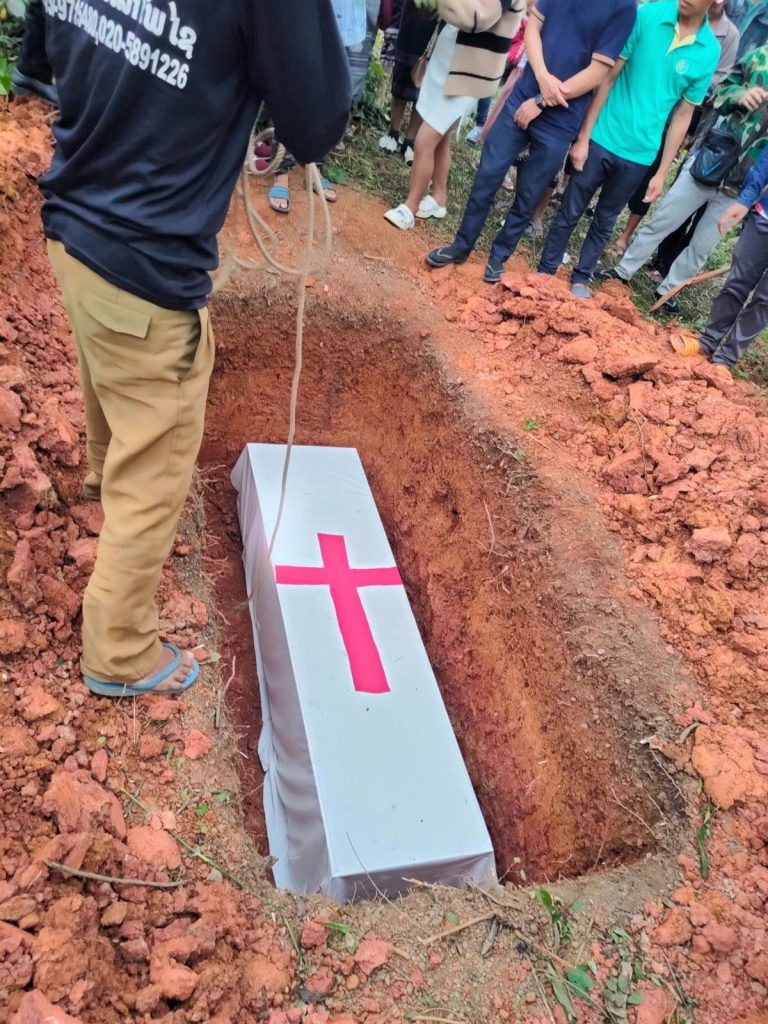
The body of a pastor with an officially recognized church in Laos was found last month with signs that he was tortured and killed for his faith, area sources said.

Christian leaders and police in central Laos’ Khammouane Province believe Pastor Seetoud, who went by a single name, was killed for spreading the gospel amid rapid church growth in the country.

The pastor had been expected to attend a meeting of Christians on Oct. 20 in Thakhek, about 100 kilometers (62 miles) from his home in Don Keo village, Nakai District, Khammouane Province, a journey of three and a half hours on his motorbike. When he failed to arrive more than three hours after the start time for the meeting, more than 20 people searched for him on the mountain pass near Don Keo village and at a local hospital, without success.

The search party also obtained CCTV footage from a local store owner in nearby Nakai showing that Pastor Seetoud on Oct. 21 dropped off a plastic gas container that he intended to pick up later, area Christians said.

An area resident later found Pastor Seetoud’s body in a ditch off a mountainous jungle road near the village and uploaded photos of the scene to Facebook, enabling the search party to find the corpse on Oct. 23.

Pastor Seetoud of Don Keo village, Khammouane Province, Laos, was last seen on Oct. 20, 2022. (Morning Star News)

Pastor Seetoud of Don Keo village, Khammouane Province, Laos, was last seen on Oct. 20, 2022. (Morning Star News)

Two Christians who had planned to leave their village and join Pastor Seetoud for the meeting in Thakhek said he was delayed because two unidentified officials questioned the church leader about his activities and reasons for travel to the town.

A witness from nearby Wangheen village told villagers that he stopped on the road when he saw a black truck with no license plates on Oct. 20, the day the pastor headed for the meeting.  He said three men got out and seized another man, violently dumped him into the truck and drove away.

The witness said he assumed the authorities were arresting a drug dealer/criminal and decided to continue his journey. When he later heard about Pastor Seetoud’s death, he told villagers that it was the pastor who was abducted.

Christian leaders said Pastor Seetoud’s body was severely disfigured and showed signs of torture. The search party found Pastor Seetoud’s Bible near his body and his motorcycle nearby on the road.

He leaves behind a wife and eight children, the youngest a 1-year-old. Pastor Seetoud led a congregation of the Lao Evangelical Church, one of three officially recognized denominations in Laos along with the Seventh-day Adventist Church and the Roman Catholic Church.

Christian leaders said provincial police have told them Pastor Seetoud was likely killed because of his faith. Police officials at the provincial level suspect local officials at the district level killed him, according to LEC leaders.

“No words can describe the pain that Seetoud’s family and the local churches are experiencing,” a Laotian evangelical leader said. “The great injustice about the whole situation is that those in authority were either directly or indirectly involved in Seetoud’s murder.”

In recent months, relatives and neighbors had followed Pastor Seetoud and threatened him with harm if he continued to share his Christian faith, according to Christian leaders. His frequent trips to Thakhek were monitored, and since July he received warnings from village authorities to stop his Christian activities, the church leaders said.

His body was taken to a hospital where family and church friends identified him. Several Lao Evangelical Church leaders and members of his congregation attended his funeral on Oct. 24, despite fear of persecution. After the funeral, family and Christians in Don Keo village held a memorial service in his home.

Thakhek provincial and district police have started an investigation into Pastor Seetoud’s death and questioned two leaders of his church for three hours, Christian leaders said.

After COVID-19 restrictions were relaxed this year, Pastor Seetoud began making more frequent trips to Thakhek as Christians had resumed helping one another care for families, taking relatives to the hospital, obtaining farm supplies, carrying out farm business and organizing holiday events.

The Lao Evangelical Church is assisting his relatives, whose long-term needs include trauma counseling, food, shelter and rebuilding of homes.

Pastor Seetoud had an official Lao Evangelical Church card and was recognized as a Bible Teacher/Trainer. On the Sunday before he was killed, he had celebrated Communion with the church in his home.

Past Persecution

Pastor Seetoud made his living as a subsistence farmer.

In 2015, he and his family left their animistic beliefs behind and put their faith in Christ. As often happens in rural Laos, in response to his conversion village authorities and local police asserted that Christianity was incompatible with traditional beliefs and cultural practices.

Pastor Seetoud, his family and other Christians were denied access to drinking water and other basic rights. Authorities tried to force him to sign an affidavit recanting his faith, as they were concerned with church growth and did not want the “foreign religion of Jesus” to interfere with local worship of idols and spirits, area Christians said.

A 2016 decree on religion empowers the Ministry of Home Affairs to stop any religious activities contrary to policies, “traditional customs,” laws or regulations, though much persecution of Christians in Laos is carried out by local officials acting outside of the law and the constitution, which guarantees religious freedom. The U.N. International Covenant on Civil and Political Rights, ratified by Laos in 2009, upholds the right to adopt a religion/belief of choice as well as the right to manifest that religion/belief in a corporate worship (Article 18).

About 60 percent of Laos’ population is Buddhist and 32 percent animist, with the ancestral spirit worship of animism also finding its way into Buddhists’ beliefs and practices.

In 2018, local police handcuffed and detained Pastor Seetoud in the village school for three days for hosting a church service in his home. Though the home services had been going on for more than three years, he was accused of holding an “illegal gathering,” area Christians said.

Pastor Seetoud was released after provincial police, who oversee village and district police, were notified, and the pastor paid a fine. Continuing to hold church services in his home, he developed stronger ties with Christians from the Lao Evangelical Church (LEC).

The LEC of Khammouane Province has a physical church in Thakhek, and church members and families meet in homes all throughout the province.

Growing Dangers

Persecution of Christians in Laos has increased in the past two years, particularly in the southern part of the country.

Christian leaders in Laos believe this is a dangerous time for believers because of rapid church growth. Despite COVID-19 lockdowns in 2021, ministry leaders in Khammouane Province said they baptized thousands of people and planted more than 60 churches.

Local church leaders said they are being watched and are living in fear for their lives.

“All the believers still love God and are determined to follow him,” a local leader who is part of Pastor Seetoud’s church told ReligionUnplugged.com.

A national ministry leader said nothing can stop the growth of the church.

“We weep but not like those without hope,” he said. “We know that in Christ we are secure. Attacks such as this have happened before in our country, and each time the kingdom of God has grown.”

In February 2021, villagers attacked 12 members of a Christian family in Dong Savanh in southern Laos and drove them from their home; previously, in 2017, the family had been expelled from their village.

Also in February 2021, Cha Xiong, an ethnic Hmong Christian community leader, was shot and killed. A villager found his body on a roadside the next day. Local authorities said they still have no suspects.

A month later, Pastor Sithon Thippavong, a Lao leader in Savannakhet, was arrested for refusing to sign a document renouncing his Christian faith, and was later jailed for a year on charges of “disrupting unity” and “creating disorder.”

In October 2020, authorities expelled and destroyed the homes of seven Christians in Saravan Province’s Ta Oy District for refusing to recant their faith. Two years earlier, four Lao Christians and three Christian leaders were detained for seven days in Savannakhet’s Phin District for celebrating Christmas “without permission.”

Officials in rural areas view Christians with suspicion and arbitrarily detain, harass and expel them from their villages for refusing to renounce their faith. Christians’ property is then confiscated, with local officials turning a blind eye to the abuse while higher government officials deny that Christians suffer any discrimination or violence.

According to the Lao constitution’s Article 43, citizens have the right to “believe or not to believe in religions.” The government officially recognizes four religions – Buddhism, Christianity, Islam, and the Baha’i faith – but gives priority to Buddhism.

The Ministry for Home Affairs and the Lao Front for National Development strictly regulate all religious institutions. Christianity is often viewed as a Western religion and is closely monitored.

In 2019, the Laotian government issued Decree 315 on religious freedom, which stipulated, “All Lao citizens have equal rights before the law regarding the belief or non-belief in religion as stipulated in the constitution, law, and regulation of Lao PDR [People’s Democratic Republic].” This stipulation is largely ignored in rural areas, where persecution is common, area Christians said.

Laos ranked 26th on Christian support organization’s Open Doors’ 2022 World Watch List of the 50 countries where it is most difficult to be a Christian.

Officially named the Lao People’s Democratic Republic since 1975, the country bordering Thailand, Myanmar and China, is a socialist, authoritarian one-party state.

Top 10 Christian Movies 2022

Here are the Top 10 Christian Movies you should see in 2022.
The must see movies are :
1. Send Proof
2. Lost Outlaw
3. Hope Lives
4. A Week Away
5. Blue Miracle
6. Life Mark
7. The Mulligan
8. A Case for Heaven
9. The Unbreakable Boy
10. Tyson’s Run

Mary Adelia McLeod, first female diocesan bishop in the history of The Episcopal Church dies at 84

Mary Adelia McLeod, the first woman to become a diocesan bishop in The Episcopal Church, has died at her home in Charleston, West Virginia, on Wednesday at the age of 84.

Although McLeod was the third woman to be consecrated a bishop in the mainline Protestant denomination, she was the first female bishop who specifically led a diocese.

The Episcopal Diocese of Vermont, the regional body that McLeod was elected in 1993 to lead, announced her death on Wednesday.

Bishop Shannon MacVean-Brown, the head of the Vermont Diocese and the first black woman to hold the leadership position, said in the announcement that McLeod “was always encouraging to me.”

“I’m trying my best to continue her work of empowering and supporting lay ministry, promoting inclusion, strengthening our stewardship, improving transparency around our financial resources, and encouraging the ministry of women,” said MacVean-Brown.

Born in Birmingham, Alabama, in 1938, McLeod later graduated from the University of Alabama with a degree in history.

Along with her husband, Henry McLeod III, she entered the Episcopal seminary at the University of the South in Sewanee, Tennessee, graduating in 1980 and becoming the first woman from Alabama to be ordained in The Episcopal Church.

She would serve at St. Timothy’s Church in Athens, Alabama, and St. John’s Church, Charleston, West Virginia, and was an archdeacon in the Episcopal Diocese of West Virginia.

In 1993, McLeod was elected bishop of the Vermont Diocese, becoming only the second woman in the entire global Anglican Communion to head a diocese as bishop.

The first was the Rt. Rev. Penelope Jamieson, who had been elected bishop of the Anglican Diocese of Dunedin, a regional body of the Anglican Church of New Zealand, in 1989. Read more …

“The Pastors” launch new talk show; first episode on abortion

Four South Carolina-based pastors have joined forces to create a new TV talk show. For their pilot episode on October 1, they discussed a challenging topic that is even controversial among Christians: Abortion.

They noted that since the Supreme Court overturned Roe v. Wade, famed advocates for pro-life are experiencing extreme pleasure, as outspoken advocates for pro-choice are undergoing intense pressure. Yet, those suffering the most are women with the painstaking task of choosing either life or death for their unborn children.

Shane Wall, an Orangeburg, SC pastor and two-time bestselling author who spearheads and hosts the talk show, has been preaching for 39 years. During the episode, he asked, “What would you say to… a young girl who said to you that a family member [impregnated me]?” Glover Richberg, another Orangeburg, SC pastor who has been preaching for 11 years, responded, “That shame is not yours….”

Nicky Raiborde, a Columbia, SC pastor who has preached in over 80 countries in the past 25 years, said, “I actually felt a little bit guilty. I felt a little bit ashamed that all this time we’ve never taken the time to educate the people [concerning Abortion].” He continued, “…as a church, I think we have failed greatly in offering [a] proper response to abortion….” Brian Lee, a Columbia, SC pastor who has been preaching for 34 years, also remarked, “…much of the church and much of the world that is classified as pro-life are really pro-birth and not pro-life.”

When asked off-camera how they strategized to represent three ethnicities amongst the four of them, Wall said, “We never discussed or planned it.” Lee responded, “We never spoke about our races regarding the show. We’re just friends and brothers.”

The Pastors talk show aspires to support communities with love and commitment as pastoral members of society. Wall said, “I am in contact with several television stations and networks for future relationships.” The public is encouraged to subscribe to The Pastors’ YouTube channel at bit.ly/thepastors and their podcast at apple.co/3C1yqu7 to view and hear weekly episodes. The Pastors website is thepastors.tv. The talk show episodes feature practical next steps and generous offers from reputable companies providing free or affordable services relative to each episode’s topic.

Islamic Terrorists Attack Chibok Village in Northeast Nigeria

ABUJA, Nigeria (Morning Star News) – Islamic extremist militants killed three Christians in an attack on a village of Chibok County, northeast Nigeria on Tuesday (Oct. 4) that wounded dozens of others and burned homes, sources said.

The terrorists attacked Njilang village, Borno state, in the latest of many acts of terrorism over several years targeting the Chibok area. An area resident identified the assailants as members of the Islamic State West Africa Province (ISWAP), though local news reports attributed the assault to Boko Haram. A faction of Boko Haram in 2016 aligned with the Islamic State and changed its name to ISWAP, and many Nigerians still refer to the group as Boko Haram.

Area resident Daniel Musa said ISWAP militants attacked after 2:30 a.m. armed with high-powered weapons, surrounding the village about four kilometers from Chibok town and shooting at Christian villagers who tried to flee after waking to the sound of gunshots.

“The ISWAP terrorists also set fire on six houses and looted five shops belonging to Christians in the village, and afterwards burned down the shops,” Musa told Morning Star News in a text message.

Musa said ISWAP has attacked three other predominantly Christian communities in the area in the past two weeks.

Umar Ibrahim, chairman of the Chibok Local Government Council, confirmed that the attack on Njilang community.

“This is not the first time our communities are being attacked, because ever since Boko Haram insurgents began their destructions in Borno state, Chibok communities have been under constant attacks,” Ibrahim said in a text message. “Preliminary reports I have received indicate that so far three persons have been confirmed killed, while many houses were destroyed and shops looted by the terrorists.”

Military authorities said earlier this month that 98 of the 276 high school girls kidnapped from Chibok town by Boko Harm in 2014 remain missing.

Col. Obinna Ezuipke, head of intelligence the military high command in the northeast, said that 57 of the girls escaped in 2014, and 107 were released in 2018. Three of the girls were recovered in 2019, two in 2021 and nine have been rescued this year, leaving 98 who remain in captivity, he said.

Maj. Gen. Chris Musa on Oct. 1 told a Nigerian TV station that the military is still searching for Leah Sharibu, kidnapped on Feb. 19, 2018, alongside more than 100 other students of the Government Girls Science and Technical Secondary School in Dapchi, Yobe state. While the other girls were released in March 21, 2018 after the kidnappers’ negotiations with the government, the terrorists retained the then-16-year-old Leah because she refused to renounce Christ.

“We will not rest until Leah Sharibu and other Chibok girls are returned and united with their families,” Musa said. “We won’t rest until all of them are safely returned.”

Nigeria led the world in Christians killed for their faith last year (Oct. 1, 2020 to Sept. 30, 2021) at 4,650, up from 3,530 the previous year, according to Open Doors’ 2022 World Watch List report. The number of kidnapped Christians was also highest in Nigeria, at more than 2,500, up from 990 the previous year, according to the WWL report.

Nigeria trailed only China in the number of churches attacked, with 470 cases, according to the report.

In the 2022 World Watch List of the countries where it is most difficult to be a Christian, Nigeria jumped to seventh place, its highest ranking ever, from No. 9 the previous year.

Source : Morning Star News

Congregation and Family Mourns Death of Rev. Willie Boyd Jr in a Car Crash

MEMPHIS — A beloved Memphis pastor and youth advocate was killed in a car accident Saturday, said Bishop Emeritus Henry Williamson Sr. of the Christian Methodist Episcopal Church.

The Rev. Willie Boyd Jr., pastor of Greenwood CME Church, left behind three children and his wife, who were not in the car at the time of the accident, Williamson said.

“We miss him like a son or a brother,” Williamson said. “That’s how people thought about him. A son or a brother. He’s irreplaceable.”

Boyd, 44, was a native Memphian, attending White Station High School, LeMoyne-Owen College and Bethel College in McKenzie, according to an archived biography listed on his church’s website. He would later attend Grand Canyon University, receiving a Master of Education with a concentration in special education, and Memphis Theological Seminary.

Before his death Saturday, Boyd posted on his Facebook that it was his “birthday weekend.”

While a college student, Boyd served as youth pastor at his home church, Mt. Pisgah CME Church, and in 2003 was ordained a deacon and assigned to pastor Morris Chapel C.M.E. Church. In 2004, he was ordained an elder.


Boyd would later pastor the historic Martin Memorial Temple CME Church, also spending part of 2015-2016 assigned to a role in California.

Williamson named Boyd pastor of Greenwood CME about two years ago, Williamson said.

“We needed his skills and abilities to handle a major charge and a great congregation,” Williamson said. “And the people of his church both at Martin and at Greenwood loved him tremendously. He was a master pastor and administrator in the life of the church.”

Boyd “never met a stranger,” Williamson said, working well with people of all ages. He was “powerful in the pulpit,” a great singer and someone who “loved God and loved people.”

“Not only did he have a powerful influence as a pastor bringing people into the church and knowledge of Jesus Christ, but he worked with juveniles who had some criminal background and element, and he was able to reform them and help them to choose a better lifestyle,” Williamson said. Read more.

Source: Black Christian News

Evangelists Sustain Knife Wounds after Debates in Uganda

NAIROBI, Kenya (Morning Star News) – Two evangelists on Sept. 24 sustained deep knife wounds after leading several Muslims to Christ at debates on Islam and Christianity in eastern Uganda, sources said.

Andrew Dikusooka, 35, and 26-year-old Ronald Musasizi had debated Islamic scholars in several areas around Iganga District, and some attacked them after a Sept. 20-24 series of such debates in the district’s predominantly Muslim Nampirika village, said a leader of their ministry, unnamed for security reasons.

“The two evangelists are nursing terrible wounds on their sick beds in Iganga town after being attacked and beaten by radical Muslims,” the leader told Morning Star News.

Dikusooka said that after the last day of the debate, well-known Muslims were among those who put their faith in Christ.

“Many people gave their lives to Christ, including Muslims, witchdoctors and street vendors,” Dikusooka told Morning Star News. “The conversion of these people angered Muslims who began shouting to disrupt the occasion. When the meeting ended, we took the new converts aside and had a few minutes explaining the meaning of the new life in Christ and the commitment to follow Jesus Christ.”

They were halfway home at about 7:30 p.m. when a group of Muslims blocked them near a railroad crossing shouting, “They are the ones – beat them, beat them,” he said.

“They then started beating us with blunt objects, and one named Shafiki Mugendawala from Nasuuti, in Iganga, hit me with a sharp knife right on my head,” Dikusooka told Morning Star News. “Another named Musiitwa Manisuuli from Kigulu Iganga, struck my friend in the belly and hands.”

He knew the assailants because they had debated them on several occasions, he said.

“Both of us fell down as a bright light flashed from a coming vehicle that appeared from the opposite direction,” he said. “From that time onwards, we did not know what happened. We only found ourselves in the hospital in Iganga town with deep wounds.”

The driver of the vehicle was the one who rescued them and drove them to the hospital, they later learned.

At this writing the two evangelists were still recovering in the hospital.

“Since we know the attackers, after our release from the hospital we shall by all means file a case against them,” Dikusooka said. “Please pray for us for quick healing.”

The attack was the latest of many instances of persecution of Christians in Uganda that Morning Star News has documented.

Uganda’s constitution and other laws provide for religious freedom, including the right to propagate one’s faith and convert from one faith to another. Muslims make up no more than 12 percent of Uganda’s population, with high concentrations in eastern areas of the country.

Source : Morning Star New

Changes to British Royal Titles Since the Death of Queen Elizabeth II

Click on VIDEO to play it

A lot of people don’t understand the royal titles, who, and why the titles is formally given to each person in the royal family. Usefulcharts had to explain this in a more simpler form.

This is best told.

Someone said, ” I have the feeling that if and when Princess Anne passes away, her title The Princess Royal may be given to Charlotte since she will basically be in the same situation as Anne due to being the second born child but only daughter of the heir. The chances of Charlotte being Queen are very slim just like Anne’s were so giving charlotte that title in the future would make sense. ”

Changes to British Royal Titles Since the Death of Queen Elizabeth II - The Christian Mail
(Youtube/Usefulcharts)

Queen Elizabeth II laying in state at Great Westminster Hall

From today, at 15:30, Queen Elizabeth II laying in state at Great Westminster Hall, London , United Kingdom

Preparation for her funeral slated for Monday, 19th of September 2022 is underway.

Queen Elizabeth II has Died

Queen Elizabeth II the Queen of the United Kingdom and 14 other Commonwealth realms has died this afternoon, the 8th of September, 2022.

King Charles III Statement - The Christian Mail
(Photo : Royal Family, Buckingham Place)

… this news is developing.
